
AIR ENG 1 BLEED FAULT
An amber caution for an engine bleed overheat or overpressure, on which the bleed monitoring computer closes the bleed valve by itself. Here is what sets it off, what the aircraft does by itself, what opening the crossbleed changes for the packs, and what STATUS keeps, with the live aircraft at the moment the caution comes on.
Written and checked by current A320 pilotschecked against the FCOM on Our editorial policy
What AIR ENG 1 BLEED FAULT means
AIR ENG 1 BLEED FAULT is an amber caution: engine 1's bleed air is too hot for too long, or its pressure too high; one version adds both its bleed temperature sensors lost. On an overtemperature or an overpressure the bleed monitoring computer (BMC) closes the bleed valve itself, and with the crossbleed shut, as it is at AUTO with the APU bleed off, pack 1 loses its air while pack 2 carries on.
The procedure has engine 1's bleed set off and the crossbleed opened, which lets engine 2 supply both sides. With one engine's air for both packs, one version of the procedure sets PACK FLOW to LO, or pack 1 off with the wing anti-ice on, for the precooler's performance; the others set pack 1 off. STATUS lists ENG 1 BLEED as inoperative.
Sources FCOM PRO-ABN-AIR AIR ENG 1(2) BLEED FAULT / FCOM PRO-ABN-AIR AIR / FCOM DSC-36-10-20 PRESSURE REGULATION AND LIMITATION / FCOM DSC-21-10-50 CONTROLS ON OVERHEAD PANEL / FCOM DSC-36-20 OVERHEAD PANEL / FCOM PRO-ABN-AIR ABNORMAL AND EMERGENCY PROCEDURES / FCOM DSC-36-10-40 GENERAL
At a glance
- Level
- Amber caution, level 2: single chime, MASTER CAUT steady amber and the BLEED page on the SD
- Sets it off
- Engine 1 running with its bleed pressure above 57 PSI, or its bleed temperature above 257 °C for 55 s, 270 °C for 15 s or 290 °C for 5 s; one version adds both bleed temperature sensors lost
- By itself
- The BMC closes the bleed valve on an overpressure or an overtemperature; with the crossbleed shut, pack 1's flow control valve closes without upstream pressure
- Lights
- FAULT in amber in the ENG 1 BLEED pushbutton on the AIR COND panel
- The logic
- Engine 1's bleed off and X BLEED to OPEN, which lets engine 2 supply both sides; one version sets PACK FLOW LO for the precooler's performance, the others set the pack off
- STATUS
- ENG 1 BLEED inoperative; one version adds ONE PACK ONLY IF WAI ON and PACK 1 if closed, the other lists PACK 1
Sources FCOM DSC-31-10 WARNING/CAUTION CLASSIFICATION / FCOM DSC-31-30 ATTENTION GETTERS / FCOM DSC-31-20 SYSTEM PAGES / FCOM PRO-ABN-AIR AIR ENG 1(2) BLEED FAULT / FCOM PRO-ABN-AIR AIR / FCOM DSC-36-10-20 PRESSURE REGULATION AND LIMITATION / FCOM DSC-21-10-50 CONTROLS ON OVERHEAD PANEL / FCOM DSC-36-20 OVERHEAD PANEL / FCOM PRO-ABN-AIR ABNORMAL AND EMERGENCY PROCEDURES / FCOM DSC-36-10-40 GENERAL
What sets the caution off?
Engine 1 must be running. The caution then comes on if the engine bleed air pressure is above 57 PSI (+3/-0), or if the bleed air temperature is above 257 °C for more than 55 s, 270 °C for more than 15 s or 290 °C for more than 5 s. One version of the triggering conditions, for some aircraft, adds a third case: both bleed temperature sensors lost.
The bleed valve, downstream of the junction of the IP and HP ducts, regulates the pressure, and the precooler downstream of it regulates the temperature to about 200 °C (on the A320neo and A321neo, 160 °C in climb or hold with both bleeds and no wing anti-ice). On an overtemperature or an overpressure the BMC closes the bleed valve fully, electrically.
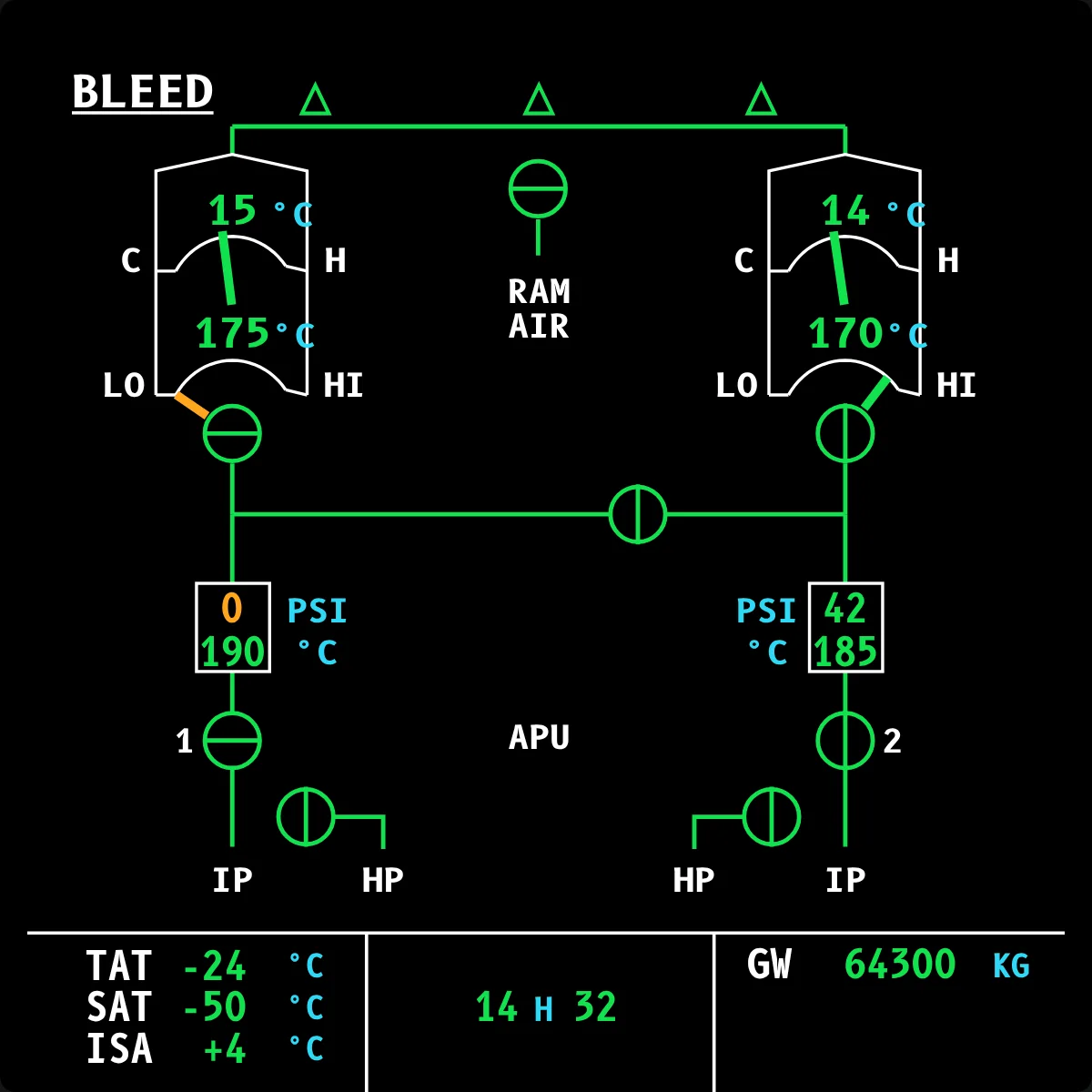
The same figures colour the BLEED page: the precooler inlet pressure turns amber on an overpressure the BMC detects, between 57 and 60 PSI, and the outlet temperature turns amber on the three overheat thresholds above.
If the bleed valve fails to close, the same caution comes up with the subtitle BLEED NOT CLOSED, and a procedure of its own.
Sources FCOM PRO-ABN-AIR AIR ENG 1(2) BLEED FAULT / FCOM PRO-ABN-AIR AIR / FCOM DSC-36-10-20 PRESSURE REGULATION AND LIMITATION / FCOM DSC-36-10-20 TEMPERATURE REGULATION AND LIMITATION / FCOM DSC-36-20 ECAM BLEED PAGE / FCOM PRO-ABN-AIR BLEED NOT CLOSED
From a hot or overpressurised bleed to the caution
What does the crew see and hear?
A level 2 caution: a single chime, the MASTER CAUT light steady amber and the caution in amber on the E/WD, and the SD normally calls up the relevant system page by itself, here the BLEED page.
On the AIR COND panel, FAULT comes on in amber in the ENG 1 BLEED pushbutton: the light covers an overpressure downstream of the bleed valve and a bleed air overheat, among other cases. On the BLEED page, engine 1's bleed valve shows closed.
Sources FCOM DSC-31-10 WARNING/CAUTION CLASSIFICATION / FCOM DSC-31-30 ATTENTION GETTERS / FCOM DSC-31-20 SYSTEM PAGES / FCOM DSC-36-20 OVERHEAD PANEL / FCOM DSC-36-20 ECAM BLEED PAGE
The moment the caution comes on
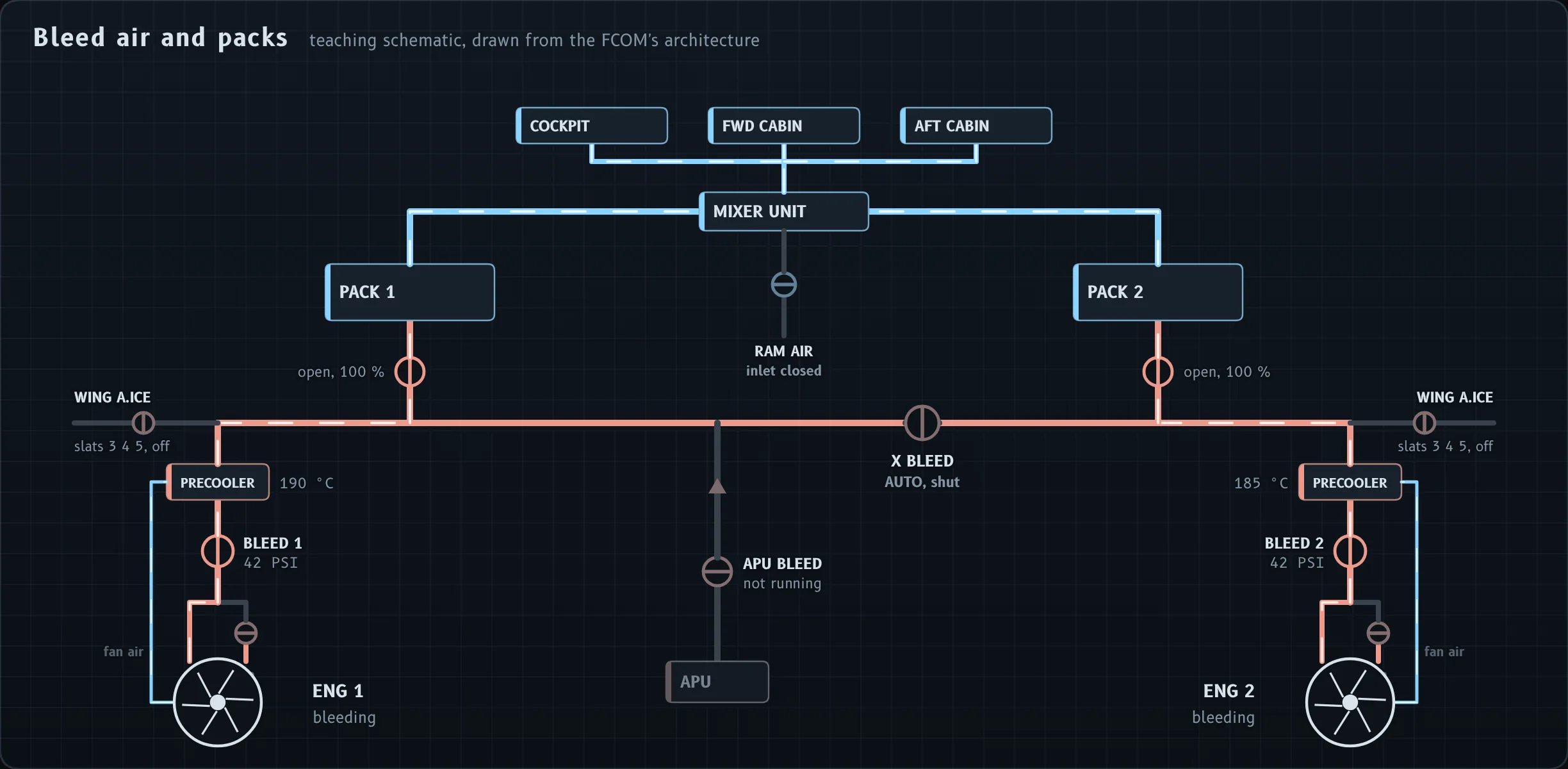
The cruise, both engine bleeds on, X BLEED at AUTO, the APU off and the wing anti-ice off. Press the button to overheat engine 1's bleed, then look at the E/WD, the BLEED page, the AIR COND panel and the schematic.
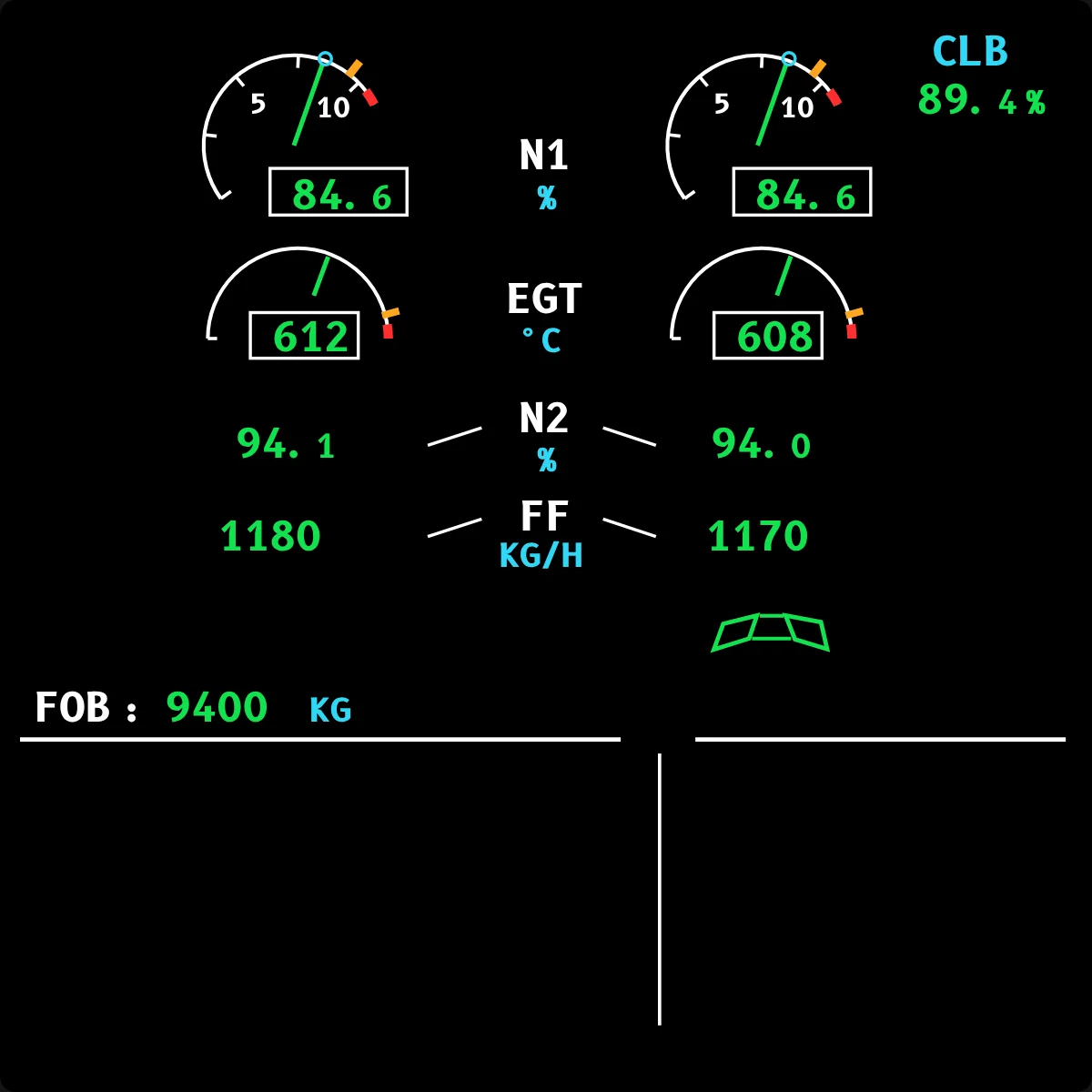
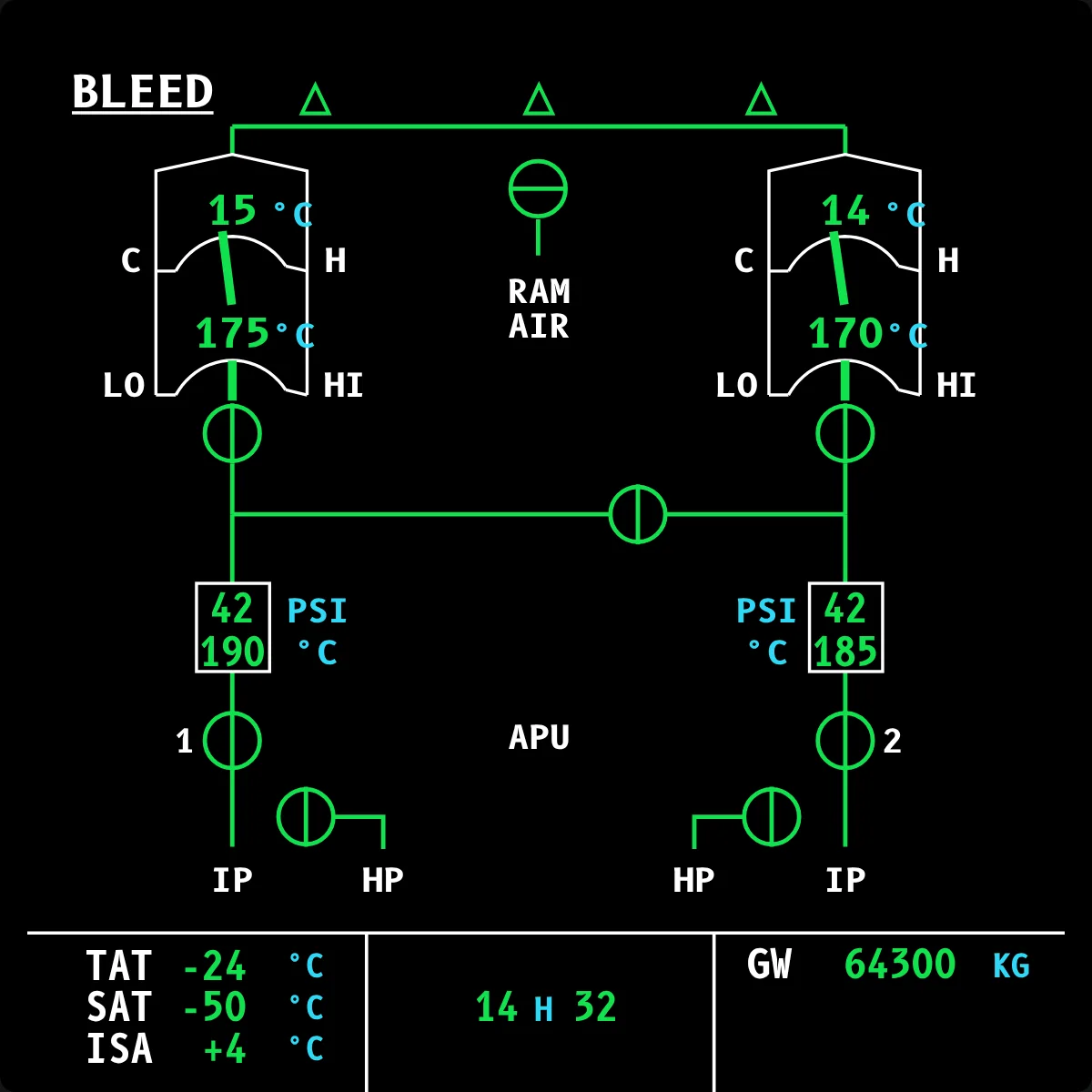
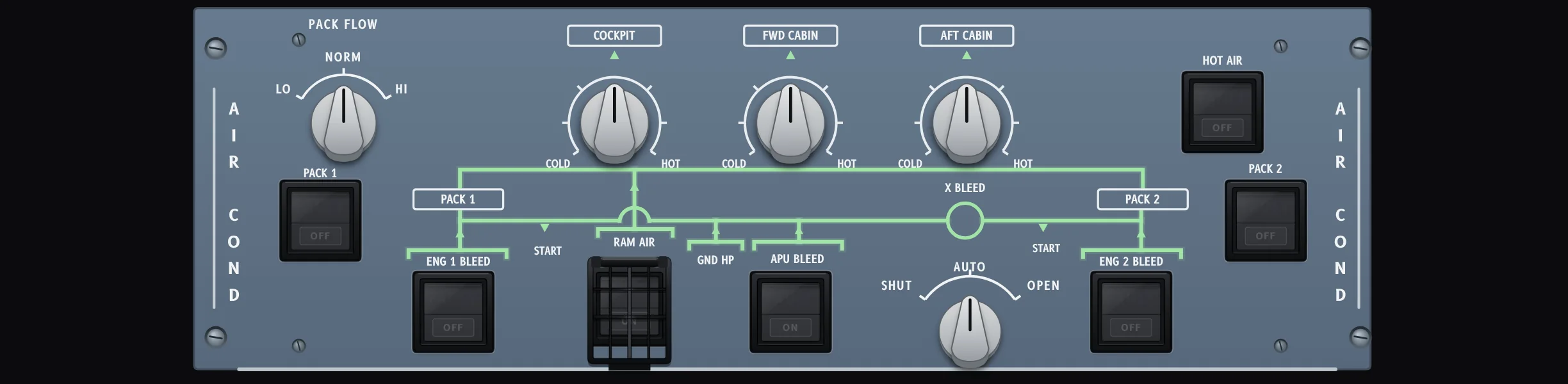
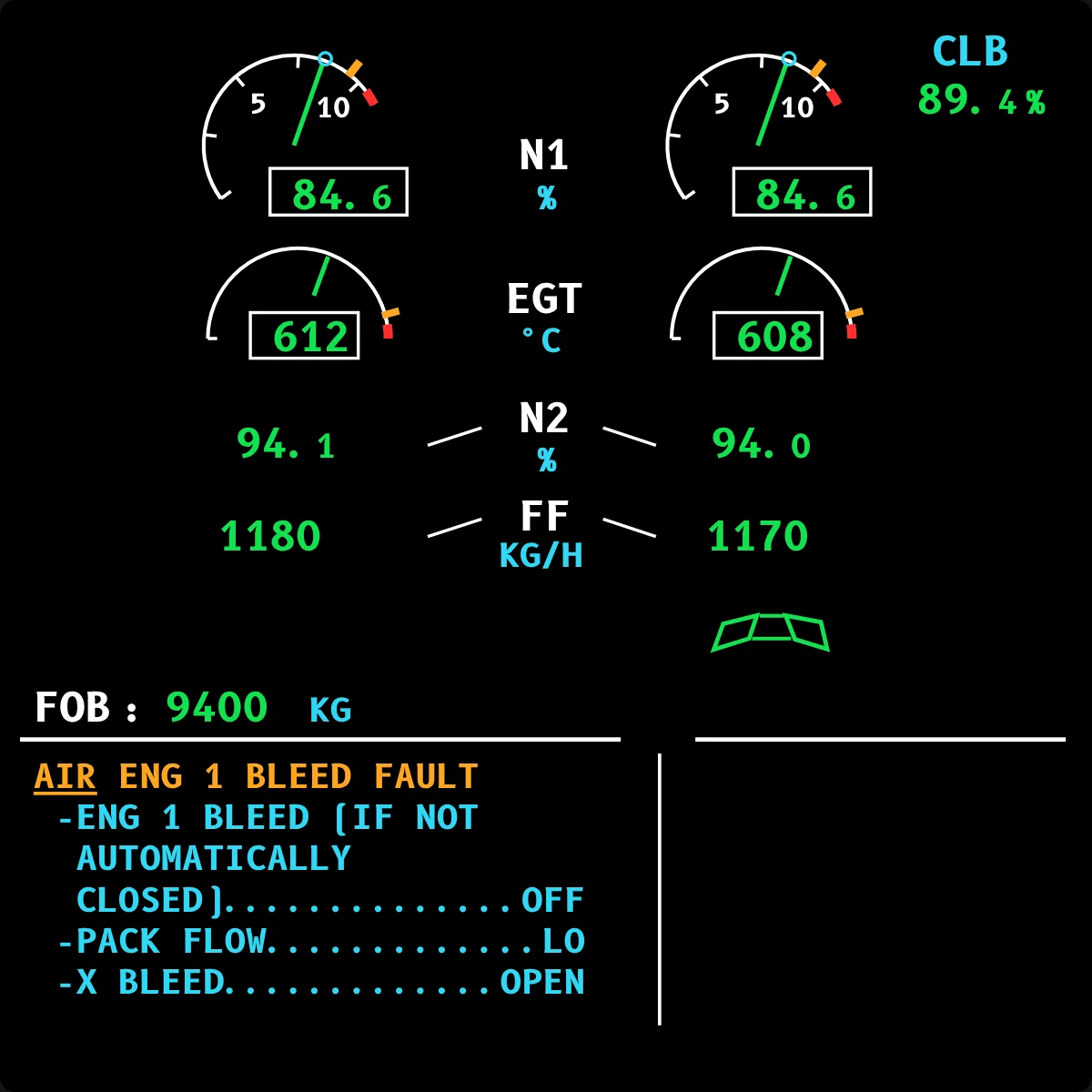
The alert Overheat engine 1's bleed
The E/WD shows the caution in amber with its lines: ENG 1 BLEED (IF NOT AUTOMATICALLY CLOSED) OFF, PACK FLOW LO and X BLEED OPEN. FAULT lights in ENG 1 BLEED. Engine 1's bleed valve is closed, and with no air upstream pack 1's flow control valve is closed too.
Here the valve closes and the light comes on at once; on the aircraft the caution waits for the temperatures and times above. Pack 2, now alone, runs at high flow: in single pack operation HI is selected automatically. Working the lines is what the ECAM Trainer does with you.
Sources FCOM PRO-ABN-AIR AIR / FCOM DSC-36-20 OVERHEAD PANEL / FCOM DSC-21-10-50 CONTROLS ON OVERHEAD PANEL / FCOM PRO-ABN-AIR AIR ENG 1(2) BLEED FAULT
What does opening the crossbleed change?
The crossbleed valve sits on the duct between the two engines' air supplies, and isolates or interconnects them. At AUTO it is open only while the APU bleed valve is open, so in the cruise with the APU bleed off it stays closed: the left side has no source once engine 1's valve shuts.
OPEN opens it whatever the APU bleed does, and engine 2's air, through its own bleed valve and precooler, reaches the left side, where pack 1 can take it. The FCTM has the PM check the SD page after an overhead selection, and gives the closure of the crossbleed valve as its example.
Sources FCOM DSC-36-10-40 GENERAL / FCOM DSC-36-20 OVERHEAD PANEL / FCOM DSC-36-10-20 TEMPERATURE REGULATION AND LIMITATION / FCOM PRO-ABN-AIR AIR / FCTM AOP-30-20 HANDLING OVERHEAD PANEL CONTROL
Open the crossbleed, then set the pack flow
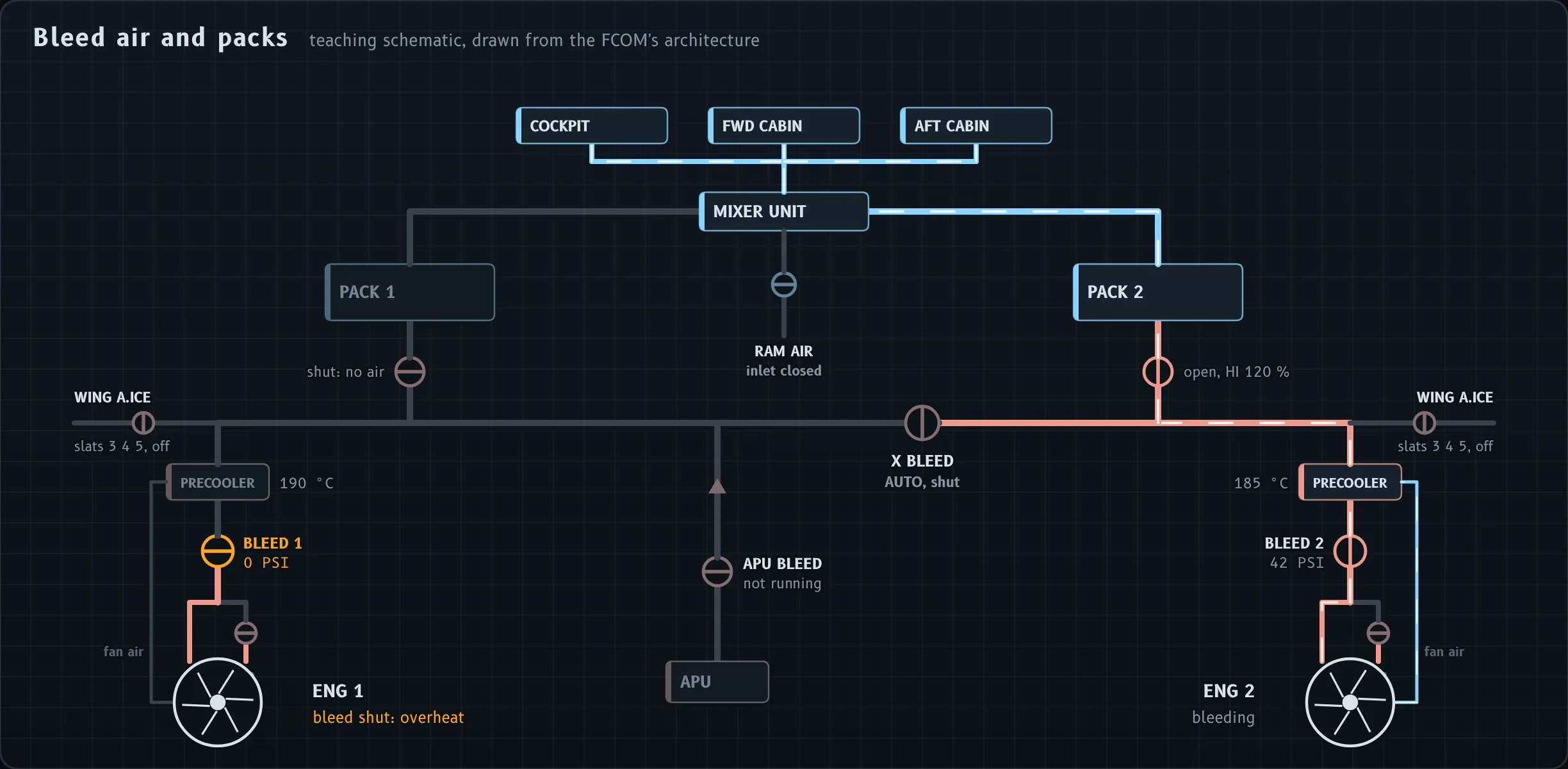
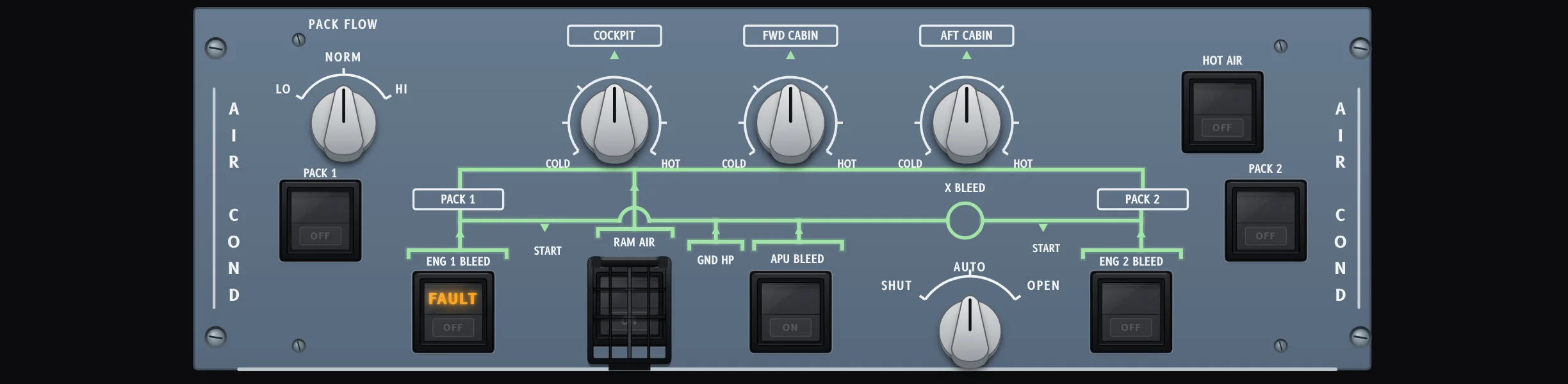
Engine 1's bleed valve has closed on the overheat and pack 1 has no air; pack 2, alone, runs at high flow. Predict first, then press, and watch the schematic and the BLEED page.
-
Predict Engine 1's bleed valve stays shut. Turn X BLEED to OPEN: where does pack 1's air come from?
Try it Turn X BLEED to OPEN.
The crossbleed valve opens and the two sides are interconnected: engine 2 now supplies both packs. Pack 1's flow control valve opens again, and pack 2 is no longer alone, so it leaves its automatic high flow.
Sources FCOM DSC-36-10-40 GENERAL / FCOM DSC-36-20 OVERHEAD PANEL / FCOM DSC-21-10-50 CONTROLS ON OVERHEAD PANEL
-
Predict Both packs now take their air from engine 2. What does PACK FLOW at LO do?
Try it Set PACK FLOW to LO.
LO is 80 % of the normal flow. The automatic HI applies to single pack operation and to the APU bleed, and here both packs run. The FCOM gives the reason for LO in this procedure as the precooler's performance, and if LO cannot meet the cooling demand the flow can go up to 100 % by itself.
Sources FCOM DSC-21-10-50 CONTROLS ON OVERHEAD PANEL / FCOM PRO-ABN-AIR AIR
Why switch the bleed off if the BMC has already shut it?
In two versions of the procedure the first line is ENG BLEED (AFFECTED, IF NOT AUTOMATICALLY CLOSED) OFF, for the case where the BMC has not closed the valve. In the third it reads ENG BLEED (AFFECTED) OFF, with no condition, so the pushbutton goes OFF whether or not the valve has closed.
The FCOM's note on the pushbutton gives what that changes for the crew: while ENG BLEED is ON, the FAULT light remains on; once it is OFF, the light goes off when the overheat or overpressure disappears.
OFF closes the bleed valve and the HP valve, and on the A320neo and A321neo the fan air valve too; the white OFF light comes on.
The pack lines depend on the wing anti-ice in one version: with it off and both packs on, PACK FLOW LO; with it on and both packs on, the affected pack off, since one pack must be closed "because of precooler performance". The other two versions set the affected pack off in every case, and list AFT CRG HOT AIR OFF where fitted.
With BLEED NOT CLOSED the logic turns round: the crossbleed goes to SHUT instead of OPEN, the affected pack goes off, the wing anti-ice goes off with AVOID ICING CONDITIONS, and with engine 1 affected, the APU bleed goes off too.
Sources FCOM PRO-ABN-AIR AIR / FCOM PRO-ABN-AIR ABNORMAL AND EMERGENCY PROCEDURES / FCOM DSC-36-20 OVERHEAD PANEL
What is lost, and what is left?
Engine 1's bleed is lost. With the crossbleed open, engine 2's air reaches the left side as well; whether pack 1 runs on it depends on the version of the procedure. The STATUS of this caution does not list the wing anti-ice as inoperative.
What STATUS keeps depends on the version. One reads ONE PACK ONLY IF WAI ON in green, lists ENG 1 BLEED as inoperative, and lists PACK 1 only if it is closed. Another lists ENG 1 BLEED and PACK 1, with no line on the left.
Sources FCOM DSC-36-10-40 GENERAL / FCOM PRO-ABN-AIR AIR / FCOM PRO-ABN-AIR ABNORMAL AND EMERGENCY PROCEDURES / FCOM DSC-31-20 STATUS PAGE
Engine 2 for both sides
What is lost afterwards?
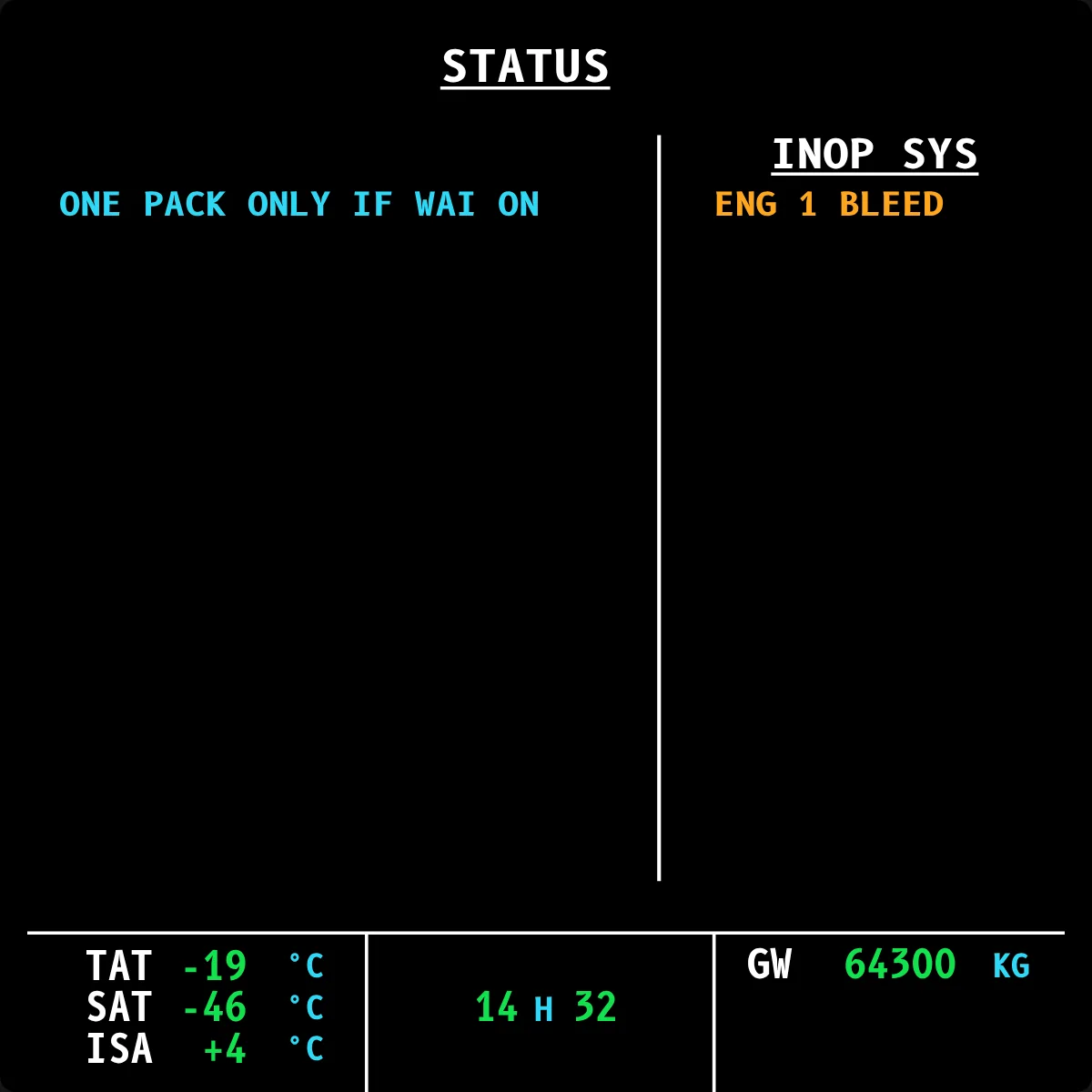
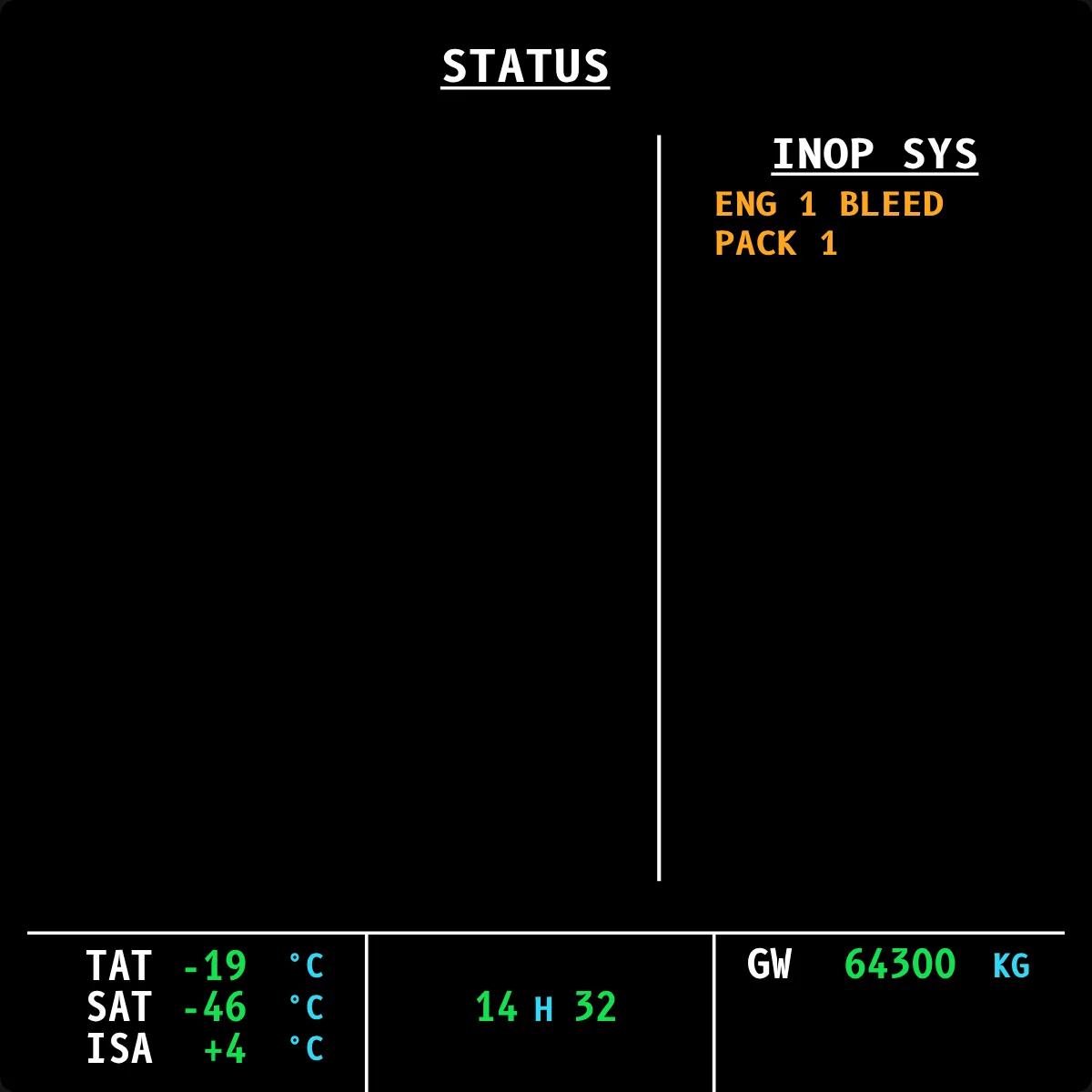
STATUS is the aircraft's operational summary. The first picture is one version: ONE PACK ONLY IF WAI ON, and ENG 1 BLEED under INOP SYS. Its PACK 1 line applies only if pack 1 is closed, and here the crossbleed has given it air.
The second is another version: no line on the left, and ENG 1 BLEED and PACK 1 under INOP SYS. The FCOM prints ONE PACK ONLY IF WAI ON in green, the colour of information; the first picture draws it in blue, as a limitation.
Which version applies depends on your aircraft: check your own FCOM.
Sources FCOM DSC-31-20 STATUS PAGE / FCOM PRO-ABN-AIR ABNORMAL AND EMERGENCY PROCEDURES
A319ceo, A320ceo, A320neo, A321neo: what differs?
| A319ceo, A320ceo | A320neo, A321neo | |
|---|---|---|
| Triggering conditions | Not given by type: one version gives the pressure and temperature cases, another adds both bleed temperature sensors lost | Not given by type: the same two versions, each for a list of aircraft |
| The procedure | Not given by type: three versions; one with PACK FLOW LO or the pack off by wing anti-ice, two with the pack off and AFT CRG HOT AIR where fitted | Not given by type: the same three versions; of the two with the pack off, one keeps IF NOT AUTOMATICALLY CLOSED on the bleed line |
| STATUS | Not given by type: one version with ONE PACK ONLY IF WAI ON and PACK 1 if closed | Not given by type: another with PACK 1 inoperative and no line on the left |
| Regulated bleed pressure | A319ceo and A320ceo: 45 ± 5 PSI | A320neo and A321neo: 42 ± 3 PSI with both bleeds, 50 ± 3 PSI with one |
| Other FAULT light cases | Some A320ceo add a dual bleed temperature sensor failure | Sensor failures, an HP valve failed open on the ground and, on LEAP-1A engines, a fan duct burst |
The FCOM prints the triggering conditions twice, the procedure three times and the STATUS twice, each version for its own aircraft. The ECAM Trainer draws the PACK FLOW LO version in one of its two drawings and the pack off version without the cargo line in the other.
Sources FCOM PRO-ABN-AIR AIR ENG 1(2) BLEED FAULT / FCOM PRO-ABN-AIR AIR / FCOM PRO-ABN-AIR ABNORMAL AND EMERGENCY PROCEDURES / FCOM DSC-36-10-20 PRESSURE REGULATION AND LIMITATION / FCOM DSC-36-20 OVERHEAD PANEL

Work AIR ENG 1 BLEED FAULT as a crew
Read and do each line against the FCOM, with the E/WD, the SD page and the overhead following your hands, the PF and PM calls, and a debrief that says what you missed.
Work this failure in the ECAM TrainerGo further
Written in our own words from the FCOM and the FCTM; each part names the units it rests on. The E/WD, the STATUS and the live aircraft are the platform's own ECAM and systems model, the same the ECAM Trainer and the flight deck run. This page explains the procedure; it is not the procedure. Aircraft differ by type, engine and options: your aircraft's FCOM, your QRH and your operator's procedures always come first. How we write and check these pages.
Every ECAM procedure, line by line, against the FCOM.
The ECAM Trainer works 108 scenarios with the E/WD, the SD page and the overhead following your hands. Start free today, or open everything with A320 Knowledge+.
For study and revision only. Always follow your operator's approved documentation and procedures. A320 Knowledge is independent and not affiliated with Airbus.
Related
- AIR BLEED LEAKA red warning with one line.
- AIR PACK 1+2 FAULTAn amber caution that takes both packs.
- AIR PACK 1 FAULTAn amber caution with one line.
- AIR PACK 1 OVHTAn amber caution with a line that waits.
- A320 pneumatics and bleed airThe system guide, with the live aircraft
- Every ECAM procedureThe alerts the ECAM Trainer works, grouped by system