
AIR X BLEED FAULT
An amber caution with a one-line procedure and a condition that matters in icing. Here is what sets it off, what manual control means, what a crossbleed valve stuck open does to the two sides, and what STATUS keeps, with the live aircraft at the moment the caution comes on.
Written and checked by current A320 pilotschecked against the FCOM on Our editorial policy
What AIR X BLEED FAULT means
AIR X BLEED FAULT is an amber caution: the crossbleed valve is not where the X BLEED selector puts it. The valve isolates or interconnects the two engines' air supply systems, and at AUTO it follows the APU bleed valve and closes on a wing, pylon or APU leak, except during an engine start.
The procedure hands the valve to the crew: X BLEED MAN CTL, OPEN only with the APU bleed on, for an engine start, or with the wing anti-ice on and one bleed inoperative, and SHUT in other cases. If manual opening does not work and only one bleed is available, the wing anti-ice goes off and the crew avoids icing conditions.
Sources FCOM PRO-ABN-AIR AIR X BLEED FAULT / FCOM DSC-36-10-40 GENERAL / FCOM DSC-36-20 OVERHEAD PANEL / FCOM PRO-ABN-AIR AIR
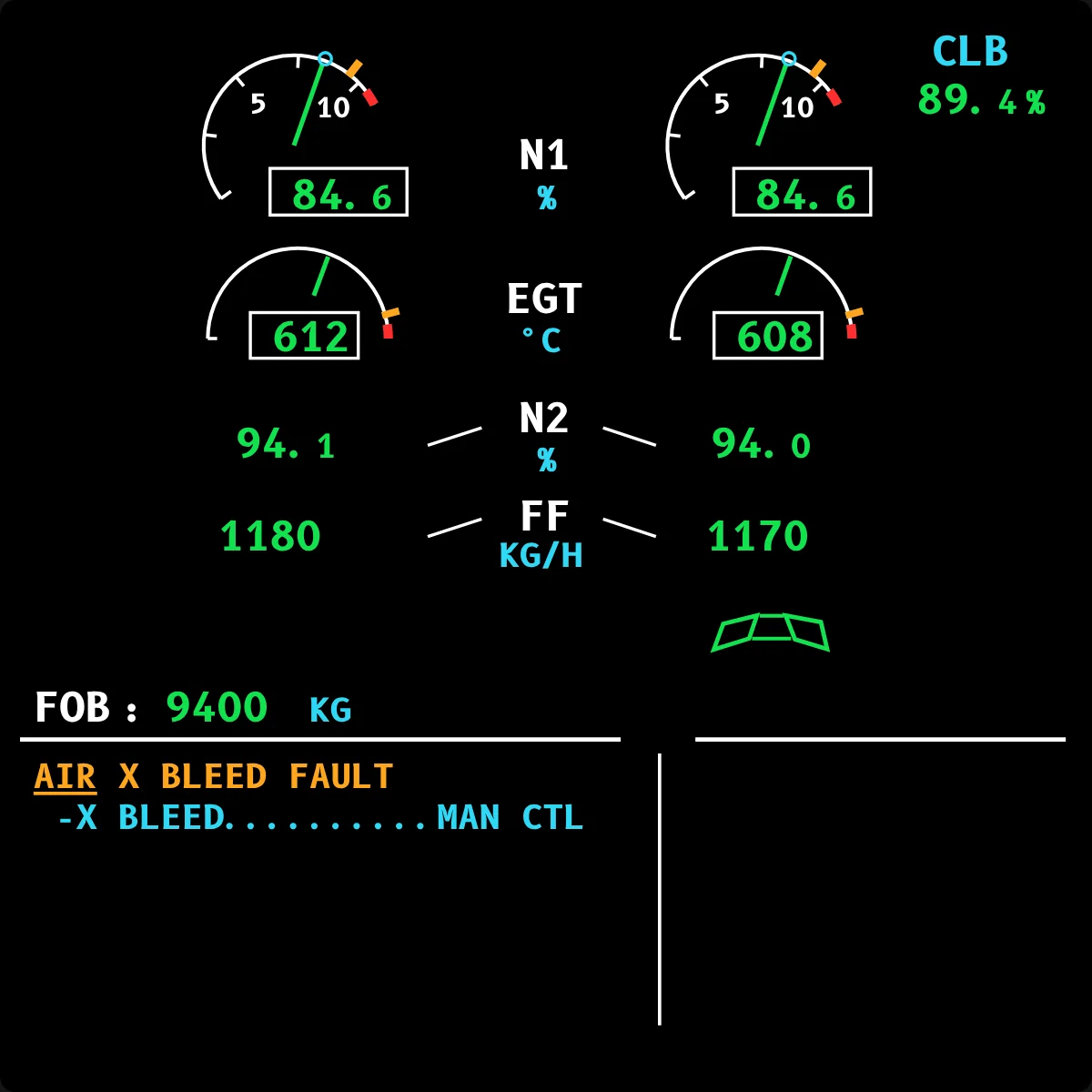
At a glance
- Level
- Amber caution, level 2: single chime, MASTER CAUT steady amber and the BLEED page on the SD
- Sets it off
- The crossbleed valve's position disagrees with the X BLEED selector's position
- The valve
- One valve on the crossbleed duct, moved electrically by two motors, one for automatic mode and one for manual mode
- Procedure
- X BLEED MAN CTL: OPEN with the APU bleed on, for an engine start, or with the wing anti-ice on and one bleed inoperative; SHUT otherwise
- If it cannot open
- With manual opening inoperative and only one bleed available: wing anti-ice off and AVOID ICING CONDITIONS
- STATUS
- X BLEED inoperative, and X BLEED MAN CTL in green
Sources FCOM DSC-31-10 WARNING/CAUTION CLASSIFICATION / FCOM DSC-31-30 ATTENTION GETTERS / FCOM DSC-31-20 SYSTEM PAGES / FCOM PRO-ABN-AIR AIR X BLEED FAULT / FCOM DSC-36-10-40 GENERAL / FCOM PRO-ABN-AIR AIR / FCOM DSC-31-20 STATUS PAGE
What sets the caution off?
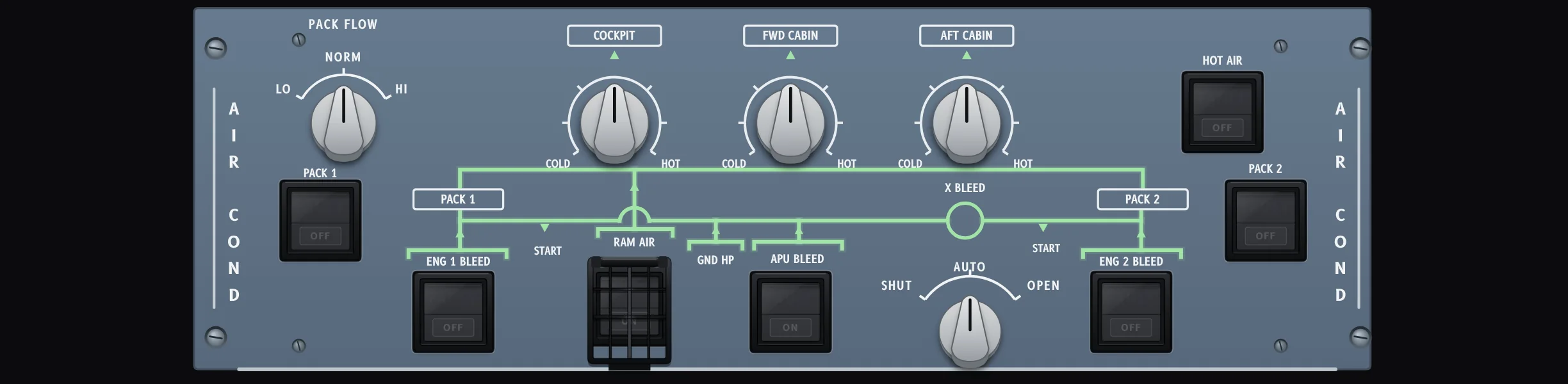
One crossbleed valve sits on the crossbleed duct between the two engines' air supply systems. The X BLEED rotary selector on the AIR COND panel controls it electrically, through two electric motors: one for automatic mode, one for manual mode.
At AUTO the valve is open if the APU bleed valve is open, and closed if the APU bleed valve is closed or on a wing, pylon or APU leak, except during an engine start. OPEN opens it and SHUT closes it.
The caution comes on when the valve's position disagrees with the selector's. The FCOM's condition does not say which way: a valve open when it should be shut, or shut when it should be open, both disagree.
Sources FCOM DSC-36-10-40 GENERAL / FCOM DSC-36-20 OVERHEAD PANEL / FCOM PRO-ABN-AIR AIR X BLEED FAULT
Selector against valve
What does the crew see and hear?
A level 2 caution: a single chime, the MASTER CAUT light steady amber and the caution in amber on the E/WD, and the SD normally calls up the relevant system page by itself, here the BLEED page.
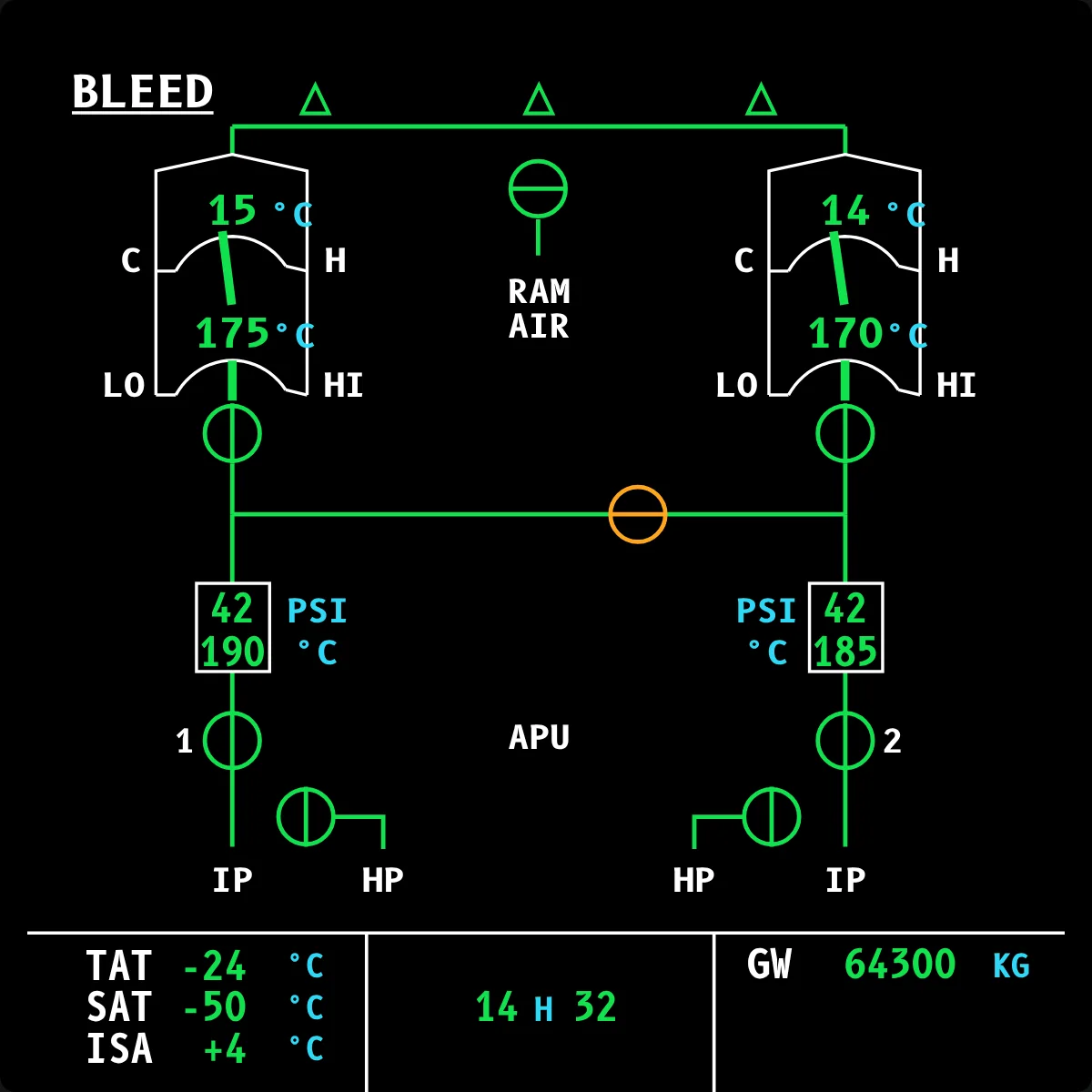
The FCOM describes no light on the X BLEED selector. The BLEED page is where the valve shows: it has its own symbols for a crossbleed valve not in its commanded closed position, not in its commanded open position, and in transit.
Sources FCOM DSC-31-10 WARNING/CAUTION CLASSIFICATION / FCOM DSC-31-30 ATTENTION GETTERS / FCOM DSC-31-20 SYSTEM PAGES / FCOM DSC-36-20 OVERHEAD PANEL / FCOM DSC-36-20 ECAM BLEED PAGE
The moment the caution comes on
The cruise, both engine bleeds on, the APU bleed off and X BLEED at AUTO, so the crossbleed valve is closed. Press the button to fail the valve open, then look at the E/WD, the BLEED page, the panel and the schematic.
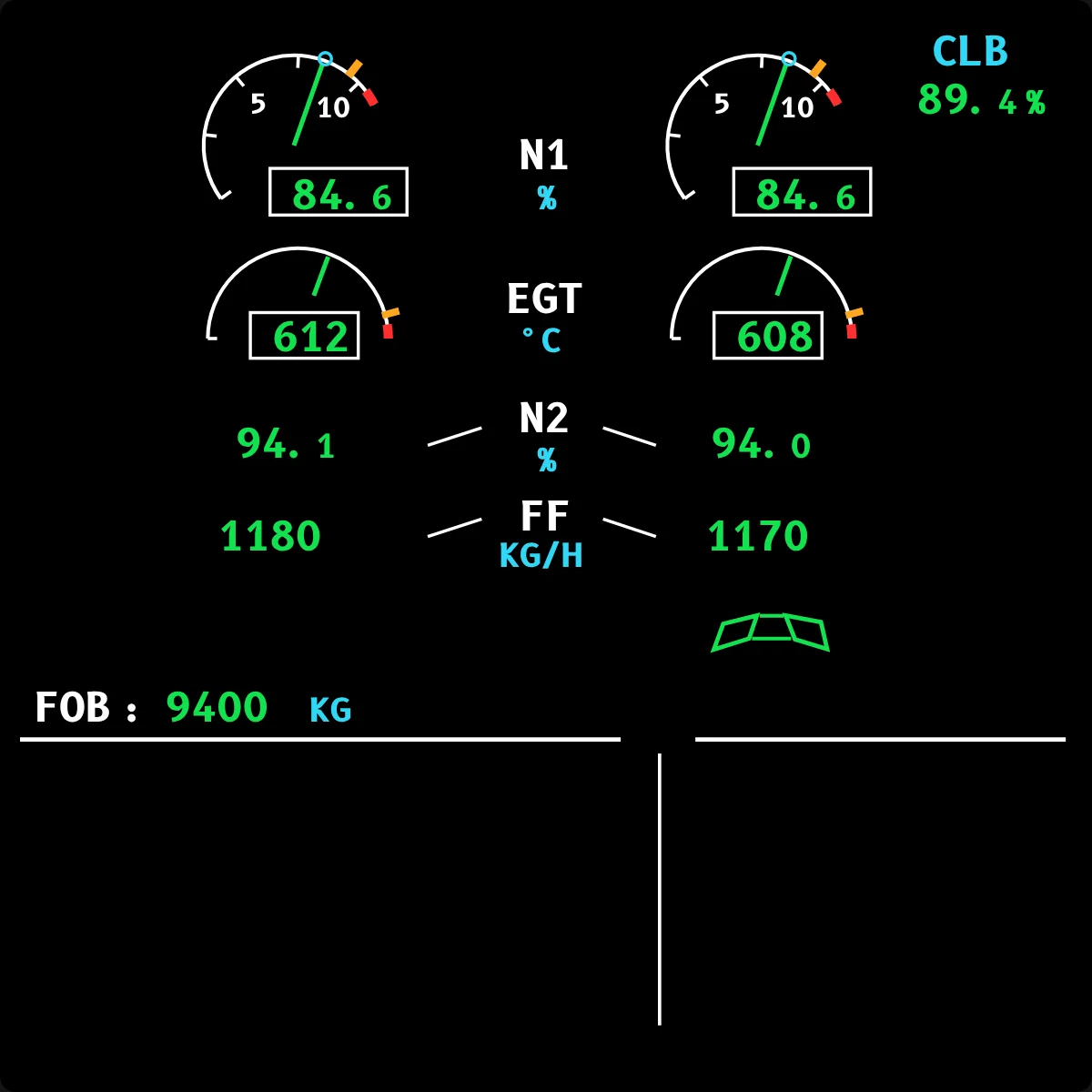
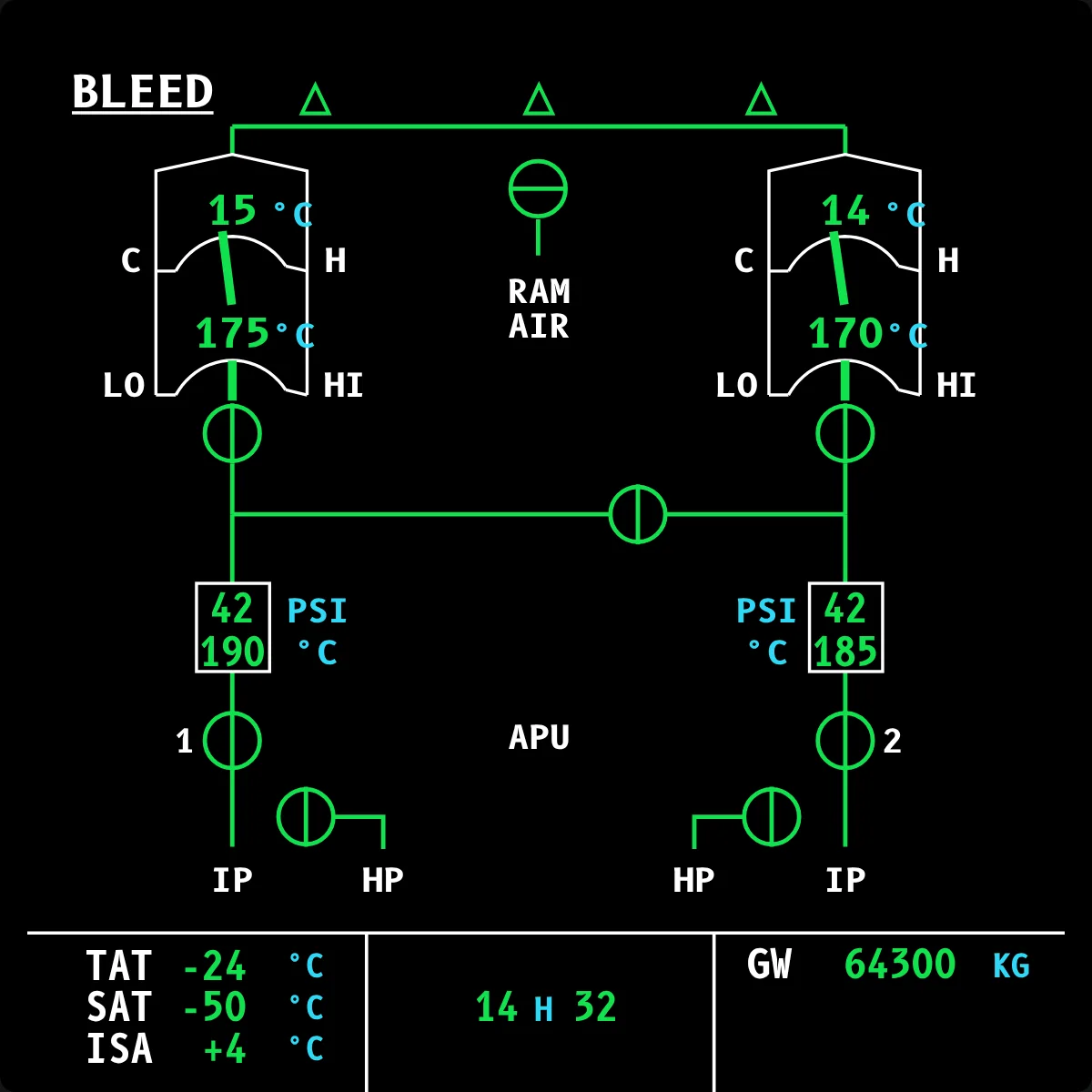
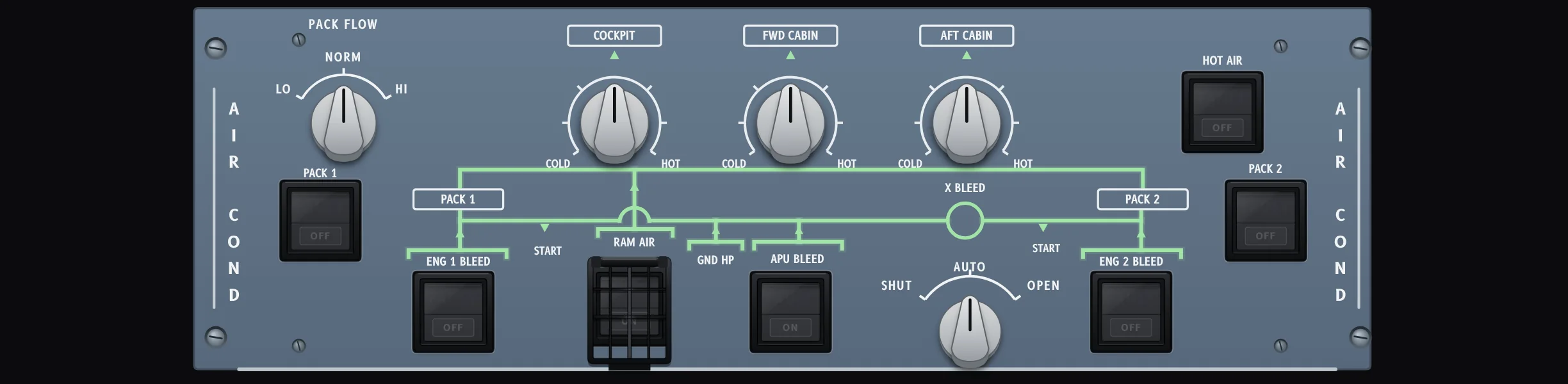
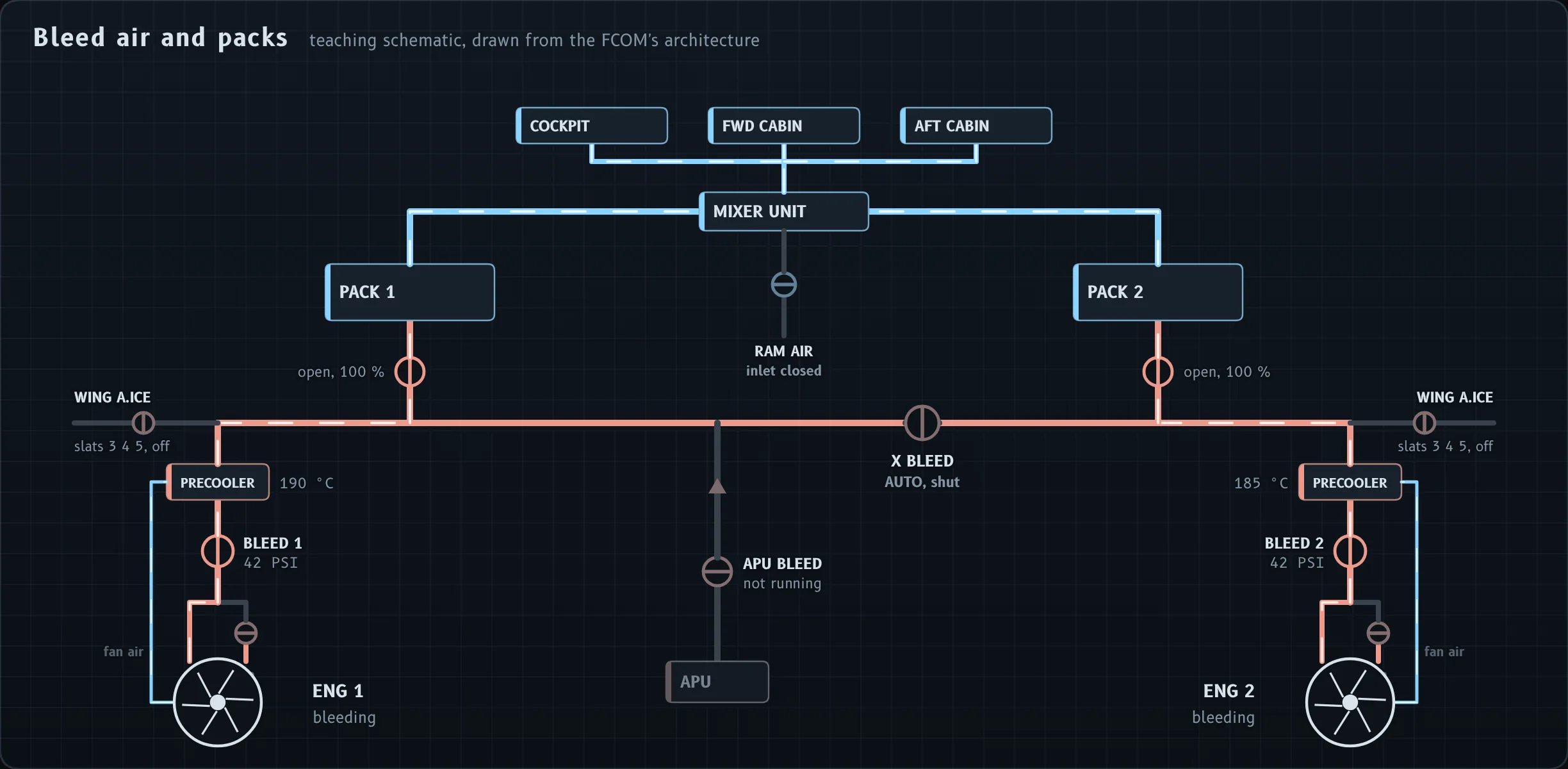
The alert Fail the crossbleed valve open
The E/WD shows the caution in amber with its one line, X BLEED MAN CTL. The selector is still at AUTO, which with the APU bleed off commands the valve closed, and the BLEED page shows it open: the disagreement that set the caution off.
On the schematic the two sides are now joined: both engines feed one duct. Working the line is what the ECAM Trainer does with you.
Sources FCOM PRO-ABN-AIR AIR X BLEED FAULT / FCOM PRO-ABN-AIR AIR / FCOM DSC-36-20 OVERHEAD PANEL / FCOM DSC-36-20 ECAM BLEED PAGE / FCOM DSC-36-10-40 GENERAL
What does X BLEED MAN CTL ask of the crew?
To take the valve by hand with the selector, choosing OPEN or SHUT. The FCOM's guidance under the line: OPEN when the APU BLEED pushbutton is ON, for an engine start, or when the WING ANTI-ICE pushbutton is ON with one bleed inoperative; SHUT in other cases. In the cruise with both engine bleeds working, the APU bleed off and the wing anti-ice off, that is SHUT.
Two of the OPEN cases match what the crossbleed does elsewhere: at AUTO it opens with the APU bleed, and after the loss of one engine bleed the ENG BLEED FAULT procedure opens it, which lets the other engine supply both sides.
Sources FCOM PRO-ABN-AIR AIR / FCOM DSC-36-20 OVERHEAD PANEL / FCOM DSC-36-10-40 GENERAL
Select SHUT, then lose a bleed
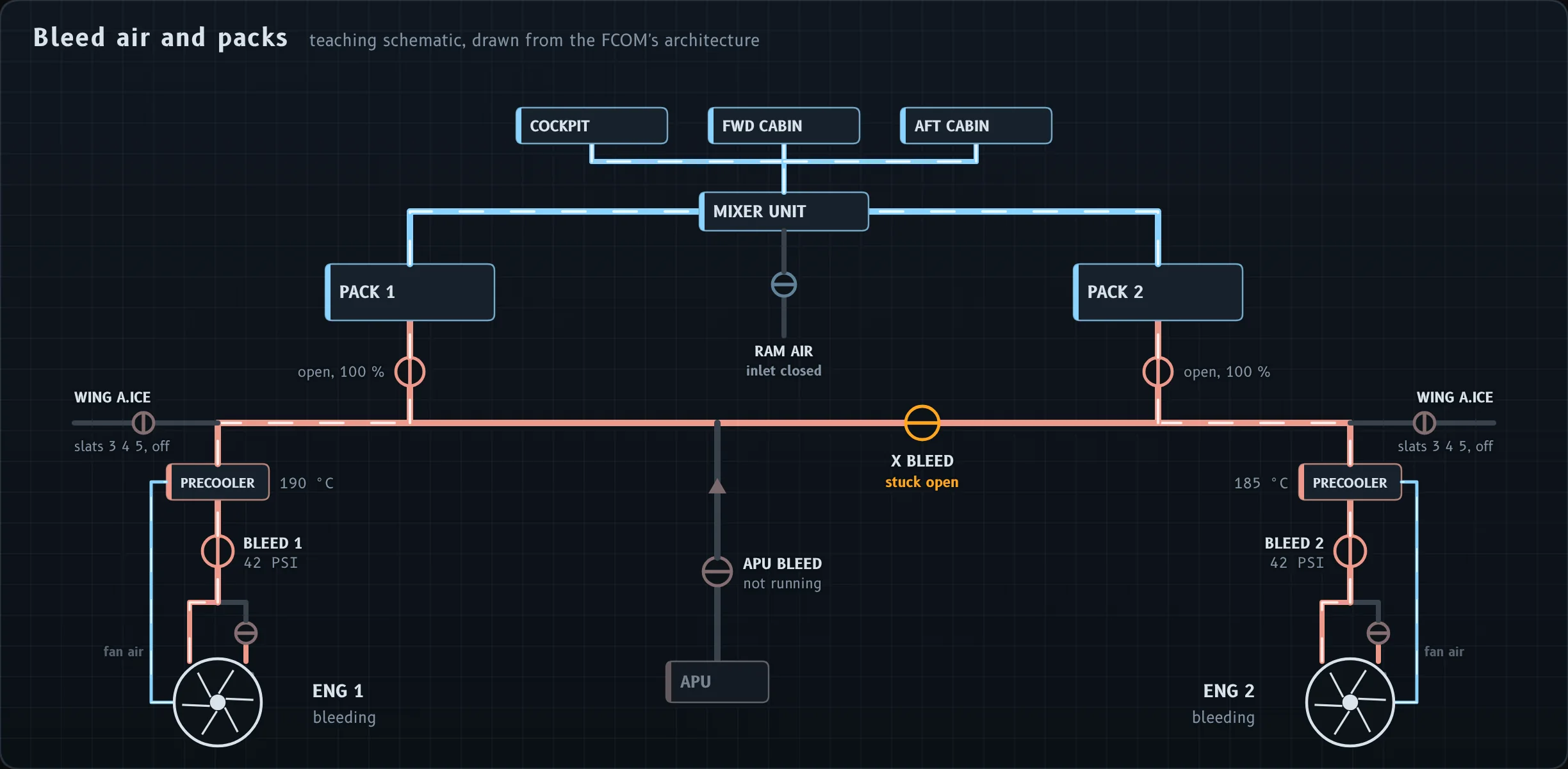
The crossbleed valve has failed open in the cruise, X BLEED still at AUTO. Predict first, then press, and watch the valve on the schematic and the BLEED page.
-
Predict In this drawing the valve is jammed open. Turn X BLEED to SHUT: what does the valve do?
Try it Turn X BLEED to SHUT.
The selector is at SHUT, the selection the guidance gives for the cruise, and the drawn valve stays open, so the disagreement remains. The FCOM gives the valve a separate motor for manual mode, but does not say whether manual control moves a valve that has disagreed; its procedure allows for both, with a condition for manual opening inoperative.
Sources FCOM PRO-ABN-AIR AIR / FCOM DSC-36-10-40 GENERAL
-
Predict With the valve stuck open, switch ENG 1 BLEED off. Does pack 1 keep its air?
Try it Switch ENG 1 BLEED off.
Engine 1's bleed valve closes, and pack 1 carries on with engine 2's air: an open crossbleed valve interconnects the two engines' air supply systems.
Sources FCOM DSC-36-20 OVERHEAD PANEL / FCOM DSC-36-10-40 GENERAL
When does it end in avoiding icing conditions?
The procedure's one condition is "If manual opening inoperative, and only one bleed available": WING ANTI ICE OFF, then AVOID ICING CONDITIONS. The guidance above asks for OPEN with the wing anti-ice on and one bleed inoperative; this condition covers a valve that cannot be opened by hand while only one bleed is available.
The wing anti-ice heats the three outboard slats of each wing with hot air from the pneumatic system, through one valve in each wing. The FCOM's drawing puts each wing on its own engine's side of the crossbleed valve. The procedure itself gives no reason for its line.
Under the same condition, STATUS adds AVOID ICING CONDITIONS; if severe ice accretion builds up, a minimum speed of VLS +10 or green dot and MANEUVER WITH CARE; and the landing distance procedure, printed outside the severe ice lines.
Sources FCOM PRO-ABN-AIR AIR / FCOM DSC-30-20-10 DESCRIPTION / FCOM DSC-36-10-20 ARCHITECTURE
What does manual control give up?
The automatic logic. At AUTO the crossbleed valve closes by itself on a wing, pylon or APU leak, except during an engine start. For OPEN and SHUT the FCOM gives no such closure: at OPEN the valve is open, at SHUT it is closed.
The FCOM prints a red AIR BLEED LEAK warning, for some aircraft, that triggers when a leak is detected in a bleed duct with the X BLEED selector at OPEN.
STATUS lists X BLEED as inoperative and ends with X BLEED MAN CTL in green, the colour of information. When manual opening is inoperative with one bleed, the icing lines above come first.
Sources FCOM DSC-36-20 OVERHEAD PANEL / FCOM PRO-ABN-AIR AIR BLEED LEAK / FCOM PRO-ABN-AIR AIR / FCOM DSC-31-20 STATUS PAGE
What is lost afterwards?
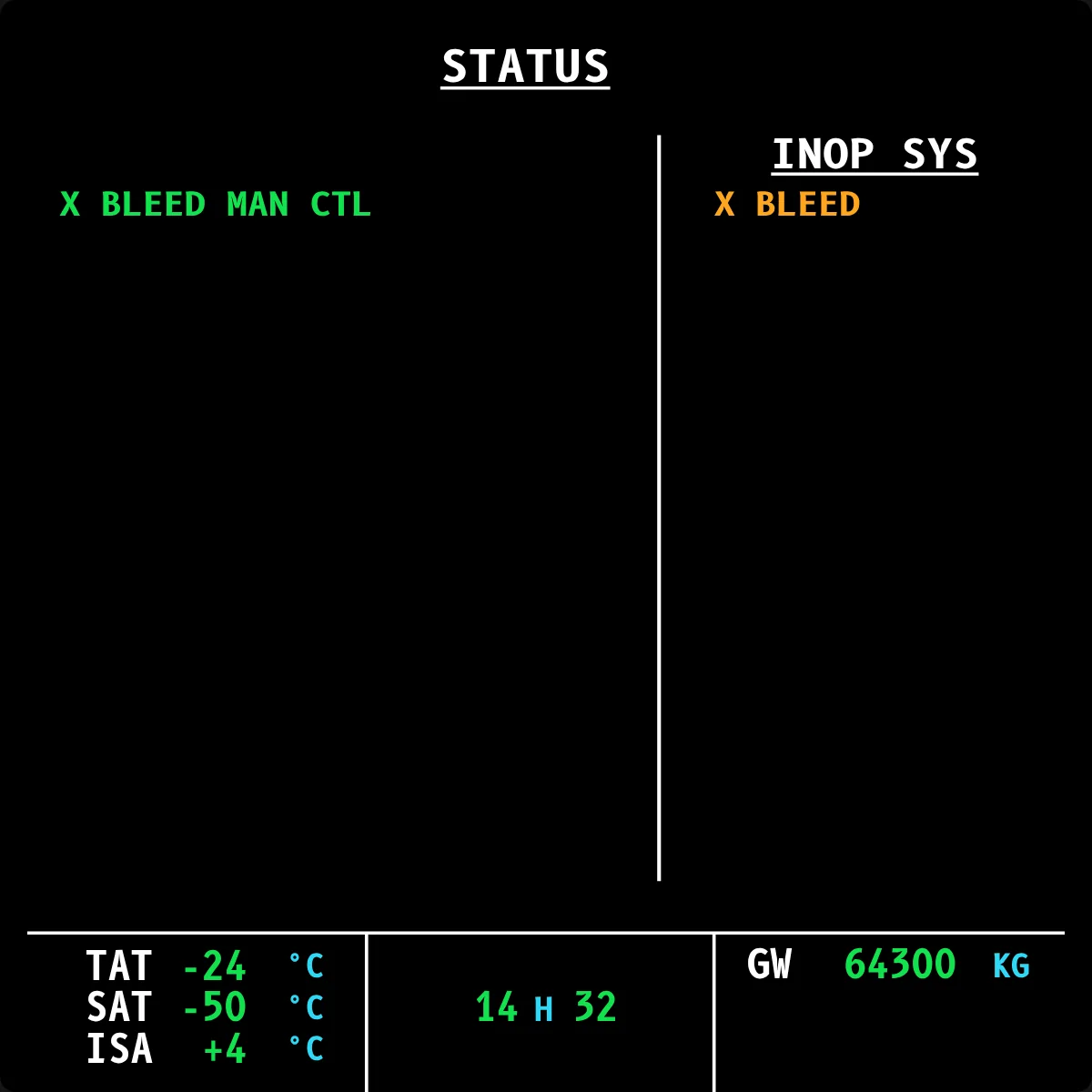
STATUS is the aircraft's operational summary. With both bleeds available, as here, it shows X BLEED MAN CTL in green and X BLEED under INOP SYS. The FCOM prints one STATUS for this caution, and the picture shows it.
The FCOM also prints WING A.ICE under INOP SYS, beside the manual opening inoperative condition but with no condition of its own. The picture leaves it out, as part of that condition; the FCOM's layout does not settle it.
Sources FCOM DSC-31-20 STATUS PAGE / FCOM PRO-ABN-AIR AIR
A319ceo, A320ceo, A320neo, A321neo: what differs?
| A319ceo, A320ceo | A320neo, A321neo | |
|---|---|---|
| The caution, its procedure and STATUS | The same in every version | The same in every version |
| The crossbleed valve and its selector | One valve, two motors; AUTO, OPEN and SHUT | The same valve, motors and positions |
| Engine bleed valve opening | A319ceo and A320ceo: upstream pressure above 8 PSI | A320neo and A321neo: above 15 PSI, and a bleed consumer on that side, or on the other with the crossbleed valve open |
On the A320neo and A321neo an engine bleed valve opens only with a pack or the wing anti-ice on, on the same side or on the other side through an open crossbleed valve; some A320ceo have the same condition.
Sources FCOM PRO-ABN-AIR AIR X BLEED FAULT / FCOM PRO-ABN-AIR AIR / FCOM DSC-36-10-40 GENERAL / FCOM DSC-36-20 OVERHEAD PANEL

Work AIR X BLEED FAULT as a crew
Read and do each line against the FCOM, with the E/WD, the SD page and the overhead following your hands, the PF and PM calls, and a debrief that says what you missed.
Work this failure in the ECAM TrainerGo further
Written in our own words from the FCOM and the FCTM; each part names the units it rests on. The E/WD, the STATUS and the live aircraft are the platform's own ECAM and systems model, the same the ECAM Trainer and the flight deck run. This page explains the procedure; it is not the procedure. Aircraft differ by type, engine and options: your aircraft's FCOM, your QRH and your operator's procedures always come first. How we write and check these pages.
Every ECAM procedure, line by line, against the FCOM.
The ECAM Trainer works 108 scenarios with the E/WD, the SD page and the overhead following your hands. Start free today, or open everything with A320 Knowledge+.
For study and revision only. Always follow your operator's approved documentation and procedures. A320 Knowledge is independent and not affiliated with Airbus.
Related
- AIR BLEED LEAKA red warning with one line.
- AIR PACK 1+2 FAULTAn amber caution that takes both packs.
- AIR PACK 1 FAULTAn amber caution with one line.
- AIR PACK 1 OVHTAn amber caution with a line that waits.
- A320 pneumatics and bleed airThe system guide, with the live aircraft
- Every ECAM procedureThe alerts the ECAM Trainer works, grouped by system