
AIR BLEED LEAK
A red warning with one line. Here is what turns a bleed leak into this warning with the crossbleed selector at OPEN, what the leak detection closes by itself and what stays open, and what shutting the crossbleed costs, with the live aircraft at the moment the warning comes on.
Written and checked by current A320 pilotschecked against the FCOM on Our editorial policy
What AIR BLEED LEAK means
AIR BLEED LEAK is a red warning: a leak has been detected in a bleed duct while the X BLEED selector is at OPEN. For a wing or pylon leak, the leak detection closes that side's bleed valve by itself, but at OPEN the crossbleed valve is open and the two sides stay interconnected.
The procedure is one line, X BLEED SHUT. As the FCOM puts it, "Closing the crossbleed valve isolates the bleed leak." A wing, pylon or APU leak also has a caution of its own, with its own procedure.
Sources FCOM PRO-ABN-AIR AIR BLEED LEAK / FCOM DSC-36-10-50 LEAK DETECTION / FCOM DSC-36-20 OVERHEAD PANEL / FCOM DSC-36-10-40 GENERAL / FCOM PRO-ABN-AIR ABNORMAL AND EMERGENCY PROCEDURES / FCOM PRO-ABN-AIR AIR L(R) WING LEAK / FCOM PRO-ABN-AIR AIR ENG 1(2) BLEED LEAK / FCOM PRO-ABN-AIR AIR APU BLEED LEAK
At a glance
- Level
- Red warning, level 3: an aural warning, MASTER WARN flashing red and, normally, the BLEED page on the SD
- Sets it off
- A leak detected in a bleed duct while the X BLEED selector is set to OPEN
- At OPEN
- The crossbleed valve is open: the selector's description gives its closure on a leak for AUTO only
- Procedure
- One line, X BLEED SHUT: closing the crossbleed valve isolates the bleed leak
- Applicability
- The FCOM gives the warning's trigger to two lists of aircraft, not to all aircraft
Sources FCOM DSC-31-10 WARNING/CAUTION CLASSIFICATION / FCOM DSC-31-30 ATTENTION GETTERS / FCOM DSC-31-20 SYSTEM PAGES / FCOM PRO-ABN-AIR AIR BLEED LEAK / FCOM DSC-36-20 OVERHEAD PANEL / FCOM DSC-36-10-40 GENERAL / FCOM PRO-ABN-AIR ABNORMAL AND EMERGENCY PROCEDURES / FCOM PRO-ABN-AIR AIR
What sets the warning off?
Leak detection loops watch for overheating near the hot air ducts in the fuselage, the pylons and the wings. BMC 1 and BMC 2 each hold identical control logic for the system. A wing or pylon leak signal closes the bleed valve on that side and, except during an engine start, the crossbleed valve and, for a left wing or pylon 1 leak, an open APU bleed valve. An APU leak signal closes the APU bleed valve and the crossbleed valve, except during an engine start.
The crossbleed valve has two electric motors, one for the automatic mode and one for manual. The closure on a leak is part of the automatic mode: at AUTO the valve is closed in case of a wing, pylon or APU leak, except during an engine start, while at OPEN the FCOM says only that the valve is open.
AIR BLEED LEAK triggers on exactly that combination: a leak detected in a bleed duct and the X BLEED selector set to OPEN. The FCOM prints its trigger twice, each for a list of aircraft, with slightly different flight phase inhibitions; the copy does not give it to all aircraft.
Sources FCOM DSC-36-10-50 LEAK DETECTION / FCOM DSC-36-10-30 GENERAL / FCOM DSC-36-10-40 GENERAL / FCOM DSC-36-20 OVERHEAD PANEL / FCOM PRO-ABN-AIR AIR BLEED LEAK / FCOM PRO-ABN-AIR AIR
A leak with the crossbleed open
What does the crew see and hear?
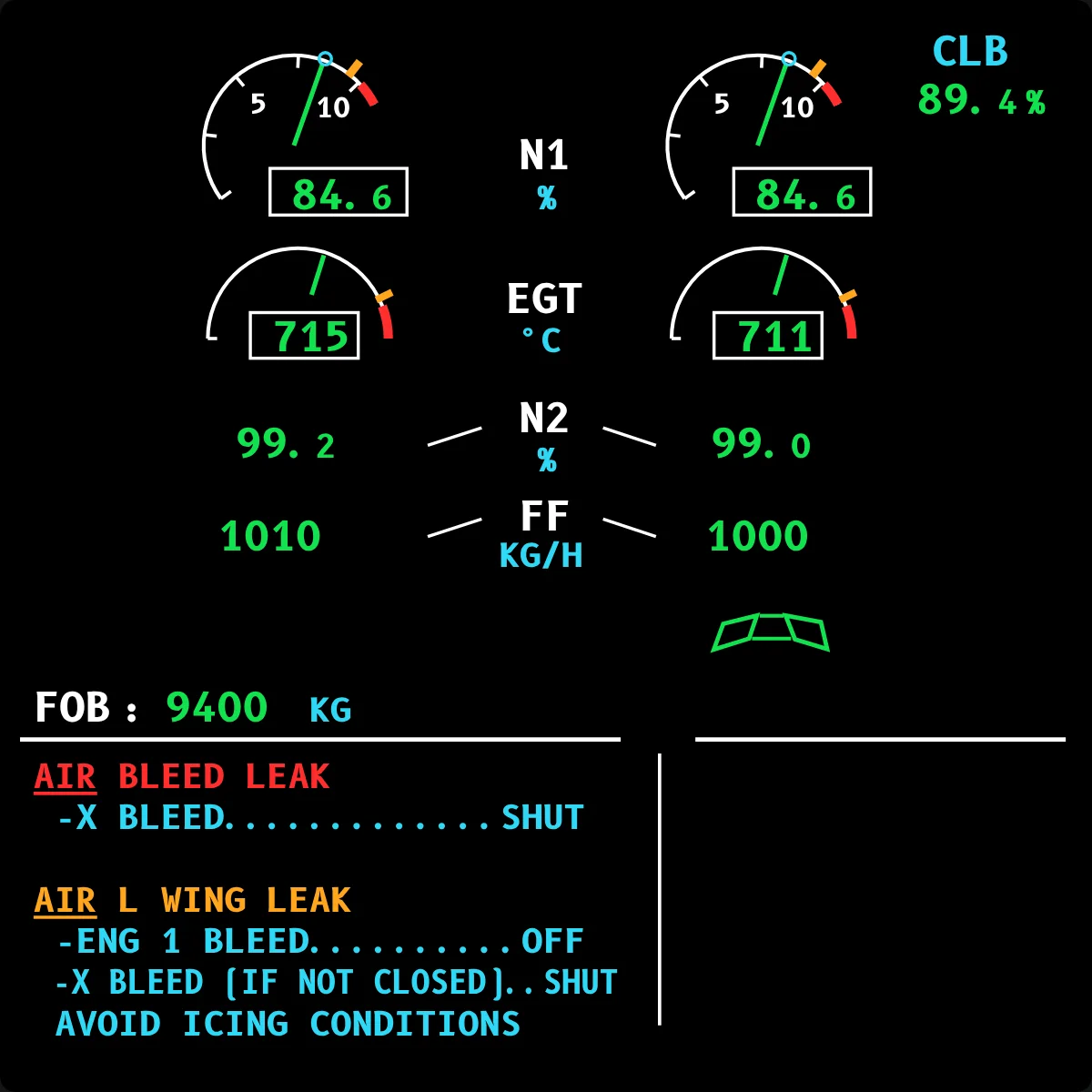
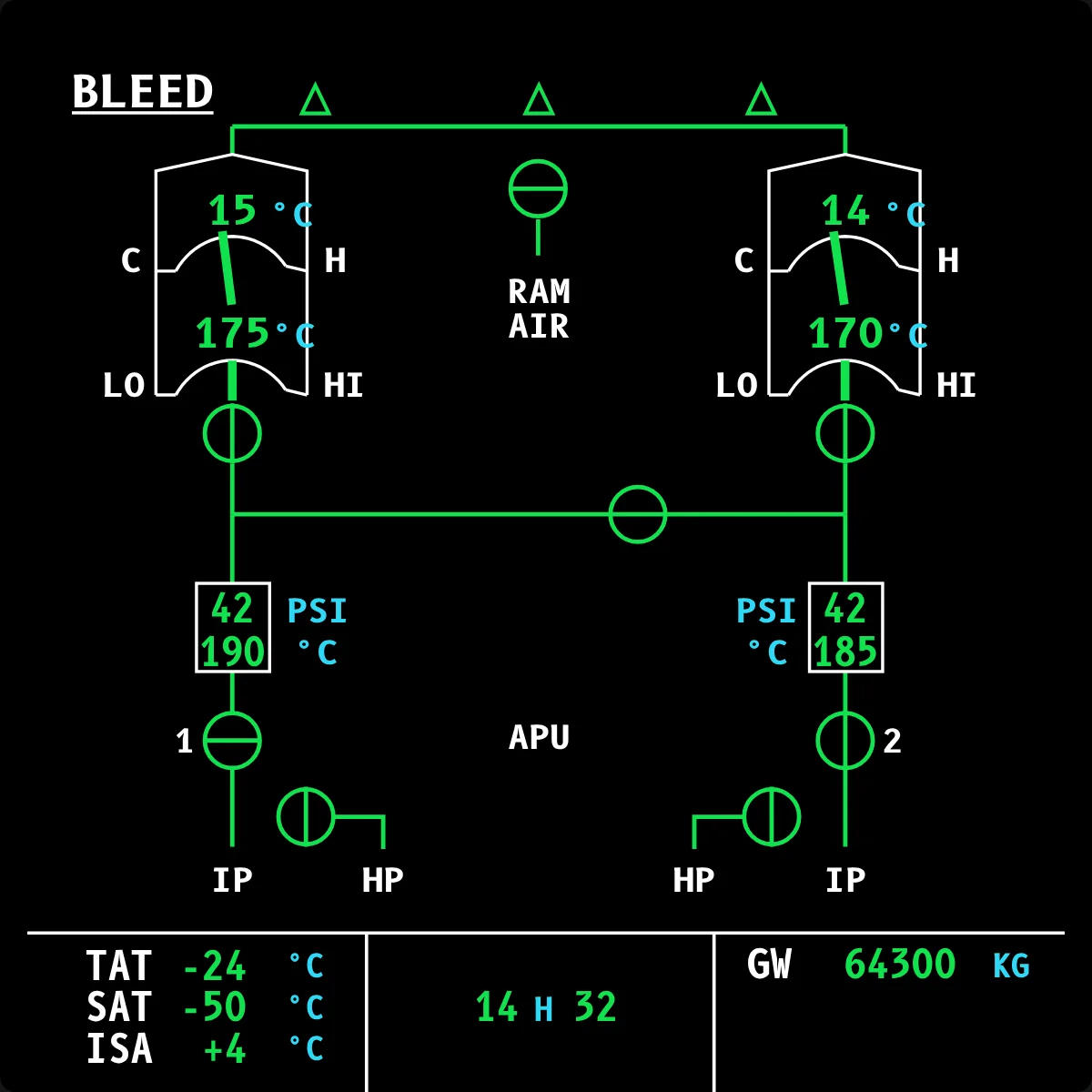
A level 3 warning, the ECAM's highest: an aural warning (the FCOM gives a continuous repetitive chime, a specific sound or a synthetic voice for level 3), MASTER WARN flashing red, the warning in red on the E/WD, and normally the relevant system page, here BLEED, on the SD.
The leak's own signs are on the AIR COND panel: for a wing or pylon leak, the FAULT light of the related engine's ENG BLEED pushbutton; for an APU leak, the FAULT light of the APU BLEED pushbutton. A level 3 warning has priority over a level 2 caution.
Sources FCOM DSC-31-10 WARNING/CAUTION CLASSIFICATION / FCOM DSC-31-10 PRIORITY RULES / FCOM DSC-31-30 ATTENTION GETTERS / FCOM DSC-31-20 SYSTEM PAGES / FCOM DSC-36-10-50 LEAK DETECTION / FCOM DSC-36-20 OVERHEAD PANEL
The moment the warning comes on
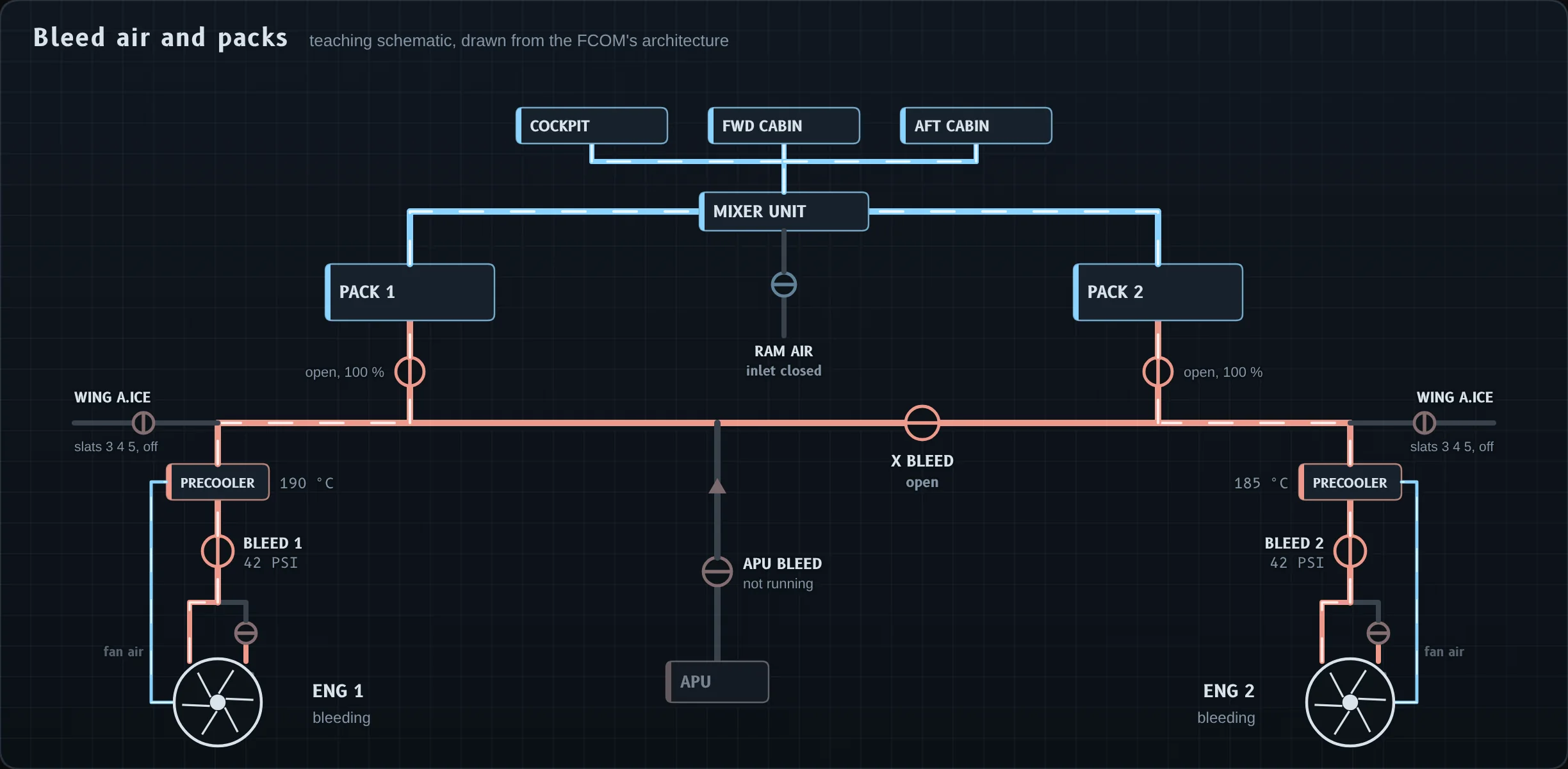
The cruise at FL 350, both engine bleeds on, the APU off, the wing anti-ice off, and X BLEED turned to OPEN: the two sides are interconnected. Press the button to start a leak in the left wing, then look at the E/WD, the BLEED page, the panel and the schematic.
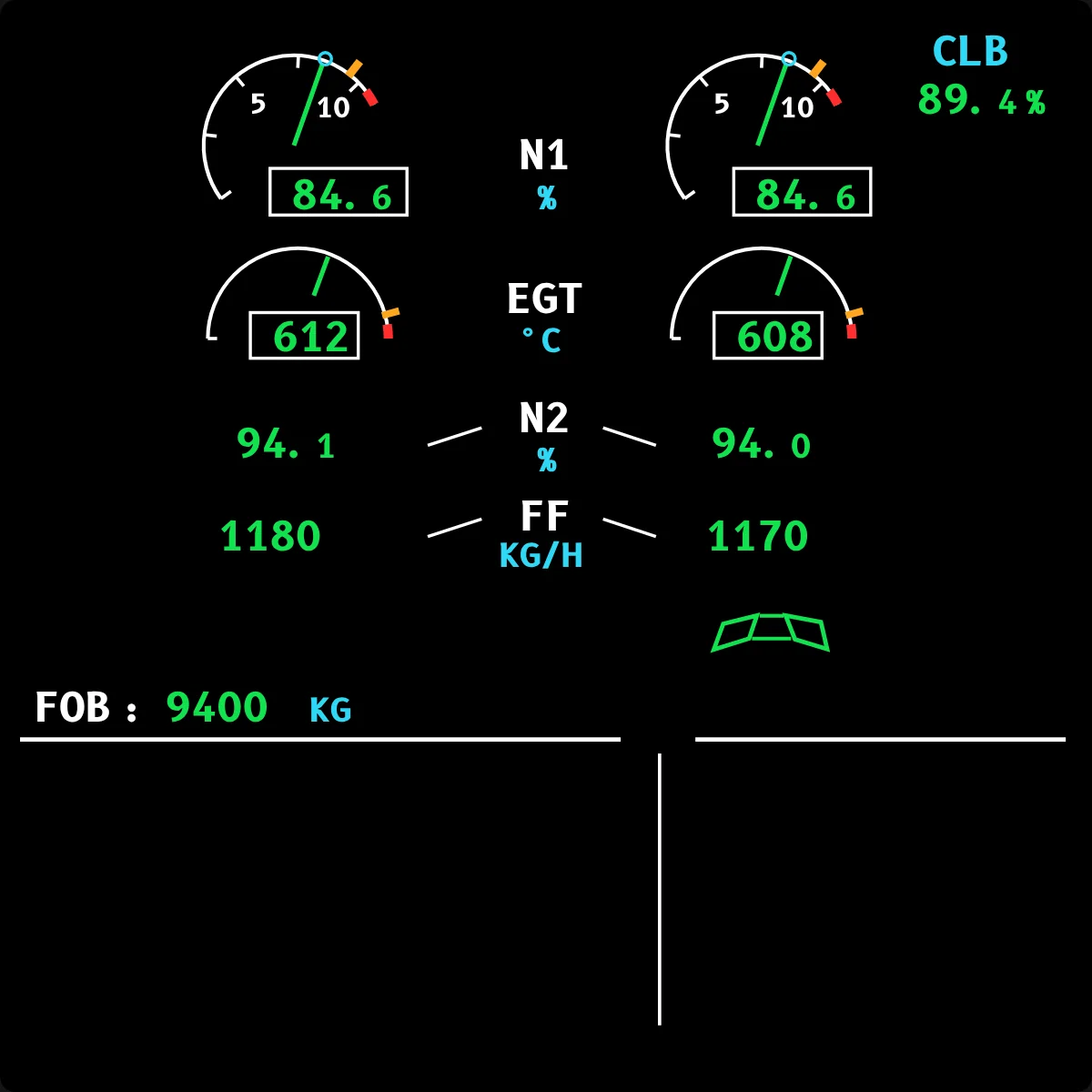
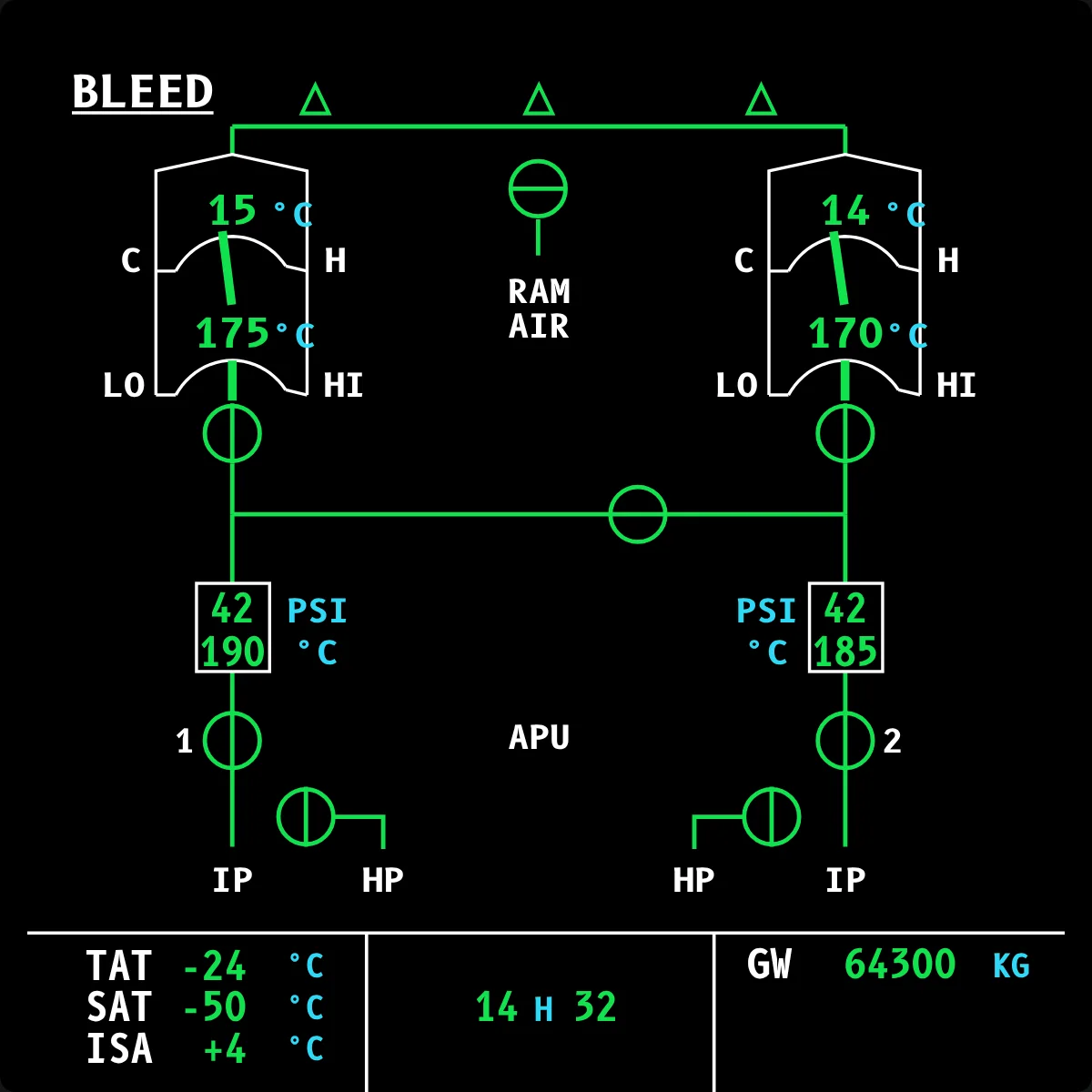
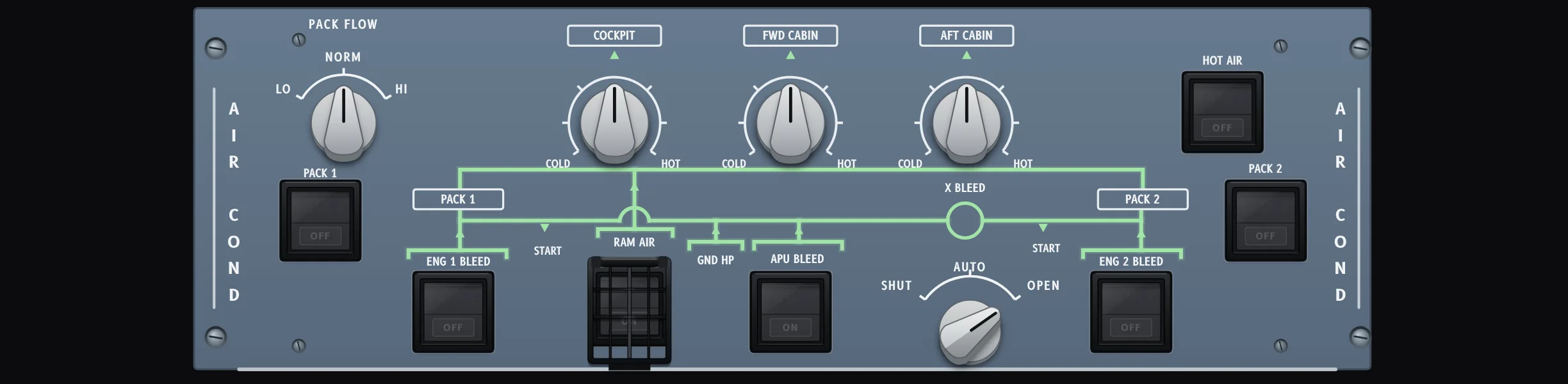
The alert Leak hot air in the left wing
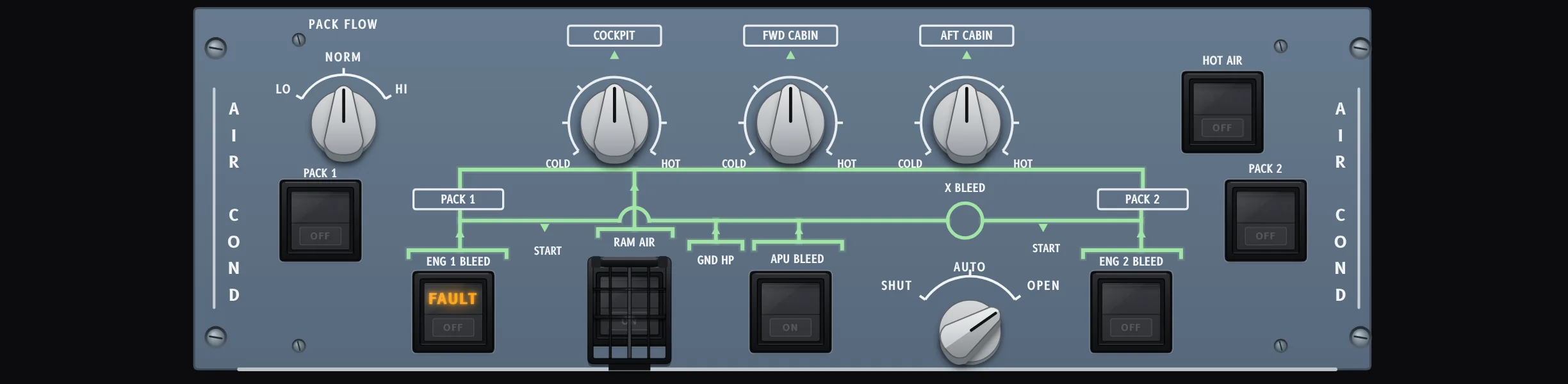
The E/WD shows AIR BLEED LEAK in red, its one line X BLEED SHUT, and under it AIR L WING LEAK, the trainer's pairing (see the E/WD caption above). On the panel FAULT lights in ENG 1 BLEED and engine 1's bleed valve has closed, though the pushbutton is still ON: the leak signal closed it.
The crossbleed valve has not moved: at OPEN it is open. On the schematic pack 1 is still running, now on engine 2's air through the open crossbleed.
Sources FCOM PRO-ABN-AIR ABNORMAL AND EMERGENCY PROCEDURES / FCOM PRO-ABN-AIR AIR L(R) WING LEAK / FCOM DSC-36-10-50 LEAK DETECTION / FCOM DSC-36-20 OVERHEAD PANEL / FCOM DSC-36-10-40 GENERAL
What does X BLEED SHUT change?
At SHUT the crossbleed valve is closed, and the two sides are isolated from each other. The FCOM's note under the line gives its purpose: closing the crossbleed valve isolates the bleed leak.
The cost is on the leaking side. With its own bleed valve closed by the leak signal and the crossbleed shut, with the APU off nothing supplies it, and its pack's flow control valve does not open with upstream pressure below minimum. The other pack runs alone, at HI flow, selected automatically in single pack operation.
Sources FCOM DSC-36-20 OVERHEAD PANEL / FCOM DSC-36-10-40 GENERAL / FCOM PRO-ABN-AIR ABNORMAL AND EMERGENCY PROCEDURES / FCOM DSC-36-10-50 LEAK DETECTION / FCOM DSC-21-10-50 CONTROLS ON OVERHEAD PANEL
Shut the crossbleed
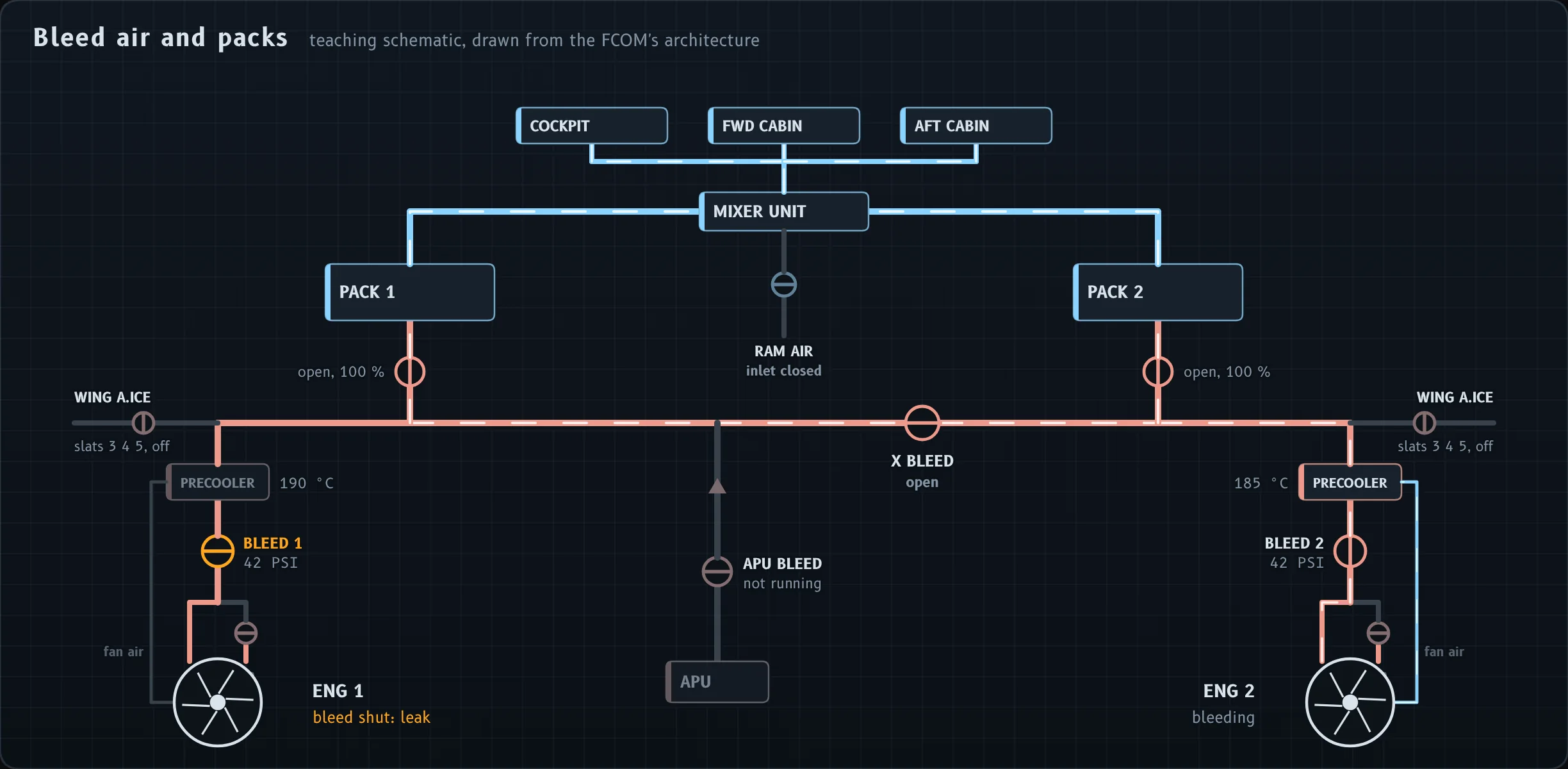
The left wing is leaking, engine 1's bleed valve is closed, and engine 2 feeds both packs through the open crossbleed. Predict first, then turn X BLEED and watch pack 1.
-
Predict Engine 1's bleed valve is already closed. What does turning X BLEED to SHUT cost pack 1?
Try it Turn X BLEED to SHUT.
The crossbleed valve closes and engine 2's air stays on the right side. Pack 1 loses its air and its flow control valve closes; pack 2 carries on alone at HI flow.
In the drawing AIR BLEED LEAK leaves the E/WD and AIR L WING LEAK stays, the trainer's pairing again. The warning's trigger needs the selector at OPEN, and the FCOM keeps an alert on the E/WD as long as its failure is present; it does not describe this case.
Sources FCOM DSC-36-20 OVERHEAD PANEL / FCOM DSC-21-10-50 CONTROLS ON OVERHEAD PANEL / FCOM PRO-ABN-AIR AIR BLEED LEAK / FCOM PRO-ABN-AIR AIR L(R) WING LEAK / FCOM DSC-31-15 FLIGHT PHASES
When is the crossbleed selector at OPEN in flight?
At AUTO the crossbleed valve is open only when the APU bleed valve is open. Several of the FCOM's procedures set OPEN; among them, every version of AIR ENG 1(2) BLEED FAULT ends with X BLEED OPEN.
AIR X BLEED FAULT, the valve disagreeing with its selector, has the crew control it by hand: OPEN when the APU bleed is on, for an engine start, or when the wing anti-ice is on with one bleed inoperative, and SHUT in other cases. WING A.ICE SYS FAULT, with one engine or one bleed not operative, also has X BLEED OPEN.
In each of these the selector is set to OPEN, and a leak detected while it stays there is the case this warning covers. The FCOM gives no further reason; it states the trigger and the line.
Sources FCOM DSC-36-10-40 GENERAL / FCOM DSC-36-20 OVERHEAD PANEL / FCOM PRO-ABN-AIR AIR / FCOM PRO-ABN-AIR ABNORMAL AND EMERGENCY PROCEDURES / FCOM PRO-ABN-AIR AIR X BLEED FAULT / FCOM PRO-ABN-W_A_ICE WING A.ICE / FCOM PRO-ABN-AIR AIR BLEED LEAK
What follows the warning, and what is lost?
AIR BLEED LEAK prints no STATUS of its own: its procedure is the single line and its note. The FCOM gives a wing, pylon or APU leak its own caution as well, each with its own trigger: AIR L(R) WING LEAK for both wing loops above 124 °C, AIR ENG 1(2) BLEED LEAK for a pylon leak above 204 °C, AIR APU BLEED LEAK for the APU loop above 124 °C.
The ECAM Trainer leaks the left wing and shows AIR L WING LEAK with the warning; that pairing is the trainer's, as the FCOM never describes the two together. The caution's procedure, in either version, has ENG BLEED OFF, for a left wing leak APU BLEED (IF NOT CLOSED) OFF, X BLEED (IF NOT CLOSED) SHUT, which the warning's X BLEED SHUT covers once done, WING ANTI-ICE OFF and AVOID ICING CONDITIONS. With a leak, the affected side's wing anti-ice valve closes automatically.
Sources FCOM PRO-ABN-AIR ABNORMAL AND EMERGENCY PROCEDURES / FCOM PRO-ABN-AIR AIR L(R) WING LEAK / FCOM PRO-ABN-AIR AIR ENG 1(2) BLEED LEAK / FCOM PRO-ABN-AIR AIR / FCOM PRO-ABN-AIR AIR APU BLEED LEAK / FCOM DSC-30-20-10 DESCRIPTION
What the left side loses
What is lost afterwards?
STATUS is the SD's operational summary of the aircraft's state. The FCOM prints none for AIR BLEED LEAK: its page ends with the X BLEED SHUT line and the note that closing the crossbleed valve isolates the bleed leak.
What STATUS shows afterwards comes from the leak's own caution. For the ECAM Trainer's left wing leak that is AIR L WING LEAK, whose STATUS, printed once for all aircraft, is drawn on that caution's page.
Sources FCOM DSC-31-20 STATUS PAGE / FCOM PRO-ABN-AIR ABNORMAL AND EMERGENCY PROCEDURES / FCOM PRO-ABN-AIR AIR L(R) WING LEAK
A319ceo, A320ceo, A320neo, A321neo: what differs?
| A319ceo, A320ceo | A320neo, A321neo | |
|---|---|---|
| The warning | Not given by type: the FCOM gives it to lists of aircraft; the ECAM Trainer does not draw it in this column | Not given by type: the FCOM gives it to lists of aircraft; the ECAM Trainer draws it here |
| The wing leak procedure that follows | Not given by type: two versions, each for a list of aircraft, one reading ENG BLEED (AFFECTED, IF NOT AUTOMATICALLY CLOSED) OFF, the other ENG BLEED (AFFECTED) OFF | Not given by type: the same two versions; the ECAM Trainer draws the second here |
| Leak detection loops | A319ceo and A320ceo: a double loop in each wing, a single loop for each pylon and the APU | A320neo and A321neo: a double loop in each wing and each pylon, a single loop for the APU |
| X BLEED selector | The same on all four types: at AUTO the valve closes on a wing, pylon or APU leak, except during an engine start; at OPEN it is open | The same on all four types: at AUTO the valve closes on a wing, pylon or APU leak, except during an engine start; at OPEN it is open |
The FCOM copy the site writes from prints the warning's trigger in two versions, each for a list of aircraft. The page ties neither version to a type.
Sources FCOM PRO-ABN-AIR AIR BLEED LEAK / FCOM PRO-ABN-AIR AIR / FCOM PRO-ABN-AIR ABNORMAL AND EMERGENCY PROCEDURES / FCOM DSC-36-10-50 LEAK DETECTION / FCOM DSC-36-20 OVERHEAD PANEL

Work AIR BLEED LEAK as a crew
Read and do each line against the FCOM, with the E/WD, the SD page and the overhead following your hands, the PF and PM calls, and a debrief that says what you missed.
Work this failure in the ECAM TrainerGo further
Written in our own words from the FCOM and the FCTM; each part names the units it rests on. The E/WD, the STATUS and the live aircraft are the platform's own ECAM and systems model, the same the ECAM Trainer and the flight deck run. This page explains the procedure; it is not the procedure. Aircraft differ by type, engine and options: your aircraft's FCOM, your QRH and your operator's procedures always come first. How we write and check these pages.
Every ECAM procedure, line by line, against the FCOM.
The ECAM Trainer works 108 scenarios with the E/WD, the SD page and the overhead following your hands. Start free today, or open everything with A320 Knowledge+.
For study and revision only. Always follow your operator's approved documentation and procedures. A320 Knowledge is independent and not affiliated with Airbus.
Related
- AIR PACK 1+2 FAULTAn amber caution that takes both packs.
- AIR PACK 1 FAULTAn amber caution with one line.
- AIR PACK 1 OVHTAn amber caution with a line that waits.
- AIR X BLEED FAULTAn amber caution with a one-line procedure and a condition that matters in icing.
- A320 pneumatics and bleed airThe system guide, with the live aircraft
- Every ECAM procedureThe alerts the ECAM Trainer works, grouped by system