
AIR PACK 1+2 FAULT
An amber caution that takes both packs. Here is what the two controllers do, what the aircraft loses with them, why ram air waits for less than 1 PSI, and what STATUS keeps, with the live aircraft at the moment the caution comes on.
Written and checked by current A320 pilotschecked against the FCOM on Our editorial policy
What AIR PACK 1+2 FAULT means
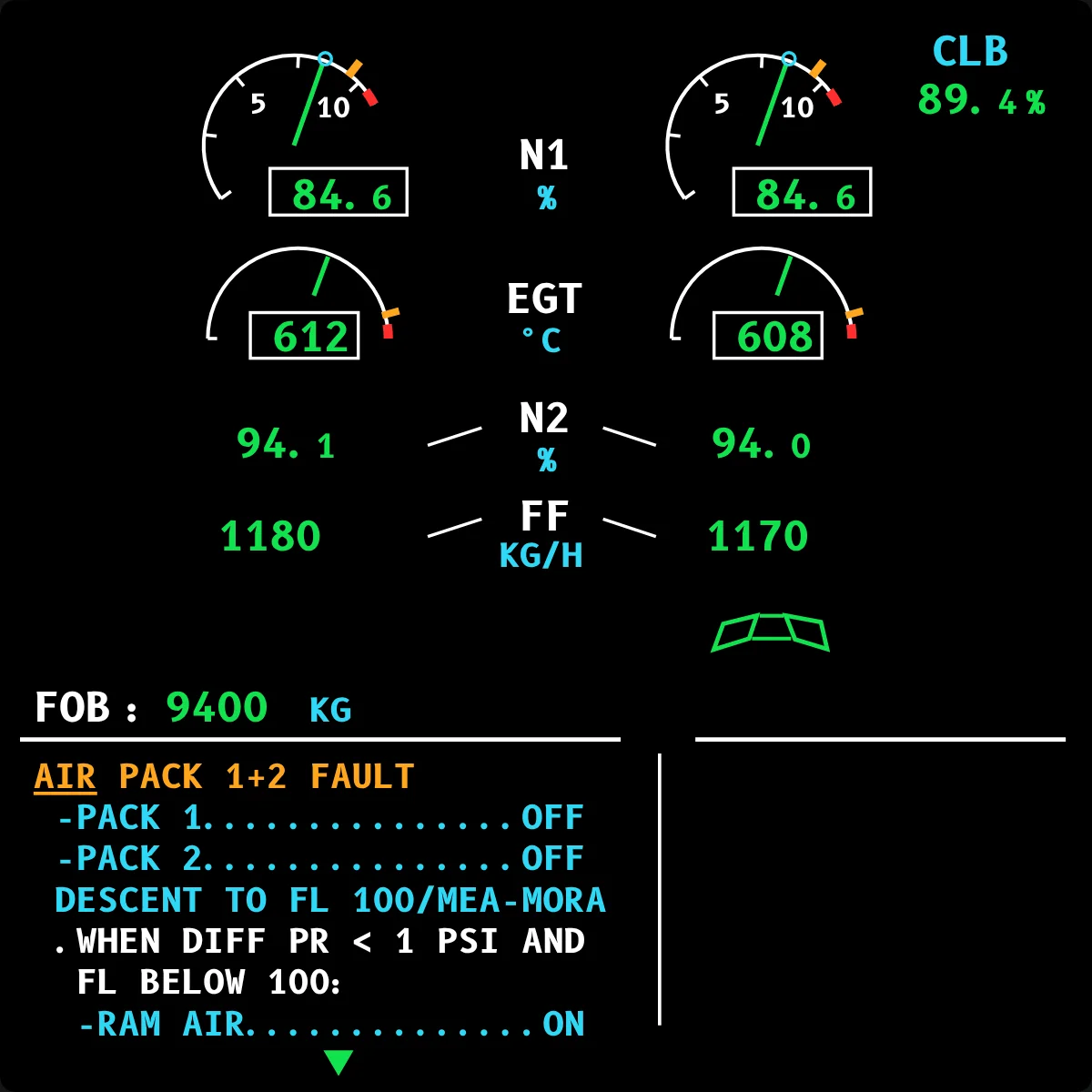
AIR PACK 1+2 FAULT is an amber caution: both air conditioning system controllers have failed. With both lanes of a controller failed its pack is lost, so here both packs are. With no pack off before, the procedure switches both packs off and calls for a descent to FL 100 or MEA-MORA, whichever is higher, with a note on the rate at which the cabin altitude increases.
Below FL 100, once the differential pressure is less than 1 PSI, the procedure sets RAM AIR ON and the emergency ram air inlet supplies the mixer unit. STATUS shows MAX FL 100/MEA-MORA if the packs are not recovered.
Sources FCOM PRO-ABN-AIR AIR PACK 1+2 FAULT / FCOM DSC-21-10-40 / FCOM PRO-ABN-AIR AIR / FCOM DSC-21-10-20 EMERGENCY RAM AIR / FCOM DSC-21-10-50 CONTROLS ON OVERHEAD PANEL / FCOM PRO-ABN-AIR
At a glance
- Level
- Amber caution, level 2: single chime, MASTER CAUT and the relevant system page on the SD
- Sets it off
- Both air conditioning system controllers (ACSC) failed
- What is lost
- Both packs; with each controller, the hot air pressure-regulating valve and its trim air valves close
- Procedure
- With no pack off before: PACK 1 and PACK 2 OFF, descent to FL 100 or MEA-MORA, whichever is higher; below FL 100 and 1 PSI, RAM AIR ON
- FAULT lights
- The procedure's remark: the fault light goes off when the failure disappears
- STATUS
- If the packs are not recovered, MAX FL 100/MEA-MORA, CKPT and CAB AT FIXED TEMP; PACK 1 + 2, COND CTL 1 and COND CTL 2 inoperative
Sources FCOM DSC-31-10 WARNING/CAUTION CLASSIFICATION / FCOM DSC-31-20 SYSTEM PAGES / FCOM PRO-ABN-AIR AIR PACK 1+2 FAULT / FCOM DSC-21-10-40 / FCOM PRO-ABN-AIR AIR / FCOM PRO-ABN-AIR
What sets the caution off?
The FCOM describes two fits for temperature regulation: a zone controller with two pack controllers, or two air conditioning system controllers (ACSC). Both the A319ceo and A320ceo description and the A320neo and A321neo description give ACSCs: each regulates its pack's temperature and its flow control valve.
Each controller has two lanes: one controls, the other takes over if the active lane fails, so one lane failing has no effect. With both lanes failed, the related pack is lost, and the hot air pressure-regulating valve and its trim air valves close.
The caution triggers when both ACSCs are failed.
Sources FCOM DSC-21-10-10 GENERAL / FCOM DSC-21-10-30 AIR CONDITIONING SYSTEM CONTROLLERS / FCOM DSC-21-10-40 GENERAL / FCOM DSC-21-10-40 / FCOM PRO-ABN-AIR AIR PACK 1+2 FAULT
Two controllers, both packs
What does the crew see and hear?
A level 2 caution: a single chime, the MASTER CAUT light steady amber, the caution in amber on the E/WD, and the SD normally calls up the relevant system page. The pack flows and flow control valves are on the BLEED page.
On the BLEED page a pack's flow turns amber when its flow control valve is closed. The users indication above the packs turns amber in flight when the ram air is not fully open and both pack flow control valves are closed.
Sources FCOM DSC-31-10 WARNING/CAUTION CLASSIFICATION / FCOM DSC-31-20 SYSTEM PAGES / FCOM DSC-21-10-50 ECAM BLEED PAGE
The moment the caution comes on
In the cruise, both packs running at NORM flow. Press the button to fail both air conditioning controllers, then look at the E/WD, the BLEED page, the AIR COND panel and the schematic.
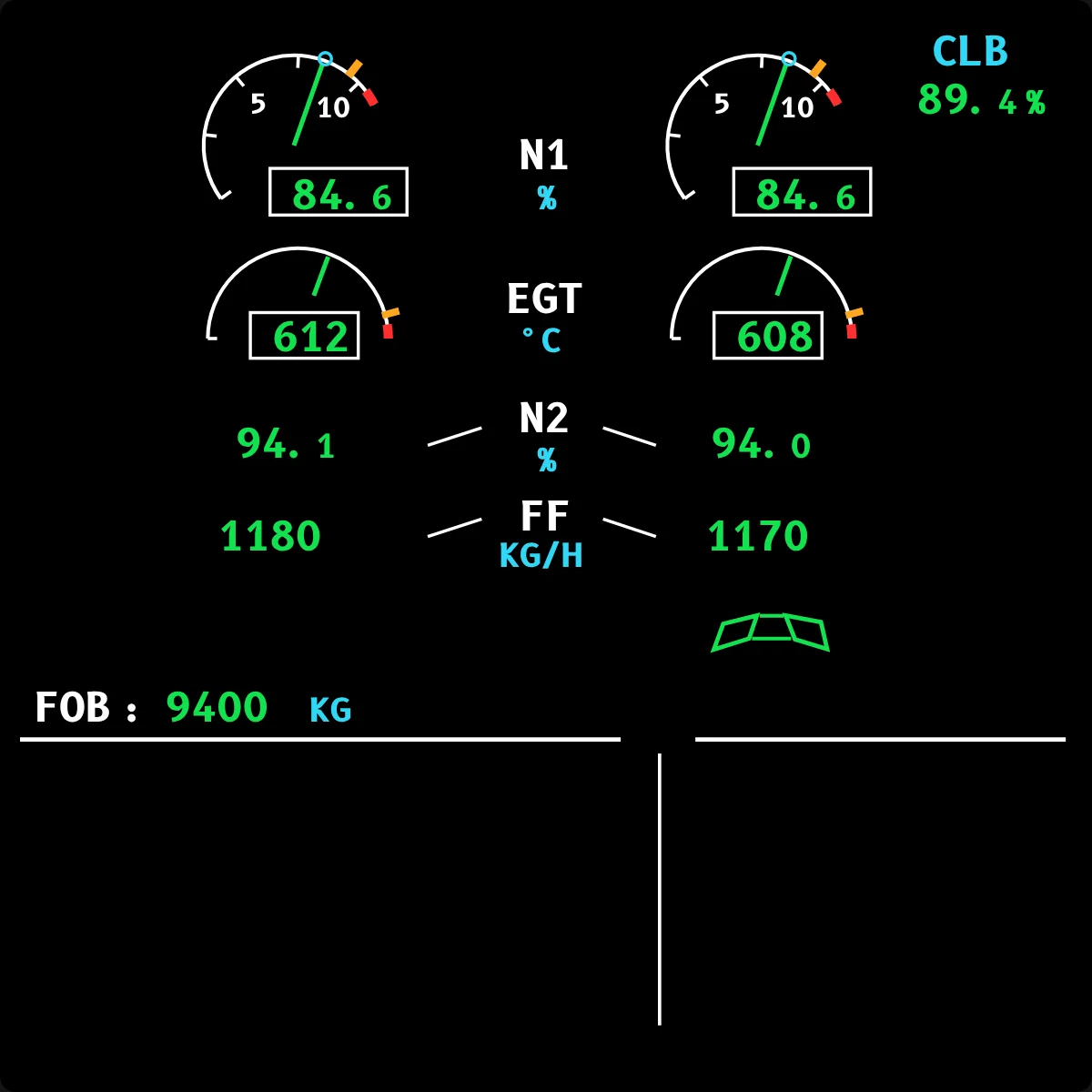
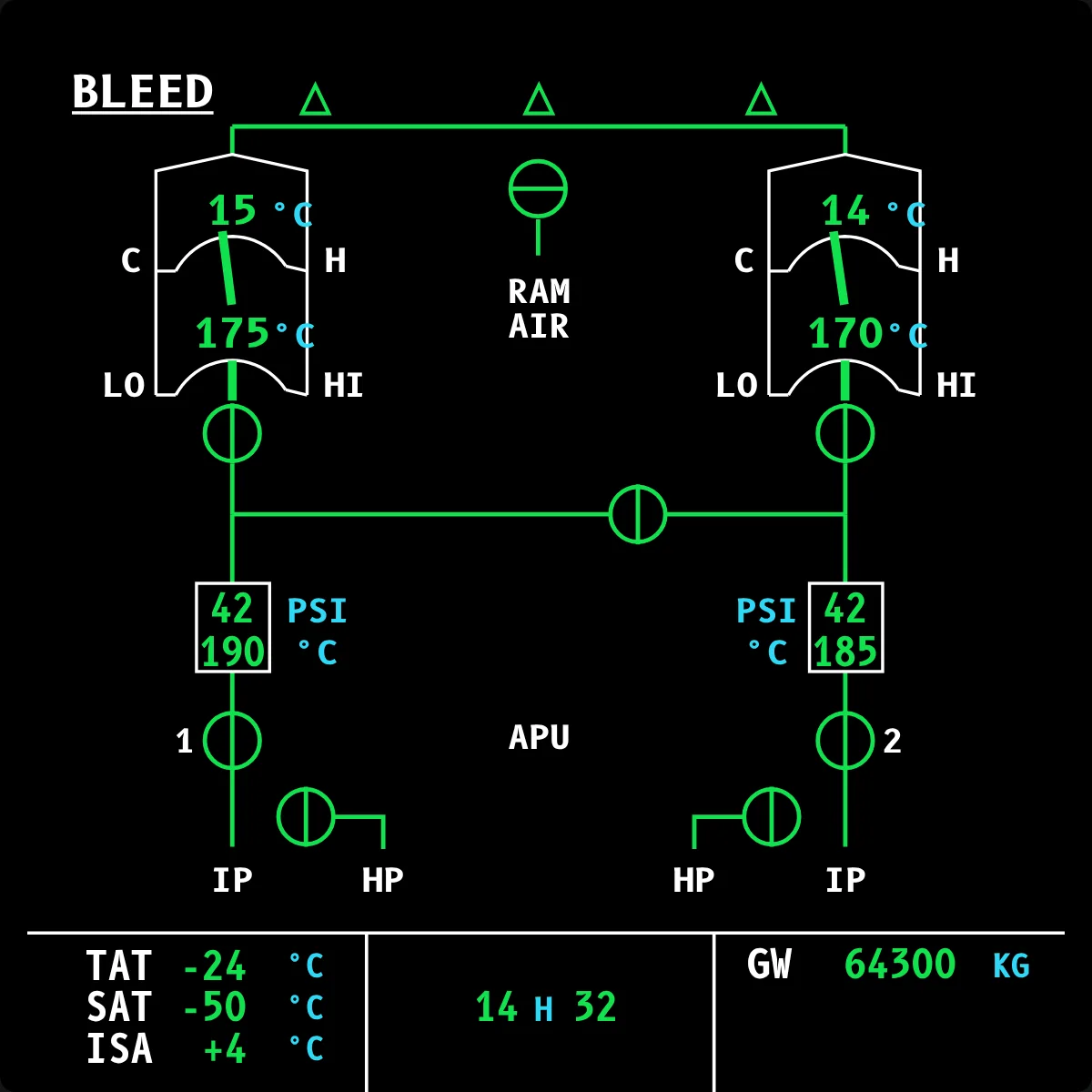
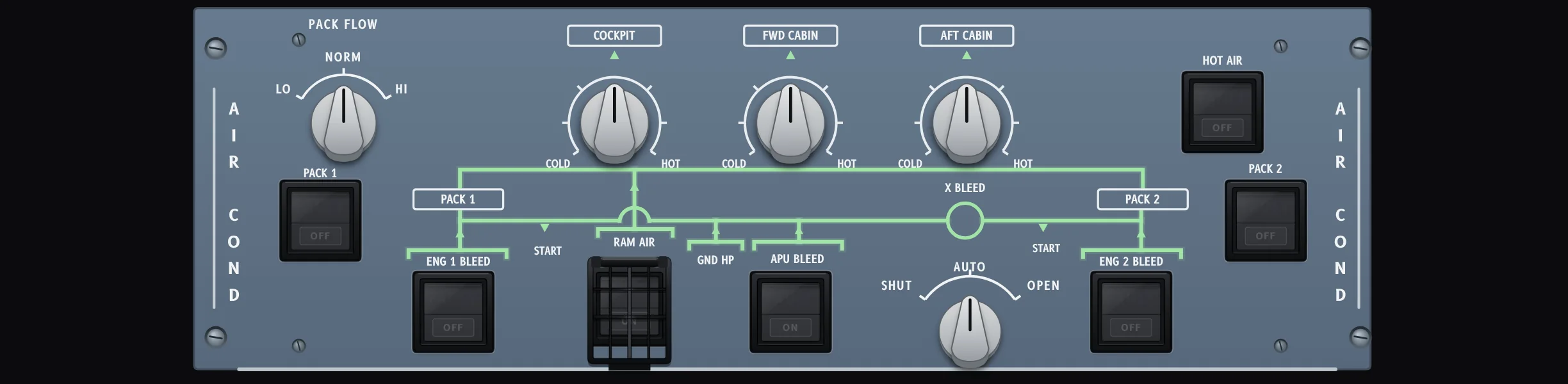
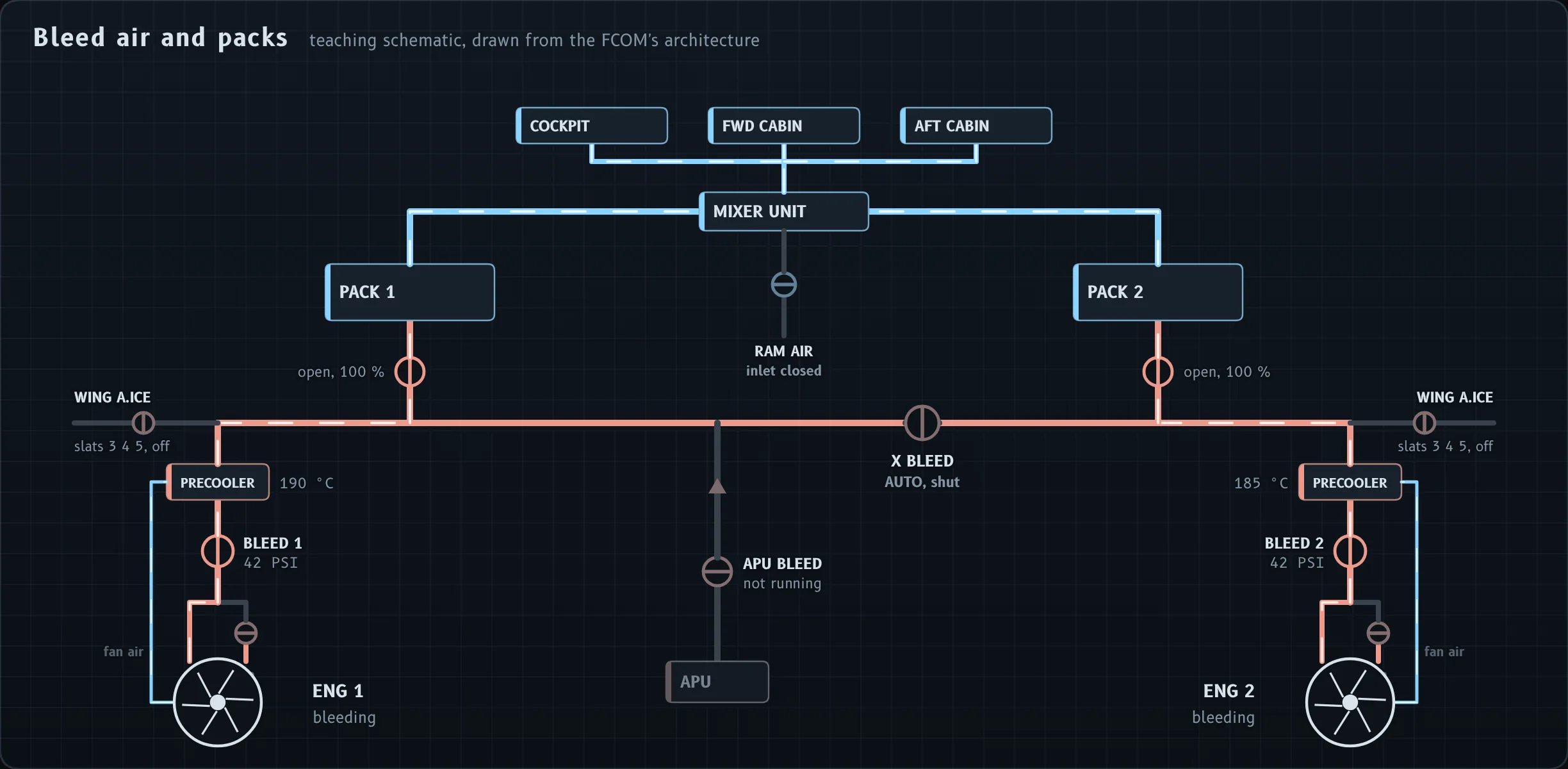
The alert Fail both air conditioning controllers
The E/WD shows the caution in amber: PACK 1 OFF, PACK 2 OFF, DESCENT TO FL 100/MEA-MORA, then the condition WHEN DIFF PR < 1 PSI AND FL BELOW 100, with RAM AIR ON and MAX FL 100/MEA-MORA under it.
FAULT lights in both PACK pushbuttons. On the BLEED page both valves are crossline amber, both flows amber, and the users indication amber. The FCOM says each pack is lost; the drawing shows that as its flow control valve closed against the ON.
Sources FCOM PRO-ABN-AIR AIR / FCOM DSC-21-10-40 / FCOM DSC-21-10-50 CONTROLS ON OVERHEAD PANEL / FCOM DSC-21-10-50 ECAM BLEED PAGE
Why does ram air wait for less than 1 PSI?
An emergency ram air inlet ventilates the cockpit and cabin if both packs fail, or to remove smoke. RAM AIR, a guarded pushbutton on the AIR COND panel, opens it, provided ditching is not selected.
With the inlet open, air comes in only below 1 PSI of differential pressure. Above it, the check valve downstream of the ram air door does not open, even with the door selected open, and no airflow is supplied. Below it, the outflow valve opens about 50 % under automatic control, though not by itself under manual control, and ram air goes straight to the mixer unit.
The procedure states the condition, WHEN DIFF PR < 1 PSI AND FL BELOW 100, in large letters, so it appears on the ECAM. The FCOM gives no further reason for FL 100.
Sources FCOM DSC-21-10-20 EMERGENCY RAM AIR / FCOM DSC-21-10-50 CONTROLS ON OVERHEAD PANEL / FCOM PRO-ABN-AIR AIR / FCOM PRO-ABN-ABN-00 INTRODUCTION
Ram air below FL 100
Later in the same failure: both controllers failed, both packs off, the aircraft level at 9 000 ft and the cabin 0.8 PSI above the outside air. Predict first, then press, and watch the ram air on the BLEED page and the schematic.
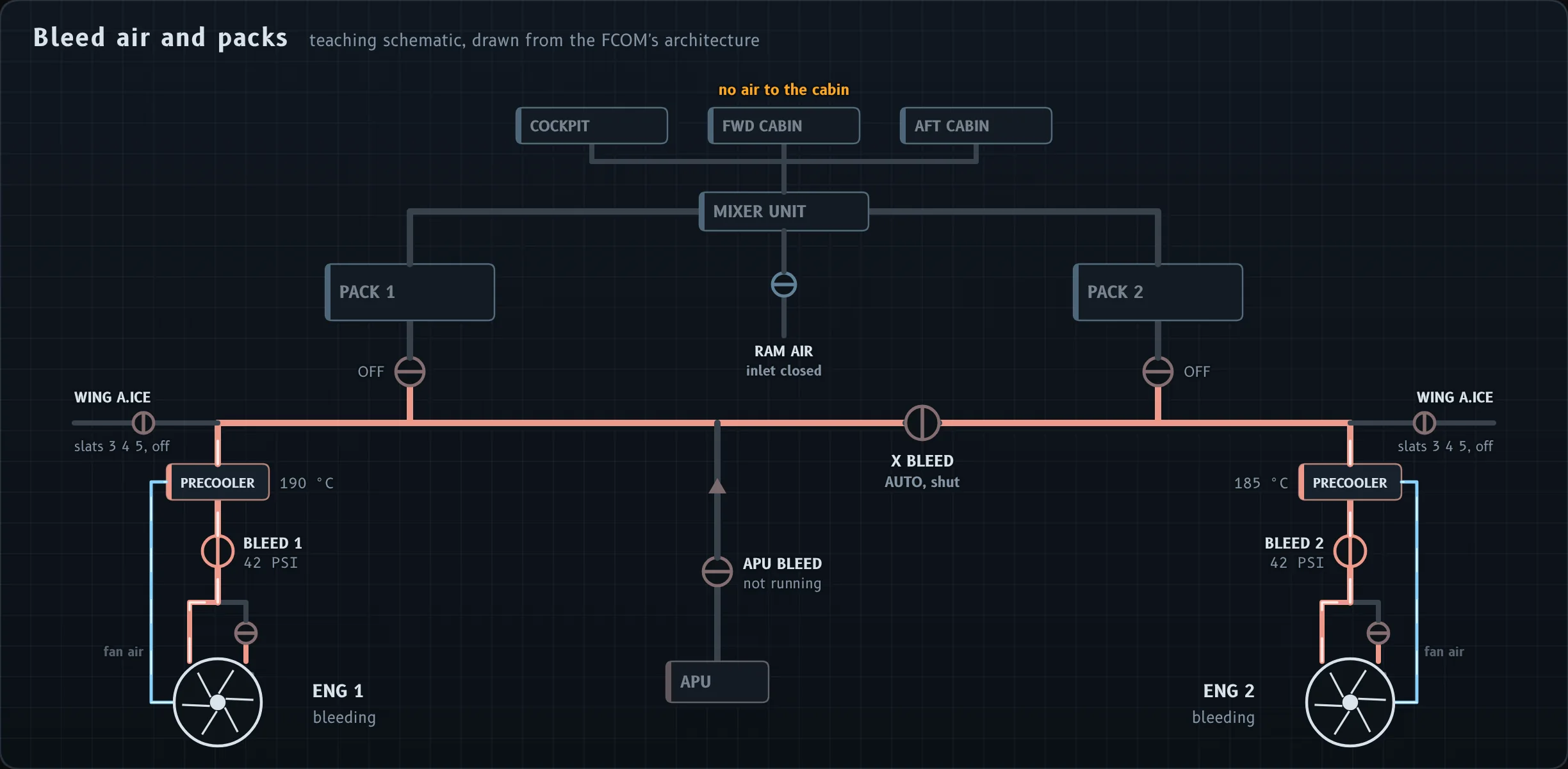
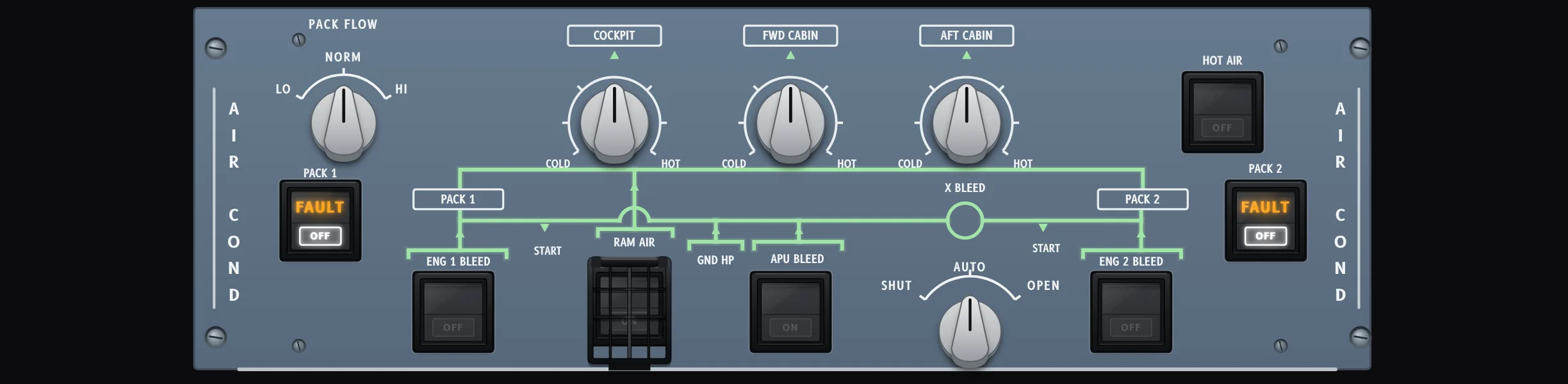
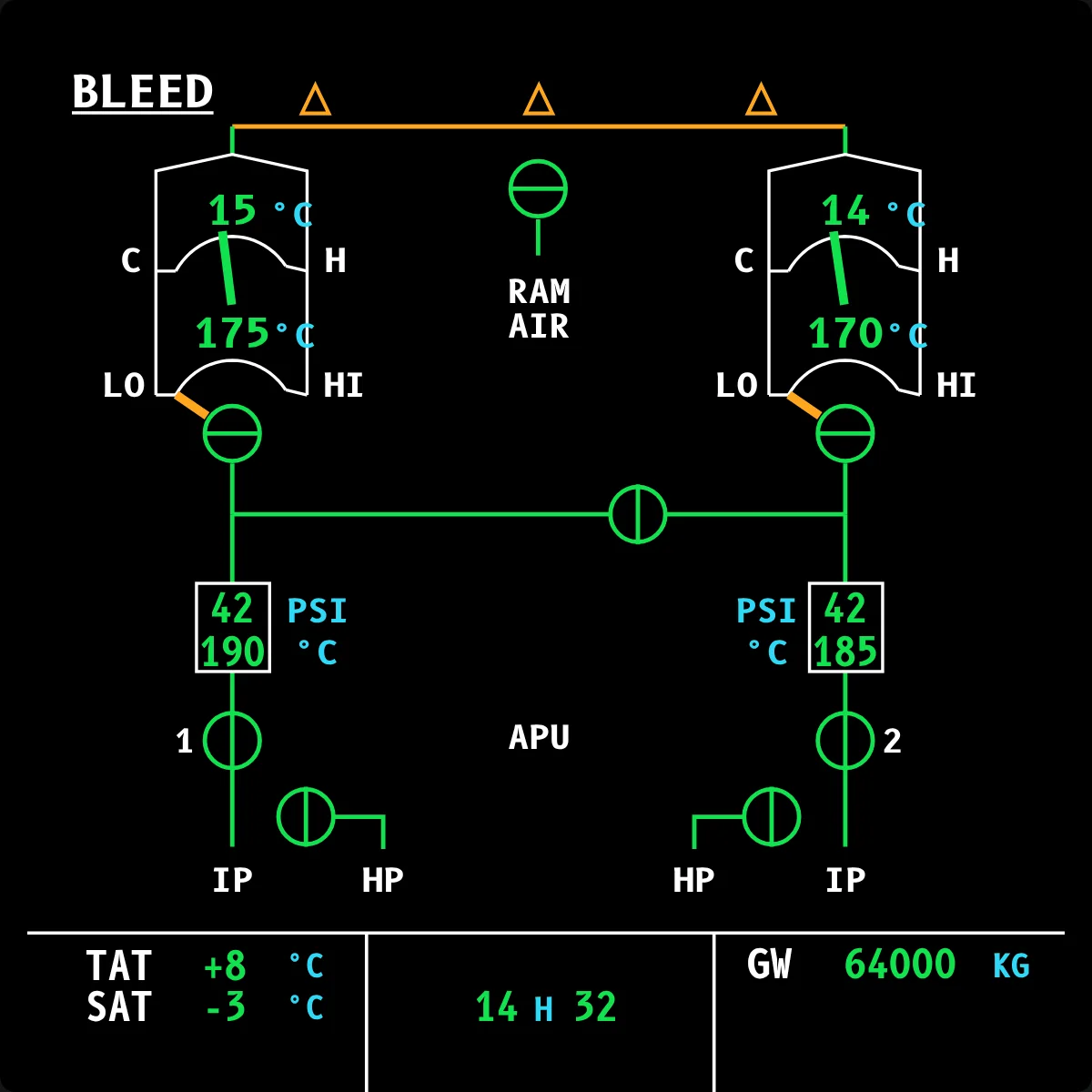
-
Predict Below FL 100, with 0.8 PSI of differential pressure, you switch RAM AIR on. Does outside air come in?
Try it Switch RAM AIR on.
ON lights white, the inlet opens and, below 1 PSI, ram air flows; the BLEED page's users indication is no longer amber. On the aircraft the green RAM AIR ON memo appears.
The drawing leaves the outflow valve where it was, nearly closed. The FCOM says it opens about 50 % with RAM AIR ON below 1 PSI under automatic control, and does not open by itself under manual control.
Sources FCOM DSC-21-10-50 CONTROLS ON OVERHEAD PANEL / FCOM DSC-21-10-50 ECAM BLEED PAGE / FCOM DSC-21-10-50 MEMO DISPLAY / FCOM DSC-21-10-20 EMERGENCY RAM AIR
Why both packs off, then the descent?
With no pack off before, the procedure starts with PACK 1 OFF and PACK 2 OFF, and a remark: the fault light goes off when the failure disappears. The FCOM gives no reason for the two lines.
Then DESCENT TO FL 100/MEA-MORA: descend to FL 100, or MEA-MORA, whichever is higher. A note says "The rate at which the cabin altitude increases may be minimized" by closing the forward cargo isolation valve, where fitted, if the cargo freight permits.
MAX FL 100/MEA-MORA comes under the ram air condition, and STATUS shows it if the packs are not recovered. If the fault was caused by an overheat, AIR PACK 1(2) OVHT follows as an associated procedure, with the affected pack back on once the overheat is out.
One version of the procedure, for some aircraft, starts with another case: if a pack was already set off after a failure of its engine bleed, the other pack goes off and that pack back on, and once it is on the caution is replaced by the other pack's own AIR PACK FAULT. Another version, for other aircraft, prints only the lines above.
Sources FCOM PRO-ABN-AIR AIR / FCOM PRO-ABN-AIR
What is lost with both packs?
If the packs are not recovered, STATUS shows MAX FL 100/MEA-MORA in blue, then CKPT AT FIXED TEMP and CAB AT FIXED TEMP in green. Under INOP SYS: PACK 1 + 2, COND CTL 1, COND CTL 2, and FWD CRG HEAT where fitted.
The FCOM's description gives each controller its zones: ACSC 1 the cockpit temperature, ACSC 2 the two cabin zones. With both lanes failed, the hot air valve and the trim air valves close.
If the fault was caused by an overheat, STATUS also shows WHEN PACK OVHT OUT, PACK (AFFECTED) ON.
Sources FCOM PRO-ABN-AIR / FCOM DSC-21-10-30 TEMPERATURE REGULATION / FCOM DSC-21-10-40
With no pack, ram air
What is lost afterwards?
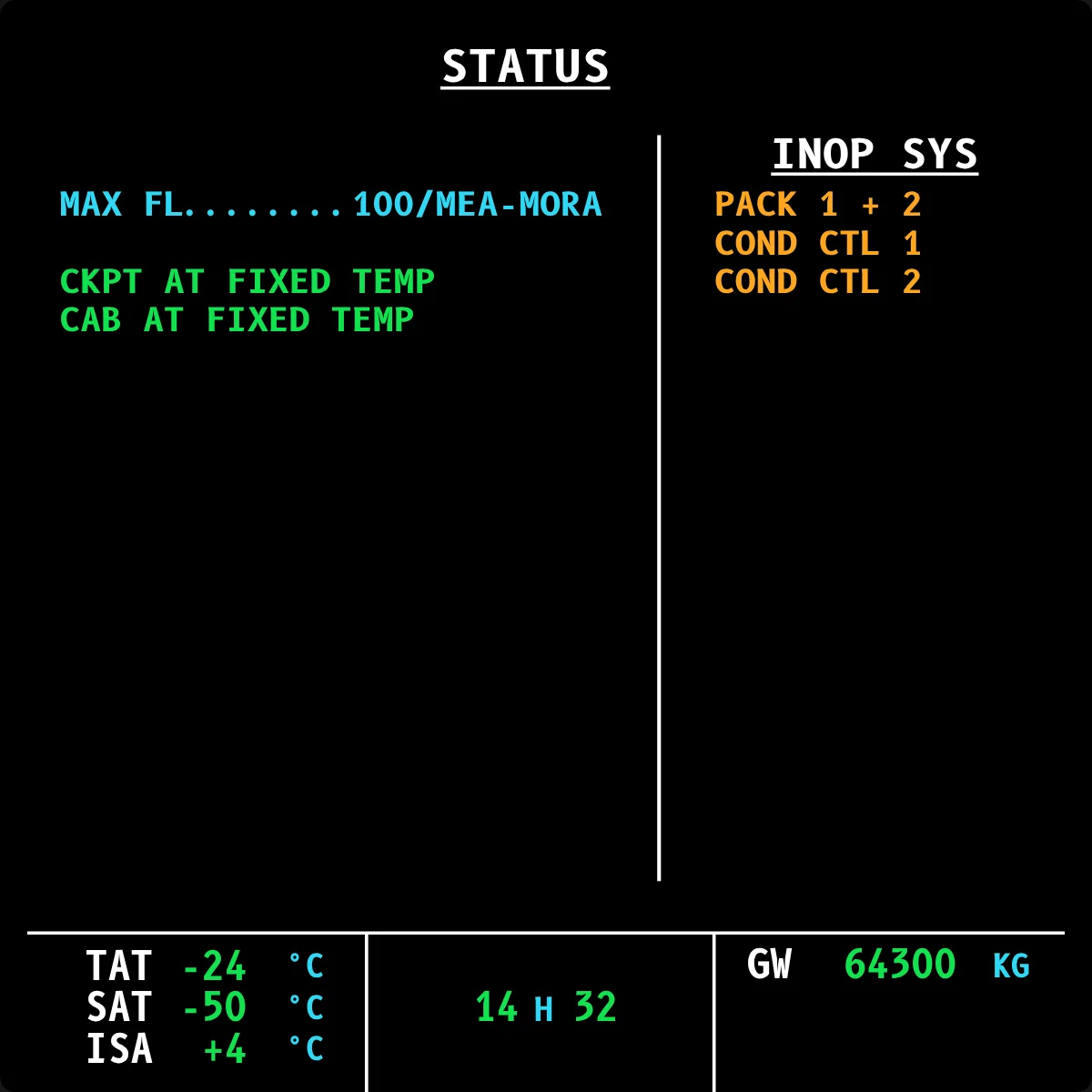
STATUS is the aircraft's operational summary. The FCOM prints one STATUS for this caution, for all aircraft. Its condition, if packs not recovered, is in small letters, a precondition the ECAM does not display, so the picture shows the lines under it without it: MAX FL 100/MEA-MORA, CKPT AT FIXED TEMP and CAB AT FIXED TEMP.
INOP SYS lists PACK 1 + 2, COND CTL 1 and COND CTL 2. The FCOM adds FWD CRG HEAT, marked as optional equipment; the picture leaves it out. The lines for a fault caused by an overheat are not drawn, as the trainer's failure has no overheat.
Sources FCOM DSC-31-20 STATUS PAGE / FCOM PRO-ABN-AIR / FCOM PRO-ABN-ABN-00 INTRODUCTION
A319ceo, A320ceo, A320neo, A321neo: what differs?
| A319ceo, A320ceo | A320neo, A321neo | |
|---|---|---|
| The caution and its STATUS | The same in every version | The same in every version |
| The procedure | Not given by type: two versions, each for a list of aircraft; one adds a first case, for a pack already set off after a failure of its engine bleed | Not given by type: the same two versions, with the same lines when no pack was off before |
| Air conditioning system controllers | Each regulates its pack's temperature and flow (A319ceo and A320ceo description) | The same in the A320neo and A321neo description |
Which procedure version applies depends on the aircraft, not the type: check your own FCOM. The E/WD above gives the lines both versions share when neither pack was off before.
Sources FCOM PRO-ABN-AIR AIR PACK 1+2 FAULT / FCOM PRO-ABN-AIR / FCOM PRO-ABN-AIR AIR / FCOM DSC-21-10-30 AIR CONDITIONING SYSTEM CONTROLLERS

Work AIR PACK 1+2 FAULT as a crew
Read and do each line against the FCOM, with the E/WD, the SD page and the overhead following your hands, the PF and PM calls, and a debrief that says what you missed.
Work this failure in the ECAM TrainerGo further
Written in our own words from the FCOM and the FCTM; each part names the units it rests on. The E/WD, the STATUS and the live aircraft are the platform's own ECAM and systems model, the same the ECAM Trainer and the flight deck run. This page explains the procedure; it is not the procedure. Aircraft differ by type, engine and options: your aircraft's FCOM, your QRH and your operator's procedures always come first. How we write and check these pages.
Every ECAM procedure, line by line, against the FCOM.
The ECAM Trainer works 108 scenarios with the E/WD, the SD page and the overhead following your hands. Start free today, or open everything with A320 Knowledge+.
For study and revision only. Always follow your operator's approved documentation and procedures. A320 Knowledge is independent and not affiliated with Airbus.
Related
- AIR BLEED LEAKA red warning with one line.
- AIR PACK 1 FAULTAn amber caution with one line.
- AIR PACK 1 OVHTAn amber caution with a line that waits.
- AIR X BLEED FAULTAn amber caution with a one-line procedure and a condition that matters in icing.
- A320 air conditioning and pressurisationThe system guide, with the live aircraft
- Every ECAM procedureThe alerts the ECAM Trainer works, grouped by system