
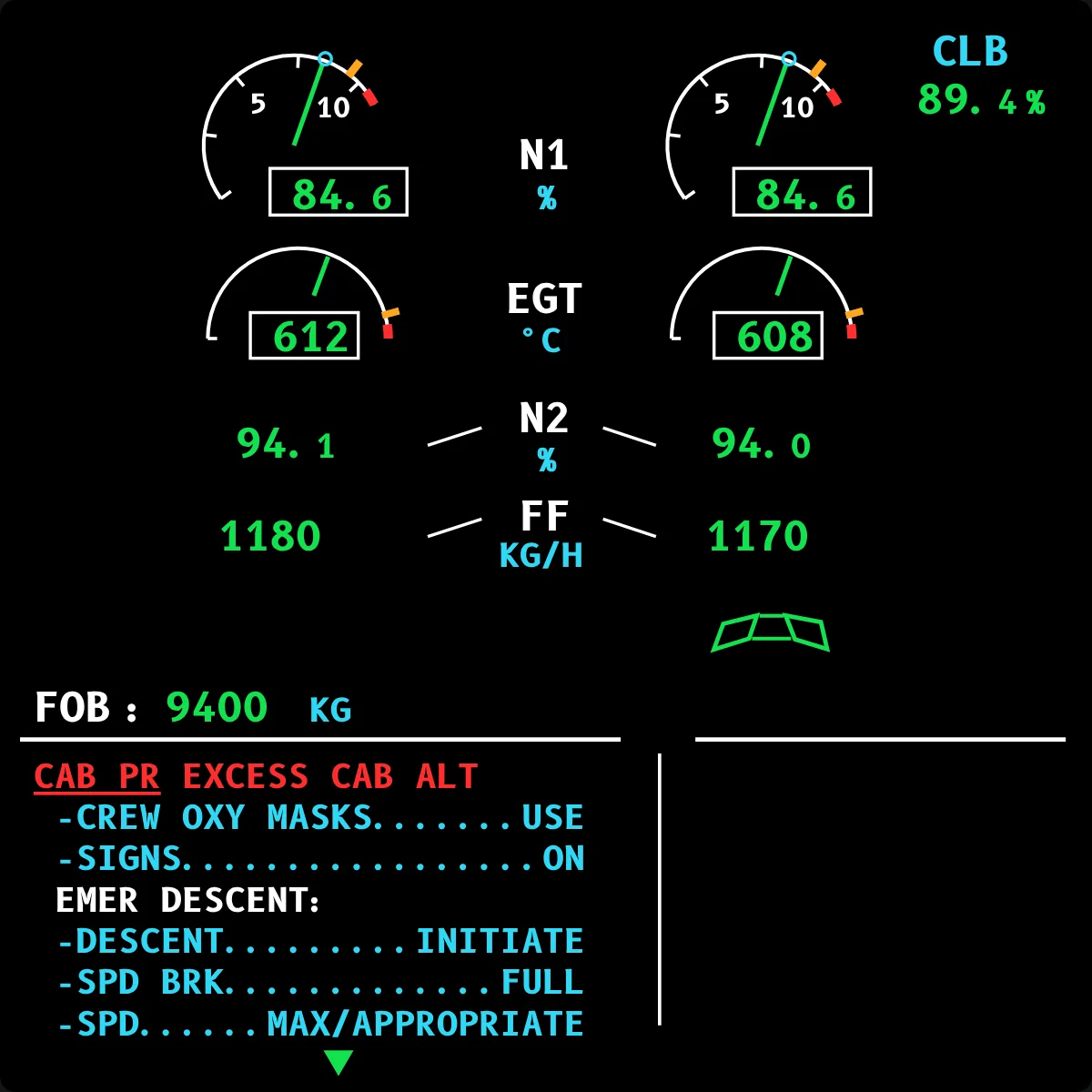
CAB PR EXCESS CAB ALT
A red warning: the cabin altitude is too high. Here is what sets it off, why the crew trusts it even when the SD disagrees, what the passenger masks do by themselves, and what the memory items and the emergency descent are for, with the live CABIN PRESS panel.
Written and checked by current A320 pilotschecked against the FCOM on Our editorial policy
What CAB PR EXCESS CAB ALT means
CAB PR EXCESS CAB ALT is a red warning: the cabin altitude is above 9 550 ft in the cruise, or in climb and descent above 9 550 ft or 1 000 ft above the airfield, whichever is higher. The crew relies on it even if the CAB PRESS page does not show it, as it can come from a different sensor.
Above FL 100 the crew goes on oxygen first. Above FL 160 the answer is the emergency descent, one of the FCOM's memory items, flown first from memory, then refined with the ECAM, down to FL 100 or MEA-MORA. Above 14 000 ft of cabin altitude (16 000 ft with HI ALT LANDING on, where fitted) the passenger mask doors open by themselves.
Sources FCOM PRO-ABN-CAB_PR CAB PR EXCESS CAB ALT / FCOM PRO-ABN-CAB_PR CAB PR / FCOM PRO-ABN-ABN-MEM / FCOM PRO-ABN-CAB_PR / FCOM DSC-35-30-10 OPERATION / FCOM DSC-35-30-20 OVERHEAD PANEL / FCTM PR-AEP-MISC EMER DESCENT
At a glance
- Level
- Red warning, level 3: continuous repetitive chime and a flashing red MASTER WARN light
- Sets it off
- In the cruise, a cabin altitude above 9 550 ft; in climb or descent, above 9 550 ft or 1 000 ft above the airfield pressure altitude, whichever is higher
- Trust it
- Rely on the warning even if the CAB PRESS page does not confirm it: it can come from another cabin pressure sensor
- Memory item
- EMER DESCENT, called out by its title, "EMERGENCY DESCENT"
- Passenger masks
- Their doors open by themselves when the cabin altitude exceeds 14 000 ft (16 000 ft with HI ALT LANDING on, where fitted)
- STATUS
- MAX FL 100/MEA-MORA
Sources FCOM DSC-31-10 WARNING/CAUTION CLASSIFICATION / FCOM DSC-31-10 AUDIO INDICATORS / FCOM DSC-31-30 ATTENTION GETTERS / FCOM PRO-ABN-CAB_PR CAB PR EXCESS CAB ALT / FCOM PRO-ABN-CAB_PR CAB PR / FCTM PR-AEP-MISC EMER DESCENT / FCOM PRO-ABN-ABN-MEM / FCOM PRO-ABN-ABN-00 INTRODUCTION / FCOM DSC-35-30-10 OPERATION / FCOM DSC-35-30-20 OVERHEAD PANEL / FCOM PRO-ABN-CAB_PR
What sets the warning off?
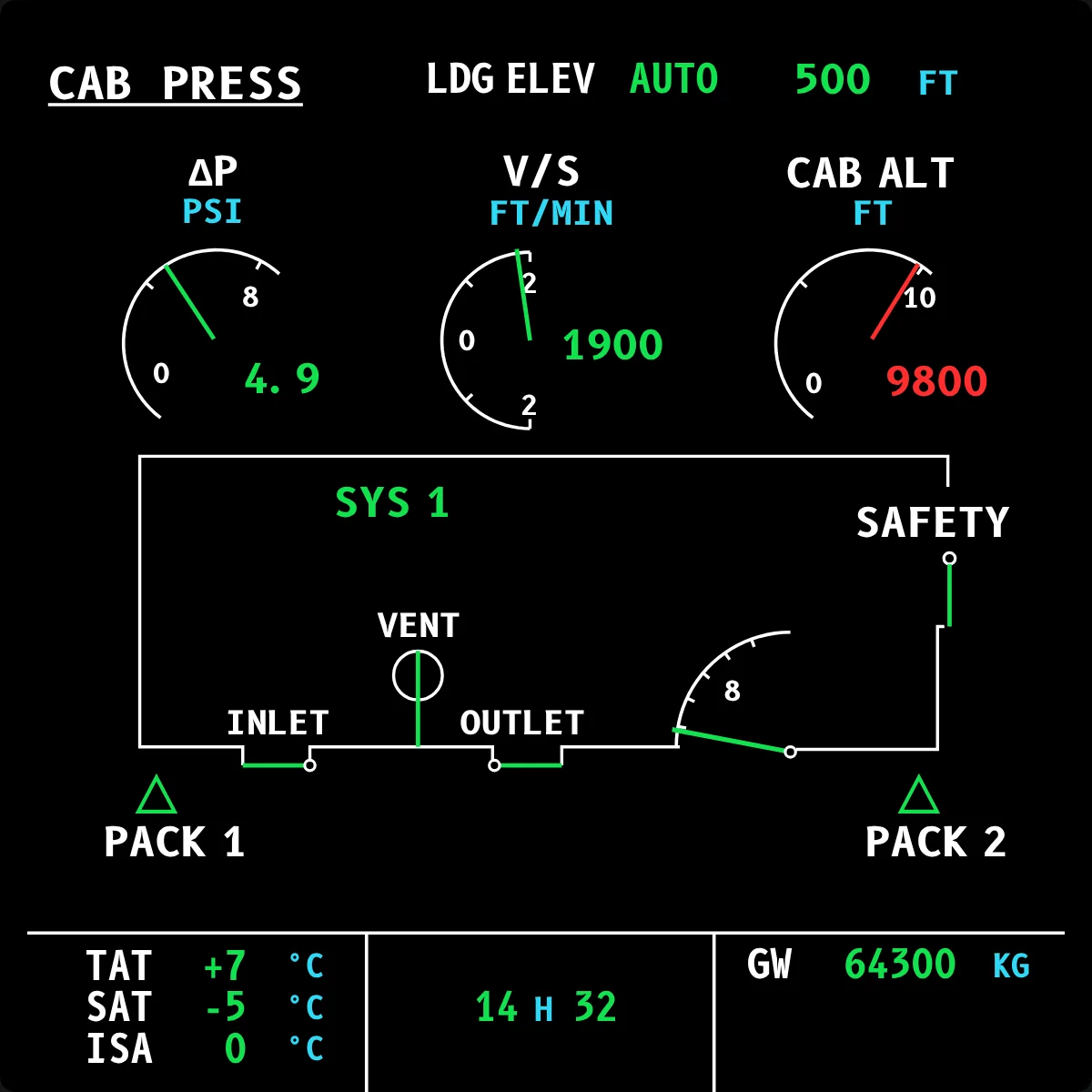
In normal operation the cabin pressure is fully automatic, and in the cruise the controller limits the cabin altitude target to about 8 000 ft. The CAB PRESS page makes the cabin altitude pulse at or above 8 800 ft and turns it red above 9 550 ft.
The warning triggers in the cruise when the cabin altitude is above 9 550 ft. In climb or descent the threshold is the higher of 9 550 ft and 1 000 ft above the airfield pressure altitude.
The FCOM adds that the warning can be triggered by a cabin pressure sensor different from the one used to control the pressure and to display the cabin altitude on the SD.
Sources FCOM DSC-21-20-10 GENERAL / FCOM DSC-21-20-30 AUTOMATIC PRESSURE CONTROL MODE / FCOM DSC-21-20-40 ECAM CAB PRESS PAGE / FCOM PRO-ABN-CAB_PR CAB PR EXCESS CAB ALT / FCOM PRO-ABN-CAB_PR CAB PR
The cabin altitude, step by step
What does the crew see and hear?
A red warning is the ECAM's highest level, and the FCOM names an excessive cabin altitude among its examples: the continuous repetitive chime, MASTER WARN flashing red, the warning in red on the E/WD, and, except in some cases, the relevant system page called up on the SD.
The CAB PRESS page shows the cabin altitude in red above 9 550 ft, and the cabin vertical speed digits pulse above 1 750 ft/min. On the CRUISE page the cabin altitude is red too: that page's description gives red at or above 9 550 ft.
If the page does not agree, the warning wins: "Rely on the CAB PR EXCESS CAB ALT warning even if not confirmed on the CAB PRESS SD page."
Sources FCOM DSC-31-10 WARNING/CAUTION CLASSIFICATION / FCOM DSC-31-10 AUDIO INDICATORS / FCOM DSC-31-30 ATTENTION GETTERS / FCOM DSC-21-20-40 ECAM CAB PRESS PAGE / FCOM DSC-21-20-40 ECAM CRUISE PAGE / FCOM PRO-ABN-CAB_PR CAB PR / FCTM PR-AEP-MISC EMER DESCENT
What does the aircraft do by itself?
The passenger oxygen containers have an electrical latch that opens by itself, to let the masks drop, if the cabin pressure altitude exceeds 14 000 ft, within plus 250 or minus 750 ft. With the HI ALT LANDING pushbutton on, where fitted, the threshold is 16 000 ft. Where fitted, the passenger address system then broadcasts prerecorded instructions.
The MASK MAN ON pushbutton, guarded in AUTO, overrides that: pressed, it opens the mask doors, and the PASSENGER SYS ON light comes on in white. In the warning's procedure, MAN ON above 14 000 ft confirms that the masks are released. The FCTM adds that the crew could press it before the cabin reaches 14 000 ft when it is obvious that it will.
In the ECAM Trainer's picture the cabin is at 9 800 ft, below that threshold: the E/WD shows the condition IF CAB ALT > 14 000 FT with the passenger mask line under it, not yet applicable. The ECAM Trainer has no passenger oxygen system: nothing it draws shows the masks drop.
Sources FCOM DSC-35-30-10 OPERATION / FCOM DSC-35-30-20 OVERHEAD PANEL / FCOM PRO-ABN-CAB_PR CAB PR / FCTM PR-AEP-MISC EMER DESCENT
Why the memory items and the emergency descent?
Memory items are the parts of an ECAM or QRH procedure that the crew must apply from memory to keep a safe flight path: in some time-critical situations there is no time to refer to the ECAM. The emergency descent is one of them, and the crew calls it out by its title, EMERGENCY DESCENT, so that the crew is aware of the situation and ready to react together.
The FCTM splits the emergency descent in two: first the memory items, with the PM watching the FMA to make sure the PF has set the aircraft in descent; then the read and do procedure on the ECAM, where the PF refines the settings. The FCTM highly recommends the autopilot and autothrust to start it.
The FCTM says an emergency descent should be started only on positive confirmation that the cabin altitude and its rate of climb are excessive and uncontrollable, but it too tells the crew to rely on this warning even if the CAB PRESS page does not confirm it.
The procedure scales with the flight level, under conditions the ECAM does not display: most of it sits under If above FL 100; below FL 160 it asks for a descent, with the cabin crew advised; above FL 160, for the full emergency descent. Both end at MAX FL 100/MEA-MORA, the line STATUS also shows.
The FCTM adds that the TCAS mode selector stays at TA/RA: avoiding a collision has priority, even if it means interrupting the descent for a while.
Sources FCOM PRO-ABN-ABN-00 CONTENT / FCOM PRO-ABN-ABN-MEM / FCOM PRO-ABN-ABN-00 INTRODUCTION / FCTM AOP-10-40 ABNORMAL AND EMERGENCY PROCEDURES / FCTM PR-AEP-MISC EMER DESCENT / FCOM PRO-ABN-CAB_PR CAB PR / FCOM PRO-ABN-CAB_PR
What can the crew do about the outflow valve?
A note closes the procedure: once the descent is established and if time permits, check on the CAB PRESS page that the outflow valve is closed. If it is not, with a positive differential pressure, select the other controller; if it still does not close, MODE SEL to MAN and V/S CTL full down.
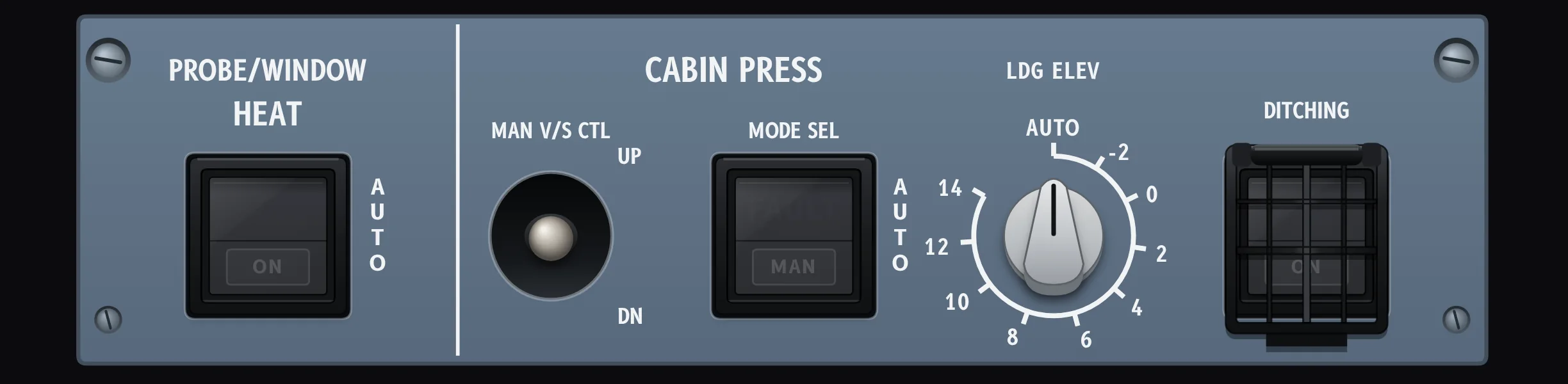
On the panel, MODE SEL at MAN for at least 10 s and back to AUTO selects the other system. MAN alone cuts the power to the automatic motors and gives the valve to the manual motor; MAN V/S CTL DN moves it towards closed.
Sources FCOM PRO-ABN-CAB_PR CAB PR / FCOM DSC-21-20-40 OVERHEAD PANEL / FCOM DSC-21-20-30 MANUAL PRESSURE CONTROL MODE
The outflow valve by hand
The cabin at 9 800 ft and climbing at 1 900 ft/min, CAB ALT red on the page, system 1 in control. Predict first, then press MODE SEL on the CABIN PRESS panel and watch the CAB PRESS page.
-
Predict The outflow valve will not close, and you set MODE SEL to MAN. What moves the valve now?
Try it Press MODE SEL to MAN.
MAN lights white. On the CAB PRESS page SYS 1 goes and MAN appears in green: the automatic motors have lost their power, and the manual motor now drives the outflow valve.
In the drawing, MAN V/S CTL does not move the valve or the cabin figures, and MODE SEL back at AUTO gives control to system 1 again. On the aircraft, DN moves the valve towards closed, and MAN for at least 10 s, then AUTO, selects the other system. The procedures say it may take 10 s in manual mode before the crew notices the valve move; the system description gives up to 5 s for the ECAM indication.
Sources FCOM DSC-21-20-40 OVERHEAD PANEL / FCOM DSC-21-20-30 MANUAL PRESSURE CONTROL MODE / FCOM DSC-21-20-40 ECAM CAB PRESS PAGE / FCOM PRO-ABN-CAB_PR CAB PR
When does the emergency descent end?
The target is MAX FL 100/MEA-MORA, and STATUS shows it. Below FL 100, the FCTM asks the crew to limit the rate of descent to about 1 000 ft/min, except during the approach; it gives about 7 000 ft/min at idle thrust, high speed and speed brakes out, and about 4 min and 40 NM from FL 390 to FL 100.
The FCOM's notes ask the crew to tell the cabin crew when the aircraft reaches a safe flight level. To save oxygen they set the crew masks' diluter selector to N: left at 100 %, the oxygen quantity may not be enough for the whole descent.
Once the masks are off, the FCTM has the crew close the mask stowage compartment and press the PRESS TO RESET slide, which deactivates the mask microphone and cuts the oxygen.
Sources FCOM PRO-ABN-CAB_PR CAB PR / FCOM PRO-ABN-CAB_PR / FCTM PR-AEP-MISC EMER DESCENT
What is lost afterwards?
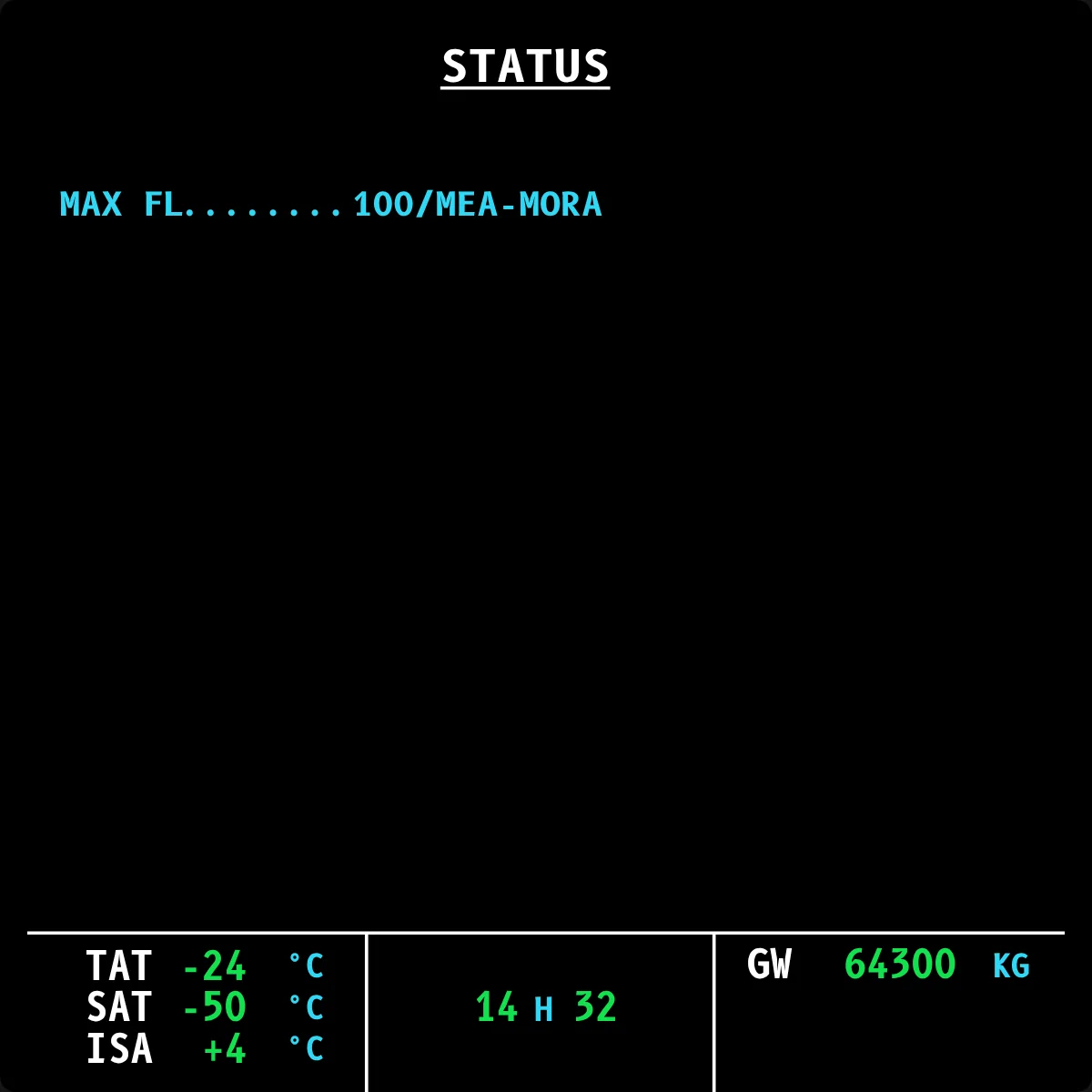
STATUS is the aircraft's operational summary. The FCOM prints one STATUS for this warning, for all aircraft: MAX FL 100/MEA-MORA, in blue, the colour of a limitation. It lists no inoperative system.
Sources FCOM DSC-31-20 STATUS PAGE / FCOM PRO-ABN-CAB_PR
A319ceo, A320ceo, A320neo, A321neo: what differs?
| A319ceo, A320ceo | A320neo, A321neo | |
|---|---|---|
| The warning, its procedure and STATUS | The same in every version | The same in every version |
| The CAB PRESS page: cabin altitude red above 9 550 ft | The same on all four types | The same on all four types |
Sources FCOM PRO-ABN-CAB_PR CAB PR EXCESS CAB ALT / FCOM PRO-ABN-CAB_PR CAB PR / FCOM PRO-ABN-CAB_PR / FCOM DSC-21-20-40 ECAM CAB PRESS PAGE

Work CAB PR EXCESS CAB ALT as a crew
Read and do each line against the FCOM, with the E/WD, the SD page and the overhead following your hands, the PF and PM calls, and a debrief that says what you missed.
Work this failure in the ECAM TrainerGo further
Written in our own words from the FCOM and the FCTM; each part names the units it rests on. The E/WD, the STATUS and the live aircraft are the platform's own ECAM and systems model, the same the ECAM Trainer and the flight deck run. This page explains the procedure; it is not the procedure. Aircraft differ by type, engine and options: your aircraft's FCOM, your QRH and your operator's procedures always come first. How we write and check these pages.
Every ECAM procedure, line by line, against the FCOM.
The ECAM Trainer works 108 scenarios with the E/WD, the SD page and the overhead following your hands. Start free today, or open everything with A320 Knowledge+.
For study and revision only. Always follow your operator's approved documentation and procedures. A320 Knowledge is independent and not affiliated with Airbus.
Related
- CAB PR LO DIFF PRAn amber caution: the differential pressure would reach zero in less than 1.5 min, and in less than the cabin's time to the landing field elevation plus 30 s.
- CAB PR SAFETY VALVE OPENAn amber caution: a safety valve has stayed open.
- CAB PR SYS 1+2 FAULTAn amber caution that takes both automatic pressure controllers.
- A320 air conditioning and pressurisationThe system guide, with the live aircraft
- Every ECAM procedureThe alerts the ECAM Trainer works, grouped by system