
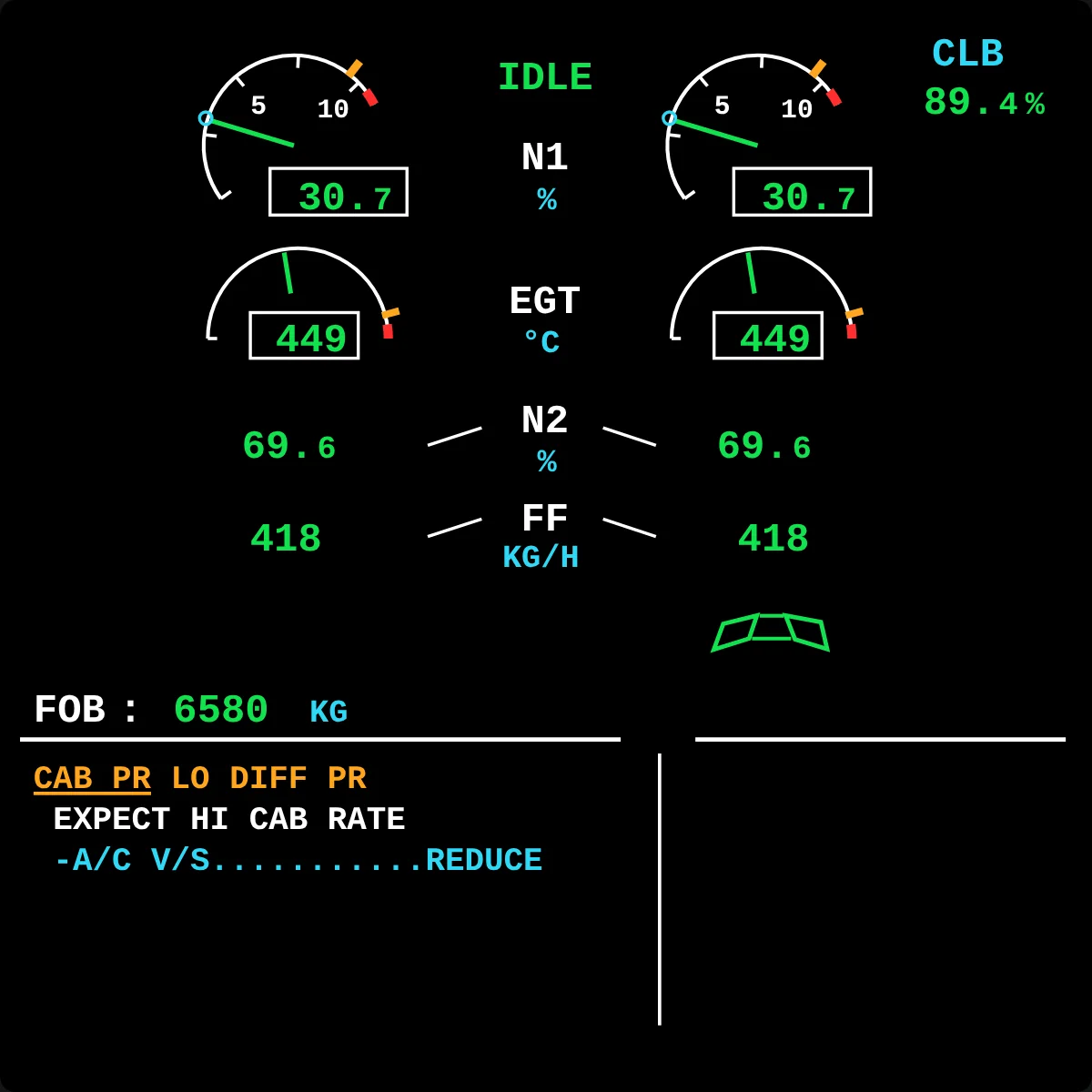
CAB PR LO DIFF PR
An amber caution: the differential pressure would reach zero in less than 1.5 min, and in less than the cabin's time to the landing field elevation plus 30 s. Here are the three conditions behind it, the two lines the crew gets, and what a negative differential pressure would bring, with the live aircraft at the moment the caution comes on.
Written and checked by current A320 pilotschecked against the FCOM on Our editorial policy
What CAB PR LO DIFF PR means
CAB PR LO DIFF PR is an amber caution: the differential pressure between the cabin and the outside air would reach zero in less than 1.5 min, and in less than the time the cabin altitude needs to reach the landing field elevation plus 30 s, with the aircraft still at least 3 000 ft above it.
The procedure has two lines: a remark, EXPECT HI CAB RATE, and one action, A/C V/S REDUCE. The FCOM leaves the action out of the display in an emergency descent for an excessive cabin altitude. There is no STATUS.
Sources FCOM PRO-ABN-CAB_PR CAB PR LO DIFF PR / FCOM PRO-ABN-CAB_PR CAB PR
At a glance
- Level
- Amber caution, level 2: single chime, MASTER CAUT and, except in some cases, the CAB PRESS page on the SD
- Sets it off
- The differential pressure would reach zero in less than 1.5 min, and in less than the time the cabin altitude needs to reach the landing field elevation plus 30 s, with the aircraft at least 3 000 ft above that elevation
- Stays
- The alert remains when the aircraft descends within 3 000 ft of the landing field elevation
- Procedure
- EXPECT HI CAB RATE, then A/C V/S REDUCE
- STATUS
- None: the FCOM prints no STATUS for this caution
Sources FCOM DSC-31-10 WARNING/CAUTION CLASSIFICATION / FCOM DSC-31-30 ATTENTION GETTERS / FCOM DSC-31-20 SYSTEM PAGES / FCOM PRO-ABN-CAB_PR CAB PR LO DIFF PR / FCOM PRO-ABN-CAB_PR CAB PR
What sets the caution off?
In its automatic descent mode the pressure controller sets a cabin rate of descent so that the cabin pressure equals the landing field pressure plus 0.1 PSI shortly before landing. The FCOM gives 750 ft/min as that mode's maximum cabin descent rate.
The caution compares two times. It triggers when all three conditions hold: the time to reach a differential pressure of zero is less than 1.5 min; it is also less than the time for the cabin altitude to reach the landing field elevation, plus 30 s; and the aircraft is at least 3 000 ft above the landing field elevation.
Once on, it stays: the FCOM notes that the alert remains when the aircraft descends within 3 000 ft of the landing field elevation.
Sources FCOM DSC-21-20-30 AUTOMATIC PRESSURE CONTROL MODE / FCOM PRO-ABN-CAB_PR CAB PR LO DIFF PR
Three conditions, all together
What does the crew see and hear?
A level 2 caution: a single chime, MASTER CAUT steady amber, the caution in amber on the E/WD, and, except in some cases, the CAB PRESS page called up on the SD.
On the CAB PRESS page the crew follows the cabin vertical speed, whose digits pulse above 1 750 ft/min, and the differential pressure, green in its normal range and amber at or below -0.4 PSI.
Sources FCOM DSC-31-10 WARNING/CAUTION CLASSIFICATION / FCOM DSC-31-30 ATTENTION GETTERS / FCOM DSC-31-20 SYSTEM PAGES / FCOM DSC-21-20-40 ECAM CAB PRESS PAGE
The moment the caution comes on
In the descent, system 1 in control, the cabin at 3 900 ft coming down at 350 ft/min and 5 PSI above the outside air. Press the button to bring up the caution, then look at the E/WD and the CAB PRESS page.
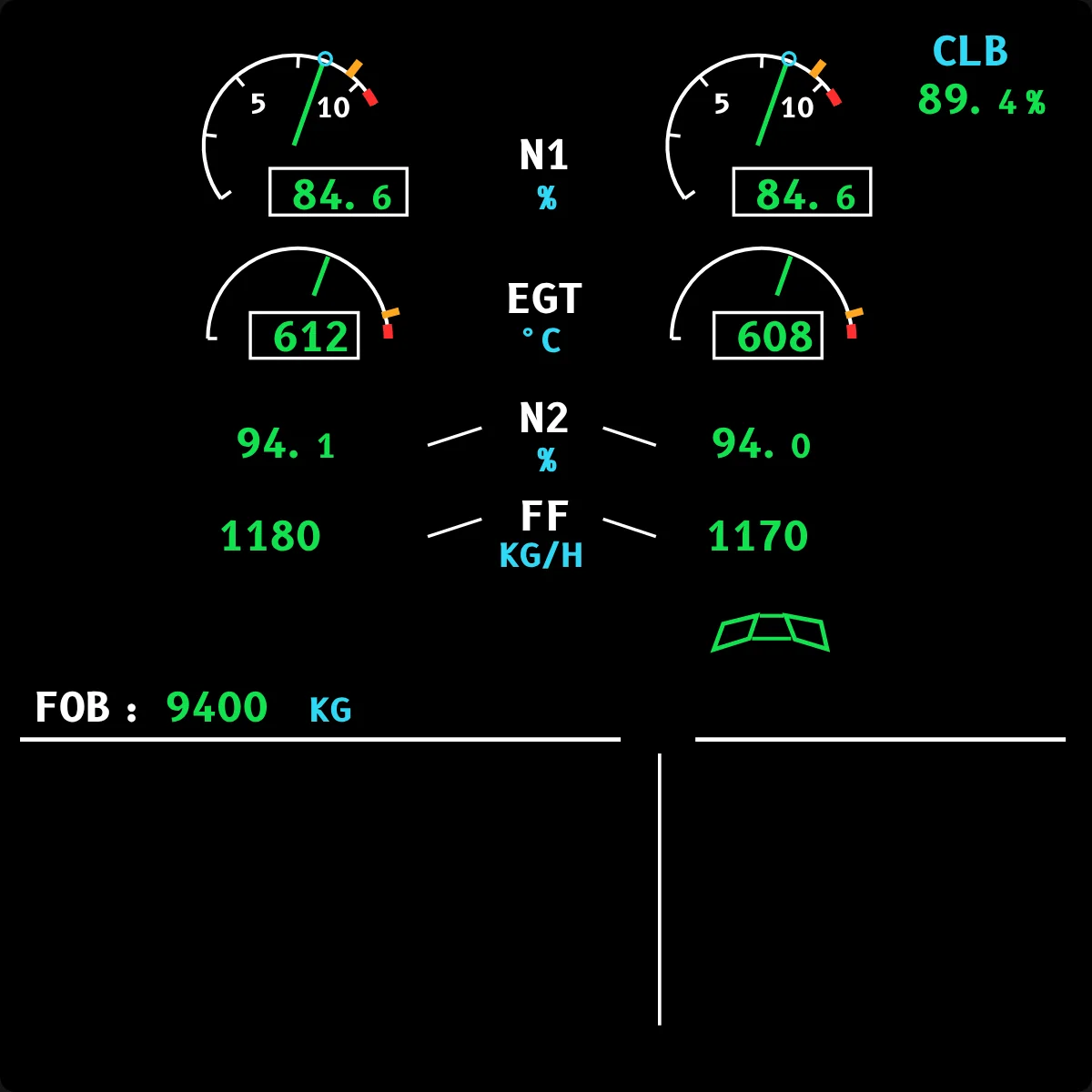
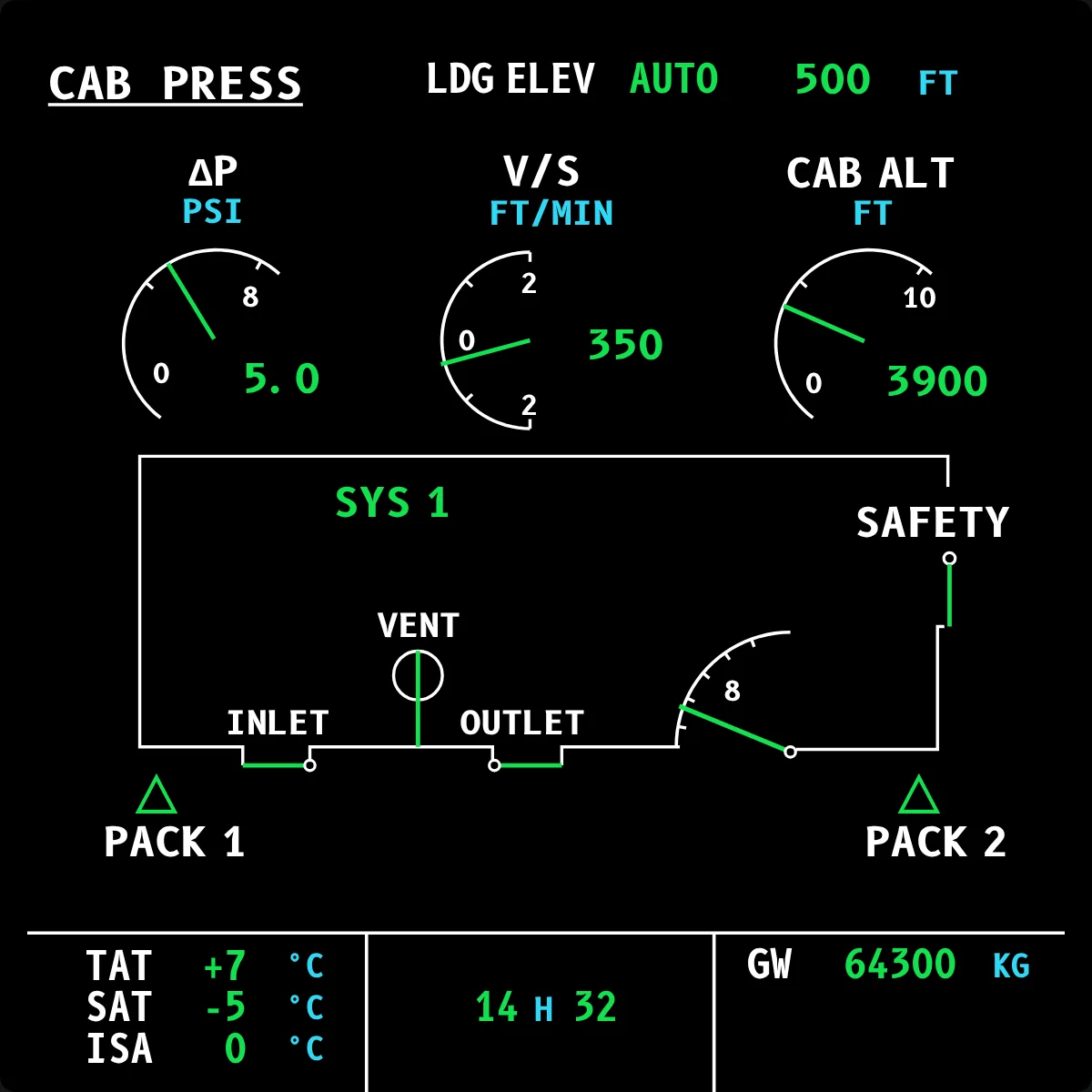
The alert Bring up the low differential pressure caution
The E/WD shows the caution in amber with its two lines: EXPECT HI CAB RATE, a remark, and A/C V/S REDUCE. The CAB PRESS page is on the SD.
The drawing raises the caution when the button is pressed: it does not work out the two times the FCOM compares, so the cabin figures do not change. On the aircraft, the three conditions of the trigger decide. The drawing stands in the descent, above 800 ft: flight phase 6, one of the two phases in which the FCOM's flight phase chart lets this caution through.
Sources FCOM PRO-ABN-CAB_PR CAB PR / FCOM DSC-31-20 SYSTEM PAGES / FCOM PRO-ABN-CAB_PR CAB PR LO DIFF PR / FCOM DSC-31-15 FLIGHT PHASES
What does A/C V/S REDUCE ask of the crew?
The procedure is a remark and one action. EXPECT HI CAB RATE tells the crew what to expect; A/C V/S REDUCE is for the aircraft, not the cabin: the crew reduces the aircraft's vertical speed. No line of the procedure involves the CABIN PRESS panel.
The FCOM gives no reason in words. Its trigger sets the time for the differential pressure to reach zero against the time the cabin needs to come down to the landing field elevation, and its description of the automatic mode limits the cabin's rate of descent to 750 ft/min.
Sources FCOM PRO-ABN-CAB_PR CAB PR / FCOM PRO-ABN-CAB_PR CAB PR LO DIFF PR / FCOM DSC-21-20-30 AUTOMATIC PRESSURE CONTROL MODE
When is A/C V/S REDUCE not displayed?
The FCOM says the A/C V/S REDUCE line is not displayed in an emergency descent for an excessive cabin altitude. It gives no reason for it.
That emergency descent belongs to CAB PR EXCESS CAB ALT, a red warning. The FCTM gives a rate of descent of about 7 000 ft/min at idle thrust, high speed and speed brakes extended, and asks the crew, below FL 100, to limit the rate of descent to about 1 000 ft/min, except during the approach.
Sources FCOM PRO-ABN-CAB_PR CAB PR / FCOM PRO-ABN-CAB_PR CAB PR EXCESS CAB ALT / FCTM PR-AEP-MISC EMER DESCENT
What if the differential pressure goes negative?
The two safety valves keep the cabin from going more than 1 PSI below the outside pressure, and the limitations give -1.0 PSI as the maximum negative differential pressure. On the CAB PRESS page the differential pressure turns amber at or below -0.4 PSI.
If a safety valve is not fully closed in flight for more than 1 min, CAB PR SAFETY VALVE OPEN triggers. Its branch for a differential pressure below 0 PSI prints the same two lines as this caution: EXPECT HI CAB RATE and A/C V/S REDUCE.
Sources FCOM DSC-21-20-20 SAFETY VALVES / FCOM LIM-AIR CABIN PRESSURE / FCOM DSC-21-20-40 ECAM CAB PRESS PAGE / FCOM PRO-ABN-CAB_PR CAB PR SAFETY VALVE OPEN / FCOM PRO-ABN-CAB_PR CAB PR
What is lost afterwards?
STATUS is the aircraft's operational summary. The FCOM prints none for this caution, so there is no STATUS page to draw: the procedure ends with A/C V/S REDUCE.
Sources FCOM DSC-31-20 STATUS PAGE / FCOM PRO-ABN-CAB_PR CAB PR
A319ceo, A320ceo, A320neo, A321neo: what differs?
| A319ceo, A320ceo | A320neo, A321neo | |
|---|---|---|
| The caution and its procedure | The same in every version | The same in every version |
Sources FCOM PRO-ABN-CAB_PR CAB PR LO DIFF PR / FCOM PRO-ABN-CAB_PR CAB PR

Work CAB PR LO DIFF PR as a crew
Read and do each line against the FCOM, with the E/WD, the SD page and the overhead following your hands, the PF and PM calls, and a debrief that says what you missed.
Work this failure in the ECAM TrainerGo further
Written in our own words from the FCOM and the FCTM; each part names the units it rests on. The E/WD, the STATUS and the live aircraft are the platform's own ECAM and systems model, the same the ECAM Trainer and the flight deck run. This page explains the procedure; it is not the procedure. Aircraft differ by type, engine and options: your aircraft's FCOM, your QRH and your operator's procedures always come first. How we write and check these pages.
Every ECAM procedure, line by line, against the FCOM.
The ECAM Trainer works 108 scenarios with the E/WD, the SD page and the overhead following your hands. Start free today, or open everything with A320 Knowledge+.
For study and revision only. Always follow your operator's approved documentation and procedures. A320 Knowledge is independent and not affiliated with Airbus.
Related
- CAB PR EXCESS CAB ALTA red warning: the cabin altitude is too high.
- CAB PR SAFETY VALVE OPENAn amber caution: a safety valve has stayed open.
- CAB PR SYS 1+2 FAULTAn amber caution that takes both automatic pressure controllers.
- A320 air conditioning and pressurisationThe system guide, with the live aircraft
- Every ECAM procedureThe alerts the ECAM Trainer works, grouped by system