
CAB PR SYS 1+2 FAULT
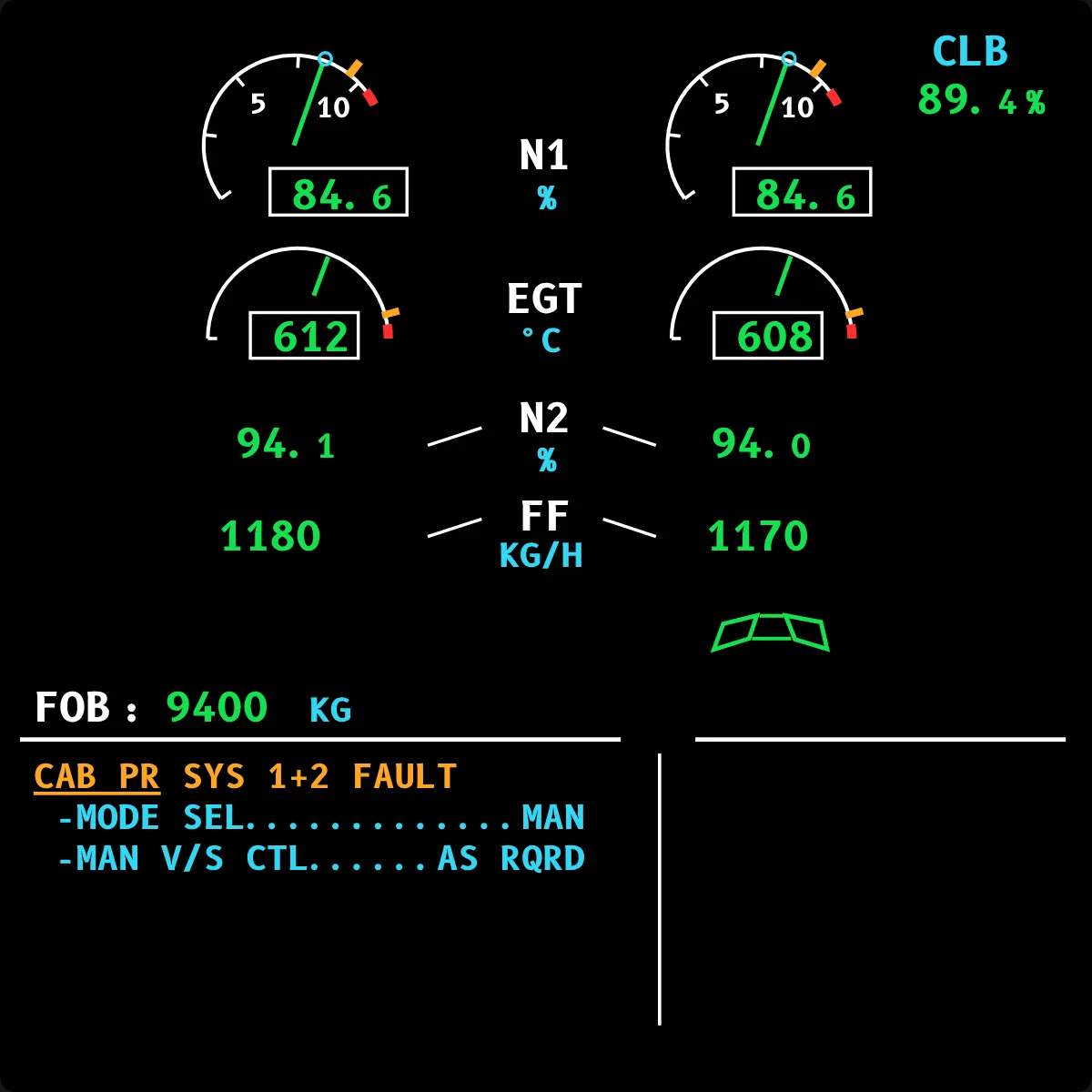
An amber caution that takes both automatic pressure controllers. Here is what the crew is left with, what MODE SEL at MAN does to the outflow valve, and what the STATUS gives the crew to fly, with the live aircraft at the moment the caution comes on.
Written and checked by current A320 pilotschecked against the FCOM on Our editorial policy
What CAB PR SYS 1+2 FAULT means
CAB PR SYS 1+2 FAULT is an amber caution: both cabin pressure controllers have failed, so neither automatic system can drive the outflow valve. The procedure sets MODE SEL to MAN, which cuts the power to the automatic motors and gives the valve to the manual motor, and the crew then moves it with the MAN V/S CTL switch as required.
The FCOM warns that, as the valve closes slowly in manual mode and depending on the failure, the procedure may not avoid the depressurisation. STATUS gives the crew target cabin rates and cabin altitudes, and V/S CTL FULL UP on final approach.
Sources FCOM PRO-ABN-CAB_PR CAB PR SYS 1+2 FAULT / FCOM PRO-ABN-CAB_PR CAB PR / FCOM DSC-21-20-30 MANUAL PRESSURE CONTROL MODE
At a glance
- Level
- Amber caution, level 2: single chime, MASTER CAUT and, except in some cases, the CAB PRESS page on the SD
- Sets it off
- Both cabin pressure controllers failed
- Lights
- FAULT in amber in the MODE SEL pushbutton, which comes on only when both automatic systems are faulty
- Procedure
- MODE SEL to MAN, then MAN V/S CTL as required: the crew drives the outflow valve through its manual motor
- STATUS
- MAN CAB PR CTL, target cabin rates of 500 ft/min in the climb and 300 ft/min in the descent, a cabin altitude target table, and V/S CTL FULL UP on final
Sources FCOM DSC-31-10 WARNING/CAUTION CLASSIFICATION / FCOM DSC-31-30 ATTENTION GETTERS / FCOM DSC-31-20 SYSTEM PAGES / FCOM PRO-ABN-CAB_PR CAB PR SYS 1+2 FAULT / FCOM DSC-21-20-40 OVERHEAD PANEL / FCOM PRO-ABN-CAB_PR CAB PR / FCOM DSC-21-20-30 MANUAL PRESSURE CONTROL MODE
What sets the caution off?
Two identical, independent digital controllers run the cabin pressure. In automatic mode one is active and the other on standby; each drives the single outflow valve through its own automatic motor, and the valve's actuator also carries a third, manual motor. Any one of the three motors can move the valve.
If the operating system fails, control passes automatically to the other one, and the crew sees CAB PR SYS 1 FAULT or SYS 2 FAULT, with CAB PR 1 or CAB PR 2 under INOP SYS on STATUS.
CAB PR SYS 1+2 FAULT triggers when both controllers have failed. There is no automatic system left to hand over to: what remains is the manual motor, which the crew controls from the CABIN PRESS panel.
Sources FCOM DSC-21-20-10 GENERAL / FCOM DSC-21-20-20 CABIN PRESSURE CONTROLLERS / FCOM DSC-21-20-20 OUTFLOW VALVE / FCOM DSC-21-20-30 AUTOMATIC PRESSURE CONTROL MODE / FCOM PRO-ABN-CAB_PR CAB PR SYS 1(2) FAULT / FCOM PRO-ABN-CAB_PR CAB PR / FCOM PRO-ABN-CAB_PR CAB PR SYS 1+2 FAULT / FCOM DSC-21-20-30 MANUAL PRESSURE CONTROL MODE
Two controllers, three motors
What does the crew see and hear?
A level 2 caution: a single chime, MASTER CAUT steady amber, the caution in amber on the E/WD, and, except in some cases, the CAB PRESS page called up on the SD.
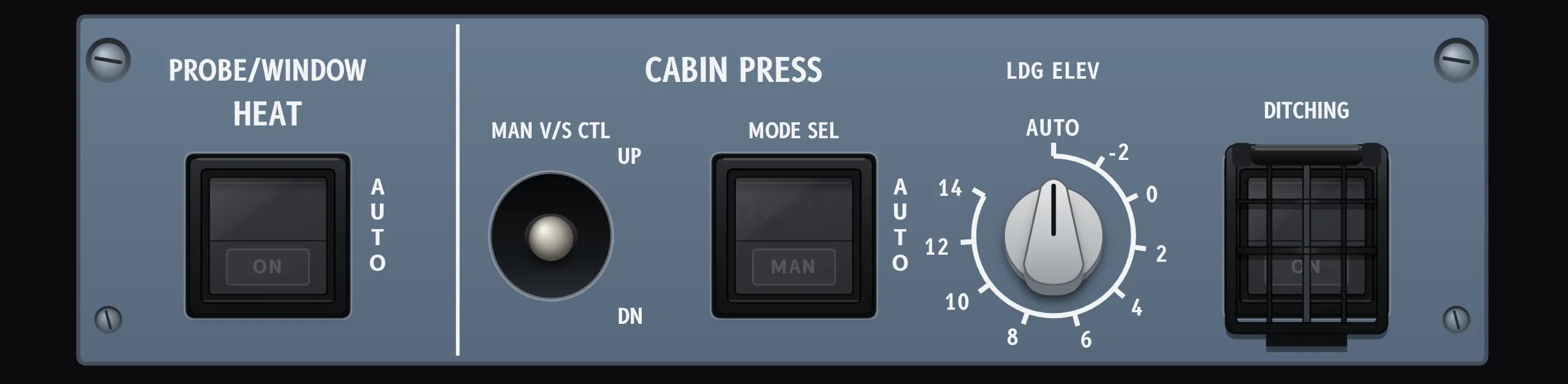
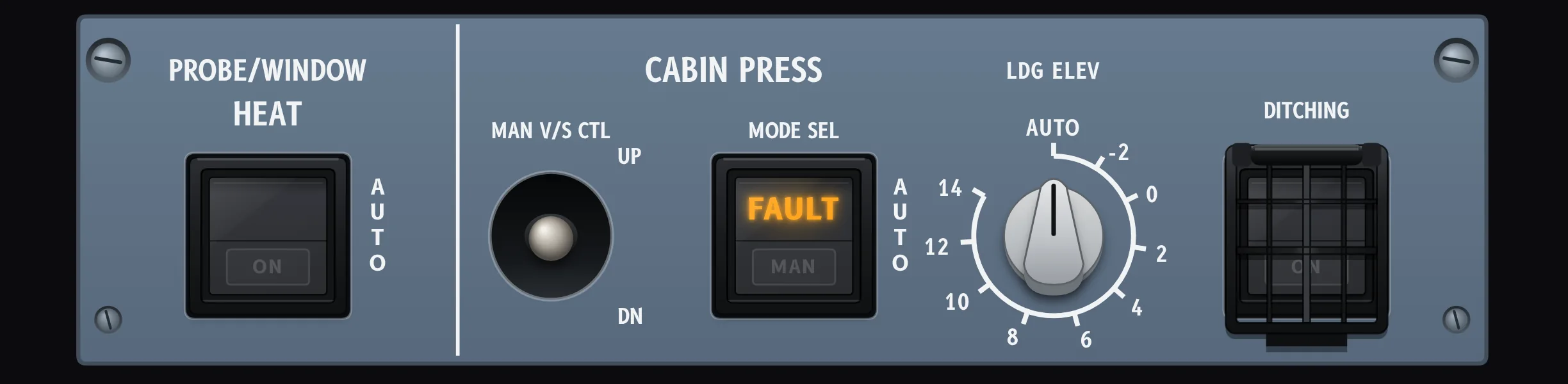
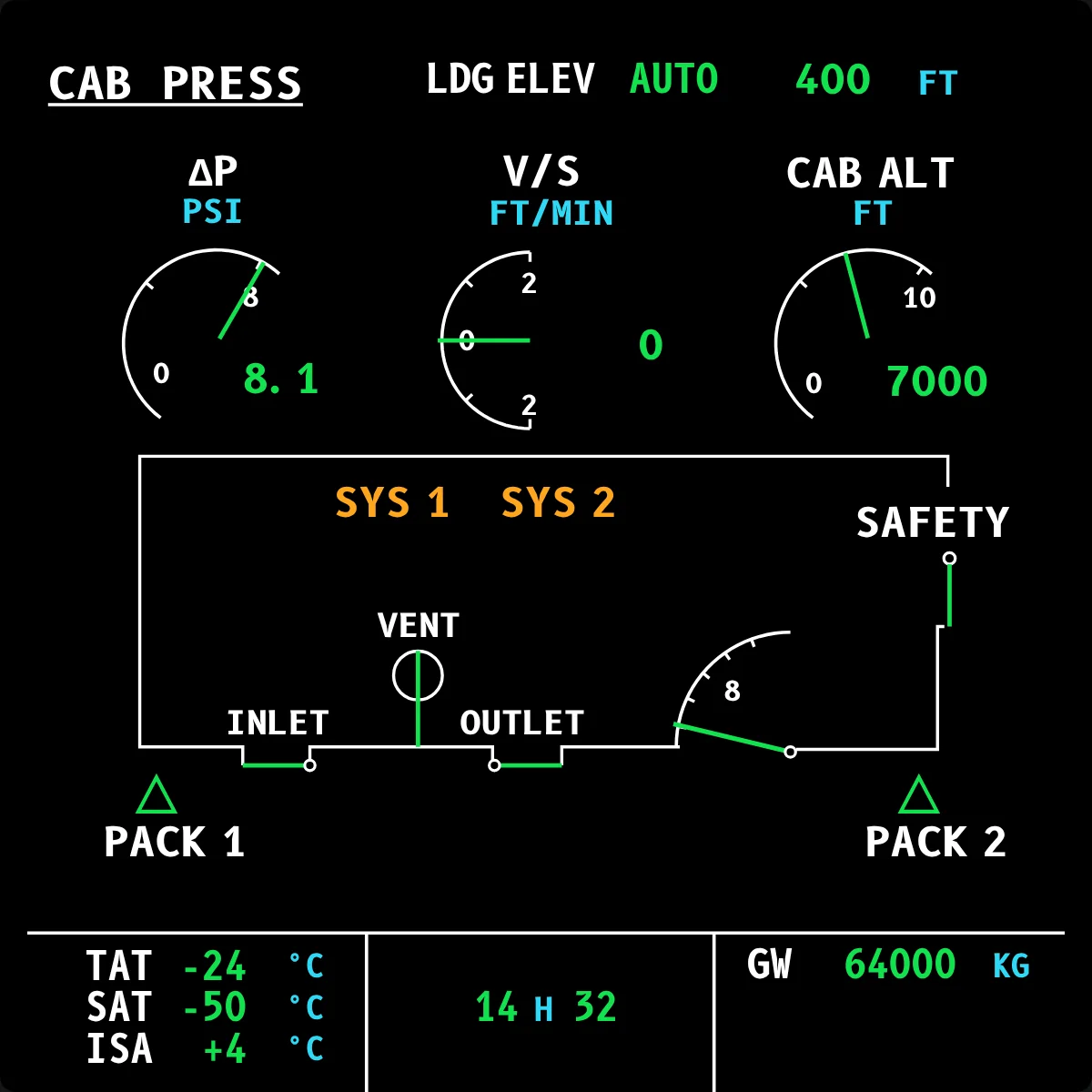
On the CABIN PRESS panel, FAULT comes on in amber in the MODE SEL pushbutton; the FCOM ties it, and the ECAM caution, to both automatic systems being faulty. On the CAB PRESS page, SYS 1 and SYS 2 appear in amber when faulty.
Sources FCOM DSC-31-10 WARNING/CAUTION CLASSIFICATION / FCOM DSC-31-30 ATTENTION GETTERS / FCOM DSC-31-20 SYSTEM PAGES / FCOM DSC-21-20-40 OVERHEAD PANEL / FCOM DSC-21-20-40 ECAM CAB PRESS PAGE
The moment the caution comes on
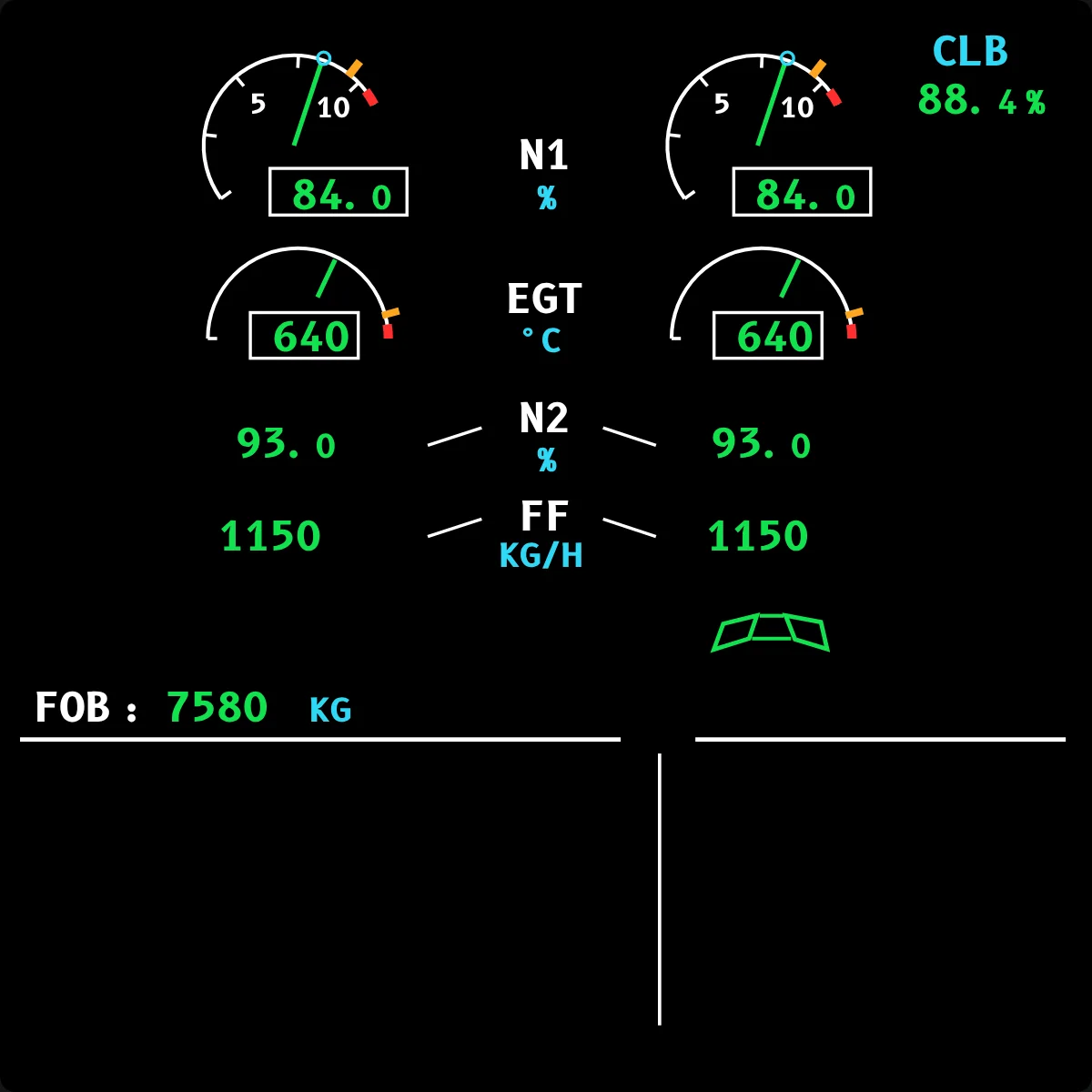
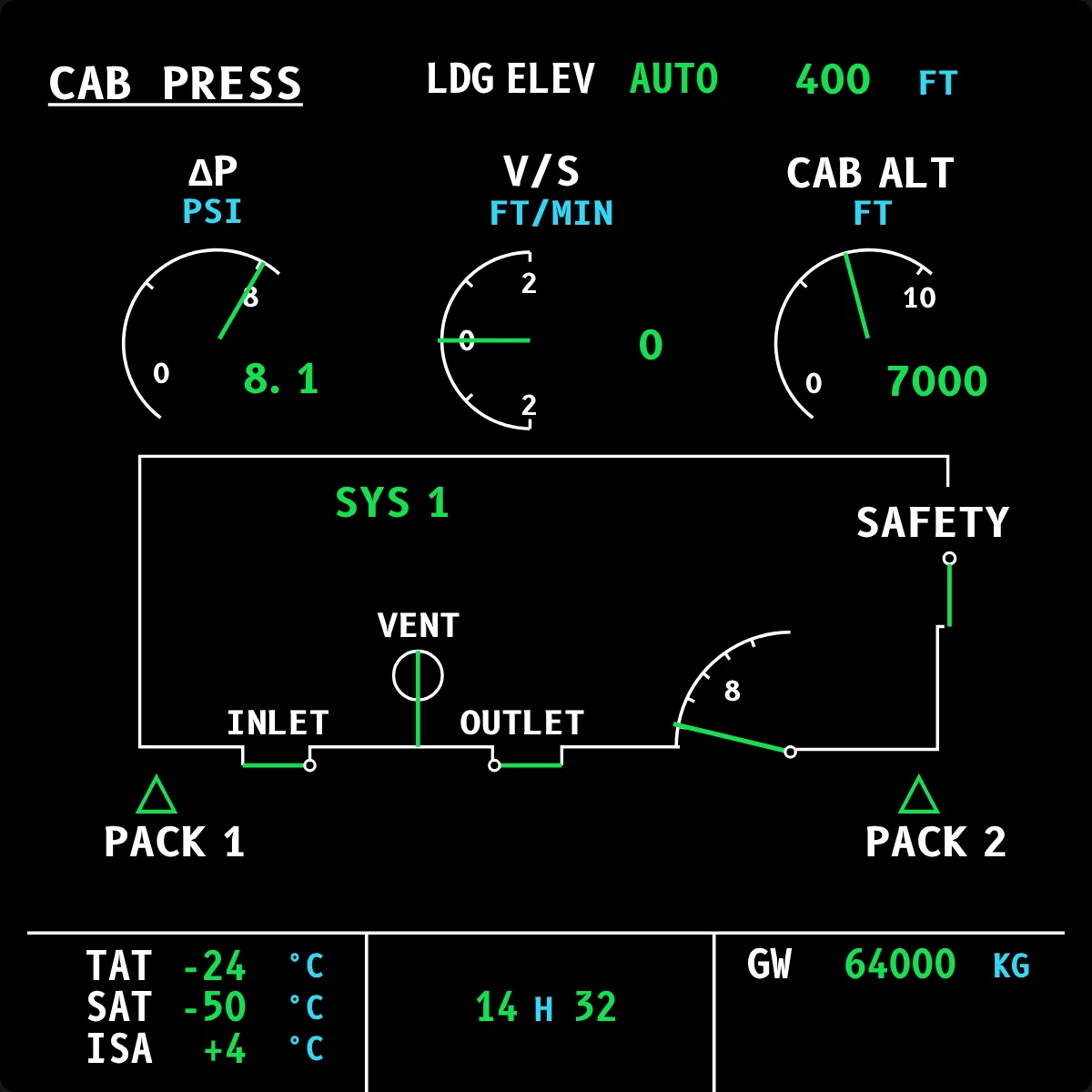
In the cruise, system 1 in control, the cabin at 7 000 ft and 8.1 PSI above the outside air. Press the button to fail both controllers, then look at the E/WD, the CAB PRESS page and the CABIN PRESS panel.
The alert Fail both pressure controllers
The E/WD shows the caution in amber with two lines: MODE SEL MAN and MAN V/S CTL AS RQRD. FAULT is lit in MODE SEL, and on the CAB PRESS page SYS 1 and SYS 2 are both amber: no system is in control.
The drawing leaves the cabin figures where they were. The FCOM gives no figures for what the cabin does next; it warns only that the procedure may not avoid a depressurisation, depending on the failure.
Sources FCOM PRO-ABN-CAB_PR CAB PR / FCOM DSC-21-20-40 OVERHEAD PANEL / FCOM DSC-21-20-40 ECAM CAB PRESS PAGE
What does MODE SEL at MAN actually do?
Releasing MODE SEL to MAN is the first of the two manual actions: it cuts the power to the automatic motors and lets the manual motor control the outflow valve. MAN shows in white and FAULT does not come on. The crew then moves the valve with MAN V/S CTL, a switch spring-loaded to neutral: UP towards open, so the cabin climbs, DN towards closed, so it descends.
In manual mode the backup section of controller 1 signals the valve position to the ECAM, and a backup pressure sensor gives the ECAM the cabin altitude and pressure. The FCOM warns that the CAB ALT indication may vary when the system switches from AUTO to MAN, from the backup sensor's reduced resolution.
Sources FCOM DSC-21-20-30 MANUAL PRESSURE CONTROL MODE / FCOM DSC-21-20-40 OVERHEAD PANEL / FCOM DSC-21-20-20 CABIN PRESSURE CONTROLLERS / FCOM DSC-21-20-20 OUTFLOW VALVE
Take the outflow valve by hand
Both controllers failed, FAULT lit in MODE SEL. Predict first, then press MODE SEL on the panel and watch the pushbutton and the CAB PRESS page.
-
Predict Both controllers are still failed. What happens to the FAULT light when you select MAN?
Try it Press MODE SEL to MAN.
FAULT goes out and MAN lights white, as the FCOM gives it for MAN, and MAN appears in green on the CAB PRESS page. The automatic motors have lost their power; on the aircraft, the valve now moves only when the crew holds MAN V/S CTL UP or DN.
In the drawing, MAN V/S CTL does not move the valve or the cabin figures. On the aircraft, the FCOM asks for short inputs to target a precise cabin rate. The procedure says it may take 10 s in manual mode before the crew notices the valve move, and to confirm it on the cabin V/S; the system description gives up to 5 s for the ECAM indication.
Sources FCOM DSC-21-20-40 OVERHEAD PANEL / FCOM DSC-21-20-30 MANUAL PRESSURE CONTROL MODE / FCOM DSC-21-20-40 ECAM CAB PRESS PAGE / FCOM PRO-ABN-CAB_PR CAB PR
What does the crew watch when flying the cabin by hand?
The FCOM opens the procedure with a warning: as the outflow valve closes slowly in manual mode, the procedure may not avoid the depressurisation, depending on the failure. Its notes then set the crew's priorities while flying the cabin by hand.
- Confirm the valve on the cabin V/S indication: a change may take 10 s to see.
- Monitor the cabin V/S and CAB ALT often, and adjust as necessary.
- Keep the aircraft altitude at or above the cabin altitude.
- The two safety valves limit the differential pressure to 8.6 PSI.
STATUS then gives the crew the numbers to fly: a target cabin rate of 500 ft/min in the climb and 300 ft/min in the descent, and a table of cabin altitude targets by flight level, from 8 000 ft at FL 390 down to 0 below FL 200. The automatic system, by comparison, limits the cabin altitude target to about 8 000 ft in the cruise, and its descent mode to a cabin rate of 750 ft/min at most.
Sources FCOM PRO-ABN-CAB_PR CAB PR / FCOM DSC-21-20-20 SAFETY VALVES / FCOM DSC-21-20-30 AUTOMATIC PRESSURE CONTROL MODE
What changes for the approach and landing?
Under manual control the outflow valve does not open by itself at touchdown. STATUS asks for V/S CTL FULL UP during the final approach, which the FCTM says is to cancel any residual cabin pressure, with a note: on the intermediate approach, below the airfield pressure altitude plus 2 500 ft, adjust the differential pressure to zero. A caution follows: check that it is zero before opening the doors.
The FCTM ties this caution to the evacuation procedure. As the residual pressure sensor indicator in the cabin door is inhibited with the slides armed, EMER EVAC asks for an additional differential pressure check. The FCTM adds that at least one automatic system must work at departure.
Where fitted, a residual pressure control unit (RPCU) opens the outflow valve on the ground by itself when abnormal pressure remains: valve not fully open, both controllers failed or MAN selected, and all engines shut down or the airspeed below 100 kt.
Two other automatic actions do not reach a valve under manual control: DITCHING does not close it automatically, and RAM AIR on below 1 PSI does not open it to about 50 %.
Sources FCOM DSC-21-20-30 MANUAL PRESSURE CONTROL MODE / FCOM PRO-ABN-CAB_PR CAB PR / FCTM PR-AEP-MISC / FCOM DSC-21-20-10 GENERAL / FCOM DSC-21-20-20 / FCOM DSC-21-20-40 OVERHEAD PANEL / FCOM DSC-21-20-20 OUTFLOW VALVE
From the cruise to the doors
What is lost afterwards?
STATUS is the aircraft's operational summary. The FCOM prints one STATUS for this caution, for all aircraft: MAN CAB PR CTL, printed in amber and underlined; the two TGT V/S lines and the table of cabin altitude targets, in blue (FL 390, 8 000 ft; FL 350, 7 000 ft; FL 300, 5 500 ft; FL 250, 3 000 ft; below FL 200, 0); then, during the final approach, V/S CTL FULL UP in blue, a note to adjust the differential pressure to zero on the intermediate approach, below the airfield pressure altitude plus 2 500 ft, and a caution to check that it is zero before opening the doors. INOP SYS lists CAB PR 1+2, in amber.
No STATUS picture is drawn here: the ECAM Trainer's picture keeps only the last row of the table, below FL 200 and 0, and draws MAN CAB PR CTL in blue, not amber and underlined.
Sources FCOM DSC-31-20 STATUS PAGE / FCOM PRO-ABN-CAB_PR CAB PR
A319ceo, A320ceo, A320neo, A321neo: what differs?
| A319ceo, A320ceo | A320neo, A321neo | |
|---|---|---|
| The caution, its procedure and STATUS | The same in every version | The same in every version |
| MODE SEL and MAN V/S CTL | The same on all four types (the A320ceo panel description calls MAN V/S CTL a selector) | The same on all four types |
Sources FCOM PRO-ABN-CAB_PR CAB PR SYS 1+2 FAULT / FCOM PRO-ABN-CAB_PR CAB PR / FCOM DSC-21-20-40 OVERHEAD PANEL

Work CAB PR SYS 1+2 FAULT as a crew
Read and do each line against the FCOM, with the E/WD, the SD page and the overhead following your hands, the PF and PM calls, and a debrief that says what you missed.
Work this failure in the ECAM TrainerGo further
Written in our own words from the FCOM and the FCTM; each part names the units it rests on. The E/WD, the STATUS and the live aircraft are the platform's own ECAM and systems model, the same the ECAM Trainer and the flight deck run. This page explains the procedure; it is not the procedure. Aircraft differ by type, engine and options: your aircraft's FCOM, your QRH and your operator's procedures always come first. How we write and check these pages.
Every ECAM procedure, line by line, against the FCOM.
The ECAM Trainer works 108 scenarios with the E/WD, the SD page and the overhead following your hands. Start free today, or open everything with A320 Knowledge+.
For study and revision only. Always follow your operator's approved documentation and procedures. A320 Knowledge is independent and not affiliated with Airbus.
Related
- CAB PR EXCESS CAB ALTA red warning: the cabin altitude is too high.
- CAB PR LO DIFF PRAn amber caution: the differential pressure would reach zero in less than 1.5 min, and in less than the cabin's time to the landing field elevation plus 30 s.
- CAB PR SAFETY VALVE OPENAn amber caution: a safety valve has stayed open.
- A320 air conditioning and pressurisationThe system guide, with the live aircraft
- Every ECAM procedureThe alerts the ECAM Trainer works, grouped by system