
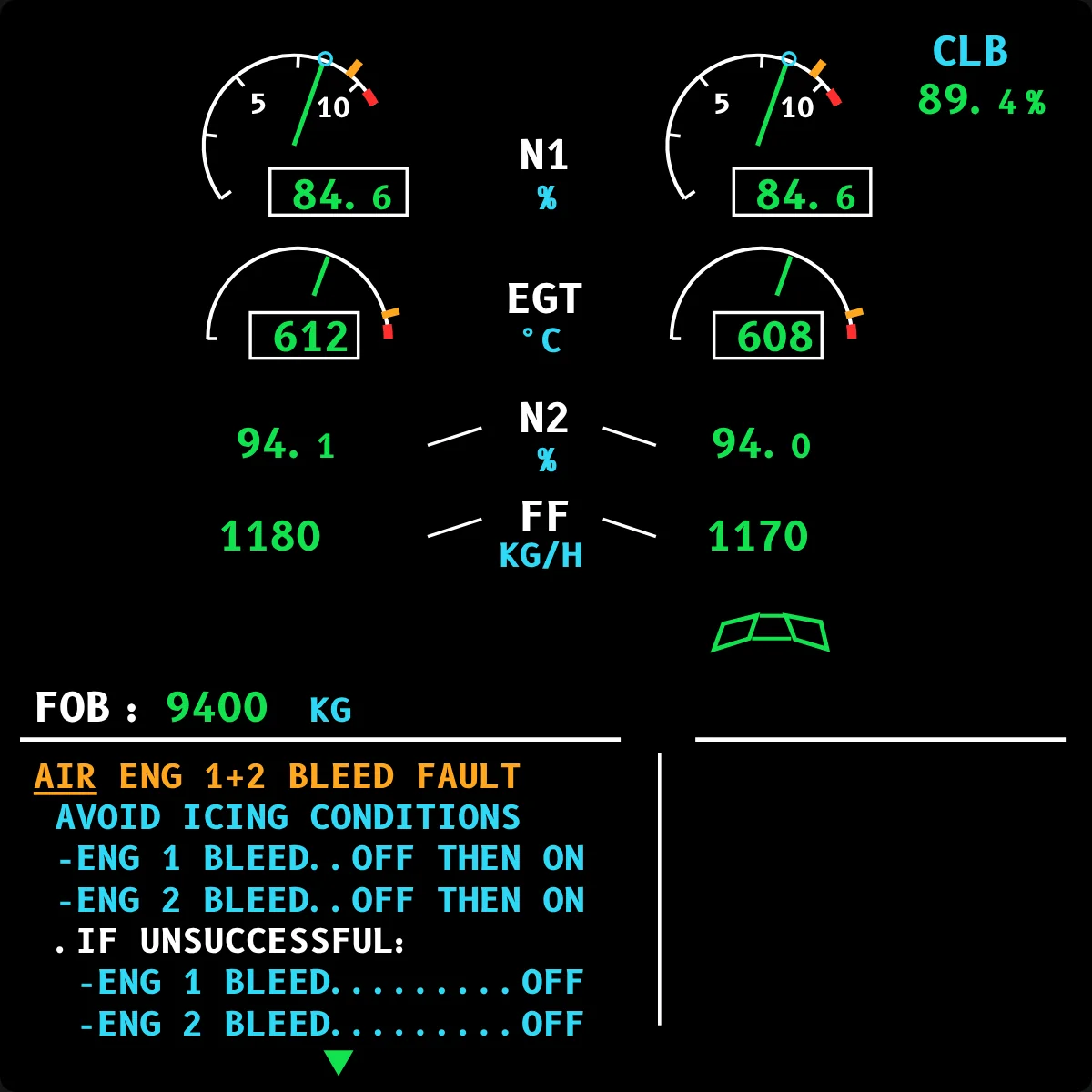
AIR ENG 1+2 BLEED FAULT
An amber caution that leaves both packs without engine air. Here is what sets it off, what the leak subtitles change, why opening the crossbleed brings no engine air, and what the ECAM asks before the descent, with the live aircraft at the moment the caution comes on.
Written and checked by current A320 pilotschecked against the FCOM on Our editorial policy
What AIR ENG 1+2 BLEED FAULT means
AIR ENG 1+2 BLEED FAULT is an amber caution: both engine bleed supply systems are lost, with no wing or pylon leak on either side. Neither pack then has engine air, and the wing anti-ice, which uses hot air from the pneumatic system, has none either.
With no leak, the procedure sets the crossbleed to AUTO and the wing anti-ice off, and tries each engine bleed once, OFF then ON. If that does not work, both bleeds go off, the aircraft descends to FL 100 or the MEA-MORA, and the crew applies the separate BLEED 1+2 procedure. STATUS asks the crew to avoid icing conditions.
Sources FCOM PRO-ABN-AIR AIR ENG 1+2 BLEED FAULT / FCOM DSC-21-10-50 CONTROLS ON OVERHEAD PANEL / FCOM DSC-30-20-10 DESCRIPTION / FCOM PRO-ABN-AIR AIR / FCOM PRO-ABN-AIR ABNORMAL AND EMERGENCY PROCEDURES / FCOM PRO-ABN-AIR
At a glance
- Level
- Amber caution, level 2: single chime, MASTER CAUT steady amber and the BLEED page on the SD
- Sets it off
- Both engine bleed supply systems lost without a wing or pylon leak on either side; with a leak, a subtitle names the side
- Lights
- FAULT in amber in an ENG BLEED pushbutton on the AIR COND panel when that side has an overpressure, an overheat or a wing or pylon leak; the alert itself names no cause
- Procedure
- With no leak: X BLEED to AUTO, wing anti-ice off, one OFF THEN ON of each engine bleed; if unsuccessful, both bleeds off and a descent
- Descent
- DES TO FL 100/MEA-MORA if the resets do not work, or at once with leaks on both sides, then BLEED 1+2 PROC
- STATUS
- AVOID ICING CONDITIONS; inoperative: WING A. ICE, ENG 1 BLEED, ENG 2 BLEED, APU BLEED and PACK 1+2
Sources FCOM DSC-31-10 WARNING/CAUTION CLASSIFICATION / FCOM DSC-31-30 ATTENTION GETTERS / FCOM DSC-31-20 SYSTEM PAGES / FCOM PRO-ABN-AIR AIR ENG 1+2 BLEED FAULT / FCOM PRO-ABN-AIR LEFT LEAK / FCOM PRO-ABN-AIR RIGHT LEAK / FCOM PRO-ABN-AIR LEFT LEAK AND RIGHT LEAK / FCOM DSC-36-20 OVERHEAD PANEL / FCOM PRO-ABN-AIR AIR / FCOM PRO-ABN-AIR / FCOM PRO-ABN-AIR ABNORMAL AND EMERGENCY PROCEDURES
What sets the caution off?
The FCOM's condition is short: both engine bleed supply systems are lost, without a wing leak or a pylon leak on either side. It names no cause. Each engine's bleed valve closes, among other cases, when its BMC detects an overtemperature or an overpressure, and the FAULT light of that side comes on.
If a leak is part of the loss, the same title carries a subtitle and a procedure of its own: LEFT LEAK for a left wing leak or a pylon leak on side 1, RIGHT LEAK for the right wing or pylon 2, and LEFT LEAK AND RIGHT LEAK for both sides.
Sources FCOM PRO-ABN-AIR AIR ENG 1+2 BLEED FAULT / FCOM DSC-36-10-20 PRESSURE REGULATION AND LIMITATION / FCOM DSC-36-20 OVERHEAD PANEL / FCOM PRO-ABN-AIR LEFT LEAK / FCOM PRO-ABN-AIR RIGHT LEAK / FCOM PRO-ABN-AIR LEFT LEAK AND RIGHT LEAK
Two bleeds lost, and which caution
What does the crew see and hear?
A level 2 caution: a single chime, the MASTER CAUT light steady amber and the caution in amber on the E/WD, and the SD normally calls up the relevant system page by itself, here the BLEED page.
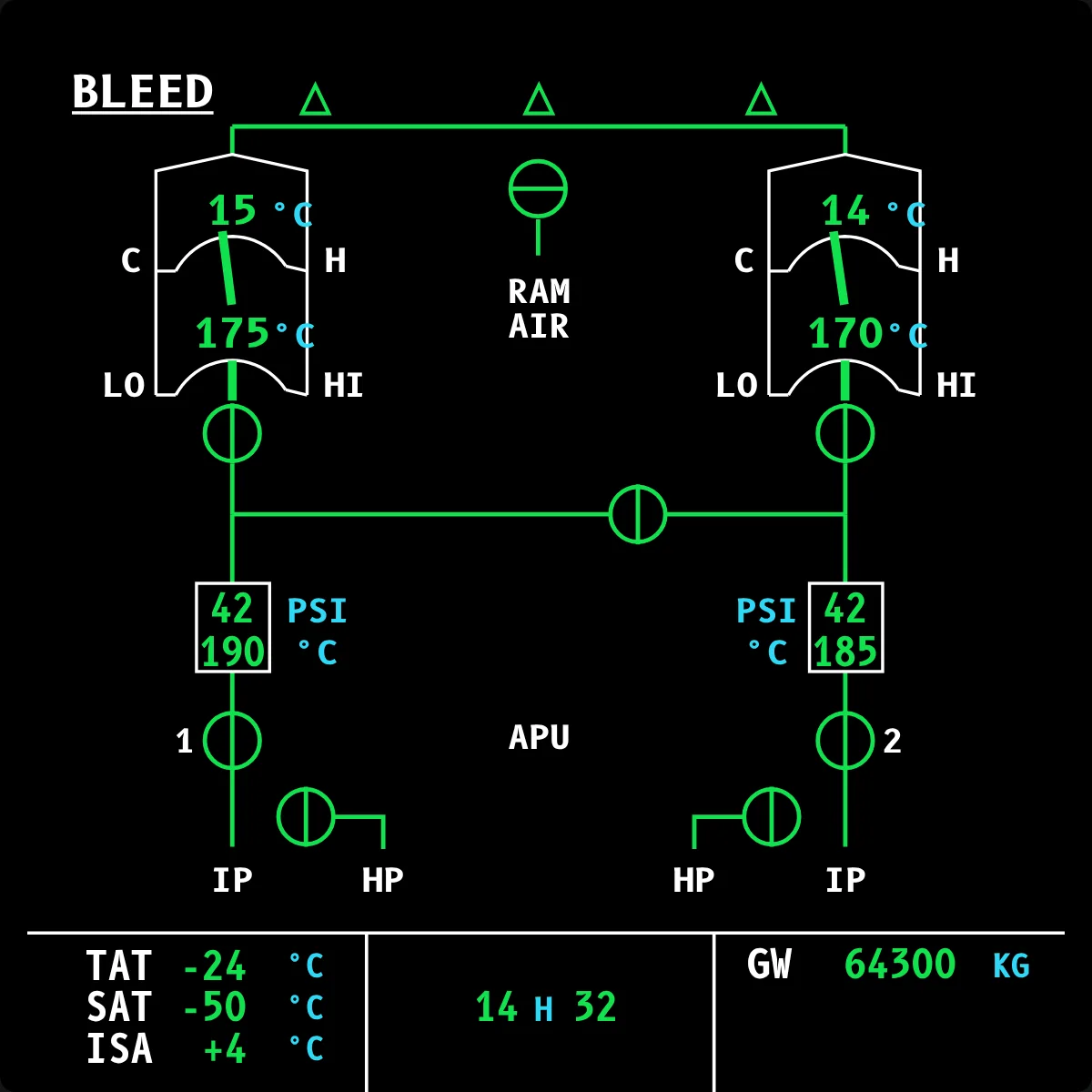
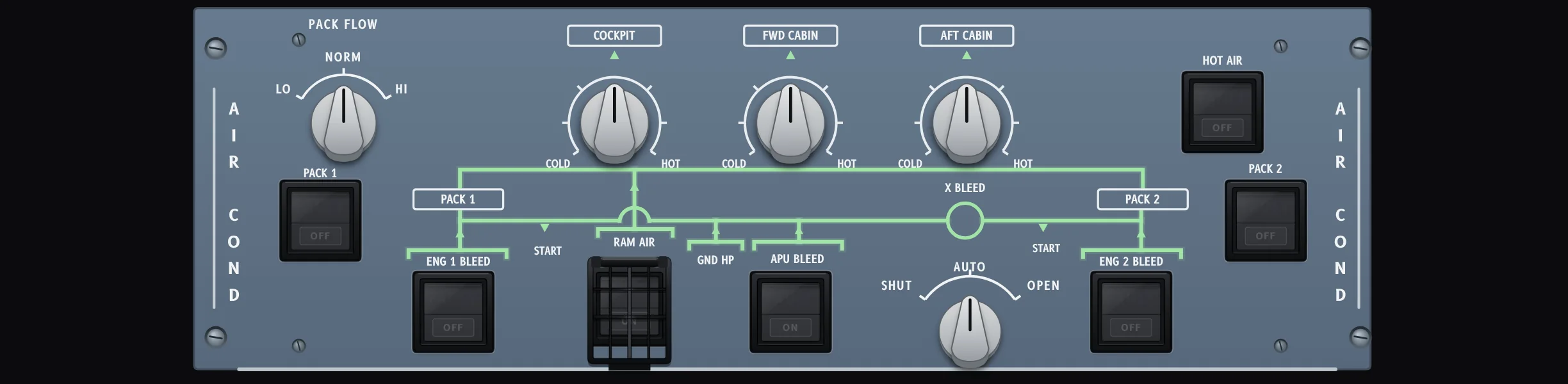
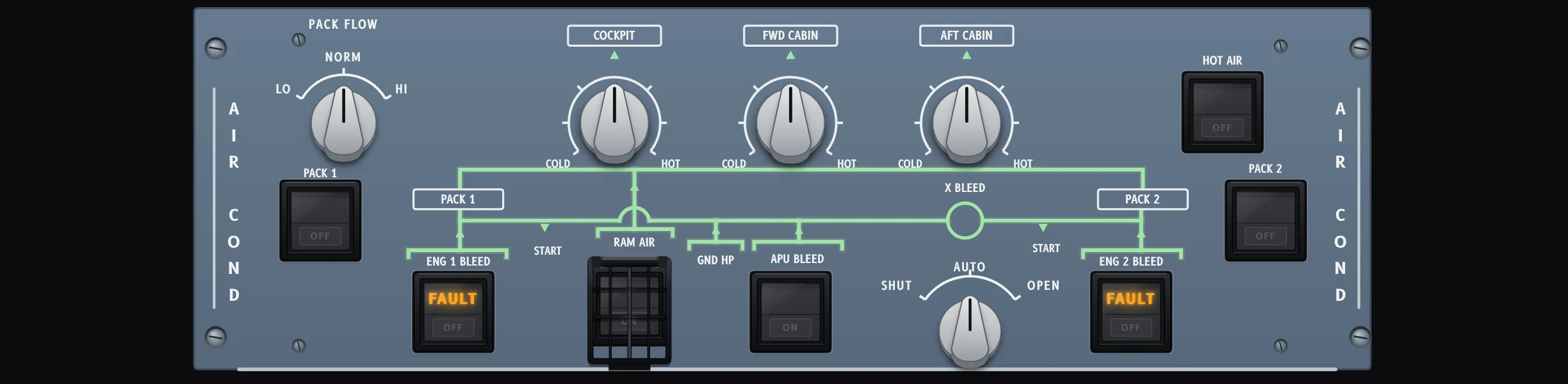
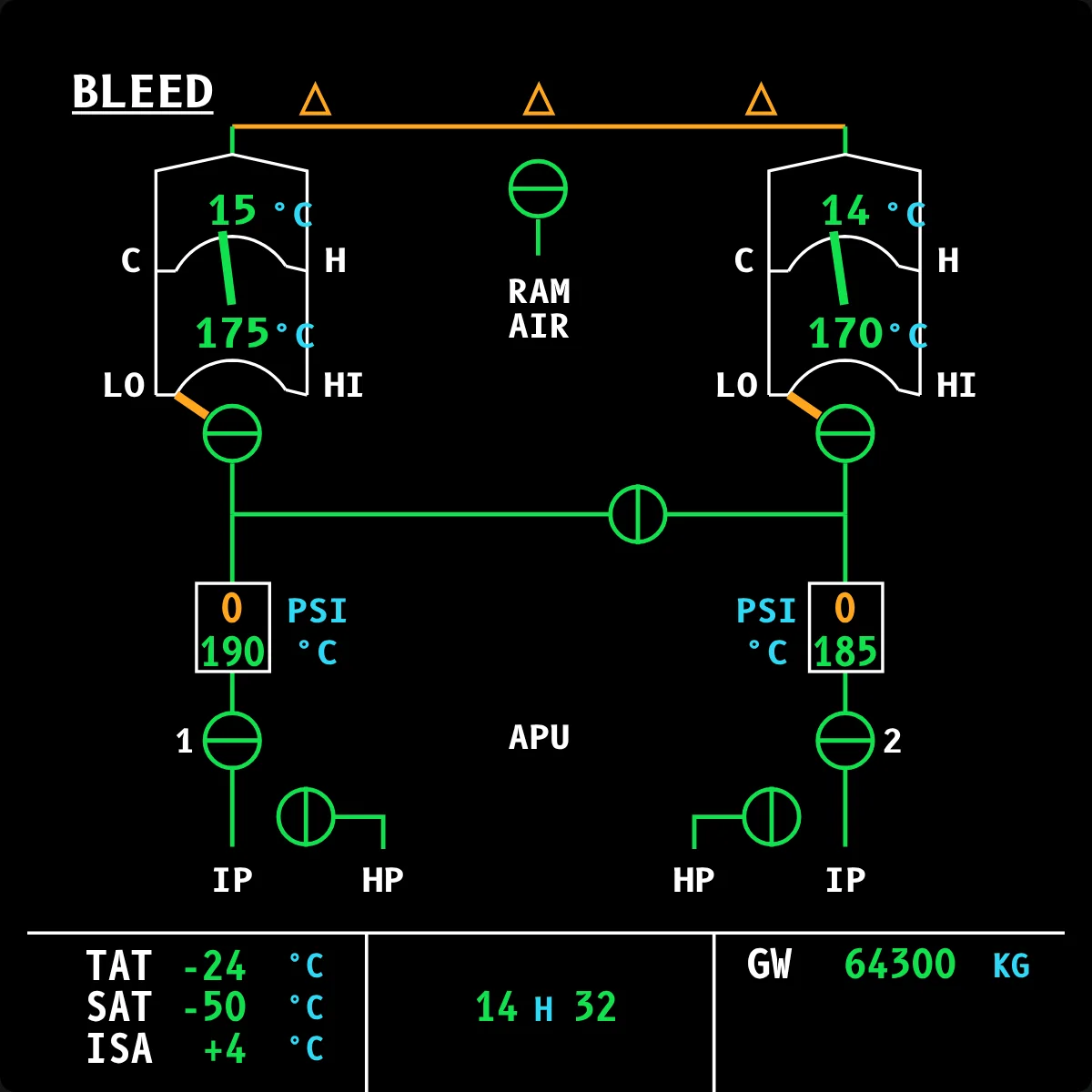
Where both bleeds closed on an overpressure or an overheat, as in the live aircraft below, FAULT lights in both ENG BLEED pushbuttons on the AIR COND panel. On the BLEED page, both engine bleed valves show closed, and both packs' flow control valves close, since each opens only with enough upstream pressure.
Sources FCOM DSC-31-10 WARNING/CAUTION CLASSIFICATION / FCOM DSC-31-30 ATTENTION GETTERS / FCOM DSC-31-20 SYSTEM PAGES / FCOM DSC-36-20 OVERHEAD PANEL / FCOM DSC-36-20 ECAM BLEED PAGE / FCOM DSC-21-10-50 CONTROLS ON OVERHEAD PANEL
The moment the caution comes on
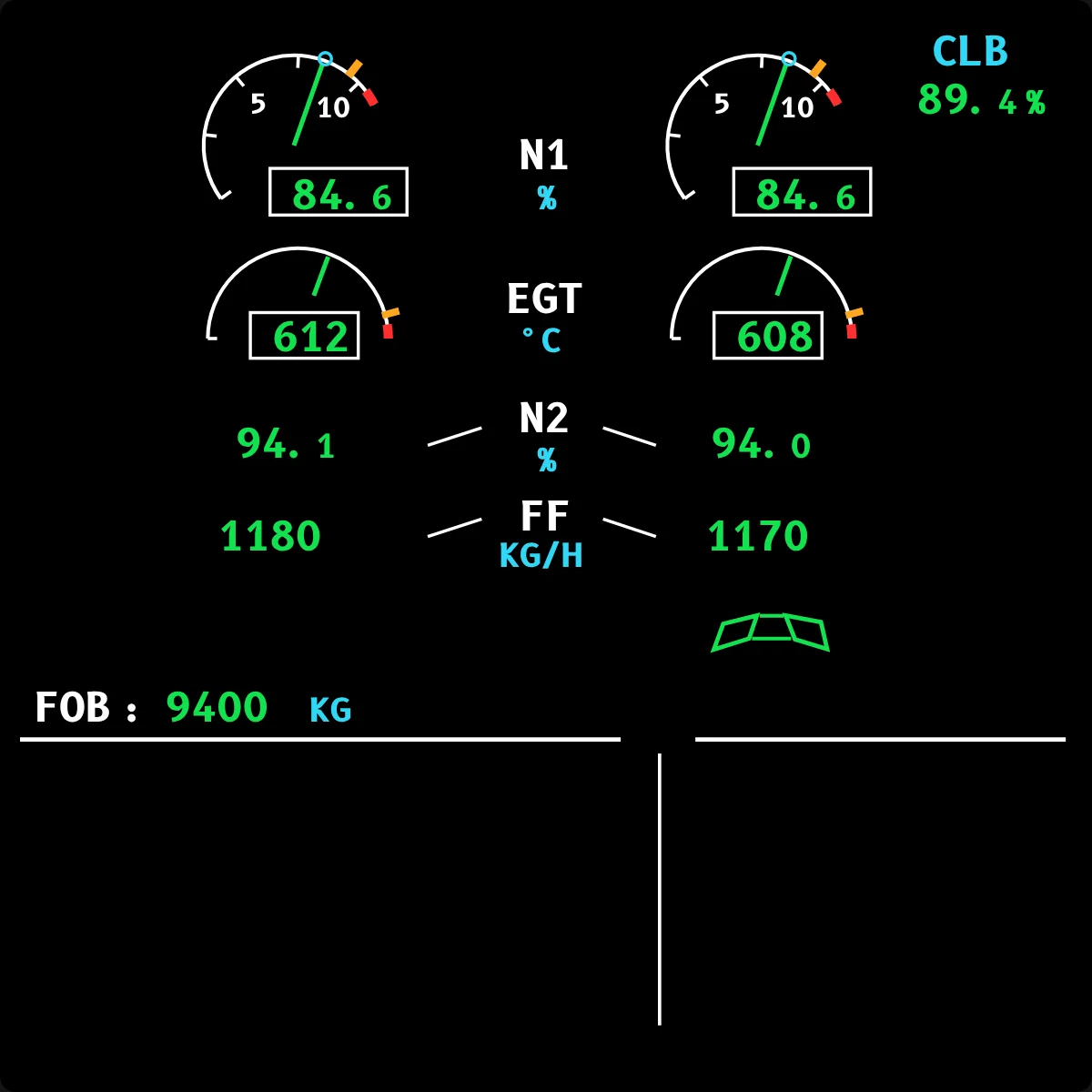
The cruise, both engine bleeds on, X BLEED at AUTO, the APU off and the wing anti-ice off. Press the button to overheat both engine bleeds, then look at the E/WD, the BLEED page, the AIR COND panel and the schematic.
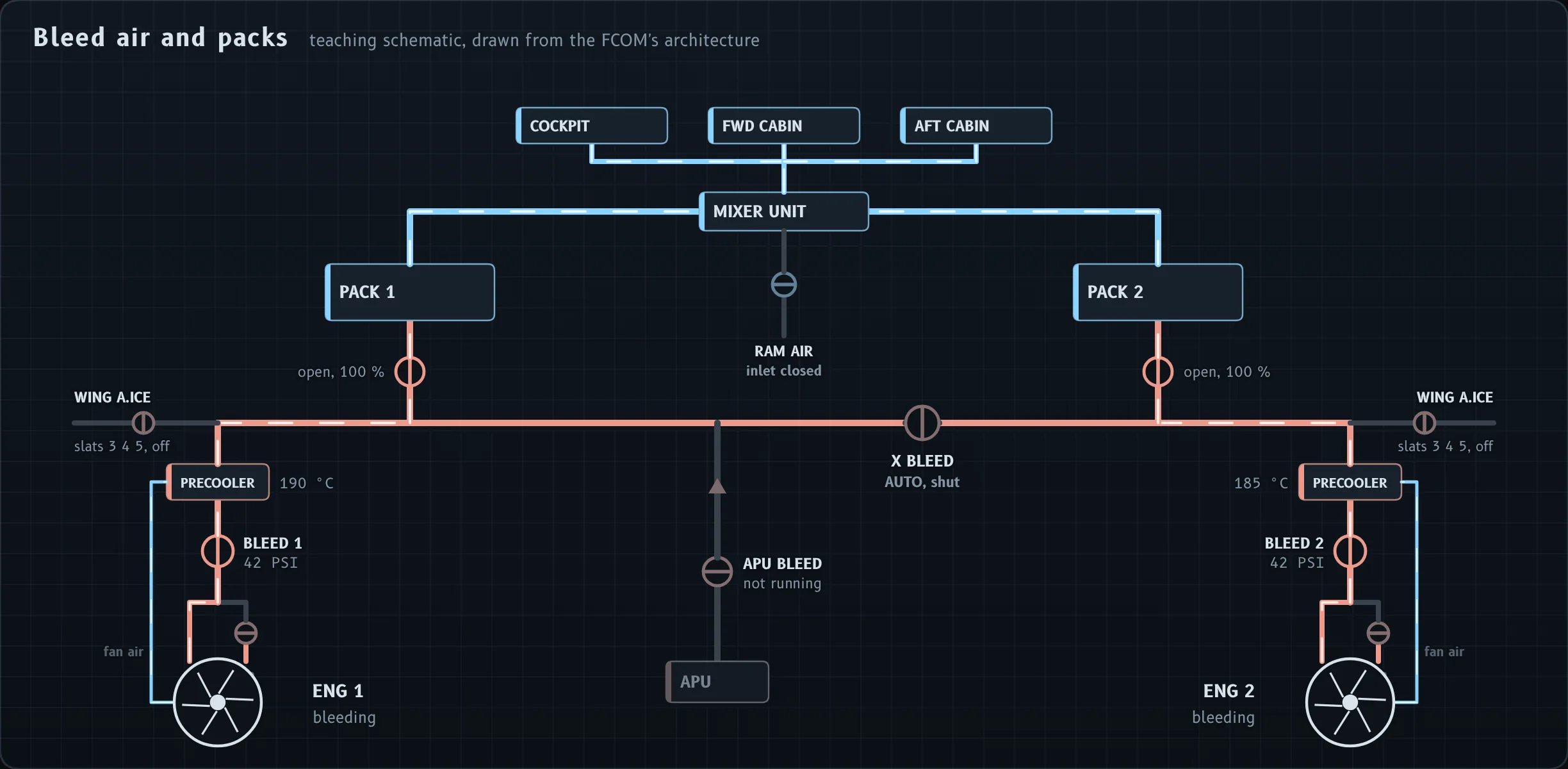
The alert Overheat both engine bleeds
The E/WD shows the caution in amber, its lines starting with AVOID ICING CONDITIONS, ENG 1 BLEED OFF THEN ON and ENG 2 BLEED OFF THEN ON. FAULT lights in both ENG BLEED pushbuttons, both bleed valves are closed and neither pack has air.
On the BLEED page the user indication turns amber: the FCOM makes it amber in flight when the RAM AIR flap is not fully open and both pack flow control valves are closed. Working the lines is what the ECAM Trainer does with you.
Sources FCOM PRO-ABN-AIR AIR / FCOM DSC-36-20 OVERHEAD PANEL / FCOM DSC-21-10-50 ECAM BLEED PAGE
Can the crossbleed help?
The crossbleed valve isolates or interconnects the two engines' air supply systems. After a single bleed fault, opening it lets the other engine supply both sides. With both engine bleeds lost there is no engine air on either side to share.
The procedure's first line is X BLEED to AUTO. At AUTO the valve is open only while the APU bleed valve is open; with the APU bleed off, it stays closed. The FCOM gives no reason for the line.
Sources FCOM DSC-36-10-40 GENERAL / FCOM PRO-ABN-AIR AIR / FCOM DSC-36-20 OVERHEAD PANEL
Open the crossbleed with both bleeds lost
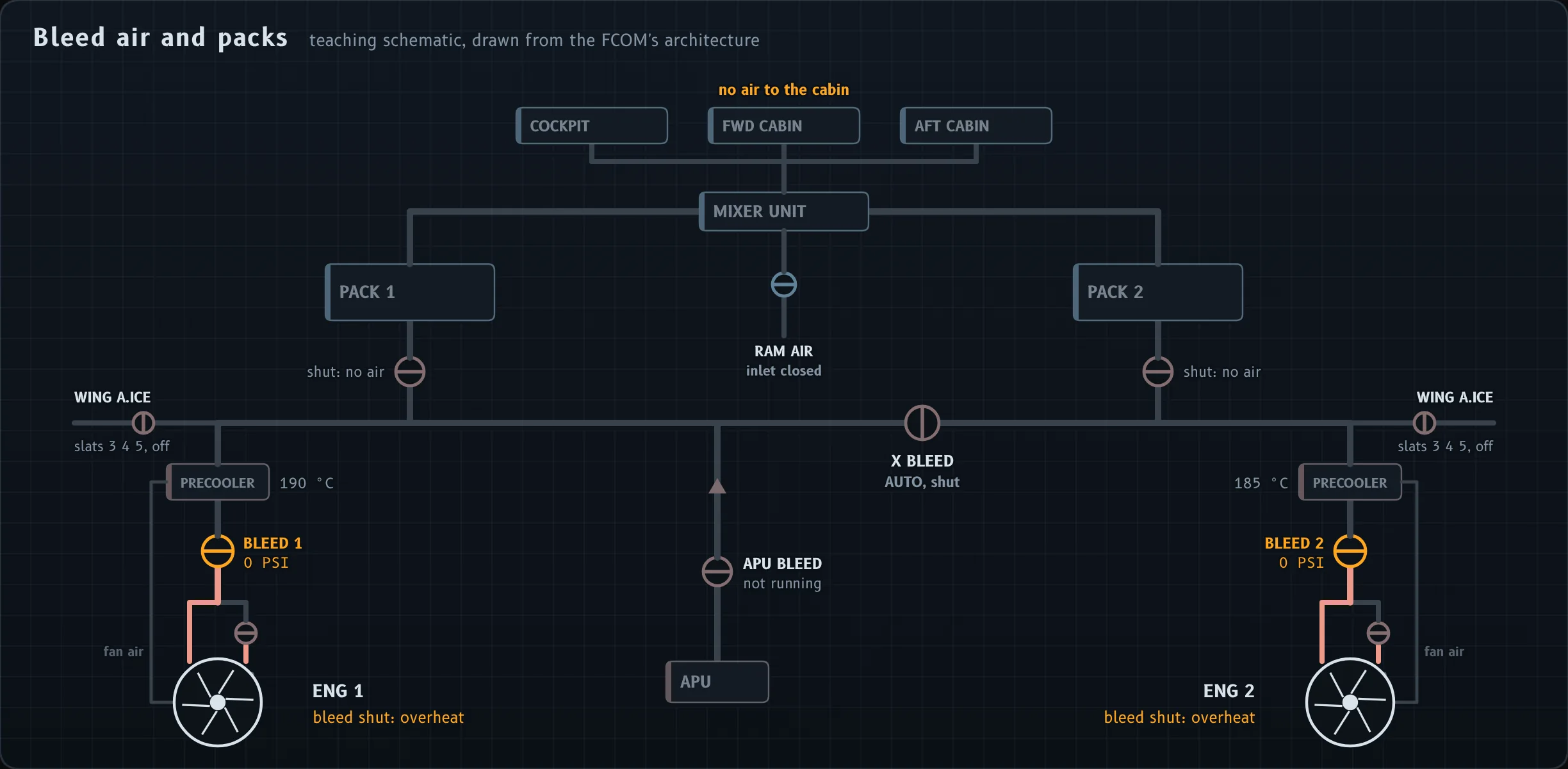
Both engine bleed valves have closed on the overheat, the APU is off and neither pack has air. Predict first, then press, and watch the schematic.
-
Predict Turn X BLEED to OPEN. Does either pack get air?
Try it Turn X BLEED to OPEN.
The valve opens and joins two empty sides: both engine bleed valves are closed and the APU bleed is off, so nothing reaches either pack.
Sources FCOM DSC-36-10-40 GENERAL / FCOM DSC-36-20 OVERHEAD PANEL
-
Try it Turn X BLEED back to AUTO.
At AUTO, with the APU bleed valve closed, the crossbleed valve closes again: the position the procedure's first line asks for.
Sources FCOM DSC-36-20 OVERHEAD PANEL / FCOM PRO-ABN-AIR AIR
How does the procedure try to recover the bleeds, and what if that fails?
With no leak, the procedure tries each engine bleed once: ENG 1 BLEED OFF THEN ON, then ENG 2 BLEED OFF THEN ON.
On the pushbutton, OFF closes the bleed valve and the HP valve (on the A320neo and A321neo the fan air valve too), and the FAULT light goes out once the fault has disappeared; ON lets the valve open again if its opening conditions are met, among them no overpressure or overtemperature detected.
Before the resets come X BLEED to AUTO, WING ANTI ICE off and AVOID ICING CONDITIONS, and, if the APU bleed is ON and fails, APU BLEED OFF.
IF UNSUCCESSFUL, both engine bleeds go OFF and the procedure reads DES TO FL 100/MEA-MORA, then BLEED 1+2 PROC APPLY. That is a separate procedure, applied when both engine bleed supply systems are still failed at the end of this ECAM procedure.
The leak versions differ. LEFT LEAK sets X BLEED to SHUT and, with the APU bleed on, APU BLEED OFF, and resets engine 2 only; RIGHT LEAK sets X BLEED to SHUT and, if the APU bleed is on and fails, APU BLEED OFF, and resets engine 1 only; with leaks on both sides there is no reset at all, both bleeds go off and the descent follows.
Sources FCOM PRO-ABN-AIR AIR / FCOM DSC-36-20 OVERHEAD PANEL / FCOM PRO-ABN-AIR / FCOM PRO-ABN-AIR AIR ENG 1+2 BLEED FAULT
What does the aircraft lose?
Engine air for the packs and for the wing anti-ice. The wing anti-ice heats the three outboard slats of each wing with hot air from the pneumatic system, and the limitations do not permit APU bleed air for wing anti-ice.
STATUS opens with AVOID ICING CONDITIONS and, if severe ice accretion builds up, a minimum speed of VLS +10 or green dot, MANEUVER WITH CARE and the landing distance procedure. INOP SYS lists WING A. ICE, ENG 1 BLEED, ENG 2 BLEED, APU BLEED and PACK 1+2.
Sources FCOM DSC-30-20-10 DESCRIPTION / FCOM LIM-APU AUXILIARY POWER UNIT / FCOM PRO-ABN-AIR ABNORMAL AND EMERGENCY PROCEDURES / FCOM PRO-ABN-AIR AIR
Both bleeds gone, and what went with them
What is lost afterwards?
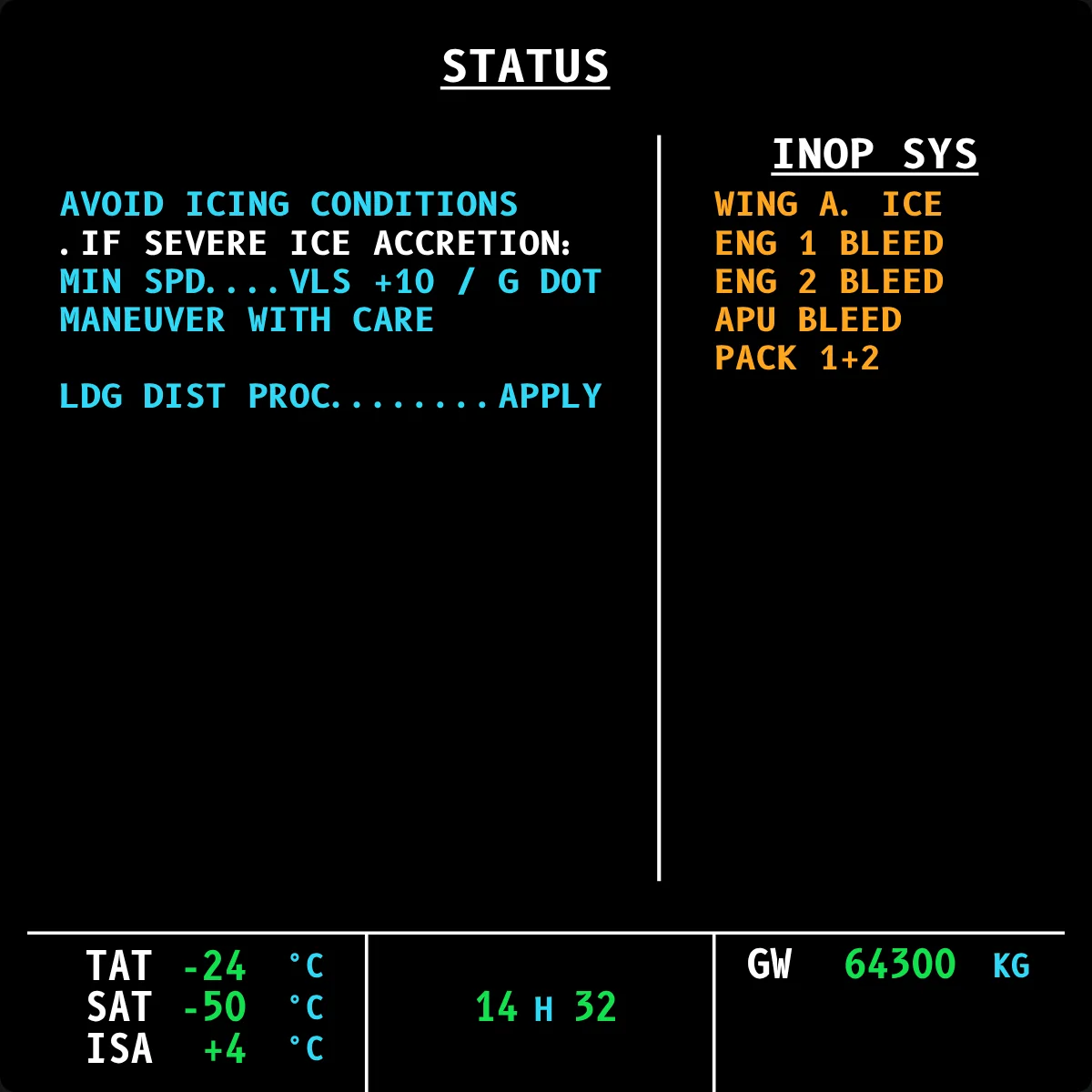
STATUS is the aircraft's operational summary. The picture is one version: AVOID ICING CONDITIONS, then the severe ice accretion lines, and five inoperative systems in amber.
Another version, for other aircraft, reads IF SEVERE ICE ACCRETIONS and adds BMC 1+2 to INOP SYS, marked if dual BMC fault. Without a BMC fault it reads like the picture, and the ECAM Trainer draws that on both its types.
Which version applies depends on your aircraft: check your own FCOM.
Sources FCOM DSC-31-20 STATUS PAGE / FCOM PRO-ABN-AIR ABNORMAL AND EMERGENCY PROCEDURES / FCOM PRO-ABN-AIR AIR
A319ceo, A320ceo, A320neo, A321neo: what differs?
| A319ceo, A320ceo | A320neo, A321neo | |
|---|---|---|
| The caution and its procedure | The same in every version | The same in every version |
| STATUS | Not given by type: one version as drawn above | Not given by type: another version adds BMC 1+2 if dual BMC fault |
| One BMC failed | A319ceo and A320ceo: the other BMC still warns of overtemperature, but the failed side's FAULT light is lost | A320neo and A321neo: the failed side's overtemperature protection is lost |
In both BMC cases the failed side's bleed valve no longer closes automatically, and the other BMC still issues the overpressure and wing leak warnings.
Sources FCOM PRO-ABN-AIR AIR ENG 1+2 BLEED FAULT / FCOM PRO-ABN-AIR AIR / FCOM PRO-ABN-AIR ABNORMAL AND EMERGENCY PROCEDURES / FCOM DSC-36-10-60 BMC FAILURE

Work AIR ENG 1+2 BLEED FAULT as a crew
Read and do each line against the FCOM, with the E/WD, the SD page and the overhead following your hands, the PF and PM calls, and a debrief that says what you missed.
Work this failure in the ECAM TrainerGo further
Written in our own words from the FCOM and the FCTM; each part names the units it rests on. The E/WD, the STATUS and the live aircraft are the platform's own ECAM and systems model, the same the ECAM Trainer and the flight deck run. This page explains the procedure; it is not the procedure. Aircraft differ by type, engine and options: your aircraft's FCOM, your QRH and your operator's procedures always come first. How we write and check these pages.
Every ECAM procedure, line by line, against the FCOM.
The ECAM Trainer works 108 scenarios with the E/WD, the SD page and the overhead following your hands. Start free today, or open everything with A320 Knowledge+.
For study and revision only. Always follow your operator's approved documentation and procedures. A320 Knowledge is independent and not affiliated with Airbus.
Related
- AIR BLEED LEAKA red warning with one line.
- AIR PACK 1+2 FAULTAn amber caution that takes both packs.
- AIR PACK 1 FAULTAn amber caution with one line.
- AIR PACK 1 OVHTAn amber caution with a line that waits.
- A320 pneumatics and bleed airThe system guide, with the live aircraft
- Every ECAM procedureThe alerts the ECAM Trainer works, grouped by system