
HYD G RSVR LO AIR PR
An amber caution whose actions wait on a condition. Here is what the air in the green reservoir is for, what the ECAM does only if green's pressure fluctuates, and why STATUS asks for the pump back on, with the live aircraft at the moment the caution comes on.
Written and checked by current A320 pilotschecked against the FCOM on Our editorial policy
What HYD G RSVR LO AIR PR means
HYD G RSVR LO AIR PR is an amber caution: the air pressure in the green reservoir is 22 psi or less. That air keeps the pumps from cavitating. The caution alone asks for nothing; only if green's pressure fluctuates does the ECAM have the crew switch the PTU off, then the green engine pump, and green is lost.
STATUS then asks for the pump back ON. The FCOM's reason: cavitation is more likely at altitude, so the system may be restored after a descent. If it is not, the gear comes down by gravity and the landing distance procedure applies.
Sources FCOM PRO-ABN-HYD HYD G RSVR LO AIR PR / FCOM DSC-29-10-20 RESERVOIR PRESSURIZATION / FCOM PRO-ABN-HYD HYD
At a glance
- Level
- Amber caution, level 2: single chime, MASTER CAUT and the HYD page on the SD
- Sets it off
- Green reservoir air pressure at or below 22 psi; it resets at 25 psi
- Lights
- FAULT in ENG 1 PUMP and in PTU on the overhead HYD panel; LO AIR PRESS in amber under the green reservoir on the HYD page
- Procedure
- Only if green's pressure fluctuates: PTU OFF, then GREEN ENG 1 PUMP OFF
- STATUS
- GREEN ENG 1 PUMP ON, after a note that cavitation is more likely at altitude; if not recovered, the gear down by gravity
Sources FCOM PRO-ABN-HYD HYD G RSVR LO AIR PR / FCOM DSC-31-10 WARNING/CAUTION CLASSIFICATION / FCOM DSC-31-20 SYSTEM PAGES / FCOM DSC-29-20 OVERHEAD PANEL / FCOM DSC-29-20 ECAM HYD PAGE / FCOM PRO-ABN-HYD HYD
What is the air in the reservoir for?
The three hydraulic reservoirs are pressurised by air. Normally HP bleed air from engine 1 does it automatically; if that bleed pressure is too low, the air comes from the crossbleed duct. The aim, in the FCOM's words: "The systems maintain a high enough pressure to prevent their pumps from cavitating."
The caution triggers when the green reservoir's air pressure is at or below 22 psi, and resets at 25 psi. On the HYD page LO AIR PRESS appears in amber under the green reservoir, and FAULT lights in two pushbuttons: ENG 1 PUMP, and PTU, which covers a low air pressure in the green or the yellow reservoir.
Sources FCOM DSC-29-10-20 RESERVOIR PRESSURIZATION / FCOM PRO-ABN-HYD HYD G RSVR LO AIR PR / FCOM DSC-29-20 ECAM HYD PAGE / FCOM DSC-29-20 OVERHEAD PANEL
Where the reservoir's air comes from
What does the crew see and hear?
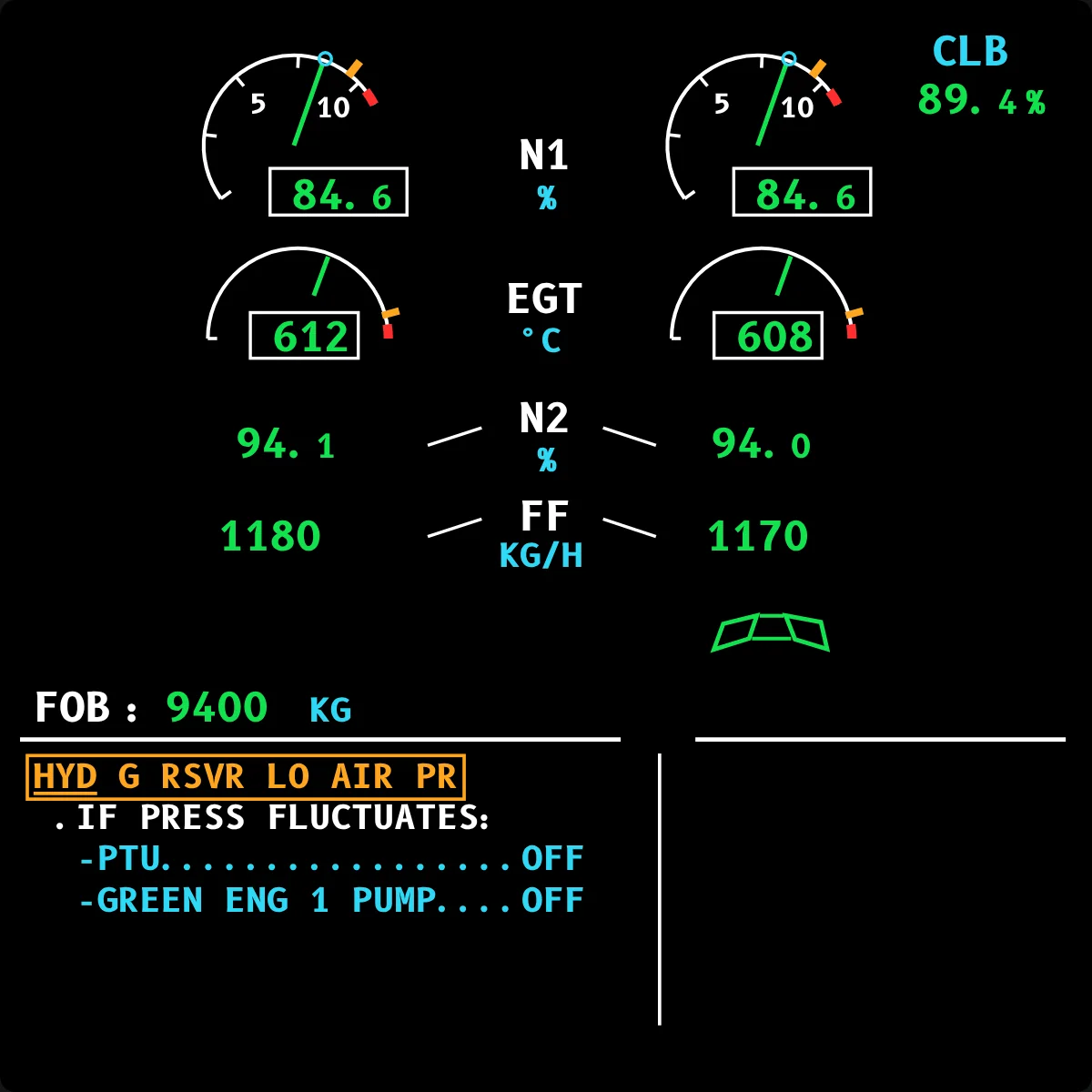
A level 2 caution: a single chime, MASTER CAUT steady amber, the caution in amber on the E/WD, and the HYD page on the SD. Under the title, the E/WD shows a condition first, IF PRESS FLUCTUATES, with PTU OFF and GREEN ENG 1 PUMP OFF indented under it.
The condition is printed in large letters, the FCOM's mark for a precondition that appears on the ECAM, and indented actions depend on it. Green's pressure is on the HYD page.
Sources FCOM DSC-31-10 WARNING/CAUTION CLASSIFICATION / FCOM DSC-31-20 SYSTEM PAGES / FCOM PRO-ABN-HYD HYD / FCOM PRO-ABN-ABN-00 INTRODUCTION / FCOM DSC-29-20 ECAM HYD PAGE
The moment the caution comes on
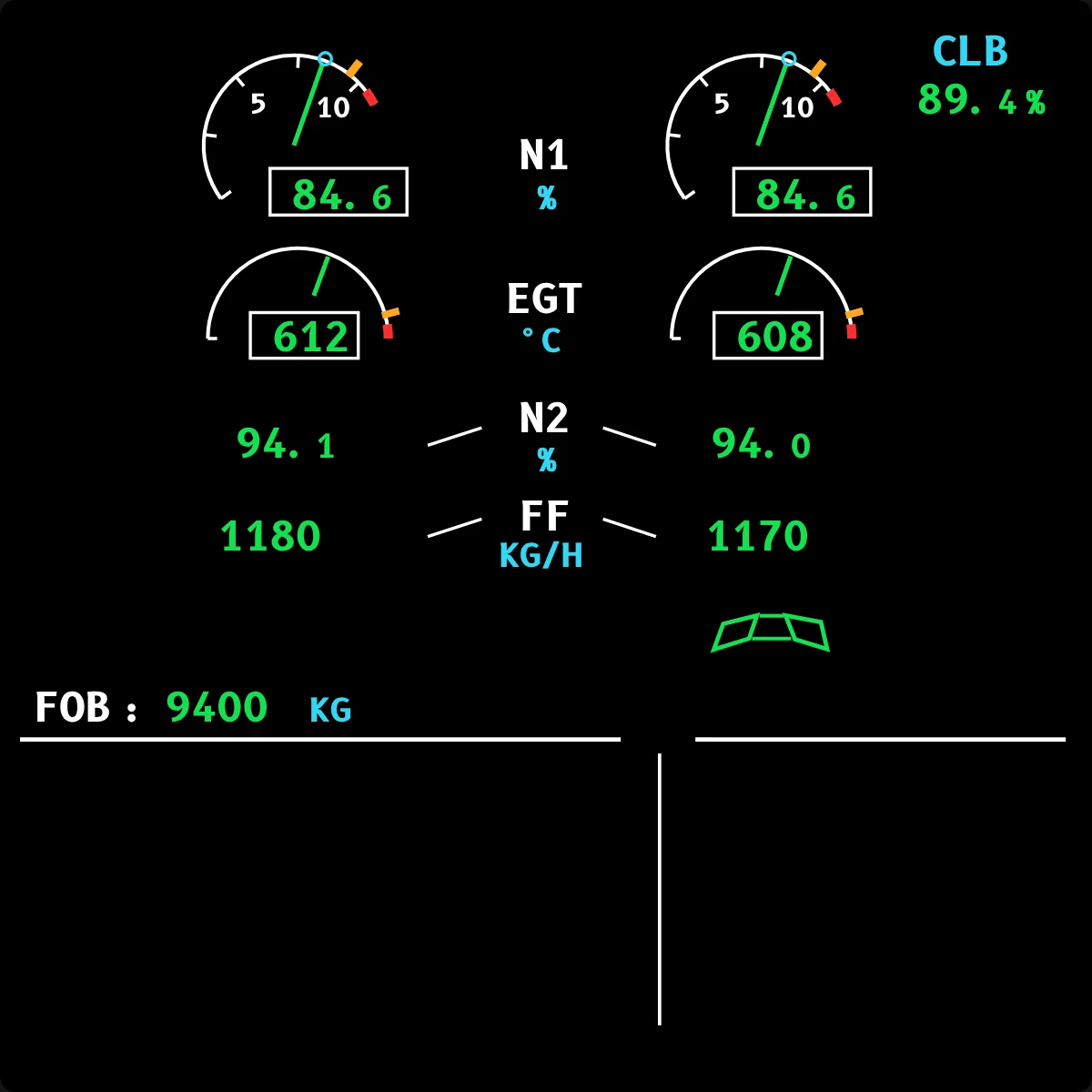
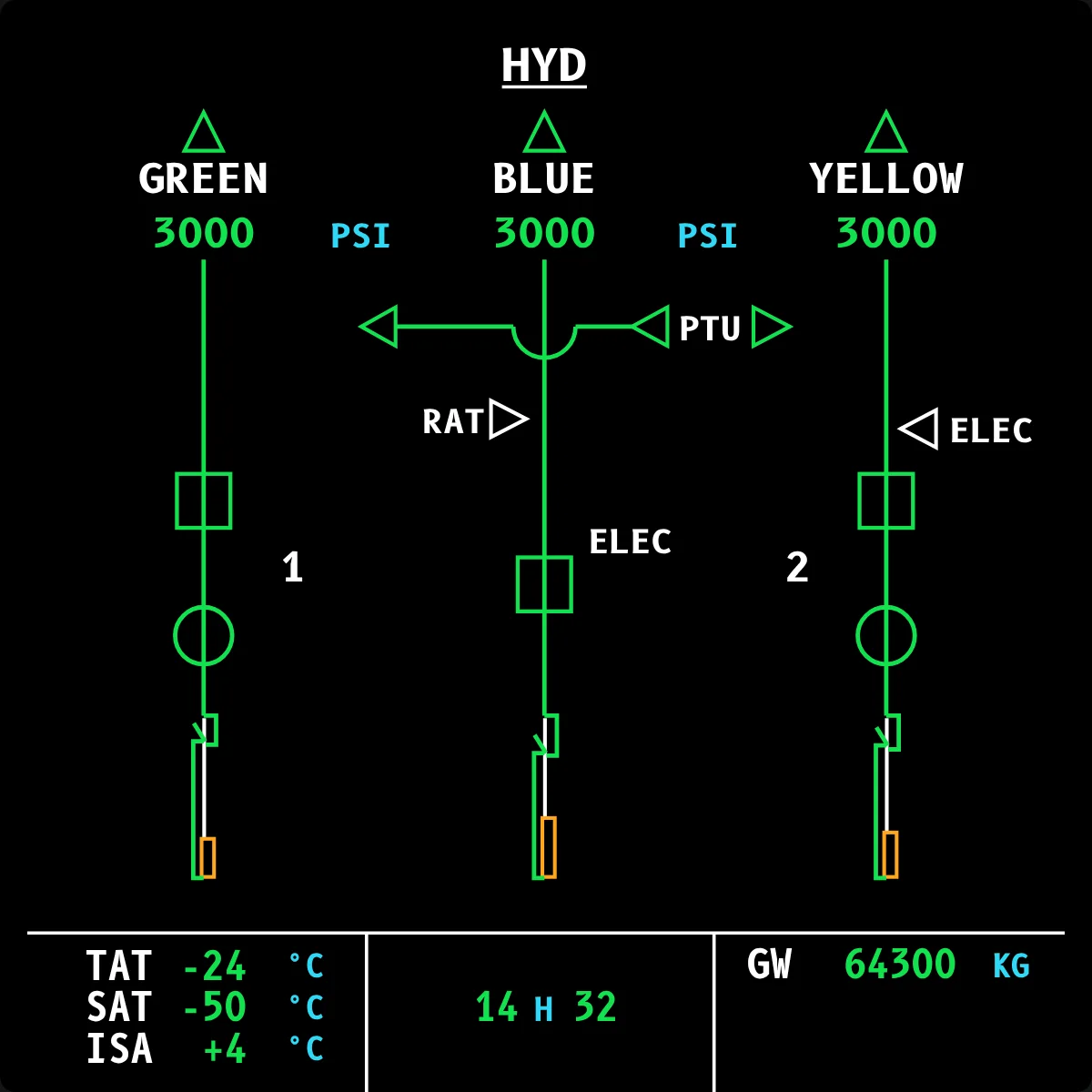
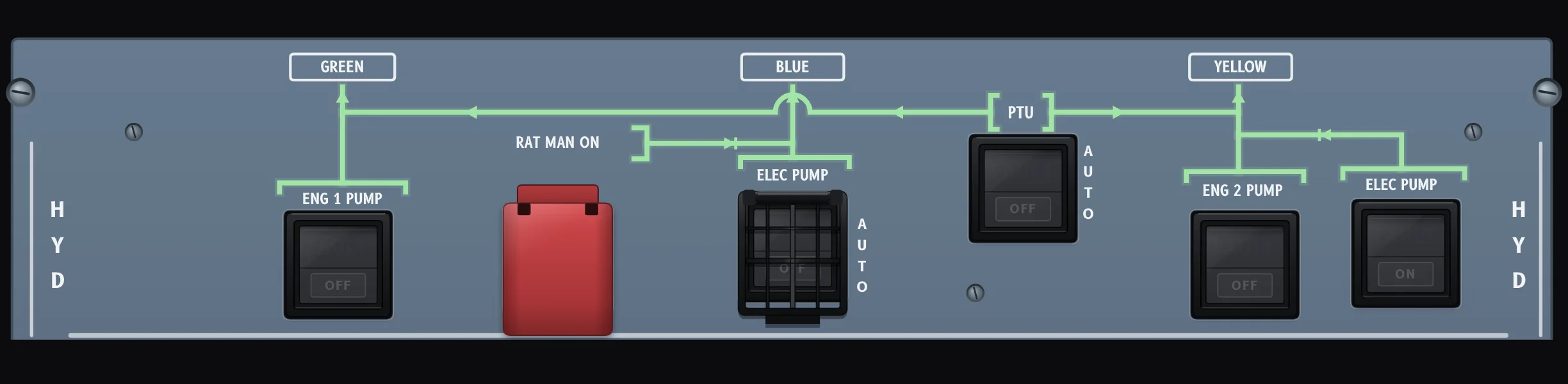
The cruise, all three systems normal. Press the button to drop the air pressure in the green reservoir, then look at the E/WD, the HYD page, the panel and the schematic.
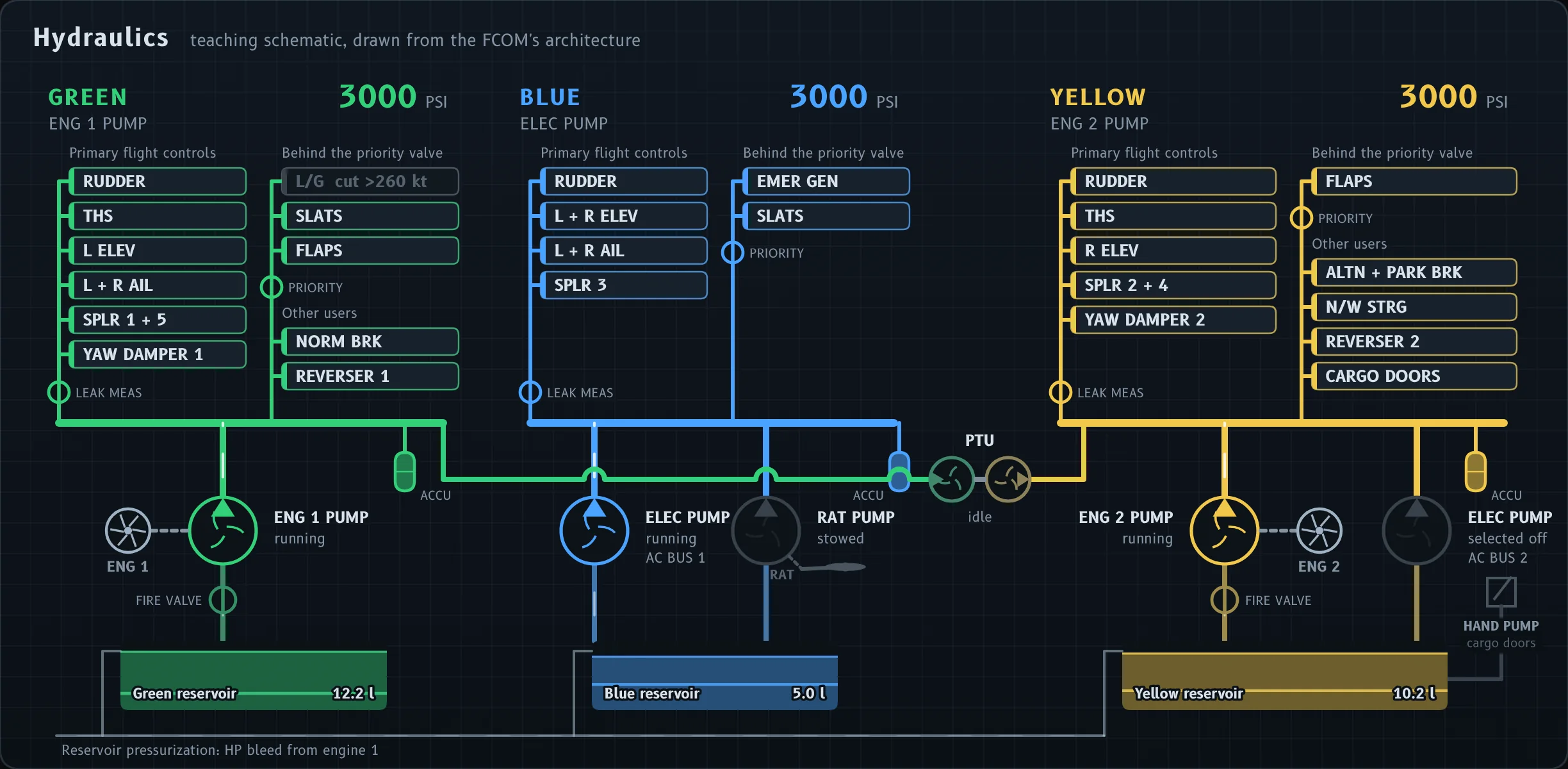
The alert Drop the green reservoir's air pressure
The E/WD shows the caution with IF PRESS FLUCTUATES and its two lines. LO AIR PRESS shows under the green reservoir on the HYD page, and FAULT lights in ENG 1 PUMP and PTU.
Green is still pressurised by its own pump. Whether the two lines apply depends on the condition; working it is what the ECAM Trainer does with you.
Sources FCOM PRO-ABN-HYD HYD / FCOM DSC-29-20 OVERHEAD PANEL / FCOM DSC-29-20 ECAM HYD PAGE / FCOM PRO-ABN-ABN-00 INTRODUCTION
What if the pressure fluctuates?
The FCOM sets the condition without explaining it. What it gives is the effect: if green's pressure does not fluctuate, nothing under IF PRESS FLUCTUATES applies, the PTU stays at AUTO and the pump stays on.
If it does fluctuate, the PTU goes off first. The FCTM's reason covers the three green and yellow reservoir faults: the PTU goes off to avoid a PTU overheat, which may occur two minutes later, and "a PTU overheat may lead to the loss of the second hydraulic circuit." Its list of cautions where the PTU goes off without delay names this one, "(Only if pressure fluctuates)".
Then GREEN ENG 1 PUMP OFF: the pump is depressurised and, with the PTU off, nothing pressurises green. G SYS LO PR follows, with *WHEEL and *F/CTL as secondary failures.
Sources FCOM PRO-ABN-HYD HYD / FCOM PRO-ABN-ABN-00 INTRODUCTION / FCTM PR-AEP-HYD HYDRAULIC GENERATION PARTICULARITIES / FCOM DSC-29-20 OVERHEAD PANEL
Can green come back?
STATUS says it may. Under the approach procedure HYD LO PR, it gives the reason in two sentences: "The probability of cavitation increases with altitude." Therefore the system may be restored after descending to a lower altitude. Its next line is GREEN ENG 1 PUMP ON, with no condition before it.
The PTU is not asked back to AUTO. If green is not recovered, STATUS goes on with the gear down by gravity and the landing distance procedure.
Sources FCOM PRO-ABN-HYD HYD
Switch the pump back on
The PTU and the green engine pump are off and green is lost. STATUS asks for the pump back on. Predict first, then press.
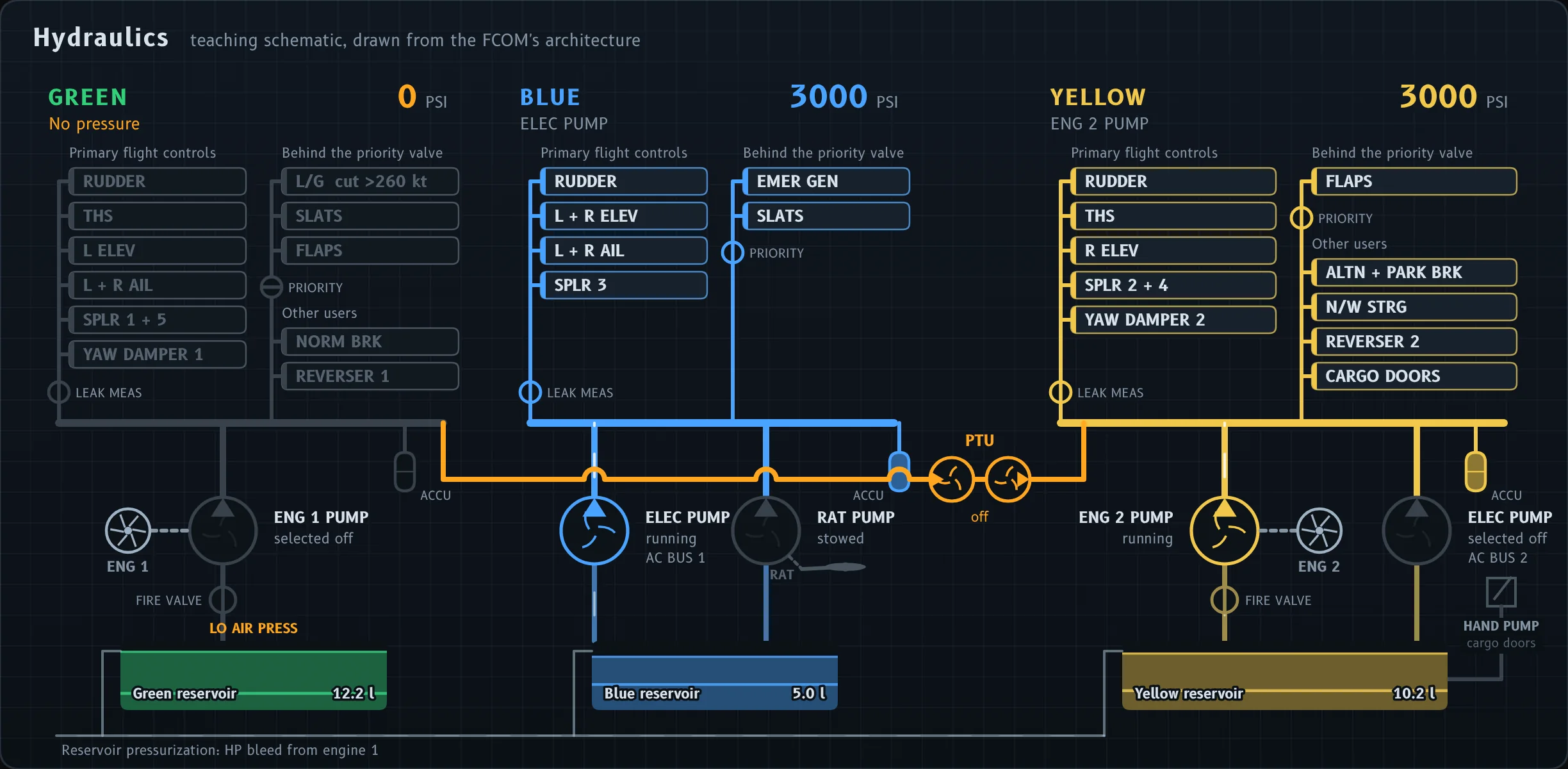
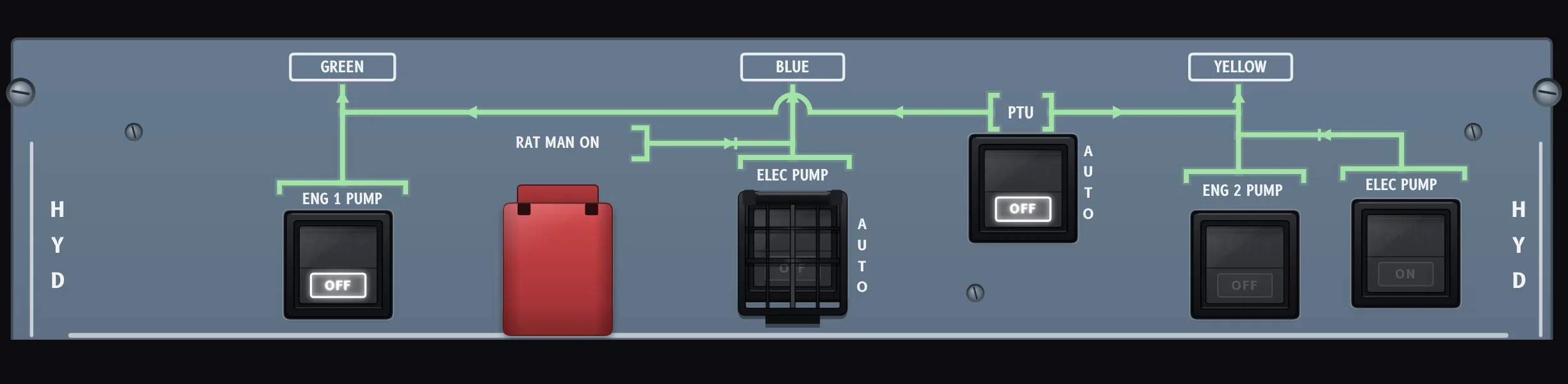
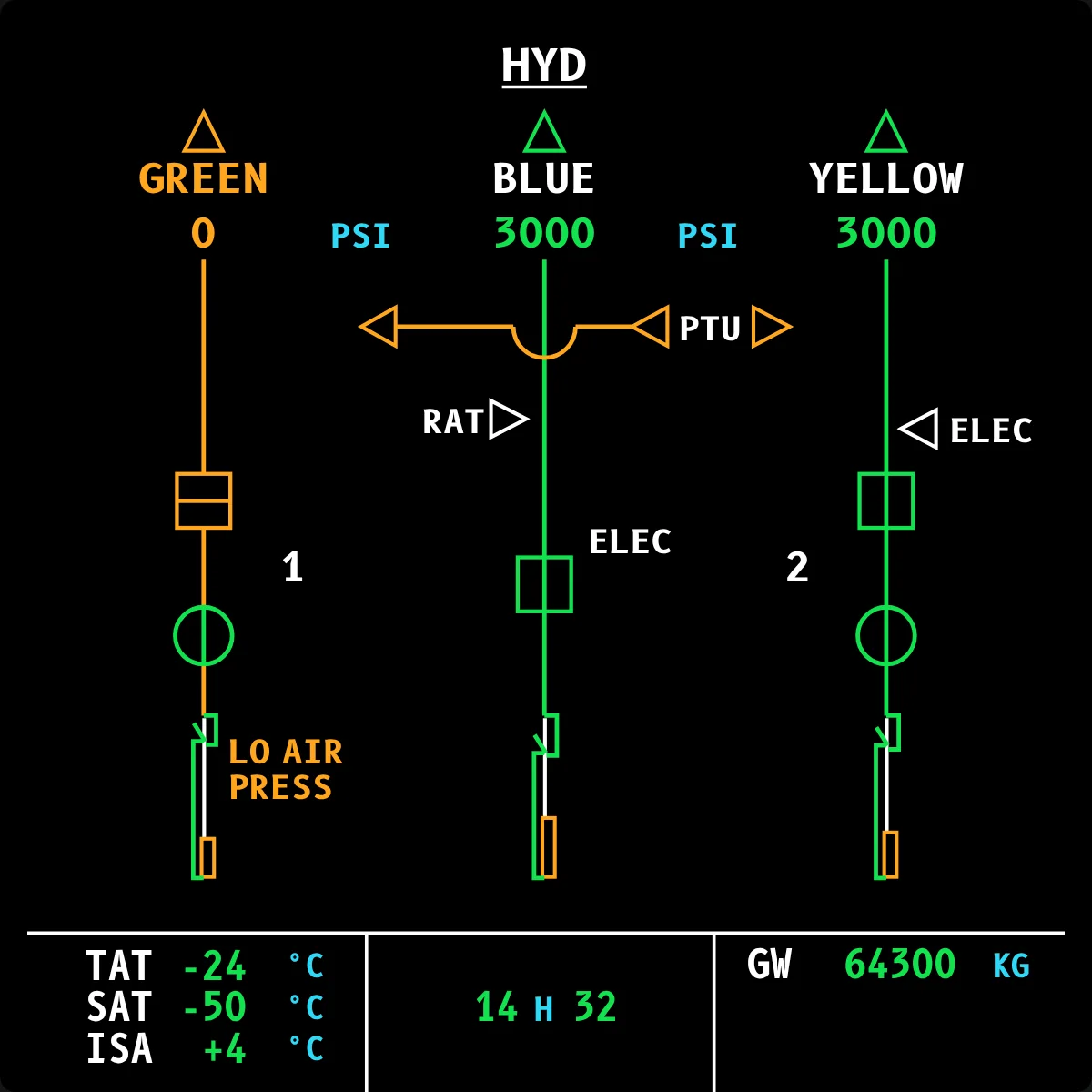
-
Predict The PTU stays off. What does GREEN ENG 1 PUMP ON do for green?
Try it Switch ENG 1 PUMP on.
Green is back on its engine pump, with the PTU still off: the pump is green's own source and needs no help from yellow. In the drawing the pump holds at once; on the aircraft the FCOM promises only that recovery may be possible after a descent.
Sources FCOM DSC-29-10-20 GREEN SYSTEM PUMP / FCOM DSC-29-20 OVERHEAD PANEL / FCOM PRO-ABN-HYD HYD
What if green is not recovered?
STATUS lists the cost. Inoperative: the green system, spoilers 1 and 5, CAT 3 DUAL, the autobrake, normal braking, gear retraction, reverser 1 and yaw damper 1. It also shows alternate yellow braking with anti-skid, slats and flaps slow and CAT 3 SINGLE ONLY, with FUEL CONSUMPT INCRSD and FMS PRED UNRELIABLE.
Green actuates all the gear and doors, and if green is not recovered this STATUS asks for the gear down by gravity.
Sources FCOM PRO-ABN-HYD HYD / FCOM DSC-32-10-10 LANDING GEARS AND DOORS OPERATION
STATUS, read as a decision
What is lost afterwards?
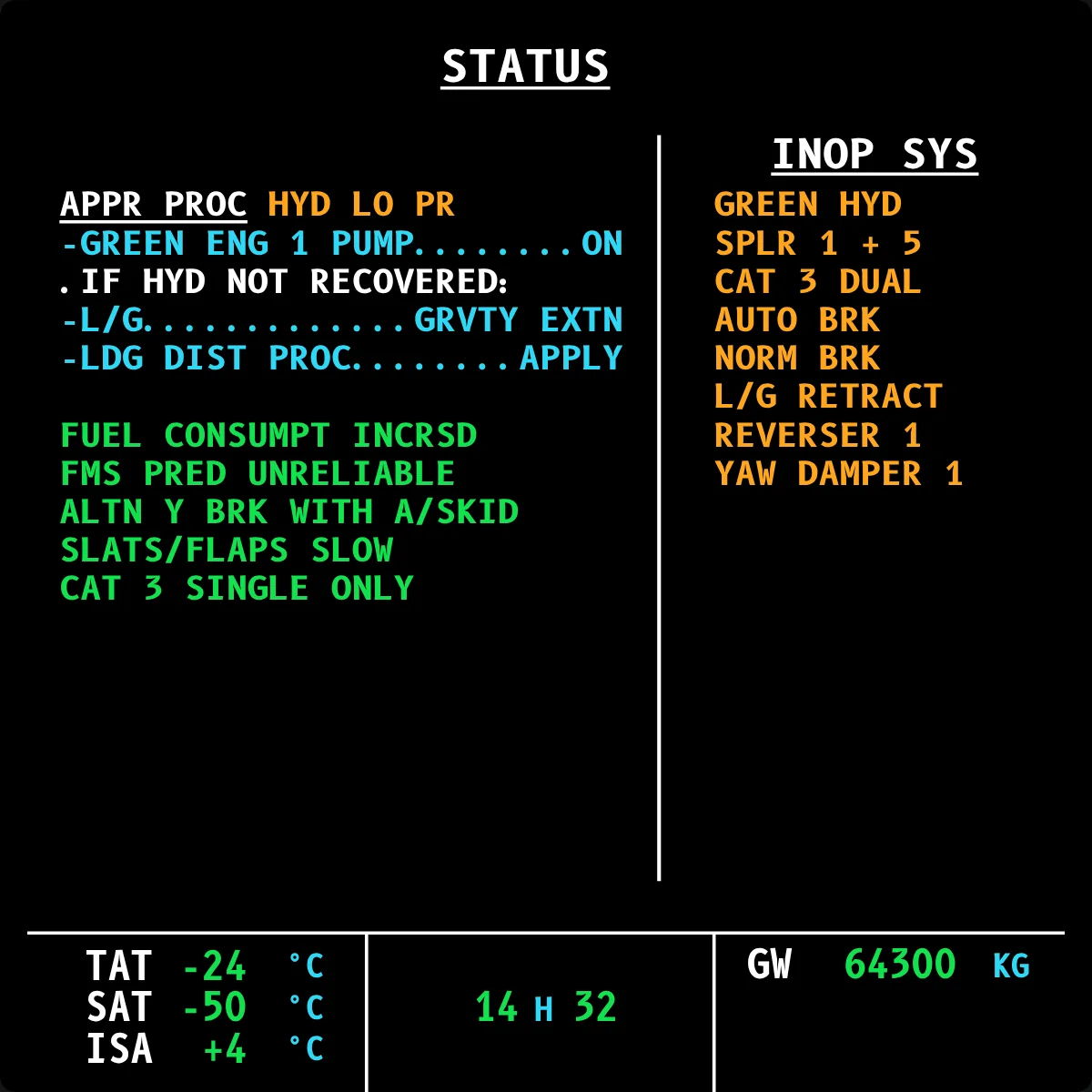
STATUS opens with the approach procedure HYD LO PR and the pump line, then IF HYD NOT RECOVERED. The two sentences about cavitation sit on the FCOM's STATUS; the ECAM Trainer does not draw them on the page, and the FCOM does not say whether the aircraft's SD shows them.
The FCOM prints this STATUS in two versions, for different aircraft. Their lines are the same; the second marks AUTO BRK and YAW DAMPER 1 with a footnote, "When both engines are running". The pictures show both engines running, where the two agree.
Which version applies depends on your aircraft: check your own FCOM.
Sources FCOM PRO-ABN-HYD HYD / FCOM DSC-31-20 STATUS PAGE
A319ceo, A320ceo, A320neo, A321neo: what differs?
| A319ceo, A320ceo | A320neo, A321neo | |
|---|---|---|
| The caution, its procedure and its STATUS lines | The same in every version | The same in every version |
Green's is printed once, for every aircraft. The blue reservoir's is not: one version of its triggering conditions, for some aircraft, adds a second trigger at 30 psi, detected in flight but displayed only on the ground after landing.
Sources FCOM PRO-ABN-HYD HYD G RSVR LO AIR PR / FCOM PRO-ABN-HYD HYD / FCOM PRO-ABN-HYD HYD B RSVR LO AIR PR

Work HYD G RSVR LO AIR PR as a crew
Read and do each line against the FCOM, with the E/WD, the SD page and the overhead following your hands, the PF and PM calls, and a debrief that says what you missed.
Work this failure in the ECAM TrainerGo further
Written in our own words from the FCOM and the FCTM; each part names the units it rests on. The E/WD, the STATUS and the live aircraft are the platform's own ECAM and systems model, the same the ECAM Trainer and the flight deck run. This page explains the procedure; it is not the procedure. Aircraft differ by type, engine and options: your aircraft's FCOM, your QRH and your operator's procedures always come first. How we write and check these pages.
Every ECAM procedure, line by line, against the FCOM.
The ECAM Trainer works 108 scenarios with the E/WD, the SD page and the overhead following your hands. Start free today, or open everything with A320 Knowledge+.
For study and revision only. Always follow your operator's approved documentation and procedures. A320 Knowledge is independent and not affiliated with Airbus.
Related
- HYD B+Y SYS LO PRA red warning: blue and yellow are lost and green is left alone, still in normal law.
- HYD B ELEC PUMP LO PRAn amber caution that costs a whole system.
- HYD B RSVR LO LVLAn amber caution: the blue system is losing its fluid.
- HYD B RSVR OVHTAn amber caution with one line, and the FCOM's own worked example of the ECAM.
- A320 hydraulic systemThe system guide, with the live aircraft
- Every ECAM procedureThe alerts the ECAM Trainer works, grouped by system