
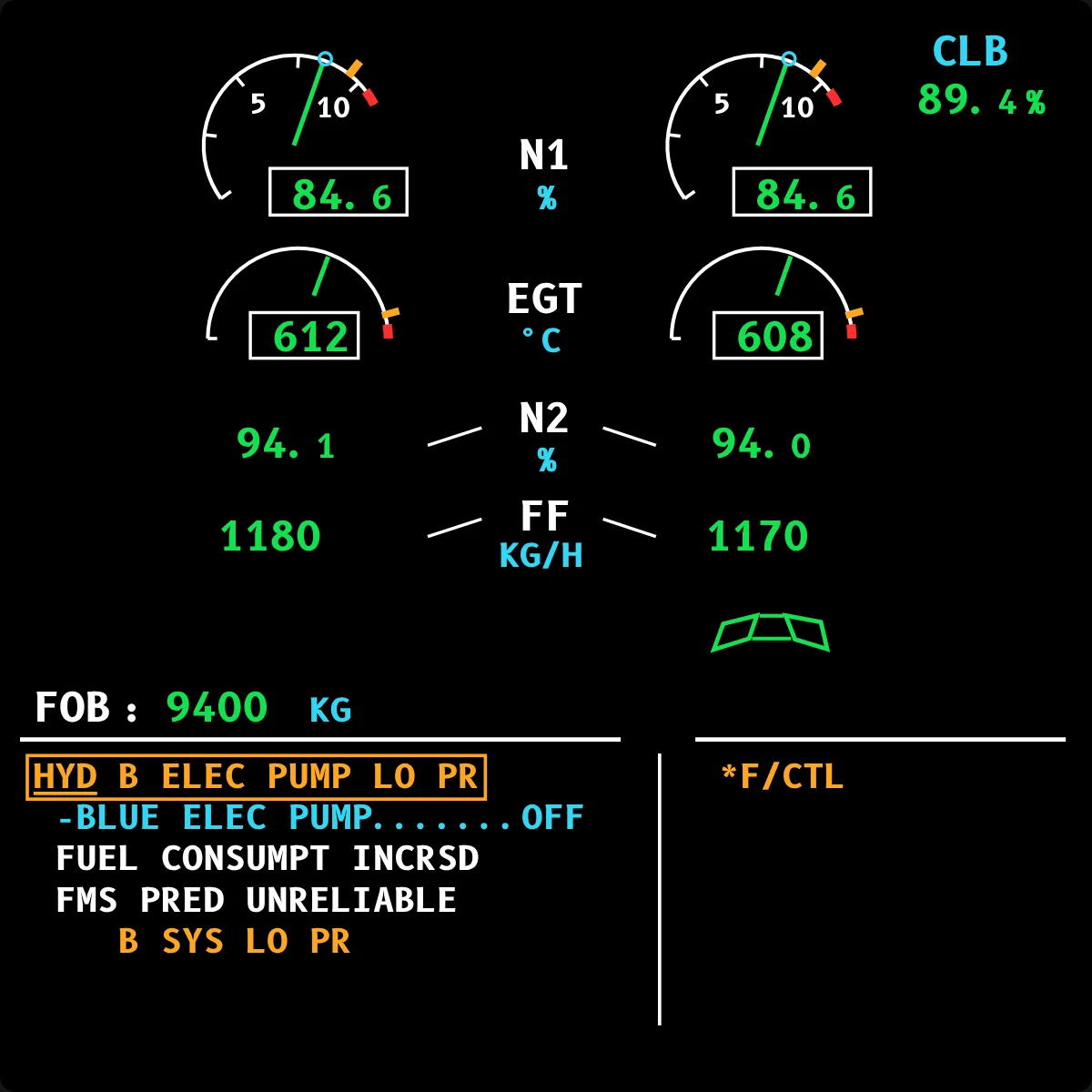
HYD B ELEC PUMP LO PR
An amber caution that costs a whole system. Blue has one pump in normal operation, so when it weakens, blue goes with it. Here is what sets it off, why no other system can lend blue its pressure, and what the STATUS keeps in reserve, with the live aircraft at the moment the caution comes on.
Written and checked by current A320 pilotschecked against the FCOM on Our editorial policy
What HYD B ELEC PUMP LO PR means
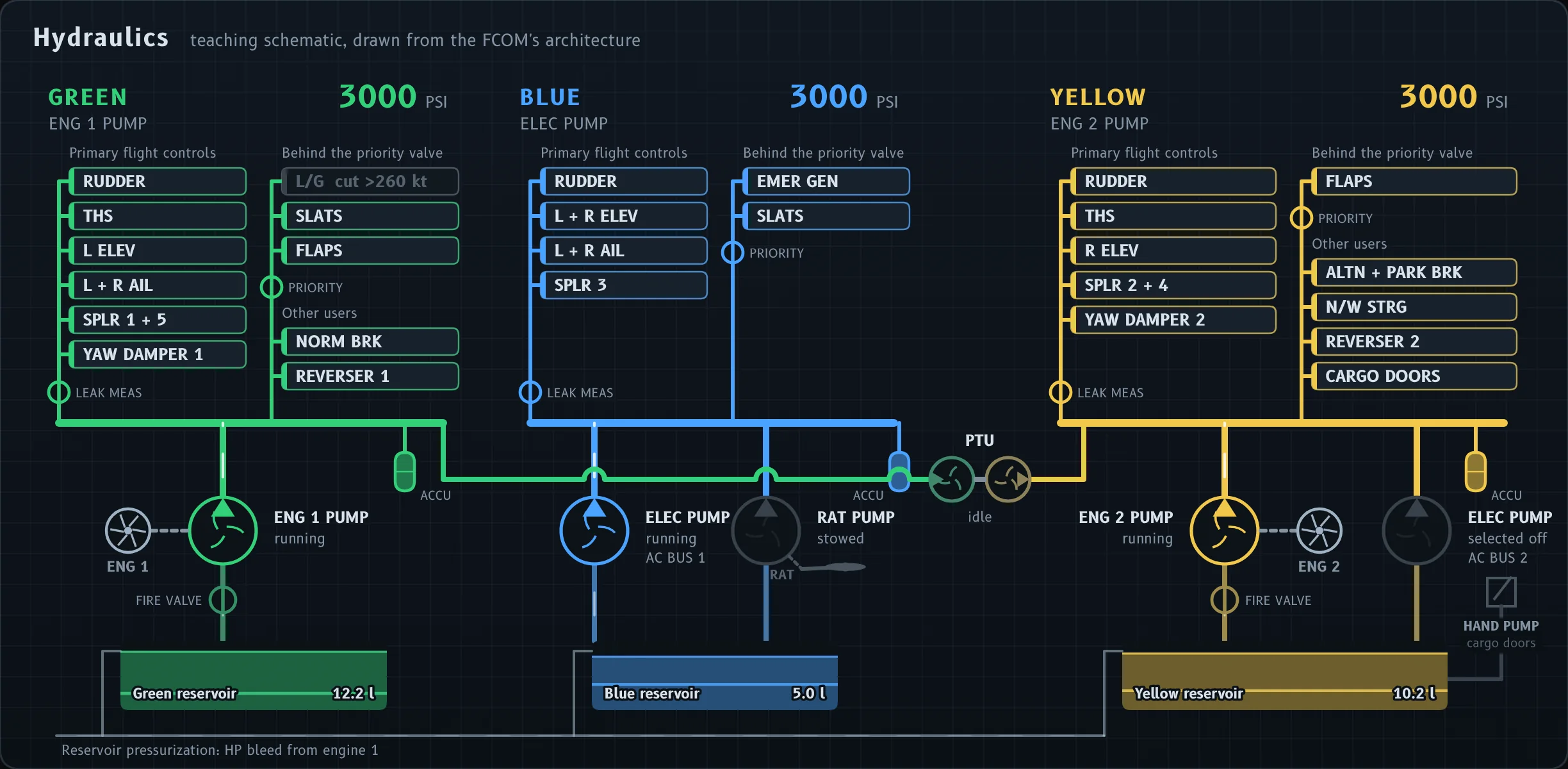
HYD B ELEC PUMP LO PR is an amber caution: the blue electric pump delivers 1 450 psi or less at its outlet. The FCOM prints one procedure for this and for the pump overheating. Blue's only pump in normal operation is that electric pump, and the PTU links green and yellow only, so blue loses its pressure with it.
The procedure is BLUE ELEC PUMP OFF, then B SYS LO PR. STATUS lists spoiler 3 and the blue system as inoperative, the slats slow, CAT 3 SINGLE ONLY and the landing distance procedure, and keeps a way back: if the blue overheat goes out, the pump goes back to AUTO.
Sources FCOM PRO-ABN-HYD HYD B ELEC PUMP LO PR OR OVHT / FCOM DSC-29-10-20 BLUE SYSTEM PUMPS / FCOM DSC-29-10-20 POWER TRANSFER UNIT (PTU) / FCOM PRO-ABN-HYD HYD / FCOM PRO-ABN-HYD
At a glance
- Level
- Amber caution, level 2: single chime, MASTER CAUT and the HYD page on the SD
- Sets it off
- The blue electric pump's outlet pressure at or below 1 450 psi (resets at 1 750 psi), or the pump overheating
- Lights
- FAULT in the guarded BLUE ELEC PUMP pushbutton on the overhead HYD panel
- Then
- B SYS LO PR, with FUEL CONSUMPT INCRSD, FMS PRED UNRELIABLE and the secondary failure *F/CTL
- Blue's other pump
- Driven by the RAT, for an emergency; the PTU links green and yellow only
- STATUS
- SPLR 3 and BLUE HYD inoperative, slats slow, CAT 3 SINGLE ONLY, landing distance procedure; the same in every version
Sources FCOM PRO-ABN-HYD HYD B ELEC PUMP LO PR OR OVHT / FCOM DSC-31-10 WARNING/CAUTION CLASSIFICATION / FCOM DSC-31-20 SYSTEM PAGES / FCOM DSC-29-20 OVERHEAD PANEL / FCOM PRO-ABN-HYD HYD / FCOM DSC-29-10-20 BLUE SYSTEM PUMPS / FCOM DSC-29-10-20 POWER TRANSFER UNIT (PTU) / FCOM PRO-ABN-HYD
What sets the caution off?
Two things, under one title in the FCOM. LO PR: the pump's outlet pressure at or below 1 450 psi, resetting at 1 750 psi. OVHT: the blue electric pump overheats.
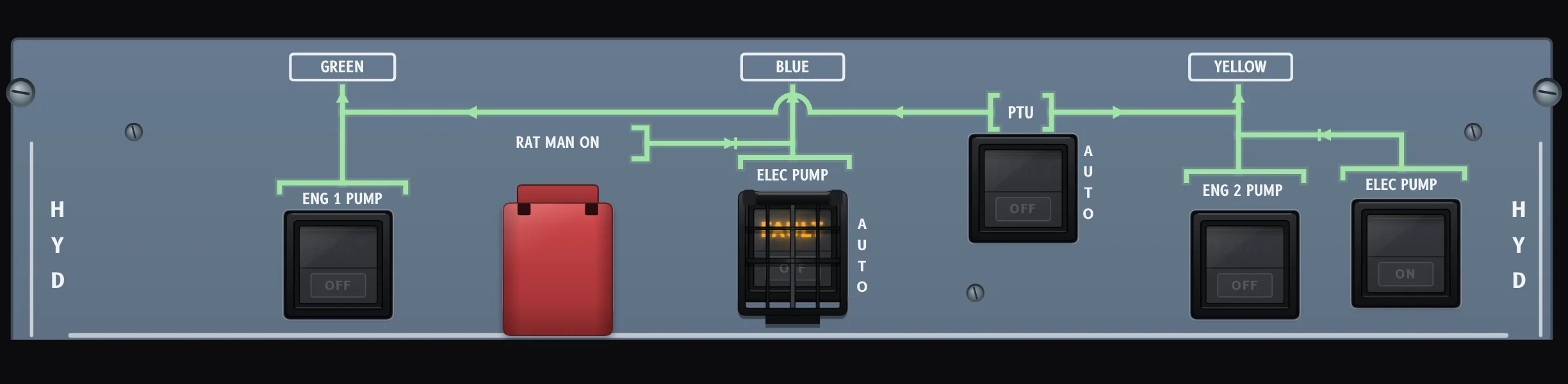
Blue's normal pump is electric, not engine driven. At AUTO, with AC power available, it runs in flight, and on the ground once an engine is running or the BLUE PUMP OVRD pushbutton has been pressed. Its FAULT light covers a low pump pressure, a pump overheat and the three reservoir faults; the low pressure part is inhibited on the ground with the engines stopped.
Sources FCOM PRO-ABN-HYD HYD B ELEC PUMP LO PR OR OVHT / FCOM DSC-29-10-20 BLUE SYSTEM PUMPS / FCOM DSC-29-20 OVERHEAD PANEL
Blue's sources, and what is missing
What does the crew see and hear?
A level 2 caution: a single chime, MASTER CAUT steady amber, the caution in amber on the E/WD and, normally, the HYD page on the SD. In the FCOM, B SYS LO PR is printed in a box, the ECAM's mark of a primary failure, and *F/CTL appears as a secondary failure, marked with a star.
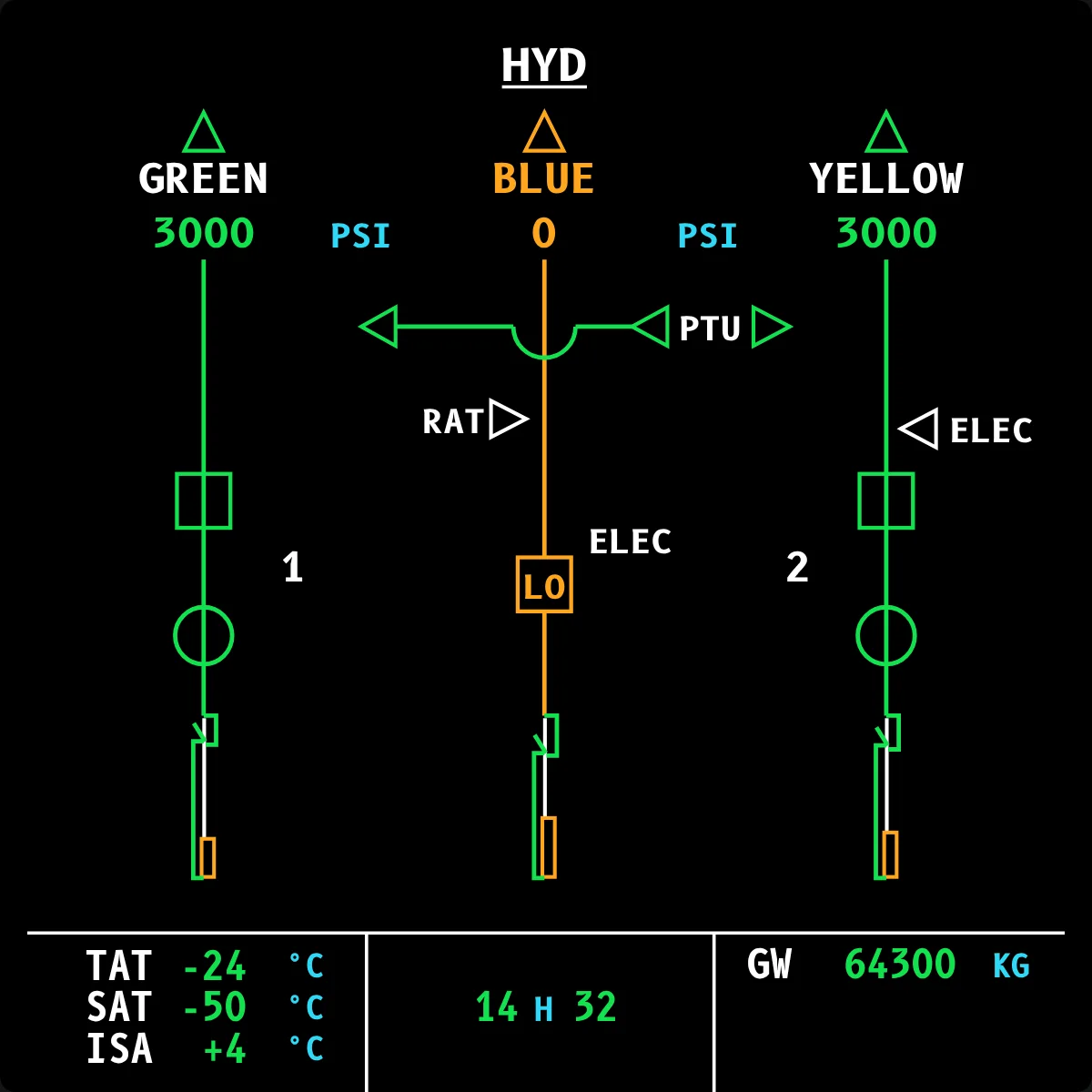
Under the line to switch the pump off, the E/WD shows two lines printed in blue, FUEL CONSUMPT INCRSD and FMS PRED UNRELIABLE, and then B SYS LO PR. On the HYD page blue's pressure turns amber below 1 450 psi.
Sources FCOM DSC-31-10 WARNING/CAUTION CLASSIFICATION / FCOM DSC-31-20 SYSTEM PAGES / FCOM DSC-31-15 PRIMARY AND SECONDARY FAILURE / FCOM PRO-ABN-HYD HYD / FCOM DSC-31-10 COLOR CODE / FCOM DSC-29-20 ECAM HYD PAGE
The moment the caution comes on
The cruise, all three systems normal. Press the button to fail the blue electric pump, then look at the E/WD, the HYD page, the panel and the schematic.
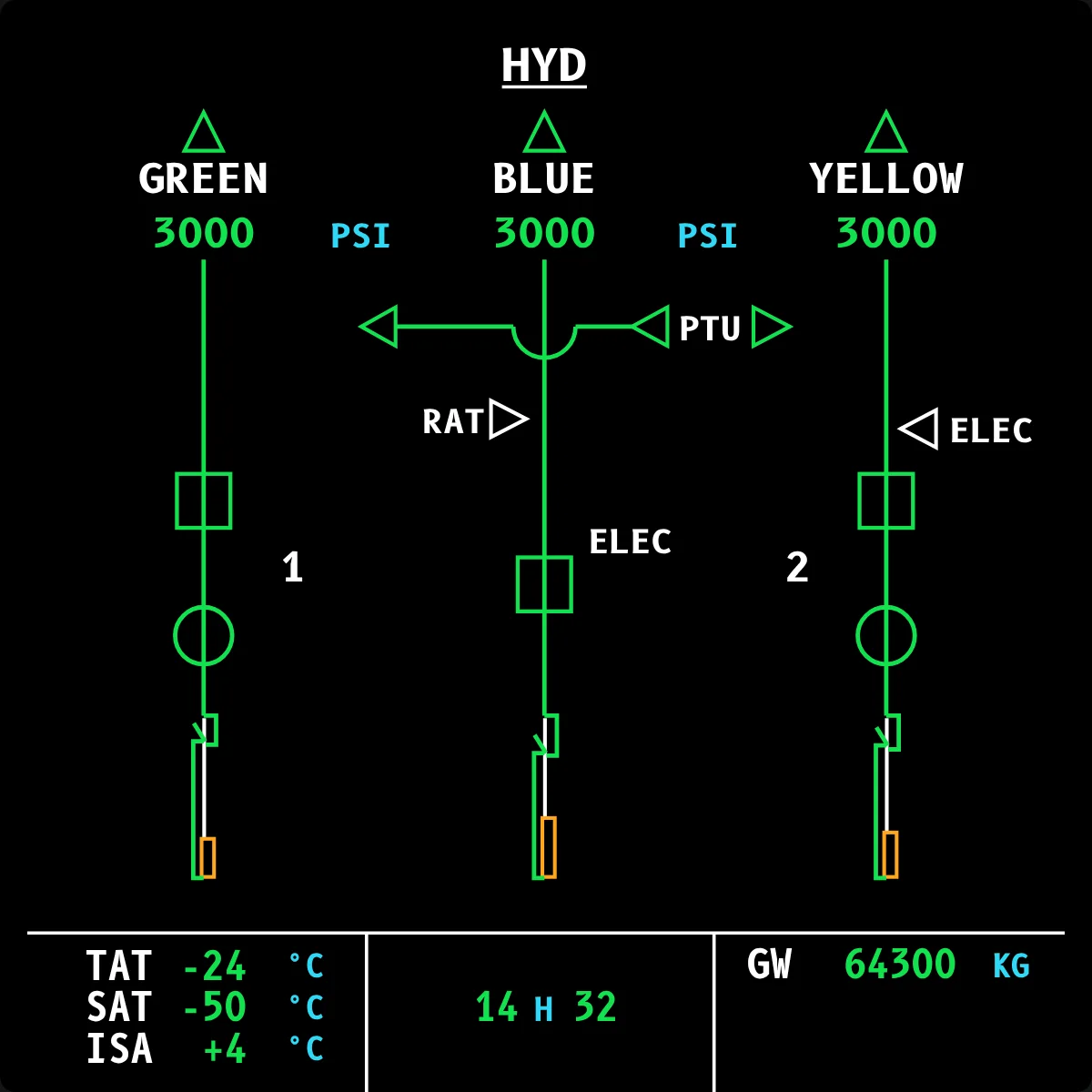
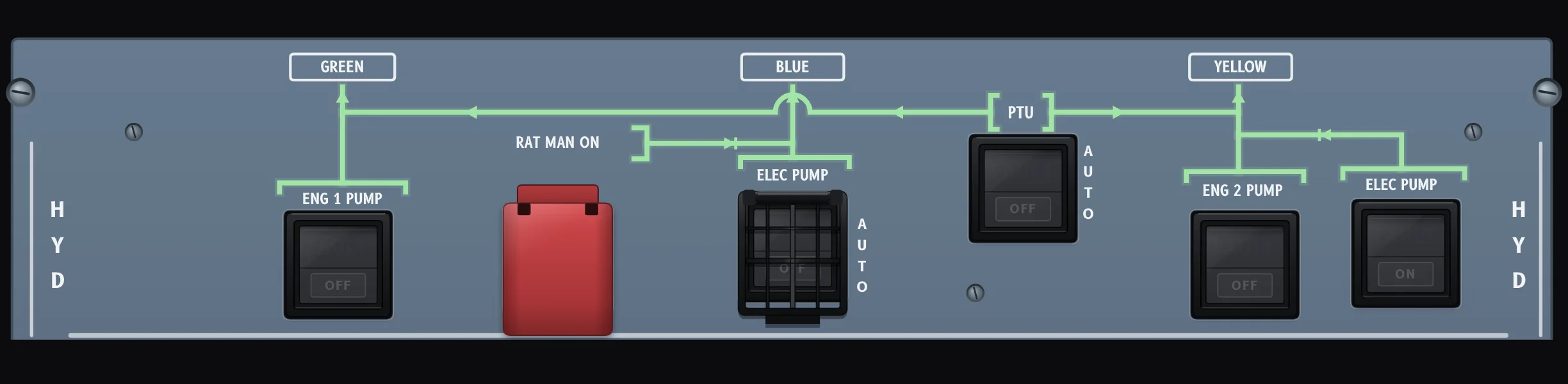
The alert Fail the blue electric pump
The E/WD shows the caution with BLUE ELEC PUMP OFF, the two remarks and B SYS LO PR. FAULT lights in the BLUE ELEC PUMP pushbutton, and on the HYD page blue's pressure is amber.
Look at the PTU: it stays idle. Green and yellow are both at their normal pressure, and the PTU has no link to blue. Working the procedure is what the ECAM Trainer does with you.
Sources FCOM PRO-ABN-HYD HYD / FCOM DSC-29-20 OVERHEAD PANEL / FCOM DSC-29-20 ECAM HYD PAGE / FCOM DSC-29-10-20 POWER TRANSFER UNIT (PTU)
Why does blue go with its pump?
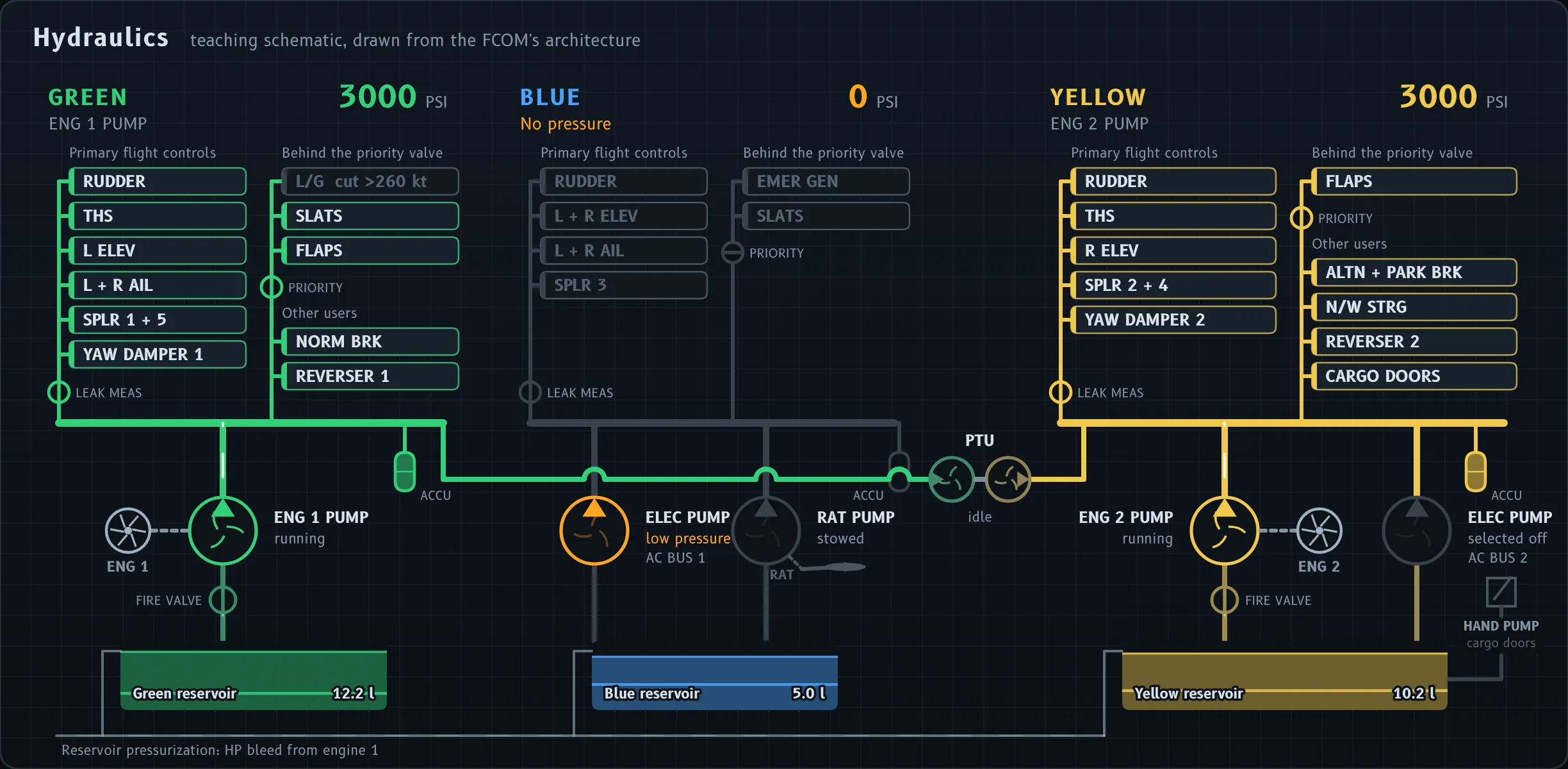
Each system has its own reservoir, and no fluid can pass from one system to another. Blue has two pumps: the electric one, and one turned by the ram air turbine (RAT) for an emergency. The PTU only lets green and yellow pressurise each other.
The RAT drops out by itself if AC BUS 1 and AC BUS 2 are both lost, and the crew can extend it at any time with RAT MAN ON. Once out, it can be stowed only on the ground. The single failure's procedure does not ask for it.
Sources FCOM DSC-29-10-10 GENERAL / FCOM DSC-29-10-20 BLUE SYSTEM PUMPS / FCOM DSC-29-10-20 POWER TRANSFER UNIT (PTU) / FCOM DSC-29-10-20 RAM AIR TURBINE (RAT) / FCOM DSC-29-20 OVERHEAD PANEL / FCOM PRO-ABN-HYD HYD
Switch the pump off, then try the RAT
The blue electric pump has failed and blue has no pressure. Predict first, then press, and watch blue on the schematic.
-
Predict You switch the failed blue pump off. Does the PTU now come to blue's help?
Try it Lift the guard and switch the BLUE ELEC PUMP off.
OFF de-energises the pump, and its FAULT light goes out, as it does for any cause but an overheat. Blue stays at zero: nothing in normal operation can pressurise it.
Sources FCOM DSC-29-20 OVERHEAD PANEL / FCOM DSC-29-10-20 BLUE SYSTEM PUMPS / FCOM DSC-29-10-20 POWER TRANSFER UNIT (PTU)
-
Predict Which source could still give blue its pressure?
Try it Extend the RAT with RAT MAN ON.
Driven by the RAT, blue runs at 2 500 psi. For this single failure the ECAM does not ask for it. In HYD B+Y SYS LO PR, where blue was lost by its electric pump's low pressure, the procedure has the crew extend the RAT, with a minimum RAT speed of 140 kt.
Sources FCOM DSC-29-10-10 GENERAL / FCOM DSC-29-10-20 RAM AIR TURBINE (RAT) / FCOM PRO-ABN-HYD HYD
What if the pump overheats instead?
The same procedure covers a pump overheat. Its FAULT light goes out when the crew selects OFF, except during an overheat: it then stays on as long as the overheat lasts. On the HYD page, OVHT appears in amber by the blue electric pump.
STATUS opens with an approach procedure, HYD LO PR, and its first condition: IF BLUE OVHT OUT, BLUE ELEC PUMP AUTO. The FCOM gives no reason for it. As printed, the pump goes back to AUTO only if the overheat goes out.
The pushbutton is guarded, and in flight the FCTM has the PF and PM crosscheck before any action on a guarded control.
Sources FCOM PRO-ABN-HYD HYD B ELEC PUMP LO PR OR OVHT / FCOM DSC-29-20 OVERHEAD PANEL / FCOM DSC-29-20 ECAM HYD PAGE / FCOM PRO-ABN-HYD / FCTM AOP-30-20 GENERAL
What does the aircraft lose with blue?
STATUS gives the cost. Inoperative: the blue system, spoiler 3, CAT 3 DUAL, the blue electric pump and, where fitted, the steep approach function. In green it shows SLATS SLOW and CAT 3 SINGLE ONLY, and the landing distance procedure applies.
FUEL CONSUMPT INCRSD appears when the failure affects the aircraft's nominal aerodynamic characteristics, and FMS PRED UNRELIABLE tells the crew to disregard the FMS fuel predictions and apply a fuel penalty factor.
The FCTM sums up a single hydraulic failure: very little effect on the handling, but the landing capability drops to CAT 3 SINGLE.
Sources FCOM PRO-ABN-HYD / FCTM PR-AEP-HYD DUAL HYDRAULIC FAILURES
What goes with blue
What is lost afterwards?
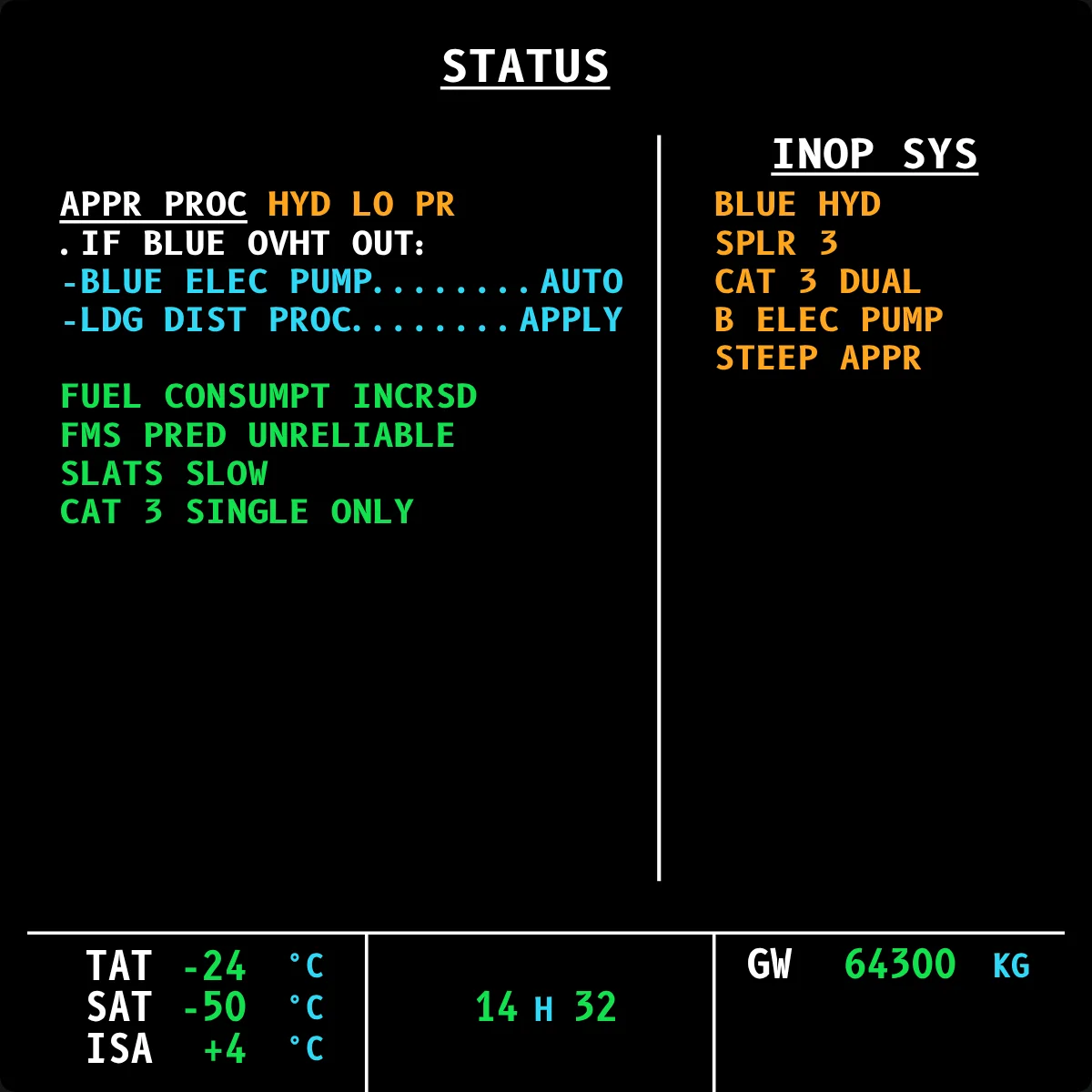
STATUS is the aircraft's operational summary: the approach procedure HYD LO PR in amber, its actions in blue, the information in green and the inoperative systems in amber. The FCOM prints this STATUS once, for every aircraft.
The FCOM marks STEEP APPR as an option, so it applies only where the function is fitted. IF BLUE OVHT OUT is printed in large letters, the FCOM's mark for a condition that appears on the ECAM.
Sources FCOM PRO-ABN-HYD / FCOM DSC-31-20 STATUS PAGE / FCOM PRO-ABN-ABN-00 INTRODUCTION
A319ceo, A320ceo, A320neo, A321neo: what differs?
| A319ceo, A320ceo | A320neo, A321neo | |
|---|---|---|
| The caution, its procedure and its STATUS | The same in every version | The same in every version |
Sources FCOM PRO-ABN-HYD HYD B ELEC PUMP LO PR OR OVHT / FCOM PRO-ABN-HYD HYD / FCOM PRO-ABN-HYD

Work HYD B ELEC PUMP LO PR as a crew
Read and do each line against the FCOM, with the E/WD, the SD page and the overhead following your hands, the PF and PM calls, and a debrief that says what you missed.
Work this failure in the ECAM TrainerGo further
Written in our own words from the FCOM and the FCTM; each part names the units it rests on. The E/WD, the STATUS and the live aircraft are the platform's own ECAM and systems model, the same the ECAM Trainer and the flight deck run. This page explains the procedure; it is not the procedure. Aircraft differ by type, engine and options: your aircraft's FCOM, your QRH and your operator's procedures always come first. How we write and check these pages.
Every ECAM procedure, line by line, against the FCOM.
The ECAM Trainer works 108 scenarios with the E/WD, the SD page and the overhead following your hands. Start free today, or open everything with A320 Knowledge+.
For study and revision only. Always follow your operator's approved documentation and procedures. A320 Knowledge is independent and not affiliated with Airbus.
Related
- HYD B+Y SYS LO PRA red warning: blue and yellow are lost and green is left alone, still in normal law.
- HYD B RSVR LO LVLAn amber caution: the blue system is losing its fluid.
- HYD B RSVR OVHTAn amber caution with one line, and the FCOM's own worked example of the ECAM.
- HYD G+B SYS LO PRA red warning: green and blue are lost and yellow is left alone.
- A320 hydraulic systemThe system guide, with the live aircraft
- Every ECAM procedureThe alerts the ECAM Trainer works, grouped by system