
HYD G+B SYS LO PR
A red warning: green and blue are lost and yellow is left alone. Here is why it is an emergency, when the RAT can bring blue back, why the protections and the ailerons go, and why the gear comes down at 200 kt, with the live aircraft at the moment the warning comes on.
Written and checked by current A320 pilotschecked against the FCOM on Our editorial policy
What HYD G+B SYS LO PR means
HYD G+B SYS LO PR is a red warning: green and blue are both at or below 1 450 psi, and yellow alone is left. The slats, whose motors use green and blue, are lost, and the flight controls go to alternate law without reduced protection.
The procedure gives red LAND ASAP and, if blue was lost by its electric pump, the RAT to bring blue back. If no system is recovered, STATUS sets up a hand-flown approach: A/THR off, flap lever 3, the gear by gravity at 200 kt and an increased approach speed.
Sources FCOM PRO-ABN-HYD HYD G+B SYS LO PR / FCOM DSC-27-30-10 MAIN COMPONENTS / FCOM PRO-ABN-HYD HYD / FCOM DSC-27-20-20 ALTERNATE LAW WITHOUT REDUCED PROTECTION / FCTM AOP-30-10 LAND ASAP DEFINITION / FCTM PR-AEP-HYD DUAL HYDRAULIC FAILURES
At a glance
- Level
- Red warning, level 3: continuous repetitive chime, flashing red MASTER WARN, and red LAND ASAP
- Sets it off
- Green and blue both at or below 1 450 psi; resets at 1 750 psi
- Flight controls
- Alternate law without reduced protection: only the load factor limitation remains; direct law with the gear down
- Lost
- Slats, both ailerons, the left elevator, spoilers 1, 3 and 5, normal brakes and the autopilot
- Landing
- A/THR off, flap lever 3, the gear by gravity at 200 kt, alternate braking with anti-skid
Sources FCOM DSC-31-10 WARNING/CAUTION CLASSIFICATION / FCOM DSC-31-10 AUDIO INDICATORS / FCOM PRO-ABN-HYD HYD / FCTM AOP-30-10 LAND ASAP DEFINITION / FCOM PRO-ABN-HYD HYD G+B SYS LO PR / FCOM DSC-27-20-20 ALTERNATE LAW WITHOUT REDUCED PROTECTION / FCTM PR-AEP-HYD REMAINING SYSTEMS
What sets the warning off?
The warning triggers when green and blue are both at or below 1 450 psi, and resets once the pressure is 1 750 psi or more.
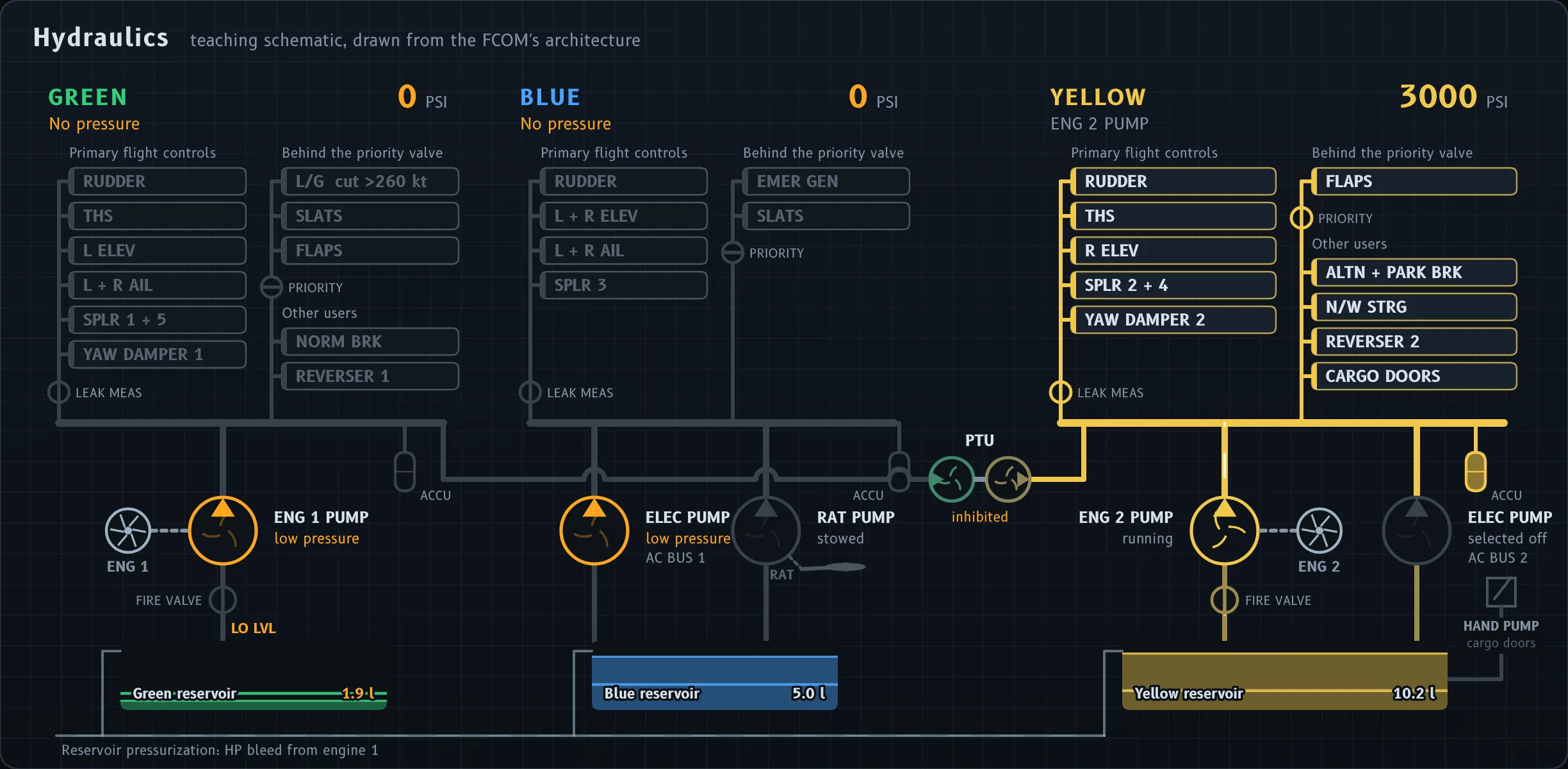
Green has one pump, driven by engine 1. Blue's normal pump is electric, and a pump turned by the ram air turbine pressurises blue in an emergency. The PTU joins green and yellow only, so it cannot help blue, and in flight HYD PTU FAULT triggers if the PTU at AUTO does not run with the green or yellow reservoir level low and the green or yellow system pressure low.
The procedure notes that with green lost by its low level, HYD PTU FAULT may appear and ask for the PTU off.
Sources FCOM PRO-ABN-HYD HYD G+B SYS LO PR / FCOM DSC-29-10-20 GREEN SYSTEM PUMP / FCOM DSC-29-10-20 BLUE SYSTEM PUMPS / FCOM DSC-29-10-20 POWER TRANSFER UNIT (PTU) / FCOM PRO-ABN-HYD HYD PTU FAULT / FCOM PRO-ABN-HYD HYD
Two systems, one warning
What does the crew see and hear?
A red warning is the ECAM's highest level: the continuous repetitive chime, MASTER WARN flashing red, the warning message in red on the E/WD, and the SD normally calls up the relevant system page.
The procedure opens with LAND ASAP in red: land as soon as possible at the nearest airport at which a safe landing can be made. F/CTL ALTN LAW (PROT LOST) follows as its associated procedure.
Sources FCOM DSC-31-10 WARNING/CAUTION CLASSIFICATION / FCOM DSC-31-10 AUDIO INDICATORS / FCOM PRO-ABN-HYD HYD / FCTM AOP-30-10 LAND ASAP DEFINITION
The moment the warning comes on
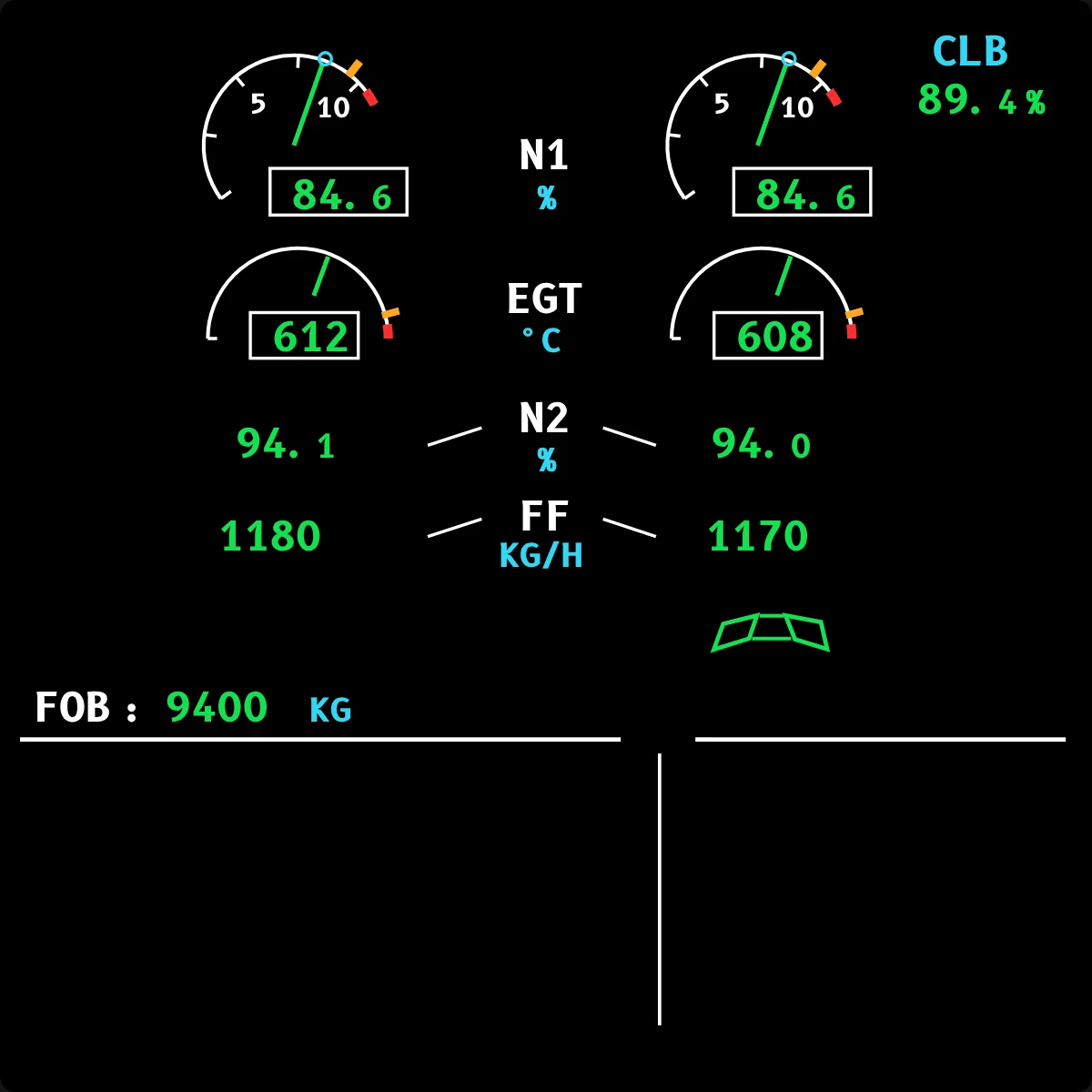
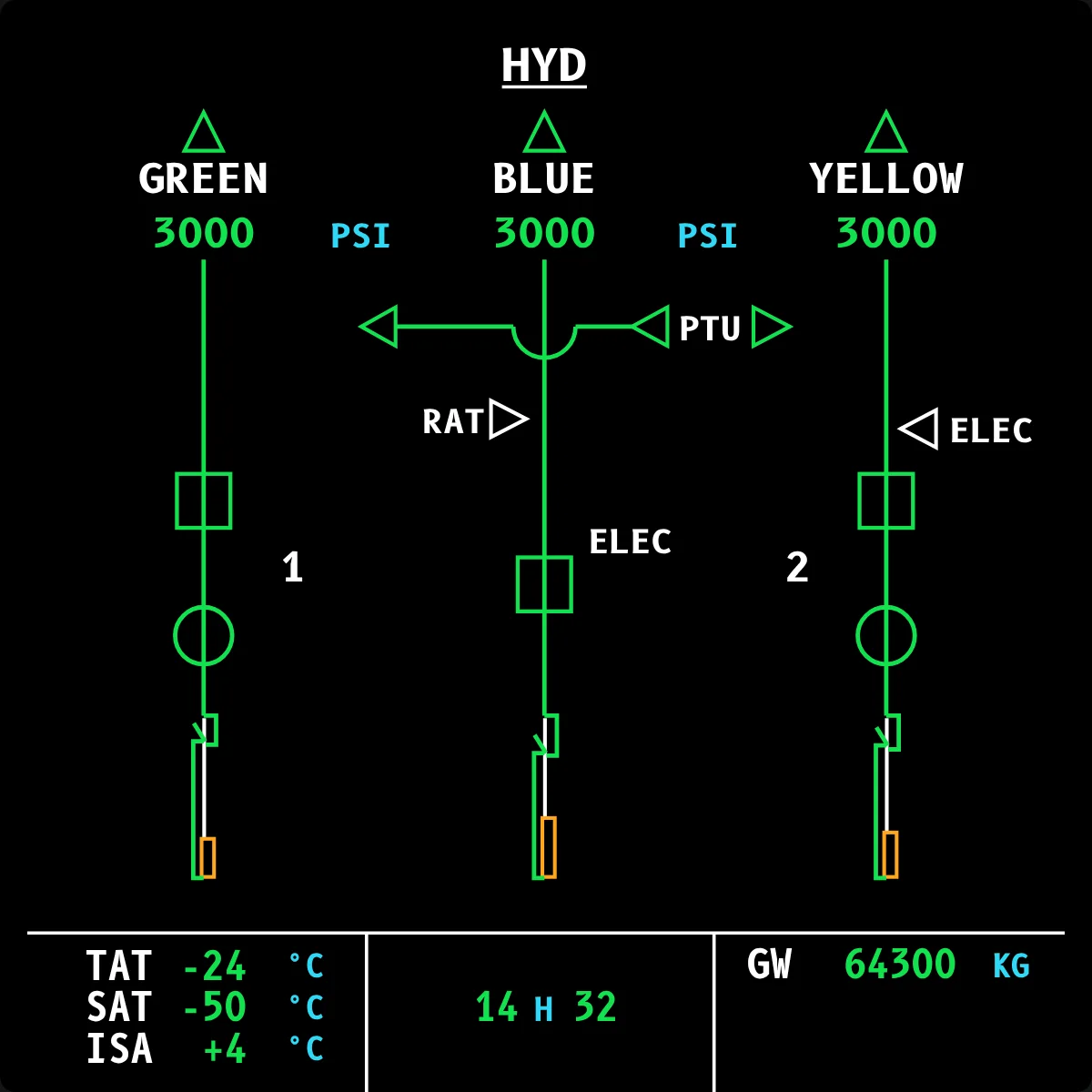
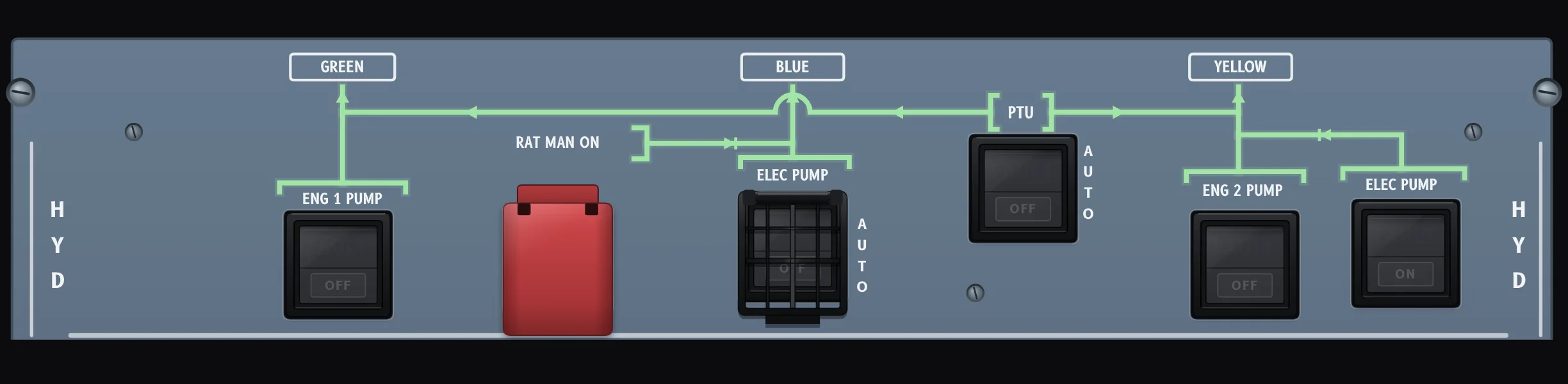
A healthy aircraft in the cruise. Press the button to drain the green and blue reservoirs, then look at the E/WD, the HYD page and the HYD panel.
The alert Drain green and blue
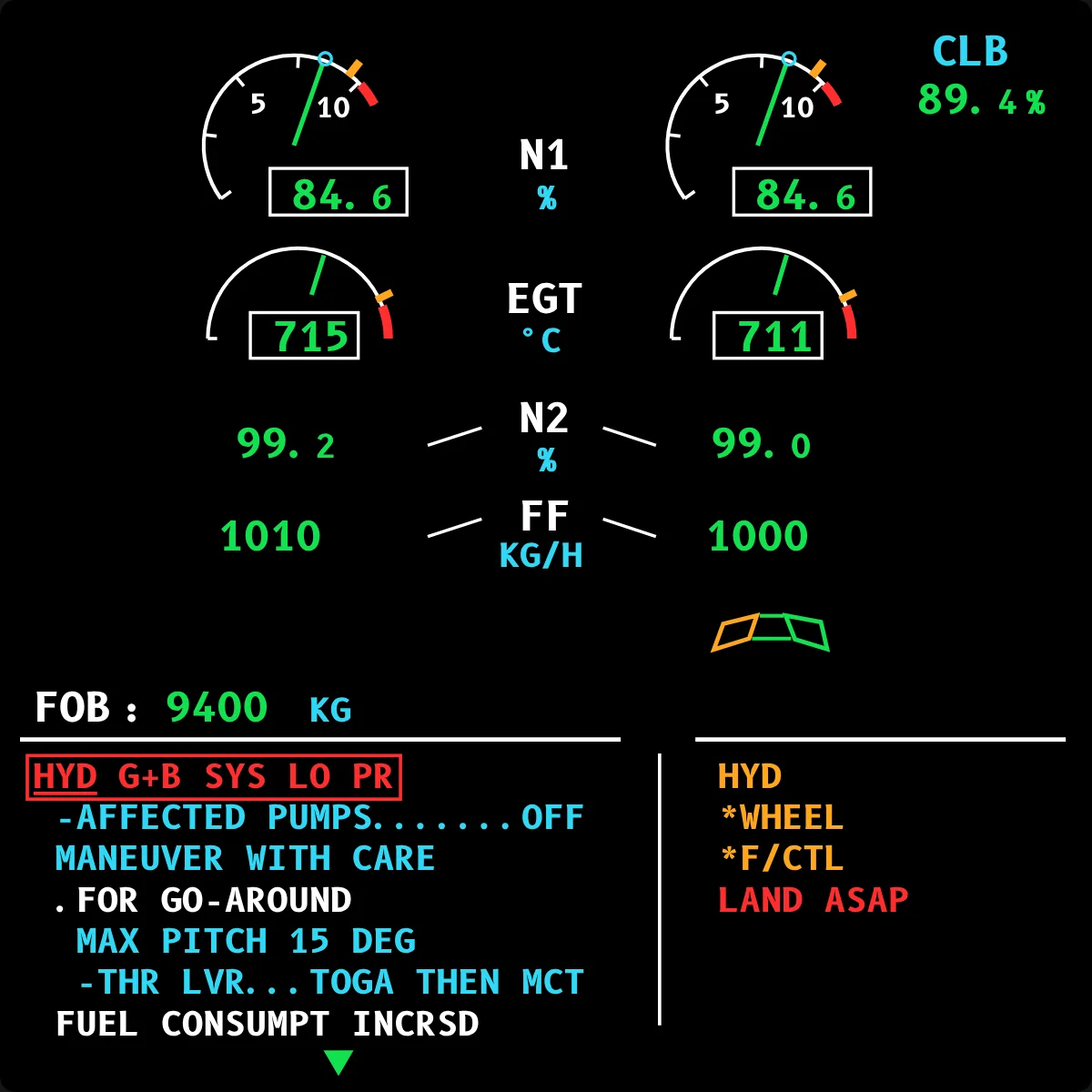
The E/WD, drawn here in one version of the procedure, for some aircraft, shows HYD G+B SYS LO PR in red with red LAND ASAP, AFFECTED PUMPS OFF, MANEUVER WITH CARE and the go-around lines, then F/CTL ALTN LAW (PROT LOST) with MAX SPEED 320/0.77, SPD BRK DO NOT USE and S/F JAMMED PROC APPLY. There is no RAT line: its condition is a blue loss by ELEC PUMP LO PR. The two other versions, for other aircraft, have FOR GA: MAX PITCH 15 DEG only, and refer to the slats or flaps jammed procedure instead of an S/F JAMMED PROC line.
The reservoir cautions and HYD PTU FAULT come after the warning, which has priority. The HYD page shows green and blue lost and yellow alone, on engine 2's pump. Working the procedure is what the ECAM Trainer does with you.
Sources FCOM PRO-ABN-HYD HYD / FCOM PRO-ABN-HYD / FCOM DSC-31-10 PRIORITY RULES / FCOM PRO-ABN-HYD HYD PTU FAULT / FCOM DSC-29-20 ECAM HYD PAGE / FCOM DSC-29-10-20 YELLOW SYSTEM PUMPS
When does the RAT bring blue back?
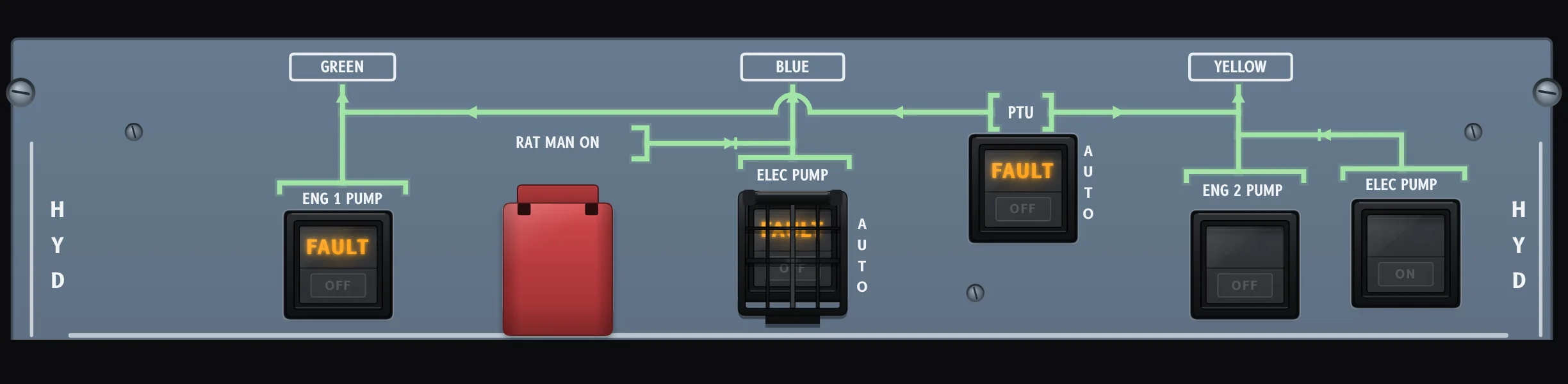
The procedure's first condition: if blue was lost by ELEC PUMP LO PR, RAT MAN ON, then a minimum RAT speed of 140 kt. The RAT is coupled to a hydraulic pump that lets blue work, and blue then runs at 2 500 psi.
If blue is recovered, the procedure for a single failure applies; if not, S/F JAMMED PROC applies, a reference to the same procedure in the two other versions, for other aircraft.
If blue was lost by its reservoir low level, the RAT line's condition is not met, and with the blue reservoir low the STATUS lists EMER GEN as inoperative: the emergency generator is driven by the blue system.
Sources FCOM PRO-ABN-HYD HYD / FCOM DSC-29-10-10 GENERAL / FCOM DSC-29-10-20 RAM AIR TURBINE (RAT) / FCOM PRO-ABN-HYD / FCOM DSC-24-20 OVERHEAD PANEL (CONT'D)
Blue back on the RAT
Green has leaked away and the blue electric pump has failed: green and blue are both lost, but blue's fluid is still there. Predict first, then press RAT MAN ON and watch the schematic.
-
Predict What does the RAT give back?
Try it Lift the guard and press RAT MAN ON.
The RAT drops out and blue is back on its pump at 2 500 psi. Green stays lost: the PTU joins green and yellow, not blue.
With blue recovered, the procedure for a single failure applies, and the crew keeps at least 140 kt for the RAT.
Sources FCOM DSC-29-10-10 GENERAL / FCOM DSC-29-10-20 RAM AIR TURBINE (RAT) / FCOM DSC-29-20 OVERHEAD PANEL / FCOM DSC-29-10-20 POWER TRANSFER UNIT (PTU) / FCOM PRO-ABN-HYD HYD
Why is it so serious?
The FCTM's answer: a dual hydraulic failure, although unlikely, can, depending on the systems lost, cost the autopilot, degrade the flight control law, mean a landing in an abnormal configuration, and bring long ECAM procedures with their workload and task sharing.
It is an emergency with red LAND ASAP, and the FCTM says a MAYDAY should be declared. The landing is made as soon as possible, but the ECAM actions should be completed before the approach.
The FCTM names this failure and HYD G+Y SYS LO PR as the ones where the PF is very busy, flying in alternate law and handling the communications. The autopilot is lost; the FD and A/THR remain, until STATUS has the A/THR set off for the approach.
It is a complex procedure: the QRH summary is used once the ECAM procedure is done, and the briefing concentrates on the hand-flown approach, the gravity extension, the configuration and VAPP.
Sources FCTM PR-AEP-HYD DUAL HYDRAULIC FAILURES / FCTM AOP-30-10 LAND ASAP DEFINITION / FCOM PRO-ABN-HYD HYD
What happens to the flight controls?
The procedure reads F/CTL ALTN LAW (PROT LOST): normal law and its protections are lost, and only the load factor limitation is provided, which the procedure calls alternate law without protection. The system description names it alternate law without reduced protection: of its protections, only the load factor limitation remains. Unlike the reduced protection after HYD G+Y SYS LO PR, neither the low speed nor the high speed stability remains.
MAX SPEED 320/0.77 comes with it, as the high speed protection is lost, and the speed brakes are not to be used.
The ailerons are lost: their servojacks go to damping mode with blue and green both at low pressure. The left elevator and spoilers 1, 3 and 5 are lost too, leaving the right elevator, two spoilers a wing, the stabiliser and yaw damper 2.
At gear extension the law becomes direct, in pitch and in roll, and in roll direct law with the ailerons failed, all the roll spoilers become active.
Sources FCOM PRO-ABN-HYD HYD / FCOM DSC-27-20-20 ALTERNATE LAW WITHOUT REDUCED PROTECTION / FCOM DSC-27-10-20 / FCTM PR-AEP-HYD REMAINING SYSTEMS / FCOM DSC-27-20-20 DIRECT LAW
What yellow alone leaves
How is the landing flown, and why the gear at 200 kt?
STATUS sets the sequence: S/F JAMMED PROC APPLY in the version drawn, then, in every version, A/THR OFF with the target speed selected on the FCU. The FCOM's reason: with the slats and some flight control surfaces lost, the A/THR may not hold the speed satisfactorily. Flap lever 3 for landing and GPWS LDG FLAP 3 ON follow.
WHEN SPD 200 KT, displayed once the slats are retracted, calls for the gear by gravity. The FCOM explains it: the gear goes down at 200 kt to revert sooner to direct law, which below 200 kt gives better pitch control than alternate law with one elevator and all the slats lost.
Green actuates the gear; for the gravity extension the crew pulls the gear crank out and turns it clockwise for 3 turns; it cannot be retracted in a go-around. The approach speed is increased, then the landing distance procedure applies.
On the ground, the normal brakes and autobrake are lost. Yellow takes over the brakes as alternate braking with anti-skid, nosewheel steering remains, and only reverser 2 works.
Sources FCOM PRO-ABN-HYD HYD / FCOM PRO-ABN-HYD / FCOM DSC-32-10-10 LANDING GEARS AND DOORS OPERATION / FCOM DSC-32-10-40 LANDING GEAR GRAVITY EXTENSION / FCTM PR-AEP-HYD REMAINING SYSTEMS / FCOM DSC-32-30-10
What is lost afterwards?
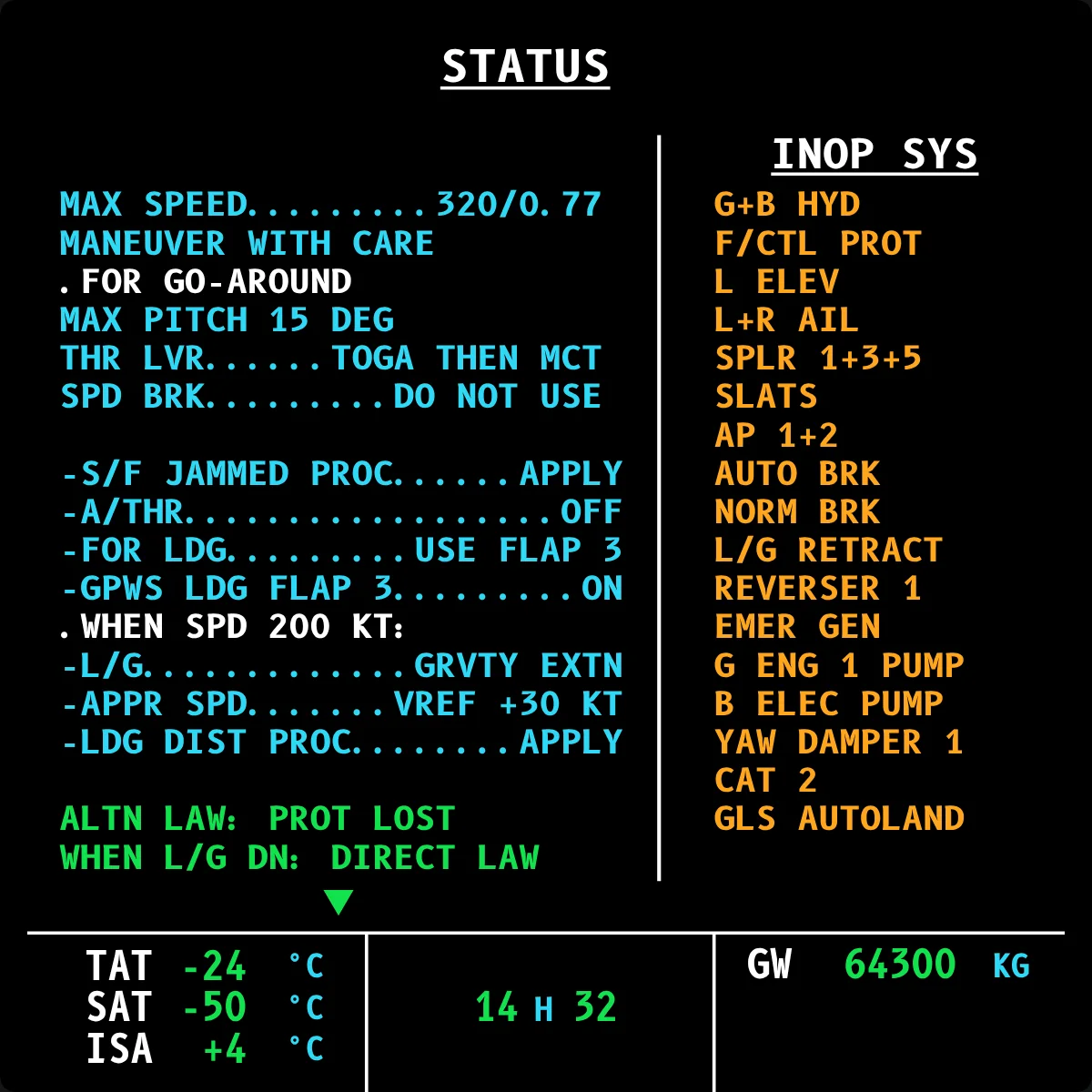
This STATUS starts with the limits in blue: MAX SPEED 320/0.77, MANEUVER WITH CARE, the go-around lines and SPD BRK DO NOT USE. MIN RAT SPD 140 KT shows only with the RAT out. The approach procedure follows, then the information in green: ALTN LAW: PROT LOST, WHEN L/G DN: DIRECT LAW and FLAPS SLOW.
The approach speed is VREF +30 KT in the version drawn and two others; one more version gives VREF +25 KT. The APPR PROC DUAL HYD LO PR title and the IF HYD NOT RECOVERED line are not displayed for a double low level, the case drawn here.
INOP SYS lists green and blue hydraulics, the protections, the left elevator, both ailerons, spoilers 1, 3 and 5, the slats, the autopilots, autobrake, normal brakes, gear retraction, reverser 1, the emergency generator if blue's reservoir is low, the green and blue pumps, yaw damper 1, CAT 2 and, where fitted, GLS autoland.
Which version applies depends on your aircraft: check your own FCOM.
Sources FCOM PRO-ABN-HYD HYD / FCOM DSC-31-20 STATUS PAGE
A319ceo, A320ceo, A320neo, A321neo: what differs?
| A319ceo, A320ceo | A320neo, A321neo | |
|---|---|---|
| The warning and its trigger | The same in every version | The same in every version |
| STATUS: go-around lines | Not given by type: FOR GA: MAX PITCH 15 DEG in one version; the go-around lines of the version drawn in the others | Not given by type: the version drawn and one other, each for a list of aircraft, add THR LVR TOGA THEN MCT; a third gives FOR GA: MAX PITCH 15 DEG |
| Procedure: blue not recovered | Not given by type: S/F JAMMED PROC APPLY in the version drawn; a reference to the slats or flaps jammed procedure in the two others | Not given by type: S/F JAMMED PROC APPLY in the version drawn; a reference to the slats or flaps jammed procedure in the two others |
| STATUS: S/F JAMMED PROC | Not given by type: not on STATUS in one version; on STATUS in the version drawn and another | Not given by type: on STATUS in the version drawn and one other, each for a list of aircraft; not in a third |
| STATUS: approach speed | Not given by type: VREF +25 KT in one version, VREF +30 KT in the other three | Not given by type: VREF +30 KT in the three versions given to lists of aircraft |
| STATUS: INOP SYS extras | Not given by type: STEEP APPR, where fitted, in one version; none in the three given to lists of aircraft | Not given by type: STEEP APPR, where fitted, in one version; none in the three given to lists of aircraft |
The FCOM prints three versions of this procedure and four of its STATUS. The STATUS above is one of the four.
Sources FCOM PRO-ABN-HYD HYD G+B SYS LO PR / FCOM PRO-ABN-HYD / FCOM PRO-ABN-HYD HYD

Work HYD G+B SYS LO PR as a crew
Read and do each line against the FCOM, with the E/WD, the SD page and the overhead following your hands, the PF and PM calls, and a debrief that says what you missed.
Work this failure in the ECAM TrainerGo further
Written in our own words from the FCOM and the FCTM; each part names the units it rests on. The E/WD, the STATUS and the live aircraft are the platform's own ECAM and systems model, the same the ECAM Trainer and the flight deck run. This page explains the procedure; it is not the procedure. Aircraft differ by type, engine and options: your aircraft's FCOM, your QRH and your operator's procedures always come first. How we write and check these pages.
Every ECAM procedure, line by line, against the FCOM.
The ECAM Trainer works 108 scenarios with the E/WD, the SD page and the overhead following your hands. Start free today, or open everything with A320 Knowledge+.
For study and revision only. Always follow your operator's approved documentation and procedures. A320 Knowledge is independent and not affiliated with Airbus.
Related
- HYD B+Y SYS LO PRA red warning: blue and yellow are lost and green is left alone, still in normal law.
- HYD B ELEC PUMP LO PRAn amber caution that costs a whole system.
- HYD B RSVR LO LVLAn amber caution: the blue system is losing its fluid.
- HYD B RSVR OVHTAn amber caution with one line, and the FCOM's own worked example of the ECAM.
- A320 hydraulic systemThe system guide, with the live aircraft
- Every ECAM procedureThe alerts the ECAM Trainer works, grouped by system