
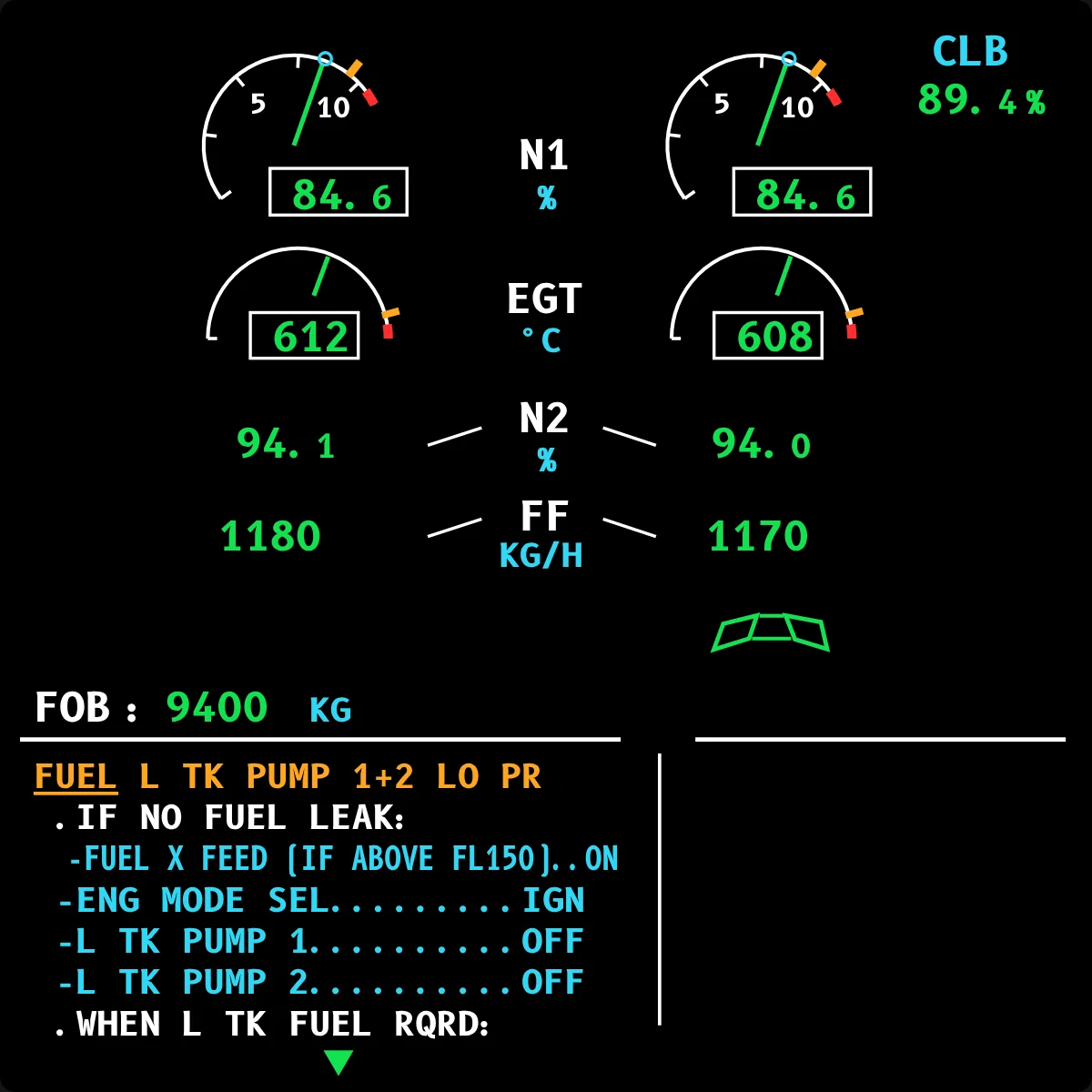
FUEL L TK PUMP 1+2 LO PR
An amber caution with a long procedure. Here is what losing both pumps of one wing means, what keeps the engine running without being asked, why the procedure starts with a leak check, and the live aircraft at the moment the caution comes on.
Written and checked by current A320 pilotschecked against the FCOM on Our editorial policy
What FUEL L TK PUMP 1+2 LO PR means
FUEL L TK PUMP 1+2 LO PR is an amber caution: both pumps in the left wing have lost their pressure. Engine 1 is not cut off from its fuel. Its pumps' pressure normally holds the suction valves closed; without it, they let the engine draw fuel from its own tank by gravity.
Gravity feeding has a ceiling, and the procedure offers another way. If there is no fuel leak, and above FL 150, the cross-feed opens; with the centre tank empty, the right pumps then feed both engines. Continuous ignition goes on, the failed pumps go off, and the left tank's fuel can later only be used by gravity.
Sources FCOM PRO-ABN-FUEL FUEL L (R) TK PUMP 1 + 2 LO PR / FCOM DSC-28-10-30 / FCOM PRO-ABN-FUEL FUEL / FCOM PRO-ABN-FUEL
At a glance
- Level
- Amber caution, level 2: single chime, MASTER CAUT and the FUEL page on the SD
- Sets it off
- Low pressure from both tank pumps of the left wing
- Lights
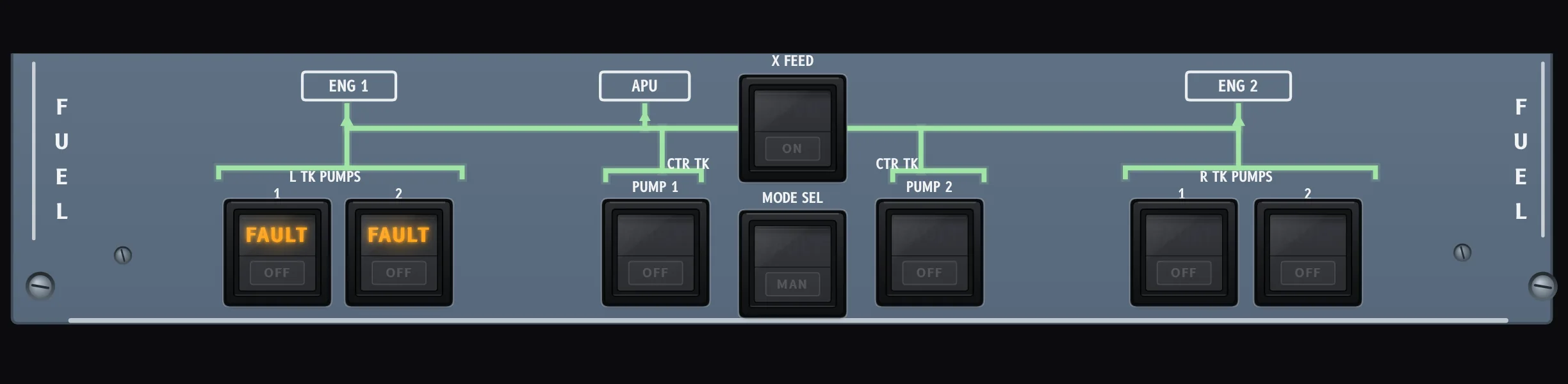
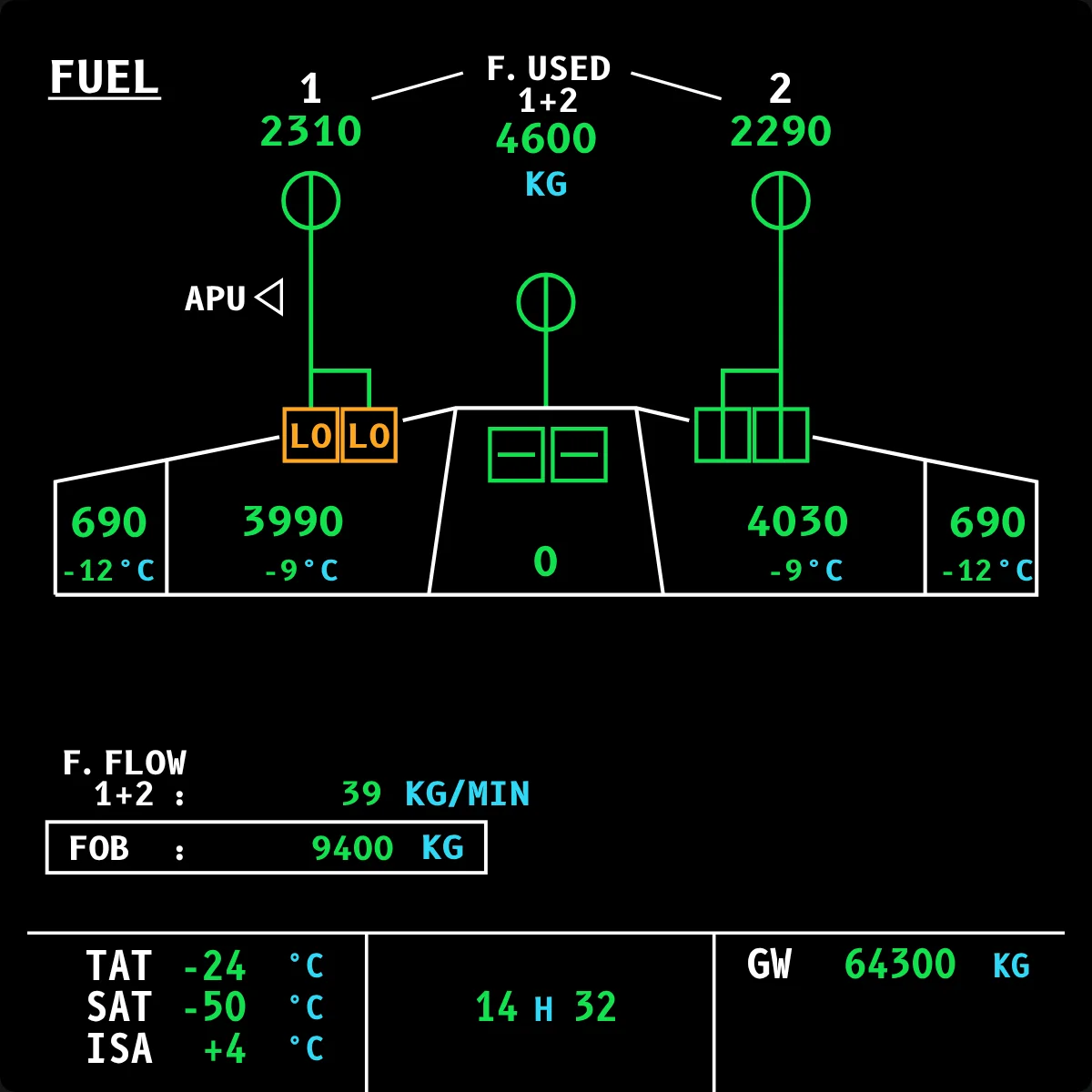
- FAULT in amber in L TK PUMPS 1 and 2 on the FUEL panel; LO in amber by each pump on the FUEL page
- What keeps engine 1 running
- The suction valves, closed by pump pressure in normal operation, let it be fed by gravity
- Procedure
- If no fuel leak, FUEL X FEED ON above FL 150; ENG MODE SEL IGN; both pumps OFF
- STATUS
- L TK GRVTY FEED ONLY; the left tank pumps inoperative
Sources FCOM PRO-ABN-FUEL FUEL L (R) TK PUMP 1 + 2 LO PR / FCOM DSC-31-10 WARNING/CAUTION CLASSIFICATION / FCOM DSC-31-20 SYSTEM PAGES / FCOM PRO-ABN-FUEL (CENTER TANK EMPTY) / FCOM DSC-28-20 FUEL / FCOM DSC-28-10-30 / FCOM PRO-ABN-FUEL FUEL / FCOM PRO-ABN-FUEL
What sets the caution off?
The FCOM's trigger is short: the pressure of the tank pumps is low. It gives no pressure figure. With the centre tank empty, each engine is supplied by the two pumps in its own side's inner tank, so here both of engine 1's pumps have gone.
Each pump's pushbutton lights FAULT in amber, with the ECAM caution, when its delivery pressure drops. The light does not come on when OFF is selected. On the FUEL page each pump shows LO in amber: its contactor is on and its pressure low.
The caution is inhibited from takeoff power until 1 500 ft, and from 800 ft until 80 kt on the landing roll, as the FCOM's flight phase graphic draws it.
The FCOM prints three versions of this caution: one with no heading, for one list of aircraft, and two for another list, headed CENTER TANK EMPTY and CENTER TANK NOT EMPTY. The trigger reads the same in all three, and the first two procedures read alike.
Sources FCOM PRO-ABN-FUEL FUEL L (R) TK PUMP 1 + 2 LO PR / FCOM PRO-ABN-FUEL (CENTER TANK EMPTY) / FCOM DSC-28-10-30 / FCOM DSC-28-20 FUEL / FCOM PRO-ABN-FUEL FUEL / FCOM PRO-ABN-FUEL (CENTER TANK NOT EMPTY)
From two weak pumps to gravity feeding
What does the crew see and hear?
A level 2 caution: a single chime, the MASTER CAUT light steady amber, the caution in amber on the E/WD, and the SD normally calls up the FUEL page by itself, the relevant system page for a caution.
The procedure under it is long: the leak condition and the cross-feed, ENG MODE SEL, both pumps, the later lines for when the left tank's fuel is needed, and the cross-feed off below FL 150.
Sources FCOM DSC-31-10 WARNING/CAUTION CLASSIFICATION / FCOM DSC-31-20 SYSTEM PAGES / FCOM PRO-ABN-FUEL FUEL L (R) TK PUMP 1 + 2 LO PR / FCOM PRO-ABN-FUEL FUEL
The moment the caution comes on
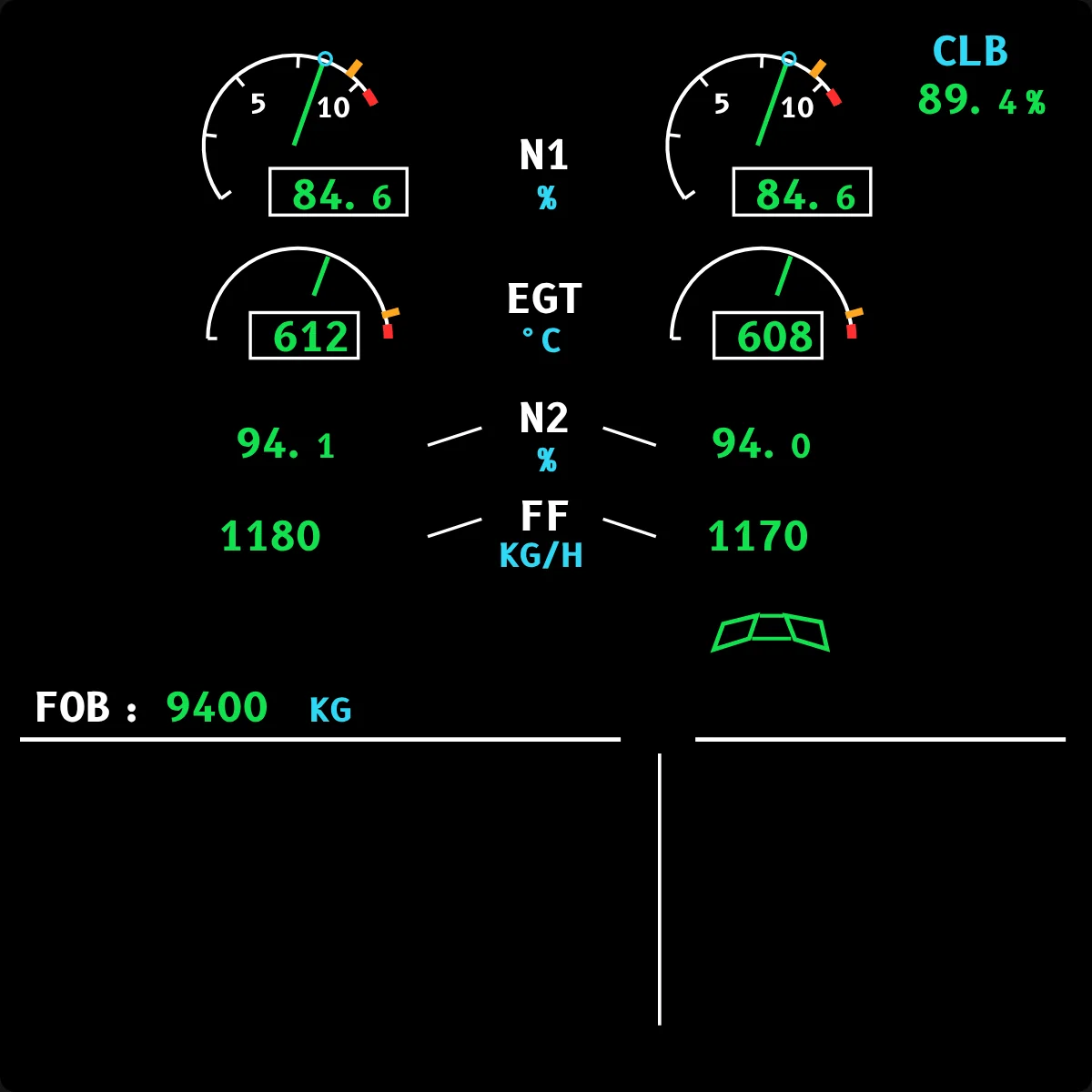
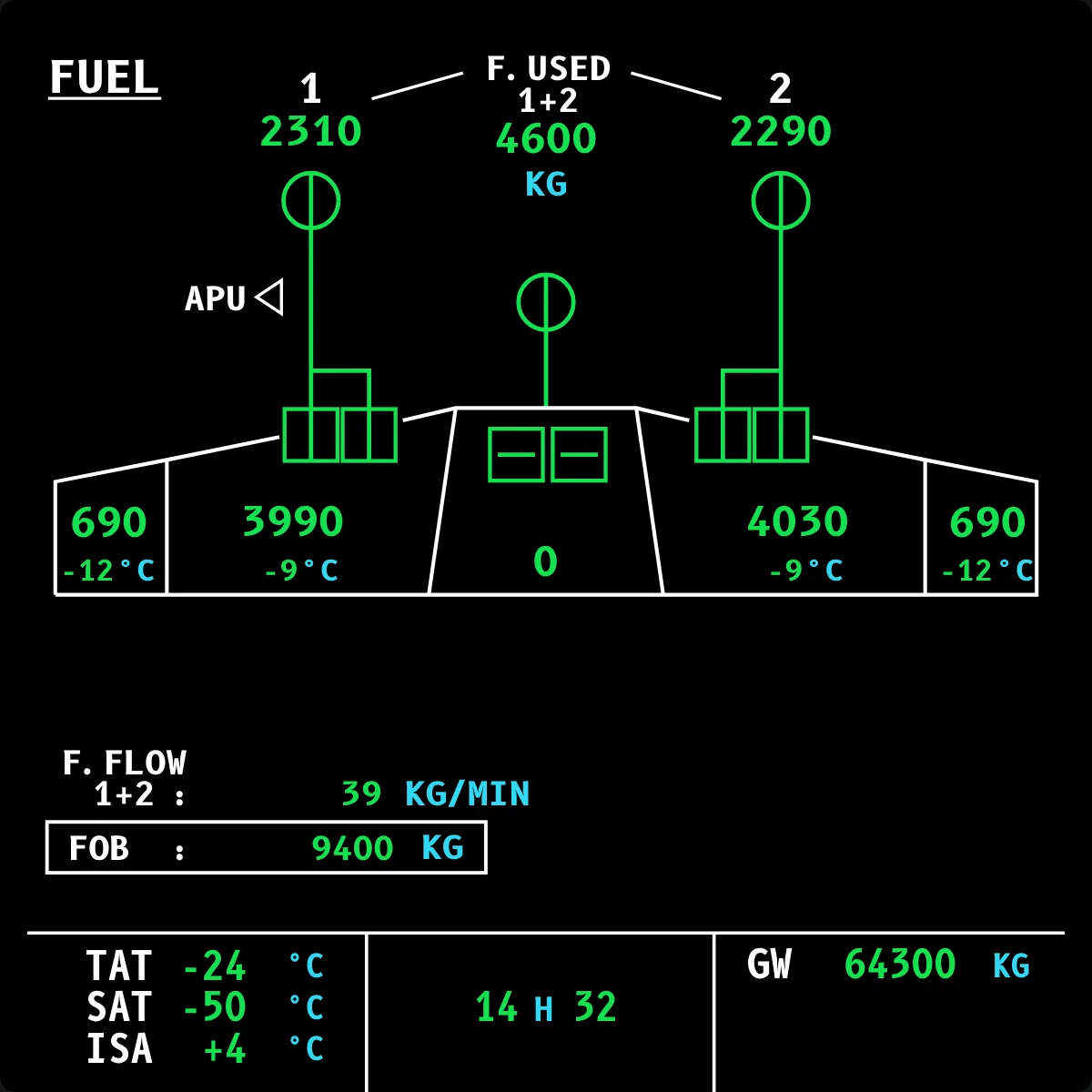
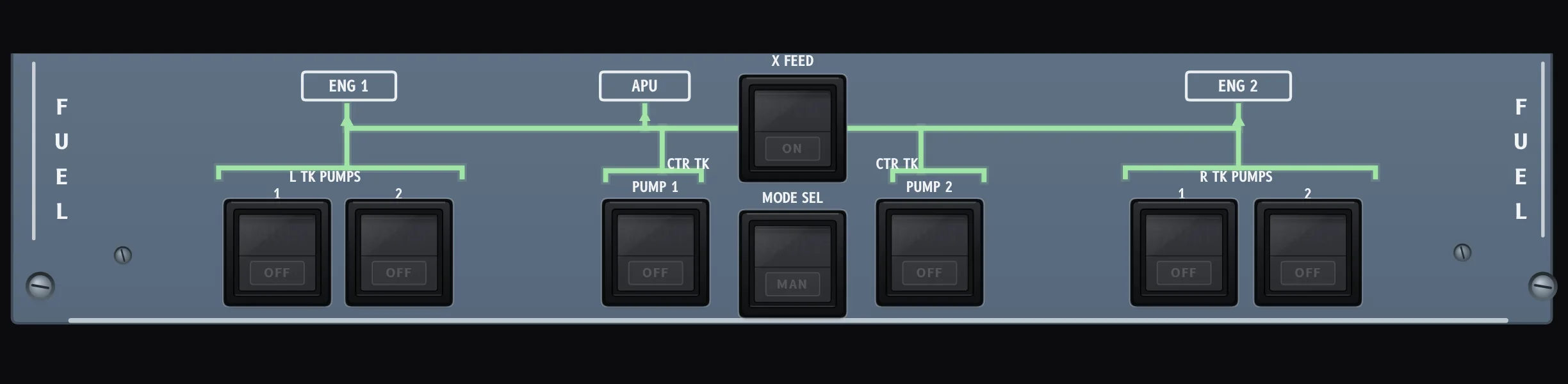
The cruise at FL 350, the centre tank empty, every wing pump running. Press the button to fail both left wing pumps, then look at the E/WD, the FUEL page, the FUEL panel and the schematic.
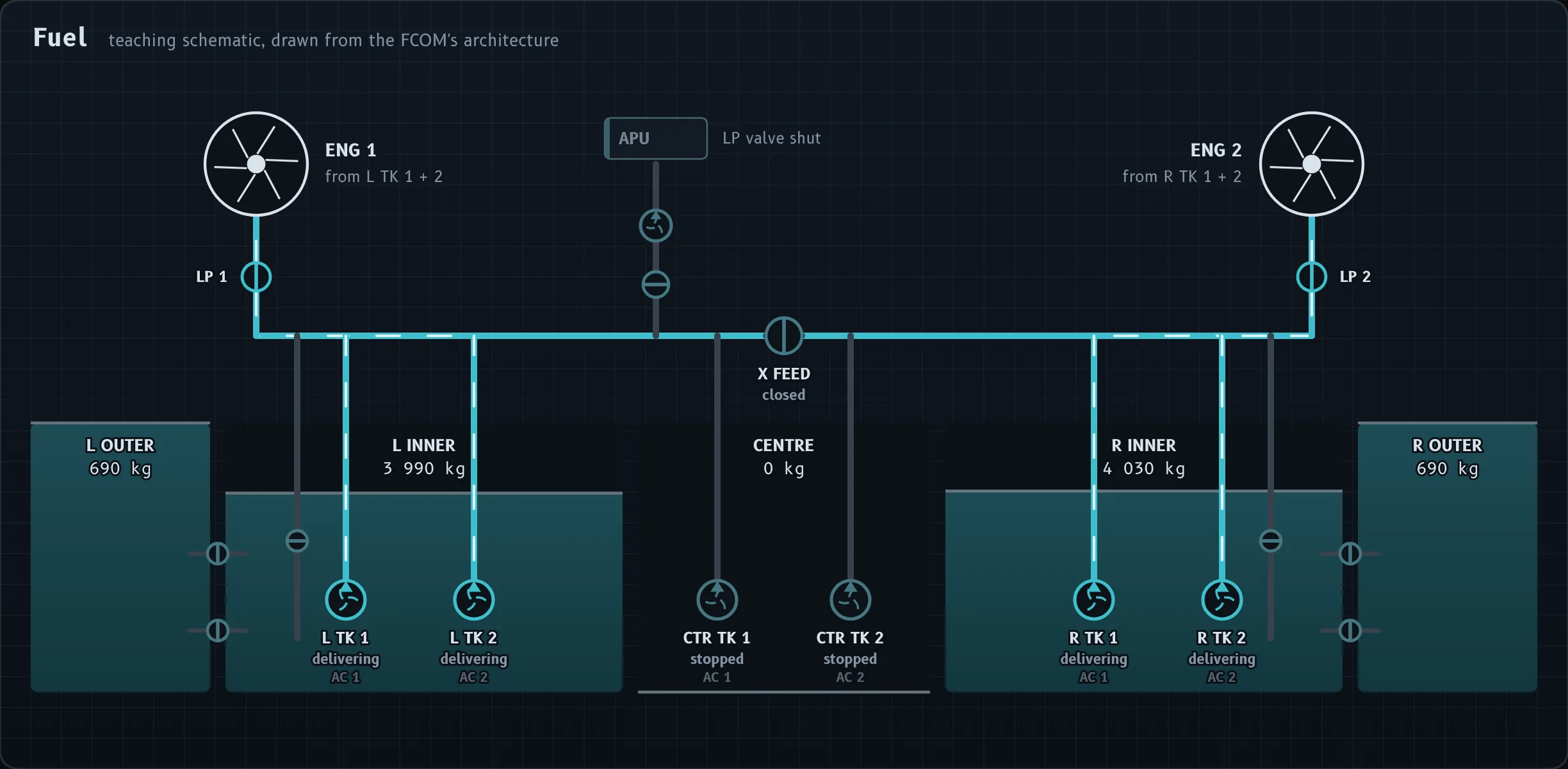
The alert Fail both left wing pumps
The E/WD shows the caution in amber and the start of its procedure, IF NO FUEL LEAK first. On the panel, FAULT lights in both L TK PUMPS pushbuttons; on the FUEL page, both pumps show LO in amber.
Nobody touched anything, and engine 1 is still fed: with no pump pressure, the suction valves let it draw from the left inner tank by gravity, as the schematic draws it. Working the procedure is what the ECAM Trainer does with you.
Sources FCOM PRO-ABN-FUEL FUEL / FCOM DSC-28-20 FUEL / FCOM DSC-28-10-30
What feeds engine 1, and what does the cross-feed change?
The cross-feed valve, driven by a double motor, lets both engines be fed from one side, or one engine from both. X FEED ON opens it, ON lights in white and, once the valve is fully open, the green OPEN light. On the FUEL page the valve turns in line, in green.
Gravity is a fall-back with a ceiling: the caution's procedure speaks of a ceiling limitation for gravity fuel feeding, and the QRH's gravity fuel feeding procedure, where it sends the crew, sets that maximum flight level.
Sources FCOM DSC-28-10-30 / FCOM DSC-28-20 / FCOM DSC-28-20 FUEL / FCOM PRO-ABN-FUEL FUEL / FCOM PRO-ABN-FUEL
Open the cross-feed, switch the pumps off, close it again
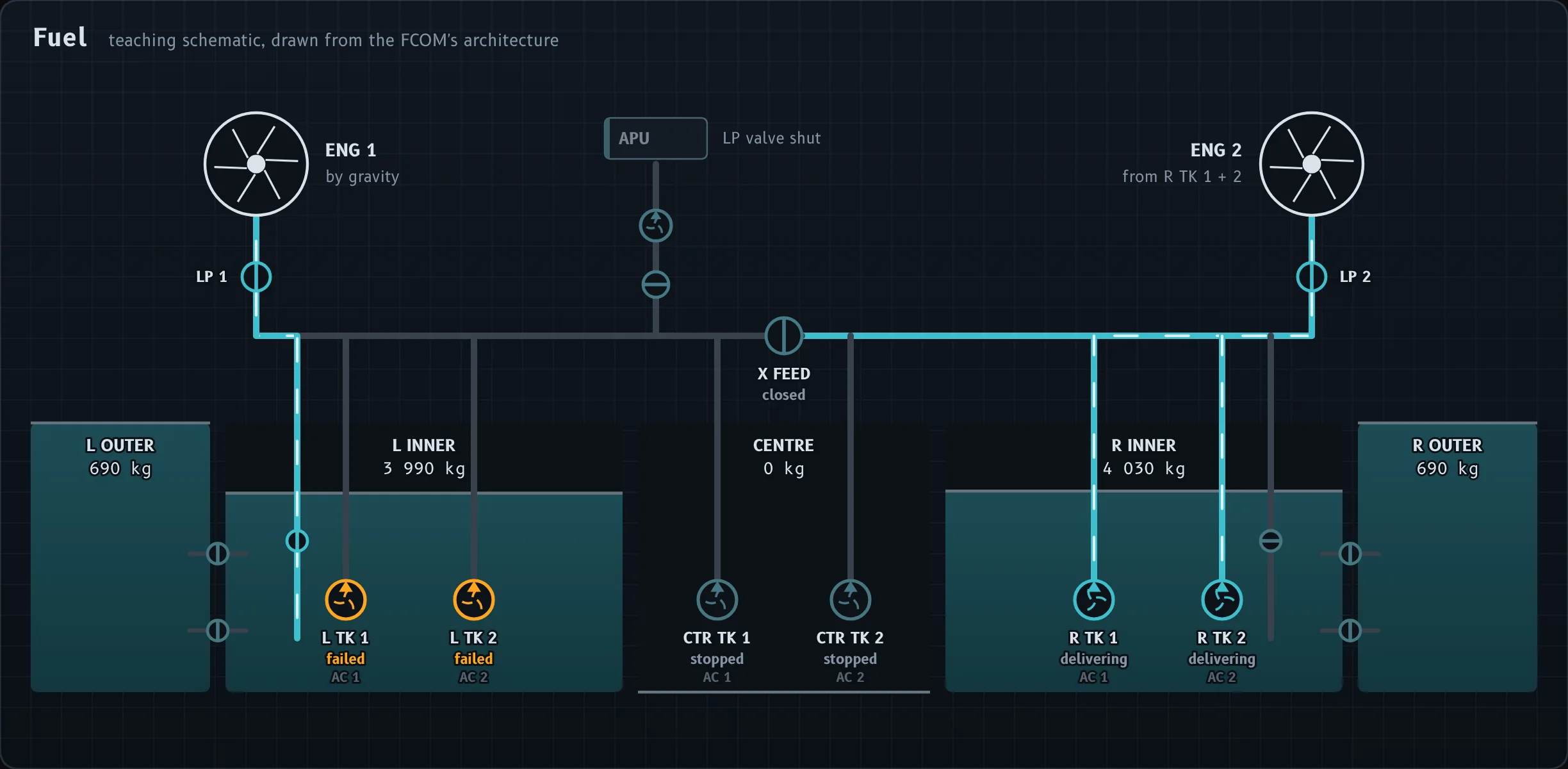
Both left pumps have failed and engine 1 is on gravity feed. Predict first, then press, and watch engine 1's source on the schematic.
-
Predict You set X FEED to ON. What feeds engine 1 now?
Try it Set X FEED to ON.
The valve opens and, as the schematic draws it with the centre tank empty, the right pumps feed both engines. Engine 1 is off gravity feed, and the left tank's fuel stays where it is for now.
Sources FCOM DSC-28-10-30 / FCOM DSC-28-20
-
Predict Now switch L TK PUMP 1 and 2 off. Does engine 1 lose its fuel?
Try it Switch L TK PUMP 1 and 2 off.
Engine 1 does not notice. Each pushbutton shows OFF in white and its FAULT light goes out, since it does not come on when OFF is selected; on the FUEL page each pump is now an amber crossline, its contactor off.
Sources FCOM DSC-28-20 FUEL
-
Try it Close the cross-feed again: set X FEED to OFF.
Engine 1 is back on gravity feed from its own tank. The FCOM puts it plainly: as long as the cross-feed is closed, that engine is fed by gravity only. The procedure closes it below FL 150 and then adds PROC: GRVTY FUEL FEEDING and AVOID NEGATIVE G FACTOR.
Sources FCOM PRO-ABN-FUEL FUEL
Why does the procedure start with a fuel leak?
The cross-feed line sits under IF NO FUEL LEAK. The caution's own procedure gives no reason for it. With a leak suspected, the FCTM sends the crew to the QRH FUEL LEAK procedure, whose aim is to isolate the leak; its steps are the QRH's, and this page does not walk them.
The ENG MODE SEL line carries its own reason: "The selection of continuous relight protects against flame-out, caused by possible fuel supply surging." The two pumps then go off, leak or not.
The flight level conditions are printed beside the cross-feed lines: ON above FL 150, OFF below it. The FCOM gives no reason for the figure. With the cross-feed off, the ECAM adds the gravity feeding procedure and AVOID NEGATIVE G FACTOR, because avoiding negative g prevents fuel surging and reduces the risk of engine malfunction.
WHEN L TK FUEL RQRD waits for later in the flight: the left tank's feed is then GRVTY ONLY, by the gravity fuel feeding procedure, and that fuel may be used at once if there is no ceiling limitation for gravity feeding.
Sources FCOM PRO-ABN-FUEL FUEL / FCTM PR-AEP-FUEL FUEL LEAK
What limits gravity feeding?
The caution's own procedure gives no figure. It says that the left tank's fuel may be used at once if there is no ceiling limitation for gravity fuel feeding, and it sends the crew to the QRH GRAVITY FUEL FEEDING procedure when that fuel is required, and again once the cross-feed is off.
That QRH procedure sets the ceiling, a maximum flight level for gravity feeding, and the FCOM prints it in more than one version. Its figures and its steps are the QRH's, and this page does not repeat them.
What the system description adds is where gravity feeding comes from: the suction valves let the engines be fed by gravity if the inner tank pumps fail. On aircraft with centre tank pumps, gravity feeding is not possible from the centre tank, since those pumps have no suction valves.
Sources FCOM PRO-ABN-FUEL FUEL / FCOM PRO-ABN-FUEL / FCOM PRO-ABN-ABN-QRH ABNORMAL AND EMERGENCY PROCEDURES / FCOM DSC-28-10-30
What changes with fuel in the centre tank?
The CENTER TANK NOT EMPTY version names the centre tank pumps and has no cross-feed line and no ENG MODE SEL line. FUEL MODE SEL goes to MAN, if the centre tank is not feeding, which lets the centre tank pumps run; then both failed pumps go off.
That version also says that if the centre tank is not empty at slat extension, the CTR TK PUMPs should be switched off, to prevent a possible wing tank overflow on the ground from IDG fuel recirculation. Its STATUS adds CTR TK FEED: MAN ONLY.
The live aircraft and the ECAM Trainer fly this caution with the centre tank empty, the version on this page.
Sources FCOM PRO-ABN-FUEL (CENTER TANK NOT EMPTY) / FCOM PRO-ABN-FUEL FUEL L (R) TK PUMP 1 + 2 LO PR / FCOM PRO-ABN-FUEL FUEL / FCOM PRO-ABN-FUEL (CENTER TANK EMPTY)
What is lost afterwards?
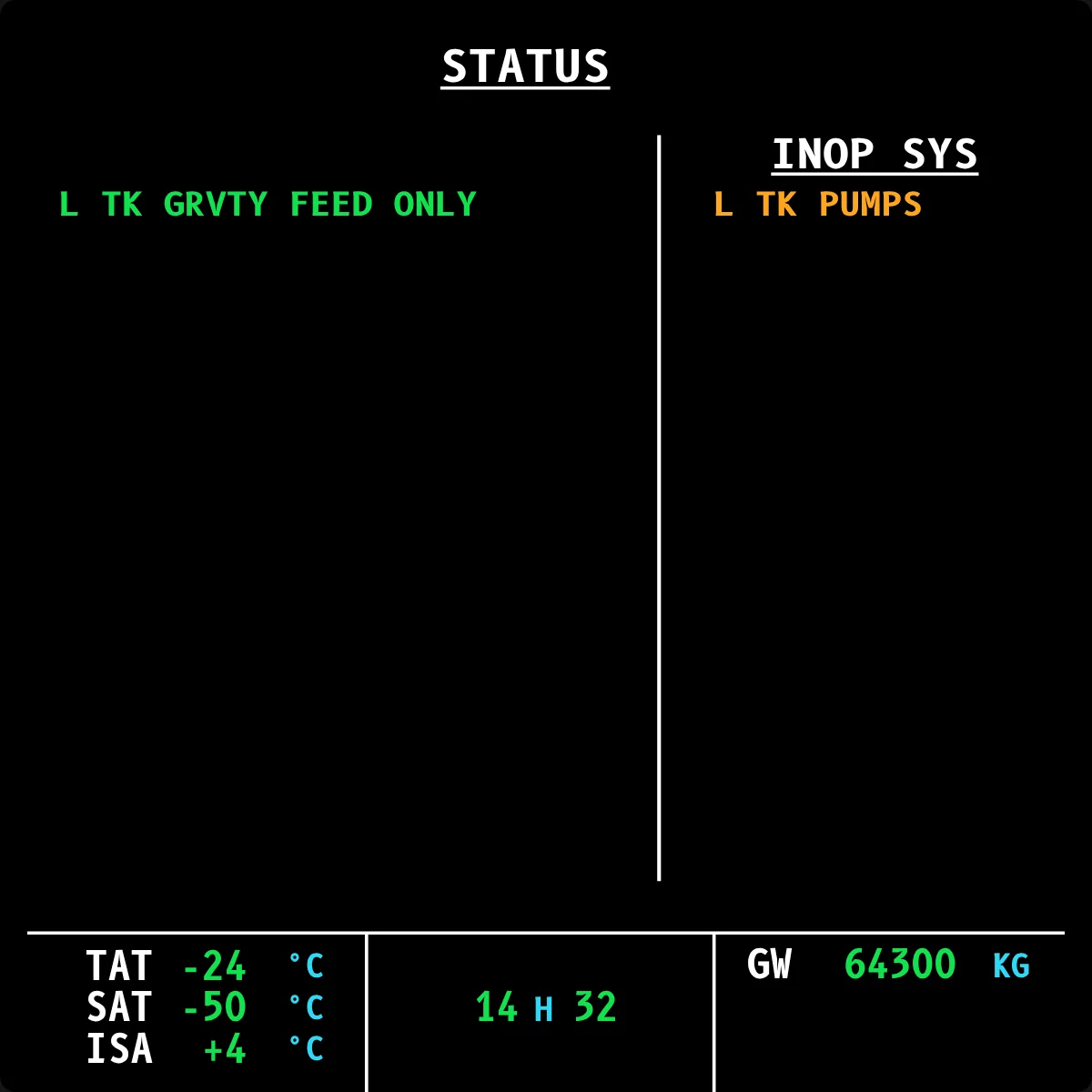
STATUS is the aircraft's operational summary. With the cross-feed open, it shows L TK GRVTY FEED ONLY, and the left tank pumps under INOP SYS in amber. The FCOM prints TK (AFFECTED) GRVTY FEED ONLY in blue; the picture draws it in green.
With the cross-feed off, STATUS adds PROC: GRVTY FUEL FEEDING and AVOID NEGATIVE G FACTOR. The version with no heading and the CENTER TANK EMPTY version print the same lines. The CENTER TANK NOT EMPTY STATUS, which the picture does not draw, has no cross-feed condition: PROC: GRVTY FUEL FEEDING and TK (AFFECTED) GRVTY FEED ONLY in blue, CTR TK FEED: MAN ONLY in green, the tank pumps under INOP SYS in amber, and no AVOID NEGATIVE G FACTOR line.
Sources FCOM DSC-31-20 STATUS PAGE / FCOM PRO-ABN-FUEL / FCOM PRO-ABN-FUEL FUEL
A319ceo, A320ceo, A320neo, A321neo: what differs?
| A319ceo, A320ceo | A320neo, A321neo | |
|---|---|---|
| The caution and its trigger | The same in every version | The same in every version |
| The centre tank | Not given by type: some aircraft have two centre tank pumps that feed the engines, six main pumps in all; others have transfer valves into the inner tanks and four main pumps | Not given by type: the same two designs, each for its own aircraft |
This page gives no version of the caution, and no fuel system design, to a type; the FCOM prints each version of the caution for a list of aircraft.
The ECAM Trainer draws one fuel design in each of its two drawings: centre tank pumps in one, centre tank transfer valves in the other. Which one applies depends on how your aircraft is built: check your own FCOM. On the centre pump design, gravity feeding is not possible from the centre tank: its pumps have no suction valves.
Sources FCOM PRO-ABN-FUEL FUEL L (R) TK PUMP 1 + 2 LO PR / FCOM PRO-ABN-FUEL (CENTER TANK EMPTY) / FCOM PRO-ABN-FUEL (CENTER TANK NOT EMPTY) / FCOM DSC-28-10-30 GENERAL / FCOM DSC-28-10-30 / FCOM DSC-28-10-30 FUEL FEED SEQUENCE

Work FUEL L TK PUMP 1+2 LO PR as a crew
Read and do each line against the FCOM, with the E/WD, the SD page and the overhead following your hands, the PF and PM calls, and a debrief that says what you missed.
Work this failure in the ECAM TrainerGo further
Written in our own words from the FCOM and the FCTM; each part names the units it rests on. The E/WD, the STATUS and the live aircraft are the platform's own ECAM and systems model, the same the ECAM Trainer and the flight deck run. This page explains the procedure; it is not the procedure. Aircraft differ by type, engine and options: your aircraft's FCOM, your QRH and your operator's procedures always come first. How we write and check these pages.
Every ECAM procedure, line by line, against the FCOM.
The ECAM Trainer works 108 scenarios with the E/WD, the SD page and the overhead following your hands. Start free today, or open everything with A320 Knowledge+.
For study and revision only. Always follow your operator's approved documentation and procedures. A320 Knowledge is independent and not affiliated with Airbus.
Related
- FUEL AUTO FEED FAULTAn amber caution with a short procedure.
- FUEL CTR TK PUMP 1 LO PRAn amber caution with a short procedure and a line that waits.
- FUEL X FEED VALVE FAULTAn amber caution with nothing to press.
- FUEL F. USED/FOB DISAGREEAn amber caution with one line, and behind it the fuel check the FCTM asks the crew to make.
- A320 fuel systemThe system guide, with the live aircraft
- Every ECAM procedureThe alerts the ECAM Trainer works, grouped by system