
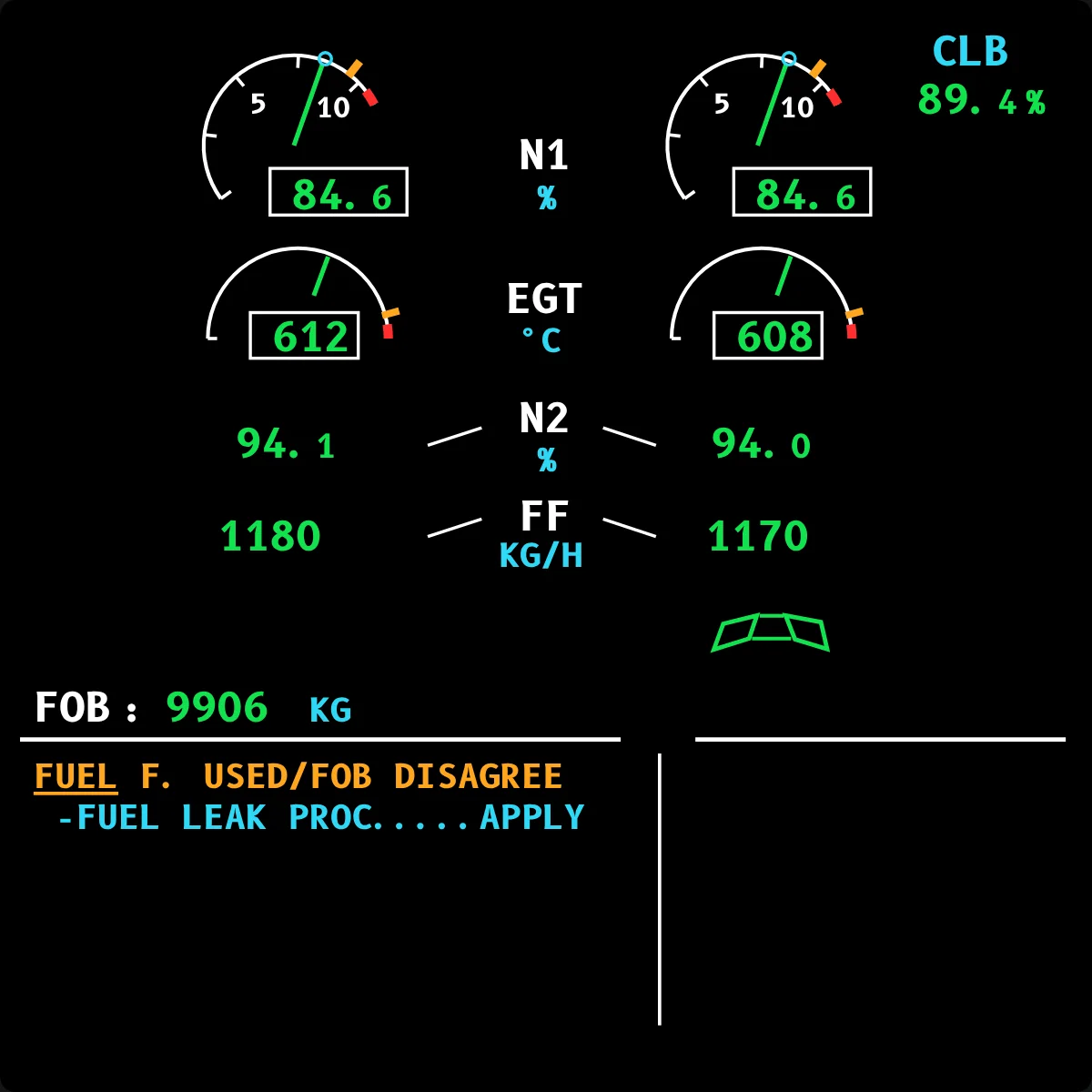
FUEL F. USED/FOB DISAGREE
An amber caution with one line, and behind it the fuel check the FCTM asks the crew to make. Here is what the ECAM compares, why it names no tank and no engine, what the FCOM's fuel leak procedure sets out to find, and the live aircraft with a leak, to see what the cross-feed valve and the LP valve do with it.
Written and checked by current A320 pilotschecked against the FCOM on Our editorial policy
What FUEL F. USED/FOB DISAGREE means
FUEL F. USED/FOB DISAGREE is an amber caution: the fuel on board plus the fuel used no longer adds up to the fuel on board at the start. Either fuel has gone somewhere the engines did not burn it, or the quantity reading is wrong.
The ECAM says no more than that, and hands over: FUEL LEAK PROC APPLY. The FCTM sends the crew to the QRH FUEL LEAK procedure if a leak is suspected. Its aim is to find whether the fuel is going from an engine, a wing, the centre tank or the APU feeding line, and to isolate the leak.
Sources FCOM PRO-ABN-FUEL FUEL F. USED/FOB DISAGREE / FCTM PR-AEP-FUEL FUEL LEAK / FCTM PR-AEP-FUEL FUEL OVERREAD / FCOM PRO-ABN-FUEL FUEL / FCOM PRO-ABN-FUEL
At a glance
- Level
- Amber caution, level 2: single chime, MASTER CAUT and the FUEL page on the SD
- Sets it off
- A significant difference between the initial FOB and the current FOB plus the fuel used
- When
- Inhibited in every flight phase but phase 6, between 1 500 ft after takeoff and 800 ft on the approach
- Procedure
- FUEL LEAK PROC APPLY; one version first asks whether the sum is more or less than the initial FOB
- STATUS
- None: the FCOM prints no STATUS for this caution
- Then
- The QRH FUEL LEAK procedure, whose aim is to find where the fuel is going and isolate the leak
Sources FCOM PRO-ABN-FUEL FUEL F. USED/FOB DISAGREE / FCOM DSC-31-10 WARNING/CAUTION CLASSIFICATION / FCOM DSC-31-20 SYSTEM PAGES / FCOM PRO-ABN-FUEL FUEL / FCOM PRO-ABN-FUEL / FCTM PR-AEP-FUEL FUEL LEAK
What does the ECAM compare?
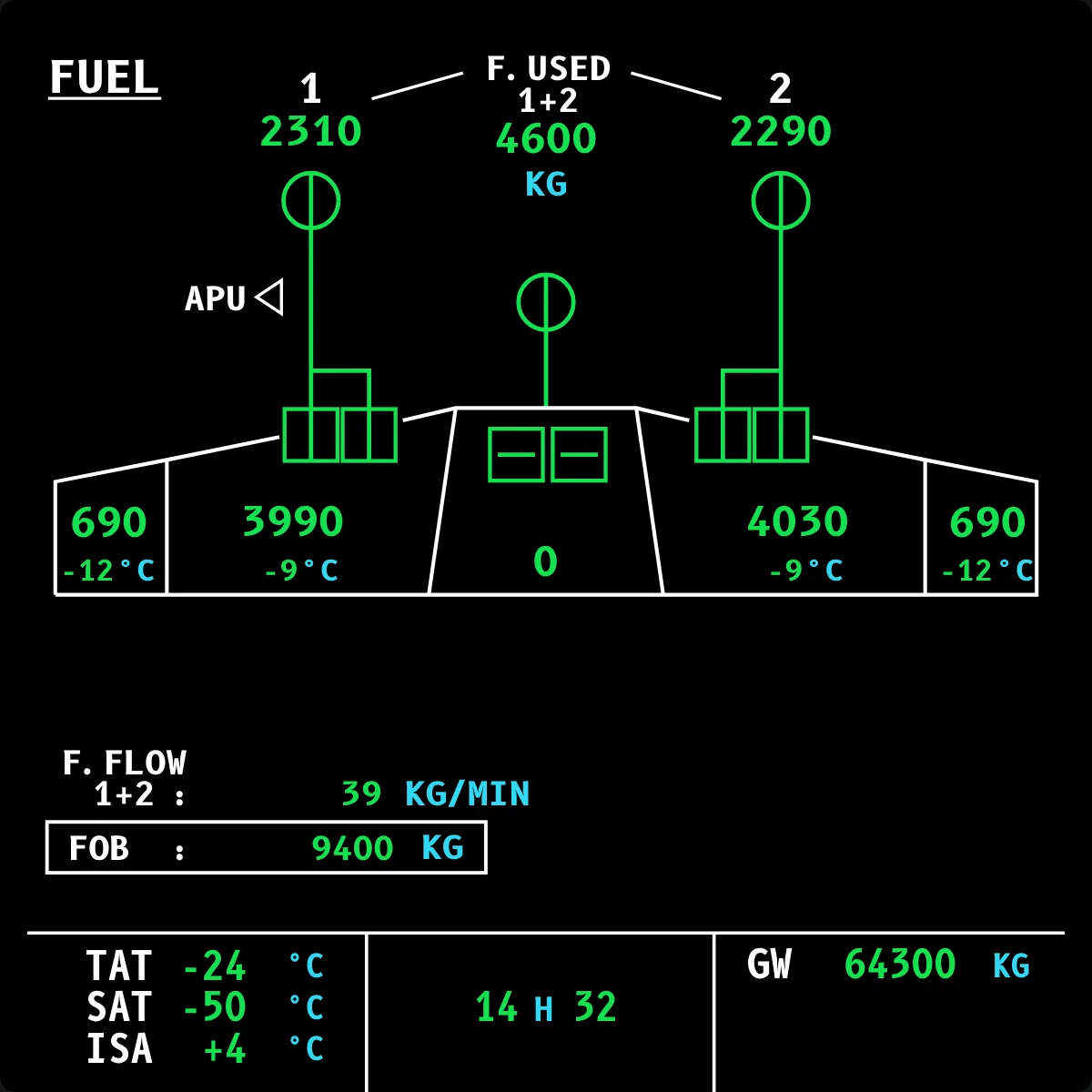
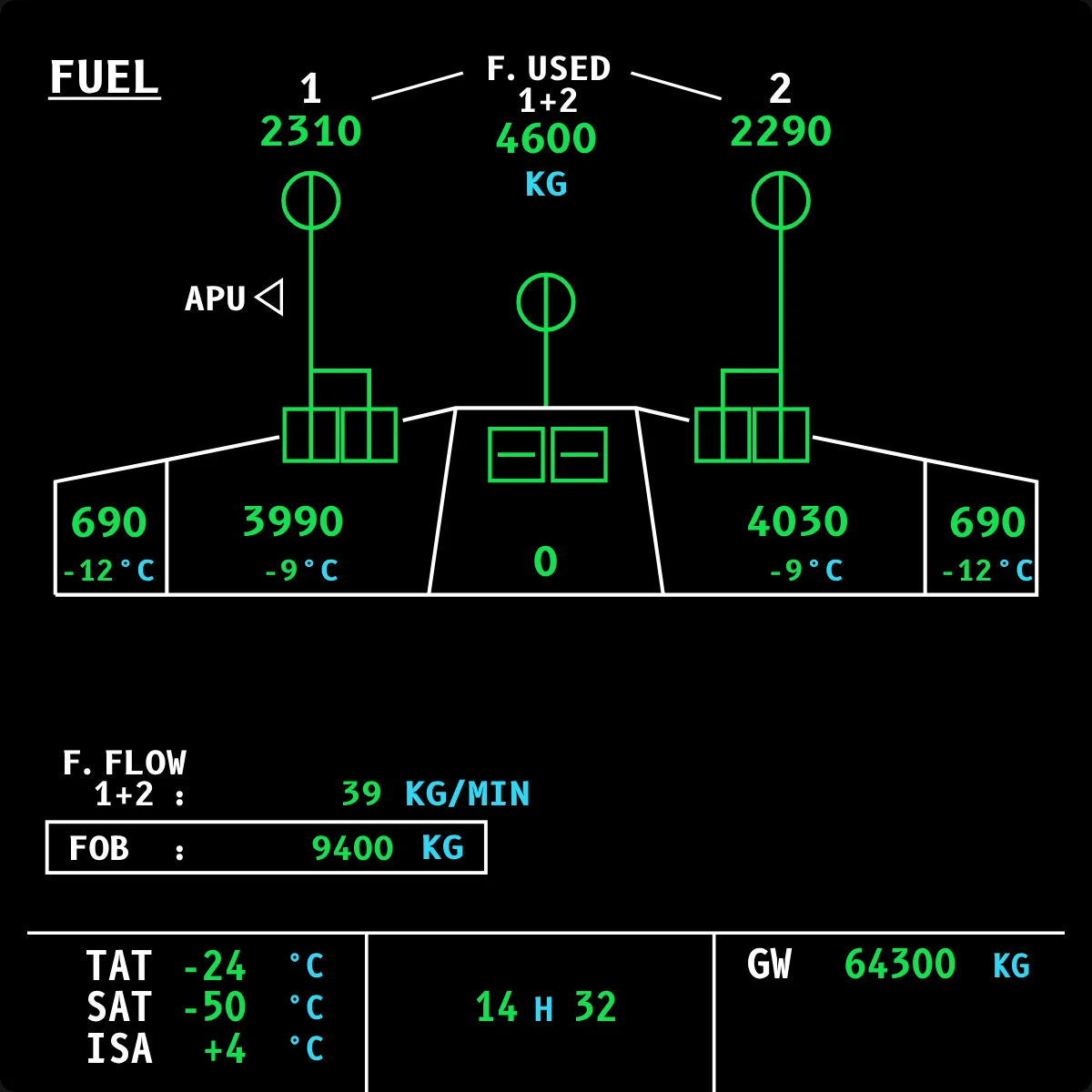
Two figures the crew can also read. The FOB on the E/WD and the FUEL page is the total of all tanks. The fuel used, per engine on the FUEL page, is reset when the engine is started on the ground. The caution triggers when the initial FOB and the current FOB plus the fuel used differ significantly.
The FCOM gives no figure for significant. Its flight phase graphic inhibits the caution everywhere but phase 6, between 1 500 ft after takeoff and 800 ft on the approach.
It is the same sum the FCTM asks the crew to make: the remaining fuel added to the burnt fuel should match the fuel on board at the gate. The FCTM also gives the sum decreasing, not only low, as a sign of a leak.
Sources FCOM PRO-ABN-FUEL FUEL F. USED/FOB DISAGREE / FCOM DSC-28-20 FUEL / FCOM DSC-31-15 GENERAL / FCTM PR-AEP-FUEL FUEL LEAK
The sum the ECAM watches
What does the crew see and hear?
A level 2 caution: a single chime, the MASTER CAUT light steady amber, the caution in amber on the E/WD, and the SD normally calls up the FUEL page, the relevant system page for a caution.
Under the title, one line: FUEL LEAK PROC APPLY. The version that branches prints its two conditions in small letters, and a precondition in small letters does not appear on the ECAM.
Sources FCOM DSC-31-10 WARNING/CAUTION CLASSIFICATION / FCOM DSC-31-20 SYSTEM PAGES / FCOM PRO-ABN-FUEL FUEL F. USED/FOB DISAGREE / FCOM PRO-ABN-FUEL FUEL / FCOM PRO-ABN-ABN-00 INTRODUCTION
The moment the caution comes on
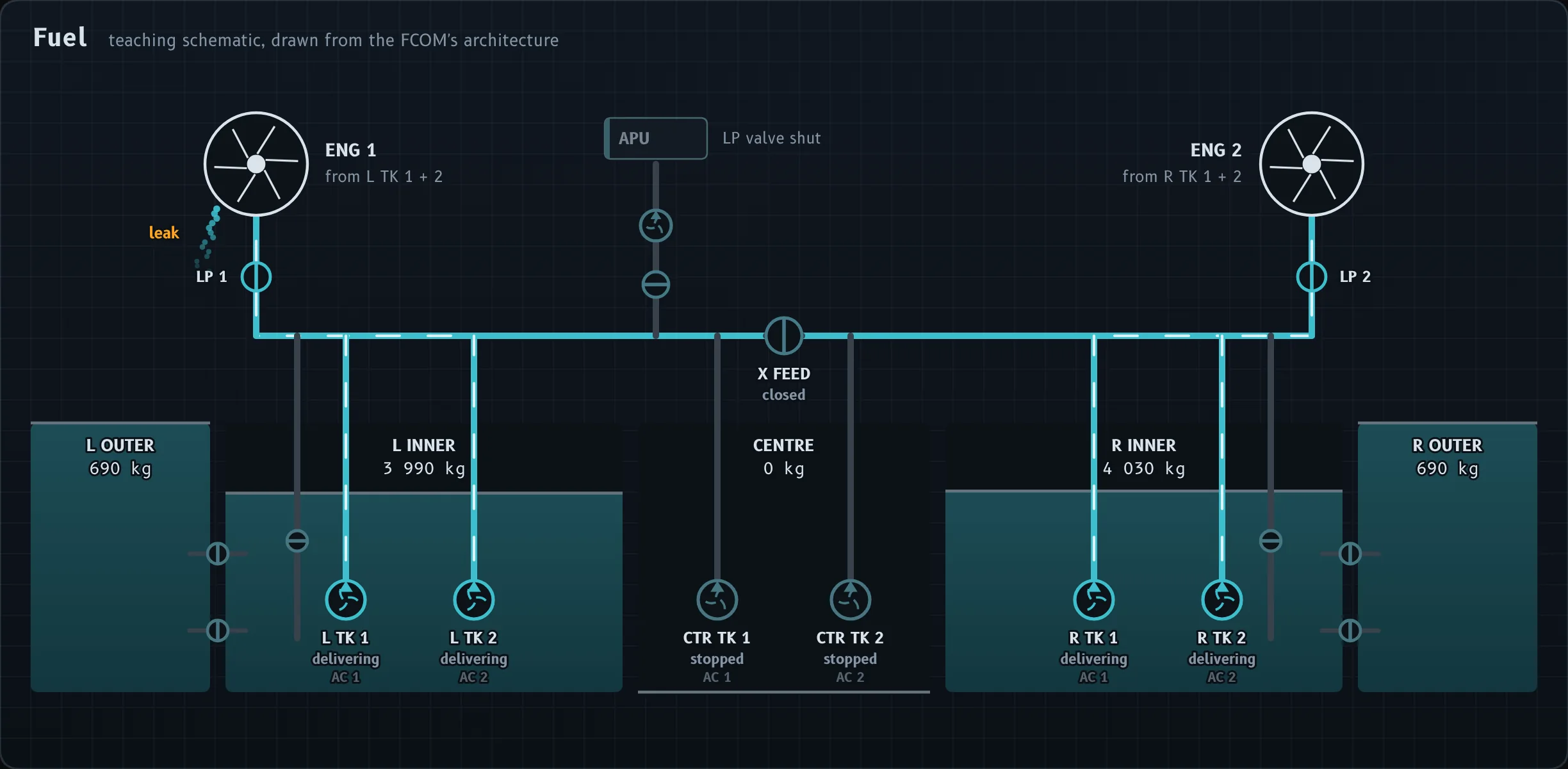
The cruise, centre tank empty, cross-feed closed. Press the button: the schematic draws the leak, but the E/WD only says what the crew can know.
The alert Start a leak at engine 1
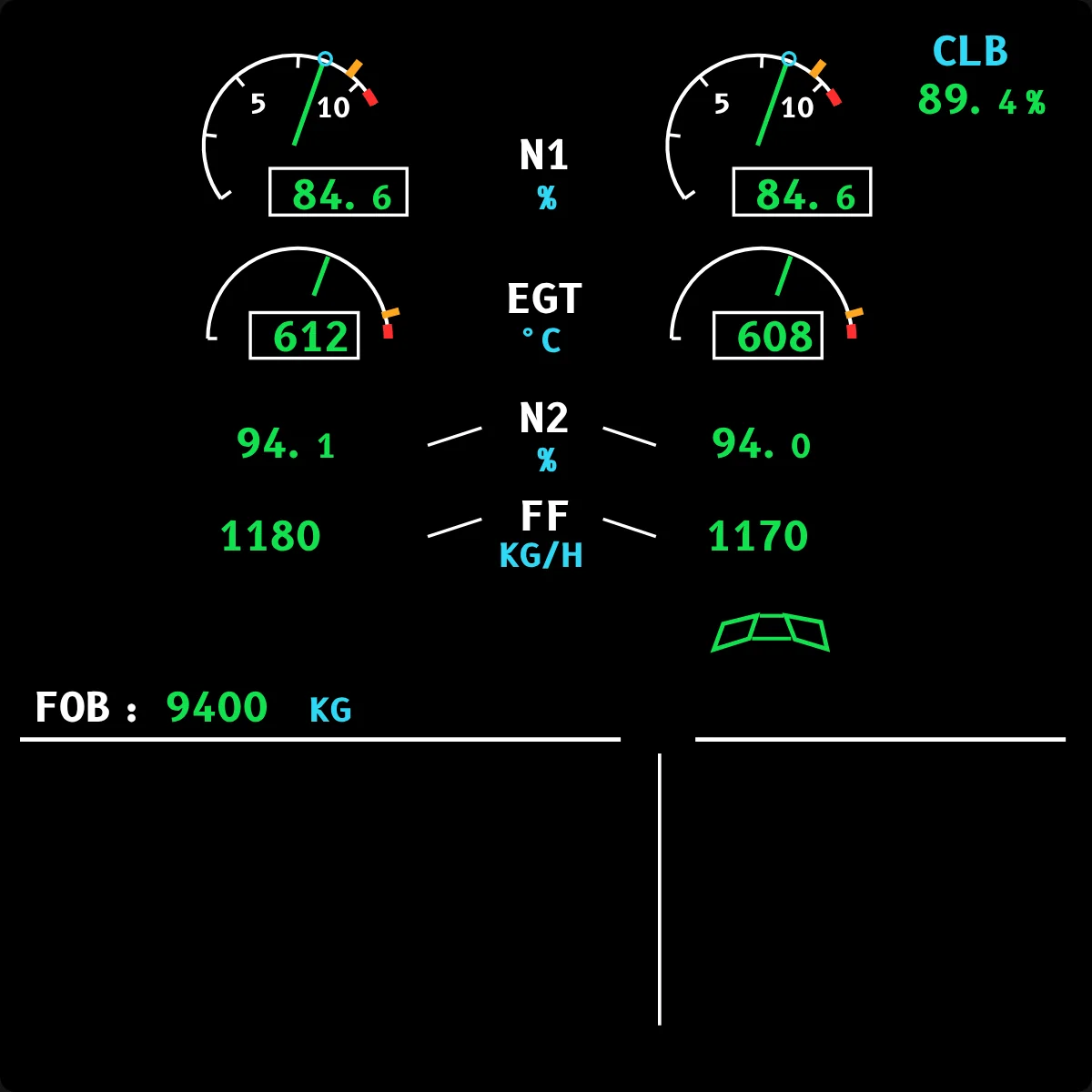
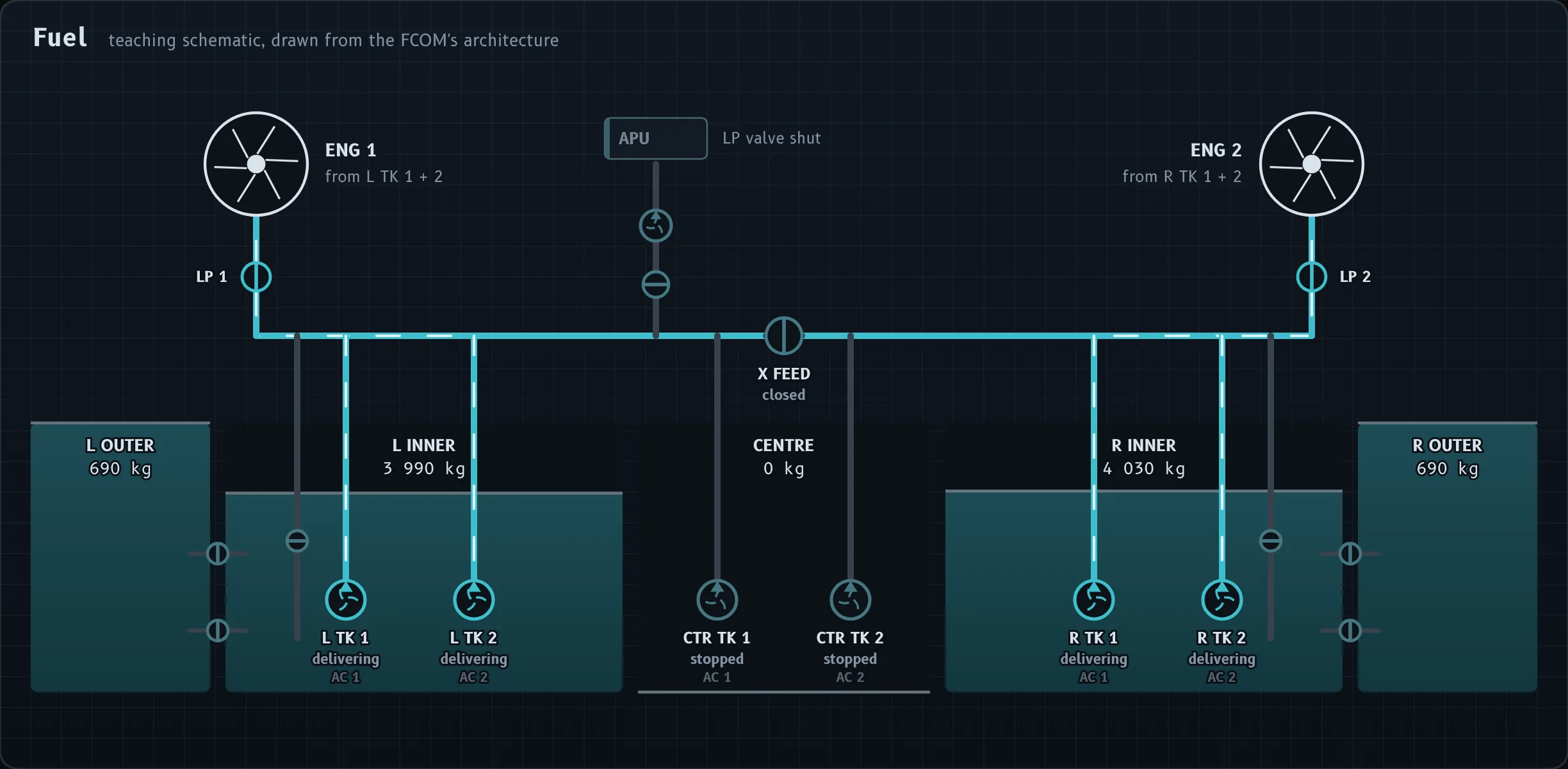
The E/WD shows the caution in amber with FUEL LEAK PROC APPLY. It names no tank and no engine. The schematic shows what the crew cannot see: fuel leaving at engine 1.
With the cross-feed closed, engine 1 is fed from the left wing only. One of the FCTM's signs of an engine leak is that wing's fuel quantity decreasing abnormally fast. Working the procedure is what the ECAM Trainer does with you.
Sources FCOM PRO-ABN-FUEL FUEL / FCOM PRO-ABN-FUEL FUEL F. USED/FOB DISAGREE / FCOM DSC-28-10-30 / FCOM DSC-28-20 / FCTM PR-AEP-FUEL FUEL LEAK
Why does the ECAM hand over to the QRH?
The caution knows only that the fuel does not add up. FUEL LEAK is one of the QRH procedures, and its aim is what the caution cannot tell: whether the leak is from an engine or a wing, from the centre tank or from the APU feeding line. The FCTM is plain that significant fuel leaks, "although rare, are sometimes difficult to detect."
The FCTM lists the signs that may reveal a leak, the caution's own sum among them: the total quantity decreasing abnormally, an imbalance developing, one wing's quantity decreasing abnormally fast, excessive fuel flow or a decreasing N1, fuel smelt in the cabin, a fuel spray seen from the cabin, or the destination EFOB decreasing or shown amber.
The FCTM's fuel check comes before any alert: the remaining fuel plus the burnt fuel against the fuel at the gate, and the fuel on board against the flight plan, when overflying a waypoint or at least every 30 min. Any discrepancy should be investigated without delay.
Sources FCOM PRO-ABN-FUEL FUEL / FCOM PRO-ABN-ABN-QRH ABNORMAL AND EMERGENCY PROCEDURES / FCOM PRO-ABN-FUEL / FCTM PR-AEP-FUEL FUEL LEAK
What do the cross-feed valve and the LP valve do with a leak?
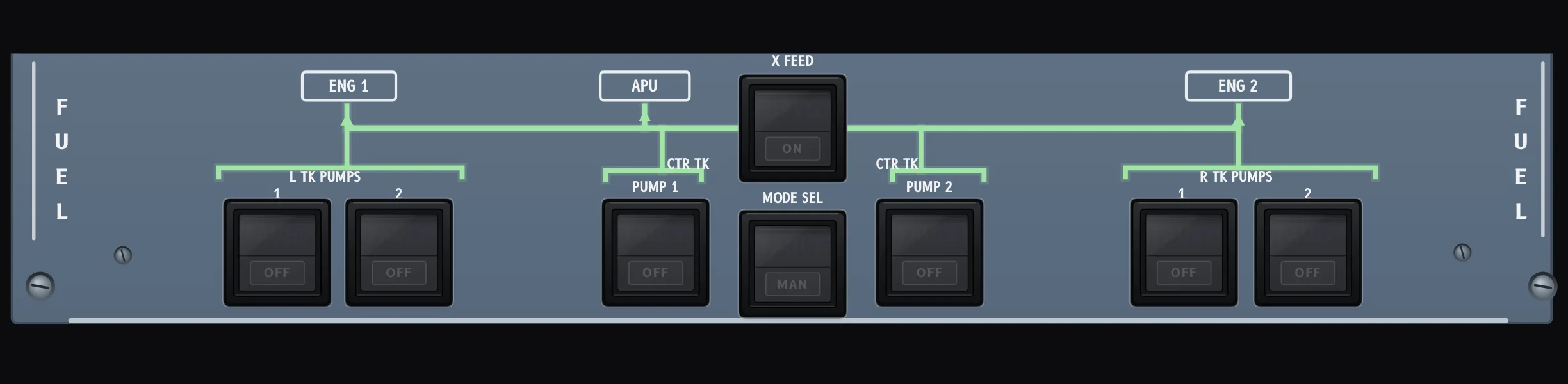
With the X FEED pushbutton off, the cross-feed valve is closed and each side feeds its own engine. Selected ON, the valve opens, and it lets both engines be fed from one side, or one engine from both sides.
Each engine's fuel flow can be stopped by its low pressure (LP) fuel valve. The engine master switch closes it, and so does the ENG FIRE pushbutton.
Between them, the two valves decide which side feeds each engine, and whether an engine gets fuel at all. The FCTM gives the QRH FUEL LEAK procedure the aim of isolating the leak and finding where it comes from; the procedure itself is the QRH's, and this page does not walk it.
Sources FCOM DSC-28-10-30 / FCOM DSC-28-20 / FCOM DSC-28-10-30 GENERAL / FCOM PRO-ABN-FUEL / FCTM PR-AEP-FUEL FUEL LEAK
Which tank feeds which engine
Isolate the leak
A leak at engine 1, cross-feed closed. Predict first, then press, and watch the leak and the feed lines on the schematic.
-
Predict Someone opens the cross-feed to balance the wings. What does that do with a leak at engine 1?
Try it Set X FEED to ON.
The valve opens and joins the two sides: all four wing pumps now feed both engines, so the leaking side draws on both wings. That is what the cross-feed valve is for, both engines fed from one side or one engine from both sides.
Sources FCOM DSC-28-10-30 / FCOM DSC-28-20
The LP valve sits on the other side of the leak. Setting ENG MASTER 1 to OFF, on the pedestal, closes engine 1's LP fuel valve, so a leak downstream of it stops even with the cross-feed open, and engine 2 then draws from both wings. The leak's place, at engine 1, is this example's choice.
Sources FCOM DSC-28-10-30
What if the sum is higher, not lower?
Then the FCTM says the crew can suspect a fuel overread rather than a leak. It notes that, depending on the warning computer's standard, this caution may cover both a leak and an overread. In the FCOM's branching version, a sum more than the initial FOB brings OVERREAD PROC APPLY.
For an overread the FCTM sends the crew to the QRH FUEL OVERREAD procedure, because fuel management is affected. That procedure is the QRH's, and this page does not walk it.
It adds that the fuel low level ECAM alerts are still valid: their sensors are independent from the fuel quantity indications.
Sources FCOM PRO-ABN-FUEL FUEL / FCTM PR-AEP-FUEL FUEL OVERREAD
Can a leak escape this caution?
Yes, and the FCOM says where. ENG 1(2) FUEL LEAK, an alert the FCOM carries for some aircraft, triggers on an abnormal difference between the engines in fuel flow or fuel used. That alert could indicate a leak downstream of the fuel metering valve, and in such a case, the FCOM says, FUEL F. USED/FOB DISAGREE will not be triggered.
The FCTM asks for a fuel leak to be considered as a possible cause any time an unexpected quantity, an ECAM fuel message or an imbalance is noted, and for the first indications to be crosschecked, by eye if possible.
Sources FCOM PRO-ABN-ENG ENG 1(2) FUEL LEAK / FCOM PRO-ABN-ENG ENG / FCTM PR-AEP-FUEL FUEL LEAK
What is lost afterwards?
The FCOM prints no STATUS for this caution: its only line hands over to the QRH. What follows comes from the QRH procedure that is applied, FUEL LEAK or, in the branching version, FUEL OVERREAD.
Sources FCOM PRO-ABN-FUEL FUEL F. USED/FOB DISAGREE / FCOM PRO-ABN-FUEL FUEL / FCOM PRO-ABN-FUEL
A319ceo, A320ceo, A320neo, A321neo: what differs?
| A319ceo, A320ceo | A320neo, A321neo | |
|---|---|---|
| The caution's procedure | Not given by type: one version applies FUEL LEAK PROC alone; another branches, OVERREAD PROC if the sum is more, FUEL LEAK PROC if less | Not given by type: the same two versions, each for a list of aircraft |
The FCOM gives the caution itself, and each version of its procedure, to lists of aircraft, not to types. The ECAM Trainer draws FUEL LEAK PROC APPLY for both its types, which is what either version shows when the sum is less than the initial FOB.
Sources FCOM PRO-ABN-FUEL FUEL / FCOM PRO-ABN-FUEL FUEL F. USED/FOB DISAGREE

Work FUEL F. USED/FOB DISAGREE as a crew
Read and do each line against the FCOM, with the E/WD, the SD page and the overhead following your hands, the PF and PM calls, and a debrief that says what you missed.
Work this failure in the ECAM TrainerGo further
Written in our own words from the FCOM and the FCTM; each part names the units it rests on. The E/WD, the STATUS and the live aircraft are the platform's own ECAM and systems model, the same the ECAM Trainer and the flight deck run. This page explains the procedure; it is not the procedure. Aircraft differ by type, engine and options: your aircraft's FCOM, your QRH and your operator's procedures always come first. How we write and check these pages.
Every ECAM procedure, line by line, against the FCOM.
The ECAM Trainer works 108 scenarios with the E/WD, the SD page and the overhead following your hands. Start free today, or open everything with A320 Knowledge+.
For study and revision only. Always follow your operator's approved documentation and procedures. A320 Knowledge is independent and not affiliated with Airbus.
Related
- FUEL AUTO FEED FAULTAn amber caution with a short procedure.
- FUEL CTR TK PUMP 1 LO PRAn amber caution with a short procedure and a line that waits.
- FUEL X FEED VALVE FAULTAn amber caution with nothing to press.
- FUEL L+R WING TK LO LVLAn amber caution that opens with LAND ASAP.
- A320 fuel systemThe system guide, with the live aircraft
- Every ECAM procedureThe alerts the ECAM Trainer works, grouped by system