
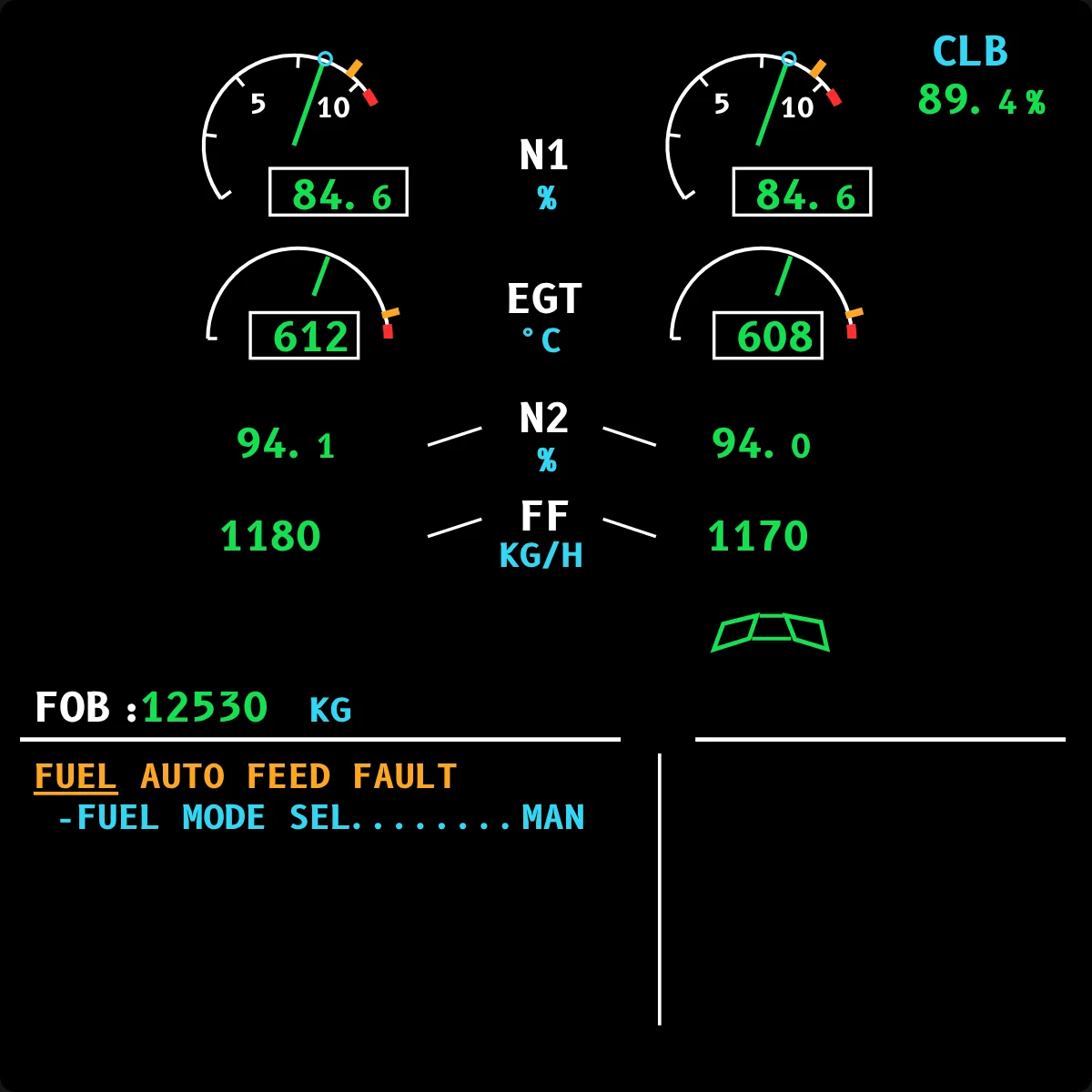
FUEL AUTO FEED FAULT
An amber caution with a short procedure. Here is what the automatic feed from the centre tank is meant to do, what the caution watches for, and what MODE SEL at MAN hands to the crew, with the live aircraft at the moment the centre pumps stop.
Written and checked by current A320 pilotschecked against the FCOM on Our editorial policy
What FUEL AUTO FEED FAULT means
FUEL AUTO FEED FAULT is an amber caution on aircraft whose centre tank has two pumps of its own, run by the automatic logic with MODE SEL at AUTO. It triggers when the centre tank still holds more than 250 kg while a wing tank is below 5 000 kg, or when the centre tank pumps do not stop after slat extension or with the centre tank level low.
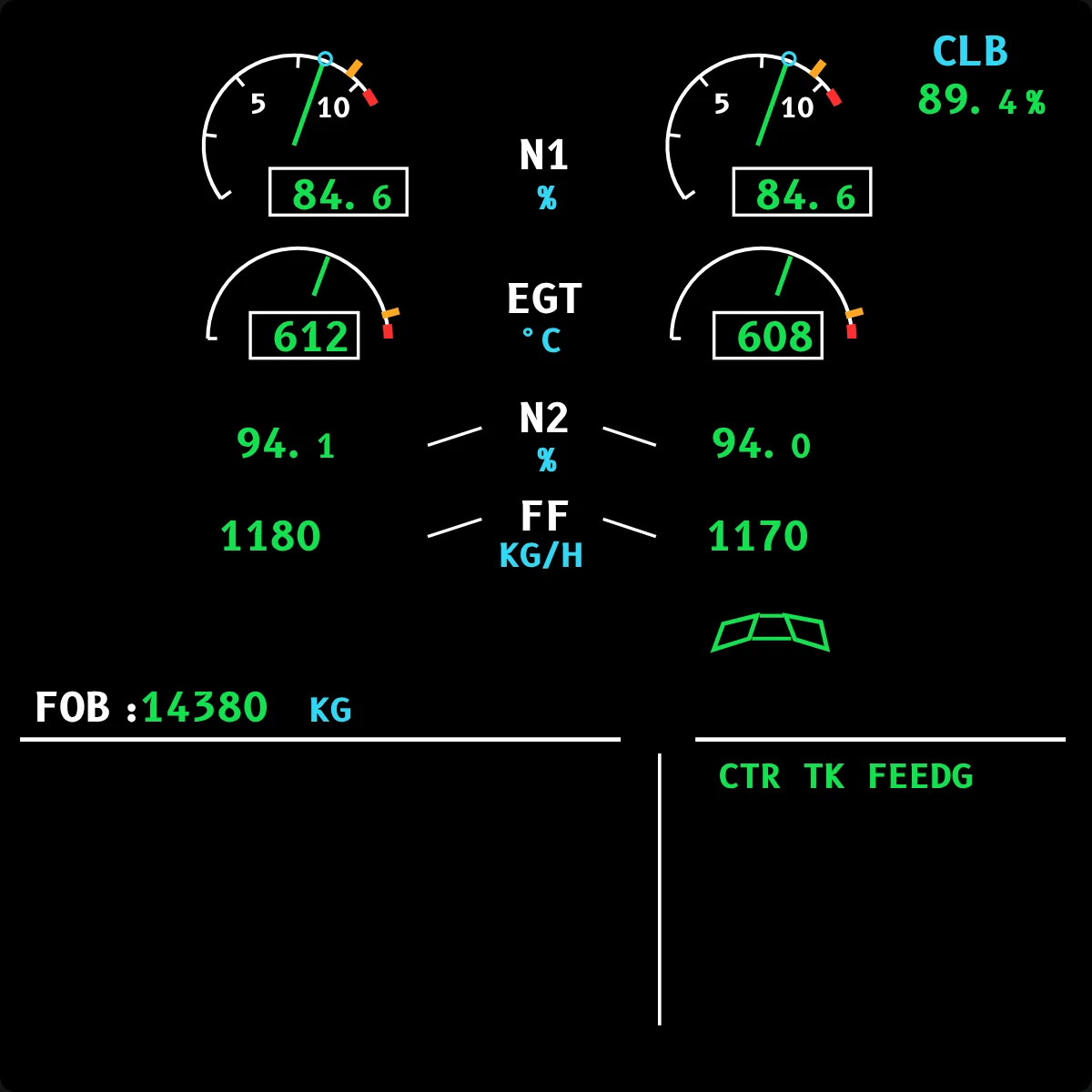
The procedure's first line is MODE SEL at MAN. The centre tank pumps then run whenever their pushbuttons are on, and the crew decides when they stop. The ECAM Trainer's STATUS holds one line, CTR TK FEED: MAN ONLY.
Sources FCOM PRO-ABN-FUEL FUEL AUTO FEED FAULT / FCOM DSC-28-10-30 GENERAL / FCOM DSC-28-20 / FCOM PRO-ABN-FUEL FUEL / FCOM PRO-ABN-FUEL
At a glance
- Level
- Amber caution, level 2: single chime, MASTER CAUT and the FUEL page on the SD
- Sets it off
- More than 250 kg in the centre tank with a wing below 5 000 kg; or centre tank pumps that do not stop after slat extension, or a low centre tank level
- Lights
- FAULT in amber in the MODE SEL pushbutton on the overhead FUEL panel, with more than 250 kg in the centre tank and a wing tank below 5 000 kg
- Which aircraft
- Those whose centre tank has two pumps feeding the engines, six main pumps in all; with transfer valves instead, the same quantities give FUEL AUTO TRANSFER FAULT
- Procedure
- FUEL MODE SEL to MAN; then both centre tank pumps ON with a wing below 5 000 kg and more than 250 kg in the centre tank, or OFF if they run after slat extension or with a low centre tank level
- STATUS
- As the ECAM Trainer draws it, one line in green, CTR TK FEED: MAN ONLY, a line the FCOM's STATUS prints for other fuel failures too
Sources FCOM DSC-31-10 WARNING/CAUTION CLASSIFICATION / FCOM DSC-31-20 SYSTEM PAGES / FCOM PRO-ABN-FUEL FUEL AUTO FEED FAULT / FCOM DSC-28-20 / FCOM DSC-28-10-30 GENERAL / FCOM PRO-ABN-FUEL FUEL AUTO TRANSFER FAULT / FCOM PRO-ABN-FUEL FUEL / FCOM PRO-ABN-FUEL / FCOM DSC-31-20 STATUS PAGE
What sets the caution off?
The FCOM gives two triggers. The first is fuel left where it should not be: more than 250 kg in the centre tank while the left or the right wing tanks hold less than 5 000 kg. The second reads "CTR TK pumps do not stop after slat extension or CTR TK level is low".
Both rest on the normal logic. The tanks empty in sequence, the centre tank before the inner tanks. With MODE SEL at AUTO the centre tank pumps run for 2 min at engine start, run before or after the start sequence if the slats are retracted, and stop 5 min after the centre tank reaches its low level. Each one also stops while its inner tank is full, and restarts once about 500 kg has been used from it.
The FCOM describes two ways of emptying the centre tank, for different aircraft. This caution belongs to the one with two centre tank pumps feeding the engines directly, six main pumps in all. Where transfer valves and jet pumps move the centre fuel into the inner tanks, the same quantities give FUEL AUTO TRANSFER FAULT, with a procedure of its own.
Sources FCOM PRO-ABN-FUEL FUEL AUTO FEED FAULT / FCOM DSC-28-10-30 FUEL FEED SEQUENCE / FCOM DSC-28-20 / FCOM DSC-28-10-60 / FCOM DSC-28-10-30 GENERAL / FCOM PRO-ABN-FUEL FUEL AUTO TRANSFER FAULT / FCOM PRO-ABN-FUEL FUEL
Two ways into one caution
What does the crew see and hear?
A level 2 caution: a single chime, the MASTER CAUT light steady amber, the caution in amber on the E/WD, and the SD normally calls up the FUEL page by itself, the relevant system page for a caution.
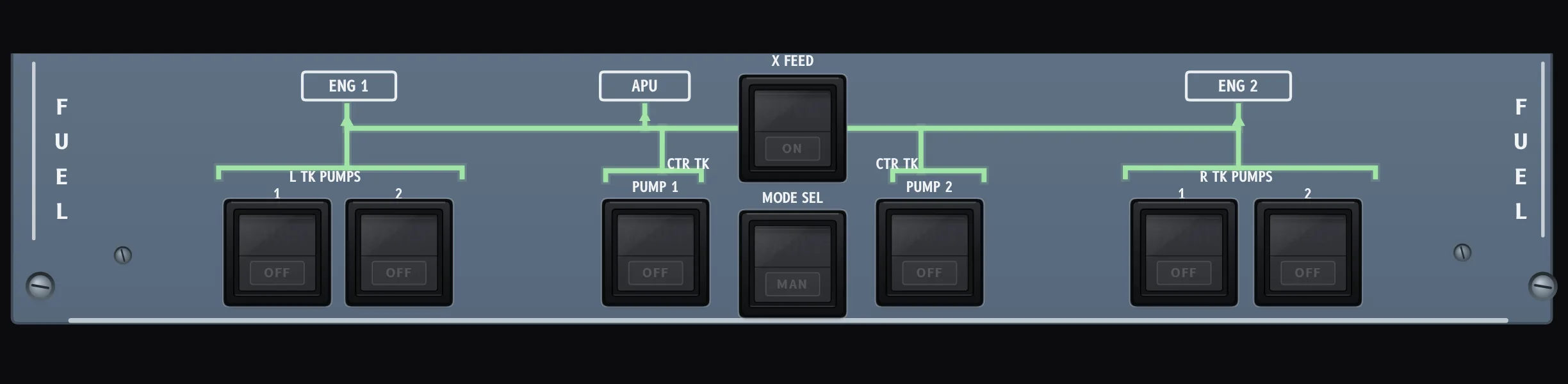
On the overhead FUEL panel FAULT comes on in amber in the MODE SEL pushbutton with the caution when the centre tank has more than 250 kg and a wing tank less than 5 000 kg; the FCOM ties the light to no other condition. On the FUEL page each centre tank pump shows what its contactor does: in line and green when it runs with normal pressure, a green crossline when it is off and the automatic shut-off wants it off, an amber crossline when it is off and the shut-off does not.
Sources FCOM DSC-31-10 WARNING/CAUTION CLASSIFICATION / FCOM DSC-31-20 SYSTEM PAGES / FCOM DSC-28-20 / FCOM DSC-28-20 FUEL
The moment the centre pumps stop
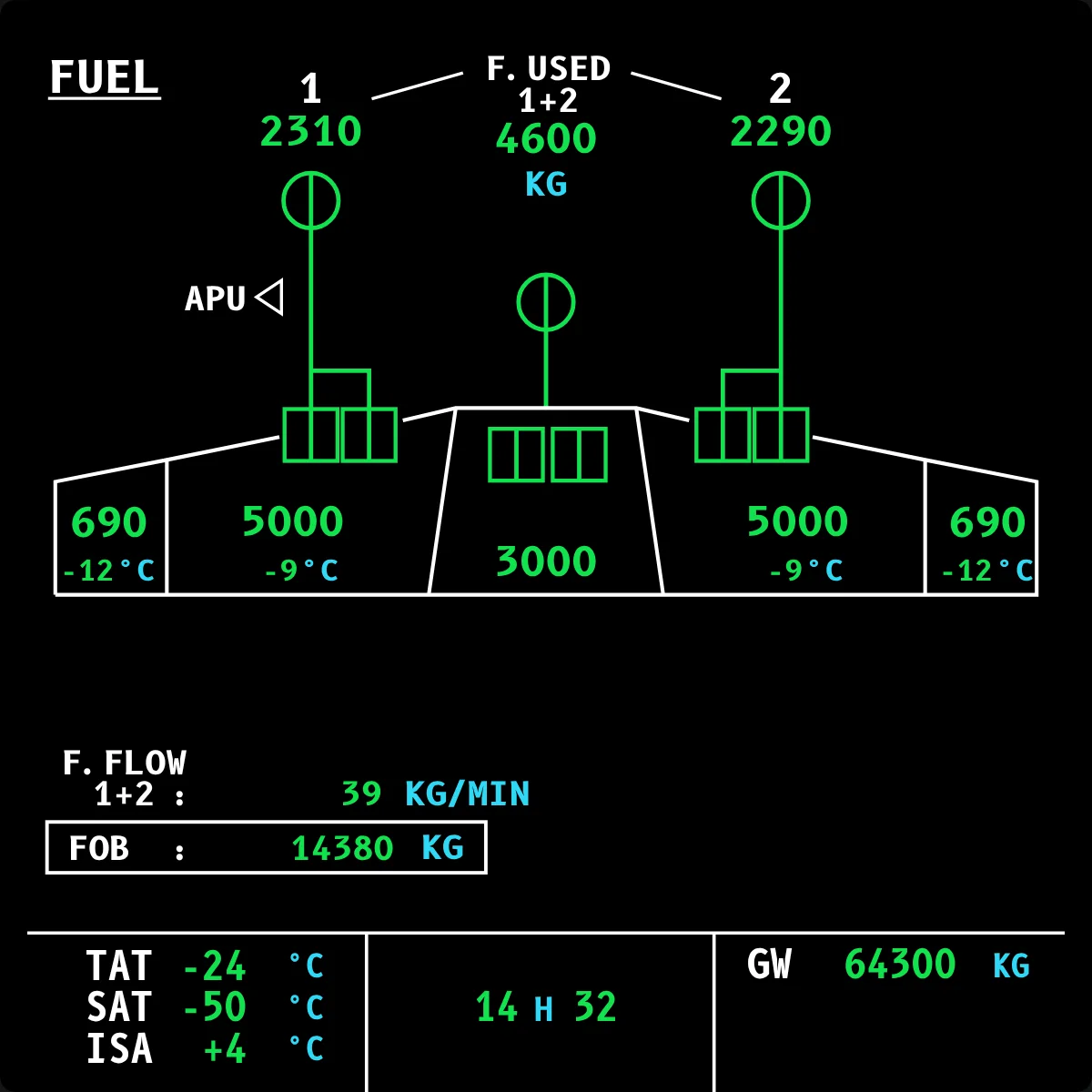
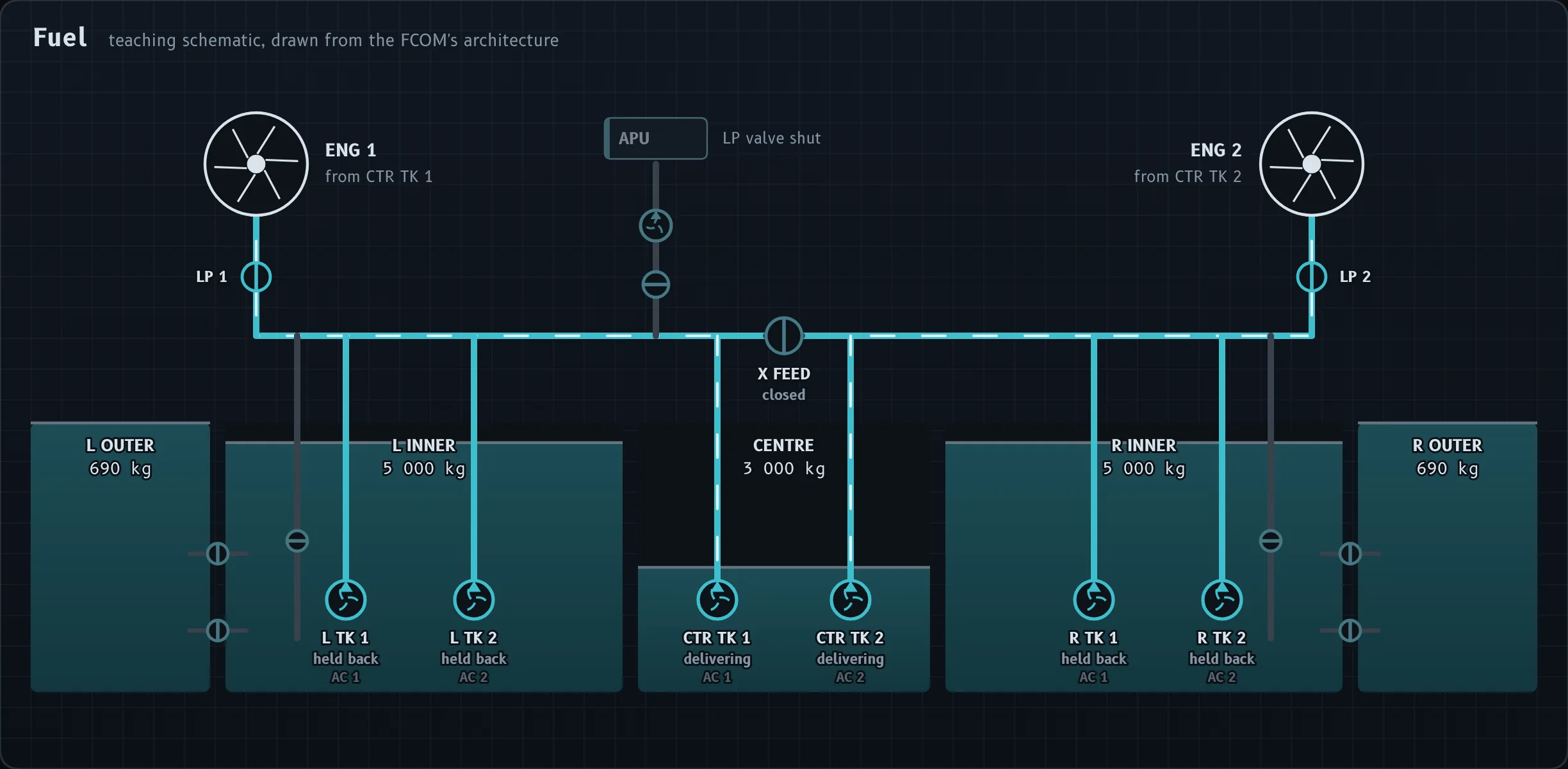
The cruise, 3 000 kg in the centre tank and both centre tank pumps feeding, MODE SEL at AUTO, each wing still above 5 000 kg in this drawing. Press the button to fail the automatic feed, then look at the E/WD, the FUEL page, the panel and the schematic.
The alert Fail the automatic feed
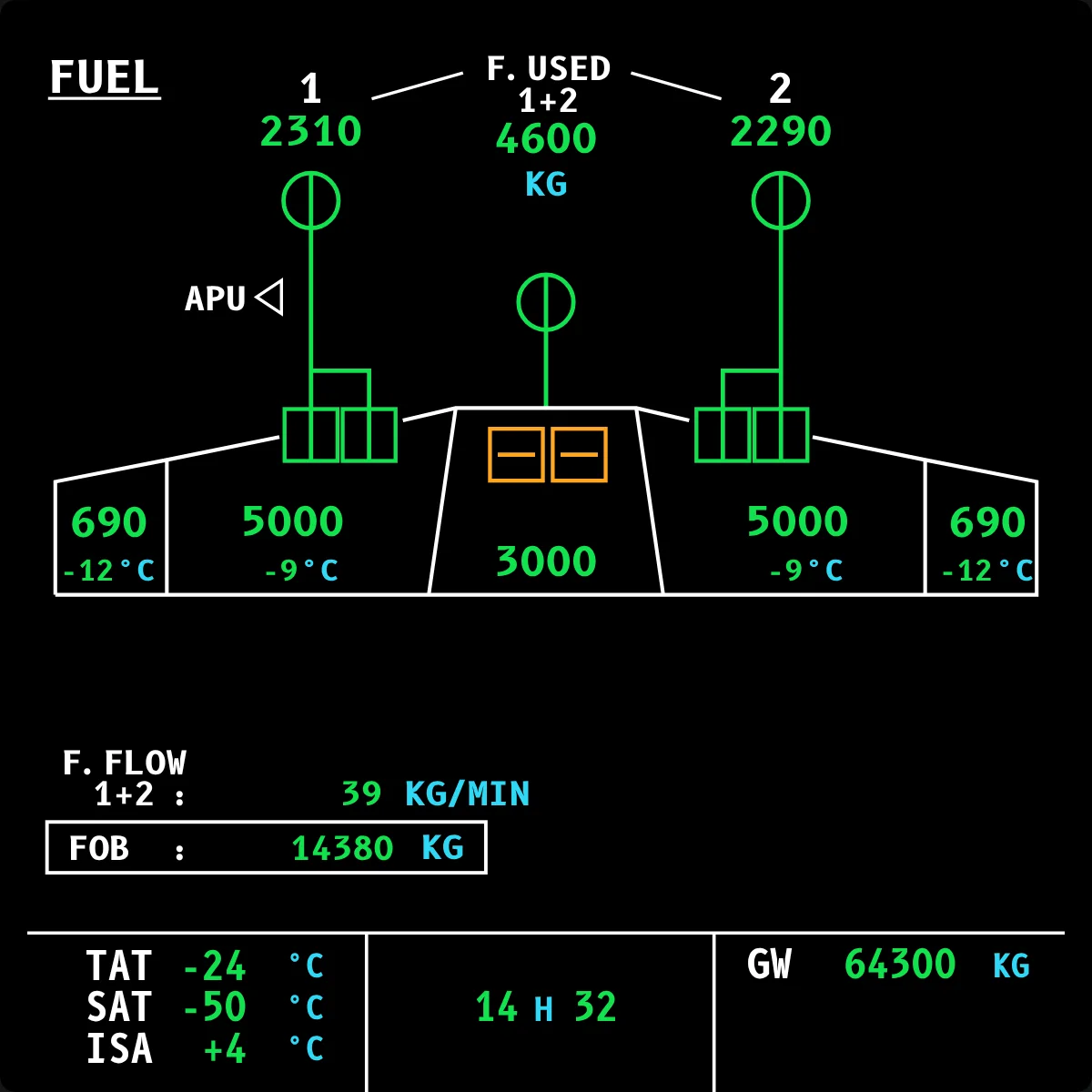
This E/WD is the ECAM Trainer's picture of the alert: the caution in amber with one line, FUEL MODE SEL MAN. On the FUEL page both centre tank pumps have stopped, each an amber crossline, with fuel still in the centre tank. The wing pumps feed the engines: they were on all along, held back by their sequence valves while the centre pumps delivered.
Where this drawing does less than the aircraft: its failure stops the centre pumps but does not itself raise the caution, and its tanks keep more than 5 000 kg in each wing, so the MODE SEL FAULT light stays out on this panel. The E/WD is the ECAM Trainer's picture of the alert, not a caution these tanks raise. The FCOM says the FAULT light and the caution come on when the centre tank has more than 250 kg and a wing tank less than 5 000 kg.
Sources FCOM PRO-ABN-FUEL FUEL / FCOM DSC-28-20 FUEL / FCOM DSC-28-10-30 / FCOM PRO-ABN-FUEL FUEL AUTO FEED FAULT / FCOM DSC-28-20
What does MODE SEL at MAN do?
At AUTO the centre tank pumps belong to the logic. At MAN the crew controls them with their own pushbuttons: with MAN selected, a pump whose pushbutton is on runs.
That is the procedure's first line, and the FCOM's note under it says what follows: the centre tank pumps will run and feed the engines. They feed first because the wing pumps' sequence valves let the centre pumps deliver preferentially when all the pumps run.
Sources FCOM DSC-28-20 / FCOM PRO-ABN-FUEL FUEL / FCOM DSC-28-10-30
Give the centre pumps back to the crew
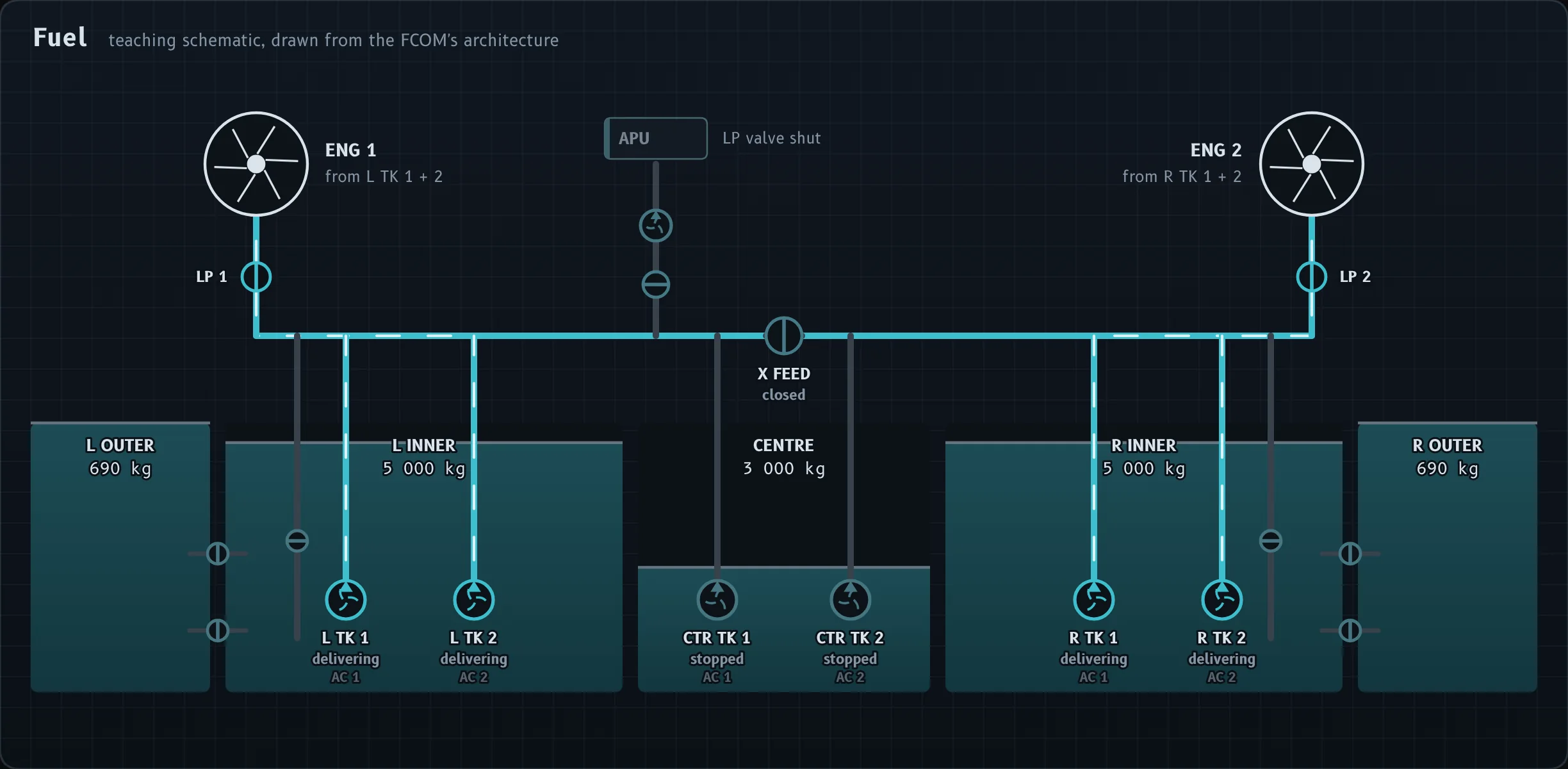
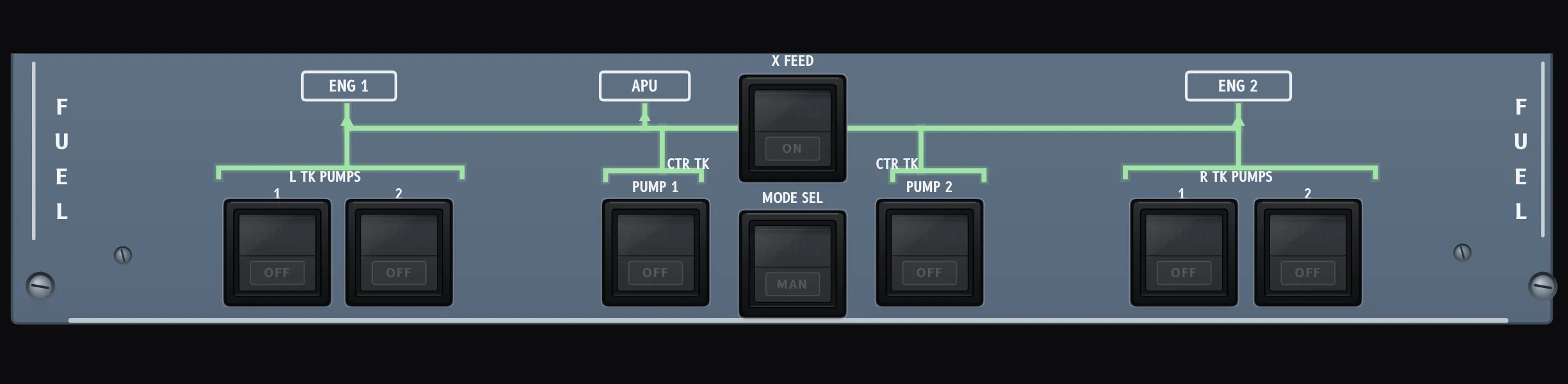
The automatic feed has failed: both centre tank pumps are stopped and the wing pumps feed the engines. Predict first, then press, and watch which pumps feed each engine on the schematic.
-
Predict You set MODE SEL to MAN, both centre tank pushbuttons still on. What feeds engine 1 now?
Try it Set MODE SEL to MAN.
Both centre pumps run, their pushbuttons being on, and they feed the engines first. The wing pumps stay on behind their sequence valves, as they do throughout the flight.
Sources FCOM DSC-28-20 / FCOM DSC-28-10-30 / FCOM PRO-ABN-FUEL FUEL
-
Predict At MAN, what stops a centre tank pump now?
Try it Switch CTR TK PUMP 1 off.
Pump 1 stops, OFF comes on in white, and the left wing pumps take engine 1 back. At MAN the system does not select the centre pumps off when an inner tank is full, so the wings can overflow on the ground if the pumps are left on.
Sources FCOM DSC-28-20 / FCOM DSC-28-10-30 / FCOM DSC-28-10-60
Why MAN first, and the pumps after?
FUEL MODE SEL MAN comes first and stands on its own. The rest sits under two conditions that the FCOM marks with black squares: with a wing below 5 000 kg and more than 250 kg in the centre tank, CTR TK PUMP 1 and 2 ON; with the pumps running after slat extension or a low level in the centre tank, both OFF.
The ECAM does not display black squares. At MAN the crew controls the pumps with their pushbuttons, and the two branches set them: on with a wing below 5 000 kg and more than 250 kg in the centre tank, off if they run after slat extension or with a low level in the centre tank.
The ECAM Trainer's E/WD at the alert shows FUEL MODE SEL MAN alone: both centre pushbuttons are already ON, and it draws the two ON lines only while a pushbutton is not. The FCOM prints them under the first condition.
The FCOM classes a level 2 caution as one the crew should be aware of without immediate action, yet to be considered without delay, time and situation permitting, so that the affected system does not degrade further.
Sources FCOM PRO-ABN-FUEL FUEL / FCOM PRO-ABN-ABN-00 INTRODUCTION / FCOM DSC-28-20 / FCOM DSC-31-10 WARNING/CAUTION CLASSIFICATION
What is left to watch for the rest of the flight?
The centre fuel stays usable: at MAN the procedure's note says the centre tank pumps will run and feed the engines. The FCOM half-boxes the FOB in amber when the centre tank pumps fail or are switched off, and boxes the centre quantity when both are; it does not say whether this caution brings either. This drawing leaves both unboxed, with the pumps stopped or running.
At MAN the crew must select the centre pumps off when the centre tank is empty, and the procedure's note says that a CTR TK PUMP LO PR alert will come on then.
On aircraft with CFM engines only, the note asks for the centre tank pumps off at slat extension if the centre tank is not empty, to prevent a possible wing tank overflow on the ground from the IDG fuel recirculation. Some of the fuel supplied to each engine returns from the IDG heat exchanger to the outer tank, and overflows into the inner tank when the outer tank is full.
Sources FCOM DSC-28-20 FUEL / FCOM PRO-ABN-FUEL FUEL / FCOM DSC-28-10-30 FUEL FEED SEQUENCE / FCOM DSC-28-10-60
With MODE SEL at MAN
What is lost afterwards?
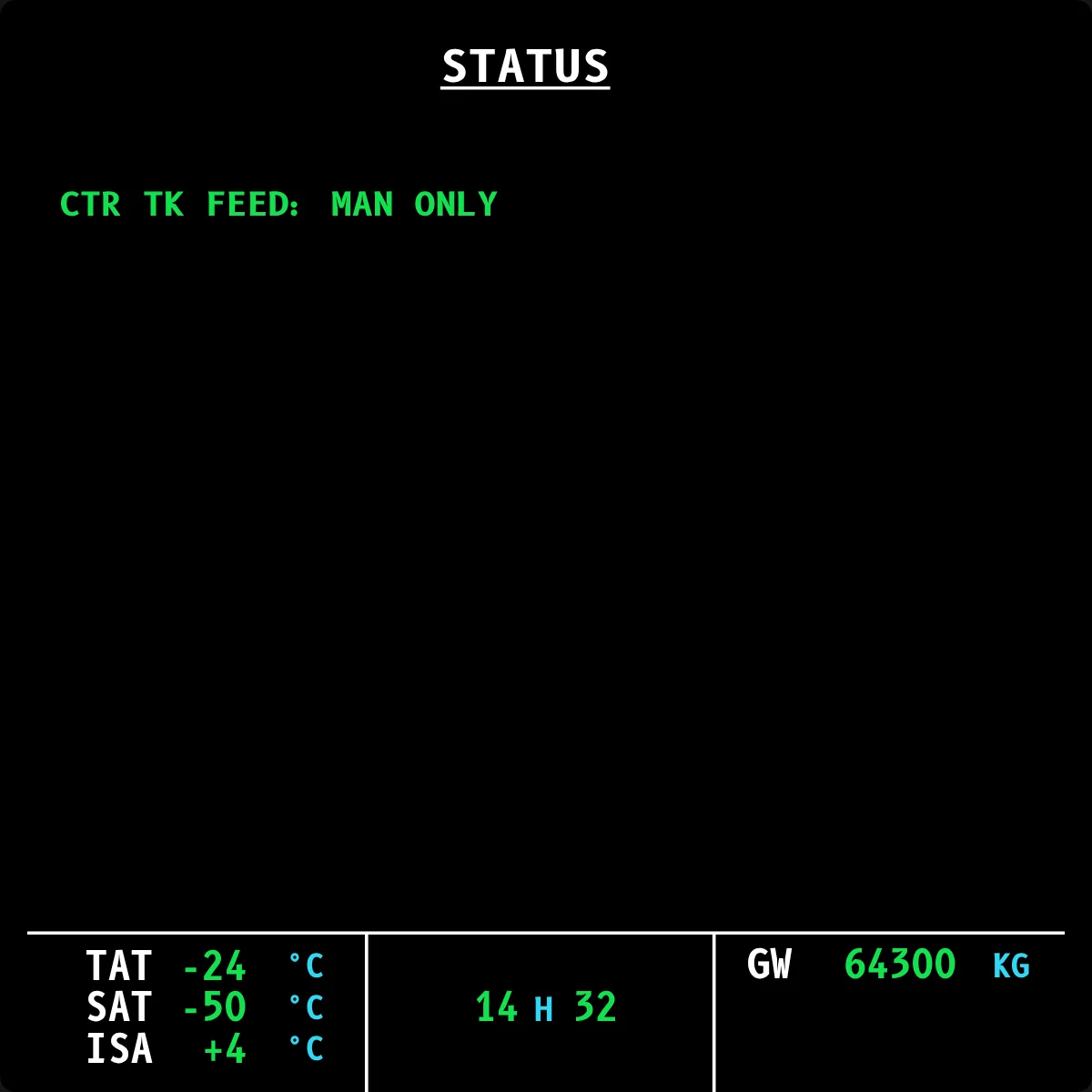
STATUS is the aircraft's operational summary, and the FCOM's procedure and status section gives the STATUS with the procedure. The ECAM Trainer's STATUS after this caution holds one line, CTR TK FEED: MAN ONLY, in green, the colour the FCOM gives to information.
The FCOM's STATUS prints the same words for FUEL L (R) WING TK LO LVL, under the condition that the centre tank is not empty, and for FUEL L (R) TK PUMP 1 + 2 LO PR.
Sources FCOM DSC-31-20 STATUS PAGE / FCOM PRO-ABN-ABN-00 INTRODUCTION / FCOM PRO-ABN-FUEL / FCOM PRO-ABN-FUEL FUEL
A319ceo, A320ceo, A320neo, A321neo: what differs?
| A319ceo, A320ceo | A320neo, A321neo | |
|---|---|---|
| This caution | Not given by type: this caution on aircraft with two centre tank pumps, six main pumps in all; on aircraft with centre tank transfer valves, the same quantities give FUEL AUTO TRANSFER FAULT | Not given by type: the same two designs, each for its own aircraft |
| Its procedure | Not given by type: with centre tank pumps, FUEL MODE SEL MAN, then the centre tank pumps ON or OFF by condition; with transfer valves, FUEL MODE SEL MAN, then CTR TK L XFR and R XFR ON, off when the centre tank is empty or the wings are full | Not given by type: the same two procedures, each for its own aircraft |
The FCOM gives each fuel design, and each version of these procedures, to a list of aircraft rather than to a type.
The ECAM Trainer draws one fuel design in each of its two drawings: centre tank pumps in one, centre tank transfer valves in the other. Which one applies depends on how your aircraft is built: check your own FCOM.
Sources FCOM DSC-28-10-30 GENERAL / FCOM PRO-ABN-FUEL FUEL AUTO FEED FAULT / FCOM PRO-ABN-FUEL FUEL AUTO TRANSFER FAULT / FCOM PRO-ABN-FUEL FUEL / FCOM DSC-28-10-30 FUEL FEED SEQUENCE

Work FUEL AUTO FEED FAULT as a crew
Read and do each line against the FCOM, with the E/WD, the SD page and the overhead following your hands, the PF and PM calls, and a debrief that says what you missed.
Work this failure in the ECAM TrainerGo further
Written in our own words from the FCOM and the FCTM; each part names the units it rests on. The E/WD, the STATUS and the live aircraft are the platform's own ECAM and systems model, the same the ECAM Trainer and the flight deck run. This page explains the procedure; it is not the procedure. Aircraft differ by type, engine and options: your aircraft's FCOM, your QRH and your operator's procedures always come first. How we write and check these pages.
Every ECAM procedure, line by line, against the FCOM.
The ECAM Trainer works 108 scenarios with the E/WD, the SD page and the overhead following your hands. Start free today, or open everything with A320 Knowledge+.
For study and revision only. Always follow your operator's approved documentation and procedures. A320 Knowledge is independent and not affiliated with Airbus.
Related
- FUEL CTR TK PUMP 1 LO PRAn amber caution with a short procedure and a line that waits.
- FUEL X FEED VALVE FAULTAn amber caution with nothing to press.
- FUEL F. USED/FOB DISAGREEAn amber caution with one line, and behind it the fuel check the FCTM asks the crew to make.
- FUEL L+R WING TK LO LVLAn amber caution that opens with LAND ASAP.
- A320 fuel systemThe system guide, with the live aircraft
- Every ECAM procedureThe alerts the ECAM Trainer works, grouped by system