
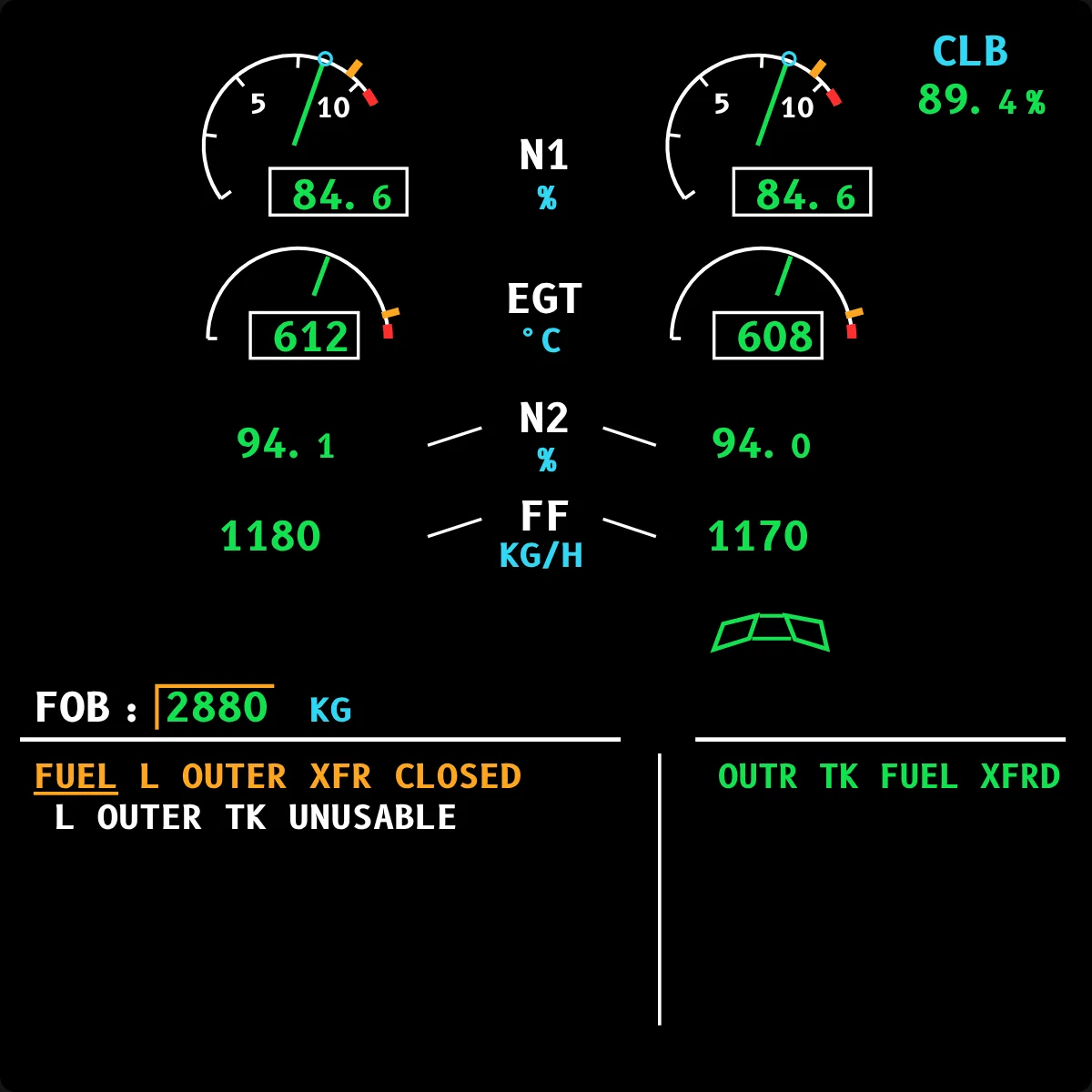
FUEL L OUTER XFR CLOSED
An amber caution with one line of information. Here is what the outer tank transfer valves are meant to do at the inner tank's low level, why the fuel they hold back cannot be used, and what comes next, with the live aircraft at the moment the caution comes on.
Written and checked by current A320 pilotschecked against the FCOM on Our editorial policy
What FUEL L OUTER XFR CLOSED means
FUEL L OUTER XFR CLOSED is an amber caution: the left inner tank has reached its low level, the outer tank's fuel should now drain into it, and both of the left wing's transfer valves have stayed closed.
The fuel in the left outer tank cannot reach the engines. The procedure is a single line, L (R) OUTER TK UNUSABLE, and STATUS repeats it. The FUEL page boxes that outer quantity and half-boxes the fuel on board in amber, and the FCOM notes that FUEL L WING TK LO LVL will come once that wing's fuel reaches the low level.
Sources FCOM PRO-ABN-FUEL FUEL L (R) OUTER XFR CLOSED / FCOM DSC-28-10-30 FUEL FEED SEQUENCE / FCOM DSC-31-10 WARNING/CAUTION CLASSIFICATION / FCOM PRO-ABN-FUEL FUEL / FCOM PRO-ABN-FUEL / FCOM DSC-28-20 / FCOM DSC-28-20 FUEL
At a glance
- Level
- Amber caution, level 2: single chime, MASTER CAUT and the FUEL page on the SD
- Sets it off
- Both transfer valves of one wing stay closed after its inner tank reaches the low level
- FUEL page
- That wing's outer tank quantity boxed in amber, and the FOB half-boxed in amber: not all the fuel shown is usable
- Procedure
- One line, in green: L (R) OUTER TK UNUSABLE
- Then
- When that wing's fuel reaches the low level, FUEL L (R) WING TK LO LVL
- Types
- Only for aircraft with outer tanks: the FCOM gives the caution to some aircraft only
Sources FCOM PRO-ABN-FUEL FUEL L (R) OUTER XFR CLOSED / FCOM DSC-31-10 WARNING/CAUTION CLASSIFICATION / FCOM DSC-31-20 SYSTEM PAGES / FCOM DSC-28-20 / FCOM DSC-28-20 FUEL / FCOM PRO-ABN-FUEL FUEL / FCOM PRO-ABN-FUEL
What sets the caution off?
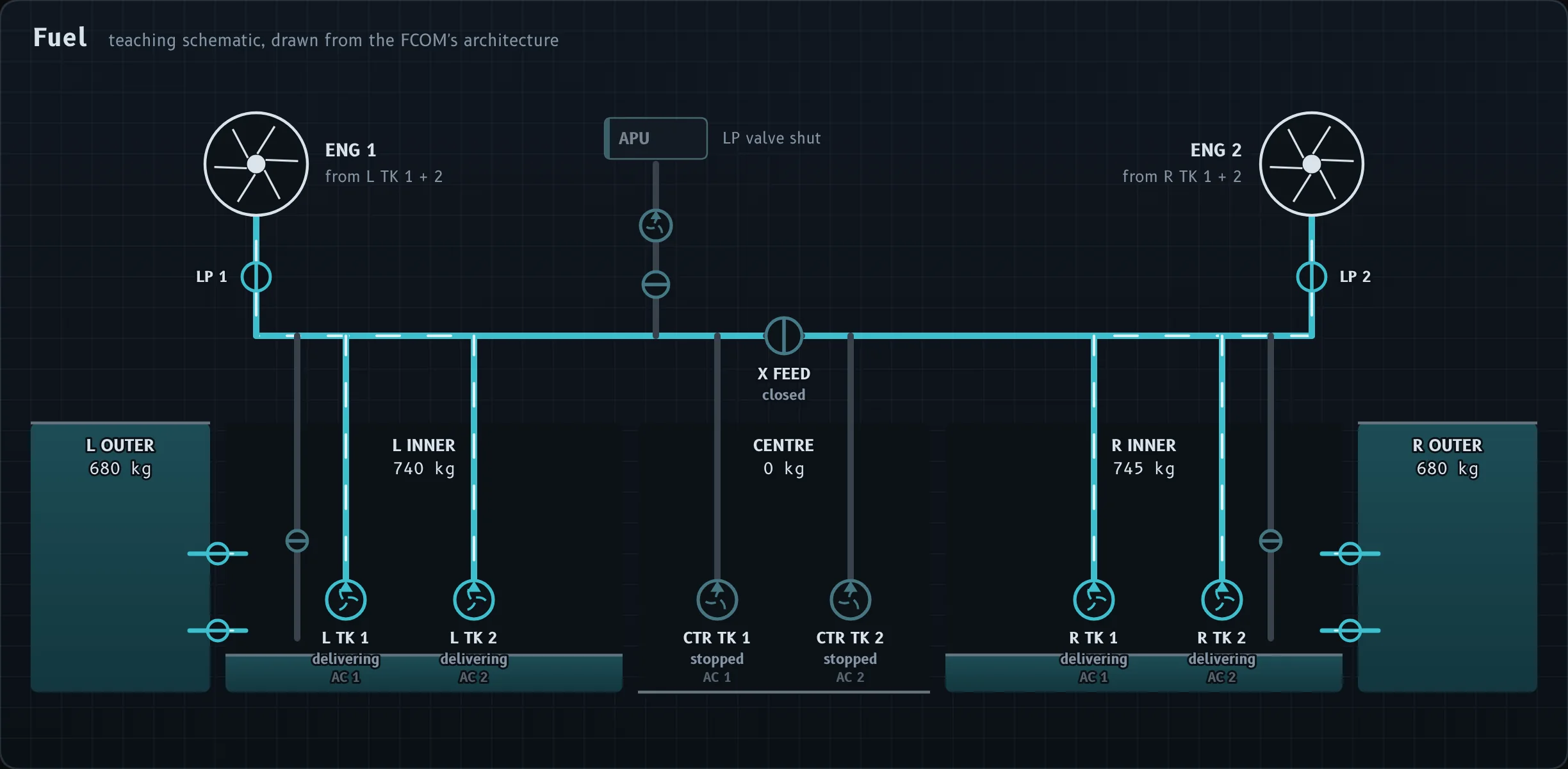
On the A319ceo, A320ceo and A320neo each wing has an inner and an outer tank, with a vent surge tank outboard of the outer one. Two electrical transfer valves in each wing let fuel pass from the outer tank to the inner tank.
The outer fuel is used last. The tanks empty in sequence: the additional centre tanks where fitted, the centre tank, then each inner tank down to 750 kg, and then the outer tanks, whose fuel transfers into the inner tanks.
The transfer is automatic. When an inner tank reaches its low level, about 750 kg, the transfer valves open and the outer fuel drains in; once open they stay latched open until the next refuelling. Two level sensors sit in each inner tank, and each controls two valves, one in each wing, so that both wings transfer together.
The caution triggers when both transfer valves of one wing remain closed after its inner tank has reached that low level. The 750 kg assumes a level aircraft with no acceleration; in a steep descent, or while accelerating or decelerating, the valves may open with more fuel in the inner tank, and the low level warning may be triggered. One version of the feed sequence adds that during takeoff with less than 7 000 kg FOB an early transfer may occur, as a wing low level sensor may become dry with the fuel moving in the wing.
Sources FCOM DSC-28-10-20 / FCOM DSC-28-10-30 / FCOM DSC-28-10-30 FUEL FEED SEQUENCE / FCOM PRO-ABN-FUEL FUEL L (R) OUTER XFR CLOSED
From the low level to the caution
What does the crew see and hear?
A level 2 caution: a single chime, MASTER CAUT steady amber, the caution in amber on the E/WD with its one line, L (R) OUTER TK UNUSABLE, printed in green, and the SD calls up the FUEL page, the relevant system page.
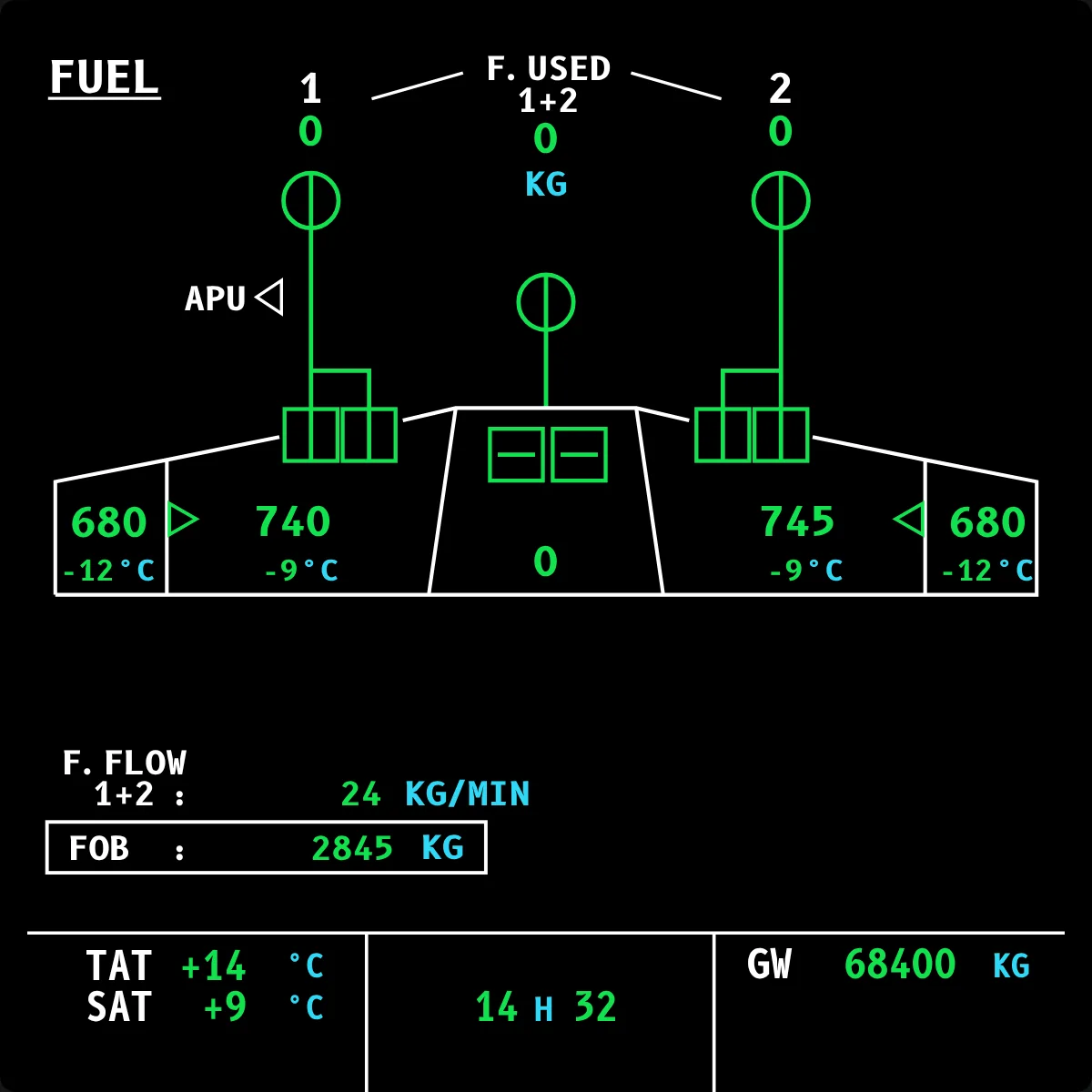
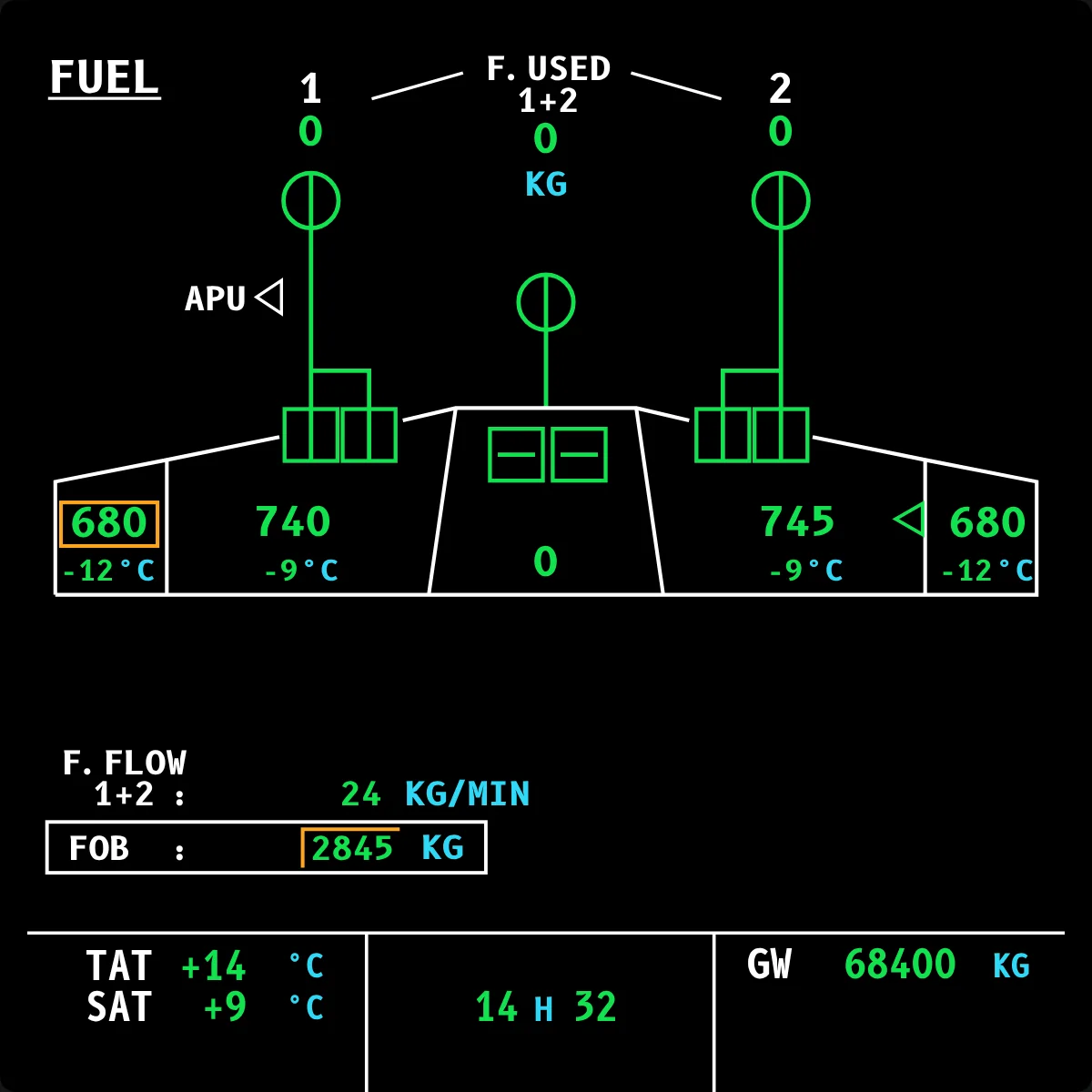
On the FUEL page the left outer tank's quantity is boxed in amber, because both its transfer valves failed to open with the inner tank at low level, and the FOB is half-boxed in amber: the quantity shown is not all usable. A green triangle marks a transfer into the inner tank while it runs, and nothing is shown for valves that are closed.
The right wing transfers as it should, so the green OUTR TK FUEL XFRD memo appears on the E/WD: it needs at least one transfer valve open.
Sources FCOM DSC-31-10 WARNING/CAUTION CLASSIFICATION / FCOM DSC-31-20 SYSTEM PAGES / FCOM PRO-ABN-FUEL FUEL / FCOM DSC-28-20 / FCOM DSC-28-20 FUEL
The moment the caution comes on
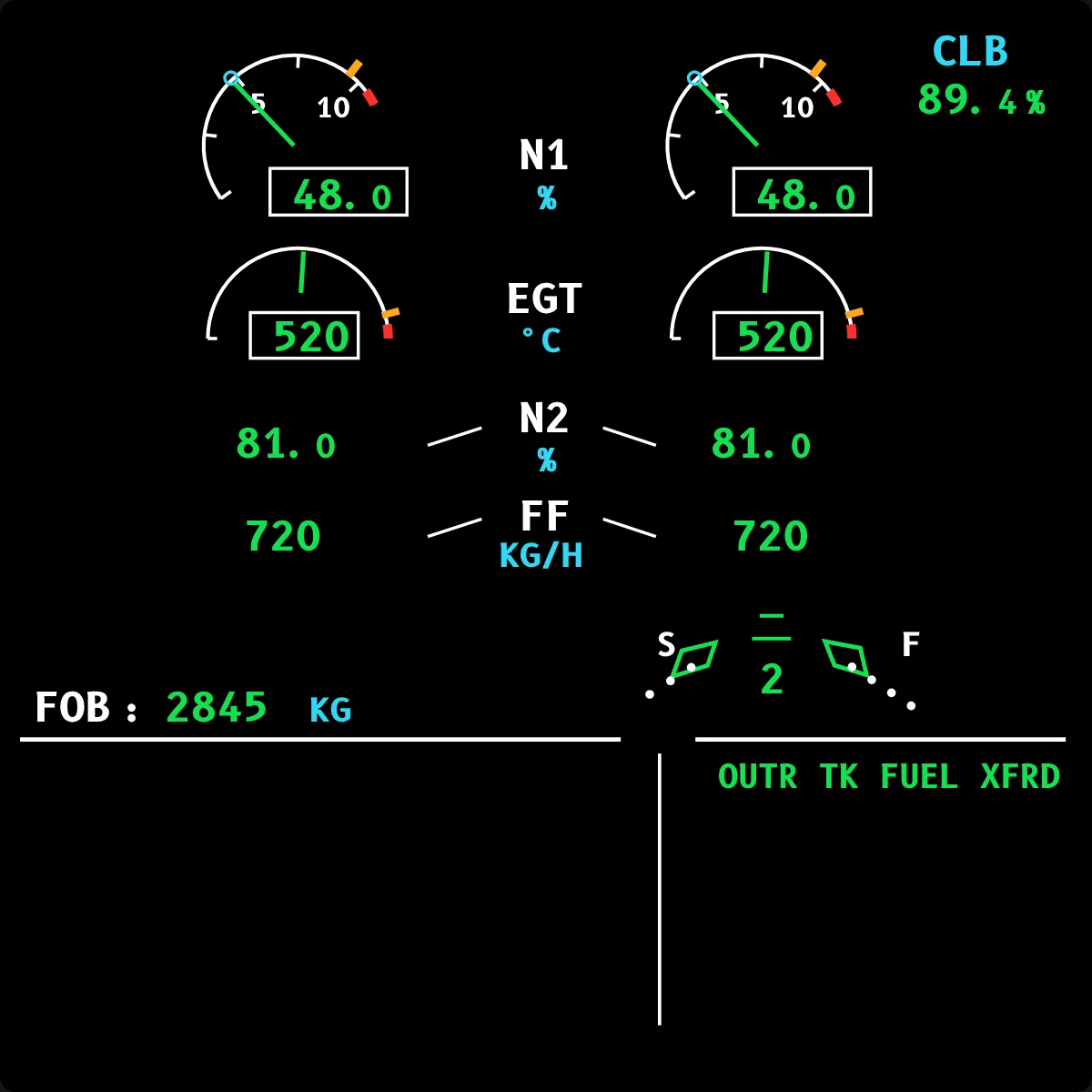
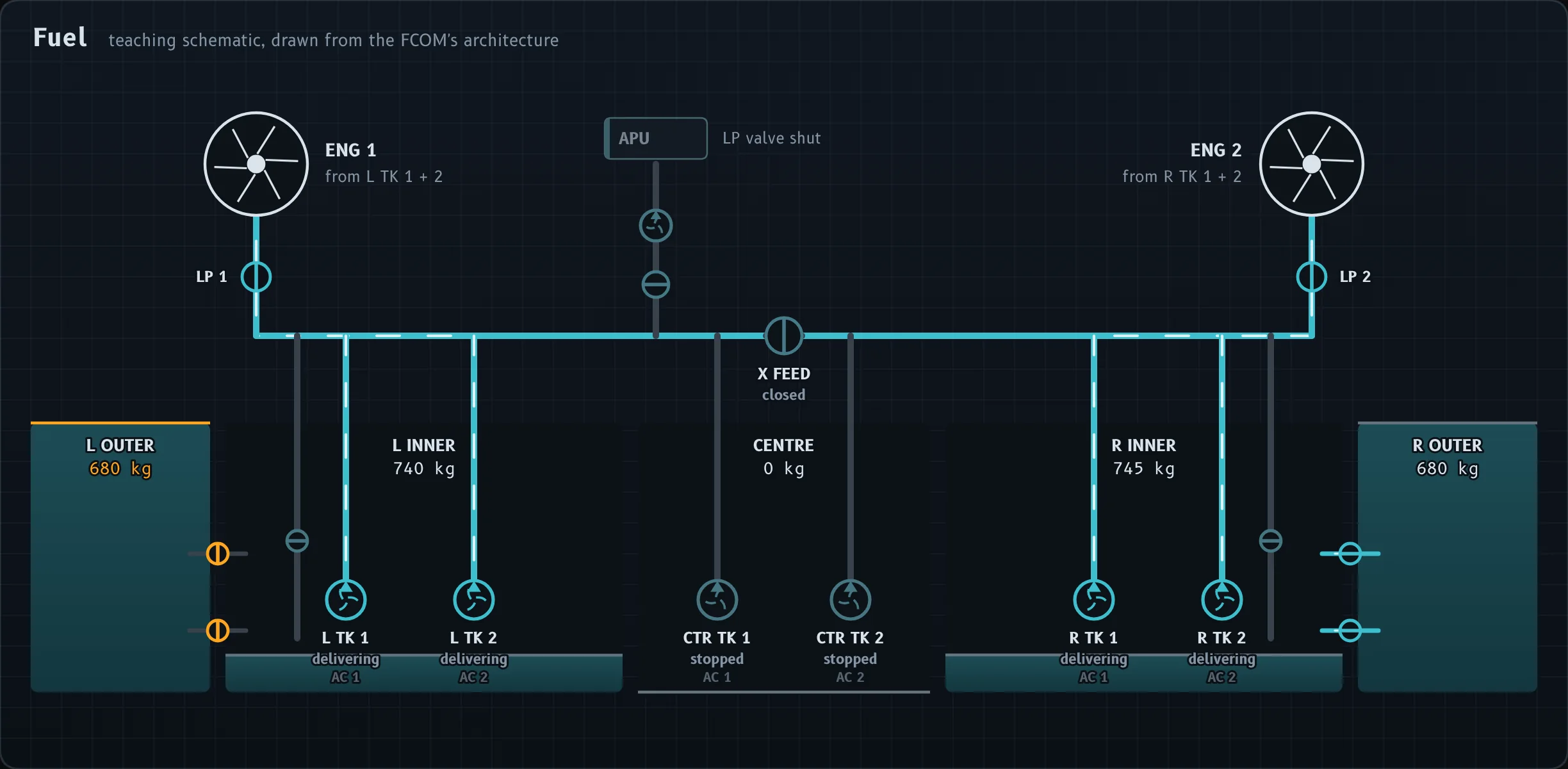
Centre tank empty, both inner tanks just under 750 kg, the low level at which the transfer valves open, and both outer tanks draining into them. Press the button to hold the left wing's transfer valves shut, then look at the E/WD, the FUEL page and the schematic.
The alert Hold the left transfer valves shut
The E/WD shows the caution in amber with L OUTER TK UNUSABLE under it, and OUTR TK FUEL XFRD in green on the right: the right wing is still transferring. The FCOM prints the L OUTER TK UNUSABLE line in green; our drawing shows it in white. Another limit of the drawing: the E/WD after the press is the one drawn for the cruise, so its engine figures and flap indication differ from the aircraft's before the press, at 3 000 ft with flaps 2; only the caution and its one line belong to this failure.
On the FUEL page the left outer quantity is now boxed in amber and the FOB half-boxed; the green transfer triangle shows on the right wing only. In the drawing the left valves close on the press; the FCOM's caution is for valves that stay closed once the inner tank reaches the low level. Working the alert is what the ECAM Trainer does with you.
Sources FCOM PRO-ABN-FUEL FUEL / FCOM DSC-28-20 / FCOM DSC-28-20 FUEL / FCOM PRO-ABN-FUEL FUEL L (R) OUTER XFR CLOSED / FCOM DSC-28-10-30 FUEL FEED SEQUENCE
Why can the outer fuel not be used?
The engines are fed by the pumps in the inner tanks: each engine from two pumps in its own side's inner tank, or on some aircraft from a centre tank pump. The outer tank's fuel reaches them by draining into the inner tank through its two transfer valves.
With both valves shut, the left outer fuel stays in the outer tank. It is still counted in the FOB, which is why the FOB is half-boxed: the FCOM puts that box on the FOB "when the displayed quantity is not all usable".
Sources FCOM DSC-28-10-30 / FCOM DSC-28-10-30 FUEL FEED SEQUENCE / FCOM DSC-28-20 / FCOM DSC-28-20 FUEL
Can the cross-feed fetch it?
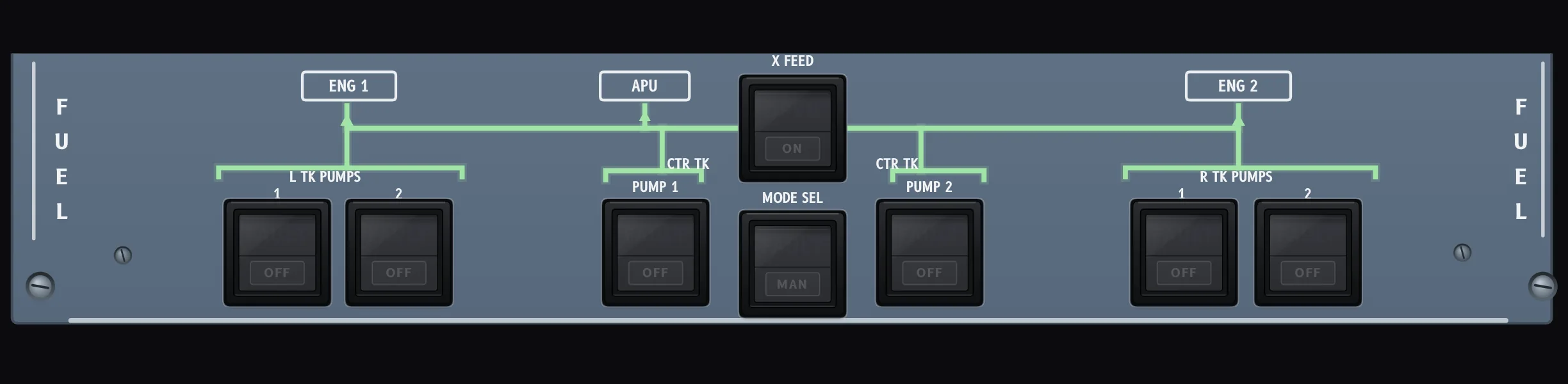
The left wing's transfer valves are shut and its outer quantity is boxed in amber. Predict first, then press X FEED, and watch the schematic and the box on the FUEL page. This is a test of the system, not a line of the procedure.
-
Predict You open the cross-feed. Does the left outer tank's fuel become usable?
Try it Set X FEED to ON.
The cross-feed valve opens, and in the drawing both sides' pumps now feed both engines: the FCOM's valve lets one engine be fed from both sides. The left outer tank is untouched: its quantity stays boxed in amber and the FOB half-boxed. The FCOM's path for outer fuel is through the transfer valves into the inner tank.
The procedure has no cross-feed line for this caution: its one line is L (R) OUTER TK UNUSABLE.
Sources FCOM DSC-28-10-30 / FCOM DSC-28-10-30 FUEL FEED SEQUENCE / FCOM DSC-28-20 / FCOM DSC-28-20 FUEL / FCOM PRO-ABN-FUEL FUEL
-
Try it Set X FEED back to OFF.
Each wing feeds its own engine again.
Sources FCOM DSC-28-10-30
What does the single line of information leave the crew with?
The procedure has no action line: it tells the crew what the failure means for the fuel, L (R) OUTER TK UNUSABLE, and STATUS keeps that line. The FCOM gives no reason for that. The outer transfer valves are automatic: they open by themselves at the low level and close at the next refuelling.
A level 2 caution is a failure the crew should be aware of without immediate action, yet to be considered without delay, time and situation permitting, so that the affected system does not degrade further.
The limitations cover the asymmetry this leaves. For the outer tanks in flight they give a maximum of 690 kg, and allow one outer tank full and the other empty under conditions on the inner tanks. They add that in exceptional conditions, that is a fuel system failure, the imbalance values may be exceeded without significant effect on the handling, the aircraft remaining fully controllable.
Sources FCOM DSC-28-10-30 FUEL FEED SEQUENCE / FCOM PRO-ABN-FUEL FUEL / FCOM PRO-ABN-FUEL / FCOM DSC-31-10 WARNING/CAUTION CLASSIFICATION / FCOM LIM-FUEL MAXIMUM ALLOWED FUEL IMBALANCE
What comes next, at the low level?
The left inner tank goes on feeding engine 1, with nothing coming in from its outer tank. The FCOM's note on this caution says that when the fuel in the affected wing reaches the low level, the corresponding FUEL WING TK LO LVL is triggered.
FUEL L WING TK LO LVL triggers below 750 kg, from sensors going dry, independently of the quantity indications. Its procedure sets MODE SEL to MAN if the centre tank is not empty; then, with no leak, X FEED to ON and that side's pumps off; with the cross-feed open, the other side can feed both engines. One version asks for no leak only, another for no leak and a fuel imbalance.
If both wings reach their low level, FUEL L+R WING TK LO LVL brings LAND ASAP, every tank pump on and the cross-feed opened if there is no leak.
Sources FCOM DSC-28-10-30 / FCOM PRO-ABN-FUEL FUEL / FCOM PRO-ABN-FUEL / FCOM PRO-ABN-FUEL FUEL L (R) WING TK LO LVL / FCOM PRO-ABN-FUEL FUEL L + R WING TK LO LVL / FCOM PRO-ABN-FUEL ABNORMAL AND EMERGENCY PROCEDURES
What follows the closed valves
What is lost afterwards?
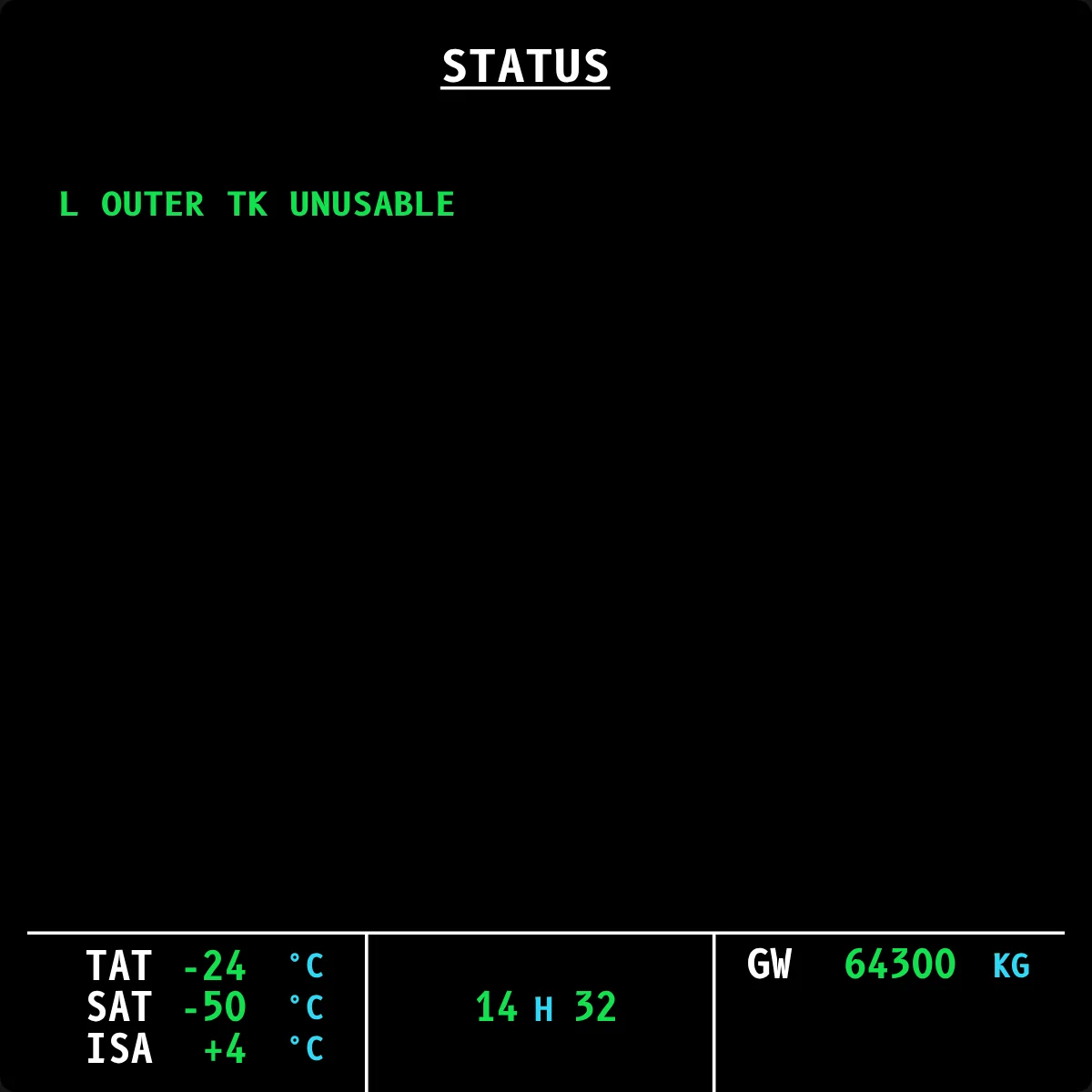
STATUS is the aircraft's operational summary. For this caution it holds one line, L (R) OUTER TK UNUSABLE, in green, the colour of information, and nothing under INOP SYS.
The FCOM prints a single STATUS for this caution, with no other version, so the picture above holds wherever the caution applies: on aircraft with outer tanks.
The A321neo has one tank in each wing and no outer tank.
Sources FCOM PRO-ABN-FUEL / FCOM DSC-31-20 STATUS PAGE / FCOM DSC-28-10-20 TANKS
A319ceo, A320ceo, A320neo, A321neo: what differs?
| A319ceo, A320ceo | A320neo, A321neo | |
|---|---|---|
| Tanks in each wing | An inner and an outer tank, with two transfer valves | A320neo: the same. A321neo: one tank in each wing, no outer tank and no outer transfer valves |
| The caution, its line and STATUS | One version, for aircraft with outer tanks | The same version, for aircraft with outer tanks |
| Outer transfer at the low level, about 750 kg | Automatic, both wings together, latched open | A320neo: the same. A321neo: none, its wing tanks feed last |
The A321neo's tank sequence ends with its wing tanks.
The FCOM prints the caution, its line and its STATUS only for aircraft with outer tanks.
Sources FCOM DSC-28-10-20 TANKS / FCOM DSC-28-10-20 / FCOM DSC-28-10-30 / FCOM PRO-ABN-FUEL FUEL L (R) OUTER XFR CLOSED / FCOM PRO-ABN-FUEL FUEL / FCOM PRO-ABN-FUEL / FCOM DSC-28-10-30 FUEL FEED SEQUENCE

Work FUEL L OUTER XFR CLOSED as a crew
Read and do each line against the FCOM, with the E/WD, the SD page and the overhead following your hands, the PF and PM calls, and a debrief that says what you missed.
Work this failure in the ECAM TrainerGo further
Written in our own words from the FCOM and the FCTM; each part names the units it rests on. The E/WD, the STATUS and the live aircraft are the platform's own ECAM and systems model, the same the ECAM Trainer and the flight deck run. This page explains the procedure; it is not the procedure. Aircraft differ by type, engine and options: your aircraft's FCOM, your QRH and your operator's procedures always come first. How we write and check these pages.
Every ECAM procedure, line by line, against the FCOM.
The ECAM Trainer works 108 scenarios with the E/WD, the SD page and the overhead following your hands. Start free today, or open everything with A320 Knowledge+.
For study and revision only. Always follow your operator's approved documentation and procedures. A320 Knowledge is independent and not affiliated with Airbus.
Related
- FUEL AUTO FEED FAULTAn amber caution with a short procedure.
- FUEL CTR TK PUMP 1 LO PRAn amber caution with a short procedure and a line that waits.
- FUEL X FEED VALVE FAULTAn amber caution with nothing to press.
- FUEL F. USED/FOB DISAGREEAn amber caution with one line, and behind it the fuel check the FCTM asks the crew to make.
- A320 fuel systemThe system guide, with the live aircraft
- Every ECAM procedureThe alerts the ECAM Trainer works, grouped by system