
F/CTL STABILIZER JAM
An amber caution: the computers have lost electrical control of the trimmable horizontal stabiliser, jammed or not. Here is how the stabiliser is normally moved, what the laws do without it, why the crew checks the trim wheel first, and how STATUS plans the landing, with the live aircraft at the moment the caution comes on.
Written and checked by current A320 pilotschecked against the FCOM on Our editorial policy
What F/CTL STABILIZER JAM means
F/CTL STABILIZER JAM is an amber caution: the flight control computers have lost electrical control of the trimmable horizontal stabiliser (THS), with or without the stabiliser jammed. Pitch control law reverts to alternate law, and depending on the type of failure, the manual pitch trim may still be available.
The ECAM's first line is a check of the pitch trim wheel. If manual trim is available, the crew trims to keep the elevators at zero, read on the F/CTL page. The associated F/CTL ALTN LAW (PROT LOST) limits the speed to 320 kt, and STATUS plans a flap 3 approach at an increased speed.
Sources FCOM PRO-ABN-F_CTL F/CTL STABILIZER JAM / FCOM PRO-ABN-F_CTL F/CTL
At a glance
- Level
- Amber caution, level 2: single chime, MASTER CAUT steady amber and, normally, the F/CTL page on the SD
- Sets it off
- A loss of the electrical control of the stabiliser, with or without the stabiliser jammed
- Law
- Pitch reverts to alternate law, and MAX SPEED 320 KT follows
- F/CTL page
- The PITCH TRIM legend in amber
- Trim wheel
- Depending on the failure, the manual pitch trim may still be available, with green or yellow working
- STATUS
- Flap 3 for landing, an increased approach speed, the landing distance procedure, and direct law once the gear is down
Sources FCOM DSC-31-10 WARNING/CAUTION CLASSIFICATION / FCOM DSC-31-30 ATTENTION GETTERS / FCOM DSC-31-20 SYSTEM PAGES / FCOM PRO-ABN-F_CTL F/CTL STABILIZER JAM / FCOM PRO-ABN-F_CTL F/CTL / FCOM DSC-27-20-30 ECAM F/CTL PAGE / FCOM DSC-27-10-20
How is the stabiliser normally moved?
Two elevators and the THS control the aircraft in pitch. The THS moves between 13.5° nose up and 4° nose down. It is controlled electrically in normal and alternate control, and mechanically for manual trim.
A screwjack, driven by two hydraulic motors on green and yellow, moves the stabiliser. The hydraulic motors take their orders from one of three electric motors, or from the mechanical trim wheel.
The computers stand behind each other on the electric motors. ELAC 2 normally controls the THS through motor 1; if ELAC 2 or its hydraulics fail, ELAC 1 takes it through motor 2; if neither ELAC is available, SEC 1 or SEC 2 takes it through motor 2 or 3.
In normal law pitch trim is automatic, flown by hand or with the autopilot engaged, though it freezes in a few cases, a manual trim order among them: the sidestick sets the elevator and the THS to hold the load factor demanded, and the crew has no need to trim for a change of speed or configuration.
The pitch trim wheels, one each side of the centre pedestal and mechanically interconnected, control the THS mechanically at any time if green or yellow is working, with priority over the electrical control.
Sources FCOM DSC-27-10-20 PITCH CONTROL / FCOM DSC-27-10-10 CONTROL SURFACES / FCOM DSC-27-10-20 / FCOM DSC-27-10-20 GENERAL ARCHITECTURE / FCOM DSC-27-20-10-20 FLIGHT MODE / FCOM DSC-27-10-10 COCKPIT CONTROLS / FCOM DSC-27-20-30 PEDESTAL
Two ways to the screwjack
What sets it off, and what do the laws do?
The caution triggers when there is a loss of the electrical control of the stabiliser, with or without the stabiliser jammed. When the flight control computers detect it, pitch control law reverts to alternate law.
The law reconfiguration table names the case, a THS jammed with this alert: alternate law with reduced protection in pitch, direct law in roll and alternate law in yaw.
In alternate law the pitch mode is still a load factor demand law, as in normal law, with less built-in protection. The load factor limitation stays; pitch attitude protection is lost; an artificial low speed stability replaces the angle of attack protection, and above VMO or MMO a nose up demand is introduced, both of which the pilot can override; there is no bank angle protection.
The ECAM adds F/CTL ALTN LAW (PROT LOST) as the associated procedure, with MAX SPEED 320 KT.
The QRH has a STABILIZER JAM procedure of its own, for a stabiliser jam the ELACs may not detect when the pitch trim wheel is jammed: normal law then remains active and there is no ECAM warning.
Sources FCOM PRO-ABN-F_CTL F/CTL STABILIZER JAM / FCOM PRO-ABN-F_CTL F/CTL / FCOM DSC-27-20-20 FLIGHT CONTROLS LAW RECONFIGURATION / FCOM DSC-27-20-20 ALTERNATE LAW / FCOM PRO-ABN-F_CTL
What does the crew see and hear?
A level 2 caution: a single chime, the MASTER CAUT light steady amber and the caution in amber on the E/WD, and the SD normally calls up the relevant system page by itself, here the F/CTL page.
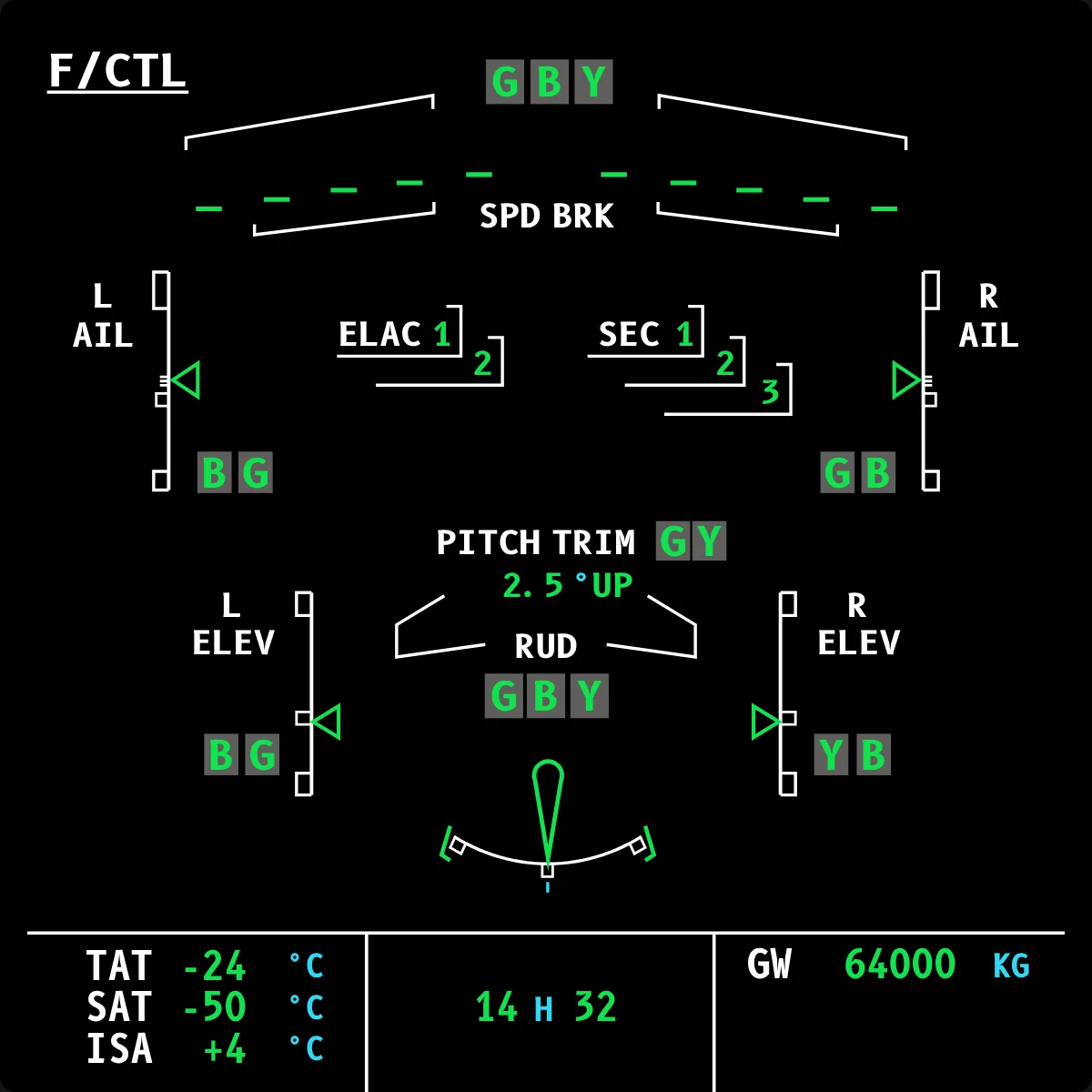
On the F/CTL page the PITCH TRIM legend, normally white, becomes amber if the pitch trim jams. The pitch trim figures are green; the FCOM turns them amber if green and yellow pressure decreases.
On the PFD in alternate law, amber crosses replace the green protection symbols.
Sources FCOM DSC-31-10 WARNING/CAUTION CLASSIFICATION / FCOM DSC-31-30 ATTENTION GETTERS / FCOM DSC-31-20 SYSTEM PAGES / FCOM DSC-27-20-30 ECAM F/CTL PAGE / FCOM DSC-27-20-20 GENERAL / FCOM DSC-27-20-20 ALTERNATE LAW
The moment the caution comes on
A healthy aircraft in the cruise. Press the button to lose the stabiliser's electrical control, then look at the E/WD, the F/CTL page and the pedestal, where the pitch trim wheels are.
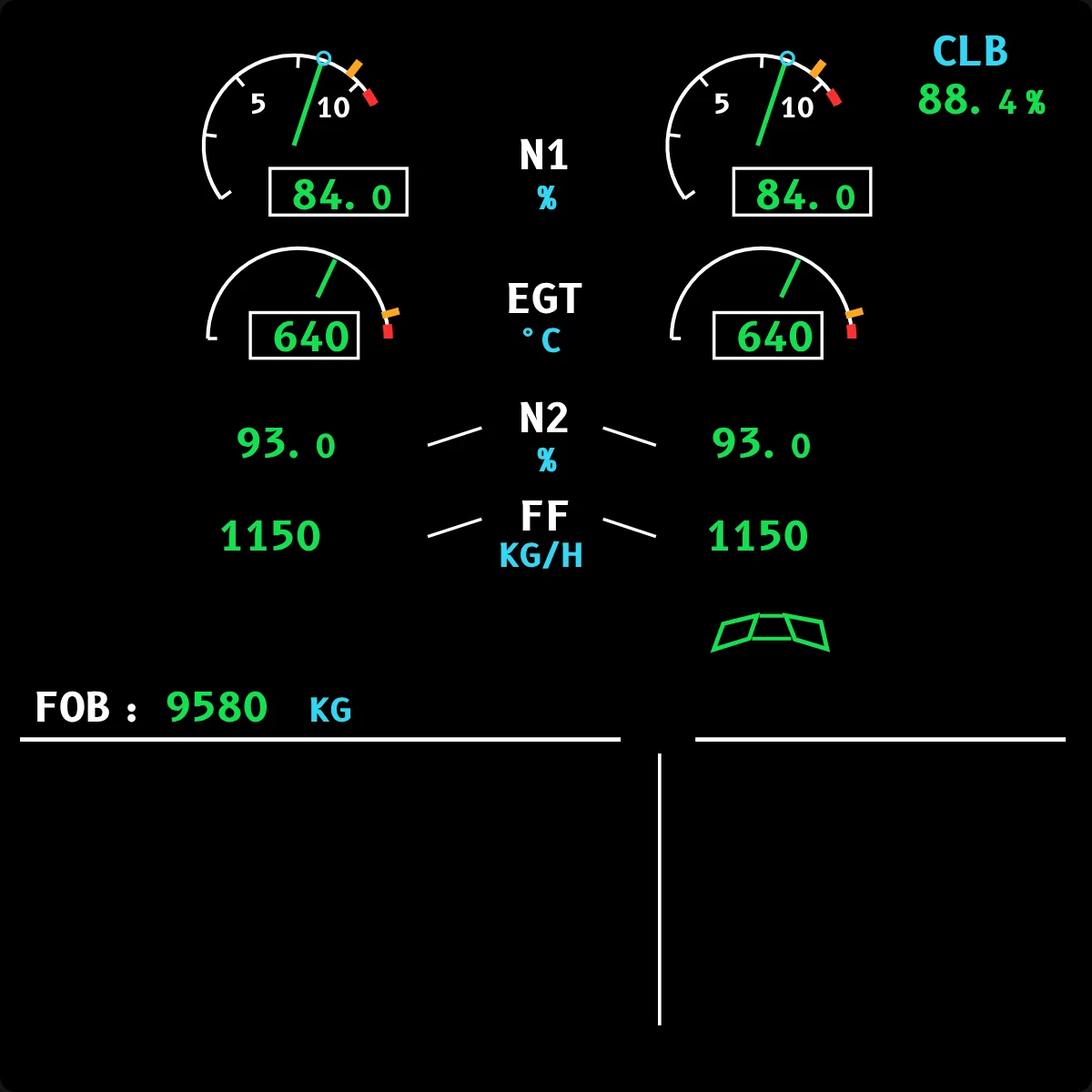

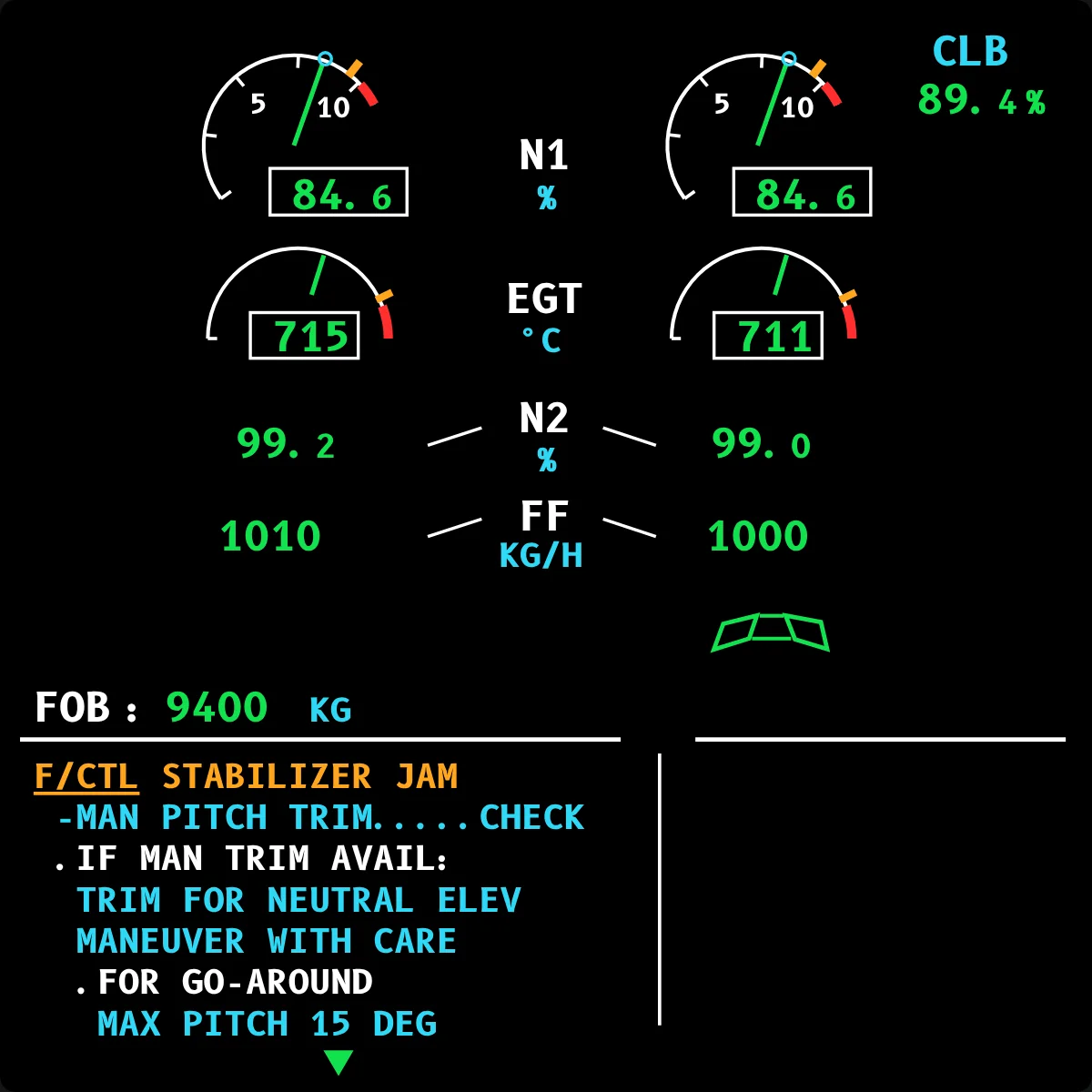
The alert Lose the stabiliser's electrical control
The E/WD shows F/CTL STABILIZER JAM in amber, MAN PITCH TRIM CHECK first, the lines under IF MAN TRIM AVAIL, then F/CTL ALTN LAW (PROT LOST) with MAX SPEED 320 KT. On the F/CTL page the PITCH TRIM legend is amber.
The pedestal shows the pitch trim wheels; the drawing does not turn them, and no PFD is drawn here. Working the lines is what the ECAM Trainer does with you.
Sources FCOM PRO-ABN-F_CTL F/CTL / FCOM DSC-27-20-30 ECAM F/CTL PAGE / FCOM DSC-27-20-30 PEDESTAL
Why is the trim wheel checked first?
The procedure's own words on it are its opening comment: depending on the type of failure, the manual pitch trim may still be available. The first line is MAN PITCH TRIM CHECK, and its remark warns that the force needed on the wheel may be higher than when the trim is set before takeoff.
The wheel's control is mechanical: it acts on the two hydraulic motors itself, not through the electric motors, and it needs green or yellow working. A pilot action on the wheel disconnects the autopilot but not the ELACs; micro-switches keep the computers synchronised with the position set by hand.
If manual trim is available, the crew trims to keep the elevators at the zero position, which the F/CTL page shows. The FCOM gives no reason for the neutral elevator. MANEUVER WITH CARE and the go-around limit follow in one version of the procedure.
The FCTM's advice in reconfiguration laws: at high altitude, descend to increase the margin to buffet, as about 4 000 ft below REC MAX ALT significantly reduces stall warnings in turbulence; at high speed, manoeuvre with care and use small control inputs.
In the block below, the stabiliser's electrical control is already lost. Take away hydraulics and watch the pitch trim figures.
Sources FCOM PRO-ABN-F_CTL F/CTL / FCOM DSC-27-10-10 CONTROL SURFACES / FCOM DSC-27-10-20 / FCOM DSC-27-20-30 PEDESTAL / FCOM DSC-27-20-30 ECAM F/CTL PAGE / FCTM AOP-10-30-20 FLYING IN RECONFIGURATION LAWS
The wheel needs green or yellow
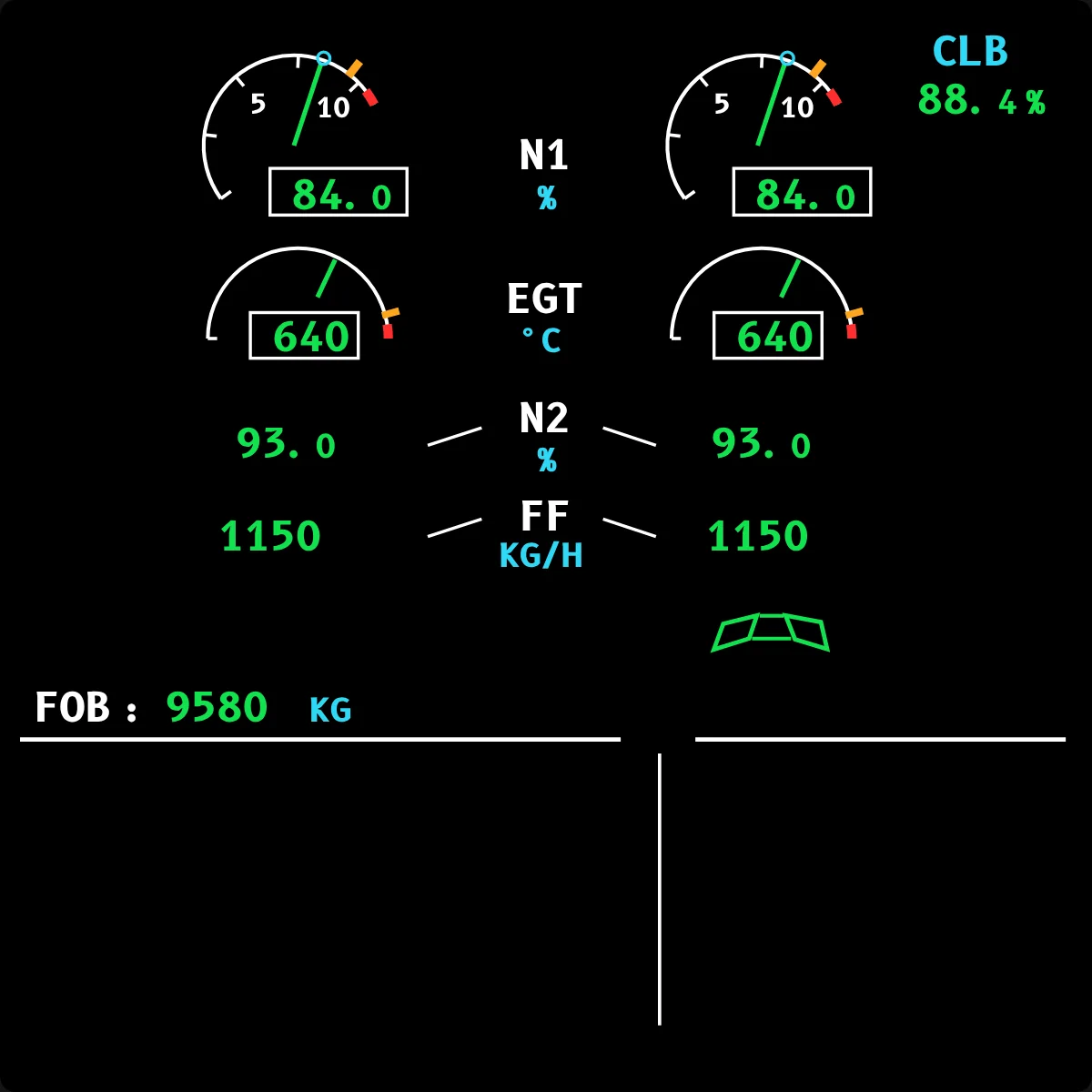
The stabiliser's electrical control is lost and PITCH TRIM is amber. Press one failure at a time and read the pitch trim figures on the F/CTL page.
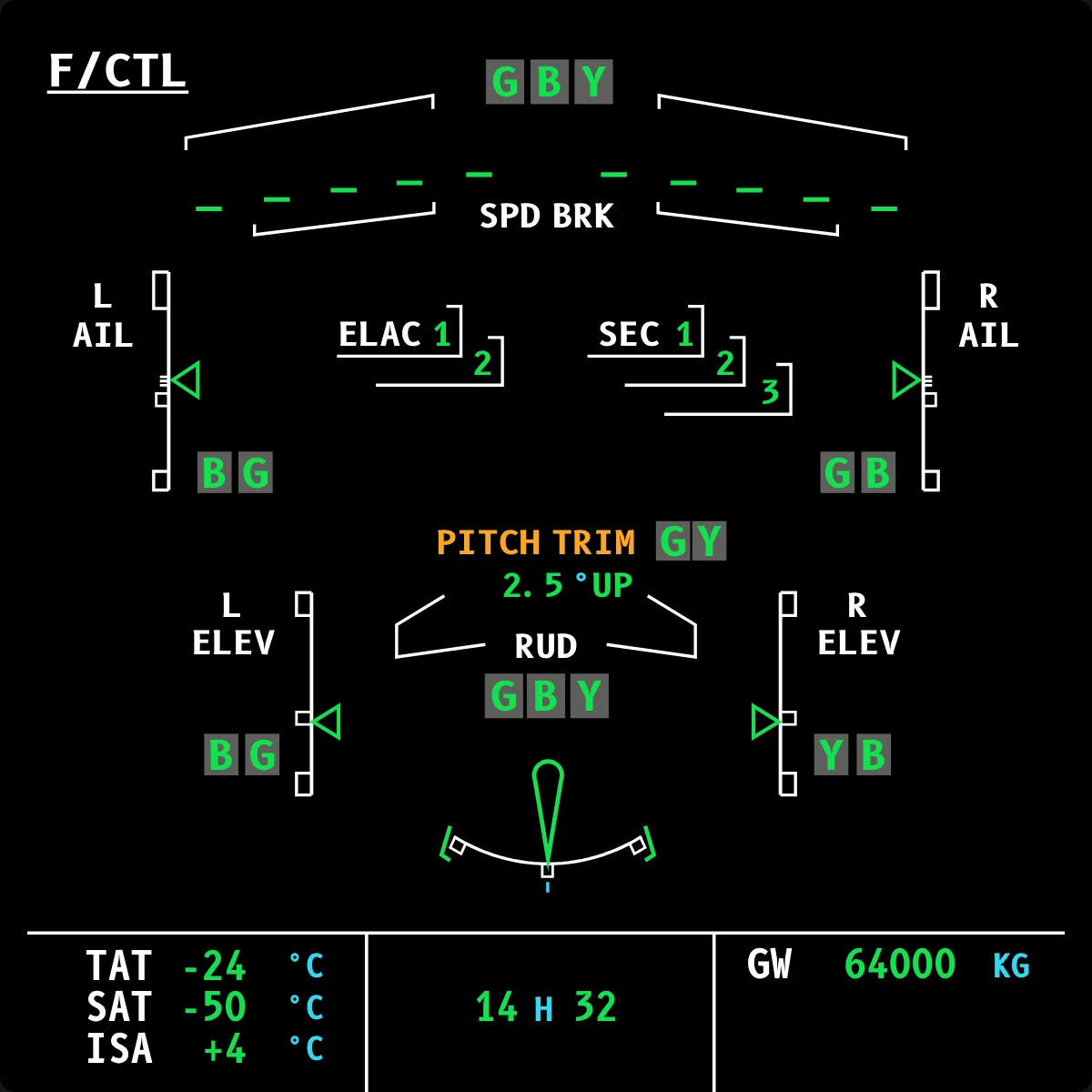
The alert Then lose green
The E/WD shows the green reservoir caution. On the F/CTL page the G beside the pitch trim turns amber, and the pitch trim figures stay green: yellow still works.
The FCOM makes the wheel's mechanical control of the THS available if either green or yellow is functioning.
Sources FCOM PRO-ABN-HYD HYD G RSVR LO LVL / FCOM DSC-27-20-30 ECAM F/CTL PAGE / FCOM DSC-27-10-20
The alert Then lose green and yellow
The E/WD shows the HYD G+Y SYS LO PR warning. On the F/CTL page the pitch trim figures turn amber: the FCOM gives them that colour when green and yellow pressure decreases.
The two hydraulic motors of the THS are on green and yellow, and the wheel's mechanical control needs one of them working.
Sources FCOM PRO-ABN-HYD HYD G+Y SYS LO PR / FCOM DSC-27-20-30 ECAM F/CTL PAGE / FCOM DSC-27-10-20 GENERAL ARCHITECTURE / FCOM DSC-27-10-20
What is lost, and how is the landing planned?
INOP SYS lists the flight control protections, the stabiliser, ELAC pitch, both autopilots and CAT 2, with GLS AUTOLAND and STEEP APPR where fitted.
The approach procedure on STATUS: flap 3 for landing, GPWS LDG FLAP 3 ON once the flaps are in configuration 3, an increased approach speed and the landing distance procedure. The FCOM gives no reason for the flap setting or the speed increment.
If manual trim is not available, STATUS puts L/G DN under WHEN CONF 3 AND VAPP: the landing gear extension is delayed, in order to delay the switching to direct law. At landing gear extension, control reverts to direct law in pitch as well as in roll.
Pitch direct law is a direct stick-to-elevator relationship with no automatic trim: the pilot trims manually, and the PFD shows USE MAN PITCH TRIM in amber. No protections are operative.
Sources FCOM PRO-ABN-F_CTL F/CTL / FCOM DSC-27-20-20 DIRECT LAW
From the cruise to the landing
What is lost afterwards?
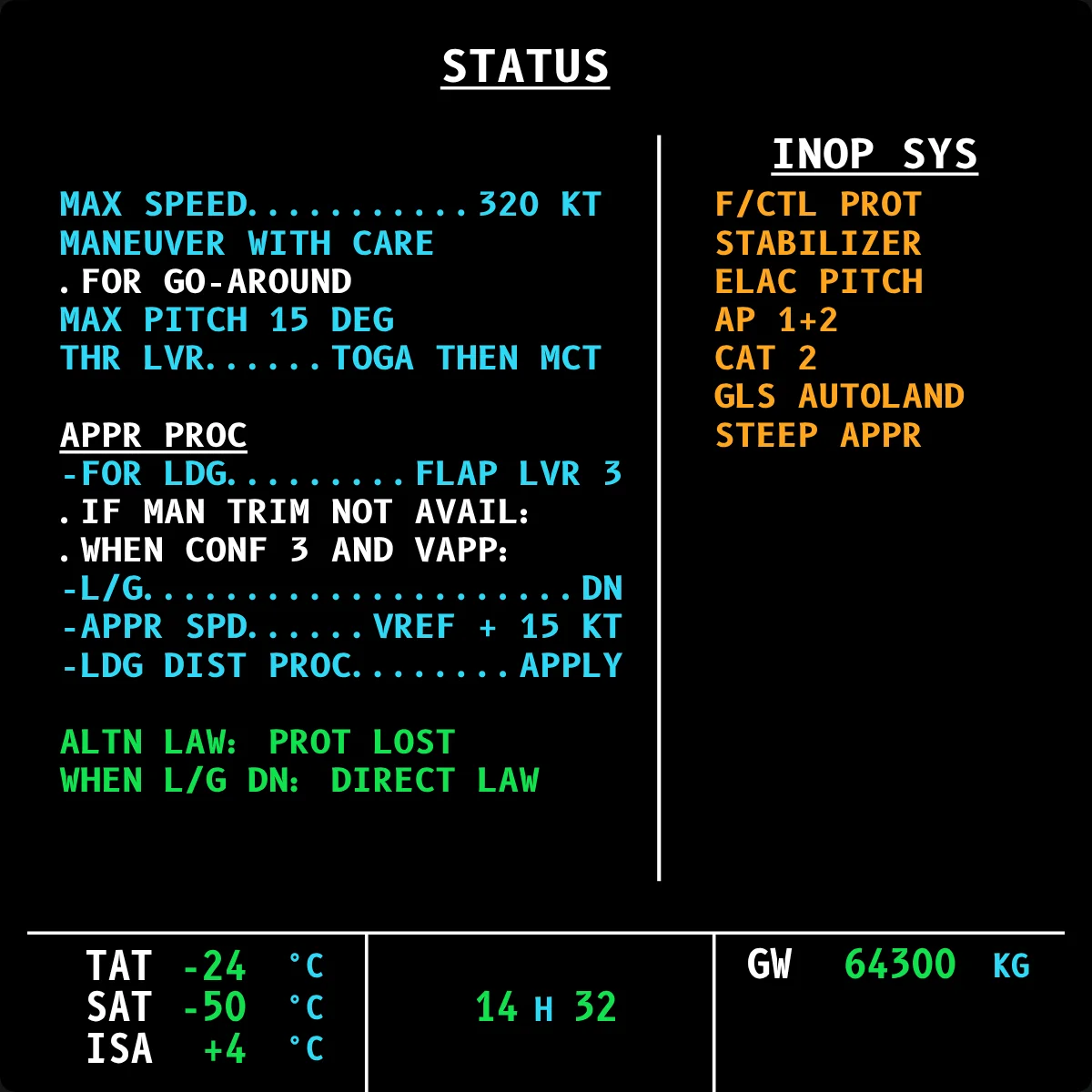
STATUS is the aircraft's operational summary. This version opens with MAX SPEED 320 KT and MANEUVER WITH CARE in blue and the go-around lines, then APPR PROC with the approach lines, and ALTN LAW: PROT LOST and WHEN L/G DN: DIRECT LAW in green.
The FOR LDG line becomes a reminder once configuration 3 is selected, and GPWS LDG FLAP 3 ON is displayed when the flaps are in configuration 3; neither applies in the cruise drawn.
The FCOM prints four versions of this STATUS. Two carry MANEUVER WITH CARE and the go-around lines, two do not; one reads FLAP LVR 3 and three USE FLAP 3; three give VREF + 15 KT and one VREF + 10 KT. The picture is one of them.
Which version applies depends on your aircraft: check your own FCOM.
Sources FCOM DSC-31-20 STATUS PAGE / FCOM PRO-ABN-F_CTL F/CTL
A319ceo, A320ceo, A320neo, A321neo: what differs?
| A319ceo, A320ceo | A320neo, A321neo | |
|---|---|---|
| The caution and its trigger | The same in every version | The same in every version |
| The procedure | Not given by type: one version adds MANEUVER WITH CARE and FOR GO-AROUND under IF MAN TRIM AVAIL; another has neither | Not given by type: one version adds MANEUVER WITH CARE and FOR GO-AROUND under IF MAN TRIM AVAIL; another has neither |
| STATUS | Not given by type: four versions; the go-around lines in two, FLAP LVR 3 in one, VREF + 10 KT in one | Not given by type: four versions; the go-around lines in two, FLAP LVR 3 in one, VREF + 10 KT in one |
Sources FCOM PRO-ABN-F_CTL F/CTL STABILIZER JAM / FCOM PRO-ABN-F_CTL F/CTL

Work F/CTL STABILIZER JAM as a crew
Read and do each line against the FCOM, with the E/WD, the SD page and the overhead following your hands, the PF and PM calls, and a debrief that says what you missed.
Work this failure in the ECAM TrainerGo further
Written in our own words from the FCOM and the FCTM; each part names the units it rests on. The E/WD, the STATUS and the live aircraft are the platform's own ECAM and systems model, the same the ECAM Trainer and the flight deck run. This page explains the procedure; it is not the procedure. Aircraft differ by type, engine and options: your aircraft's FCOM, your QRH and your operator's procedures always come first. How we write and check these pages.
Every ECAM procedure, line by line, against the FCOM.
The ECAM Trainer works 108 scenarios with the E/WD, the SD page and the overhead following your hands. Start free today, or open everything with A320 Knowledge+.
For study and revision only. Always follow your operator's approved documentation and procedures. A320 Knowledge is independent and not affiliated with Airbus.
Related
- F/CTL ELAC 1 FAULTAn amber caution for one of the two elevator aileron computers.
- F/CTL ELAC 2 FAULTAn amber caution for one of the two elevator aileron computers.
- F/CTL FLAPS FAULTAn amber caution for flaps that have lost both of their control channels.
- F/CTL FLAPS LOCKEDAn amber caution for flaps that the wingtip brakes have stopped.
- A320 flight controlsThe system guide, with the live aircraft
- Every ECAM procedureThe alerts the ECAM Trainer works, grouped by system