
F/CTL ELAC 1 FAULT
An amber caution for one of the two elevator aileron computers. Here is what ELAC 1 normally flies, what takes over when it fails, what the crew sees on the overhead and the F/CTL page, and what the reset and STATUS mean, with the live aircraft at the moment the caution comes on.
Written and checked by current A320 pilotschecked against the FCOM on Our editorial policy
What F/CTL ELAC 1 FAULT means
F/CTL ELAC 1 FAULT is an amber caution: elevator aileron computer 1 has failed, with its FAULT light on, or one sidestick transducer is faulty. ELAC 1 normally flies the ailerons, and ELAC 2 the elevators and the stabiliser. When ELAC 1 fails, the system transfers aileron control to ELAC 2 by itself.
The ECAM asks for a reset, ELAC 1 OFF then ON, and if that is unsuccessful, ELAC 1 OFF: its functions are then performed by the other ELAC. STATUS reads CAT 3 SINGLE ONLY, with fuel consumption increased and the FMS fuel predictions unreliable.
Sources FCOM PRO-ABN-F_CTL (ONE COMPUTER FAILED) / FCOM DSC-27-10-20 / FCOM PRO-ABN-F_CTL F/CTL ELAC 1(2) FAULT / FCOM PRO-ABN-F_CTL F/CTL
At a glance
- Level
- Amber caution, level 2: single chime, MASTER CAUT steady amber and, normally, the F/CTL page on the SD
- Sets it off
- A failure of ELAC 1, with its FAULT light on, or one faulty sidestick transducer
- Lights
- FAULT in amber in the ELAC 1 pushbutton on the overhead, except in some sidestick transducer cases; ELAC 1 in amber on the F/CTL page when it fails
- Takes over
- ELAC 2 takes the ailerons over by itself; it already flies the elevators and the stabiliser
- Procedure
- ELAC 1 OFF THEN ON to reset it; if unsuccessful, ELAC 1 OFF
- STATUS
- CAT 3 SINGLE ONLY, fuel consumption increased, FMS fuel predictions unreliable; ELAC 1 and CAT 3 DUAL inoperative
Sources FCOM DSC-31-10 WARNING/CAUTION CLASSIFICATION / FCOM DSC-31-30 ATTENTION GETTERS / FCOM DSC-31-20 SYSTEM PAGES / FCOM PRO-ABN-F_CTL (ONE COMPUTER FAILED) / FCOM DSC-27-20-30 OVERHEAD PANEL / FCOM DSC-27-20-30 ECAM F/CTL PAGE / FCOM PRO-ABN-F_CTL F/CTL ELAC 1(2) FAULT / FCOM DSC-27-10-20 / FCOM PRO-ABN-F_CTL F/CTL
What does ELAC 1 fly, and what takes over?
Seven computers process the pilots' and the autopilot's inputs: two ELACs (elevator aileron computers), three SECs (spoiler elevator computers) and two FACs (flight augmentation computers). The ELACs give normal elevator and stabiliser control and aileron control; the SECs give spoiler control and standby elevator and stabiliser control.
The two ELACs share the work. ELAC 1 normally controls the ailerons. ELAC 2 normally controls the elevators and the stabiliser, through the green jack on the left elevator, the yellow jack on the right and the stabiliser's electric motor 1. If ELAC 1 fails, the system transfers aileron control to ELAC 2 automatically.
Each aileron has two servojacks, a blue one and a green one, and one of them works at a time. The system selects their damping mode, where a jack simply follows the surface, if both ELACs fail or if blue and green are both at low pressure. One ELAC lost is neither case.
Each ELAC, while ON, performs normal pitch and roll, alternate pitch, direct pitch and roll, the abnormal attitude law, aileron droop and the acquisition of autopilot orders. The FCOM's law reconfiguration table has no row for one ELAC alone: its flight control rows start with both ELACs lost.
Sources FCOM DSC-27-10-10 COMPUTERS / FCOM DSC-27-10-20 / FCOM DSC-27-10-20 GENERAL ARCHITECTURE / FCOM DSC-27-20-30 OVERHEAD PANEL / FCOM DSC-27-20-20 FLIGHT CONTROLS LAW RECONFIGURATION
Who flies what, before and after
What does the crew see and hear?
A level 2 caution: a single chime, the MASTER CAUT light steady amber and the caution in amber on the E/WD, and the SD normally calls up the relevant system page by itself, here the F/CTL page.
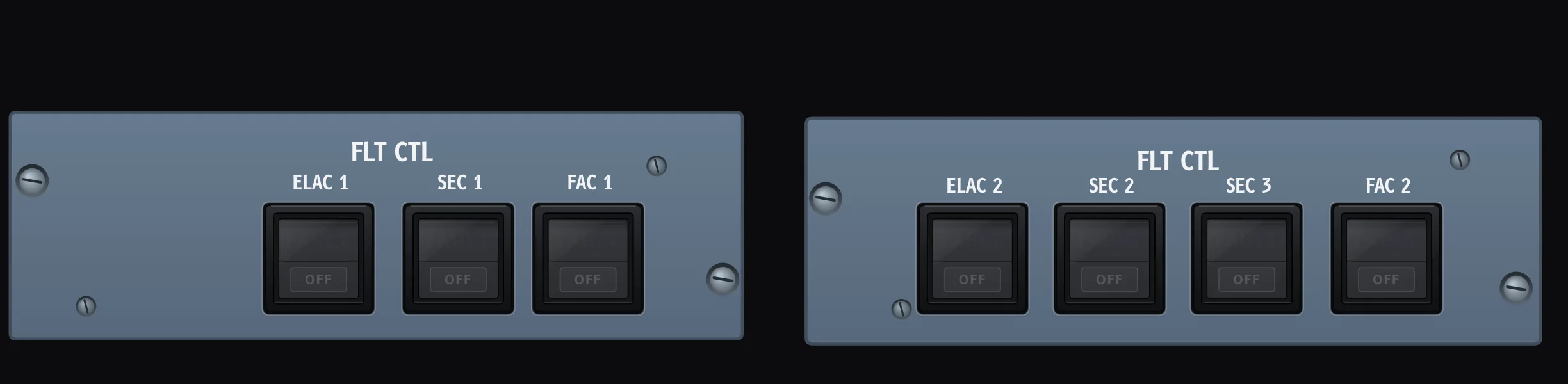
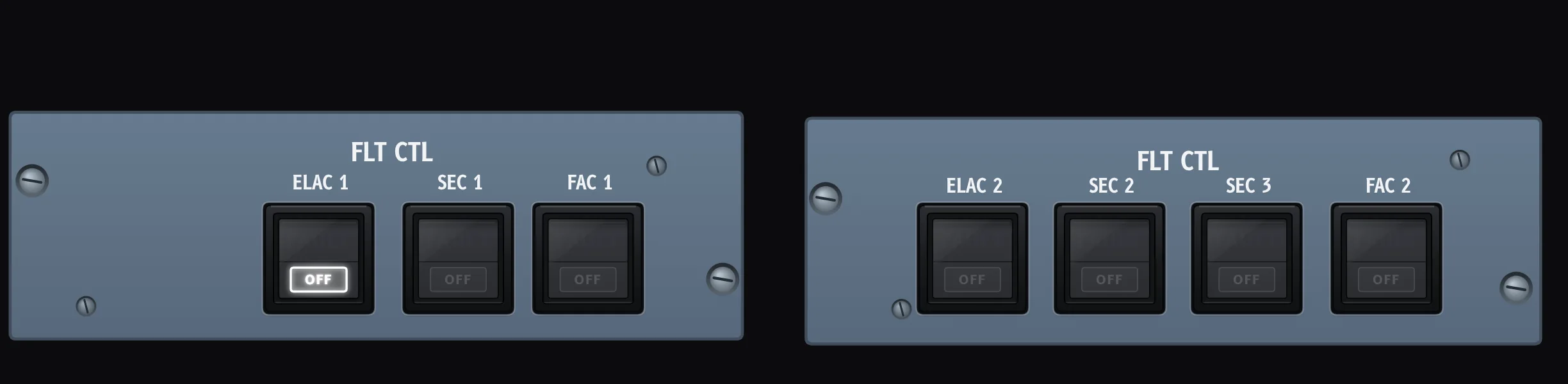
On the overhead FLT CTL panel, FAULT comes on amber in the ELAC 1 pushbutton when a failure is detected. It also comes on for the eight seconds of the ELAC's power-up test, which runs when electrical power is turned on or after an electrical transient longer than 25 ms.
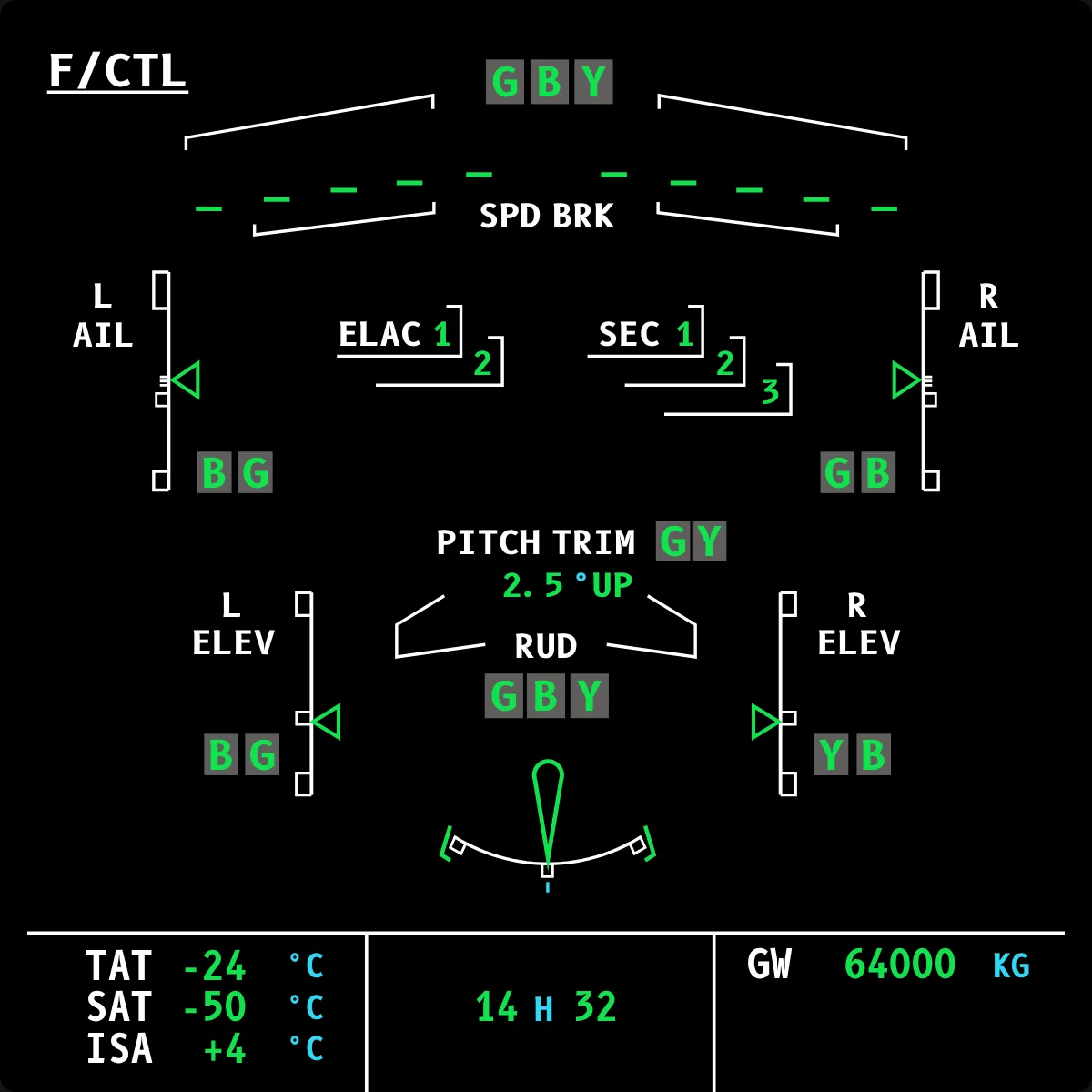
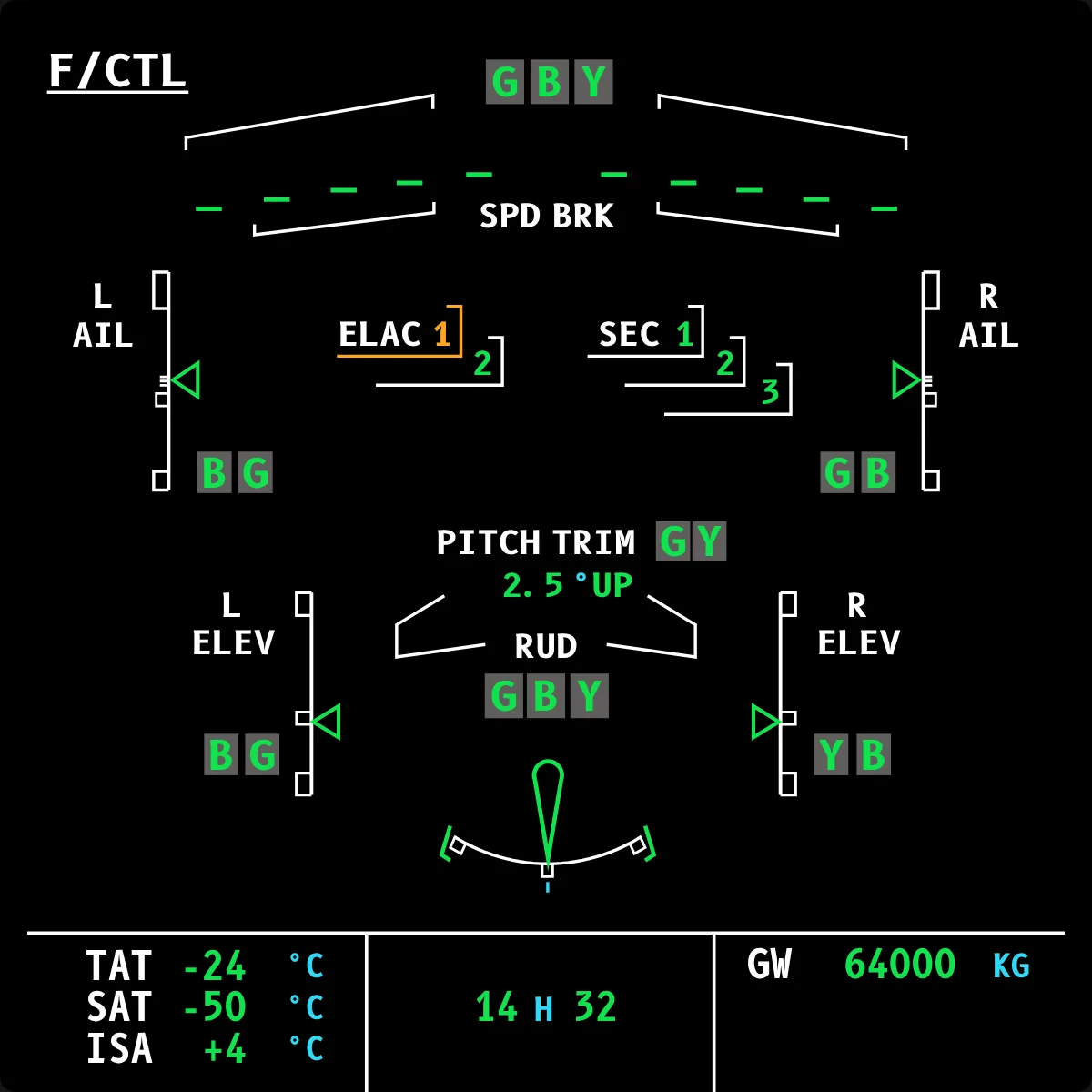
On the F/CTL page the ELAC and SEC labels stay white and each computer's number is normally green; ELAC 1's turns amber when it fails.
The procedure notes an exception: in some sidestick transducer failure cases, the caution comes without the procedure, and the pushbutton's FAULT light does not come on.
Sources FCOM DSC-31-10 WARNING/CAUTION CLASSIFICATION / FCOM DSC-31-30 ATTENTION GETTERS / FCOM DSC-31-20 SYSTEM PAGES / FCOM DSC-27-20-30 OVERHEAD PANEL / FCOM DSC-27-20-30 ECAM F/CTL PAGE / FCOM PRO-ABN-F_CTL F/CTL ELAC 1(2) FAULT
The moment the caution comes on
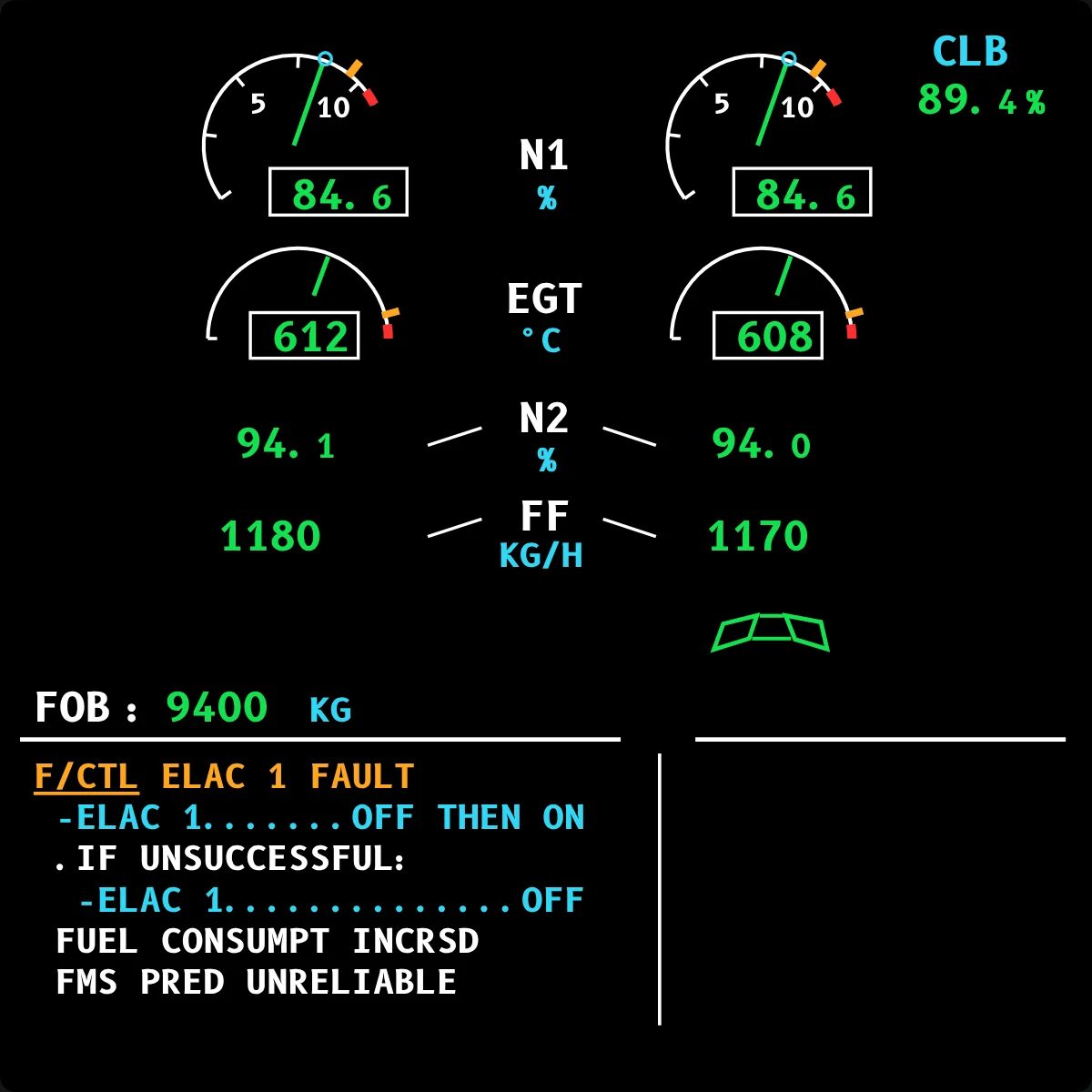
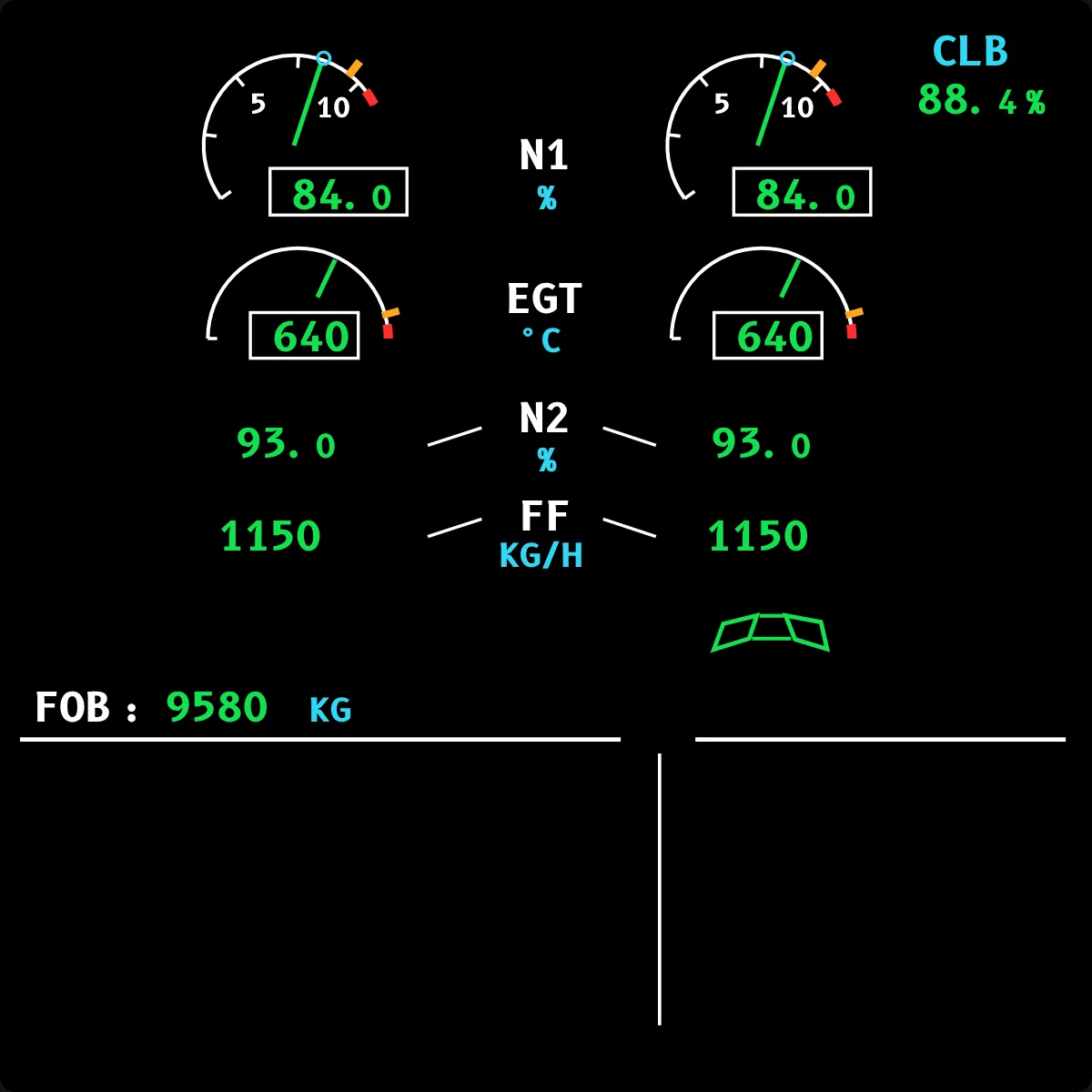
A healthy aircraft in the cruise, every flight control computer on. Press the button to fail ELAC 1, then look at the E/WD, the F/CTL page and the FLT CTL panel.
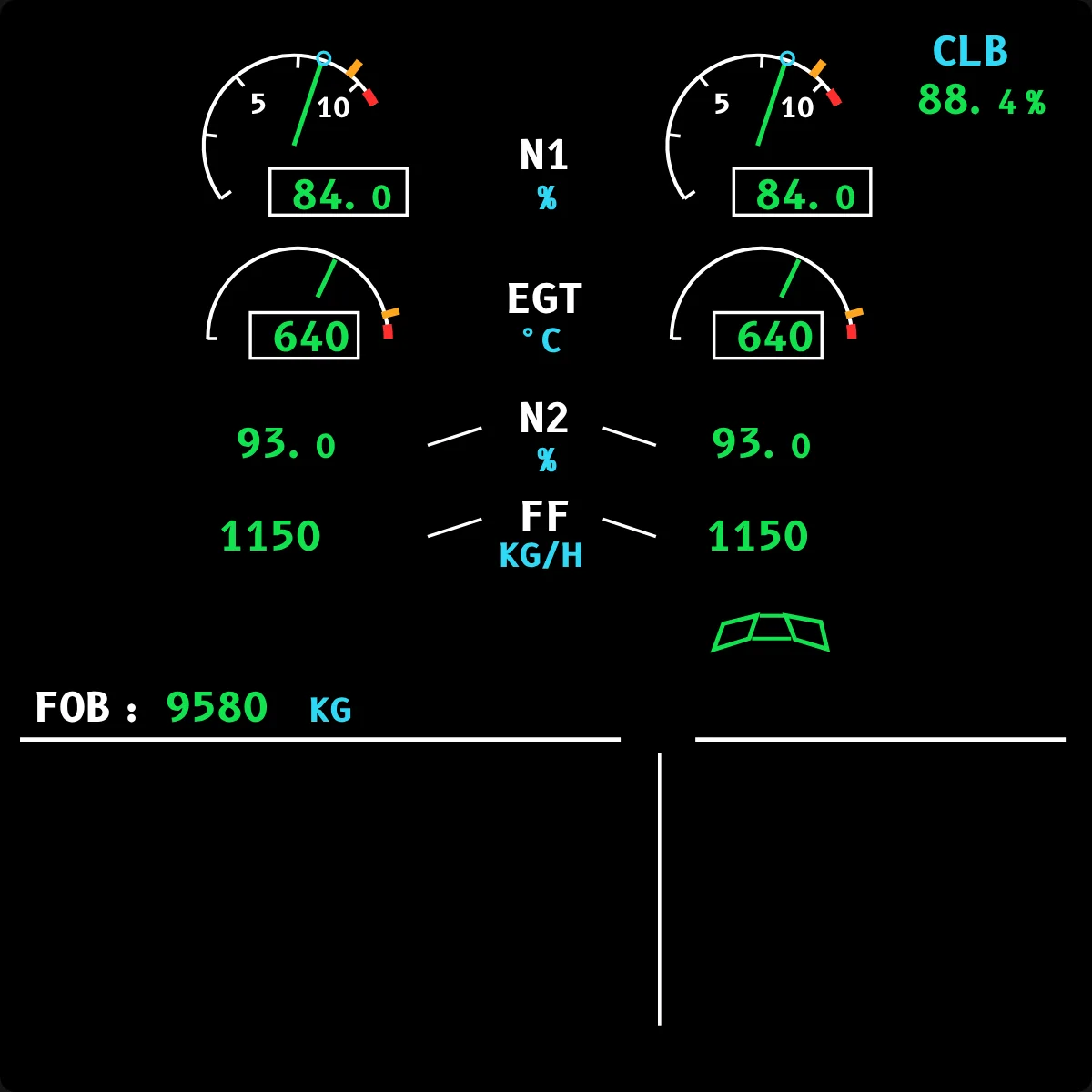
The alert Fail ELAC 1
The E/WD shows F/CTL ELAC 1 FAULT in amber with ELAC 1 OFF THEN ON, then under IF UNSUCCESSFUL, ELAC 1 OFF, and the remarks FUEL CONSUMPT INCRSD and FMS PRED UNRELIABLE. FAULT is lit in the ELAC 1 pushbutton, and ELAC 1's number is amber on the F/CTL page.
The aileron indexes stay green: the FCOM turns one amber when neither of its servojacks is available, and ELAC 2 has taken the ailerons. Working the lines is what the ECAM Trainer does with you.
Sources FCOM PRO-ABN-F_CTL F/CTL ELAC 1(2) FAULT / FCOM DSC-27-20-30 OVERHEAD PANEL / FCOM DSC-27-20-30 ECAM F/CTL PAGE / FCOM DSC-27-10-20
What does switching ELAC 1 off and on do?
The ELAC pushbutton has two positions. At OFF the computer is not active, and switching it OFF then ON resets it. Its FAULT light goes off when the pilot selects OFF, or at the end of the power-up test if the results are satisfactory.
That is the procedure's first line, ELAC 1 OFF THEN ON. If the reset is unsuccessful, ELAC 1 goes OFF, and the FCOM's comment under that line is that its functions are performed by the other ELAC.
On the overhead, the PM points to the panel and the control and announces the system, the control or reset, and the action: the PF is kept informed, and the risk of operating the wrong control is reduced. After the action, the PM checks the SD page to confirm it was done: here, the F/CTL page.
One note in the procedure names ELAC 1 alone: if ELAC 1 is reset on the ground, the pitch trim returns to its ground setting, 0°. The FCOM gives no reason.
In the block below, ELAC 1 is already off after an unsuccessful reset. Add a second failure to see what one ELAC fewer leaves.
Sources FCOM DSC-27-20-30 OVERHEAD PANEL / FCOM PRO-ABN-F_CTL F/CTL ELAC 1(2) FAULT / FCTM AOP-30-20 HANDLING OVERHEAD PANEL CONTROL
ELAC 1 off, then a second failure
ELAC 1 has failed, its reset did not work, and it is OFF: its OFF light is on and ELAC 2 is the one ELAC working. Press one failure at a time: the first draws its caution and the F/CTL page; the second has no E/WD of its own, and gives what the FCOM says.
The alert Then lose green
The E/WD shows the green reservoir caution. On the F/CTL page every G turns amber and ELAC 1 is still amber. The drawing also shows spoilers 1 and 5, on green, as failed retracted on both wings: that is the drawing's own reading. The FCOM says a spoiler that loses hydraulic pressure keeps the deflection it had, or less if aerodynamic forces push it down.
The drawing shows the hydraulics only. Every version of the FCOM's law reconfiguration table gives ELAC 1 with green lost, and ELAC 1 with yellow lost, the same row: pitch alternate law with reduced protection, roll direct, yaw alternate. With ELAC 1 off, ELAC 2 controls the elevators through the green and yellow jacks.
Sources FCOM PRO-ABN-HYD HYD G RSVR LO LVL / FCOM DSC-27-10-20 GENERAL ARCHITECTURE / FCOM DSC-27-20-30 ECAM F/CTL PAGE / FCOM DSC-27-10-20 / FCOM DSC-27-20-20 FLIGHT CONTROLS LAW RECONFIGURATION
Failure Then ELAC 2 fails too
No E/WD is drawn for this one. What follows is the FCOM's answer, not the drawing's.
With both ELACs lost the ailerons revert to damping mode and pitch passes to SEC 1 or SEC 2 with the stabiliser's motor 2 or 3. Every version of the table gives the same row for it: pitch alternate law with reduced protection, roll direct, yaw alternate. The FCOM handles both computers failed as a second case of this alert, with its own procedure.
Sources FCOM DSC-27-10-20 / FCOM DSC-27-20-20 FLIGHT CONTROLS LAW RECONFIGURATION / FCOM PRO-ABN-F_CTL (BOTH COMPUTERS FAILED)
What do the remarks and CAT 3 SINGLE ONLY mean?
FUEL CONSUMPT INCRSD is triggered when a failure, or a combination of failures, affects the aircraft's nominal aerodynamic characteristics. FMS PRED UNRELIABLE goes with it: the crew disregards the FMS fuel predictions and finds the fuel penalty factor that applies in the QRH.
Each FMGC computes the landing category, from CAT 1 to CAT 3 DUAL, from the aircraft systems and functions available, and the FMA shows it once the APPR pushbutton is pushed. When the landing capability downgrades, a triple click sounds.
CAT 3 DUAL is fail-operational: after a failure below alert height, the remaining automatic system completes the approach, flare and landing. CAT 3 SINGLE is fail-passive: a failure leaves no significant out-of-trim condition or flight path deviation, but the landing is not completed automatically and the pilot takes control.
The FCOM gives no reason why one ELAC lost removes CAT 3 DUAL; STATUS lists it as inoperative.
Sources FCOM PRO-ABN-F_CTL F/CTL / FCOM PRO-NOR-SRP-01-70 LANDING CATEGORIES / FCOM DSC-22_30-80-30-10 LANDING CAPABILITIES
What does the aircraft have left?
With ELAC 1 off, ELAC 2 alone controls the ailerons, the elevators and the stabiliser. The SECs keep the spoilers, and SEC 1 and SEC 2 hold the alternate and direct pitch functions behind the ELACs.
What comes next depends on the next failure. ELAC 2 as well: the ailerons go to damping mode, pitch passes to the SECs and the law becomes alternate. Green or yellow as well: the table gives alternate law, with ELAC 2 still working.
Sources FCOM PRO-ABN-F_CTL F/CTL ELAC 1(2) FAULT / FCOM DSC-27-10-20 / FCOM DSC-27-20-30 OVERHEAD PANEL / FCOM DSC-27-20-20 FLIGHT CONTROLS LAW RECONFIGURATION
One ELAC lost, and what the next failure does
What is lost afterwards?
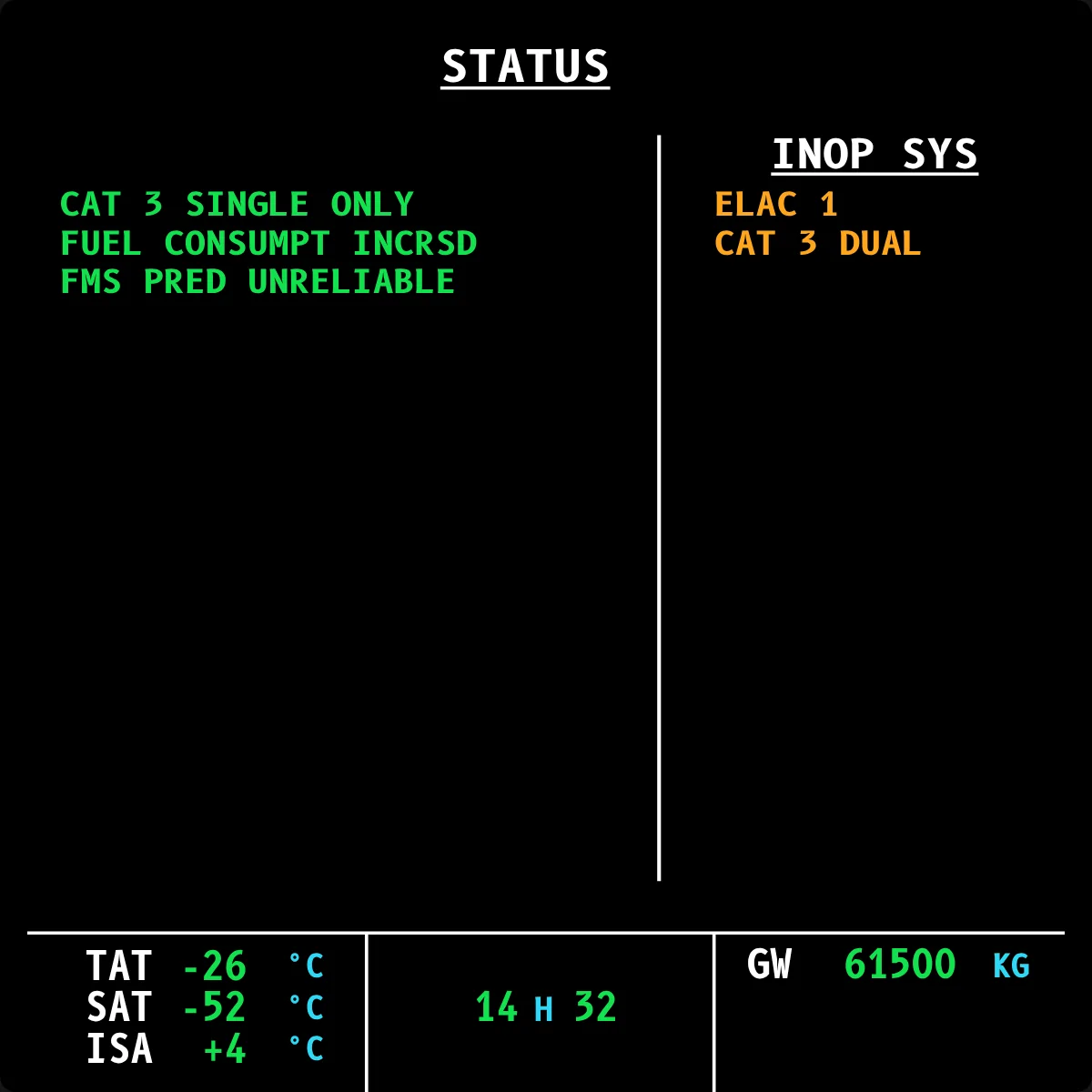
STATUS is the aircraft's operational summary. After this caution it reads CAT 3 SINGLE ONLY, FUEL CONSUMPT INCRSD and FMS PRED UNRELIABLE, with ELAC 1 and CAT 3 DUAL under INOP SYS in amber.
The FCOM prints CAT 3 SINGLE ONLY and FMS PRED UNRELIABLE in green, as information, and FUEL CONSUMPT INCRSD in blue; our picture draws all three in green.
The FCOM prints one STATUS for this caution, for all aircraft, and the same procedure.
Sources FCOM DSC-31-20 STATUS PAGE / FCOM PRO-ABN-F_CTL F/CTL / FCOM PRO-ABN-F_CTL F/CTL ELAC 1(2) FAULT
A319ceo, A320ceo, A320neo, A321neo: what differs?
| A319ceo, A320ceo | A320neo, A321neo | |
|---|---|---|
| The caution, its procedure and STATUS | The same in every version | The same in every version |
| Aileron droop, an ELAC function, with the flaps extended | The ailerons extend 5° down | 5° down on the A320neo; on the A321neo 10° in configuration 1+F and 5° in the others |
Sources FCOM PRO-ABN-F_CTL (ONE COMPUTER FAILED) / FCOM PRO-ABN-F_CTL F/CTL ELAC 1(2) FAULT / FCOM PRO-ABN-F_CTL F/CTL / FCOM DSC-27-10-20 ROLL CONTROL / FCOM DSC-27-10-20 / FCOM DSC-27-20-30 ECAM F/CTL PAGE

Work F/CTL ELAC 1 FAULT as a crew
Read and do each line against the FCOM, with the E/WD, the SD page and the overhead following your hands, the PF and PM calls, and a debrief that says what you missed.
Work this failure in the ECAM TrainerGo further
Written in our own words from the FCOM and the FCTM; each part names the units it rests on. The E/WD, the STATUS and the live aircraft are the platform's own ECAM and systems model, the same the ECAM Trainer and the flight deck run. This page explains the procedure; it is not the procedure. Aircraft differ by type, engine and options: your aircraft's FCOM, your QRH and your operator's procedures always come first. How we write and check these pages.
Every ECAM procedure, line by line, against the FCOM.
The ECAM Trainer works 108 scenarios with the E/WD, the SD page and the overhead following your hands. Start free today, or open everything with A320 Knowledge+.
For study and revision only. Always follow your operator's approved documentation and procedures. A320 Knowledge is independent and not affiliated with Airbus.
Related
- F/CTL ELAC 2 FAULTAn amber caution for one of the two elevator aileron computers.
- F/CTL FLAPS FAULTAn amber caution for flaps that have lost both of their control channels.
- F/CTL FLAPS LOCKEDAn amber caution for flaps that the wingtip brakes have stopped.
- F/CTL L AIL FAULTAn amber caution for one aileron, not for a computer: both of its servojacks are lost.
- A320 flight controlsThe system guide, with the live aircraft
- Every ECAM procedureThe alerts the ECAM Trainer works, grouped by system