
F/CTL L AIL FAULT
An amber caution for one aileron, not for a computer: both of its servojacks are lost. Here is how an aileron is driven, what the crew sees on the F/CTL page, what the two remarks mean and what is left for roll, with the live aircraft at the moment the caution comes on.
Written and checked by current A320 pilotschecked against the FCOM on Our editorial policy
What F/CTL L AIL FAULT means
F/CTL L AIL FAULT is an amber caution: both servojacks on the left aileron are lost. Each aileron has two electrically controlled hydraulic servojacks, one working at a time, and a computer, ELAC 1 or ELAC 2, controlling them. One aileron and four spoilers on each wing control the aircraft about the roll axis.
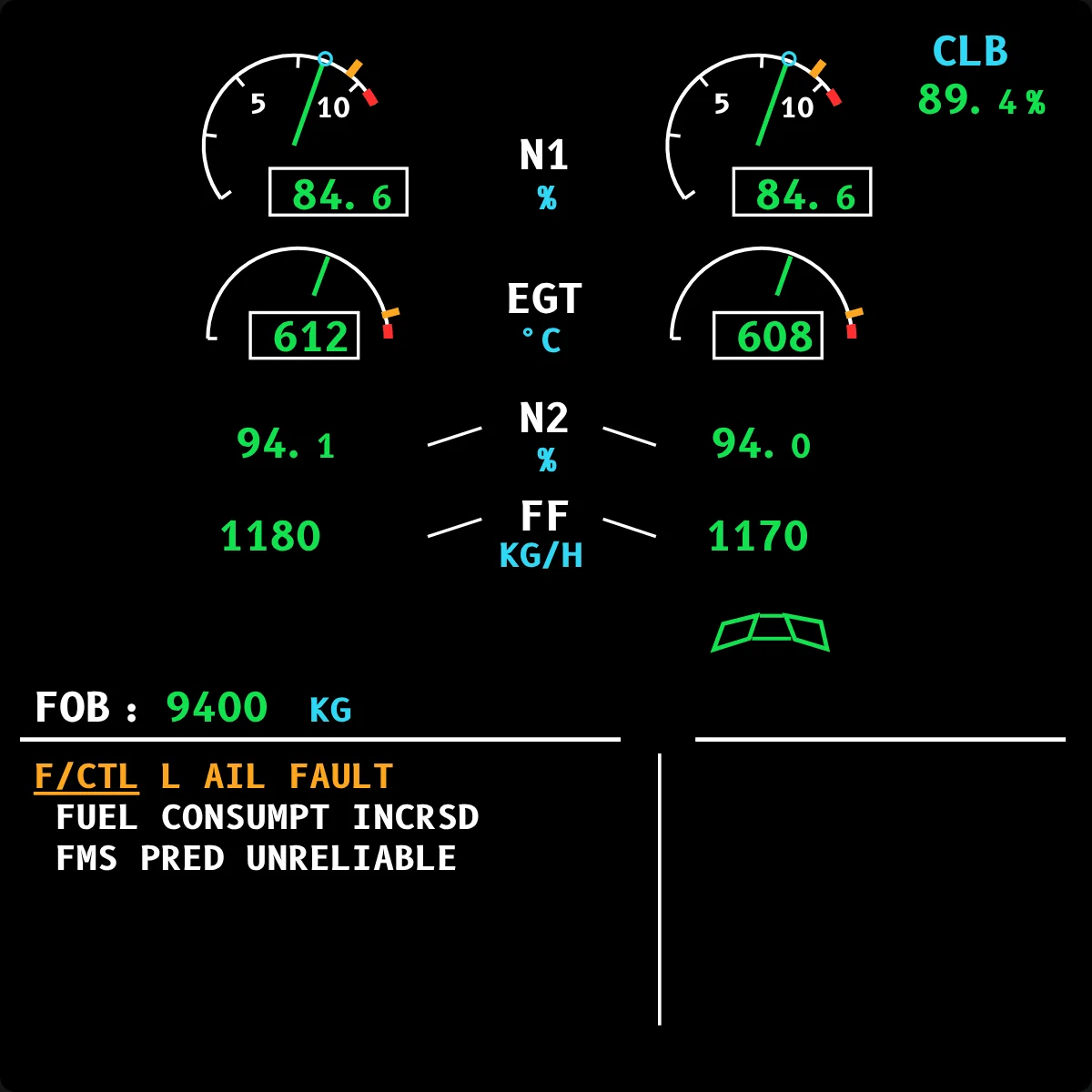
The procedure is crew awareness: nothing to press, two remarks to read, FUEL CONSUMPT INCRSD and FMS PRED UNRELIABLE. STATUS repeats them and lists the left aileron as inoperative.
Sources FCOM PRO-ABN-F_CTL F/CTL L(R) AIL FAULT / FCOM DSC-27-10-20 / FCOM DSC-27-10-20 ROLL CONTROL / FCOM PRO-ABN-F_CTL F/CTL
At a glance
- Level
- Amber caution, level 2: single chime, MASTER CAUT steady amber and, normally, the F/CTL page on the SD
- Sets it off
- Both servojacks lost on one aileron, here the left one
- F/CTL page
- The left aileron's index in amber: neither its green nor its blue servojack is available
- Procedure
- Crew awareness, with two remarks: FUEL CONSUMPT INCRSD and FMS PRED UNRELIABLE
- STATUS
- FUEL CONSUMPT INCRSD and FMS PRED UNRELIABLE; L AIL inoperative
Sources FCOM DSC-31-10 WARNING/CAUTION CLASSIFICATION / FCOM DSC-31-30 ATTENTION GETTERS / FCOM DSC-31-20 SYSTEM PAGES / FCOM PRO-ABN-F_CTL F/CTL L(R) AIL FAULT / FCOM DSC-27-20-30 ECAM F/CTL PAGE / FCOM PRO-ABN-F_CTL F/CTL
How is an aileron driven, and what has failed?
The ailerons are electrically controlled and, like every flight control surface, hydraulically actuated. Their maximum deflection is 25°, and there is no manual switch for trimming them.
Each aileron has two electrically controlled hydraulic servojacks, a blue one and a green one, and one of them works at a time. Each servojack has two modes: active, its position controlled electrically, and damping, where it follows the surface's movement.
ELAC 1 normally controls the ailerons. If ELAC 1 fails, the system transfers aileron control to ELAC 2 by itself, and if both ELACs fail, the ailerons revert to damping mode. The system also selects damping mode if blue and green are both at low pressure.
This caution is about the surface's actuators: it triggers when there is a loss of both servojacks on one aileron. One servojack lost on one aileron is a caution of its own, F/CTL AIL SERVO FAULT. The FCOM names no single cause for losing both.
Sources FCOM DSC-27-10-10 CONTROL SURFACES / FCOM DSC-27-10-10 COCKPIT CONTROLS / FCOM DSC-27-10-20 ROLL CONTROL / FCOM DSC-27-10-20 / FCOM DSC-27-10-20 GENERAL ARCHITECTURE / FCOM PRO-ABN-F_CTL F/CTL L(R) AIL FAULT / FCOM PRO-ABN-F_CTL F/CTL AIL SERVO FAULT
One aileron, two servojacks
What does the crew see and hear?
A level 2 caution: a single chime, the MASTER CAUT light steady amber and the caution in amber on the E/WD, and the SD normally calls up the relevant system page by itself, here the F/CTL page.
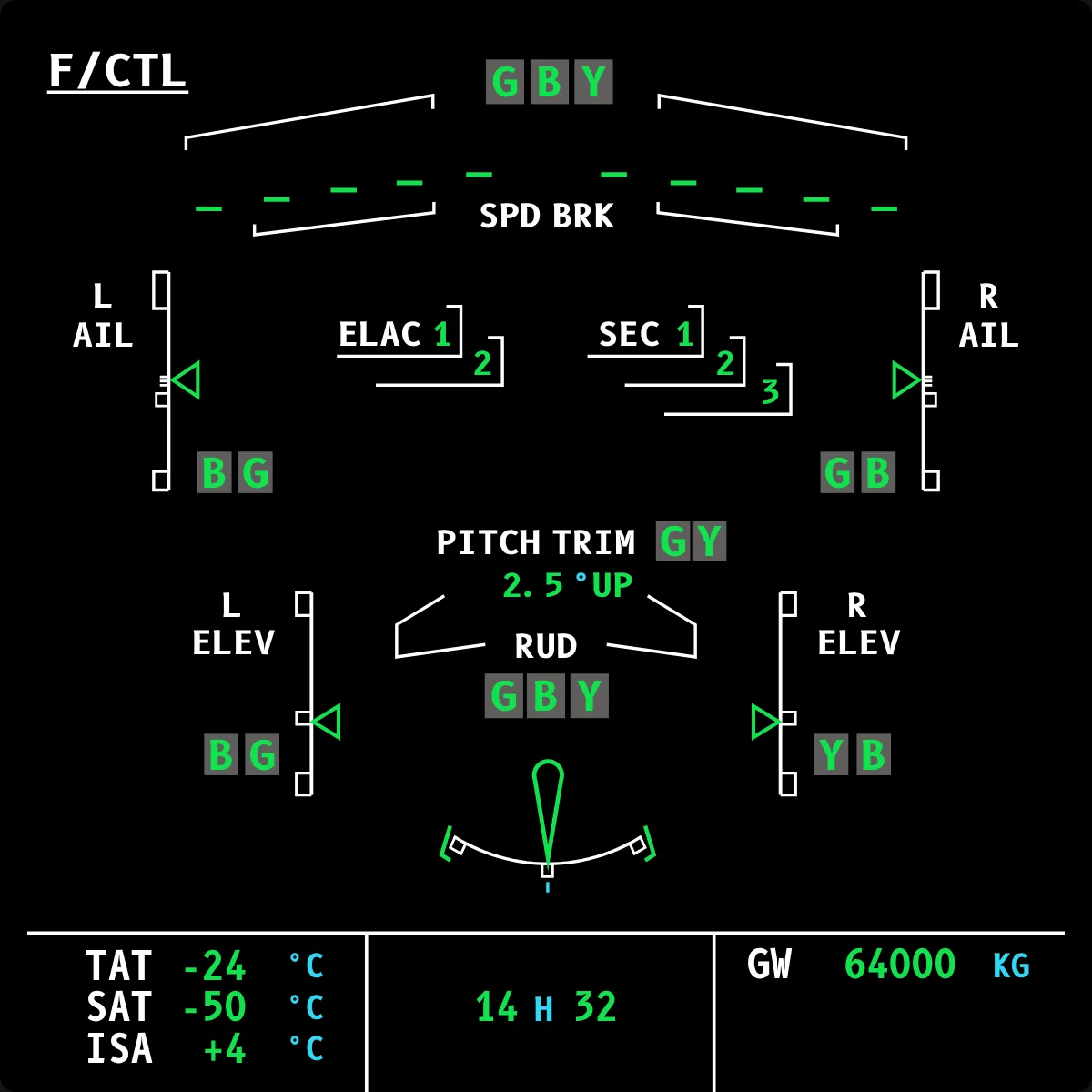
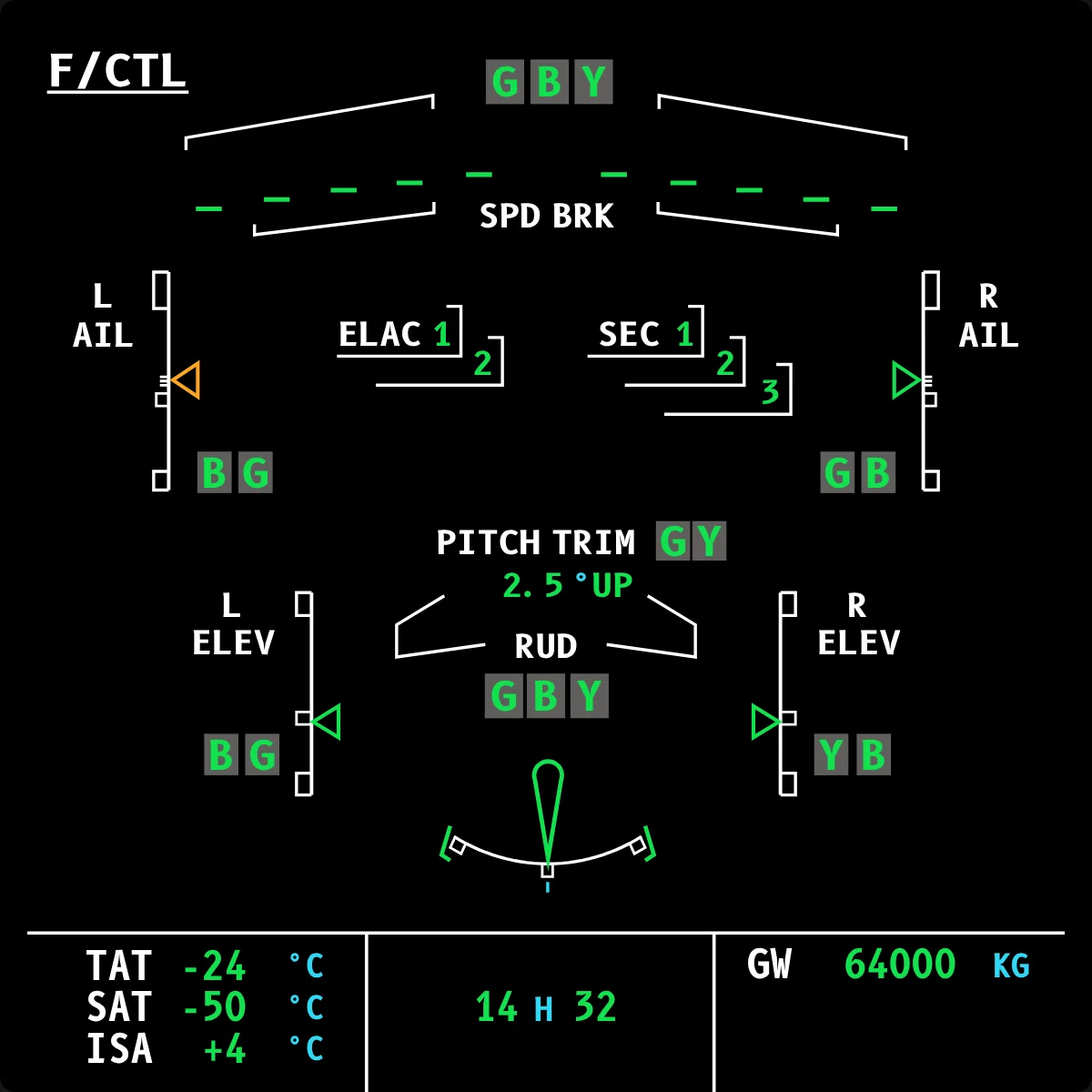
On the F/CTL page each aileron has a white scale and a green index, and the index turns amber when neither its green nor its blue servojack is available. Under it, the actuator letters B and G turn amber on a blue or green low pressure.
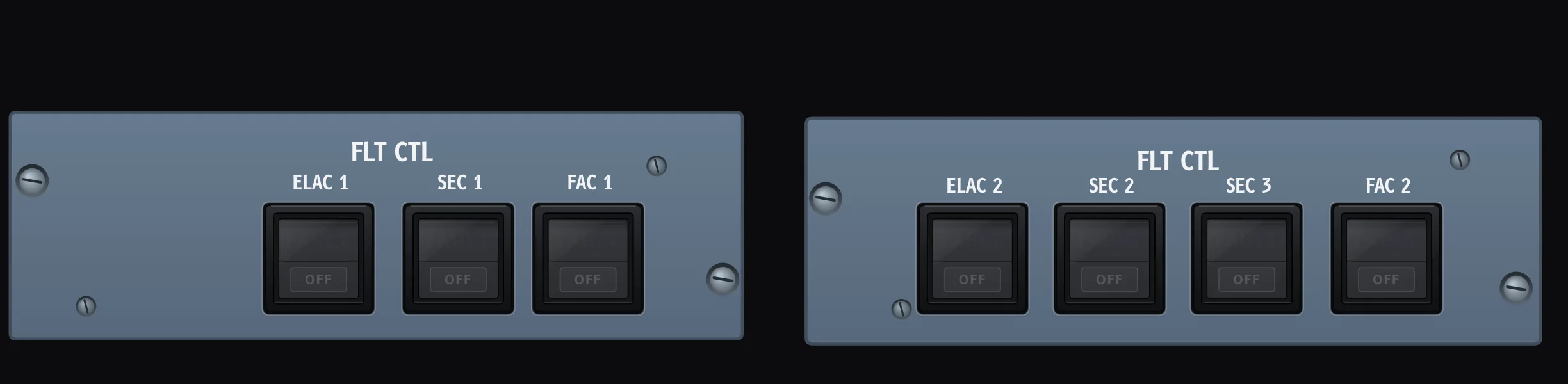
The overhead FLT CTL panel's FAULT lights belong to the computers, the ELACs, SECs and FACs, and the procedure names no pushbutton.
Sources FCOM DSC-31-10 WARNING/CAUTION CLASSIFICATION / FCOM DSC-31-30 ATTENTION GETTERS / FCOM DSC-31-20 SYSTEM PAGES / FCOM DSC-27-20-30 ECAM F/CTL PAGE / FCOM DSC-27-20-30 OVERHEAD PANEL / FCOM PRO-ABN-F_CTL F/CTL
The moment the caution comes on
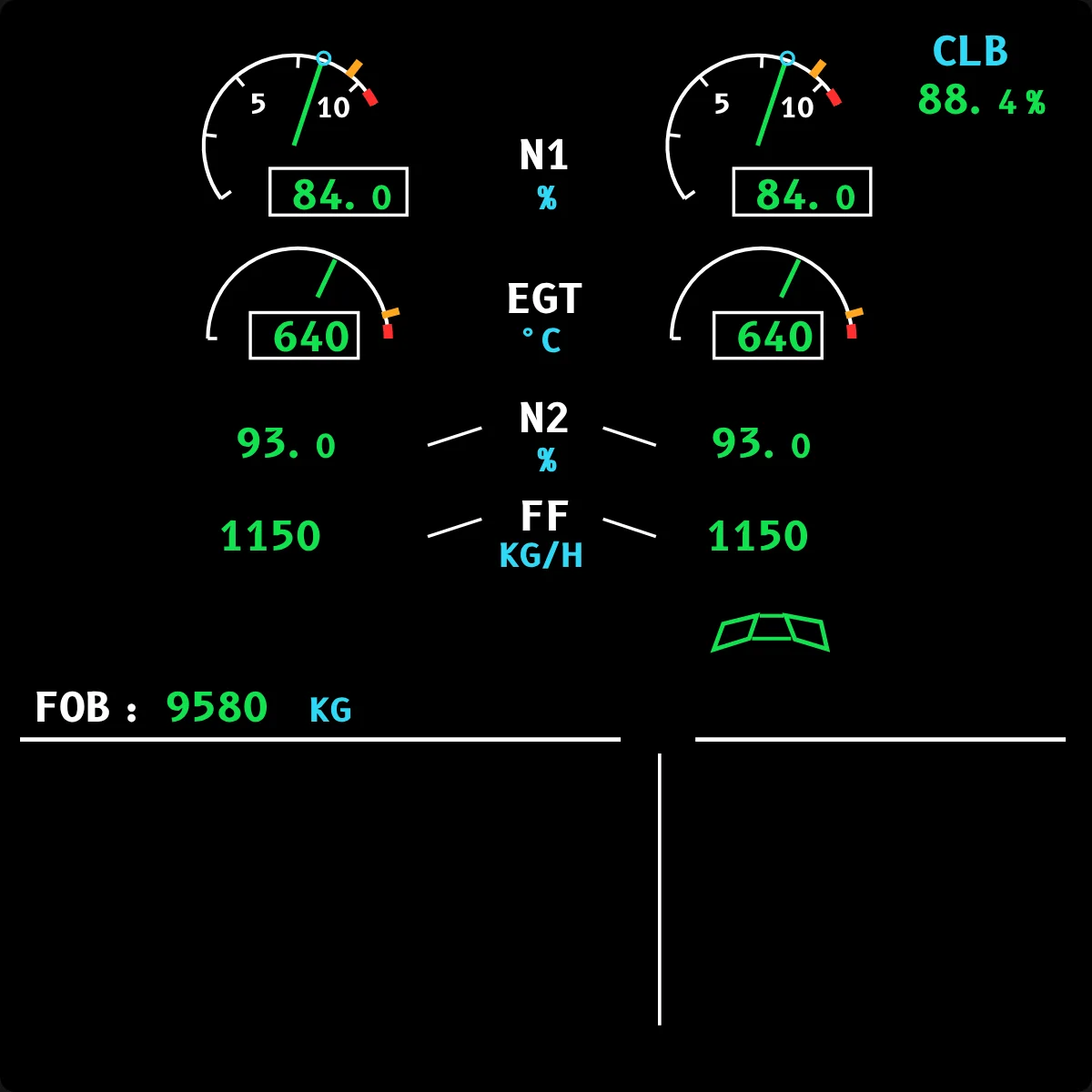
A healthy aircraft in the cruise, every flight control computer on. Press the button to lose the left aileron, then look at the E/WD, the F/CTL page and the FLT CTL panel.
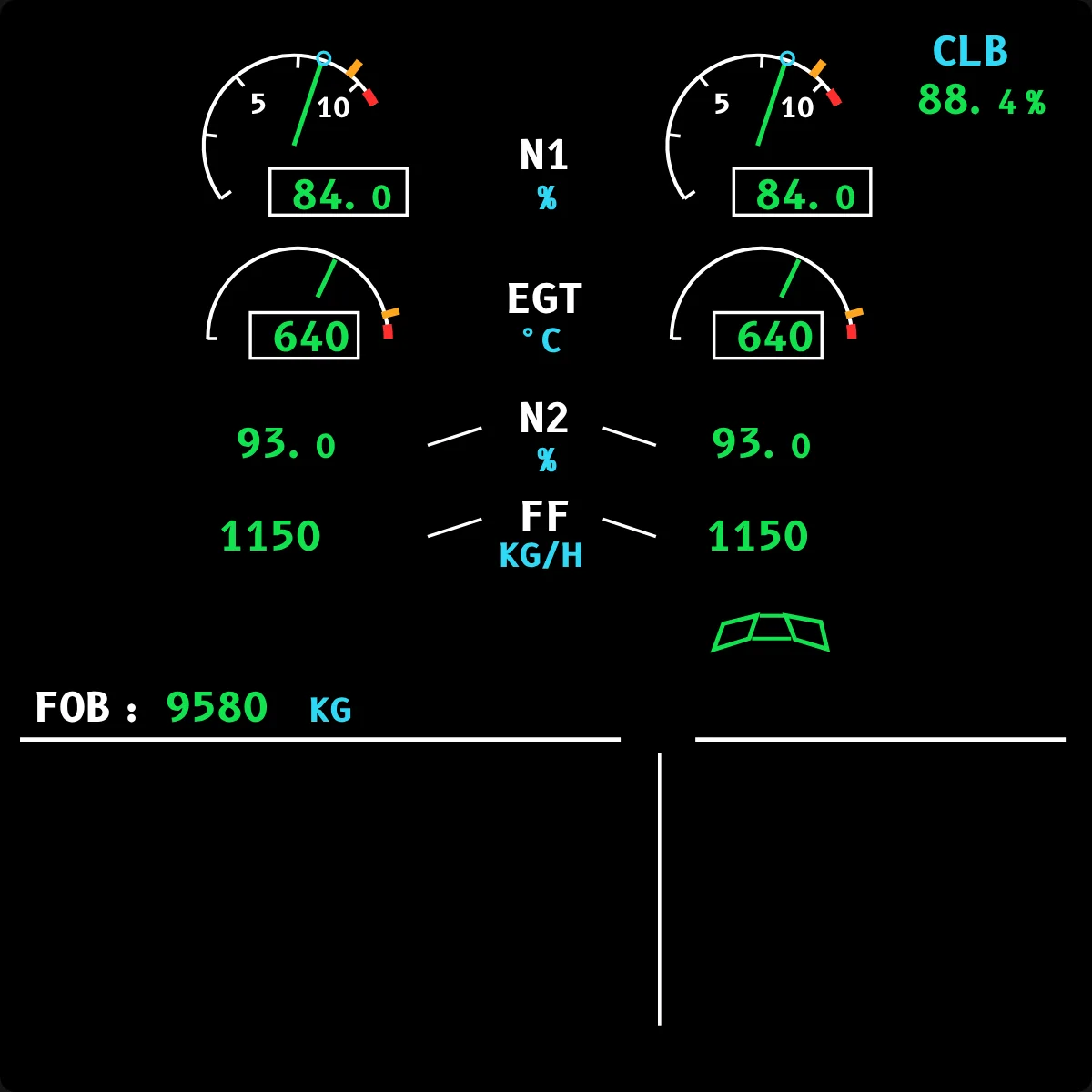
The alert Lose the left aileron
The E/WD shows F/CTL L AIL FAULT in amber with two remarks, FUEL CONSUMPT INCRSD and FMS PRED UNRELIABLE, and no line to act on. On the F/CTL page the left aileron's index turns amber.
The drawing lights nothing on the FLT CTL panel, whose FAULT lights are the computers'. The FCOM prints the two remarks in blue; our E/WD draws them in white. Reading them is what the ECAM Trainer does with you.
Sources FCOM PRO-ABN-F_CTL F/CTL / FCOM DSC-27-20-30 ECAM F/CTL PAGE / FCOM DSC-27-20-30 OVERHEAD PANEL
What still controls the aircraft in roll?
One aileron and four spoilers on each wing control the aircraft about the roll axis: spoilers 2, 3, 4 and 5, driven by the SECs. SEC 3 controls spoiler 2, SEC 1 spoilers 3 and 4, and SEC 2 spoiler 5.
The FCOM's law reconfiguration table has no row for one aileron. Its row is ELAC 1 and 2, or both ailerons, lost: alternate law with reduced protection in pitch and direct law in roll. The procedure for one aileron names no law at all; it is crew awareness.
Roll direct law normally uses only the ailerons and spoilers 4 and 5, to limit the roll rate. If the ailerons have failed, all the roll spoilers become active.
In the block below, the left aileron is already lost. Add a second failure to see what takes the other one.
Sources FCOM DSC-27-10-20 ROLL CONTROL / FCOM DSC-27-10-20 / FCOM DSC-27-20-20 FLIGHT CONTROLS LAW RECONFIGURATION / FCOM PRO-ABN-F_CTL F/CTL / FCOM DSC-27-20-20 DIRECT LAW
Roll with the left aileron lost
The left aileron lost, then a second failure
The left aileron is lost and its index is amber on the F/CTL page. Press one failure at a time: the first draws its alert and the F/CTL page, the second gives the FCOM's answer.
The alert Then lose blue and green
The E/WD shows the HYD G+B SYS LO PR warning. On the F/CTL page the B and G letters under both ailerons turn amber, and the right aileron's index turns amber too: its two servojacks are blue and green.
In the FCOM, blue and green both at low pressure send the ailerons' servojacks to damping mode, and the law table gives alternate law without reduced protection in pitch and direct law in roll.
Sources FCOM PRO-ABN-HYD HYD G+B SYS LO PR / FCOM DSC-27-20-30 ECAM F/CTL PAGE / FCOM DSC-27-10-20 GENERAL ARCHITECTURE / FCOM DSC-27-10-20 / FCOM DSC-27-20-20 FLIGHT CONTROLS LAW RECONFIGURATION
Failure Then lose the right aileron
No E/WD is drawn for this one. What follows is the FCOM's answer, not the drawing's.
With both ailerons lost, the law table gives alternate law with reduced protection in pitch and direct law in roll, and roll direct law makes all the roll spoilers active. The mechanical backup, with the rudder pedals for lateral control, is for a wider loss: among other cases, the total loss of ailerons and spoilers.
Sources FCOM DSC-27-20-20 FLIGHT CONTROLS LAW RECONFIGURATION / FCOM DSC-27-20-20 DIRECT LAW / FCOM DSC-27-20-20 MECHANICAL BACK-UP
What do the two remarks mean?
FUEL CONSUMPT INCRSD is triggered when a failure, or a combination of failures, affects the aircraft's nominal aerodynamic characteristics. FMS PRED UNRELIABLE goes with it: the crew disregards the FMS fuel predictions and finds the fuel penalty factor that applies in the QRH.
That is the whole procedure: the words crew awareness and the two remarks, with no action line. The FCOM gives no reason beyond the remark's own explanation.
The two remarks keep their place on STATUS, so they stay in front of the crew after the E/WD is cleared. STATUS appears by itself when the crew clears the last alert and the page is not empty.
Sources FCOM PRO-ABN-F_CTL F/CTL / FCOM DSC-31-20 STATUS PAGE
What does it change for the landing?
STATUS gives this caution no approach procedure and no landing correction: the two remarks, and the left aileron under INOP SYS.
One system design fact concerns the runway. With the ground spoilers fully extended, the ailerons are fully extended too, aileron anti droop where fitted, provided one aileron servocontrol is available on each side, the flaps are not clean, the pitch attitude is below 2.5°, the aircraft is flown manually and in normal law only.
The procedure and STATUS do not mention that condition for this caution; the FCOM gives it in the description of the ground spoilers only.
Sources FCOM PRO-ABN-F_CTL F/CTL / FCOM DSC-27-10-20
What is lost afterwards?
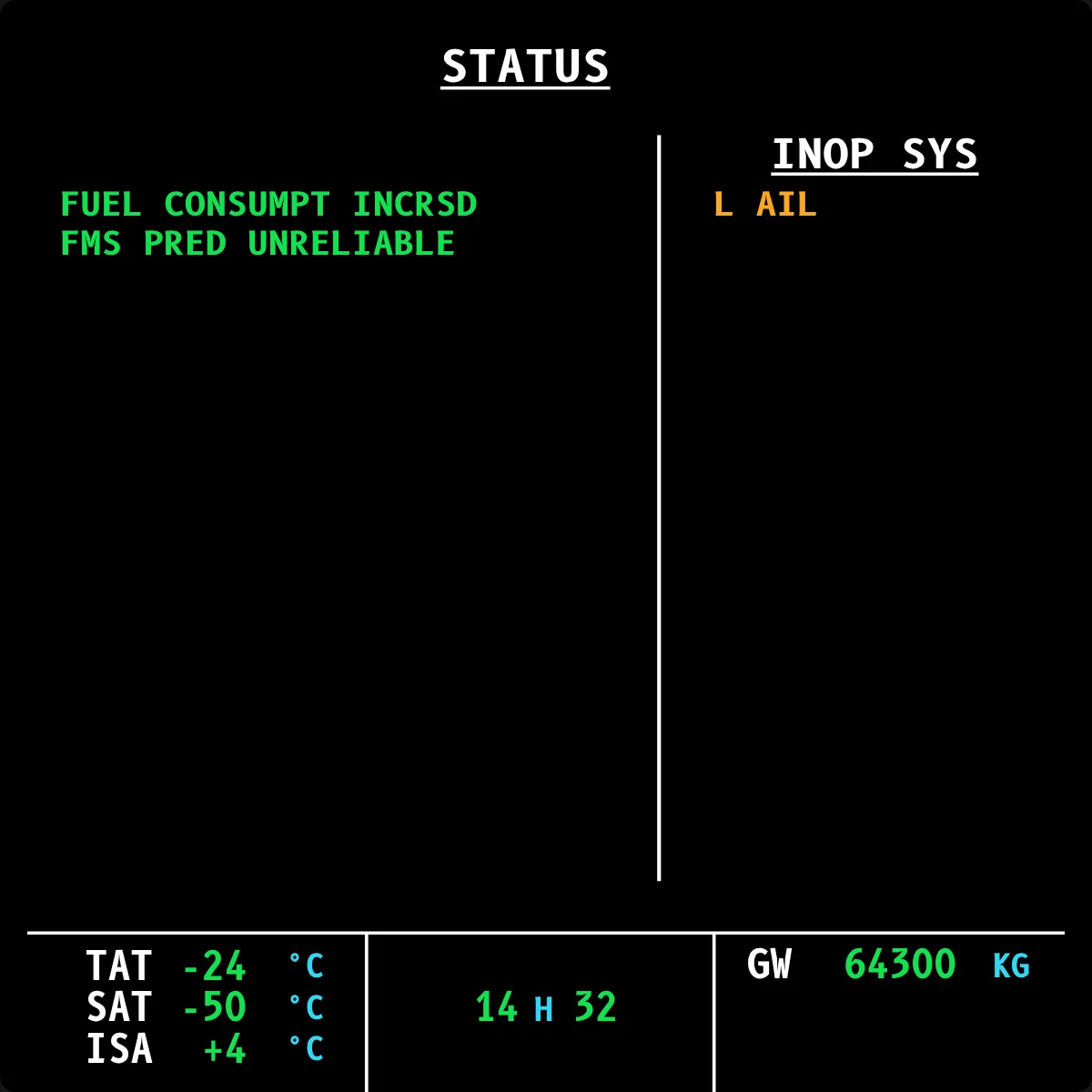
STATUS is the aircraft's operational summary. After this caution it reads FUEL CONSUMPT INCRSD and FMS PRED UNRELIABLE, with L AIL under INOP SYS in amber.
The FCOM prints FUEL CONSUMPT INCRSD in blue, and FMS PRED UNRELIABLE in green, the STATUS colour for information; our picture draws both in green.
The FCOM prints one procedure and one STATUS for this caution, for all aircraft.
Sources FCOM DSC-31-20 STATUS PAGE / FCOM PRO-ABN-F_CTL F/CTL
A319ceo, A320ceo, A320neo, A321neo: what differs?
| A319ceo, A320ceo | A320neo, A321neo | |
|---|---|---|
| The caution, its procedure and STATUS | The same in every version | The same in every version |
| Aileron droop, an ELAC function, with the flaps extended | The ailerons extend 5° down | 5° down on the A320neo; on the A321neo 10° in configuration 1+F and 5° in the others |
Sources FCOM PRO-ABN-F_CTL F/CTL L(R) AIL FAULT / FCOM PRO-ABN-F_CTL F/CTL / FCOM DSC-27-10-20 ROLL CONTROL / FCOM DSC-27-10-20 / FCOM DSC-27-20-30 ECAM F/CTL PAGE

Work F/CTL L AIL FAULT as a crew
Read and do each line against the FCOM, with the E/WD, the SD page and the overhead following your hands, the PF and PM calls, and a debrief that says what you missed.
Work this failure in the ECAM TrainerGo further
Written in our own words from the FCOM and the FCTM; each part names the units it rests on. The E/WD, the STATUS and the live aircraft are the platform's own ECAM and systems model, the same the ECAM Trainer and the flight deck run. This page explains the procedure; it is not the procedure. Aircraft differ by type, engine and options: your aircraft's FCOM, your QRH and your operator's procedures always come first. How we write and check these pages.
Every ECAM procedure, line by line, against the FCOM.
The ECAM Trainer works 108 scenarios with the E/WD, the SD page and the overhead following your hands. Start free today, or open everything with A320 Knowledge+.
For study and revision only. Always follow your operator's approved documentation and procedures. A320 Knowledge is independent and not affiliated with Airbus.
Related
- F/CTL ELAC 1 FAULTAn amber caution for one of the two elevator aileron computers.
- F/CTL ELAC 2 FAULTAn amber caution for one of the two elevator aileron computers.
- F/CTL FLAPS FAULTAn amber caution for flaps that have lost both of their control channels.
- F/CTL FLAPS LOCKEDAn amber caution for flaps that the wingtip brakes have stopped.
- A320 flight controlsThe system guide, with the live aircraft
- Every ECAM procedureThe alerts the ECAM Trainer works, grouped by system