
F/CTL L ELEV FAULT
An amber caution: the left elevator is lost, the right one still works, and pitch passes to the SECs in alternate law. Here is how one elevator is lost, what the crew sees, why the ECAM limits the speed, what it says of the speed brakes, and how STATUS plans the landing, with the live aircraft at the moment the caution comes on.
Written and checked by current A320 pilotschecked against the FCOM on Our editorial policy
What F/CTL L ELEV FAULT means
F/CTL L ELEV FAULT is an amber caution: both servojacks on the left elevator are lost, or the ELAC's elevator flutter protection is active. When an elevator fails, the FCOM's note says, the ELACs lose pitch control through it, so the SECs control pitch in alternate law, with the right elevator, whose deflection is limited.
The ECAM asks the crew to manoeuvre with care and limits the go-around pitch to 15°. Its associated procedure, F/CTL ALTN LAW (PROT LOST), limits the speed to 320 kt and forbids the speed brakes. STATUS plans a flap 3 approach at an increased speed, and direct law once the landing gear is down.
Sources FCOM PRO-ABN-F_CTL F/CTL L(R) ELEV FAULT / FCOM PRO-ABN-F_CTL F/CTL / FCOM PRO-ABN-F_CTL ABNORMAL AND EMERGENCY PROCEDURES / FCOM DSC-27-10-20
At a glance
- Level
- Amber caution, level 2: single chime, MASTER CAUT steady amber and, normally, the F/CTL page on the SD
- Sets it off
- Both servojacks lost on one elevator, here the left, or the ELAC's elevator flutter protection active
- Pitch
- The ELACs lose pitch control through the elevator: the SECs control pitch in alternate law
- Limits
- MANEUVER WITH CARE, MAX PITCH 15 DEG for a go-around, MAX SPEED 320 kt and no speed brakes
- STATUS
- Flap 3 for landing, an increased approach speed, the landing distance procedure, and direct law once the gear is down
Sources FCOM DSC-31-10 WARNING/CAUTION CLASSIFICATION / FCOM DSC-31-30 ATTENTION GETTERS / FCOM DSC-31-20 SYSTEM PAGES / FCOM PRO-ABN-F_CTL F/CTL L(R) ELEV FAULT / FCOM PRO-ABN-F_CTL F/CTL / FCOM PRO-ABN-F_CTL ABNORMAL AND EMERGENCY PROCEDURES
What does losing one elevator mean?
Two elevators and the trimmable horizontal stabiliser (THS) control the aircraft in pitch. The elevators deflect up to 30° nose up and 17° nose down.
Each elevator has two electrically controlled hydraulic servojacks: blue and green on the left elevator, yellow and blue on the right. Normally one jack is active and the other in damping mode; if the active one fails, the damped one becomes active.
In normal operation ELAC 2 controls the elevators, and the green and yellow jacks drive the left and right elevators. If ELAC 2, its hydraulic systems or its jacks fail, ELAC 1 takes pitch on the blue jacks, and if neither ELAC is available, SEC 1 or SEC 2 takes it.
This caution triggers when there is a loss of both servojacks on one elevator, or when the ELAC's elevator flutter protection activates. With both elevators lost, the alert is a red warning of its own, F/CTL L+R ELEV FAULT.
Sources FCOM DSC-27-10-20 PITCH CONTROL / FCOM DSC-27-10-20 GENERAL ARCHITECTURE / FCOM DSC-27-10-20 / FCOM PRO-ABN-F_CTL F/CTL L(R) ELEV FAULT / FCOM PRO-ABN-F_CTL F/CTL L+R ELEV FAULT
Left elevator lost, pitch to the SECs
What does the crew see and hear?
A level 2 caution: a single chime, the MASTER CAUT light steady amber and the caution in amber on the E/WD, and the SD normally calls up the relevant system page by itself, here the F/CTL page.
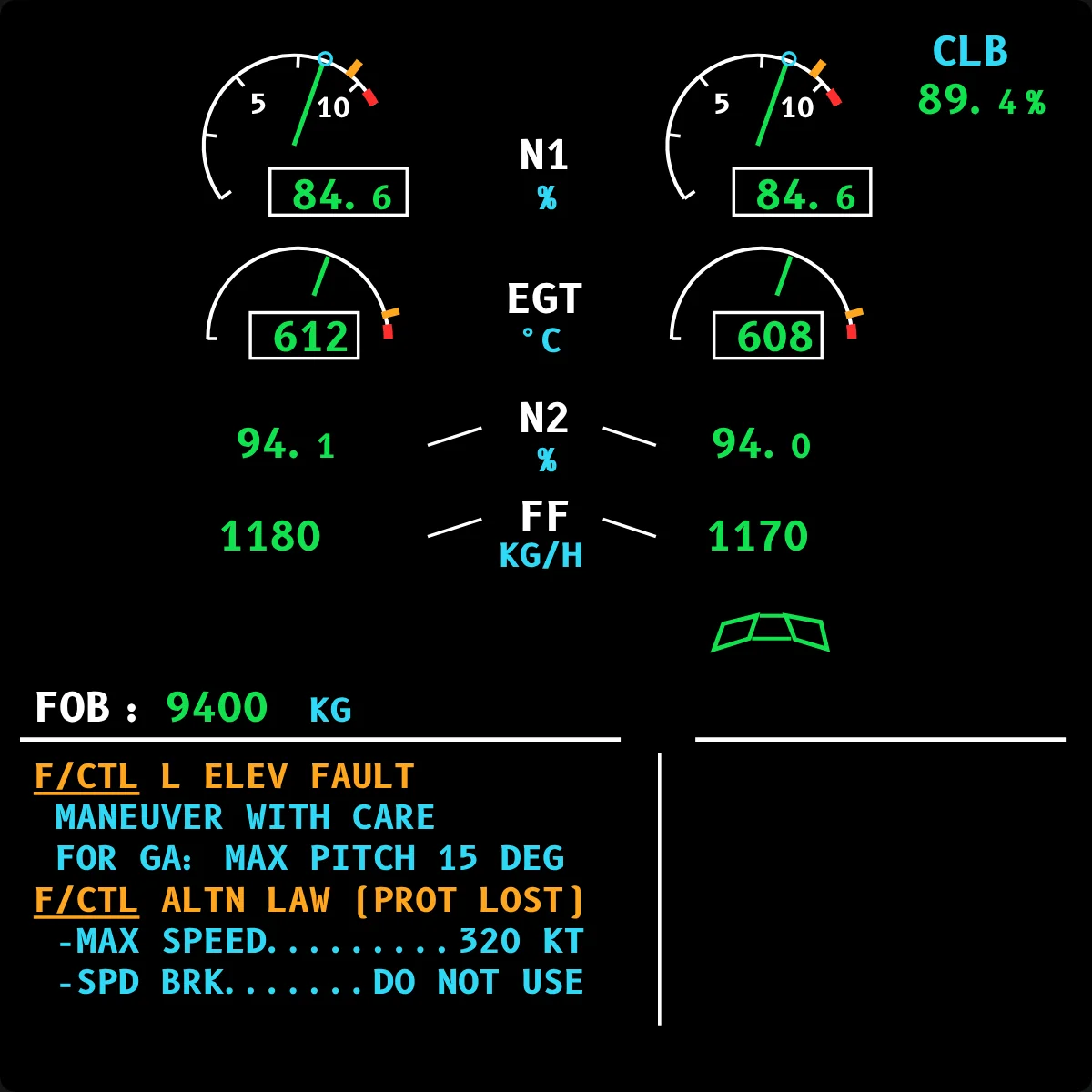
The E/WD gives MANEUVER WITH CARE and a go-around pitch limit, then the associated procedure F/CTL ALTN LAW (PROT LOST), with MAX SPEED 320 kt and SPD BRK DO NOT USE.
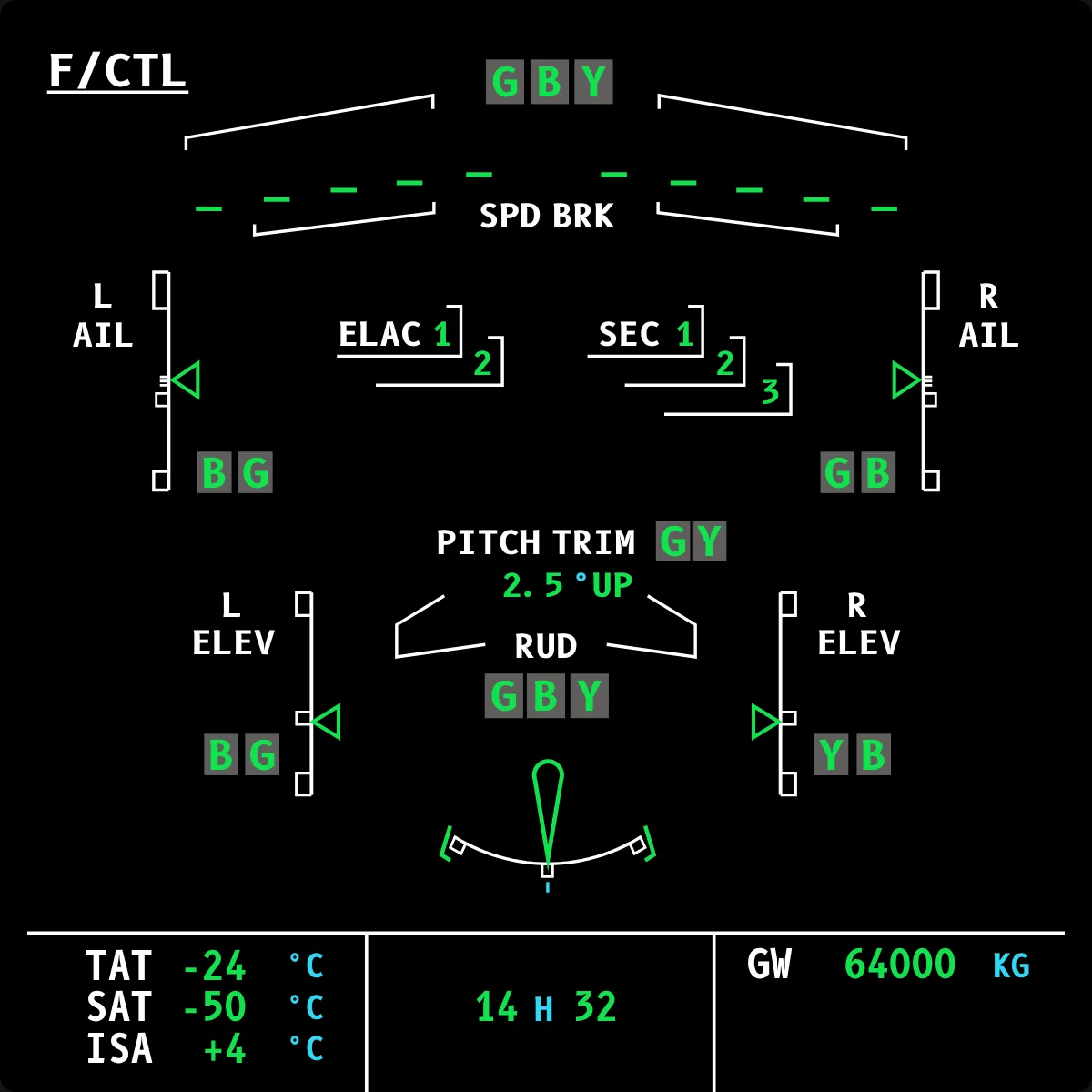
On the F/CTL page each elevator has a white scale and a green index, and the index becomes amber when both of its actuators are not available. On the PFD in alternate law, amber crosses replace the green protection symbols.
Sources FCOM DSC-31-10 WARNING/CAUTION CLASSIFICATION / FCOM DSC-31-30 ATTENTION GETTERS / FCOM DSC-31-20 SYSTEM PAGES / FCOM PRO-ABN-F_CTL F/CTL / FCOM PRO-ABN-F_CTL ABNORMAL AND EMERGENCY PROCEDURES / FCOM DSC-27-20-30 ECAM F/CTL PAGE / FCOM DSC-27-20-20 GENERAL / FCOM DSC-27-20-20 ALTERNATE LAW
The moment the caution comes on
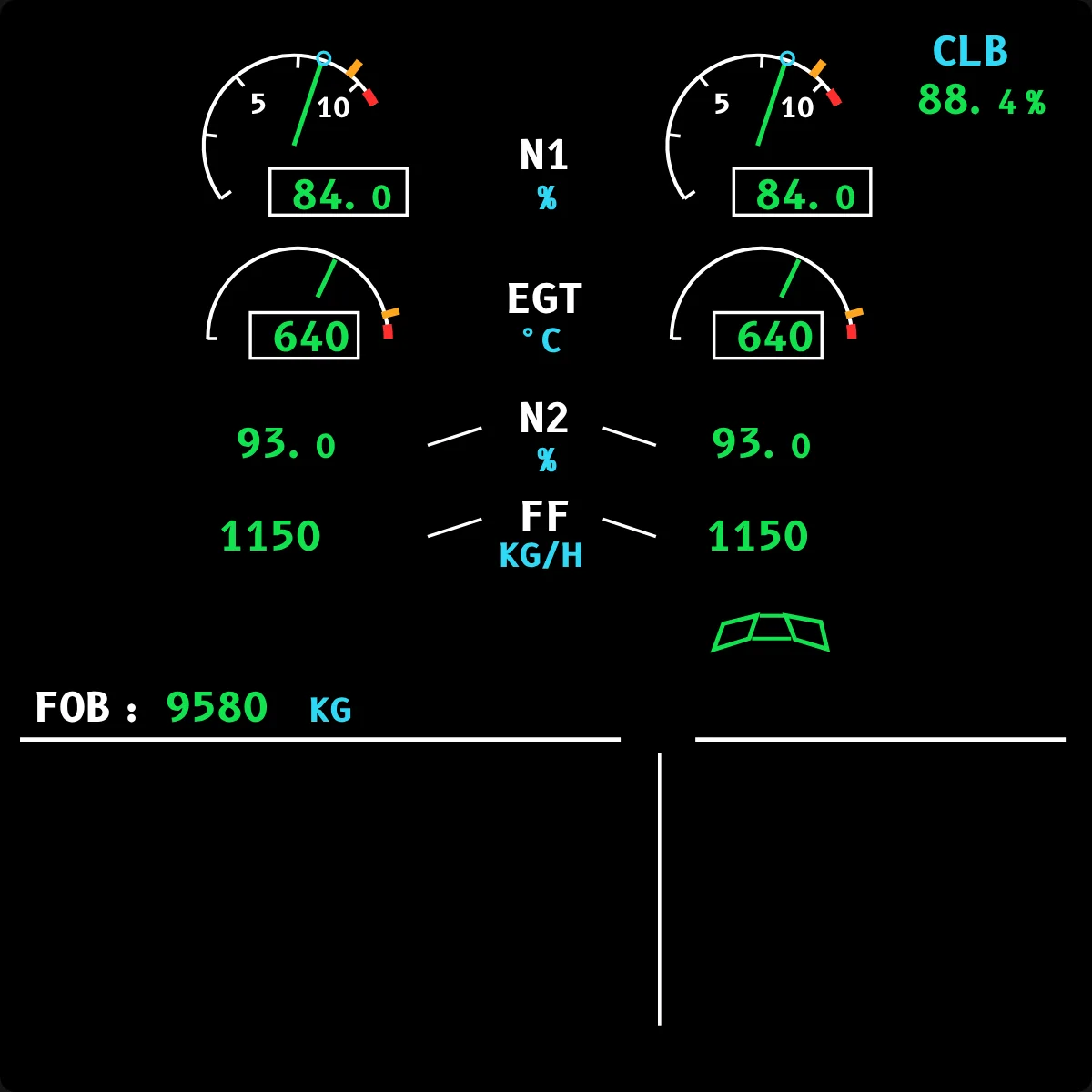
A healthy aircraft in the cruise. Press the button to lose the left elevator, then look at the E/WD and the F/CTL page.
The alert Lose the left elevator
The E/WD shows F/CTL L ELEV FAULT in amber with MANEUVER WITH CARE and FOR GA: MAX PITCH 15 DEG, then F/CTL ALTN LAW (PROT LOST) with MAX SPEED 320 KT and SPD BRK DO NOT USE. On the F/CTL page the left elevator's index is amber.
The right elevator's index stays green: the FCOM turns an index amber when both of that elevator's actuators are not available. Working the lines is what the ECAM Trainer does with you.
Sources FCOM PRO-ABN-F_CTL ABNORMAL AND EMERGENCY PROCEDURES / FCOM DSC-27-20-30 ECAM F/CTL PAGE
Why does pitch go to alternate law?
The FCOM gives the reason in a note: if the left or right elevator fails, the ELACs lose pitch control through the elevator, and therefore the SECs control pitch in alternate law. The note has one exception, the right elevator lost through the failure of blue and yellow, where pitch normal law remains active in the ELACs. For the left elevator it names none.
The remaining elevator does not get full authority: its deflection is limited, to avoid excessive asymmetric loads on the horizontal tailplane or the rear fuselage.
The law reconfiguration table gives one elevator lost as alternate law with reduced protection in pitch, direct law in roll and alternate law in yaw.
In alternate law the pitch mode is still a load factor demand law, as in normal law, with less built-in protection. The load factor limitation stays; pitch attitude protection is lost; an artificial low speed stability replaces the angle of attack protection, and above VMO or MMO a nose up demand is introduced, both of which the pilot can override; there is no bank angle protection. Roll follows the roll direct law.
In the block below, compare the left elevator with both elevators lost, and with the right one lost through blue and yellow.
Sources FCOM PRO-ABN-F_CTL F/CTL / FCOM PRO-ABN-F_CTL ABNORMAL AND EMERGENCY PROCEDURES / FCOM DSC-27-10-20 / FCOM DSC-27-20-20 FLIGHT CONTROLS LAW RECONFIGURATION / FCOM DSC-27-20-20 ALTERNATE LAW
The left elevator against the others
A healthy aircraft in the cruise. Press one failure at a time and compare the E/WD and the F/CTL page with the caution above.
The alert Lose both elevators
A red warning, not an amber caution: F/CTL L+R ELEV FAULT, with MAX SPEED 320/.77, MAN PITCH TRIM USE and SPD BRK DO NOT USE. Both elevator indexes are amber.
With both elevators lost, only manual trim is available for pitch control: in the mechanical backup the pilot trims the THS by hand, and the PFDs show MAN PITCH TRIM ONLY in red. With the left elevator alone, the SECs control pitch in alternate law and the remaining elevator's deflection is limited.
Sources FCOM PRO-ABN-F_CTL F/CTL L+R ELEV FAULT / FCOM PRO-ABN-F_CTL F/CTL / FCOM DSC-27-20-30 ECAM F/CTL PAGE / FCOM DSC-27-20-20 MECHANICAL BACK-UP / FCOM PRO-ABN-F_CTL ABNORMAL AND EMERGENCY PROCEDURES / FCOM DSC-27-10-20
The alert Lose blue and yellow
The E/WD shows the HYD B+Y SYS LO PR warning. On the F/CTL page the right elevator's index turns amber, as its two servojacks are yellow and blue; the left elevator, on blue and green, keeps a green index.
This is the exception in the FCOM's note: with the right elevator lost through the failure of blue and yellow, pitch normal law remains active in the ELACs. Left and right are not twins here.
Sources FCOM PRO-ABN-HYD HYD B+Y SYS LO PR / FCOM DSC-27-20-30 ECAM F/CTL PAGE / FCOM DSC-27-10-20 GENERAL ARCHITECTURE / FCOM PRO-ABN-F_CTL F/CTL / FCOM PRO-ABN-F_CTL ABNORMAL AND EMERGENCY PROCEDURES
Why 320 kt, no speed brakes and a go-around limit?
MAX SPEED 320 kt: the procedure says the speed is limited because the high speed protection is lost. MANEUVER WITH CARE and MAX PITCH 15 DEG for a go-around come without a reason in the FCOM.
SPD BRK DO NOT USE also comes without a reason under the line. Separately, the system inhibits speed brake extension when an elevator is faulty; if the inhibition comes with the speed brakes out, they retract by themselves and stay in until it disappears and the crew resets the lever.
In one version of the procedure the go-around line reads FOR GO-AROUND with MAX PITCH 15 DEG and THR LVR TOGA THEN MCT, the THR LVR line not displayed with one engine inoperative; in another, FOR GA: MAX PITCH 15 DEG alone.
The FCTM's advice in reconfiguration laws: at high altitude, descend to increase the margin to buffet, as about 4 000 ft below REC MAX ALT significantly reduces stall warnings in turbulence; at high speed, manoeuvre with care and use small control inputs.
Sources FCOM PRO-ABN-F_CTL F/CTL / FCOM PRO-ABN-F_CTL ABNORMAL AND EMERGENCY PROCEDURES / FCOM DSC-27-10-20 SPEED BRAKES AND GROUND SPOILERS / FCOM DSC-27-10-20 / FCTM AOP-10-30-20 FLYING IN RECONFIGURATION LAWS
What is lost, and how is the landing planned?
INOP SYS lists the flight control protections, the left elevator, ELAC pitch, both autopilots and CAT 2, with GLS AUTOLAND and STEEP APPR where fitted.
The approach procedure on STATUS: flap 3 for landing, GPWS LDG FLAP 3 ON once the flaps are in configuration 3, an increased approach speed and the landing distance procedure. The FCOM gives no reason for the flap setting or the speed increment.
Two green lines close it: ALTN LAW: PROT LOST, and WHEN L/G DN: DIRECT LAW. At landing gear extension, control reverts to direct law in pitch as well as in roll.
Pitch direct law is a direct stick-to-elevator relationship with no automatic trim: the pilot trims manually, and the PFD shows USE MAN PITCH TRIM in amber. No protections are operative.
Sources FCOM PRO-ABN-F_CTL F/CTL / FCOM DSC-27-20-20 DIRECT LAW
From the cruise to the landing
What is lost afterwards?
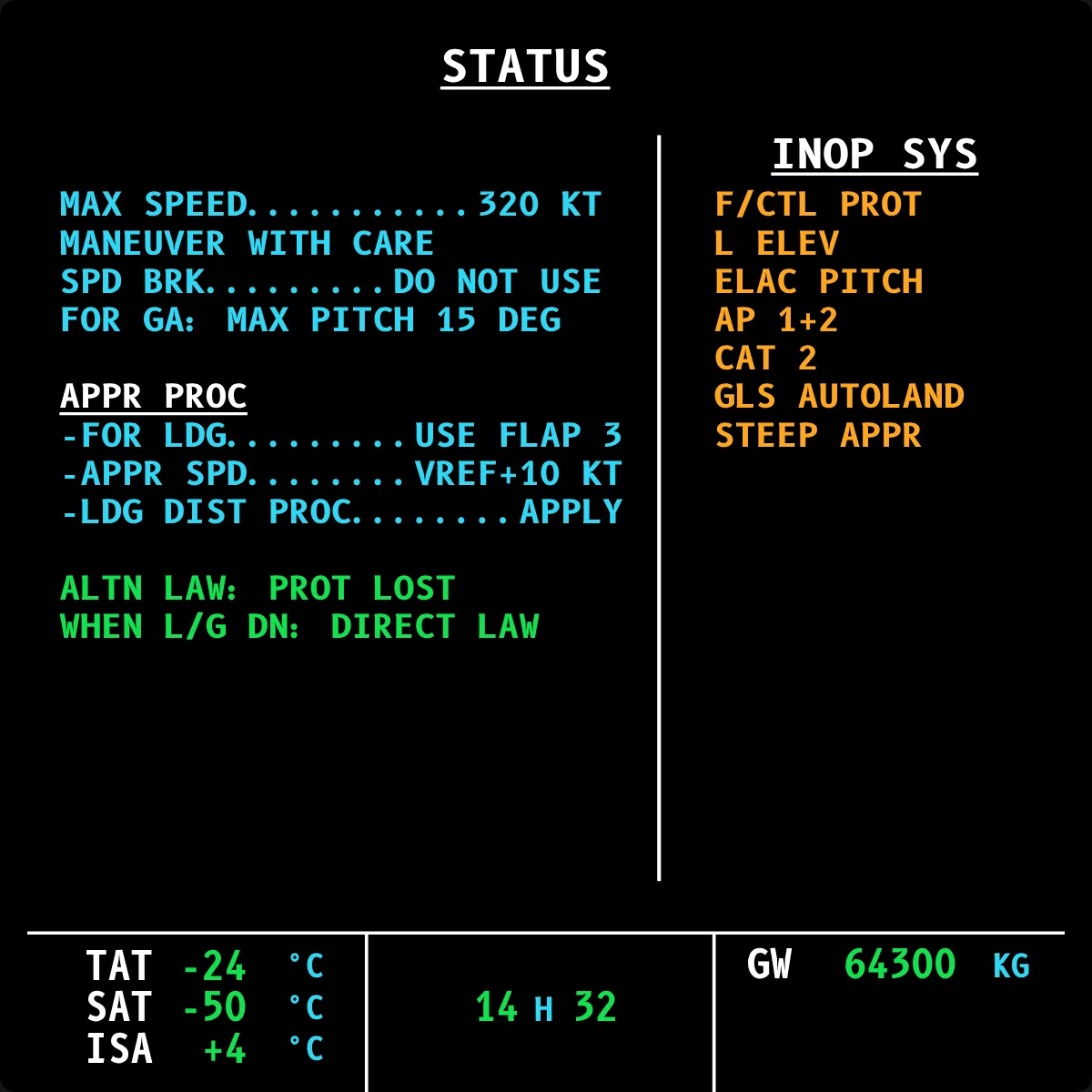
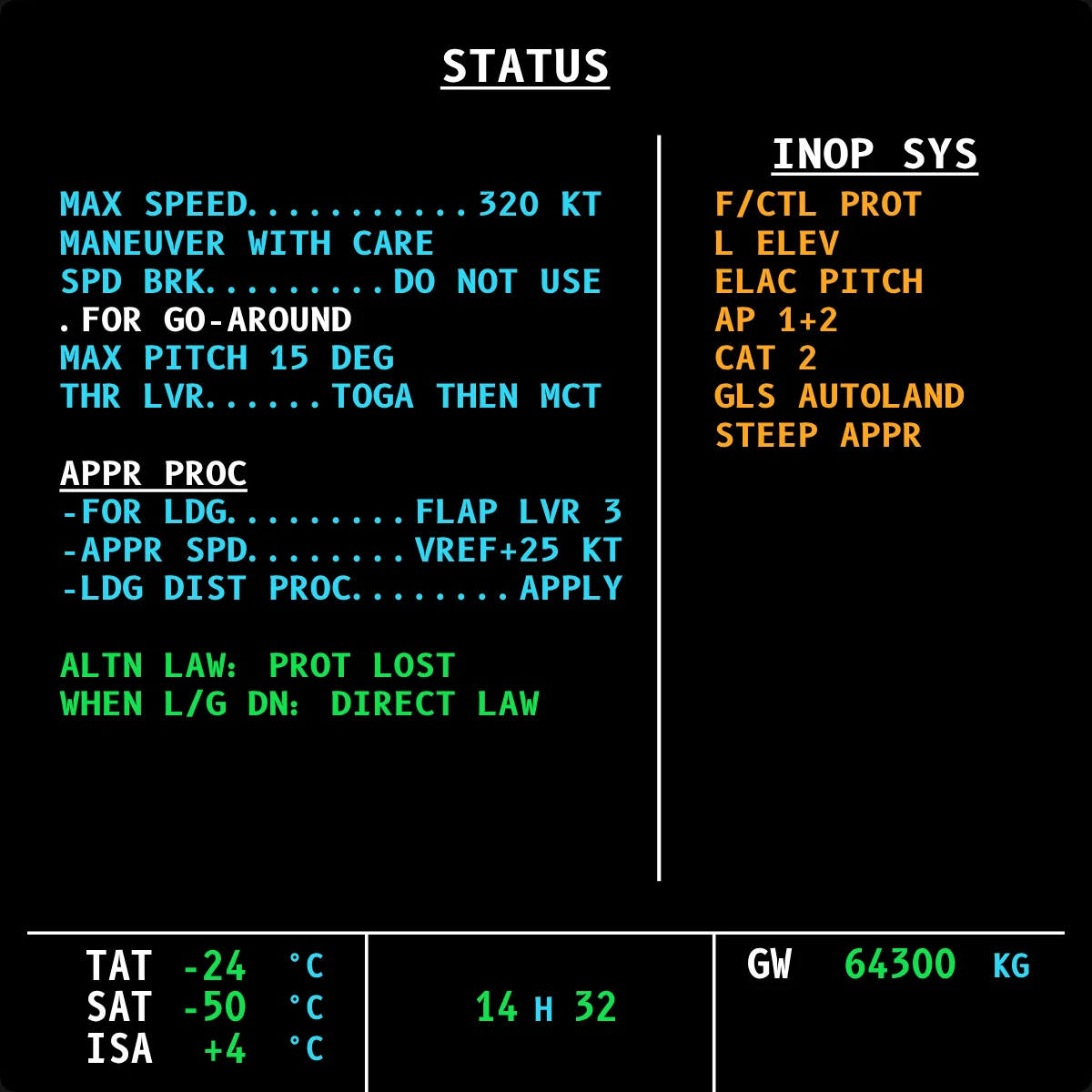
STATUS is the aircraft's operational summary. It opens with the limits in blue, MAX SPEED 320 KT, MANEUVER WITH CARE, SPD BRK DO NOT USE and the go-around pitch limit, then APPR PROC with the approach lines, and ALTN LAW: PROT LOST and WHEN L/G DN: DIRECT LAW in green.
The FOR LDG line becomes a reminder once configuration 3 is selected, and GPWS LDG FLAP 3 ON is displayed when the flaps are in configuration 3; neither applies in the cruise drawn.
The FCOM prints five versions of this STATUS. They differ in the go-around lines, the flap line, FLAP LVR 3 or USE FLAP 3, and the approach speed, VREF+10, VREF+15 or VREF+25 KT; the two pictures are two of them.
Which version applies depends on your aircraft: check your own FCOM.
Sources FCOM DSC-31-20 STATUS PAGE / FCOM PRO-ABN-F_CTL F/CTL
A319ceo, A320ceo, A320neo, A321neo: what differs?
| A319ceo, A320ceo | A320neo, A321neo | |
|---|---|---|
| The caution and its trigger | The same in every version | The same in every version |
| The go-around lines | Not given by type: FOR GA: MAX PITCH 15 DEG in two versions; FOR GO-AROUND with MAX PITCH 15 DEG and THR LVR TOGA THEN MCT in another | Not given by type: FOR GA: MAX PITCH 15 DEG in two versions; FOR GO-AROUND with MAX PITCH 15 DEG and THR LVR TOGA THEN MCT in another |
| STATUS: flap line | Not given by type: FOR LDG FLAP LVR 3 in one version, FOR LDG USE FLAP 3 in the four others | Not given by type: FOR LDG FLAP LVR 3 in one version, FOR LDG USE FLAP 3 in the four others |
| STATUS: approach speed | Not given by type: VREF+10 KT in one version, VREF+15 KT in another, VREF+25 KT in three | Not given by type: VREF+10 KT in one version, VREF+15 KT in another, VREF+25 KT in three |
Sources FCOM PRO-ABN-F_CTL F/CTL L(R) ELEV FAULT / FCOM PRO-ABN-F_CTL F/CTL / FCOM PRO-ABN-F_CTL ABNORMAL AND EMERGENCY PROCEDURES

Work F/CTL L ELEV FAULT as a crew
Read and do each line against the FCOM, with the E/WD, the SD page and the overhead following your hands, the PF and PM calls, and a debrief that says what you missed.
Work this failure in the ECAM TrainerGo further
Written in our own words from the FCOM and the FCTM; each part names the units it rests on. The E/WD, the STATUS and the live aircraft are the platform's own ECAM and systems model, the same the ECAM Trainer and the flight deck run. This page explains the procedure; it is not the procedure. Aircraft differ by type, engine and options: your aircraft's FCOM, your QRH and your operator's procedures always come first. How we write and check these pages.
Every ECAM procedure, line by line, against the FCOM.
The ECAM Trainer works 108 scenarios with the E/WD, the SD page and the overhead following your hands. Start free today, or open everything with A320 Knowledge+.
For study and revision only. Always follow your operator's approved documentation and procedures. A320 Knowledge is independent and not affiliated with Airbus.
Related
- F/CTL ELAC 1 FAULTAn amber caution for one of the two elevator aileron computers.
- F/CTL ELAC 2 FAULTAn amber caution for one of the two elevator aileron computers.
- F/CTL FLAPS FAULTAn amber caution for flaps that have lost both of their control channels.
- F/CTL FLAPS LOCKEDAn amber caution for flaps that the wingtip brakes have stopped.
- A320 flight controlsThe system guide, with the live aircraft
- Every ECAM procedureThe alerts the ECAM Trainer works, grouped by system