
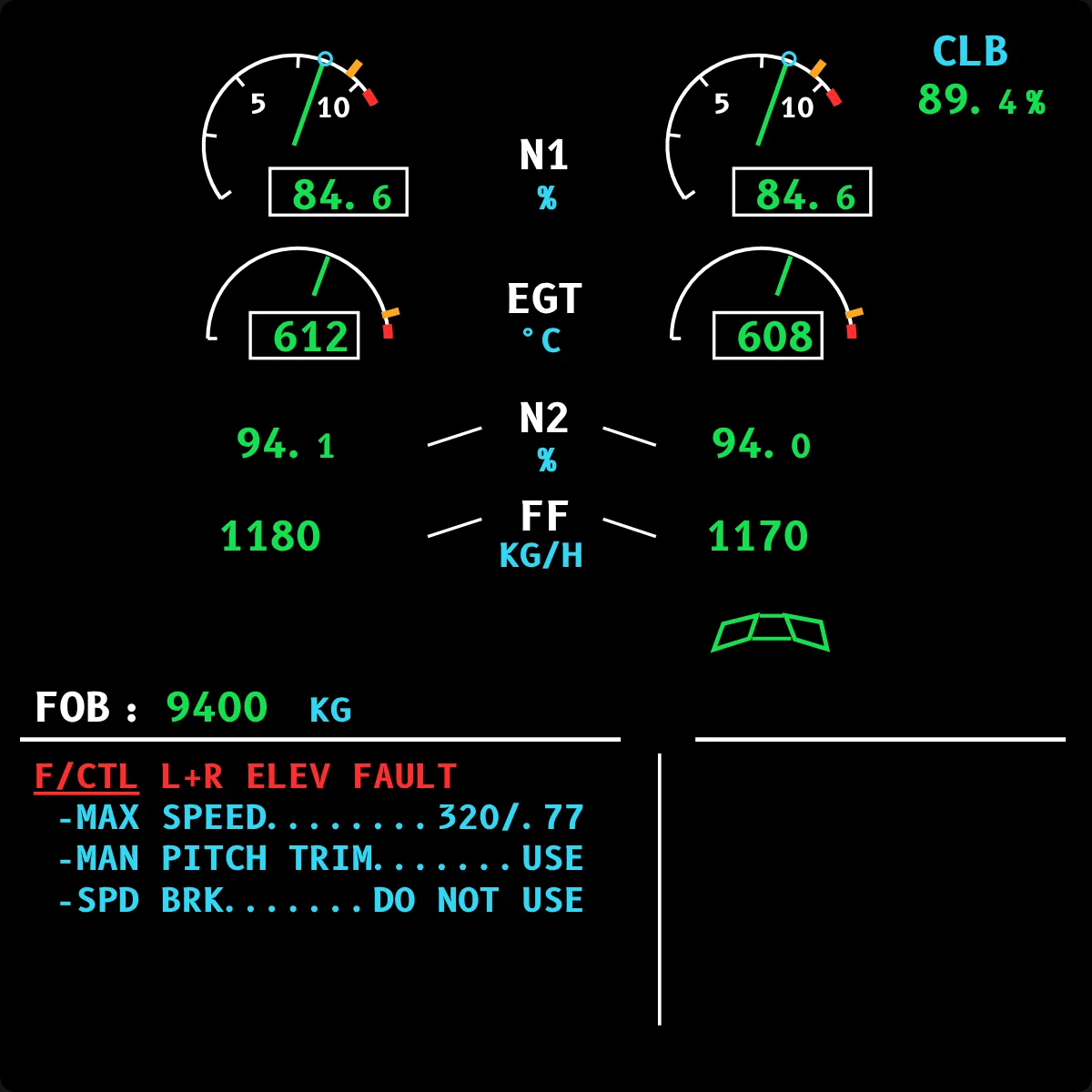
F/CTL L+R ELEV FAULT
A red warning: both elevators are lost, and pitch is left to the stabiliser, moved by hand with the pitch trim wheel. Here is how the aircraft gets there, what the crew sees, why the ECAM limits the speed and bans the speed brakes, and how STATUS plans the landing, with the live aircraft at the moment the warning comes on.
Written and checked by current A320 pilotschecked against the FCOM on Our editorial policy
What F/CTL L+R ELEV FAULT means
F/CTL L+R ELEV FAULT is a red warning: both elevators are lost. Pitch is left to the trimmable horizontal stabiliser, which the crew moves mechanically with the pitch trim wheel, as long as green or yellow hydraulics work. This is the mechanical backup in pitch, and the PFDs show MAN PITCH TRIM ONLY in red.
The ECAM gives three lines: MAX SPEED 320/.77, as the high speed protections are lost; MAN PITCH TRIM USE, the only pitch control left; and SPD BRK DO NOT USE, as their pitch moment is hard to control with the trim alone. STATUS plans a flap 3 approach at an increased speed, with roll in direct law.
Sources FCOM PRO-ABN-F_CTL F/CTL L+R ELEV FAULT / FCOM DSC-27-10-20 / FCOM DSC-27-20-20 MECHANICAL BACK-UP / FCOM PRO-ABN-F_CTL F/CTL / FCOM PRO-ABN-F_CTL ABNORMAL AND EMERGENCY PROCEDURES
At a glance
- Level
- Red warning, level 3: an aural warning such as the continuous repetitive chime, MASTER WARN flashing red and, normally, the F/CTL page on the SD
- Sets it off
- Both elevators lost
- Pitch
- The stabiliser alone, on the manual pitch trim: MAN PITCH TRIM ONLY in red on the PFDs
- Limits
- MAX SPEED 320/.77 and no speed brakes
- STATUS
- Flap 3 for landing, an increased approach speed, the landing distance procedure; PITCH MECH BACK UP and ROLL DIRECT LAW
Sources FCOM DSC-31-10 WARNING/CAUTION CLASSIFICATION / FCOM DSC-31-30 ATTENTION GETTERS / FCOM DSC-31-20 SYSTEM PAGES / FCOM PRO-ABN-F_CTL F/CTL L+R ELEV FAULT / FCOM PRO-ABN-F_CTL F/CTL / FCOM DSC-27-10-20 / FCOM DSC-27-20-20 MECHANICAL BACK-UP / FCOM PRO-ABN-F_CTL ABNORMAL AND EMERGENCY PROCEDURES
How can both elevators be lost?
Two elevators and the trimmable horizontal stabiliser (THS) control the aircraft in pitch. Each elevator has two electrically controlled hydraulic servojacks: blue and green on the left elevator, yellow and blue on the right. In normal operation one jack is active and the other in damping mode (some manoeuvres make the second active too); if the active one fails, the other takes over.
The computers stand behind each other. ELAC 2 normally flies pitch, ELAC 1 takes over if ELAC 2 or its hydraulics fail, and SEC 1 or SEC 2 if neither ELAC is available. If neither jack of an elevator is controlled electrically, both go to centring mode; if neither is controlled hydraulically, both go to damping mode.
One elevator lost, both of its servojacks gone (or the ELAC's elevator flutter protection active), gives F/CTL L ELEV FAULT or R ELEV FAULT, a caution. This warning triggers when both elevators are lost; the FCOM names no single cause.
Sources FCOM DSC-27-10-20 PITCH CONTROL / FCOM DSC-27-10-20 GENERAL ARCHITECTURE / FCOM DSC-27-10-20 / FCOM PRO-ABN-F_CTL F/CTL L(R) ELEV FAULT / FCOM PRO-ABN-F_CTL F/CTL L+R ELEV FAULT
From two elevators to the trim wheel
What does the crew see and hear?
A red warning is the ECAM's highest level: an aural warning (the continuous repetitive chime, a specific sound or a synthetic voice), MASTER WARN flashing red, the warning in red on the E/WD, and the SD normally calls up the relevant system page, here the F/CTL page.
On the F/CTL page each elevator's index turns amber when both its actuators are not available. On the PFDs, the mechanical backup shows MAN PITCH TRIM ONLY in red.
Sources FCOM DSC-31-10 WARNING/CAUTION CLASSIFICATION / FCOM DSC-31-30 ATTENTION GETTERS / FCOM DSC-31-20 SYSTEM PAGES / FCOM DSC-27-20-30 ECAM F/CTL PAGE / FCOM DSC-27-20-20 MECHANICAL BACK-UP
The moment the warning comes on
A healthy aircraft in the cruise. Press the button to lose both elevators, then look at the E/WD, the F/CTL page and the pedestal, where the pitch trim wheels are.
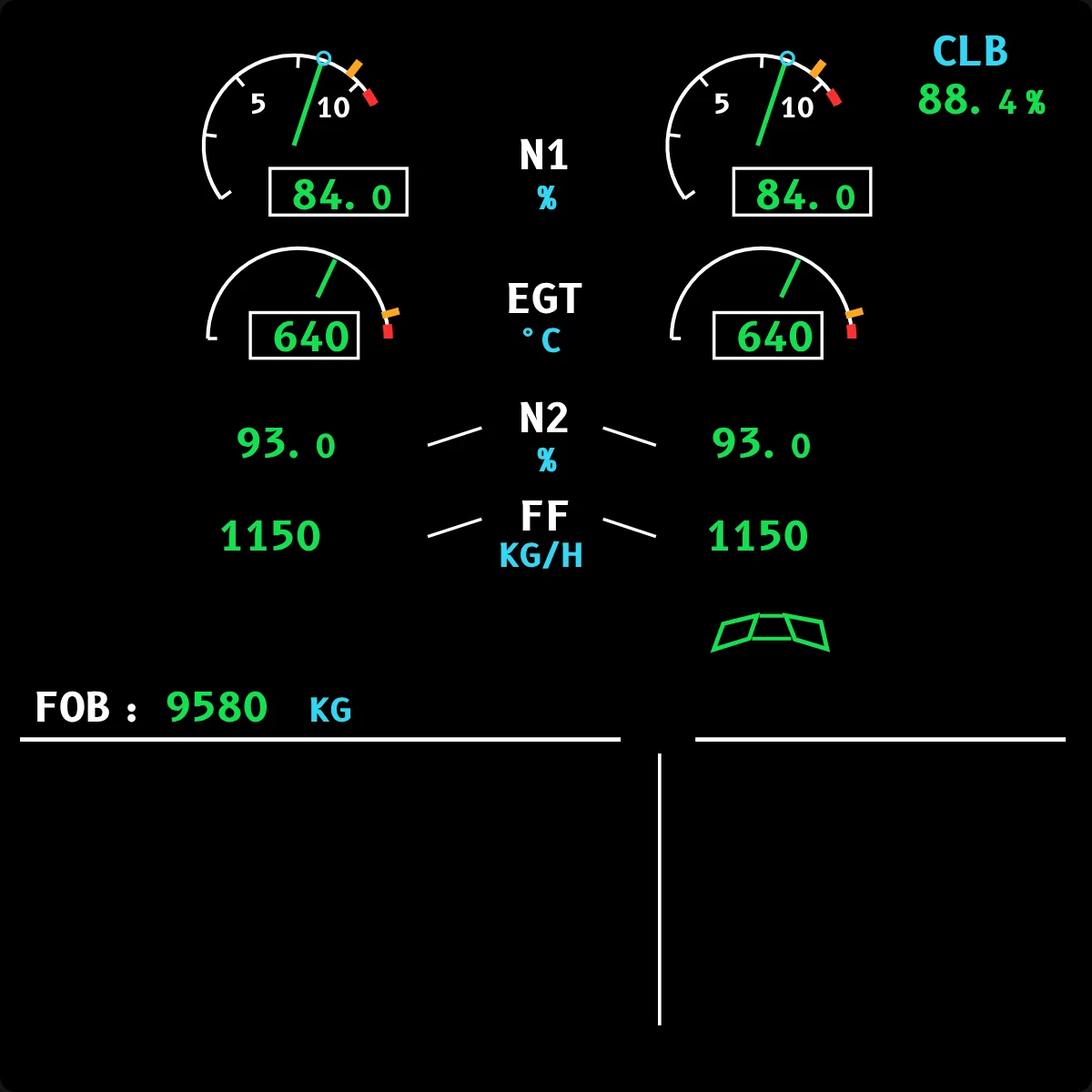
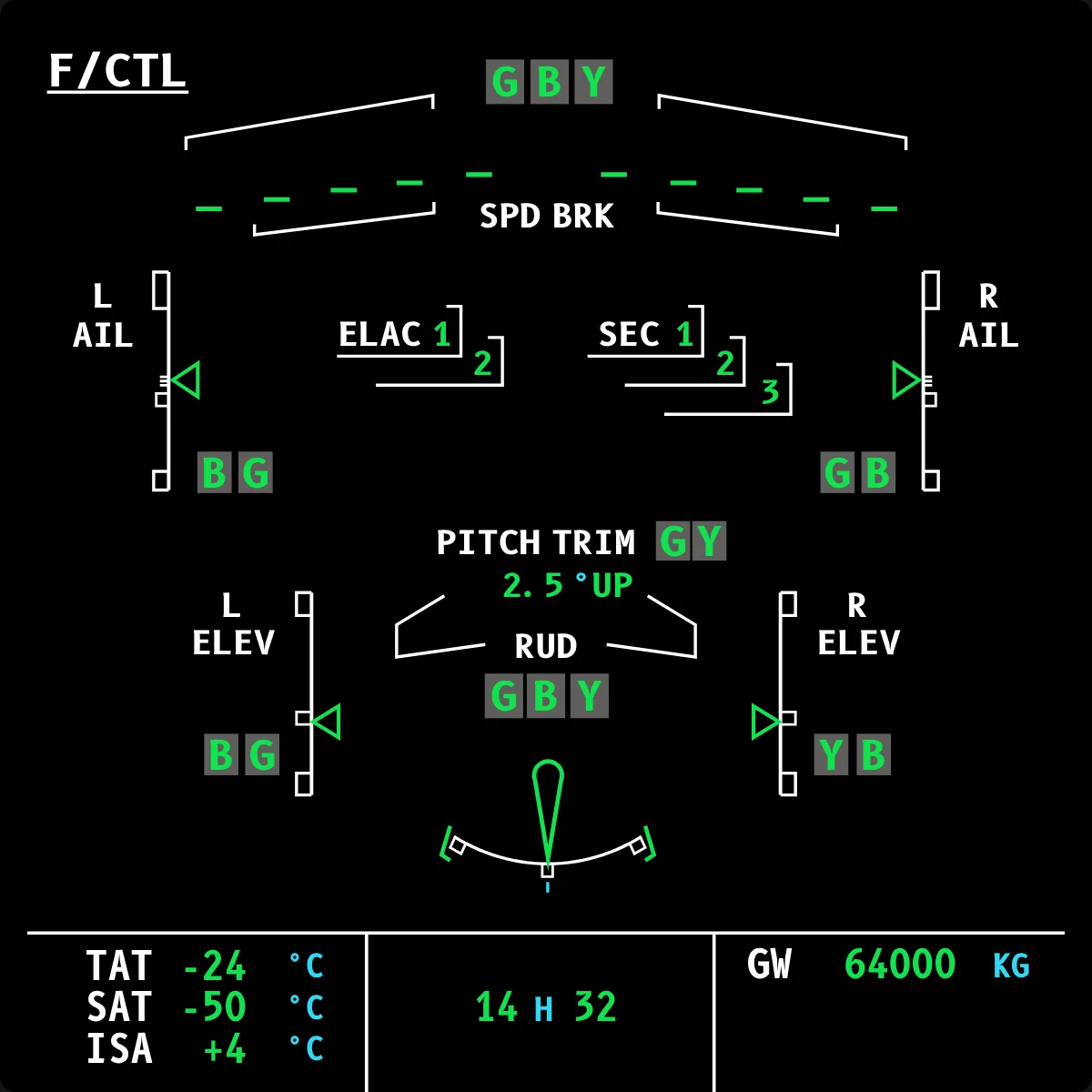

The alert Lose both elevators
The E/WD shows F/CTL L+R ELEV FAULT in red with three lines: MAX SPEED 320/.77, MAN PITCH TRIM USE and SPD BRK DO NOT USE. On the F/CTL page both elevator indexes are amber.
The pedestal shows the pitch trim wheels, now the only pitch control; the drawing does not turn them, and no PFD is drawn here. Working the procedure is what the ECAM Trainer does with you.
Sources FCOM PRO-ABN-F_CTL F/CTL / FCOM DSC-27-20-30 ECAM F/CTL PAGE / FCOM DSC-27-10-20
How is the aircraft flown in pitch now?
With the trim wheel. Mechanical control of the THS is available from the pitch trim wheel at any time, if either green or yellow is working, and it has priority over electrical control. A screwjack, turned by two hydraulic motors, drives the stabiliser; the motors take their orders from one of three electric motors or from the trim wheel.
The FCOM's mechanical backup exists for cases like this one: among them, the loss of both elevators. The pilot trims the THS manually to control the aircraft in pitch, and the PFDs show MAN PITCH TRIM ONLY in red.
The FCTM sets the aim: in mechanical backup the crew does not try to fly accurately, but keeps the attitude safe and stabilised. Any action on the trim wheel is smooth, as the stabiliser is large and its effect significant.
The THS moves between 13.5° nose up and 4° nose down.
Sources FCOM DSC-27-10-20 / FCOM DSC-27-20-20 MECHANICAL BACK-UP / FCTM AOP-10-30-20 FLYING IN RECONFIGURATION LAWS / FCOM DSC-27-10-20 PITCH CONTROL
One elevator, or both
A healthy aircraft in the cruise. Lose the left elevator alone and compare the E/WD and the F/CTL page with the warning above.
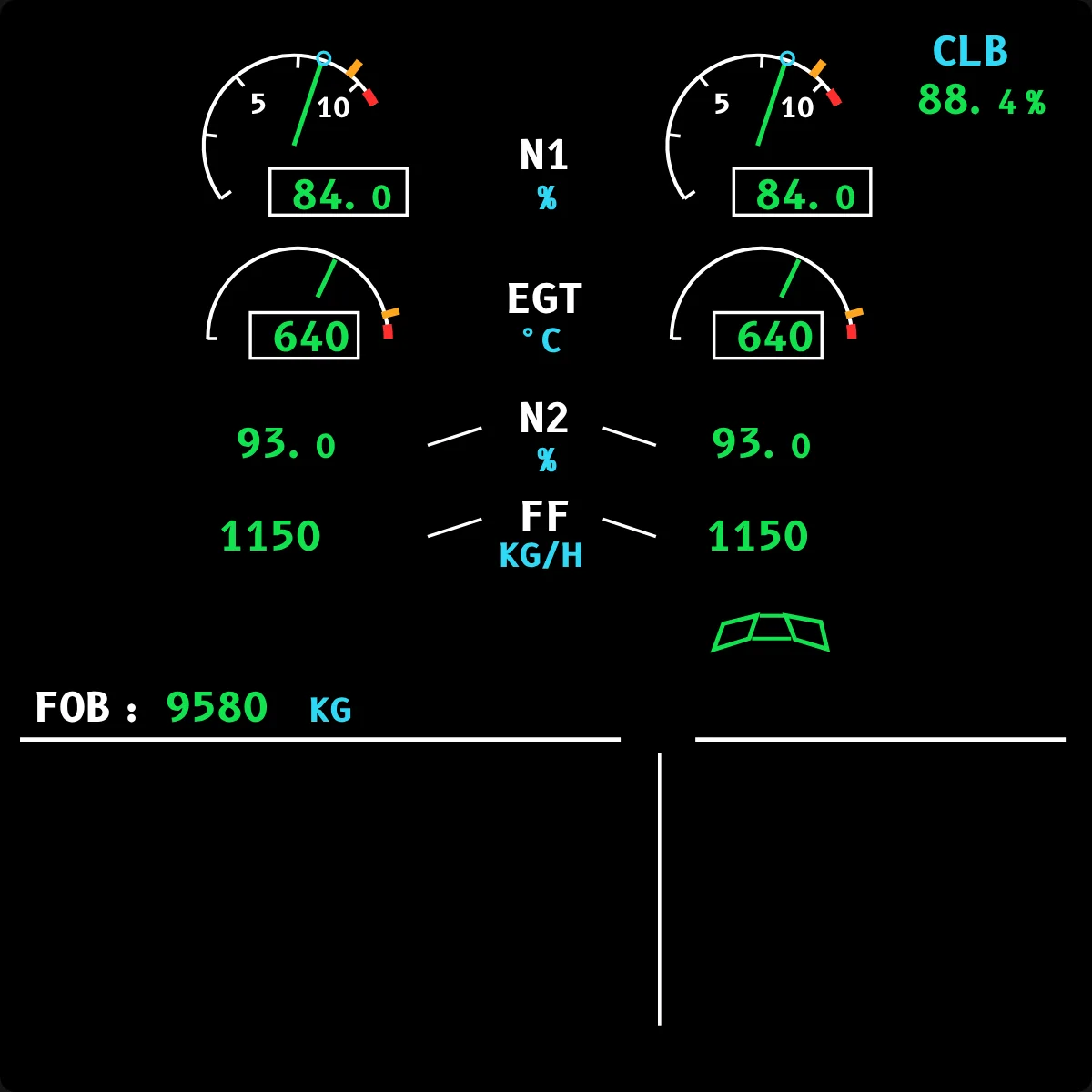
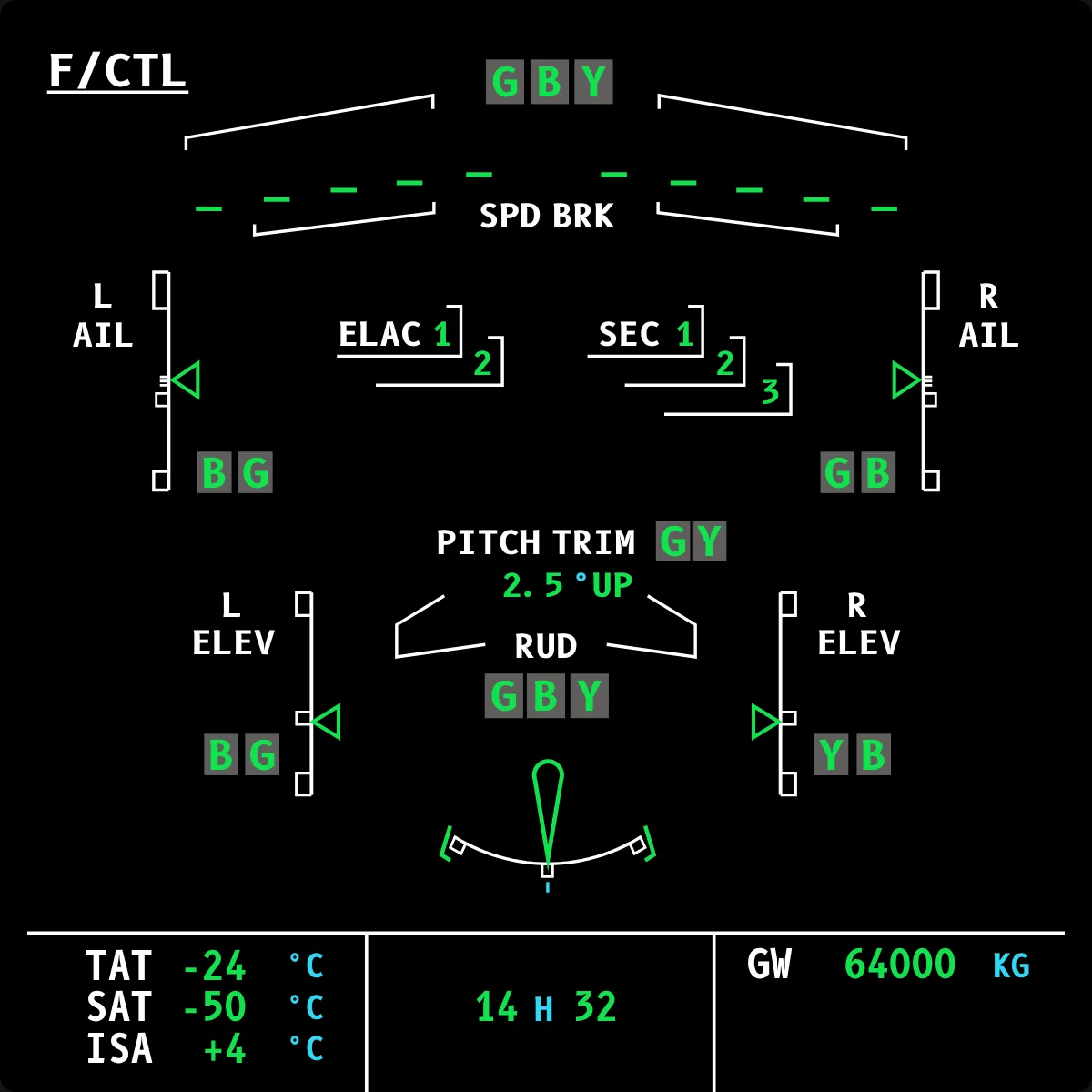
The alert Lose the left elevator only
An amber caution, not a red warning: F/CTL L ELEV FAULT, with MANEUVER WITH CARE, a go-around pitch limit, F/CTL ALTN LAW (PROT LOST), MAX SPEED 320 KT and SPD BRK DO NOT USE. On the F/CTL page only the left elevator index is amber.
The FCOM's note: if the left or right elevator fails, the ELACs lose pitch control through the elevator, so the SECs control pitch in alternate law; not so for the right elevator lost through blue and yellow failing, where pitch normal law stays in the ELACs. The remaining elevator's deflection is limited, to avoid excessive asymmetric loads on the tailplane or the rear fuselage.
Sources FCOM PRO-ABN-F_CTL F/CTL L(R) ELEV FAULT / FCOM PRO-ABN-F_CTL F/CTL / FCOM PRO-ABN-F_CTL ABNORMAL AND EMERGENCY PROCEDURES / FCOM DSC-27-20-30 ECAM F/CTL PAGE / FCOM DSC-27-10-20
Why limit the speed and ban the speed brakes?
The procedure gives a reason for each of its lines. MAX SPEED 320/.77 comes from the loss of the high speed protections. MAN PITCH TRIM USE, because only manual trim is available for pitch control.
SPD BRK DO NOT USE: the FCOM says it is "difficult to control the induced pitch moment with manual pitch trim only." Separately, the system inhibits speed brake extension when an elevator is faulty.
The FCTM's advice in reconfiguration laws, the mechanical backup among them: at high altitude, descend to increase the margin to buffet, as about 4 000 ft below REC MAX ALT significantly reduces stall warnings in turbulence; at high speed, use small control inputs. It adds that in these laws the roll control law is always direct.
Sources FCOM PRO-ABN-F_CTL F/CTL / FCOM DSC-27-10-20 SPEED BRAKES AND GROUND SPOILERS / FCOM DSC-27-10-20 / FCTM AOP-10-30-20 FLYING IN RECONFIGURATION LAWS
What is lost, and how is the landing planned?
INOP SYS lists both elevators, ELAC pitch, both autopilots and CAT 2, with GLS AUTOLAND and STEEP APPR where fitted. Pitch is mechanical backup and roll is in direct law, the two green lines of STATUS.
Roll direct law is a direct stick-to-surface relationship, with gains set by the slat and flap configuration: about 30° per second clean, about 25° with the slats out. To limit the roll rate it uses only the ailerons and spoilers 4 and 5, with spoiler 3 in place of a failed spoiler 4.
The approach procedure on STATUS: flap 3 for landing, GPWS LDG FLAP 3 ON once the flaps are in configuration 3, the manual pitch trim, an increased approach speed and the landing distance procedure. The FCOM gives no reason for the flap setting or the speed increment.
Sources FCOM PRO-ABN-F_CTL F/CTL / FCOM PRO-ABN-F_CTL ABNORMAL AND EMERGENCY PROCEDURES / FCOM DSC-27-20-20 DIRECT LAW
What is left, axis by axis
What is lost afterwards?
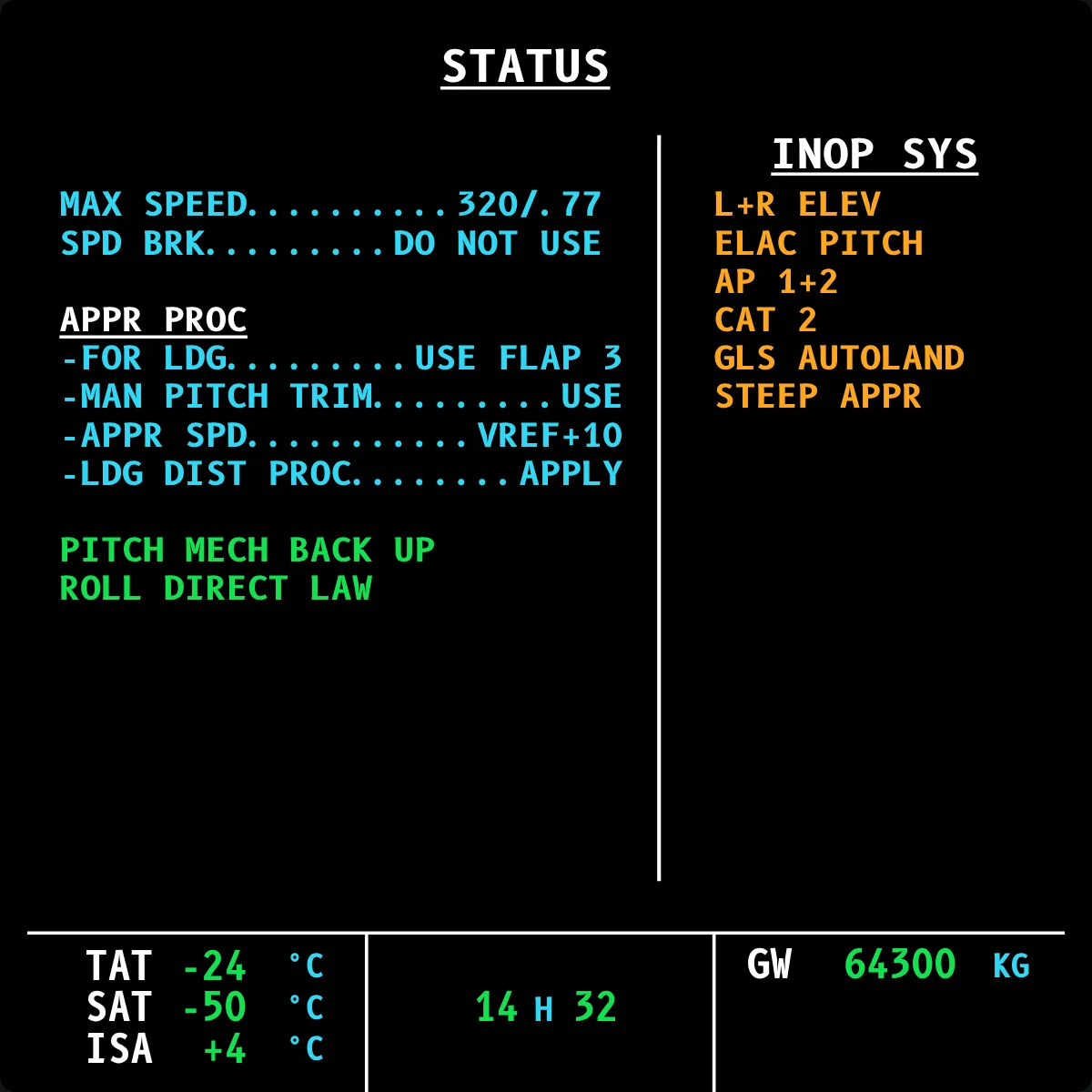
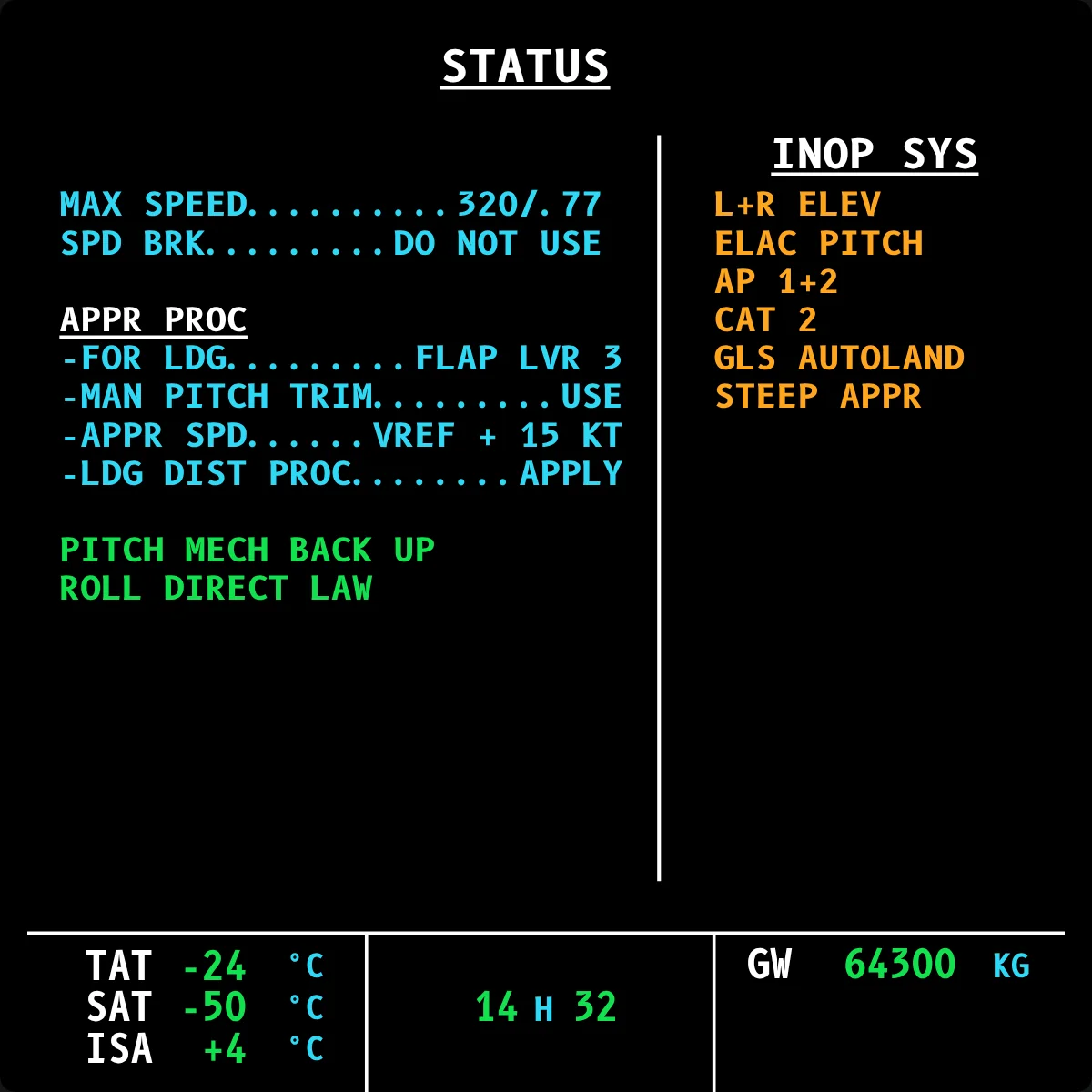
STATUS is the aircraft's operational summary. It opens with the limits in blue, MAX SPEED 320/.77 and SPD BRK DO NOT USE, then APPR PROC with the approach lines, and PITCH MECH BACK UP and ROLL DIRECT LAW in green.
The FOR LDG line becomes a reminder once configuration 3 is selected, and GPWS LDG FLAP 3 ON shows when the flaps are in configuration 3; neither applies in the cruise drawn.
The FCOM prints four versions of this STATUS. They differ in the flap line, FLAP LVR 3 or USE FLAP 3, and the approach speed, VREF+10 or VREF + 15 KT; the two pictures are two of them.
Which version applies depends on your aircraft: check your own FCOM.
Sources FCOM DSC-31-20 STATUS PAGE / FCOM PRO-ABN-F_CTL F/CTL / FCOM PRO-ABN-F_CTL ABNORMAL AND EMERGENCY PROCEDURES
A319ceo, A320ceo, A320neo, A321neo: what differs?
| A319ceo, A320ceo | A320neo, A321neo | |
|---|---|---|
| The warning and its procedure | The same in every version | The same in every version |
| STATUS: flap line | Not given by type: FOR LDG FLAP LVR 3 in one version, FOR LDG USE FLAP 3 in the three others | Not given by type: FOR LDG FLAP LVR 3 in one version, FOR LDG USE FLAP 3 in the three others |
| STATUS: approach speed | Not given by type: VREF+10 in two versions, VREF + 15 KT in the two others | Not given by type: VREF+10 in two versions, VREF + 15 KT in the two others |
Sources FCOM PRO-ABN-F_CTL F/CTL L+R ELEV FAULT / FCOM PRO-ABN-F_CTL F/CTL / FCOM PRO-ABN-F_CTL ABNORMAL AND EMERGENCY PROCEDURES

Work F/CTL L+R ELEV FAULT as a crew
Read and do each line against the FCOM, with the E/WD, the SD page and the overhead following your hands, the PF and PM calls, and a debrief that says what you missed.
Work this failure in the ECAM TrainerGo further
Written in our own words from the FCOM and the FCTM; each part names the units it rests on. The E/WD, the STATUS and the live aircraft are the platform's own ECAM and systems model, the same the ECAM Trainer and the flight deck run. This page explains the procedure; it is not the procedure. Aircraft differ by type, engine and options: your aircraft's FCOM, your QRH and your operator's procedures always come first. How we write and check these pages.
Every ECAM procedure, line by line, against the FCOM.
The ECAM Trainer works 108 scenarios with the E/WD, the SD page and the overhead following your hands. Start free today, or open everything with A320 Knowledge+.
For study and revision only. Always follow your operator's approved documentation and procedures. A320 Knowledge is independent and not affiliated with Airbus.
Related
- F/CTL ELAC 1 FAULTAn amber caution for one of the two elevator aileron computers.
- F/CTL ELAC 2 FAULTAn amber caution for one of the two elevator aileron computers.
- F/CTL FLAPS FAULTAn amber caution for flaps that have lost both of their control channels.
- F/CTL FLAPS LOCKEDAn amber caution for flaps that the wingtip brakes have stopped.
- A320 flight controlsThe system guide, with the live aircraft
- Every ECAM procedureThe alerts the ECAM Trainer works, grouped by system