
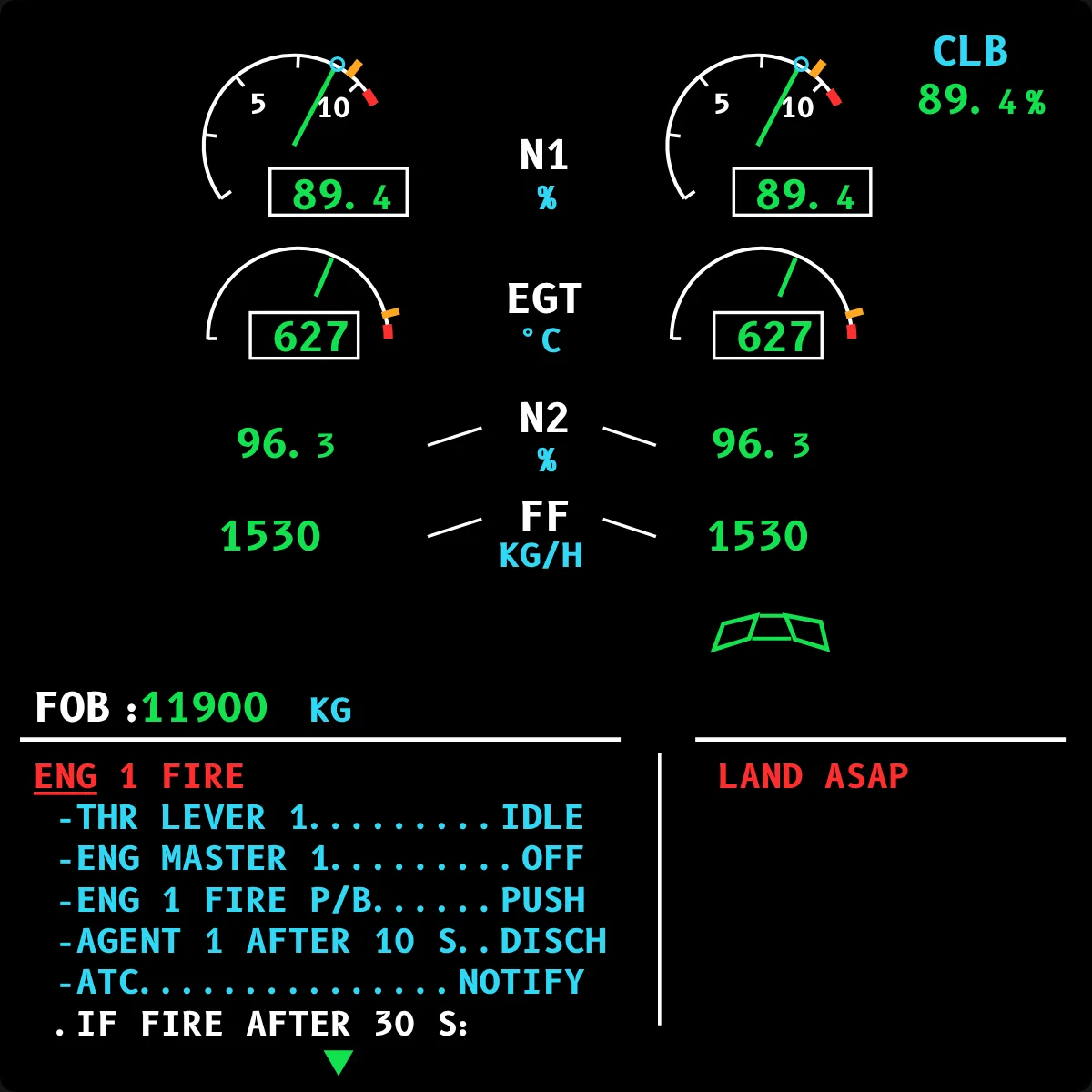
ENG 1 FIRE
A red warning that calls for immediate action. Here is what the two detection loops decide, what the aircraft does when the crew pushes the fire pushbutton, and why the procedure runs in the order it does, with the live aircraft at the moment the warning comes on.
Written and checked by current A320 pilotschecked against the FCOM on Our editorial policy
What ENG 1 FIRE means
ENG 1 FIRE is a red warning: the fire detection of engine 1 has found a fire outside the engine core and gas path, as the FCTM puts it. It needs both detection loops to agree, or one loop with the other faulty, or both loops broken within 5 s.
The ECAM then leads the crew through shutting the engine down and isolating it: the thrust lever to idle, the master lever off, the fire pushbutton pushed, the first agent after 10 s and the second if the warning is still on 30 s after the first. Red LAND ASAP means the nearest airport where a safe landing can be made.
Sources FCOM PRO-ABN-ENG (IN FLIGHT) / FCOM DSC-26-20-10 FIRE DETECTION / FCTM PR-AEP-ENG ENGINE TAILPIPE FIRE / FCOM PRO-ABN-ENG ENG / FCTM AOP-30-10 LAND ASAP DEFINITION
At a glance
- Level
- Red warning, level 3: continuous repetitive chime and a flashing red MASTER WARN light
- Sets it off
- Both detection loops sense a fire, or one does while the other is faulty, or both loops break within 5 s
- Lights
- The ENG 1 FIRE pushbutton on the overhead FIRE panel and the FIRE light by ENG MASTER 1 on the pedestal, both red
- Extinguishing
- Two bottles for each engine, AGENT 1 and AGENT 2, each discharged by a brief push once the fire pushbutton is pushed
- Then
- ENG 1 SHUT DOWN, with the secondary failures *HYD, *ELEC and *AIR BLEED
- Landing
- Red LAND ASAP: the nearest airport where a safe landing can be made
Sources FCOM DSC-31-10 WARNING/CAUTION CLASSIFICATION / FCOM DSC-26-20-10 FIRE DETECTION / FCOM DSC-31-10 AUDIO INDICATORS / FCOM PRO-ABN-ENG (IN FLIGHT) / FCOM DSC-26-20-20 / FCOM DSC-70-90-20 / FCOM DSC-26-20-10 EXTINGUISHING / FCOM PRO-ABN-ENG ENG 1(2) SHUT DOWN / FCOM PRO-ABN-ENG ENG / FCOM PRO-ABN-ENG / FCTM AOP-30-10 LAND ASAP DEFINITION
What makes the fire warning come on?
Each engine has two identical detection loops, A and B, mounted in parallel, and a Fire Detection Unit (FDU). Three or four sensing elements, as installed, sit in the pylon nacelle, the engine core and the fan section; heat on an element sends a signal to the FDU.
A fault in one loop, a break or a loss of electrical supply, does not affect the warning system. With both loops working, the FDU waits for both to sense a temperature above a preset level: the AND logic. If one loop is inoperative, the FDU goes on the remaining loop alone, the OR logic, and that loop still protects the aircraft.
Two more cases trigger the warning: breaks in both loops within 5 s of each other, which the FCOM calls the flame effect, and the crew's own test from the FIRE panel. A loop that has failed gives a caution instead, ENG 1 FIRE LOOP A FAULT or B, and both loops or the FDU failed give ENG 1 FIRE DET FAULT.
Sources FCOM DSC-26-20-10 FIRE DETECTION / FCOM DSC-26-20-10 FIRE DETECTION AND DETECTION FAULT LOGIC / FCOM PRO-ABN-ENG (IN FLIGHT) / FCOM PRO-ABN-ENG ENG 1(2) FIRE DET FAULT / FCOM PRO-ABN-ENG ENG 1(2) FIRE LOOP A(B) FAULT
How the FDU decides there is a fire
What does the crew see and hear?
A red warning is the ECAM's highest level, and the FCOM gives an engine fire as its example: the continuous repetitive chime sounds, MASTER WARN flashes red, the warning message comes up in red on the E/WD, and the SD normally calls up the relevant system page.
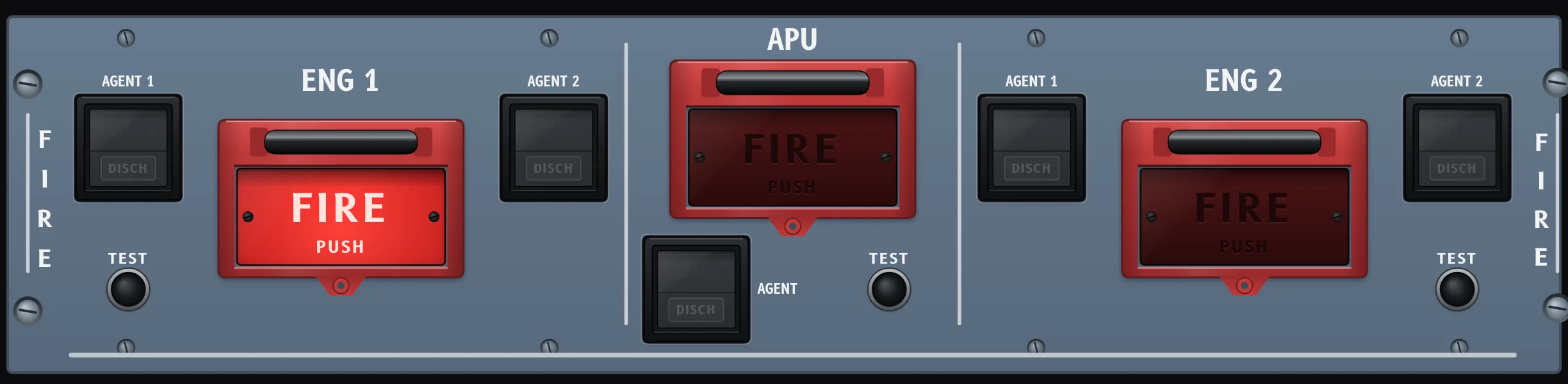
On the overhead FIRE panel the ENG 1 FIRE pushbutton lights red, and on the ENG MASTER panel on the pedestal the engine 1 FIRE light does too. That second light identifies the engine to be shut down. The pushbutton's light comes on whatever its position, and the procedure notes that it stays on until the fire is extinguished.
Sources FCOM DSC-31-10 WARNING/CAUTION CLASSIFICATION / FCOM DSC-26-20-10 FIRE DETECTION / FCOM DSC-31-10 AUDIO INDICATORS / FCOM DSC-26-20-20 / FCOM DSC-70-90-20 / FCOM PRO-ABN-ENG ENG
The moment the warning comes on
A healthy aircraft in flight. Press the button to start the fire, then look at the E/WD, the SD page and the FIRE panel.
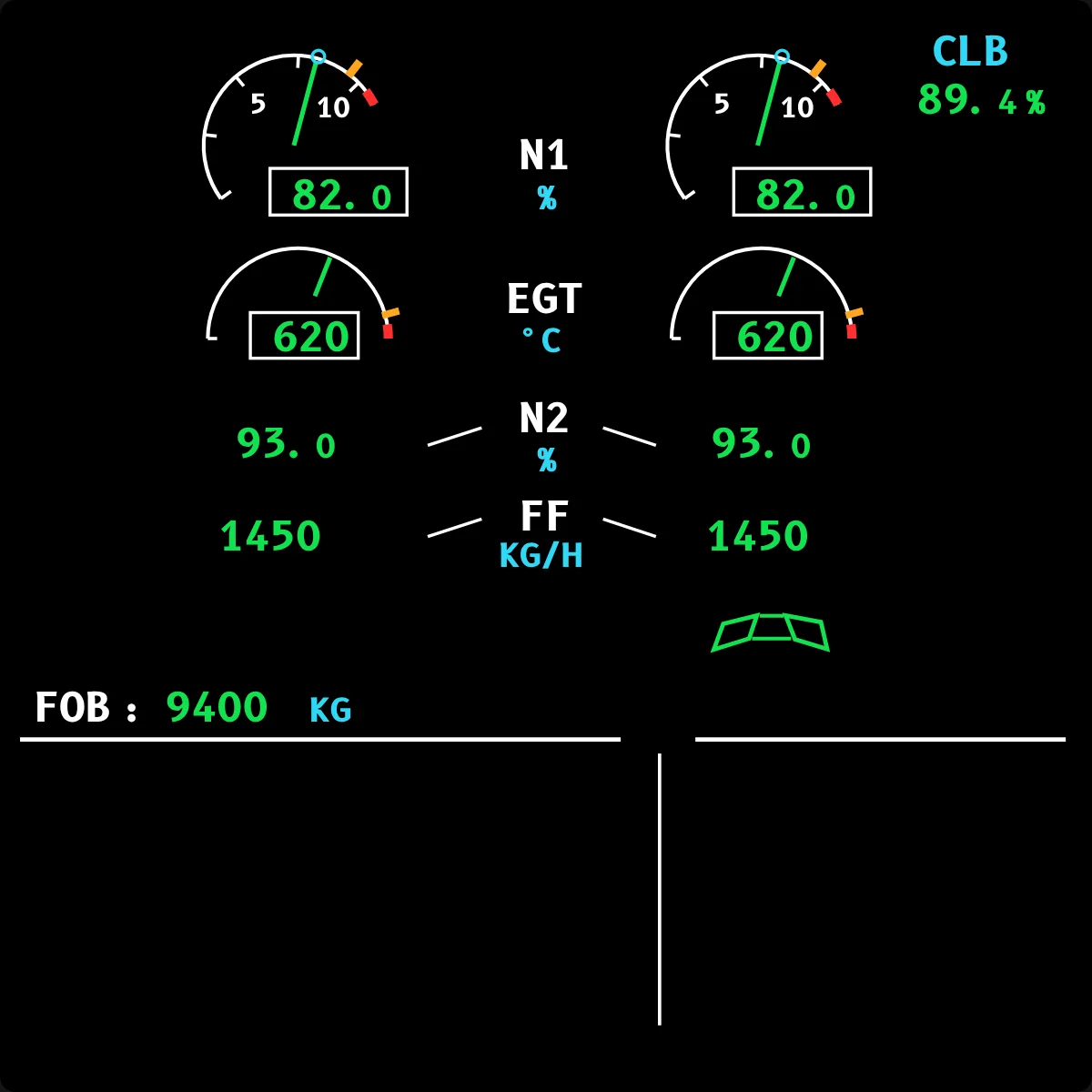
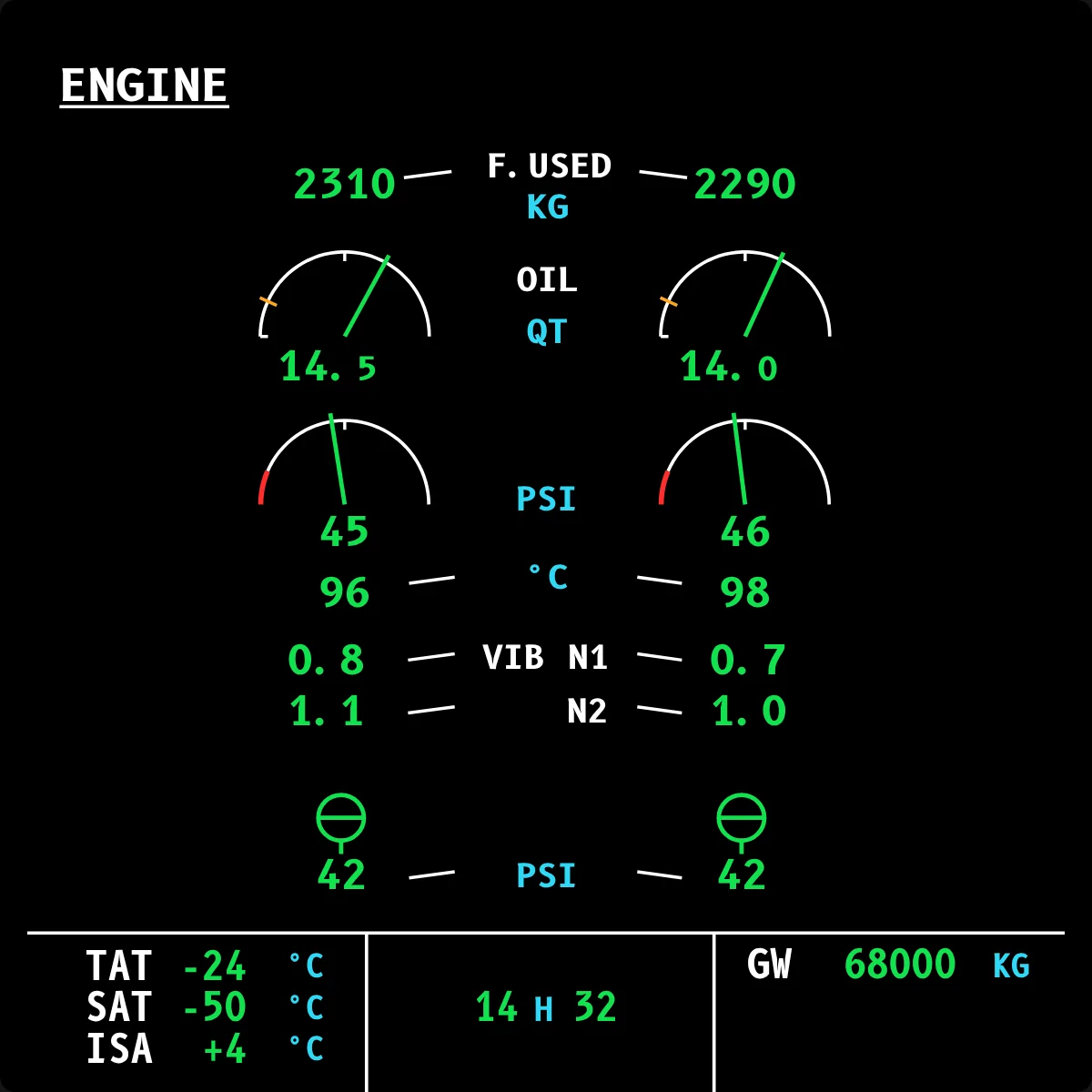
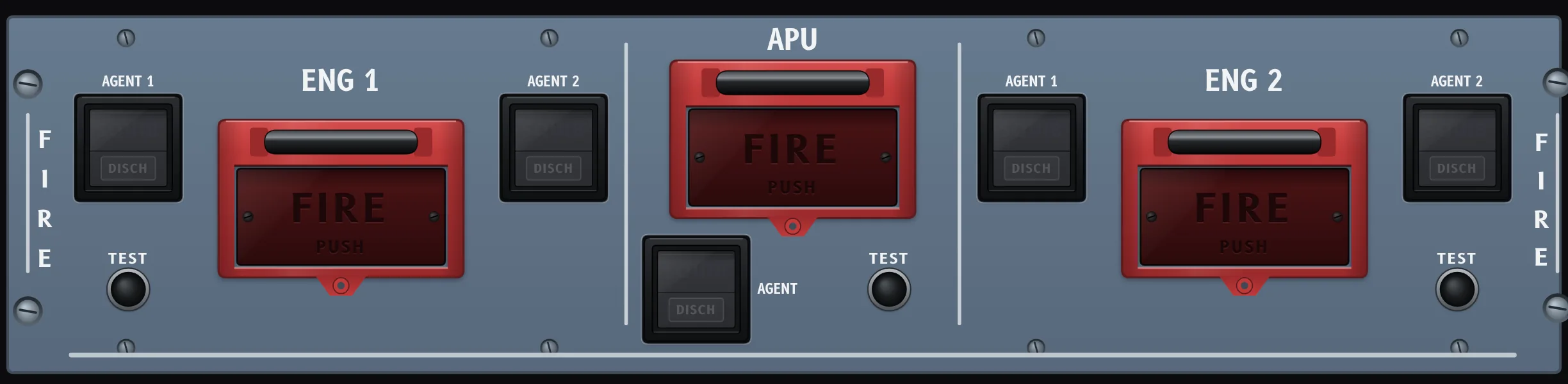
The alert Start the engine 1 fire
The E/WD shows ENG 1 FIRE in red with every line of the procedure in order, and red LAND ASAP. The ENG 1 FIRE pushbutton is lit red on the FIRE panel. Nothing has been done yet, so engine 1 is still running.
This is the alert only. Once the master lever is off in flight, the ENG 1 SHUT DOWN procedure follows: working the lines in order is what the ECAM Trainer does with you.
Sources FCOM PRO-ABN-ENG ENG / FCOM DSC-26-20-20 / FCOM DSC-31-10 WARNING/CAUTION CLASSIFICATION / FCOM PRO-ABN-ENG ENG 1(2) SHUT DOWN
What does the fire pushbutton actually do?
The ENG 1 FIRE pushbutton is the switch that isolates the engine from the rest of the aircraft. When the crew pushes it, it is released and sends one electrical signal that silences the aural warning, arms the extinguisher squibs, closes the low pressure fuel valve, the hydraulic fire shutoff valve, the engine bleed valve and the pack flow control valve, cuts the FADEC's power and deactivates the IDG.
So fuel stops reaching the engine, hydraulic fluid stops flowing to its pump, and no hot air is taken from it. The SQUIB lights then come on white on both AGENT pushbuttons, to show the crew which ones to press.
Sources FCOM DSC-26-20-20 / FCOM DSC-29-10-20 FIRE SHUTOFF VALVES
Push the fire pushbutton
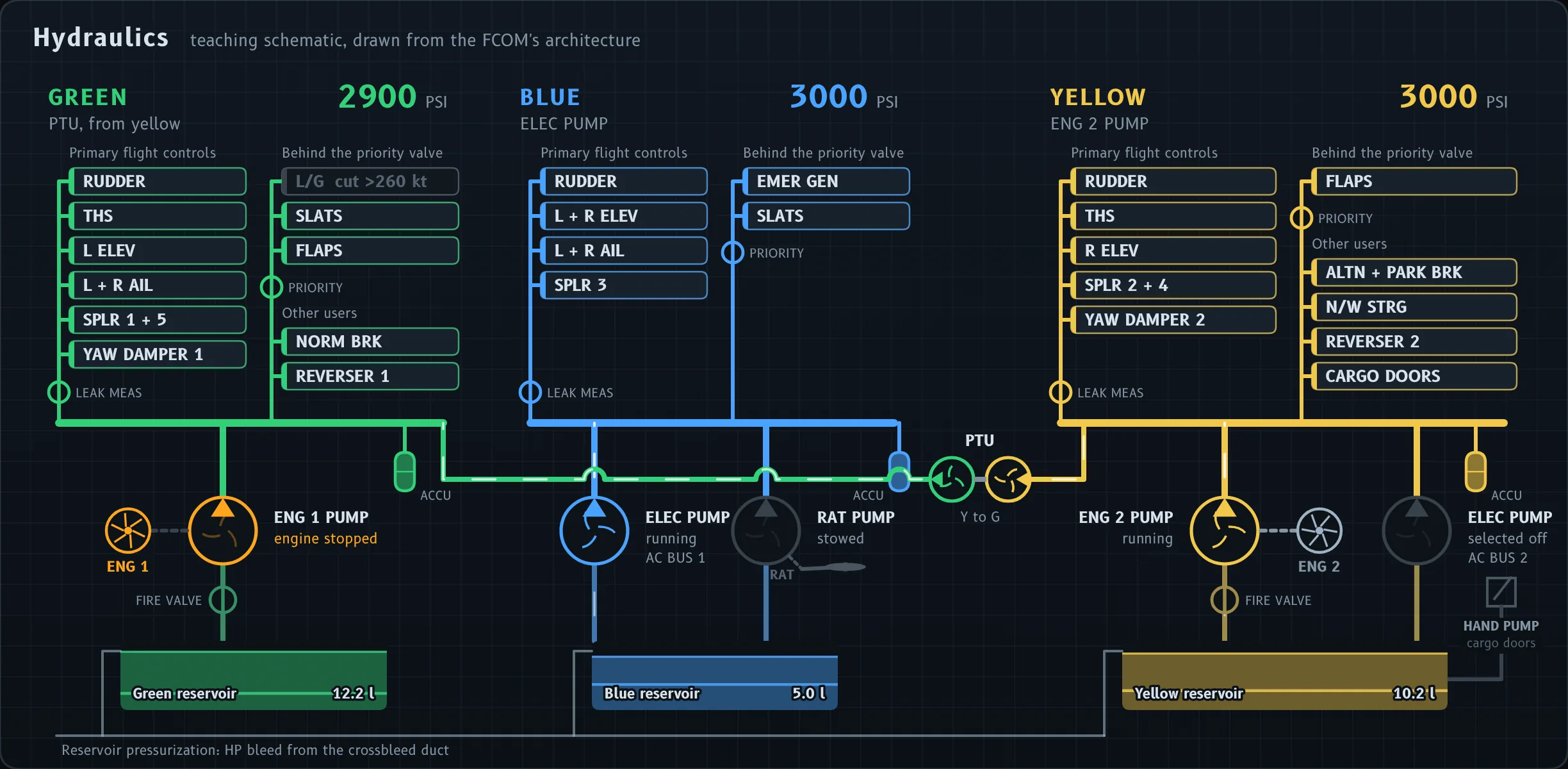
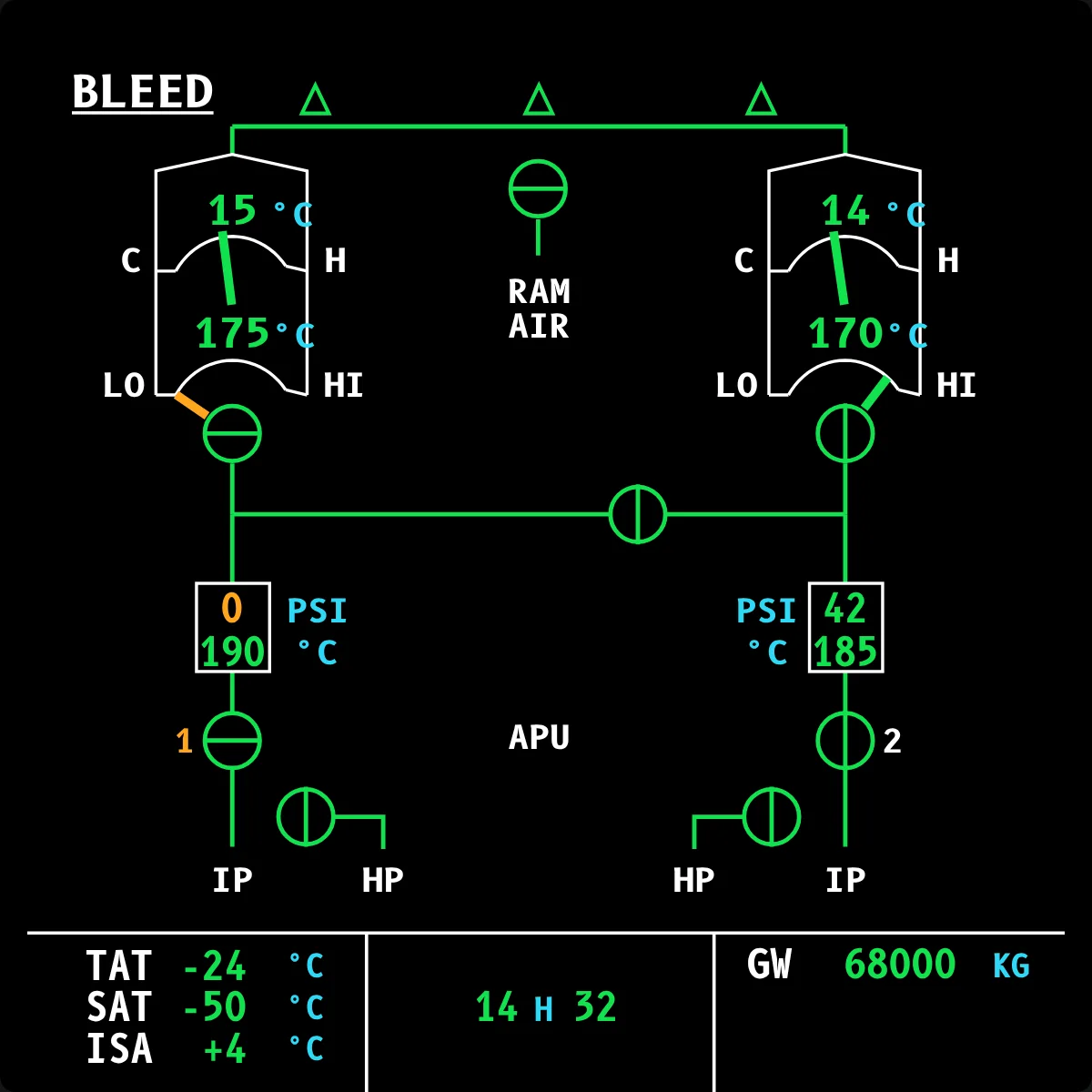
Engine 1 is on fire, its thrust lever at idle and its master lever already off. Predict first, then push the guarded ENG 1 FIRE pushbutton on the panel and watch the hydraulic schematic and the BLEED page.
-
Predict The engine is already shut down. What does pushing its fire pushbutton change for the green hydraulic system?
Try it Lift the guard and push ENG 1 FIRE.
Green's fire shutoff valve, upstream of the engine 1 pump, closes. Green does not go with it: the engine 1 pump stopped pressurising green when the engine stopped, and with the PTU in AUTO and more than 500 psi between green and yellow, the PTU runs by itself and yellow keeps green pressurised.
On the BLEED page, engine 1's bleed valve and pack 1's flow control valve show shut, as the pushbutton commands: the burning engine gives no air, and pack 2 carries on alone.
Sources FCOM DSC-29-10-20 FIRE SHUTOFF VALVES / FCOM DSC-29-10-20 POWER TRANSFER UNIT (PTU) / FCOM DSC-29-20 OVERHEAD PANEL / FCOM DSC-26-20-20
Why does the procedure run in this order?
In flight, the PF and PM crosscheck before any action on the ENG MASTER lever or any guarded control, and the ENG FIRE pushbutton is a guarded one. The aim is to prevent an inadvertent action with irreversible effects, as with a red guarded control.
The master lever comes after the thrust lever to idle and before the pushbutton: setting it off closes both the LP and the HP fuel valves. The pushbutton then cuts the engine off from fuel, hydraulics, air and electrics, and arms the extinguisher squibs.
The first agent waits 10 s on purpose. As the FCOM puts it, the delay allows "N1 to decrease, reducing nacelle ventilation, and thereby increasing the effect of the agent." The ECAM counts the 10 s down for the crew. If the warning is still on 30 s after the first agent, the second bottle goes.
The FCTM uses this very procedure as its example of a warning that disappears: if the first bottle puts the fire out, ENG 1 FIRE goes and the procedure "no longer applies", while any remaining ECAM procedures are done as usual.
Sources FCOM DSC-26-20-20 / FCTM AOP-30-20 GENERAL / FCOM PRO-ABN-ENG ENG / FCTM AOP-30-30
What does the aircraft lose with the engine?
With the master lever off in flight, ENG 1 SHUT DOWN follows, and with it three secondary failures to review: *HYD, *ELEC and *AIR BLEED. The FIRE procedure itself adds one firm rule: do not try to restart the engine.
In the shutdown procedure the crew selects continuous ignition, to protect the remaining engine, and, with the fire pushbutton pushed, shuts the crossbleed and sets wing anti-ice off; the procedure then reads AVOID ICING CONDITIONS.
Sources FCOM PRO-ABN-ENG ENG 1(2) SHUT DOWN / FCOM PRO-ABN-ENG ENG / FCOM PRO-ABN-ENG
What goes with engine 1
What is lost afterwards?
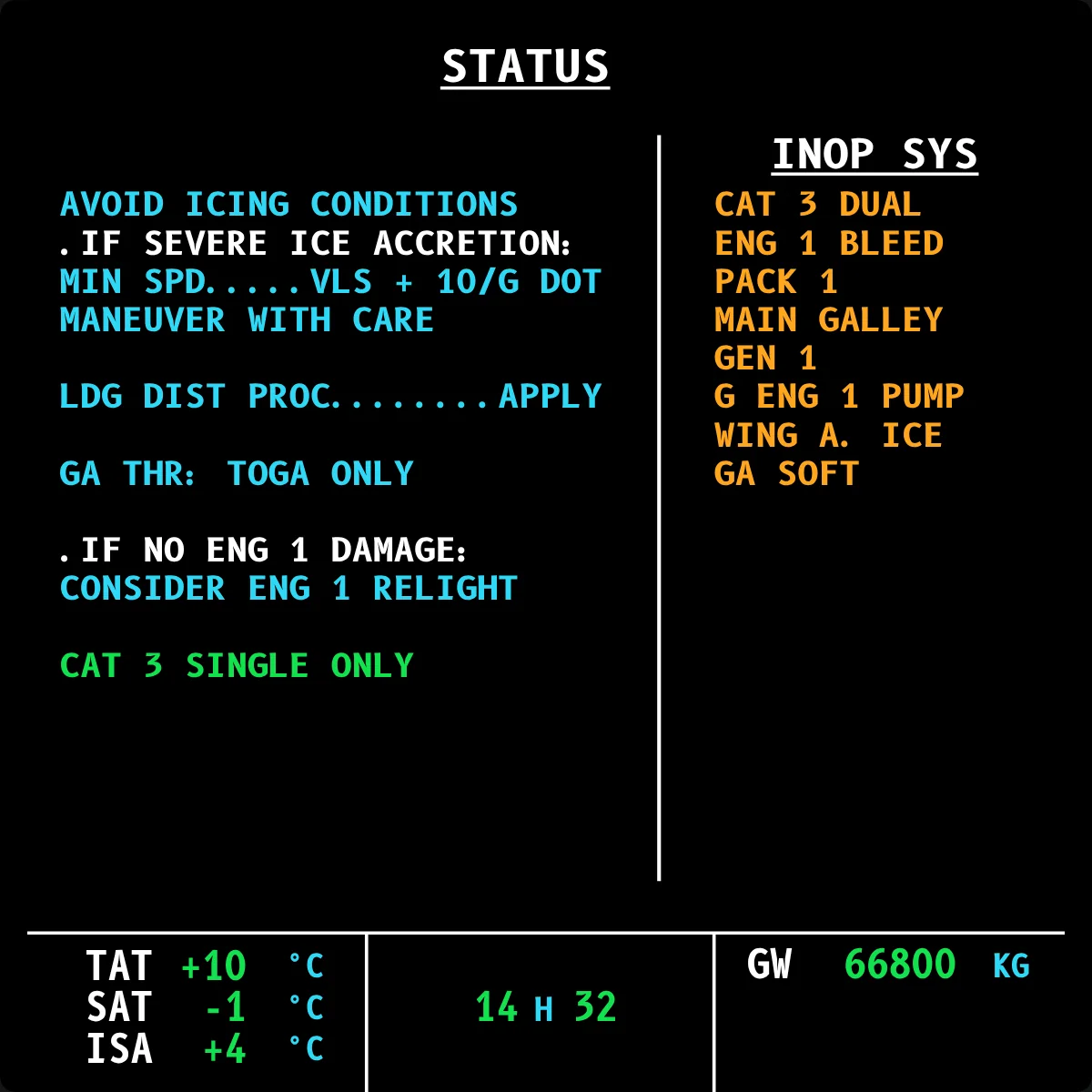
STATUS sums up what the crew lands with. With the fire pushbutton pushed, the limitations start with AVOID ICING CONDITIONS, and if severe ice builds up anyway, a minimum speed of VLS + 10 or green dot, manoeuvring with care, and the landing distance procedure.
INOP SYS lists what went with the engine: CAT 3 DUAL, ENG 1 BLEED, PACK 1, MAIN GALLEY, GEN 1, the green engine pump and, as the pushbutton was pushed, wing anti-ice. Near the foot, STATUS shows CAT 3 SINGLE ONLY.
The shutdown STATUS in the FCOM also carries CONSIDER ENG 1 RELIGHT, under IF NO ENG 1 DAMAGE. That line belongs to the shutdown procedure; after a fire, the FIRE procedure has already said not to attempt a restart.
Which version applies depends on your aircraft: check your own FCOM.
Sources FCOM PRO-ABN-ENG ENG
A319ceo, A320ceo, A320neo, A321neo: what differs?
| A319ceo, A320ceo | A320neo, A321neo | |
|---|---|---|
| The warning and its procedure | The same in every version | The same in every version |
| Engines | CFM56-5B | LEAP-1A |
| ENG SHUT DOWN: pack 1 | Not given by type: one version sets the affected pack off only with the wing anti-ice on; another whether or not it is on | Not given by type: one version sets the affected pack off only with the wing anti-ice on; another whether or not it is on |
| STATUS limitations | Not given by type: one version has no go-around thrust line and ends with ONE PACK ONLY IF WAI ON; the two others add GA THR: TOGA ONLY | Not given by type: one version has no go-around thrust line and ends with ONE PACK ONLY IF WAI ON; the two others add GA THR: TOGA ONLY |
| STATUS INOP SYS, besides the engine's own systems | Not given by type: one version lists STEEP APPR and AFT CRG HEAT, each where fitted; the two others GA SOFT, and AFT CRG HEAT where fitted | Not given by type: one version lists STEEP APPR and AFT CRG HEAT, each where fitted; the two others GA SOFT, and AFT CRG HEAT where fitted |
The FCOM prints three versions of the shutdown STATUS, worded slightly differently, mostly in the reverser lines. The STATUS above is one of them. After a fire, the pushbutton has already closed pack 1's flow control valve, whichever version applies.
Sources FCOM PRO-ABN-ENG (IN FLIGHT) / FCOM PRO-ABN-ENG ENG / FCOM DSC-70-05 OVERVIEW / FCOM DSC-70-05 / FCOM PRO-ABN-ENG / FCOM DSC-26-20-20

Work ENG 1 FIRE as a crew
Read and do each line against the FCOM, with the E/WD, the SD page and the overhead following your hands, the PF and PM calls, and a debrief that says what you missed.
Work this failure in the ECAM TrainerGo further
Written in our own words from the FCOM and the FCTM; each part names the units it rests on. The E/WD, the STATUS and the live aircraft are the platform's own ECAM and systems model, the same the ECAM Trainer and the flight deck run. This page explains the procedure; it is not the procedure. Aircraft differ by type, engine and options: your aircraft's FCOM, your QRH and your operator's procedures always come first. How we write and check these pages.
Every ECAM procedure, line by line, against the FCOM.
The ECAM Trainer works 108 scenarios with the E/WD, the SD page and the overhead following your hands. Start free today, or open everything with A320 Knowledge+.
For study and revision only. Always follow your operator's approved documentation and procedures. A320 Knowledge is independent and not affiliated with Airbus.
Related
- ENG 1 FAILAn amber caution for an engine whose core speed has fallen below idle with its master lever still on.
- ENG 1 FUEL LEAKAn amber caution for an abnormal difference between the engines in fuel flow or fuel used.
- ENG 1 OIL HI TEMPAn amber caution for engine oil that is too hot, or has been warm for too long.
- ENG 1 OIL LO PRA red warning for an engine whose oil pressure has fallen below its alert threshold.
- A320 fire protectionThe system guide, with the live aircraft
- Every ECAM procedureThe alerts the ECAM Trainer works, grouped by system