
ENG 1 OIL LO PR
A red warning for an engine whose oil pressure has fallen below its alert threshold. Here is what sets it off, what the ENGINE page check tells the crew, what the aircraft does by itself when the engine is shut down, and what STATUS keeps, with the live aircraft at the moment the warning comes on.
Written and checked by current A320 pilotschecked against the FCOM on Our editorial policy
What ENG 1 OIL LO PR means
ENG 1 OIL LO PR is a red warning: engine 1's oil pressure has fallen below the alert threshold. In one version of the alert, for some aircraft, that is 13 PSI; in another, for others, it varies with N2, from 17.4 PSI at idle to 29 PSI at high thrust.
The crew first checks the oil pressure on the ENGINE page. The thrust lever then goes to idle and the master lever off, and ENG 1 SHUT DOWN follows. A red oil pressure on the ENGINE page without the warning points to a faulty transducer instead: the crew may keep the engine running while monitoring its other parameters.
Sources FCOM PRO-ABN-ENG ENG 1(2) OIL LO PR / FCOM PRO-ABN-ENG ENG / FCOM DSC-31-10 WARNING/CAUTION CLASSIFICATION / FCOM PRO-ABN-ENG ABNORMAL AND EMERGENCY PROCEDURES / FCOM PRO-ABN-ENG ENG 1(2) SHUT DOWN
At a glance
- Level
- Red warning, level 3: continuous repetitive chime, MASTER WARN flashing red and, normally, the ENGINE page on the SD
- Sets it off
- Oil pressure below 13 PSI in one version of the alert, for some aircraft; in another, for others, below a threshold that rises with N2 from 17.4 PSI at idle to 29 PSI at high thrust
- First
- Check the oil pressure on the ENGINE page: red there without the warning points to a faulty transducer
- The actions
- Thrust lever 1 to idle and ENG MASTER 1 off; one version of the procedure puts both under IF OIL PR < 13 PSI
- Then
- ENG 1 SHUT DOWN once the master lever is off in flight, with the secondary failures *HYD, *ELEC and *AIR BLEED
- Landing
- The shutdown procedure brings amber LAND ASAP: consider landing at the nearest suitable airport
Sources FCOM DSC-31-10 WARNING/CAUTION CLASSIFICATION / FCOM DSC-31-10 AUDIO INDICATORS / FCOM DSC-31-30 ATTENTION GETTERS / FCOM DSC-31-20 SYSTEM PAGES / FCOM PRO-ABN-ENG ENG 1(2) OIL LO PR / FCOM PRO-ABN-ENG ENG / FCOM PRO-ABN-ENG ABNORMAL AND EMERGENCY PROCEDURES / FCOM PRO-ABN-ENG ENG 1(2) SHUT DOWN / FCOM PRO-ABN-ENG / FCTM AOP-30-10 LAND ASAP DEFINITION
What sets the warning off?
The warning compares engine 1's oil pressure with a threshold. The FCOM gives the alert in two versions, each for some aircraft. In one the threshold is 13 PSI. In the other it varies with N2, from 17.4 PSI at idle to 29 PSI at high thrust.
The ENGINE page and the limitations give their own figures by type. On the A319ceo and A320ceo the page's red range for the oil pressure runs from 0 to 13 PSI; the limitations give the A320neo and A321neo, whose engines are LEAP-1As, a minimum oil pressure of 17.4 PSI.
Before the red range, the ENGINE page gives an advisory: the oil pressure pulses green with N2 above 75 %, between 13 and 16 PSI on the A319ceo and A320ceo, and below the lower advisory limit on the A320neo and A321neo.
The oil system lubricates the engine. It has an oil tank, lube and scavenge pump modules, a fuel/oil heat exchanger, filters, chip detectors, and pressure relief and bypass valves.
Sources FCOM PRO-ABN-ENG ENG 1(2) OIL LO PR / FCOM PRO-ABN-ENG ENG / FCOM DSC-70-90-40 / FCOM LIM-ENG OIL / FCOM DSC-70-05 OVERVIEW / FCOM DSC-70-50 GENERAL
From the oil pressure to the warning
What does the crew see and hear?
A level 3 red warning: the continuous repetitive chime, MASTER WARN flashing red, the warning in red on the E/WD, and the SD normally calls up the relevant system page by itself, here the ENGINE page, where the oil pressure is in the red range.
The warning stops nothing by itself: the actions on the thrust lever and the master lever are the crew's.
Sources FCOM DSC-31-10 WARNING/CAUTION CLASSIFICATION / FCOM DSC-31-10 AUDIO INDICATORS / FCOM DSC-31-30 ATTENTION GETTERS / FCOM DSC-31-20 SYSTEM PAGES / FCOM DSC-70-90-40 / FCOM PRO-ABN-ENG ABNORMAL AND EMERGENCY PROCEDURES / FCOM PRO-ABN-ENG ENG
The moment the warning comes on
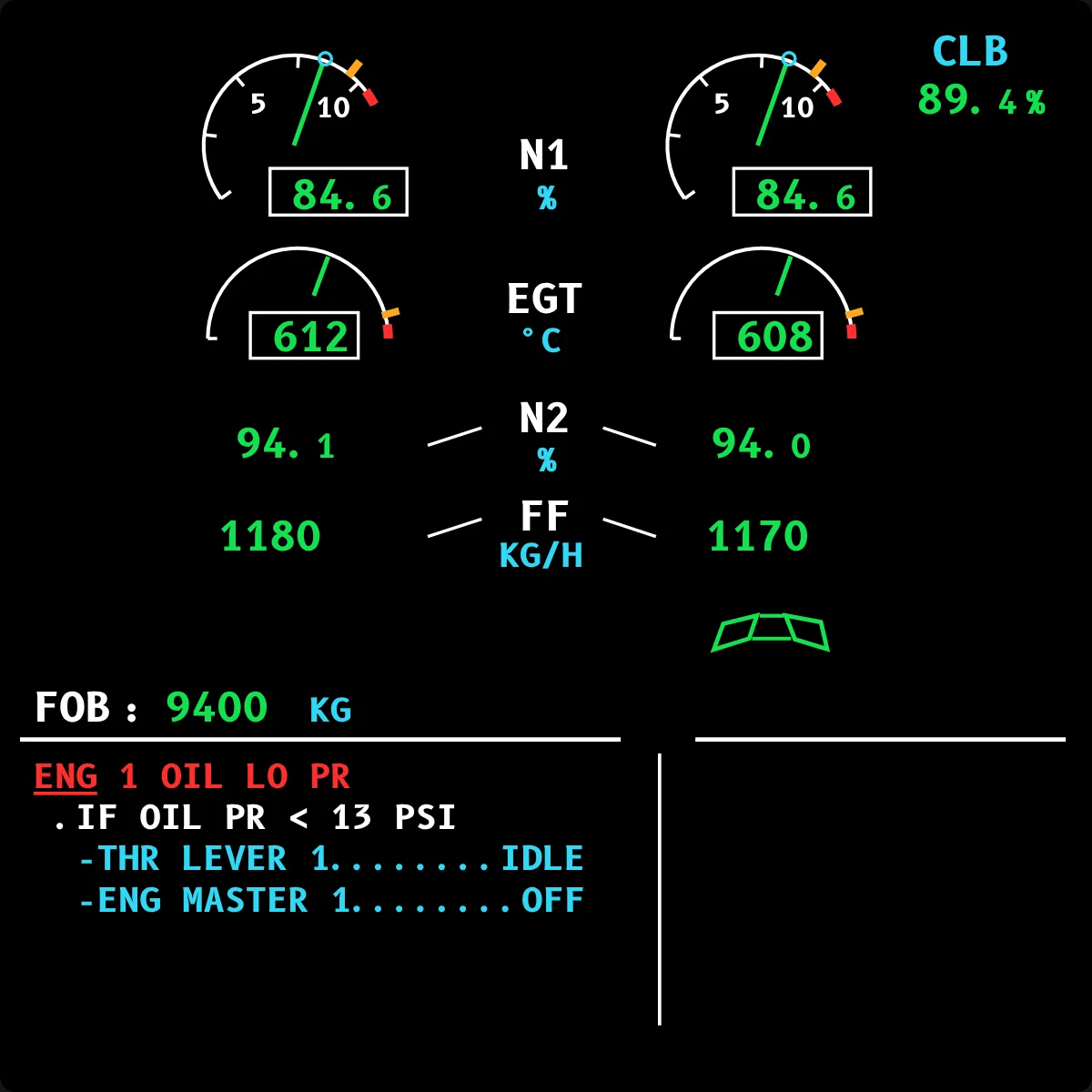
A healthy aircraft in the cruise, both engines running. Press the button to lose engine 1's oil pressure, then look at the E/WD, the ENGINE page and the ENG MASTER panel.
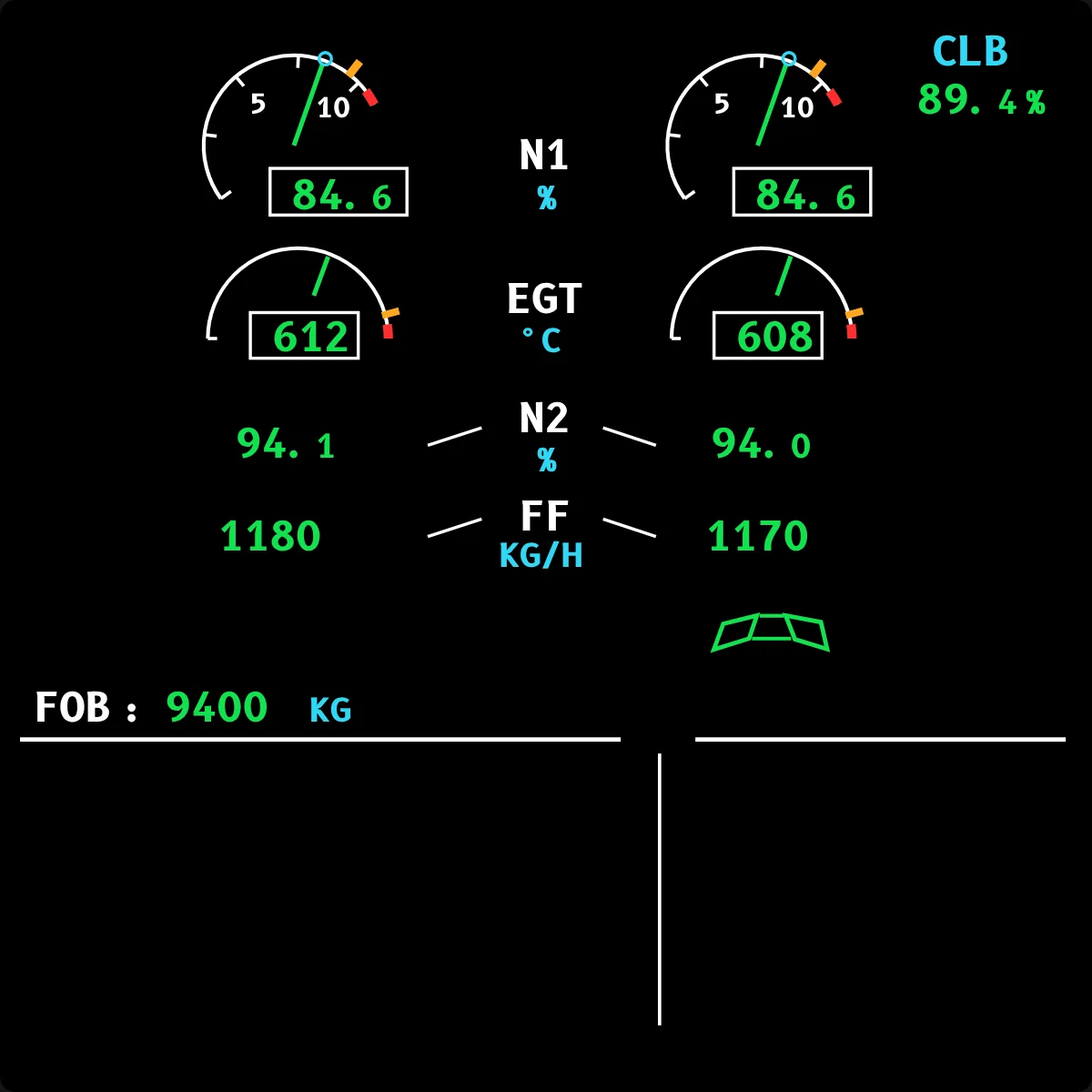
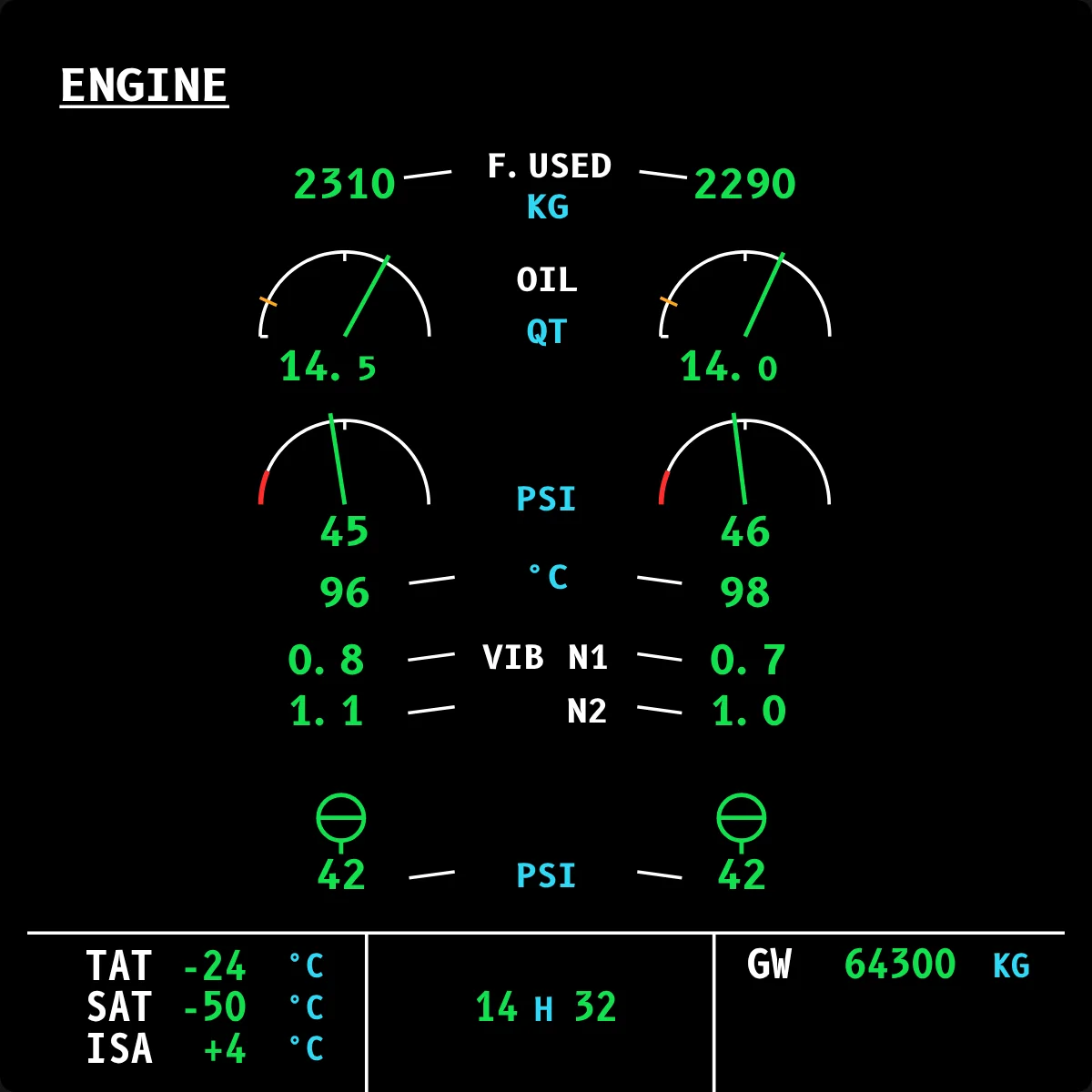

The alert Lose engine 1's oil pressure
The E/WD shows ENG 1 OIL LO PR in red with one version of the procedure's lines: IF OIL PR < 13 PSI, and under it THR LEVER 1 IDLE and ENG MASTER 1 OFF. ENG MASTER 1 is still at ON: nothing has been done yet.
The ENGINE page in this drawing keeps engine 1's normal oil pressure: the failure key does not lower it. On the aircraft the pressure is in the red range, which is what the first check looks for. Working the lines is what the ECAM Trainer does with you.
Sources FCOM PRO-ABN-ENG ABNORMAL AND EMERGENCY PROCEDURES / FCOM DSC-70-90-40 / FCOM PRO-ABN-ENG ENG
What does the ENGINE page check tell the crew?
Both versions of the procedure open with the same instruction: check the oil pressure indication on the ENGINE page. Their note sets two cases apart. If the oil pressure is red on the ENGINE page without the ENG OIL LO PR warning, the oil pressure transducer can be assumed faulty, and the crew may continue engine operation while monitoring the other engine parameters.
With the warning, one version makes the actions conditional: IF OIL PR < 13 PSI, the thrust lever to idle and the master lever off. In the other the two actions follow directly, and its note gives the low pressure as below 17.4 PSI at idle and 29 PSI at high thrust. The FCOM gives no reason for the difference, nor for idle before the master lever.
In flight the PF and PM crosscheck before any action on an ENG MASTER lever, to prevent an inadvertent action with irreversible effects.
Sources FCOM PRO-ABN-ENG ABNORMAL AND EMERGENCY PROCEDURES / FCOM PRO-ABN-ENG ENG / FCTM AOP-30-20 GENERAL
What does the aircraft do when the engine is shut down?
Setting the ENG MASTER lever to OFF has the FADEC shut the engine down and closes its LP and HP fuel valves.
The rest of the aircraft reconfigures around the stopped engine. The system replaces generator 1 with the APU generator, if available, or the other engine generator, and part of the galley load is shed. Green loses its engine driven pump; the PTU comes into action by itself once green and yellow differ by more than 500 PSI.
Sources FCOM DSC-70-90-20 / FCOM PRO-ABN-ENG ENG / FCOM DSC-24-10-30-30 FAILURE OF ONE ENGINE GENERATOR / FCOM DSC-29-10-20 POWER TRANSFER UNIT (PTU)
Shut engine 1 down
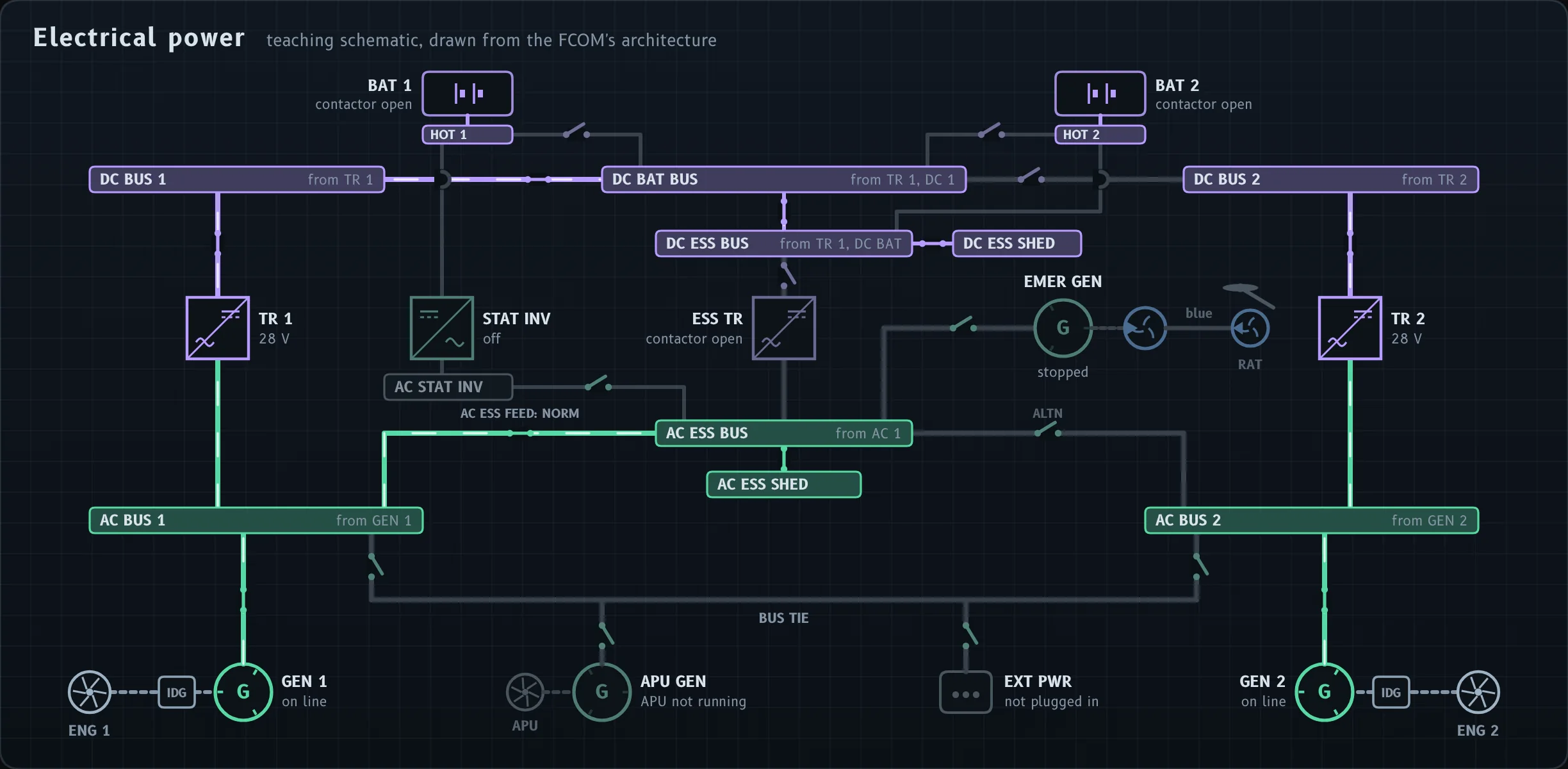
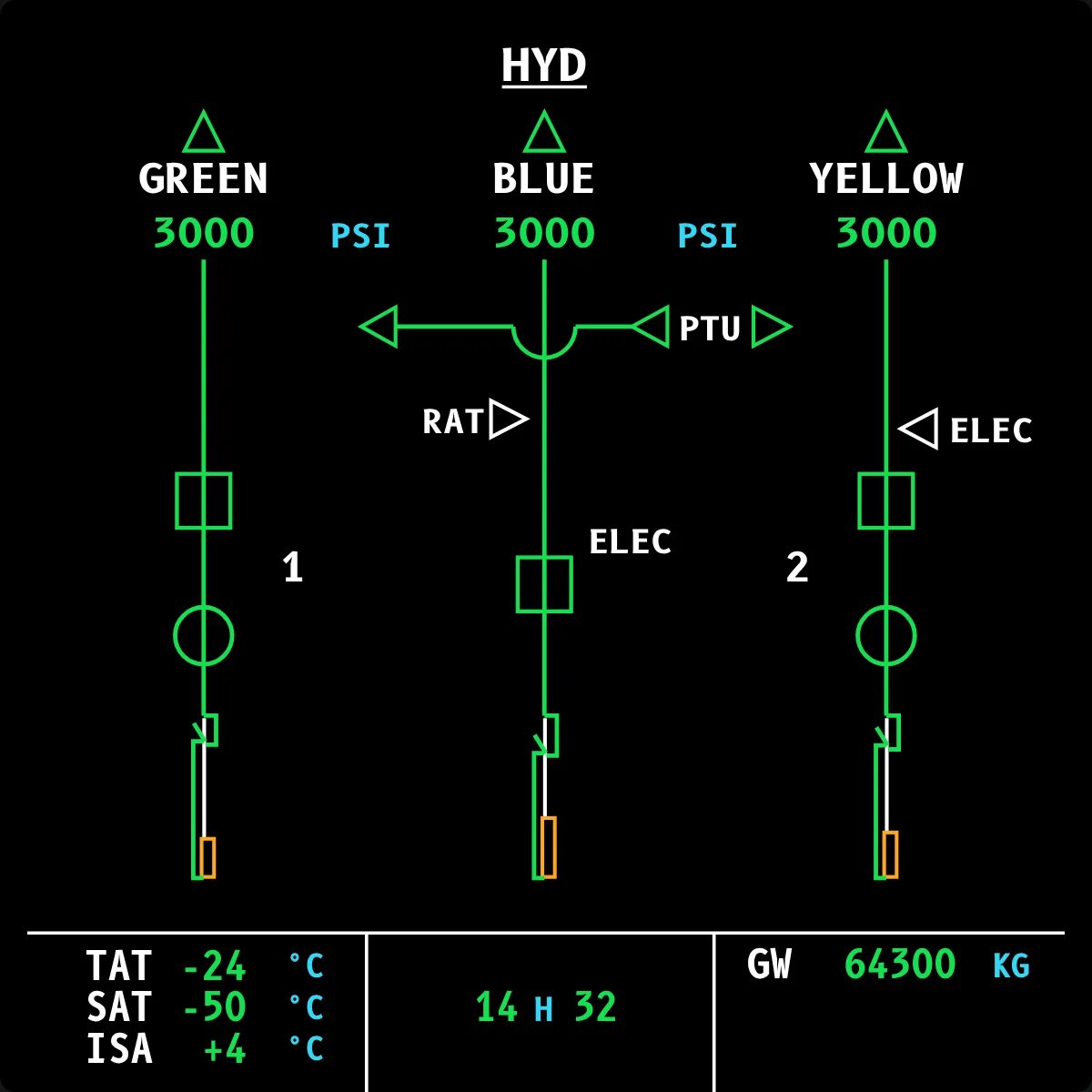
Engine 1 is still running with its oil pressure low, the APU off. Predict first, then set the lever on the ENG MASTER panel and watch the electrical schematic and the HYD page.

-
Predict Set ENG MASTER 1 to OFF and generator 1 stops with the engine. What supplies AC BUS 1 then?
Try it Set ENG MASTER 1 to OFF.
Engine 1 stops. On the schematic generator 1 drops off line, generator 2 takes AC BUS 1 as well, and part of the galley load is shed. With the APU not running, the other engine generator is the replacement.
On the HYD page green's engine pump shows low pressure and the PTU now pressurises green from yellow. STATUS will list MAIN GALLEY, GEN 1 and the green engine pump as inoperative.
Sources FCOM DSC-24-10-30-30 FAILURE OF ONE ENGINE GENERATOR / FCOM DSC-29-10-20 POWER TRANSFER UNIT (PTU) / FCOM PRO-ABN-ENG ENG
What does the aircraft lose with the engine?
With the master lever off in flight, ENG 1 SHUT DOWN follows, and with it three secondary failures to review: *HYD, *ELEC and *AIR BLEED.
The shutdown procedure opens with amber LAND ASAP, which means considering a landing at the nearest suitable airport. In it the crew selects continuous ignition, to protect the remaining engine.
Engine 1's bleed valve closes too, and with the crossbleed shut, as it is at AUTO with the APU bleed off, pack 1 is left without air; ENG 1 BLEED and PACK 1 go to INOP SYS on STATUS.
Sources FCOM PRO-ABN-ENG ENG 1(2) SHUT DOWN / FCOM PRO-ABN-ENG ENG / FCOM PRO-ABN-ENG / FCTM AOP-30-10 LAND ASAP DEFINITION / FCOM DSC-36-10-20 PRESSURE REGULATION AND LIMITATION / FCOM DSC-36-20 OVERHEAD PANEL / FCOM DSC-21-10-50 CONTROLS ON OVERHEAD PANEL
What is lost afterwards?
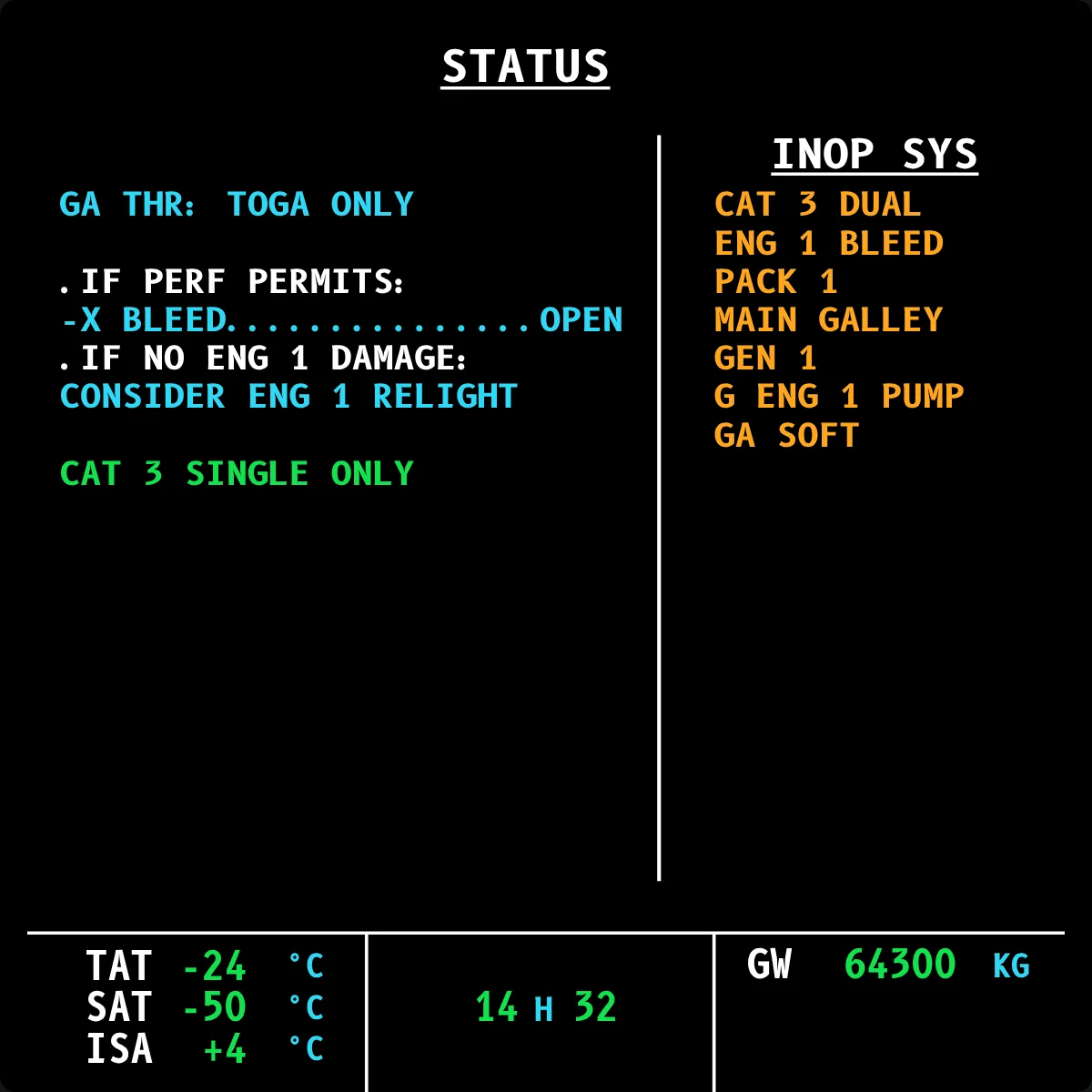
STATUS is the aircraft's operational summary. The one drawn is the ENG 1 SHUT DOWN STATUS, as it reads once the master lever is off. With the wing anti-ice off and the fire pushbutton not pushed, it reads IF PERF PERMITS: X BLEED OPEN, and the FCOM's note says to open the crossbleed if no obstacle constraint exists.
Under IF NO ENG 1 DAMAGE it reads CONSIDER ENG 1 RELIGHT, printed green in the FCOM and drawn blue here, then CAT 3 SINGLE ONLY. INOP SYS lists what went with the engine: CAT 3 DUAL, ENG 1 BLEED, PACK 1, MAIN GALLEY, GEN 1 and the green engine pump.
The version drawn also carries GA THR: TOGA ONLY on the left and GA SOFT in INOP SYS.
Which version applies depends on your aircraft: check your own FCOM.
Sources FCOM DSC-31-20 STATUS PAGE / FCOM PRO-ABN-ENG ENG
A319ceo, A320ceo, A320neo, A321neo: what differs?
| A319ceo, A320ceo | A320neo, A321neo | |
|---|---|---|
| Triggering threshold | Not given by type: one version of the alert, 13 PSI; another, a threshold that varies with N2, from 17.4 PSI at idle to 29 PSI at high thrust | Not given by type: one version of the alert, 13 PSI; another, a threshold that varies with N2, from 17.4 PSI at idle to 29 PSI at high thrust |
| The lines | Not given by type: one version puts the thrust lever and the master lever under IF OIL PR < 13 PSI; another has no condition line | Not given by type: one version puts the thrust lever and the master lever under IF OIL PR < 13 PSI; another has no condition line |
| Oil pressure on the ENGINE page | Scale 0 to 100 PSI, red from 0 to 13 PSI | Scale 0 to 130 PSI; the limitations give a minimum of 17.4 PSI |
| Engines | CFM56-5B | LEAP-1A |
| ENG SHUT DOWN: pack 1 | Not given by type: one version sets the affected pack off only with the wing anti-ice on; another whether or not it is on | Not given by type: one version sets the affected pack off only with the wing anti-ice on; another whether or not it is on |
| STATUS limitations | Not given by type: one version has no go-around thrust line and ends with ONE PACK ONLY IF WAI ON; the two others add GA THR: TOGA ONLY | Not given by type: one version has no go-around thrust line and ends with ONE PACK ONLY IF WAI ON; the two others add GA THR: TOGA ONLY |
| STATUS INOP SYS, besides the engine's own systems | Not given by type: one version lists STEEP APPR and AFT CRG HEAT, each where fitted; the two others GA SOFT, and AFT CRG HEAT where fitted | Not given by type: one version lists STEEP APPR and AFT CRG HEAT, each where fitted; the two others GA SOFT, and AFT CRG HEAT where fitted |
The FCOM prints three versions of the shutdown STATUS, worded slightly differently, mostly in the reverser lines. The STATUS above is one of them.
Sources FCOM PRO-ABN-ENG ENG 1(2) OIL LO PR / FCOM PRO-ABN-ENG ENG / FCOM PRO-ABN-ENG ABNORMAL AND EMERGENCY PROCEDURES / FCOM DSC-70-90-40 / FCOM LIM-ENG OIL / FCOM DSC-70-05 OVERVIEW / FCOM DSC-70-05 / FCOM PRO-ABN-ENG

Work ENG 1 OIL LO PR as a crew
Read and do each line against the FCOM, with the E/WD, the SD page and the overhead following your hands, the PF and PM calls, and a debrief that says what you missed.
Work this failure in the ECAM TrainerGo further
Written in our own words from the FCOM and the FCTM; each part names the units it rests on. The E/WD, the STATUS and the live aircraft are the platform's own ECAM and systems model, the same the ECAM Trainer and the flight deck run. This page explains the procedure; it is not the procedure. Aircraft differ by type, engine and options: your aircraft's FCOM, your QRH and your operator's procedures always come first. How we write and check these pages.
Every ECAM procedure, line by line, against the FCOM.
The ECAM Trainer works 108 scenarios with the E/WD, the SD page and the overhead following your hands. Start free today, or open everything with A320 Knowledge+.
For study and revision only. Always follow your operator's approved documentation and procedures. A320 Knowledge is independent and not affiliated with Airbus.
Related
- ENG 1 FAILAn amber caution for an engine whose core speed has fallen below idle with its master lever still on.
- ENG 1 FUEL LEAKAn amber caution for an abnormal difference between the engines in fuel flow or fuel used.
- ENG 1 OIL HI TEMPAn amber caution for engine oil that is too hot, or has been warm for too long.
- ENG 1 REVERSE UNLOCKEDAn amber caution for a thrust reverser that is not locked stowed in flight.
- A320 engines and APUThe system guide, with the live aircraft
- Every ECAM procedureThe alerts the ECAM Trainer works, grouped by system