
ENG 1 REVERSE UNLOCKED
An amber caution for a thrust reverser that is not locked stowed in flight. Here is what sets it off, how the reverser is built and protected on each type, what the procedure's speeds and its buffet condition change, and what the approach becomes, with the live aircraft at the moment the caution comes on.
Written and checked by current A320 pilotschecked against the FCOM on Our editorial policy
What ENG 1 REVERSE UNLOCKED means
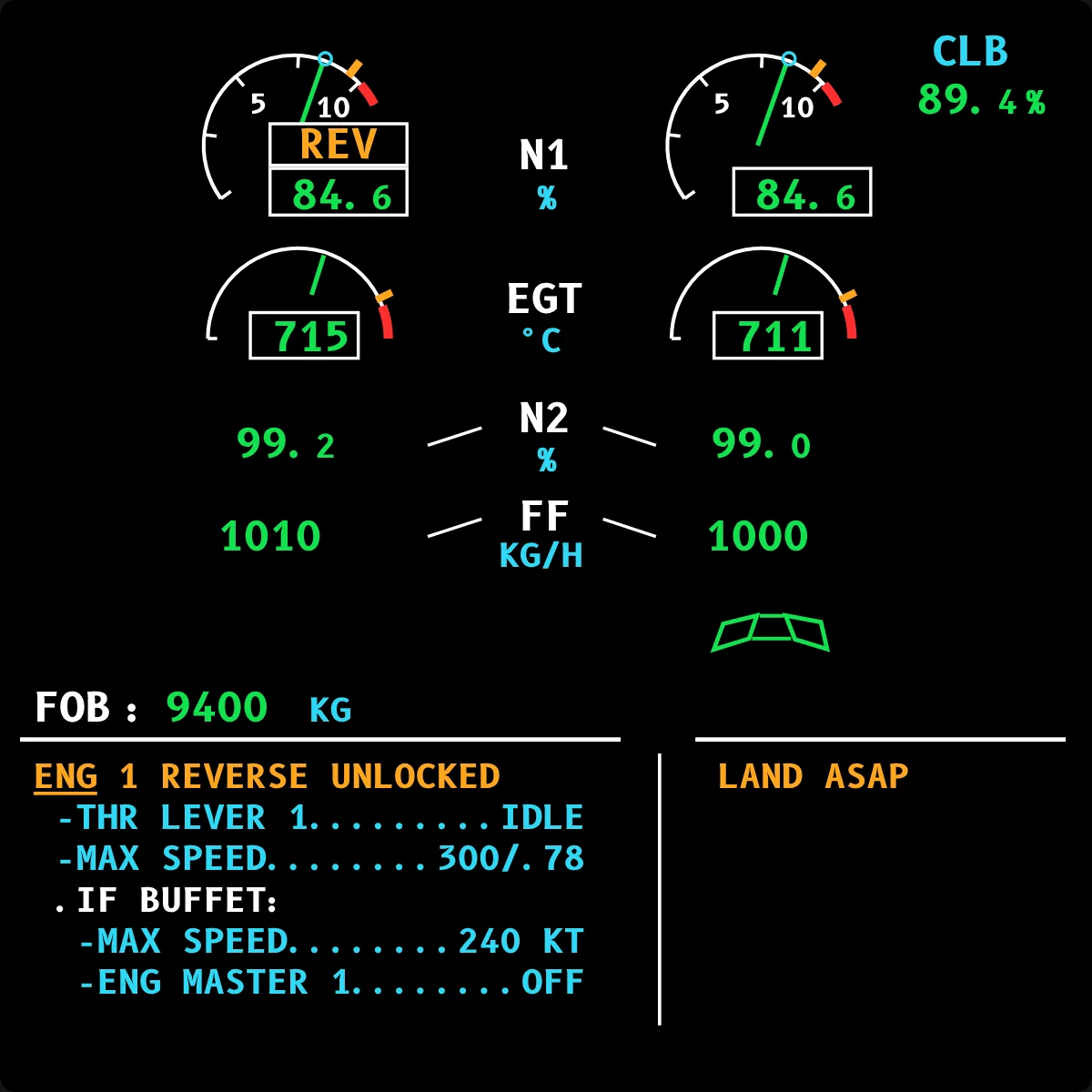
ENG 1 REVERSE UNLOCKED is an amber caution: one or more of engine 1's reverser doors are not locked in the stowed position in flight, or on the ground with no deploy order. The E/WD shows REV in amber on that engine.
In flight the crew brings the thrust lever to idle and keeps the speed at or below 300 kt or M .78, with amber LAND ASAP. If there is buffet, the speed comes down to 240 kt and the master lever goes off, and ENG 1 SHUT DOWN follows. The FADEC may already have set the engine to idle by itself.
Sources FCOM PRO-ABN-ENG ENG 1(2) REVERSE UNLOCKED / FCOM DSC-70-90-40 / FCOM PRO-ABN-ENG ENG / FCOM PRO-ABN-ENG ENG 1(2) SHUT DOWN / FCOM DSC-70-70 PROTECTION / FCTM AOP-30-10 LAND ASAP DEFINITION
At a glance
- Level
- Amber caution, level 2: single chime, MASTER CAUT steady amber, and amber REV on the E/WD
- Sets it off
- One or more reverser doors not locked stowed in flight, or on the ground with no deploy order
- By itself
- The FADEC sets the engine to idle if it detects an inadvertent deployment; ENG 1 AT IDLE then shows
- In flight
- Amber LAND ASAP, thrust lever 1 to idle, MAX SPEED 300/.78; IF BUFFET, 240 kt and ENG MASTER 1 off
- Then
- With the master lever off in flight, ENG 1 SHUT DOWN, whose STATUS sets the approach by what the reverser has done
Sources FCOM DSC-31-10 WARNING/CAUTION CLASSIFICATION / FCOM DSC-31-30 ATTENTION GETTERS / FCOM DSC-70-90-40 / FCOM PRO-ABN-ENG ENG 1(2) REVERSE UNLOCKED / FCOM DSC-70-70 PROTECTION / FCOM PRO-ABN-ENG ENG / FCTM AOP-30-10 LAND ASAP DEFINITION / FCOM PRO-ABN-ENG ENG 1(2) SHUT DOWN
What sets the caution off?
The caution triggers when one or more reverser doors are not locked in the stowed position in flight, or on the ground with no deploy order. It is inhibited in flight phase 4, except if the engine thrust is automatically set to idle.
The reverser deflects the fan airstream. On the A319ceo and A320ceo four pivoting blocker doors do it, each moved by its own hydraulic jack; on the A320neo and A321neo translating sleeves move back and let pivoting blocker doors send the fan flow forward through cascades. On all four types green powers engine 1's reverser and yellow engine 2's.
Deploying it takes several signals: the FADEC's command with the thrust lever's reverse signal, joined on the A320neo and A321neo by an EIVMU or EIU channel's, both main gears compressed from the LGCIUs, and a reverse signal from at least one SEC. The FADEC controls the system, and each engine's reverser is independent of the other's.
Sources FCOM PRO-ABN-ENG ENG 1(2) REVERSE UNLOCKED / FCOM DSC-70-70 GENERAL / FCOM DSC-70-70 ACTUATION LOGIC
From an unlocked door to the caution
What does the crew see and hear?
A level 2 caution: a single chime, the MASTER CAUT light steady amber and the caution in amber on the E/WD, and the SD normally calls up the relevant system page by itself.
On the E/WD's engine display REV shows in amber, for a reverser system that is unlocked. In flight it pulses for 9 s and then stays steady; in green it would mean a reverser fully deployed on the ground.
Sources FCOM DSC-31-10 WARNING/CAUTION CLASSIFICATION / FCOM DSC-31-30 ATTENTION GETTERS / FCOM DSC-31-20 SYSTEM PAGES / FCOM DSC-70-90-40
The moment the caution comes on
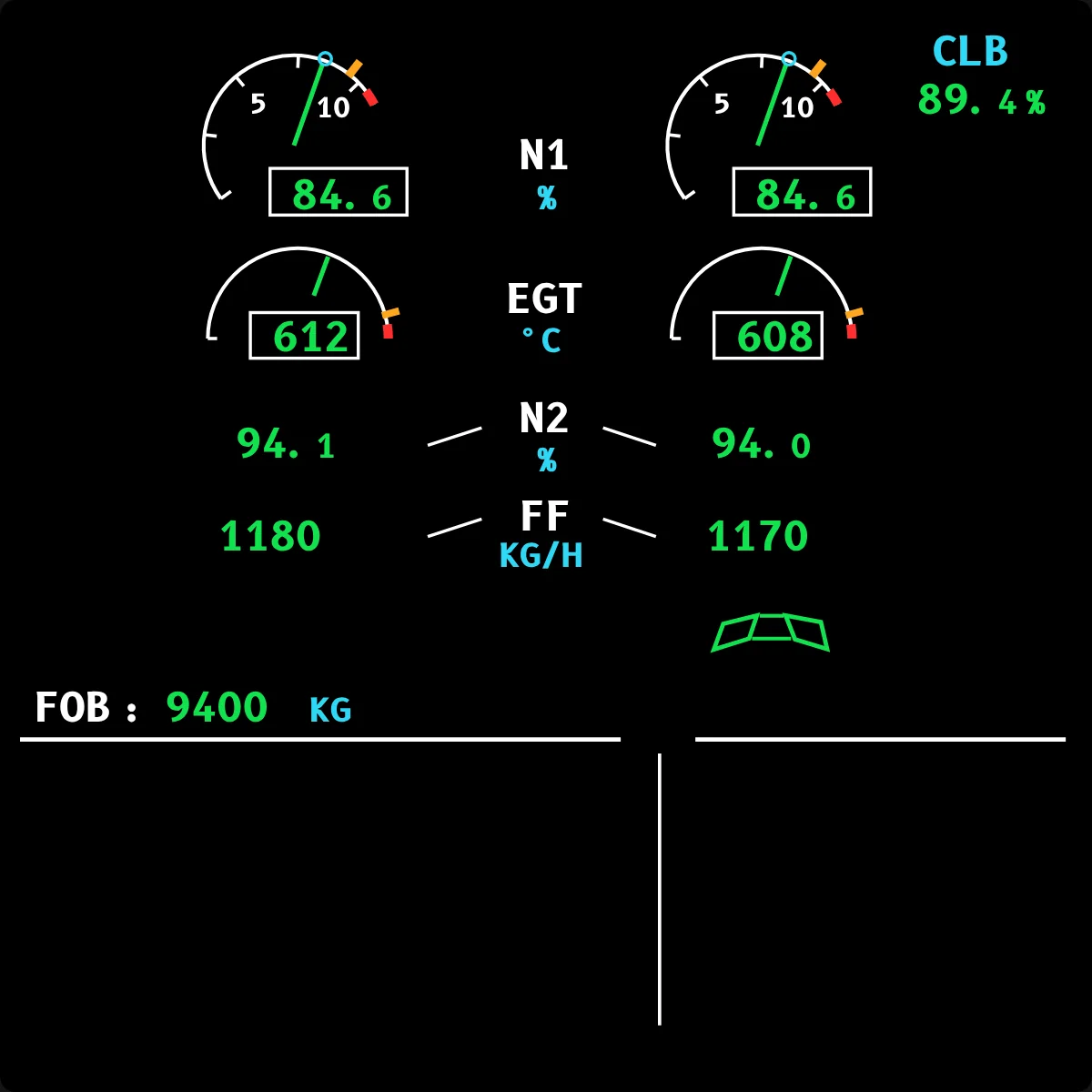
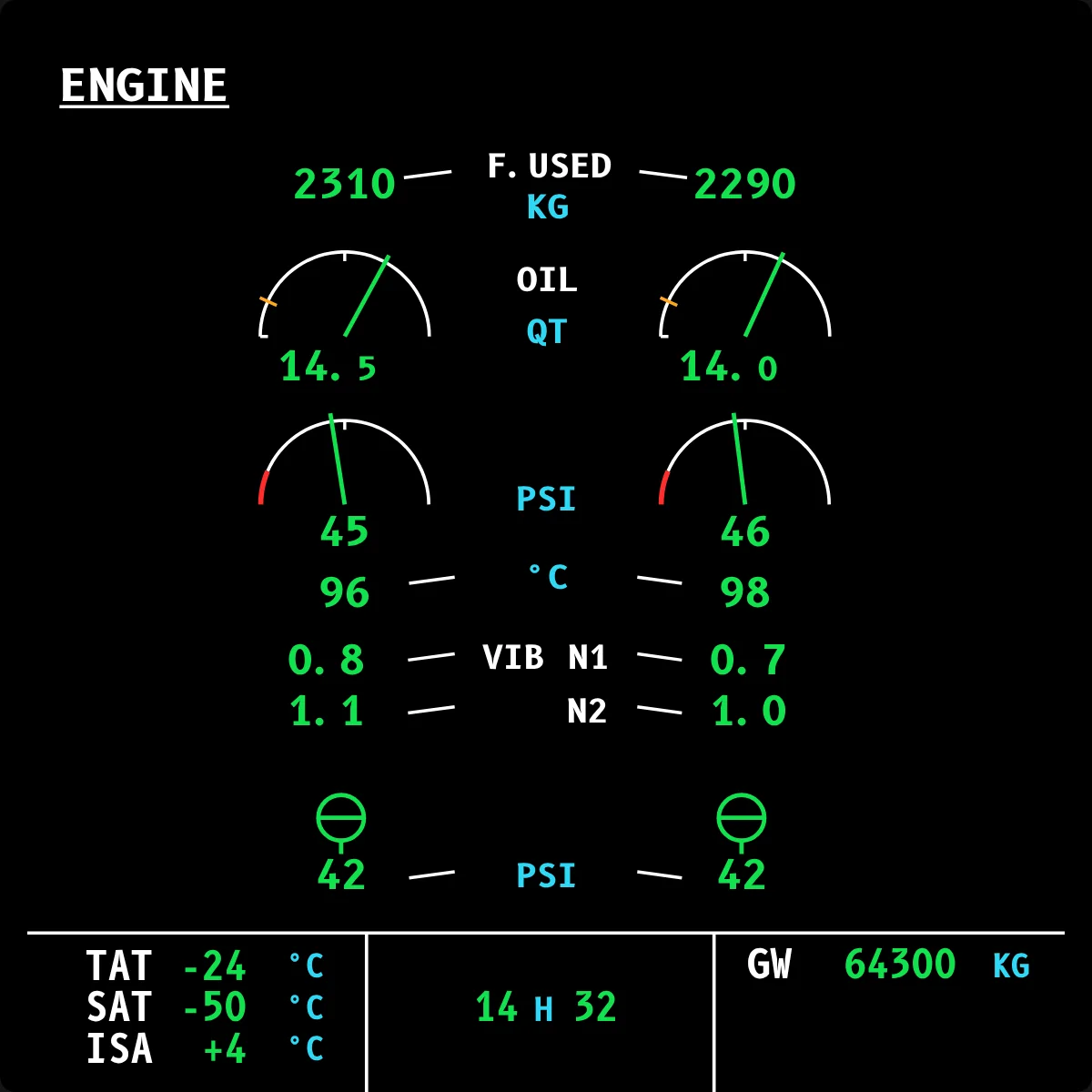
A healthy aircraft in the cruise, both thrust levers in the climb detent. Press the button to unlock engine 1's reverser, then look at the E/WD, the ENGINE page and the thrust levers.

The alert Unlock engine 1's reverser
The E/WD shows ENG 1 REVERSE UNLOCKED in amber with THR LEVER 1 IDLE and MAX SPEED 300/.78, then IF BUFFET with MAX SPEED 240 KT and ENG MASTER 1 OFF; amber LAND ASAP on the right, and REV in amber on engine 1.
ENG 1 AT IDLE is not shown: the FCOM displays it only if the engine has been set to idle by itself. The live aircraft moves no reverser and has no idle protection, so the failure changes nothing on the ENGINE page or the thrust levers: engine 1 runs on, its thrust lever in the climb detent. Working the lines is what the ECAM Trainer does with you.
Sources FCOM PRO-ABN-ENG ENG / FCOM DSC-70-90-40
What does the FADEC do by itself?
It protects the engine with idle. On the A320neo and A321neo the FADEC limits the thrust to idle if it detects an inadvertent deployment: when the reverse thrust is not selected and the translating sleeves are detected unstowed, or there is hydraulic pressure in the DCU with a door detected unstowed or the sleeves' position not available.
On the A319ceo and A320ceo the FADEC selects idle as soon as the reverser's position is above 15 % deployed while it is commanded stowed, the thrust already decreasing towards idle between 10 and 15 %.
When that happens, the procedure shows ENG 1 AT IDLE above the thrust lever line. One version of the procedure, for some aircraft, adds that with N1 above 70 % the auto-restow function is inhibited, in flight and on the ground; the other says only that the FADEC may set the engine to idle.
Sources FCOM DSC-70-70 PROTECTION / FCOM PRO-ABN-ENG ENG
The FADEC's idle protection
What do the speeds and the buffet condition change?
In flight both versions of the procedure open with amber LAND ASAP: consider landing at the nearest suitable airport. The thrust lever goes to idle and the speed is kept at or below 300 kt or M .78.
Only IF BUFFET does more follow: MAX SPEED 240 KT and the master lever off, which brings ENG 1 SHUT DOWN as the associated procedure. One version adds, if the reverser is actually deployed, full right rudder trim and the heading controlled with roll; its condition is printed in small letters, and a precondition in small letters does not appear on the ECAM.
The FCOM gives no reason for the speeds or for the order of the lines. In flight the PF and PM crosscheck before any action on an ENG MASTER lever, to prevent an inadvertent action with irreversible effects.
On the ground the caution has its own branch: the thrust lever to idle and the master lever off.
Sources FCOM PRO-ABN-ENG ENG / FCTM AOP-30-10 LAND ASAP DEFINITION / FCOM PRO-ABN-ABN-00 INTRODUCTION / FCTM AOP-30-20 GENERAL
What does the approach become?
With the master lever off in flight, ENG 1 SHUT DOWN follows, and with it three secondary failures to review: *HYD, *ELEC and *AIR BLEED. In it the crew selects continuous ignition, to protect the remaining engine.
All three versions of its STATUS have lines for an unlocked reverser: MAX SPEED 300/0.78, and an approach that depends on what the reverser has done. With buffet and the reverser deployed, worded four doors not stowed in one version, it is flap 1 for landing at VREF + 55 kt, with its own approach lines.
With buffet and the reverser only detected unlocked, worded one, two or three doors not stowed in one version, STATUS gives flap 3 for landing instead.
Sources FCOM PRO-ABN-ENG ENG 1(2) SHUT DOWN / FCOM PRO-ABN-ENG ENG / FCOM PRO-ABN-ENG
What is lost afterwards?
STATUS is the aircraft's operational summary. The FCOM prints no STATUS for this caution itself, and none is drawn here; the lines above come from the ENG 1 SHUT DOWN STATUS, once the master lever is off.
Sources FCOM DSC-31-20 STATUS PAGE / FCOM PRO-ABN-ENG ENG
A319ceo, A320ceo, A320neo, A321neo: what differs?
| A319ceo, A320ceo | A320neo, A321neo | |
|---|---|---|
| The caution and its trigger | The same in every version | The same in every version |
| The reverser | Four pivoting blocker doors, each on its own hydraulic jack; actuation in less than 2 s | Translating sleeves with pivoting blocker doors and cascades; actuation in about 2 s |
| Idle protection | Idle once the reverser is more than 15 % deployed while commanded stowed | Idle, reverse not selected, when the sleeves are detected unstowed, or with hydraulic pressure in the DCU and a door detected unstowed or the sleeves' position not available |
| The lines | Not given by type: one version adds the auto-restow note and, under IF BUFFET, RUD TRIM FULL R (L) and CONTROL HDG WITH ROLL; the other has neither | Not given by type: one version adds the auto-restow note and, under IF BUFFET, RUD TRIM FULL R (L) and CONTROL HDG WITH ROLL; the other has neither |
| Engines | CFM56-5B | LEAP-1A |
Sources FCOM PRO-ABN-ENG ENG 1(2) REVERSE UNLOCKED / FCOM DSC-70-70 GENERAL / FCOM DSC-70-70 PROTECTION / FCOM PRO-ABN-ENG ENG / FCOM DSC-70-05 OVERVIEW / FCOM DSC-70-05

Work ENG 1 REVERSE UNLOCKED as a crew
Read and do each line against the FCOM, with the E/WD, the SD page and the overhead following your hands, the PF and PM calls, and a debrief that says what you missed.
Work this failure in the ECAM TrainerGo further
Written in our own words from the FCOM and the FCTM; each part names the units it rests on. The E/WD, the STATUS and the live aircraft are the platform's own ECAM and systems model, the same the ECAM Trainer and the flight deck run. This page explains the procedure; it is not the procedure. Aircraft differ by type, engine and options: your aircraft's FCOM, your QRH and your operator's procedures always come first. How we write and check these pages.
Every ECAM procedure, line by line, against the FCOM.
The ECAM Trainer works 108 scenarios with the E/WD, the SD page and the overhead following your hands. Start free today, or open everything with A320 Knowledge+.
For study and revision only. Always follow your operator's approved documentation and procedures. A320 Knowledge is independent and not affiliated with Airbus.
Related
- ENG 1 FAILAn amber caution for an engine whose core speed has fallen below idle with its master lever still on.
- ENG 1 FUEL LEAKAn amber caution for an abnormal difference between the engines in fuel flow or fuel used.
- ENG 1 OIL HI TEMPAn amber caution for engine oil that is too hot, or has been warm for too long.
- ENG 1 OIL LO PRA red warning for an engine whose oil pressure has fallen below its alert threshold.
- A320 engines and APUThe system guide, with the live aircraft
- Every ECAM procedureThe alerts the ECAM Trainer works, grouped by system