
ENG 1 OIL HI TEMP
An amber caution for engine oil that is too hot, or has been warm for too long. Here is what sets it off, how the two versions of the procedure differ, what shutting the engine down does to the air supply, and what STATUS keeps, with the live aircraft at the moment the caution comes on.
Written and checked by current A320 pilotschecked against the FCOM on Our editorial policy
What ENG 1 OIL HI TEMP means
ENG 1 OIL HI TEMP is an amber caution: engine 1's oil has been between 140 °C and 155 °C for more than 15 min, or is above 155 °C. Those are the oil limits: 140 °C maximum continuous and 155 °C maximum transient, for 15 min.
The FCOM prints the procedure in two versions, each for some aircraft. In one the crew brings the thrust lever to idle and sets the master lever off. In the other the thrust lever first comes back below the limit, and the master lever goes off only if that is unsuccessful. The note is the same in both: operation above the maximum temperature requires engine shutdown. ENG 1 SHUT DOWN then follows.
Sources FCOM PRO-ABN-ENG ENG 1(2) OIL HI TEMP / FCOM LIM-ENG OIL / FCOM DSC-31-10 WARNING/CAUTION CLASSIFICATION / FCOM PRO-ABN-ENG ENG / FCOM PRO-ABN-ENG ENG 1(2) SHUT DOWN
At a glance
- Level
- Amber caution, level 2: single chime, MASTER CAUT steady amber and, normally, the ENGINE page on the SD
- Sets it off
- Oil temperature between 140 °C and 155 °C for more than 15 min, or above 155 °C
- The limits
- 140 °C maximum continuous and 155 °C maximum transient, for 15 min, on both engine types
- The actions
- One version of the procedure: idle, then the master lever off. Another: thrust below the limit, and the master lever off if unsuccessful
- Then
- ENG 1 SHUT DOWN once the master lever is off in flight, with the secondary failures *HYD, *ELEC and *AIR BLEED
Sources FCOM DSC-31-10 WARNING/CAUTION CLASSIFICATION / FCOM DSC-31-30 ATTENTION GETTERS / FCOM DSC-31-20 SYSTEM PAGES / FCOM PRO-ABN-ENG ENG 1(2) OIL HI TEMP / FCOM LIM-ENG OIL / FCOM PRO-ABN-ENG ENG / FCOM PRO-ABN-ENG ENG 1(2) SHUT DOWN / FCOM PRO-ABN-ENG
What sets the caution off?
Two cases: engine 1's oil temperature between 140 °C and 155 °C for more than 15 min, or above 155 °C. They are the limitations' figures, the same for the CFM56-5B and the LEAP-1A: 140 °C is the maximum continuous temperature, 155 °C the maximum transient temperature, allowed for 15 min.
The ENGINE page shows the same thresholds in colour. On the A319ceo and A320ceo the oil temperature pulses green between 140 °C and 155 °C for less than 15 min, and turns amber after 15 min there or above 155 °C; the A320neo and A321neo page words it as advisory and caution thresholds, with the same 15 min.
Both oil systems have a fuel/oil heat exchanger. On the A320neo and A321neo it uses cold fuel from the fuel metering unit to cool the oil, with an air cooling oil cooler as well, and the FADEC controls the fuel and the engine oil temperature. On both, the FADEC recirculates fuel to the tanks depending on the engine oil temperature, the fuel system configuration and the flight phase.
Sources FCOM PRO-ABN-ENG ENG 1(2) OIL HI TEMP / FCOM LIM-ENG OIL / FCOM DSC-70-05 OVERVIEW / FCOM DSC-70-05 / FCOM DSC-70-90-40 / FCOM DSC-70-50 GENERAL / FCOM DSC-70-20 FUNCTIONS
Two ways to the caution
What does the crew see and hear?
A level 2 caution: a single chime, the MASTER CAUT light steady amber and the caution in amber on the E/WD, and the SD normally calls up the relevant system page by itself, here the ENGINE page, where the oil temperature is amber.
Sources FCOM DSC-31-10 WARNING/CAUTION CLASSIFICATION / FCOM DSC-31-30 ATTENTION GETTERS / FCOM DSC-31-20 SYSTEM PAGES / FCOM DSC-70-90-40
The moment the caution comes on
A healthy aircraft in the cruise, both engines running. Press the button to overheat engine 1's oil, then look at the E/WD, the ENGINE page and the ENG MASTER panel.
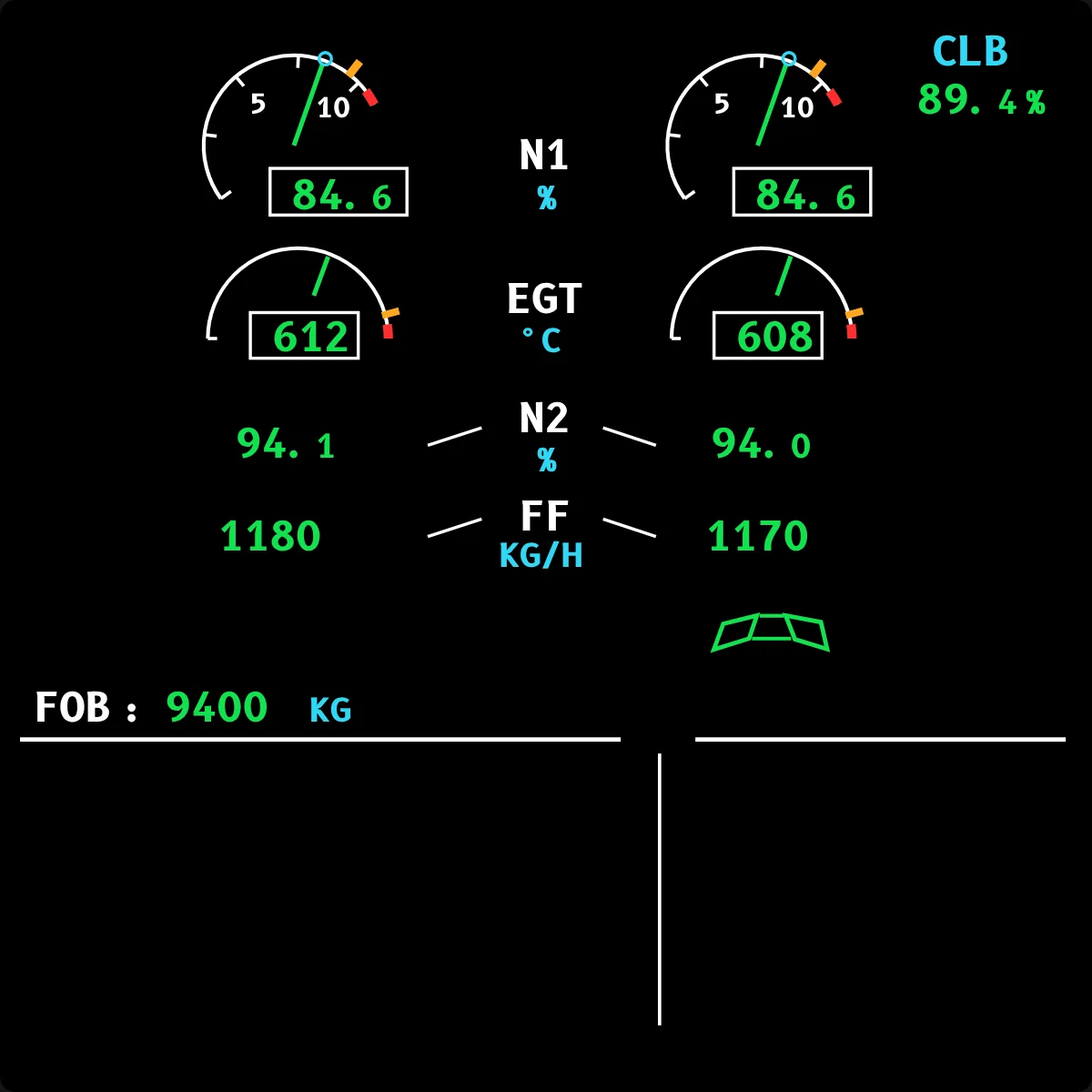
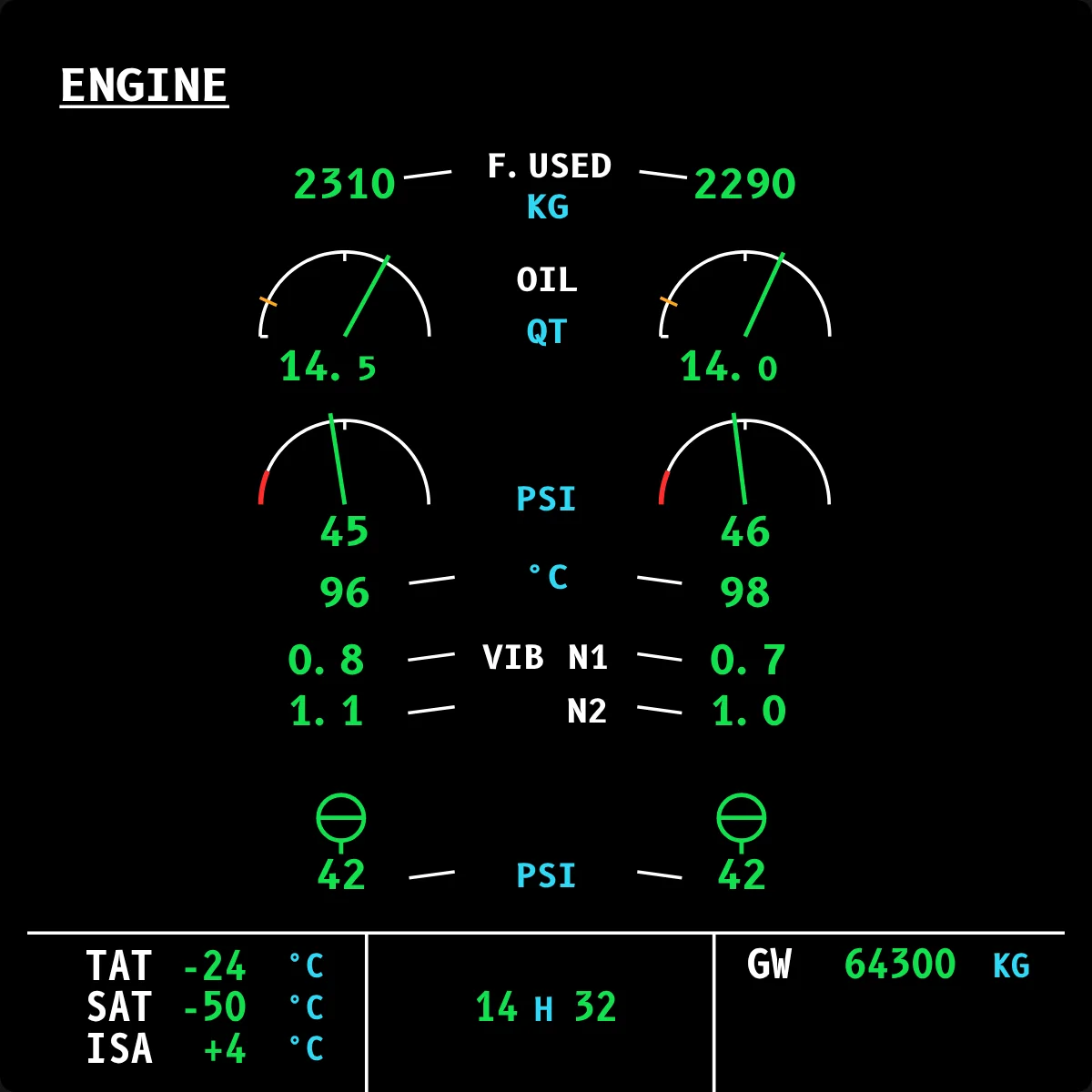

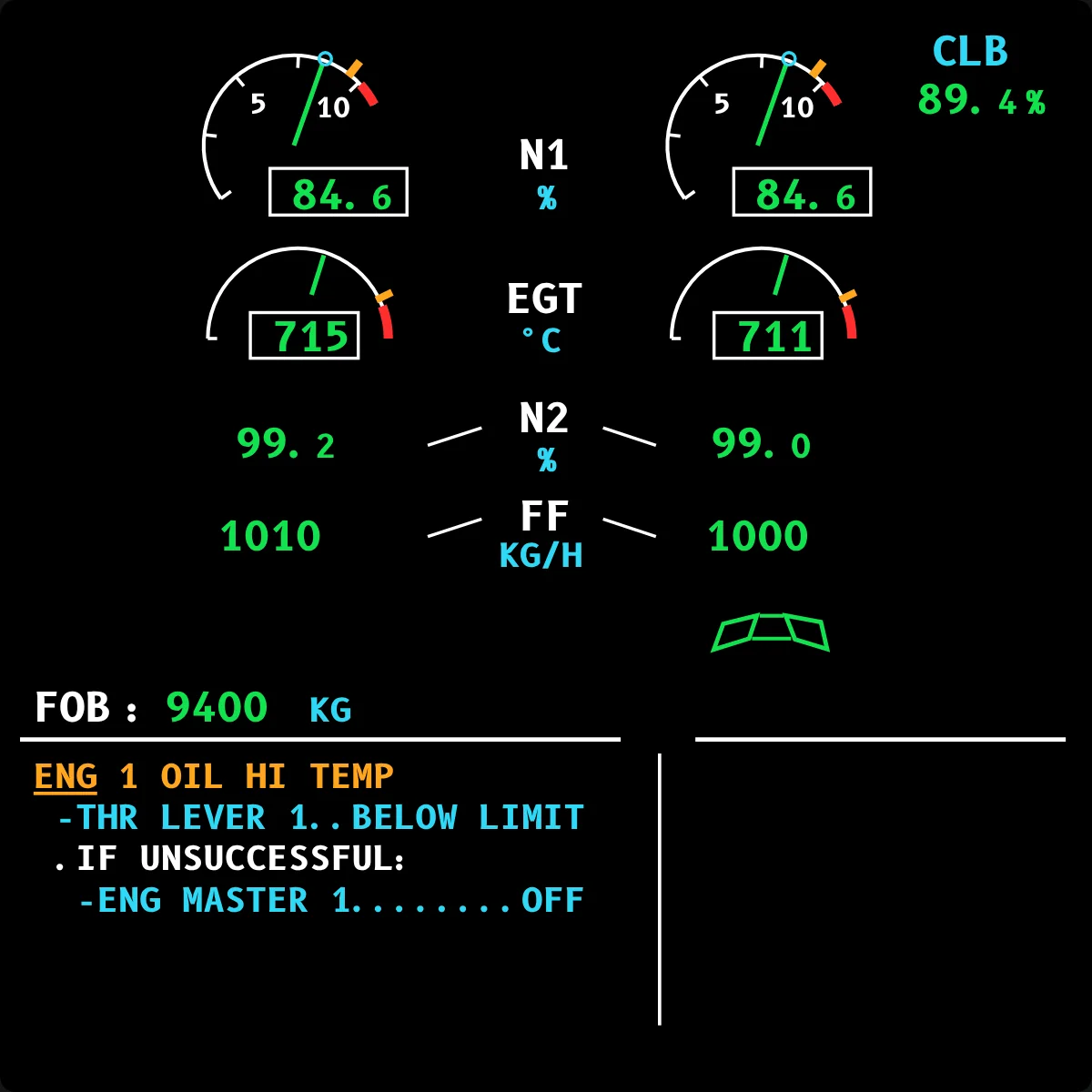
The alert Overheat engine 1's oil
The E/WD shows ENG 1 OIL HI TEMP in amber, drawn here with one version of the procedure's lines: THR LEVER 1 BELOW LIMIT, then IF UNSUCCESSFUL: ENG MASTER 1 OFF. ENG MASTER 1 is still at ON and engine 1 still runs.
The ENGINE page in this drawing keeps engine 1's normal oil temperature: the failure key does not raise it. On the aircraft it is amber. Working the lines is what the ECAM Trainer does with you.
Sources FCOM PRO-ABN-ENG ENG / FCOM DSC-70-90-40 / FCOM PRO-ABN-ENG ENG 1(2) OIL HI TEMP
What do the two versions of the procedure ask?
The FCOM gives the procedure in two versions, each for some aircraft. One is two lines: the thrust lever to idle and the master lever off. The other reads THR LEVER (AFFECTED ENGINE) BELOW LIMIT, and only IF UNSUCCESSFUL the master lever off, so the engine is shut down only if bringing the thrust back does not succeed.
Both carry the same note, that operation above the maximum temperature requires engine shutdown. The FCOM gives no reason for trying less thrust first in one version and not the other.
In flight the PF and PM crosscheck before any action on an ENG MASTER lever, to prevent an inadvertent action with irreversible effects.
Sources FCOM PRO-ABN-ENG ENG / FCTM AOP-30-20 GENERAL
What does shutting the engine down do to the air supply?
Setting the ENG MASTER lever to OFF has the FADEC shut the engine down and closes its LP and HP fuel valves.
Engine 1's bleed valve closes as well: it closes pneumatically when its upstream pressure falls too low, below 8 PSI on the A319ceo and A320ceo and 15 PSI on the A320neo and A321neo. At AUTO the crossbleed valve is open only while the APU bleed valve is open, and each pack's flow control valve closes when its upstream pressure is below the minimum.
Sources FCOM DSC-70-90-20 / FCOM PRO-ABN-ENG ENG / FCOM DSC-36-10-20 PRESSURE REGULATION AND LIMITATION / FCOM DSC-36-20 OVERHEAD PANEL / FCOM DSC-21-10-50 CONTROLS ON OVERHEAD PANEL
Shut engine 1 down and watch the air
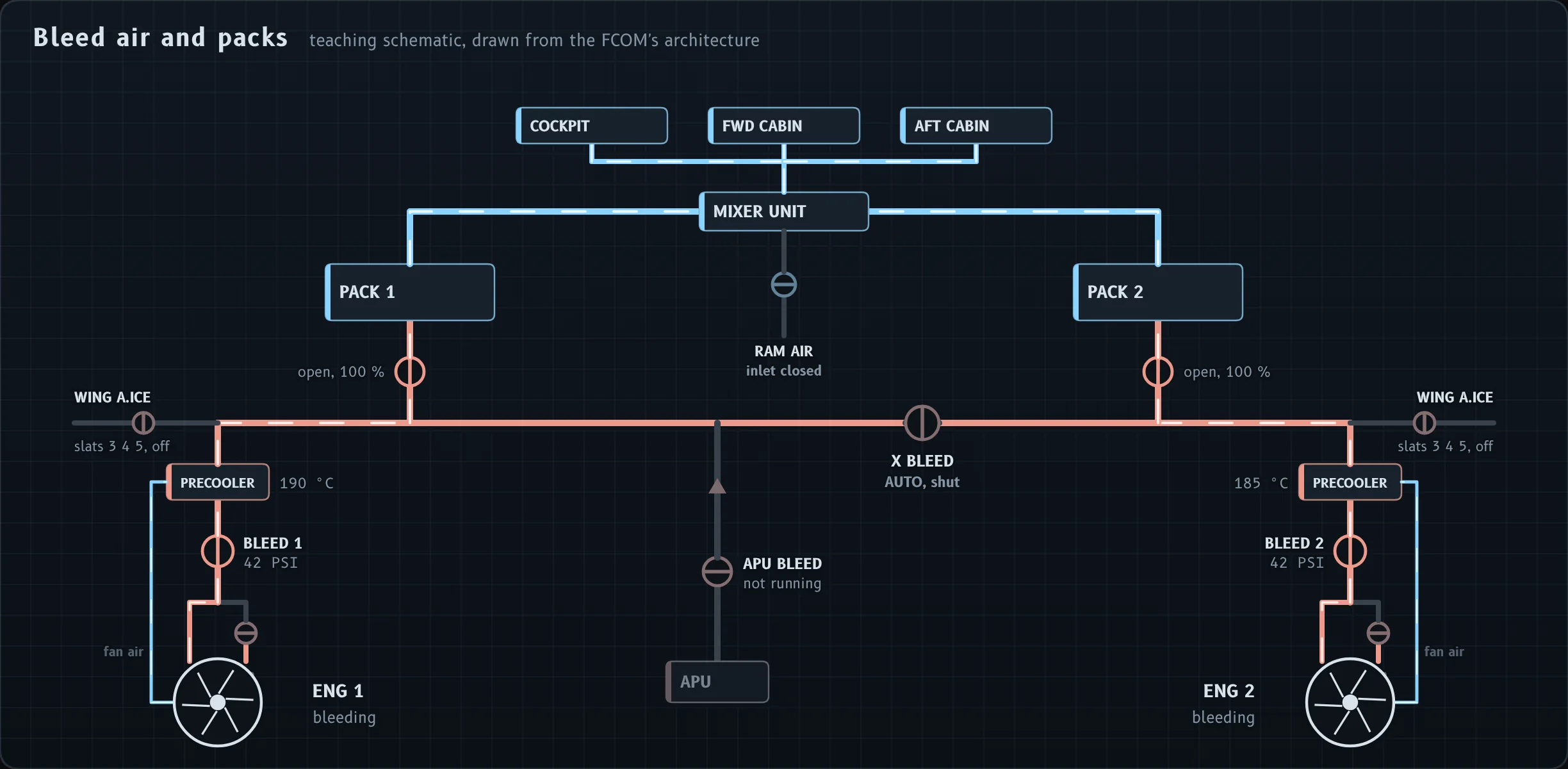
Engine 1 still runs with its oil too hot; the crossbleed is at AUTO and the APU is off. Predict first, then set the lever on the ENG MASTER panel and watch the air schematic and the BLEED page.

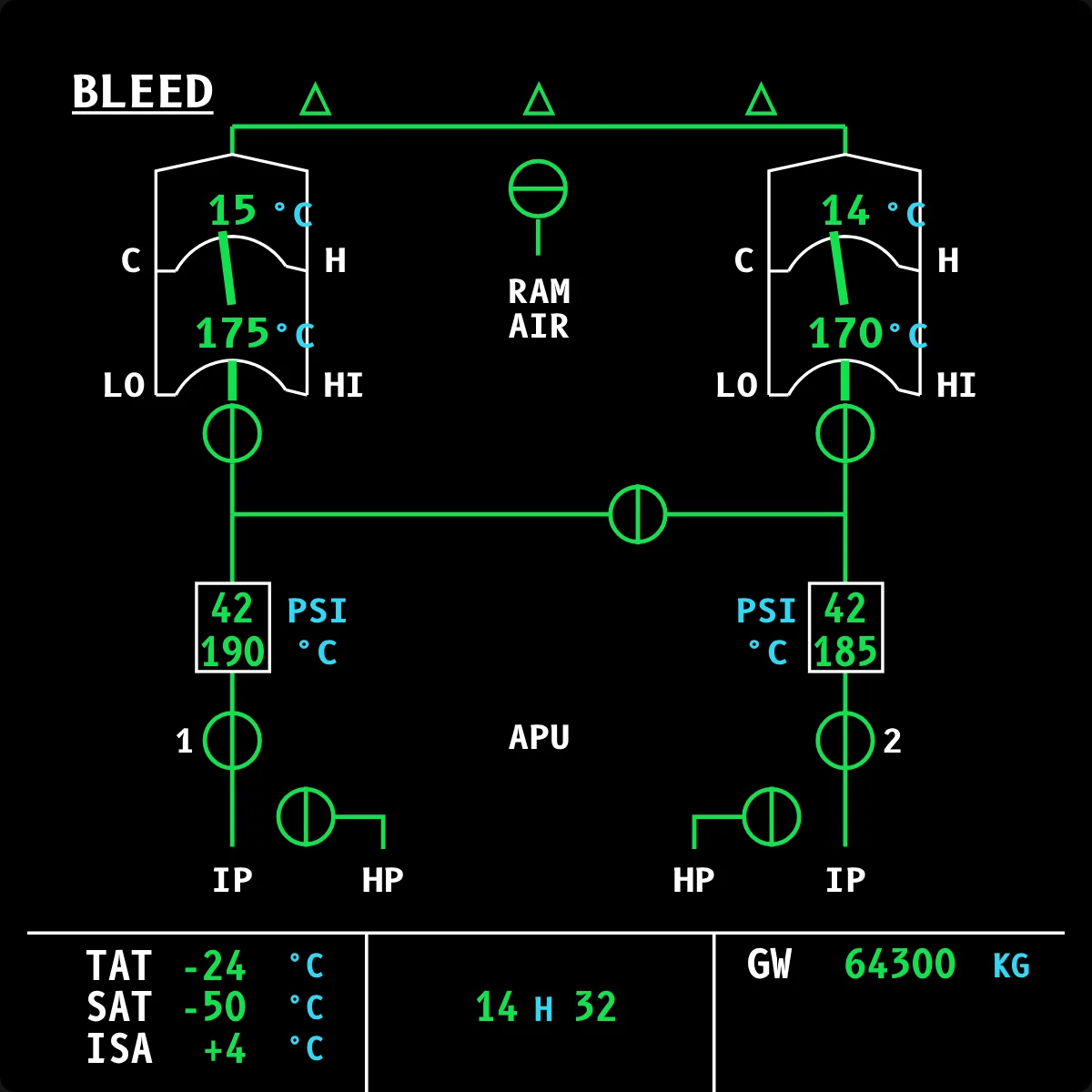
-
Predict Set ENG MASTER 1 to OFF. What happens to pack 1?
Try it Set ENG MASTER 1 to OFF.
Engine 1 stops and its bleed valve closes. The crossbleed stays shut at AUTO with no APU bleed, so pack 1 loses its upstream pressure and its flow control valve closes; pack 2 carries on alone.
Pack 2 goes to high flow: in single pack operation HI is selected automatically. The shutdown STATUS gives the way back, IF PERF PERMITS: X BLEED OPEN, if no obstacle constraint exists.
Sources FCOM DSC-36-10-20 PRESSURE REGULATION AND LIMITATION / FCOM DSC-36-20 OVERHEAD PANEL / FCOM DSC-21-10-50 CONTROLS ON OVERHEAD PANEL / FCOM PRO-ABN-ENG ENG
What does the aircraft lose with the engine?
With the master lever off in flight, ENG 1 SHUT DOWN follows, and with it three secondary failures to review: *HYD, *ELEC and *AIR BLEED.
The shutdown procedure opens with amber LAND ASAP, which means considering a landing at the nearest suitable airport. In it the crew selects continuous ignition, to protect the remaining engine.
The system replaces generator 1 with the APU generator, if available, or the other engine generator, and part of the galley load is shed. Green loses its engine driven pump; the PTU comes into action by itself once green and yellow differ by more than 500 PSI.
Sources FCOM PRO-ABN-ENG ENG 1(2) SHUT DOWN / FCOM PRO-ABN-ENG ENG / FCOM PRO-ABN-ENG / FCTM AOP-30-10 LAND ASAP DEFINITION / FCOM DSC-24-10-30-30 FAILURE OF ONE ENGINE GENERATOR / FCOM DSC-29-10-20 POWER TRANSFER UNIT (PTU)
What is lost afterwards?
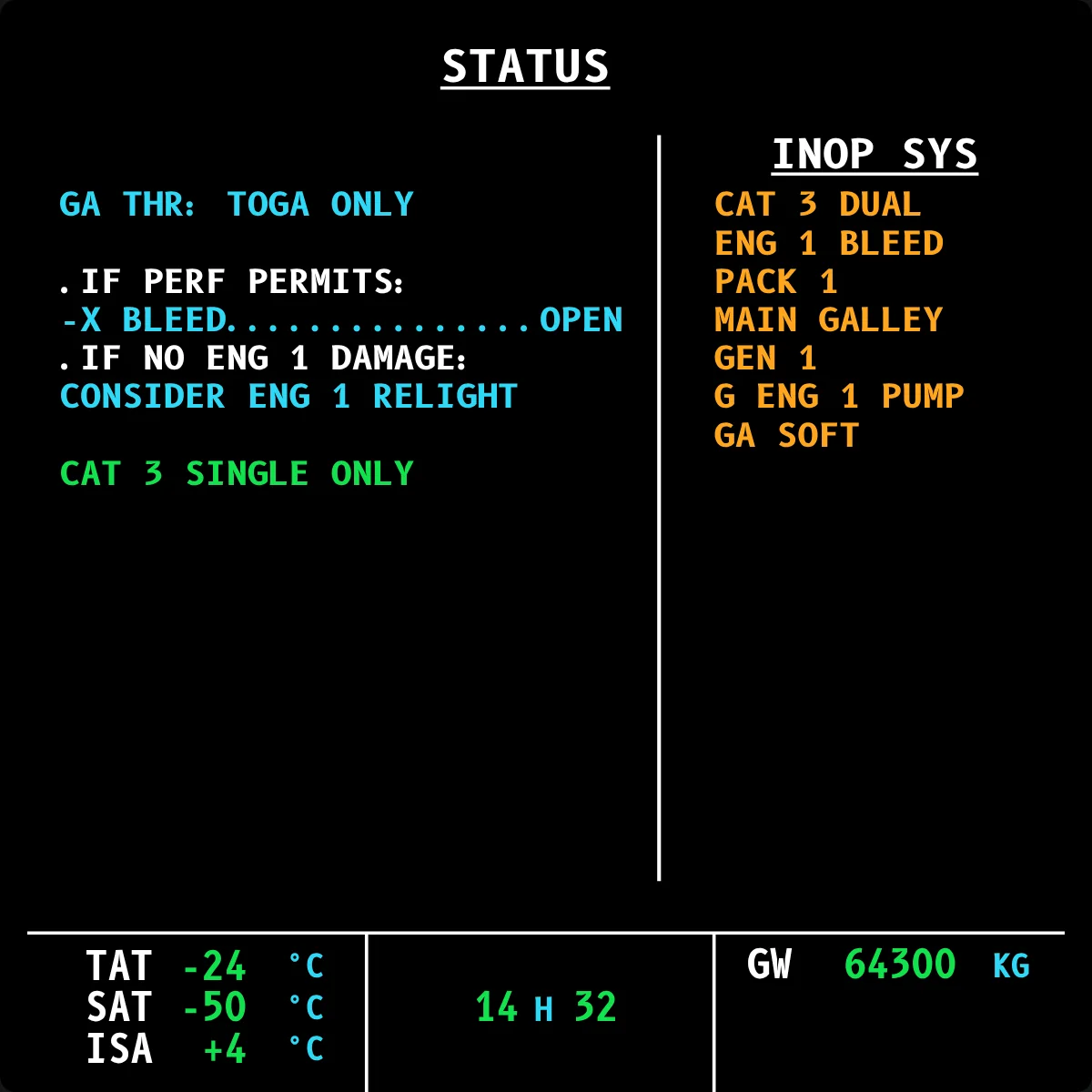
STATUS is the aircraft's operational summary. The one drawn is the ENG 1 SHUT DOWN STATUS, as it reads once the master lever is off. With the wing anti-ice off and the fire pushbutton not pushed, it reads IF PERF PERMITS: X BLEED OPEN, and the FCOM's note says to open the crossbleed if no obstacle constraint exists.
Under IF NO ENG 1 DAMAGE it reads CONSIDER ENG 1 RELIGHT, printed green in the FCOM and drawn blue here, then CAT 3 SINGLE ONLY. INOP SYS lists what went with the engine: CAT 3 DUAL, ENG 1 BLEED, PACK 1, MAIN GALLEY, GEN 1 and the green engine pump.
The version drawn also carries GA THR: TOGA ONLY on the left and GA SOFT in INOP SYS.
Which version applies depends on your aircraft: check your own FCOM.
Sources FCOM DSC-31-20 STATUS PAGE / FCOM PRO-ABN-ENG ENG
A319ceo, A320ceo, A320neo, A321neo: what differs?
| A319ceo, A320ceo | A320neo, A321neo | |
|---|---|---|
| The caution and its trigger | The same in every version | The same in every version |
| The lines | Not given by type: one version THR LEVER IDLE, then ENG MASTER OFF; another THR LEVER BELOW LIMIT, then IF UNSUCCESSFUL: ENG MASTER OFF | Not given by type: one version THR LEVER IDLE, then ENG MASTER OFF; another THR LEVER BELOW LIMIT, then IF UNSUCCESSFUL: ENG MASTER OFF |
| Oil temperature limits | 140 °C continuous, 155 °C for 15 min; minimum before takeoff -10 °C | 140 °C continuous, 155 °C for 15 min; minimum before takeoff 19 °C |
| Engines | CFM56-5B | LEAP-1A |
| ENG SHUT DOWN: pack 1 | Not given by type: one version sets the affected pack off only with the wing anti-ice on; another whether or not it is on | Not given by type: one version sets the affected pack off only with the wing anti-ice on; another whether or not it is on |
| STATUS limitations | Not given by type: one version has no go-around thrust line and ends with ONE PACK ONLY IF WAI ON; the two others add GA THR: TOGA ONLY | Not given by type: one version has no go-around thrust line and ends with ONE PACK ONLY IF WAI ON; the two others add GA THR: TOGA ONLY |
| STATUS INOP SYS, besides the engine's own systems | Not given by type: one version lists STEEP APPR and AFT CRG HEAT, each where fitted; the two others GA SOFT, and AFT CRG HEAT where fitted | Not given by type: one version lists STEEP APPR and AFT CRG HEAT, each where fitted; the two others GA SOFT, and AFT CRG HEAT where fitted |
The FCOM prints three versions of the shutdown STATUS, worded slightly differently, mostly in the reverser lines. The STATUS above is one of them.
Sources FCOM PRO-ABN-ENG ENG 1(2) OIL HI TEMP / FCOM PRO-ABN-ENG ENG / FCOM LIM-ENG OIL / FCOM DSC-70-05 OVERVIEW / FCOM DSC-70-05 / FCOM PRO-ABN-ENG

Work ENG 1 OIL HI TEMP as a crew
Read and do each line against the FCOM, with the E/WD, the SD page and the overhead following your hands, the PF and PM calls, and a debrief that says what you missed.
Work this failure in the ECAM TrainerGo further
Written in our own words from the FCOM and the FCTM; each part names the units it rests on. The E/WD, the STATUS and the live aircraft are the platform's own ECAM and systems model, the same the ECAM Trainer and the flight deck run. This page explains the procedure; it is not the procedure. Aircraft differ by type, engine and options: your aircraft's FCOM, your QRH and your operator's procedures always come first. How we write and check these pages.
Every ECAM procedure, line by line, against the FCOM.
The ECAM Trainer works 108 scenarios with the E/WD, the SD page and the overhead following your hands. Start free today, or open everything with A320 Knowledge+.
For study and revision only. Always follow your operator's approved documentation and procedures. A320 Knowledge is independent and not affiliated with Airbus.
Related
- ENG 1 FAILAn amber caution for an engine whose core speed has fallen below idle with its master lever still on.
- ENG 1 FUEL LEAKAn amber caution for an abnormal difference between the engines in fuel flow or fuel used.
- ENG 1 OIL LO PRA red warning for an engine whose oil pressure has fallen below its alert threshold.
- ENG 1 REVERSE UNLOCKEDAn amber caution for a thrust reverser that is not locked stowed in flight.
- A320 engines and APUThe system guide, with the live aircraft
- Every ECAM procedureThe alerts the ECAM Trainer works, grouped by system