
APU FIRE
A red warning with three lines to it. Here is what sets it off, what the APU does by itself on the ground and what is left to the crew in flight, and what the APU FIRE pushbutton closes, with the live aircraft at the moment the warning comes on.
Written and checked by current A320 pilotschecked against the FCOM on Our editorial policy
What APU FIRE means
APU FIRE is a red warning: the APU's fire detection has sensed a fire in its compartment. Like an engine's, it needs both detection loops to agree, or one loop with the other faulty, or both loops broken within 5 s.
On the ground the APU shuts itself down and fires its bottle. In flight the APU neither shuts down nor discharges its bottle by itself: the ECAM gives the crew LAND ASAP and three lines, the APU FIRE pushbutton pushed, the agent discharged after 10 s, and the master switch off. The APU is then not restarted.
Sources FCOM PRO-ABN-APUF APU FIRE / FCOM DSC-26-20-10 FIRE DETECTION / FCOM DSC-31-10 WARNING/CAUTION CLASSIFICATION / FCOM DSC-26-20-10 EXTINGUISHING / FCOM DSC-49-20
At a glance
- Level
- Red warning, level 3: continuous repetitive chime and a flashing red MASTER WARN light
- Sets it off
- Both detection loops sense a fire, or one does while the other is faulty, or both loops break within 5 s
- Lights
- The APU FIRE pushbutton on the overhead FIRE panel, red whatever its position, for as long as the fire is detected
- By itself
- On the ground the APU shuts down and its bottle discharges automatically; in flight both are the crew's
- Extinguishing
- One bottle with two squibs, discharged from the AGENT pushbutton once the APU FIRE pushbutton is pushed
- Landing
- Red LAND ASAP heads the procedure: the nearest airport where a safe landing can be made
Sources FCOM DSC-31-10 WARNING/CAUTION CLASSIFICATION / FCOM DSC-31-30 ATTENTION GETTERS / FCOM DSC-31-10 AUDIO INDICATORS / FCOM PRO-ABN-APUF APU FIRE / FCOM DSC-26-20-20 / FCOM DSC-26-20-10 EXTINGUISHING / FCOM DSC-49-20 / FCTM AOP-30-10 LAND ASAP DEFINITION
What makes the APU fire warning come on?
The APU has the same kind of fire and overheat detection as each engine: two identical detection loops, A and B, mounted in parallel, and a Fire Detection Unit (FDU). Where an engine's loops have three or four sensing elements, as installed, the APU's have one, in the APU compartment.
With both loops working, the FDU waits for both to sense a temperature above a preset level. A fault in one loop, a break or a loss of electrical supply, does not affect the warning system, and the other loop still protects the aircraft: the warning then comes from that loop alone.
Two more cases give the warning: breaks in both loops within 5 s of each other, and the crew's own test. The APU FIRE TEST pushbutton sounds the chime, flashes MASTER WARN, puts APU FIRE on the ECAM, lights the APU FIRE pushbutton red and lights DISCH, and SQUIB if discharge supplies are available. On the ground on batteries alone the test gives no ECAM warning, and a test held for more than 3 s on the ground may shut the APU down. A failed loop or a failed FDU gives a loop fault caution instead.
Sources FCOM DSC-26-20-10 FIRE DETECTION / FCOM DSC-26-20-10 FIRE DETECTION AND DETECTION FAULT LOGIC / FCOM DSC-26-20-20 / FCOM PRO-ABN-APUF APU FIRE
How the FDU decides the APU is on fire
What does the crew see and hear?
APU FIRE is a level 3 red warning: the continuous repetitive chime, MASTER WARN flashing red, the warning in red on the E/WD, and the SD normally calling up the relevant system page by itself.
On the overhead FIRE panel the APU FIRE pushbutton lights red. Its light comes on whatever the pushbutton's position, and the procedure notes that it stays on as long as a fire is detected.
Sources FCOM DSC-31-10 WARNING/CAUTION CLASSIFICATION / FCOM DSC-31-30 ATTENTION GETTERS / FCOM DSC-31-20 SYSTEM PAGES / FCOM DSC-26-20-20 / FCOM PRO-ABN-APUF APU FIRE
The moment the warning comes on
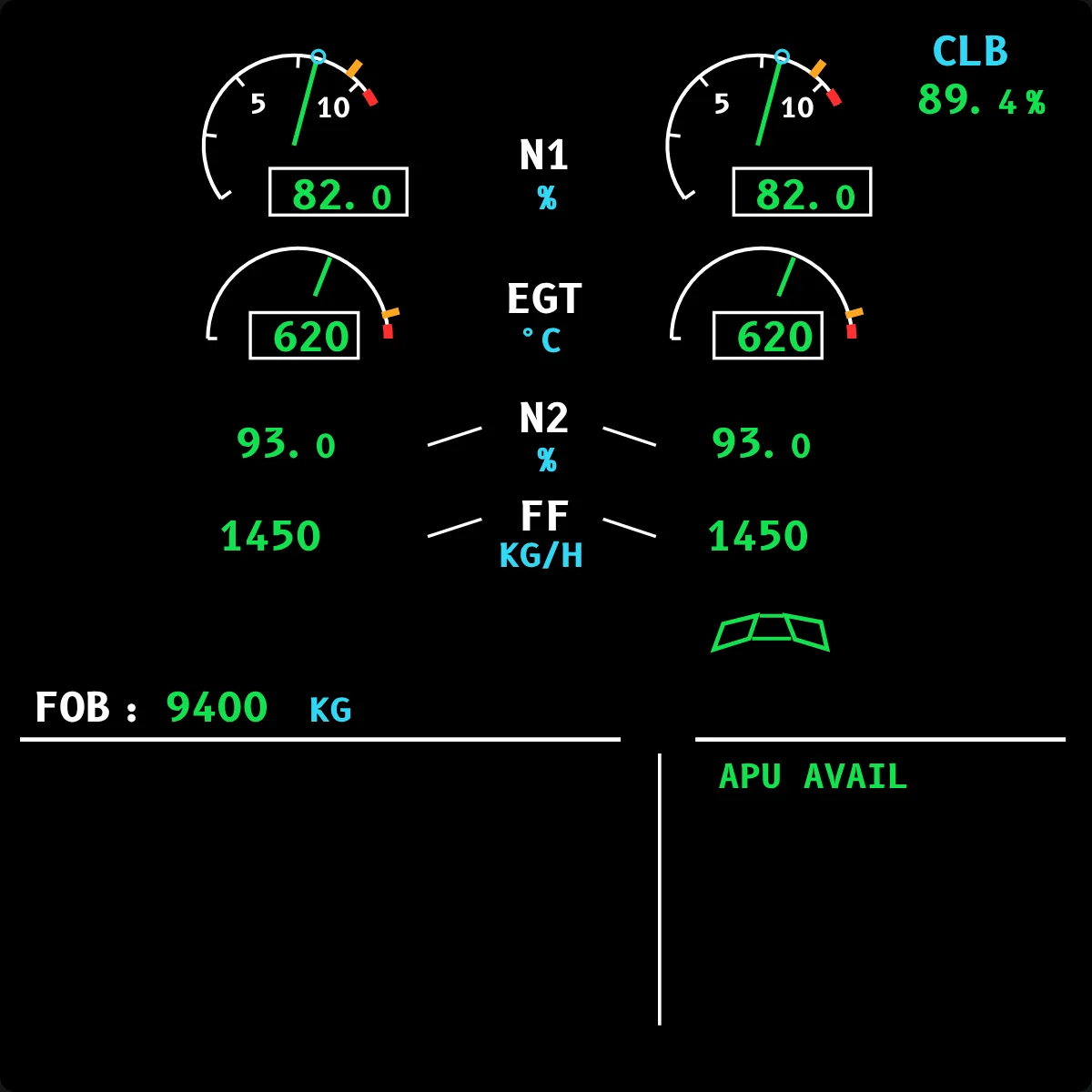
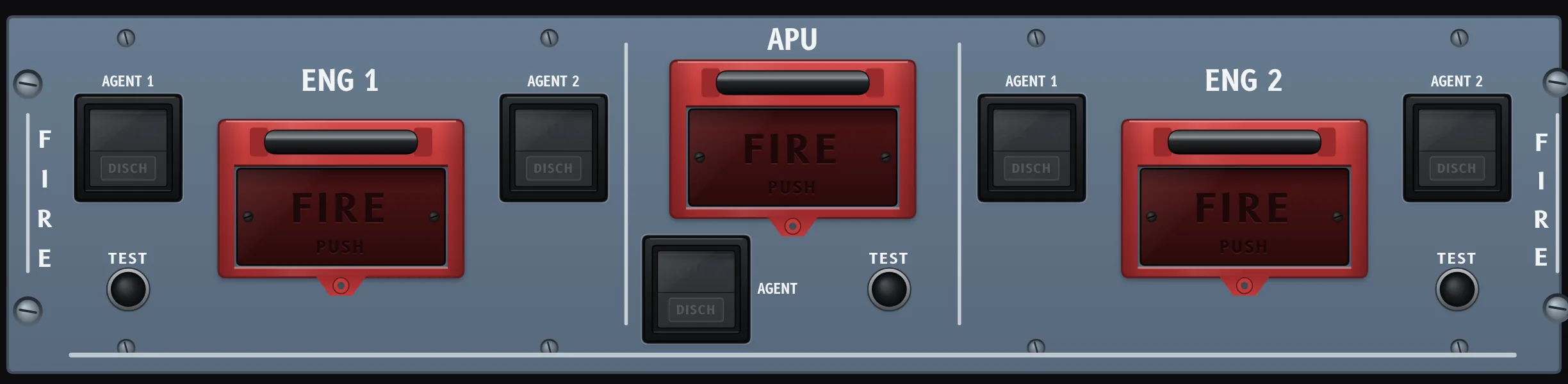
A healthy aircraft in flight, with the APU running. Press the button to start the APU fire, then look at the E/WD and the FIRE panel.
The alert Start an APU fire
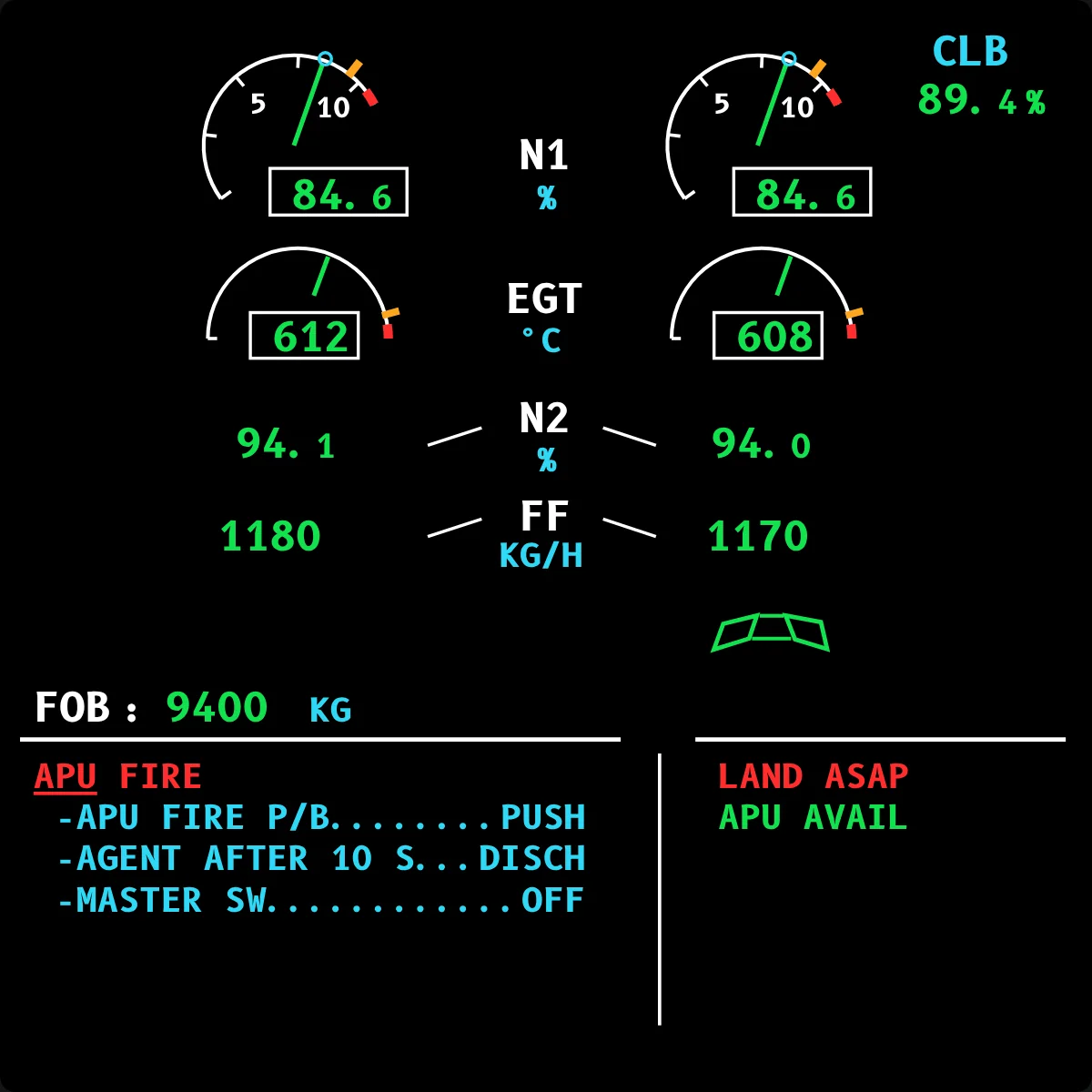
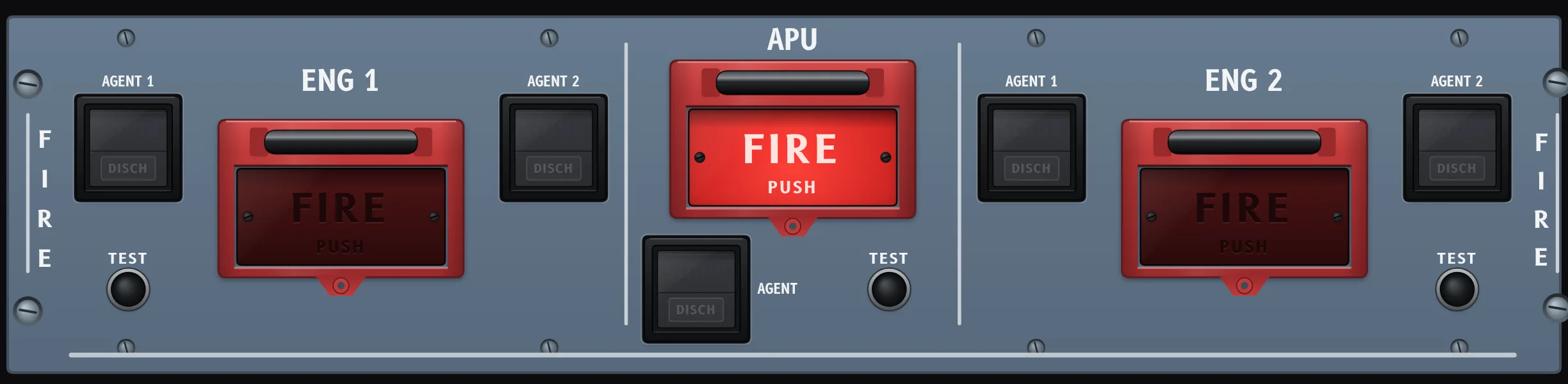
The E/WD shows APU FIRE in red with LAND ASAP and its three lines: APU FIRE P/B, PUSH; AGENT AFTER 10 S, DISCH; MASTER SW, OFF. The APU FIRE pushbutton is lit red on the FIRE panel.
Nothing has been pushed or closed yet. The FCOM gives the automatic shutdown and discharge for a fire on the ground only, so in flight the three lines are the crew's. Working them in order is what the ECAM Trainer does with you.
Sources FCOM PRO-ABN-APUF APU FIRE / FCOM DSC-26-20-20 / FCOM DSC-31-10 WARNING/CAUTION CLASSIFICATION / FCOM DSC-49-20 / FCOM DSC-26-20-10 EXTINGUISHING
What does the APU do by itself, and when?
On the ground, the FCOM lets the APU run without cockpit crew supervision, and gives it its own protection. When it detects an APU fire on the ground, the APU fire warnings operate in the cockpit, a horn sounds in the nose gear bay, the AVAIL light goes out, the FAULT light in the MASTER SW comes on, the APU shuts down and its extinguisher discharges.
The MASTER SW's list of automatic shutdowns gives fire as one reason, marked on ground only. In flight, then, the shutdown is the crew's: pushing the APU FIRE pushbutton shuts the APU down, and the bottle waits for the crew's AGENT pushbutton.
Outside, the ground crew has its own control: the APU SHUT OFF pushbutton on the interphone panel under the nose closes the APU's LP fuel valve, shuts the APU down without its cooling cycle and silences the external horn.
Sources FCOM DSC-49-10-20 GROUND OPERATION SAFETY DEVICES / FCOM DSC-26-20-10 EXTINGUISHING / FCOM DSC-49-20 / FCOM DSC-49-10-20 CONTROLS / FCOM DSC-26-20-20
What does the APU FIRE pushbutton cut?
The APU FIRE pushbutton is guarded, and normally in. When the crew pushes it, it is released and sends one electrical signal that shuts the APU down, silences the aural warning, arms the squib on the APU's bottle, closes the low pressure fuel valve, shuts off the APU fuel pump, closes the APU bleed valve and the crossbleed valve, and deactivates the APU generator.
Releasing the pushbutton also makes the AGENT pushbutton active: SQUIB comes on white on it. A brief push discharges the bottle, and DISCH comes on amber once the bottle has lost its pressure.
Sources FCOM DSC-26-20-20
Push the APU FIRE pushbutton
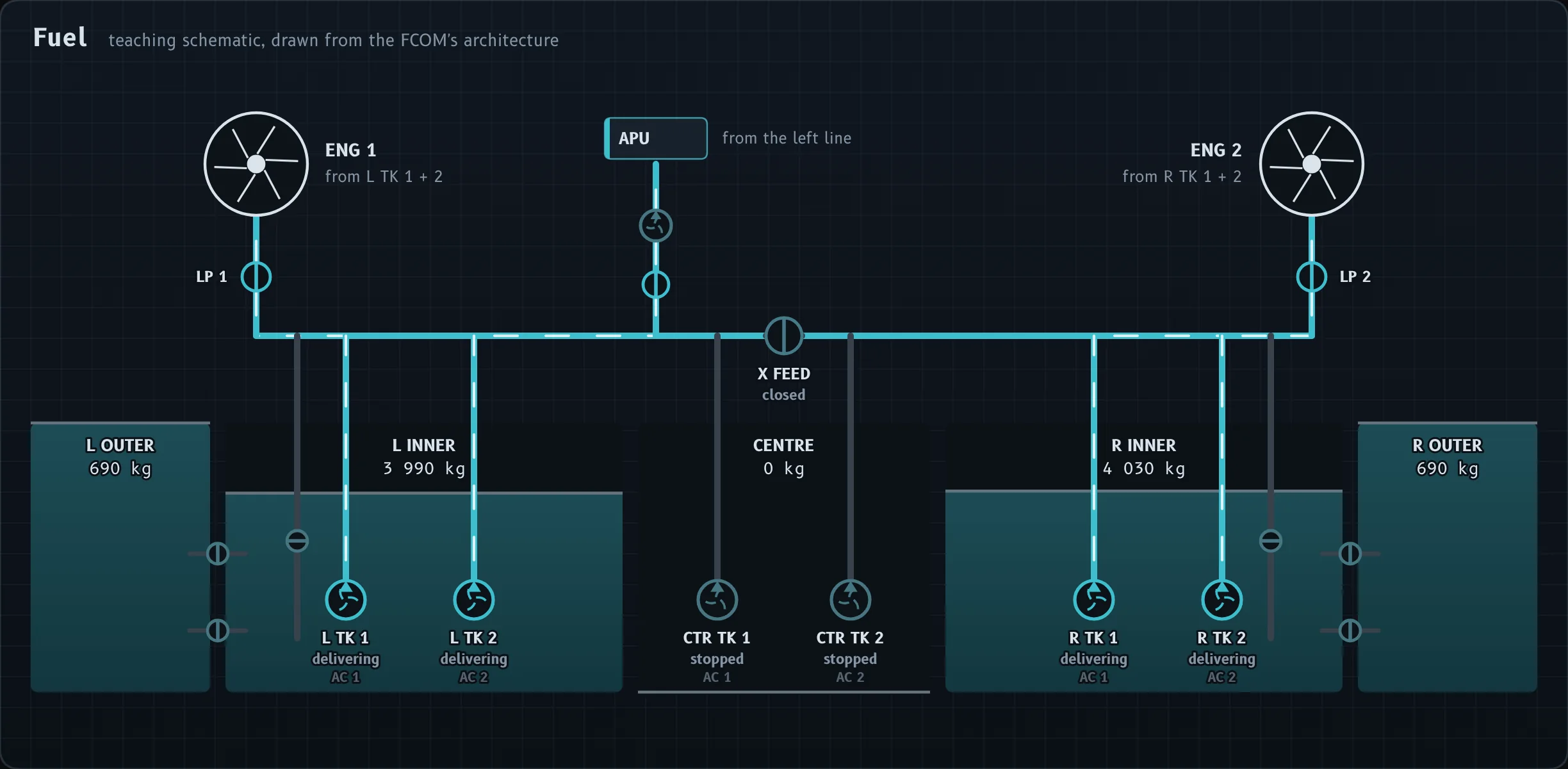
The APU is on fire in flight and still running on its fuel. Predict first, then push the guarded APU FIRE pushbutton and watch the APU's feed on the fuel schematic.
-
Predict The agent has not been discharged yet. What does pushing APU FIRE do to the APU's fuel?
Try it Lift the guard and push APU FIRE.
On the schematic the APU's LP fuel valve closes with the push and the feed line to the APU goes dry. That is all this drawing shows of the push. The FCOM gives the same push more to do: it shuts the APU down, arms the squib, shuts off the APU fuel pump, closes the APU bleed and crossbleed valves and deactivates the APU generator.
The pushbutton stays lit red: its light shows that a fire is detected, not where the pushbutton is. SQUIB on the AGENT pushbutton now shows the bottle armed.
Sources FCOM DSC-26-20-20 / FCOM PRO-ABN-APUF APU FIRE
Why wait 10 s before the agent?
The ECAM asks for the agent 10 s after the pushbutton, and counts the seconds down itself. The FCOM gives the reason in one line: "The 10 s delay allows the airflow to decrease, which increases the effect of the agent."
There is only one agent. An engine has two bottles; the APU has one, with two squibs. The APU procedure has no second discharge, where the engine fire procedure has AGENT 2 if the fire warning remains 30 s after the first.
The last line sets the APU MASTER SW off. That switch controls the APU's electric supply and its protective features, and its starting and shutdown sequences; at OFF its ON light goes out. The procedure closes with a firm rule: do not attempt to restart the APU.
Sources FCOM PRO-ABN-APUF APU FIRE / FCOM DSC-26-20-10 EXTINGUISHING / FCOM PRO-ABN-ENG ENG / FCOM DSC-49-20
What does the aircraft lose with the APU?
In flight the APU is a backup: it backs up the electrical system and the air conditioning, and it can be used to start the engines. After an APU fire it stays off: the procedure says not to attempt a restart.
What the pushbutton shuts is what the APU was ready to give: its generator is deactivated, and its bleed valve and the crossbleed valve close. When GEN 1 and GEN 2 are operating, they have priority over the APU generator anyway, so the network stays on them.
Sources FCOM DSC-49-10-10 GENERAL / FCOM PRO-ABN-APUF APU FIRE / FCOM DSC-26-20-20 / FCOM DSC-24-10-30-10 GENERAL
What goes with the APU
What is lost afterwards?
STATUS is the SD's operational summary of the aircraft's state after a failure. The FCOM prints the APU FIRE STATUS under the procedure, for all aircraft, with one line: APU under INOP SYS. No STATUS picture is drawn here; the procedure's own lines end with the master switch off and no restart of the APU.
The STATUS page comes up by itself when STATUS is not empty and the crew clears the last alert or selects CONF 1 for the approach, and the crew can call it with the STS pushbutton.
Sources FCOM DSC-31-20 STATUS PAGE / FCOM PRO-ABN-APUF APU FIRE
A319ceo, A320ceo, A320neo, A321neo: what differs?
| A319ceo, A320ceo | A320neo, A321neo | |
|---|---|---|
| The warning and its procedure | The same in every version | The same in every version |
| APU fire detection | Two loops, one sensing element in the APU compartment | Two loops, one sensing element in the APU compartment |
The FCOM prints one APU FIRE procedure, for every aircraft, and one description of the APU's detection and its bottle.
Sources FCOM PRO-ABN-APUF APU FIRE / FCOM DSC-26-20-10 FIRE DETECTION / FCOM DSC-26-20-10 EXTINGUISHING

Work APU FIRE as a crew
Read and do each line against the FCOM, with the E/WD, the SD page and the overhead following your hands, the PF and PM calls, and a debrief that says what you missed.
Work this failure in the ECAM TrainerGo further
Written in our own words from the FCOM and the FCTM; each part names the units it rests on. The E/WD, the STATUS and the live aircraft are the platform's own ECAM and systems model, the same the ECAM Trainer and the flight deck run. This page explains the procedure; it is not the procedure. Aircraft differ by type, engine and options: your aircraft's FCOM, your QRH and your operator's procedures always come first. How we write and check these pages.
Every ECAM procedure, line by line, against the FCOM.
The ECAM Trainer works 108 scenarios with the E/WD, the SD page and the overhead following your hands. Start free today, or open everything with A320 Knowledge+.
For study and revision only. Always follow your operator's approved documentation and procedures. A320 Knowledge is independent and not affiliated with Airbus.