
SMOKE AFT CARGO SMOKE
A red warning for a compartment nobody can see into. Here is how the aft hold's detectors decide there is smoke, what the aft cargo ventilation does by itself, why the agent may not make the warning go, and what changes once the aircraft is on the ground.
Written and checked by current A320 pilotschecked against the FCOM on Our editorial policy
What SMOKE AFT CARGO SMOKE means
SMOKE AFT CARGO SMOKE is a red warning: the smoke detection of the aft cargo compartment has found smoke. The red AFT SMOKE light comes on with it, and where the aft hold is ventilated, the ventilation closes off by itself.
The ECAM asks for LAND ASAP, the aft isolation valve off if it has not closed automatically, the cabin fans off and the agent into the aft hold. The crew should expect the warning to stay after the agent. Once on the ground, the passengers leave before anyone opens a cargo door.
Sources FCOM PRO-ABN-SMOKE / FCOM DSC-26-50-20 / FCOM DSC-21-40-20 / FCOM PRO-ABN-SMOKE SMOKE / FCTM PR-AEP-SMOKE CARGO SMOKE
At a glance
- Level
- Red warning, level 3: continuous repetitive chime and a flashing red MASTER WARN light
- Sets it off
- Smoke in one ceiling cavity of the aft hold: both its detectors, or one with the other inoperative
- Lights
- The red AFT SMOKE light on the CARGO SMOKE panel
- By itself
- Where aft cargo ventilation is fitted, its isolation valves close and its extraction fan stops
- Extinguishing
- One bottle for both holds, through two nozzles in the aft hold, from the AFT DISCH pushbutton
- Landing
- Red LAND ASAP: the nearest airport where a safe landing can be made
Sources FCOM DSC-31-10 WARNING/CAUTION CLASSIFICATION / FCOM DSC-31-30 ATTENTION GETTERS / FCOM DSC-31-10 AUDIO INDICATORS / FCOM PRO-ABN-SMOKE / FCOM DSC-26-50-10 SMOKE DETECTION / FCOM DSC-26-50-20 / FCOM DSC-26-50-10 FIRE EXTINGUISHING / FCOM DSC-21-40-20 / FCOM PRO-ABN-SMOKE SMOKE / FCTM AOP-30-10 LAND ASAP DEFINITION
What makes the aft cargo smoke warning come on?
Smoke detectors sit in the ceiling panel cavities of the aft hold: four on the A319ceo, A320ceo and A320neo, six on the A321neo. Each is linked to one of two detection loops, and they report to a Smoke Detection Control Unit (SDCU) with two identical channels, or to the CIDS with a smoke detection function, which passes the signal to the ECAM.
The decision is made cavity by cavity. Smoke in one cavity gives the warning if both of its detectors detect smoke, or if one does and the other is inoperative. The AFT SMOKE light follows the same idea with the two channels: both detect smoke, or one does with the other faulty.
A failed aft detection gives a caution instead, SMOKE AFT CRG DET FAULT. The crew tests the cargo smoke detection with the TEST pushbutton, held for at least 3 s: it tests the detectors in sequence, lights the SMOKE lights twice with the ECAM warning, closes the cargo ventilation isolation valves where fitted, and lights the DISCH lights.
Sources FCOM DSC-26-50-10 SMOKE DETECTION / FCOM DSC-26-50-20 / FCOM PRO-ABN-SMOKE
From an aft ceiling cavity to the warning
What does the crew see and hear?
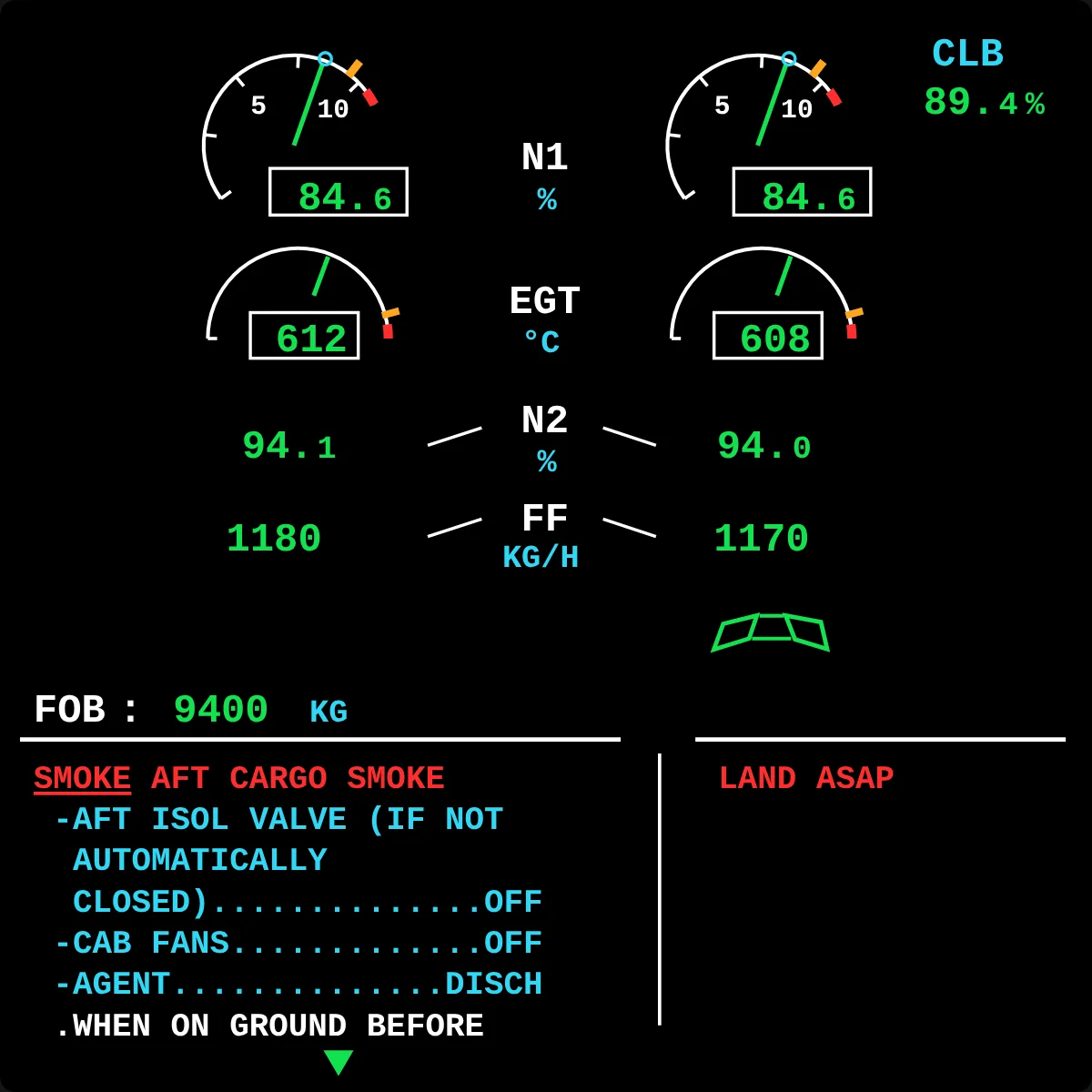
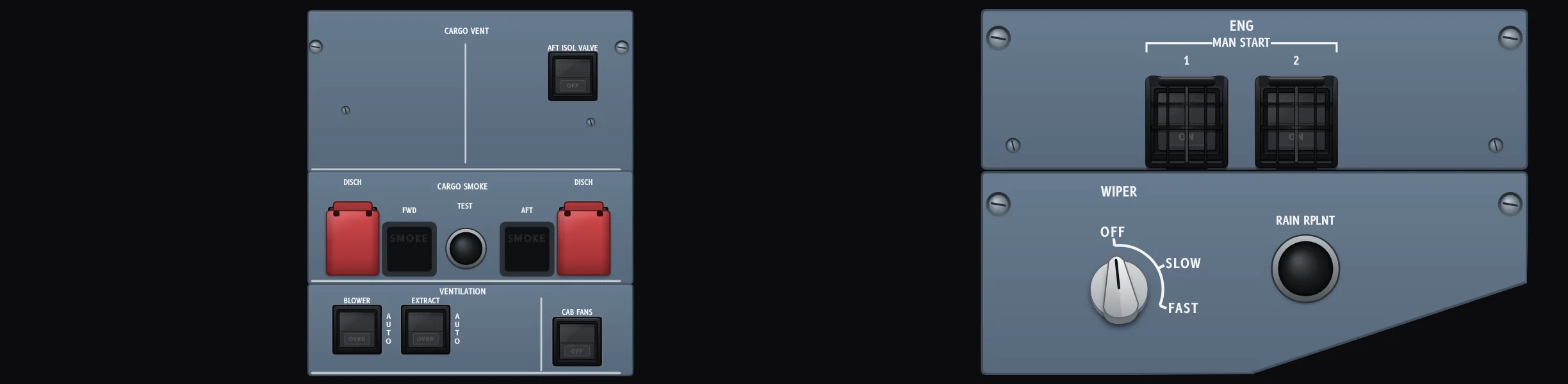
A level 3 red warning: the continuous repetitive chime, MASTER WARN flashing red and the warning in red on the E/WD. On the CARGO SMOKE panel of the overhead, the red SMOKE light under AFT comes on.
The procedure under the title starts with red LAND ASAP. The FCOM puts its option marker on the AFT ISOL VALVE line, and prints AGENT, DISCH under IF AFT CRG CLOSED, a condition displayed on ground only.
Sources FCOM DSC-31-10 WARNING/CAUTION CLASSIFICATION / FCOM DSC-31-30 ATTENTION GETTERS / FCOM DSC-26-50-20 / FCOM DSC-26-50-10 FIRE EXTINGUISHING / FCOM PRO-ABN-SMOKE SMOKE
The moment the warning comes on
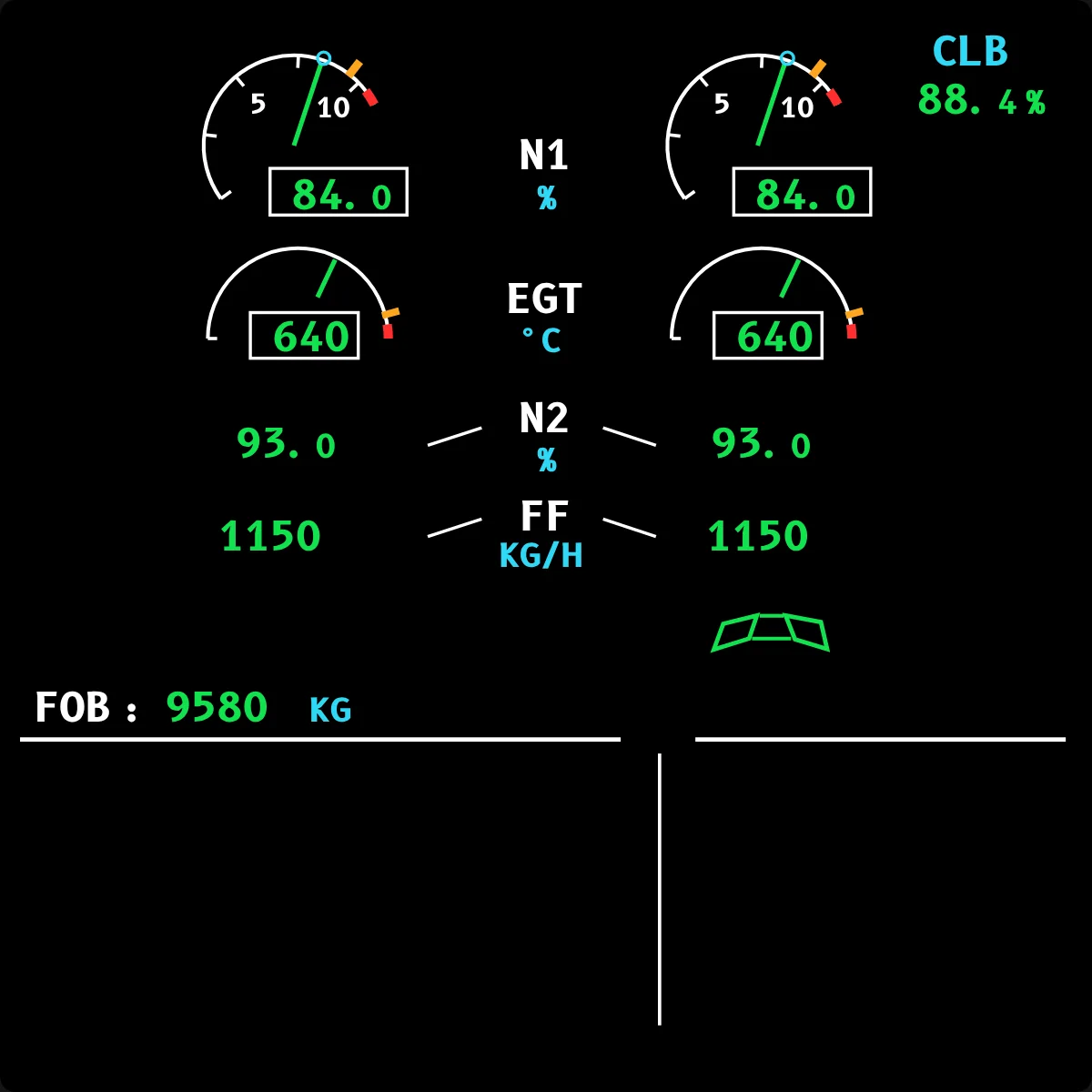
A healthy aircraft in the cruise. Press the button to put smoke in the aft hold, then look at the E/WD and the CARGO SMOKE panel.
The alert Smoke in the aft hold
The E/WD shows SMOKE AFT CARGO SMOKE in red with LAND ASAP, then AFT ISOL VALVE (IF NOT AUTOMATICALLY CLOSED) OFF, CAB FANS OFF and AGENT DISCH, and below them WHEN ON GROUND BEFORE OPEN CRG DOORS, PAX DISEMBARK. The AFT SMOKE light is red on the CARGO SMOKE panel.
Where aft cargo ventilation is fitted, its controller closes the isolation valves and stops the extraction fan when the aft smoke detection detects smoke; the live aircraft has no ventilation drawing to show it. Working the lines in order is what the ECAM Trainer does with you.
Sources FCOM PRO-ABN-SMOKE SMOKE / FCOM DSC-26-50-20 / FCOM DSC-21-40-20
What does the aircraft do by itself, and what is left to the crew?
Where the aft hold is ventilated, air from the cabin goes in through an inlet isolation valve, driven by an extraction fan, and leaves through an outlet isolation valve and then the outflow valve. A cargo ventilation controller runs the valves and the fan.
That controller closes the isolation valves and stops the extraction fan when the aft cargo smoke detection detects smoke, without the crew, and also when the crew sets the AFT ISOL VALVE pushbutton to OFF. The ECAM's line reads AFT ISOL VALVE (IF NOT AUTOMATICALLY CLOSED), OFF.
On the A320ceo panel the FCOM adds that the AFT ISOL VALVE pushbutton at OFF also closes the trim air valve.
The crew's other line is CAB FANS, OFF, on the VENTILATION panel: at OFF the two cabin fans are off. Then comes the agent. The procedure gives no reason for the ventilation lines.
Sources FCOM DSC-21-40-20 / FCOM PRO-ABN-SMOKE SMOKE / FCOM DSC-21-40-30 OVERHEAD PANEL / FCOM DSC-21-10-50 CONTROLS ON OVERHEAD PANEL
Compare: smoke in the forward hold
The same aircraft. Put the smoke in the other hold this time, and compare its E/WD line by line with the aft one.
The alert Smoke in the forward hold
Now the FWD SMOKE light is red, and the E/WD starts at CAB FANS OFF. The FCOM gives a FWD ISOL VALVE line too, but only for aircraft with forward cargo ventilation, an option this live aircraft does not have; its aft hold is ventilated, so the aft procedure keeps its line.
Sources FCOM PRO-ABN-SMOKE SMOKE / FCOM DSC-26-50-20
Why does the warning stay on after the agent?
The holds share one fire bottle with two discharge heads, one for each compartment, supplying three nozzles: one forward and two in the aft hold. The AFT DISCH pushbutton ignites the aft head's squib and the agent goes into the aft hold. Within 60 s, the amber DISCH light comes on once the bottle is fully discharged.
The procedure warns the crew to expect the SMOKE warning to remain after the discharge, even if the smoke source is extinguished. It gives two reasons: "Gases from the smoke source are not evacuated, and smoke detectors are also sensitive to the extinguishing agent."
The FCTM makes the same point: even after the cargo bottle has worked, the warning might persist, because the detectors respond to the agent.
Sources FCOM DSC-26-50-10 FIRE EXTINGUISHING / FCOM DSC-26-50-20 / FCOM PRO-ABN-SMOKE SMOKE / FCTM PR-AEP-SMOKE CARGO SMOKE
What changes once the aircraft is on the ground?
In flight, the ECAM keeps one line for later: WHEN ON GROUND BEFORE OPEN CRG DOORS, PAX DISEMBARK. On the ground the procedure shows a condition the crew does not see in flight, IF AFT CRG CLOSED: order the ground crew not to open the affected compartment's door unless the passengers have disembarked and fire services are present, and make sure the aft cargo door is closed before discharging the agent.
The FCTM adds the open door case: with the SMOKE warning on the ground and the cargo door open, the crew does not discharge the agent, and asks the ground crew to find and remove the smoke source. On the ground, the FCTM notes, a high level of humidity can trigger the warning.
One note applies only to aircraft with aft cargo ventilation; the forward procedure has its own for the forward hold. Where it is fitted, if the warning came on only for a while and no agent was discharged, normal cargo ventilation may be recovered when livestock needs it, by pulling and pushing the cargo ventilation controller's circuit breaker.
Sources FCOM PRO-ABN-SMOKE SMOKE / FCTM PR-AEP-SMOKE CARGO SMOKE
What is lost afterwards?
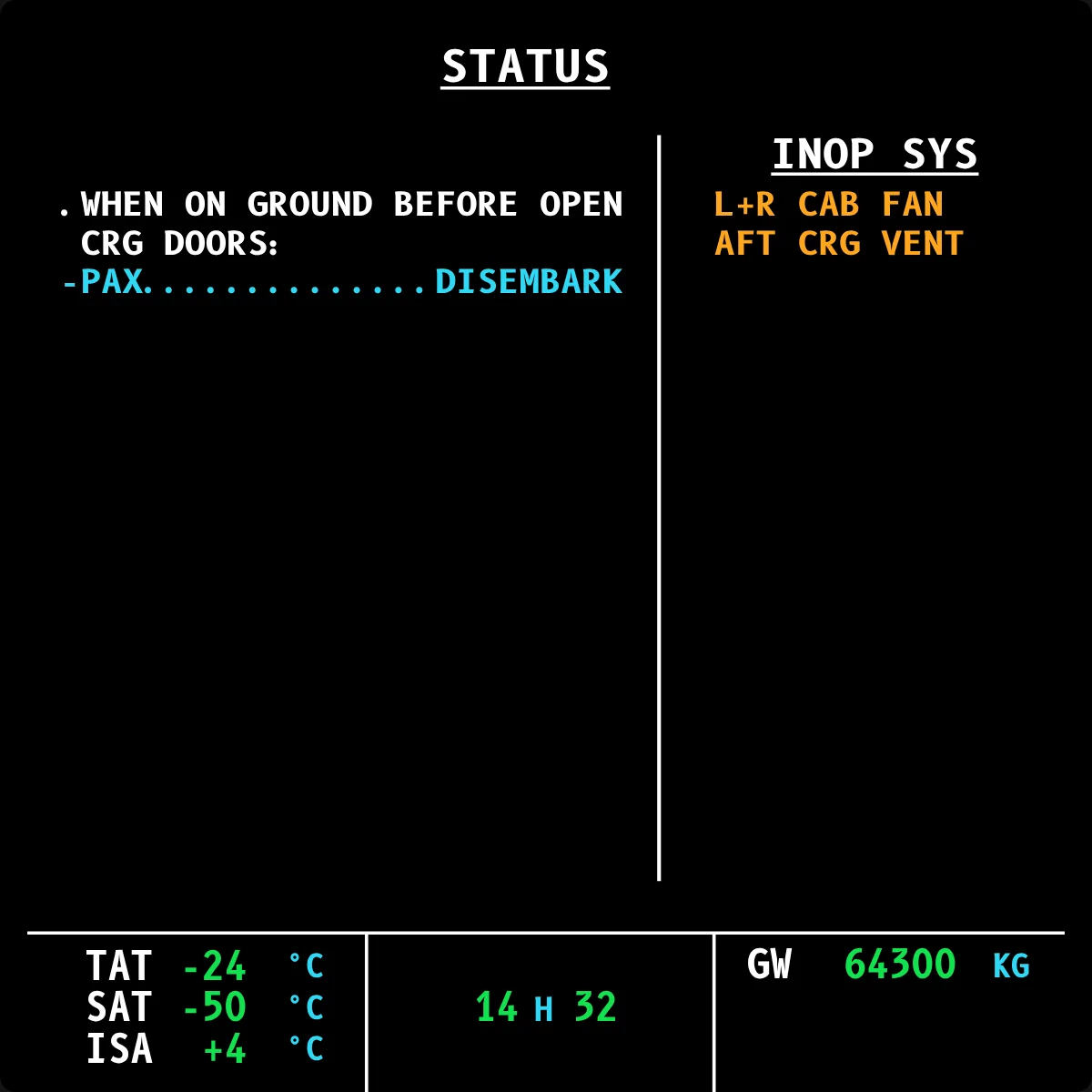
STATUS is the SD's operational summary of the aircraft's state. In flight it repeats WHEN ON GROUND BEFORE OPEN CRG DOORS, PAX DISEMBARK; on the ground the condition reads BEFORE OPEN CRG DOORS.
INOP SYS lists the cabin fans, L+R CAB FAN, the aft cargo ventilation, AFT CRG VENT, and AFT CRG HEAT, each with the FCOM's option marker. The live aircraft has no cargo heating, so the picture leaves that line out.
Which version applies depends on your aircraft: check your own FCOM.
Sources FCOM PRO-ABN-SMOKE SMOKE / FCOM DSC-31-20 STATUS PAGE
A319ceo, A320ceo, A320neo, A321neo: what differs?
| A319ceo, A320ceo | A320neo, A321neo | |
|---|---|---|
| The warning and its procedure | The same in every version | The same in every version |
| Smoke detectors in the aft hold | Four | Four on the A320neo, six on the A321neo |
| STATUS INOP SYS | Not given by type: one version lists L+R CAB FAN, AFT CRG VENT and AFT CRG HEAT, each where fitted; the other leaves out L+R CAB FAN | Not given by type either: the same two versions, each for a list of aircraft |
The FCOM prints the STATUS in two versions, each for a list of aircraft rather than a type. The version drawn above is the one with L+R CAB FAN.
Sources FCOM PRO-ABN-SMOKE / FCOM PRO-ABN-SMOKE SMOKE / FCOM DSC-26-50-10 SMOKE DETECTION / FCOM PRO-ABN-SMOKE ABNORMAL AND EMERGENCY PROCEDURES

Work SMOKE AFT CARGO SMOKE as a crew
Read and do each line against the FCOM, with the E/WD, the SD page and the overhead following your hands, the PF and PM calls, and a debrief that says what you missed.
Work this failure in the ECAM TrainerGo further
Written in our own words from the FCOM and the FCTM; each part names the units it rests on. The E/WD, the STATUS and the live aircraft are the platform's own ECAM and systems model, the same the ECAM Trainer and the flight deck run. This page explains the procedure; it is not the procedure. Aircraft differ by type, engine and options: your aircraft's FCOM, your QRH and your operator's procedures always come first. How we write and check these pages.
Every ECAM procedure, line by line, against the FCOM.
The ECAM Trainer works 108 scenarios with the E/WD, the SD page and the overhead following your hands. Start free today, or open everything with A320 Knowledge+.
For study and revision only. Always follow your operator's approved documentation and procedures. A320 Knowledge is independent and not affiliated with Airbus.