
SMOKE LAVATORY SMOKE
A red warning with a single line, and no switch to press. Here is how a lavatory's smoke reaches the cockpit, why the ECAM's answer is to talk to the cabin crew, and how the crew decides whether the smoke procedure in the QRH comes next.
Written and checked by current A320 pilotschecked against the FCOM on Our editorial policy
What SMOKE LAVATORY SMOKE means
SMOKE LAVATORY SMOKE is a red warning: a smoke detector in one of the lavatories has detected smoke, and the warning goes to the cockpit and to the cabin.
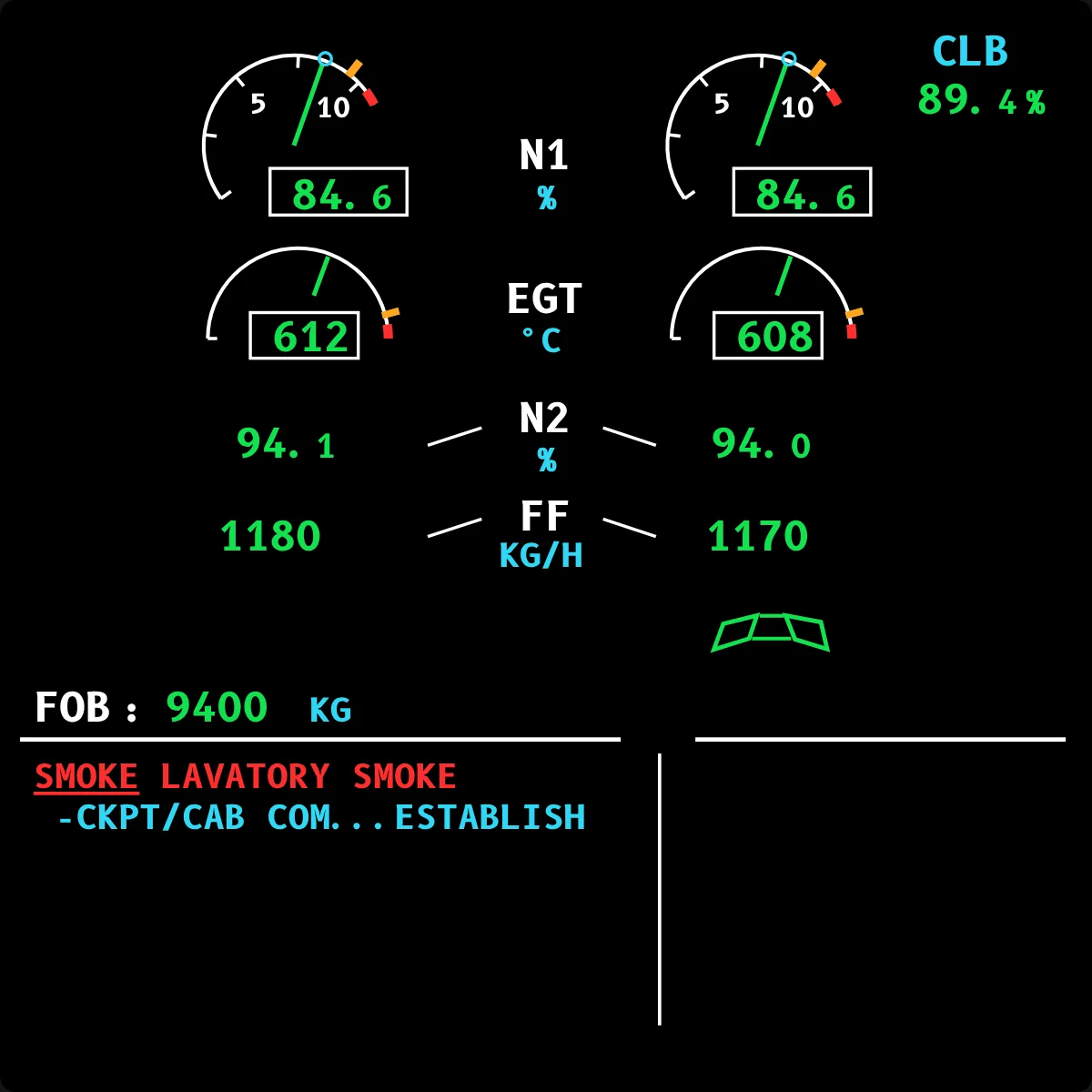
The ECAM gives the flight crew one line: establish communication with the cabin crew, to follow the smoke's origin and how it clears. Each lavatory waste bin has its own automatic fire extinguishing system. The FCOM also has the crew consider the SMOKE/FUMES/AVNCS SMOKE QRH procedure, and the FCTM sends the crew there if any doubt exists about where the smoke comes from.
Sources FCOM PRO-ABN-SMOKE SMOKE LAVATORY SMOKE / FCOM DSC-26-40-10 SMOKE DETECTION / FCOM PRO-ABN-SMOKE SMOKE / FCOM DSC-26-40-10 WASTEBIN FIRE EXTINGUISHING / FCTM PR-AEP-SMOKE SMOKE DETECTION AND PROCEDURE APPLICATION
At a glance
- Level
- Red warning, level 3: continuous repetitive chime and a flashing red MASTER WARN light
- Sets it off
- Smoke detected in one of the lavatories
- Detection
- One smoke detector in the lavatory's air extraction duct, through the SDCU or the CIDS to the Flight Warning Computer
- Warning
- In the cockpit and in the cabin
- The procedure
- One line, CKPT/CAB COM, ESTABLISH; no LAND ASAP and no agent for the crew to discharge
Sources FCOM DSC-31-10 WARNING/CAUTION CLASSIFICATION / FCOM DSC-31-30 ATTENTION GETTERS / FCOM DSC-31-10 AUDIO INDICATORS / FCOM PRO-ABN-SMOKE SMOKE LAVATORY SMOKE / FCOM DSC-26-40-10 SMOKE DETECTION / FCOM PRO-ABN-SMOKE SMOKE / FCOM DSC-26-40-10 WASTEBIN FIRE EXTINGUISHING
How does smoke in a lavatory reach the cockpit?
The FCOM describes one smoke detector, in the lavatory's air extraction duct. Unlike the cargo holds, there is no pair of detectors to agree: the system is that detector and a double channel Smoke Detection Control Unit (SDCU), or the CIDS with a smoke detection function, which triggers the alerts in the cockpit and the cabin.
When the detector senses smoke, it signals the SDCU or the CIDS, which passes it to the Flight Warning Computer (FWC). The FWC gives the warning in the cockpit and in the cabin. The CIDS, which also runs the cabin interphone and the attendant panels, lists the lavatory smoke detectors and indicators among the cabin systems it handles.
Sources FCOM DSC-26-40-10 SMOKE DETECTION / FCOM DSC-26-50-10 SMOKE DETECTION / FCOM DSC-23-10-30 CABIN INTERCOMMUNICATION DATA SYSTEM
From the lavatory to both crews
What does the crew see and hear?
A level 3 red warning: the continuous repetitive chime, MASTER WARN flashing red and the red message on the E/WD. The FCOM's description goes from the detector to the FWC; it does not describe a lavatory smoke light on the overhead, and the live aircraft lights none.
Under the title is one line. There is no LAND ASAP above it, where both cargo smoke procedures start with a red one.
Sources FCOM DSC-31-10 WARNING/CAUTION CLASSIFICATION / FCOM DSC-31-30 ATTENTION GETTERS / FCOM DSC-26-40-10 SMOKE DETECTION / FCOM PRO-ABN-SMOKE SMOKE
The moment the warning comes on
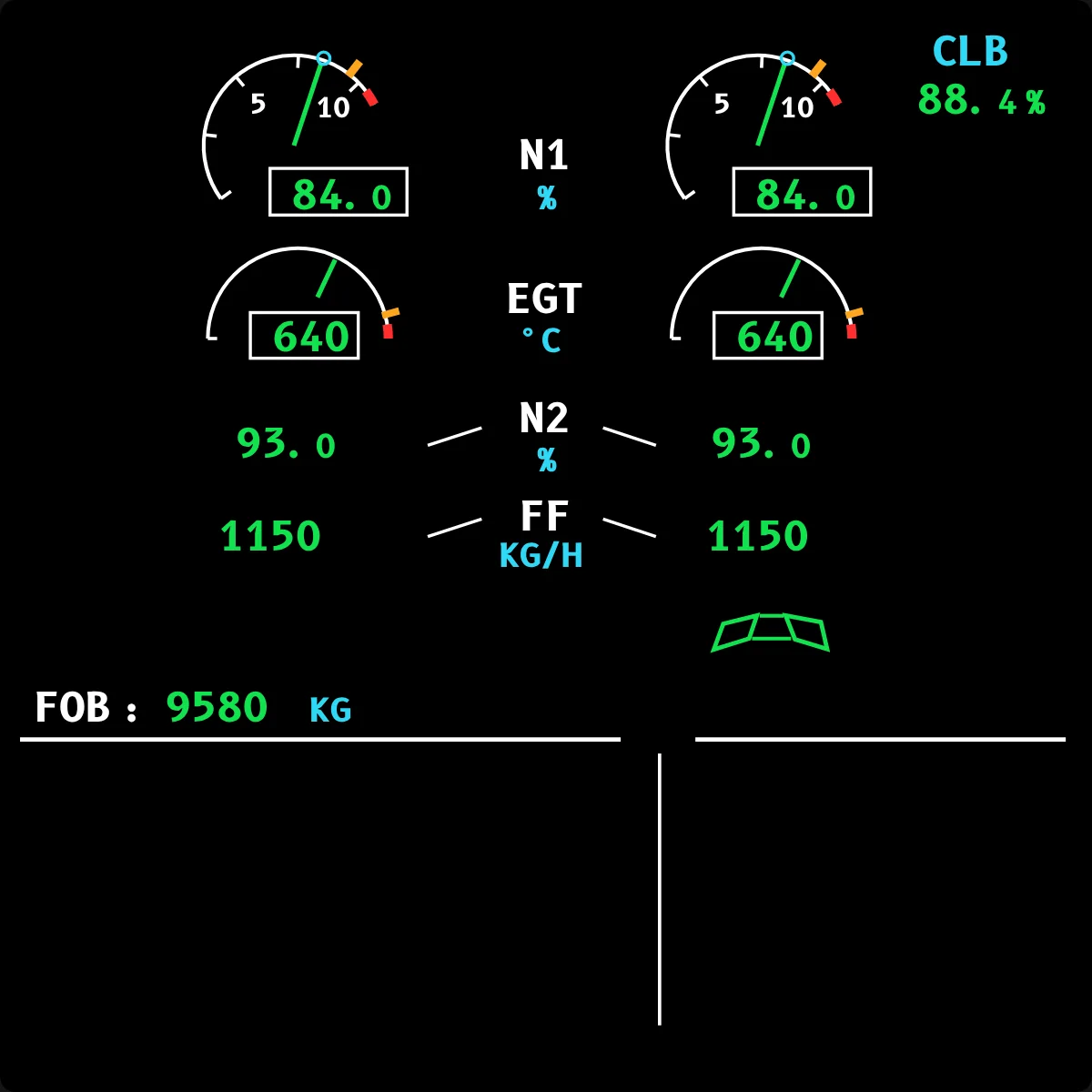
A healthy aircraft in the cruise. Press the button to put smoke in a lavatory, then look at the E/WD and at the overhead.
The alert Smoke in a lavatory
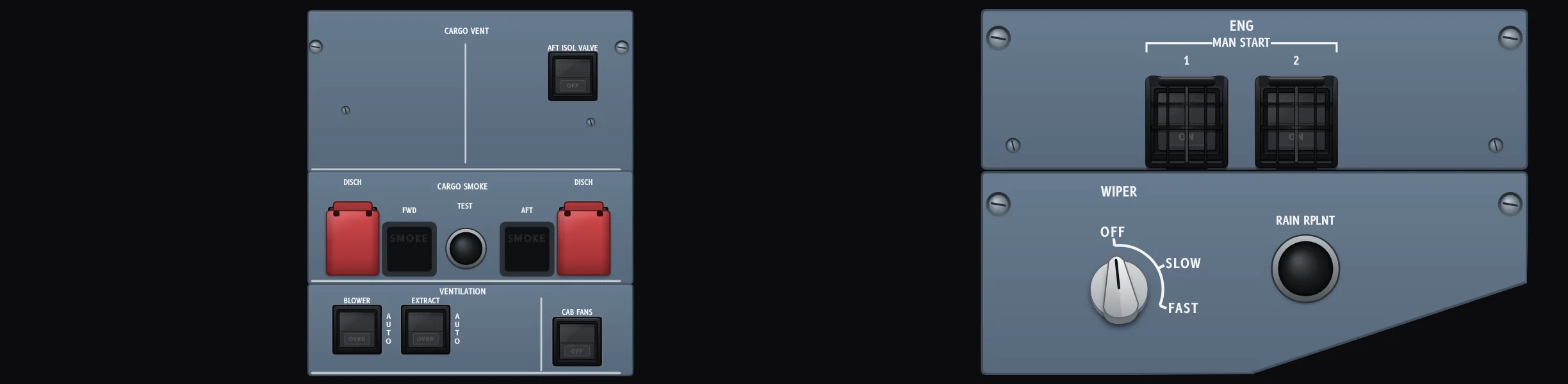
The E/WD shows SMOKE LAVATORY SMOKE in red and one line, CKPT/CAB COM, ESTABLISH. Nothing lights on the overhead panel drawn here.
The line asks for a call, not a switch. Working it, and deciding what comes after it, is what the ECAM Trainer does with you.
Sources FCOM PRO-ABN-SMOKE SMOKE / FCOM DSC-26-40-10 SMOKE DETECTION
Why is the only line a call to the cabin crew?
The FCOM gives the reason just above the line: the flight crew must establish communication with the cabin crew so as to follow up where the smoke comes from and how it dissipates.
The procedure gives the flight crew no agent to discharge. Separately, the FCOM gives each lavatory waste bin its own automatic fire extinguishing system. From the cockpit, the crew can call the cabin with the CALLS panel on the overhead, which calls one area of the cabin or all stations, or makes an emergency call with the guarded EMER pushbutton.
Sources FCOM PRO-ABN-SMOKE SMOKE / FCOM DSC-26-40-10 SMOKE DETECTION / FCOM DSC-26-40-10 WASTEBIN FIRE EXTINGUISHING / FCOM DSC-23-20-20 CABIN CALL SYSTEM
When does the crew go to the QRH smoke procedure?
The FCOM puts a second sentence above the line: consider applying the SMOKE/FUMES/AVNCS SMOKE QRH procedure. The procedure itself is the QRH's, and this page names it without walking it.
The FCTM gives the order for this warning by name: if another ECAM SMOKE warning such as LAVATORY SMOKE triggers, the crew must apply the ECAM procedure, and if any doubt exists about the smoke's origin, then refer to the QRH procedure.
The FCTM gives that QRH procedure one global philosophy for cabin and cockpit smoke alike, and its words on the diversion are: "Time is critical."
Sources FCOM PRO-ABN-SMOKE SMOKE / FCOM PRO-ABN-SMOKE / FCTM PR-AEP-SMOKE SMOKE DETECTION AND PROCEDURE APPLICATION / FCTM PR-AEP-SMOKE SMOKE/FUMES/AVNCS SMOKE QRH PROCEDURE
How does it differ from a cargo smoke warning?
Both are red smoke warnings, but their procedures differ. A cargo hold has detectors in pairs, its own red SMOKE light, a bottle the flight crew discharges, and LAND ASAP in red. A lavatory has one detector, no cockpit agent, and a call to the cabin crew.
Sources FCOM DSC-26-50-10 SMOKE DETECTION / FCOM DSC-26-50-20 / FCOM DSC-26-50-10 FIRE EXTINGUISHING / FCOM PRO-ABN-SMOKE SMOKE / FCOM DSC-26-40-10 SMOKE DETECTION
Compare: smoke in the aft hold
The same aircraft, with a cargo smoke warning this time. Press it and set its E/WD and the overhead beside the lavatory's.
The alert Smoke in the aft hold
Now an overhead light comes on, the red AFT SMOKE on the CARGO SMOKE panel, and the E/WD opens with red LAND ASAP. On this aircraft, which has aft cargo ventilation, its first three lines are actions on overhead panels: the aft isolation valve if not automatically closed, the cabin fans, the agent.
Sources FCOM DSC-26-50-20 / FCOM PRO-ABN-SMOKE SMOKE / FCOM DSC-21-40-30 OVERHEAD PANEL / FCOM DSC-21-10-50 CONTROLS ON OVERHEAD PANEL / FCOM DSC-26-50-10 FIRE EXTINGUISHING
What is lost afterwards?
STATUS is the SD's operational summary of the aircraft's state. The FCOM prints none for SMOKE LAVATORY SMOKE: its page ends with the CKPT/CAB COM line.
Sources FCOM DSC-31-20 STATUS PAGE / FCOM PRO-ABN-SMOKE SMOKE
A319ceo, A320ceo, A320neo, A321neo: what differs?
| A319ceo, A320ceo | A320neo, A321neo | |
|---|---|---|
| The warning and its procedure | The same in every version | The same in every version |
| Lavatory smoke detection | One smoke detector in the lavatory's air extraction duct, SDCU or CIDS | One smoke detector in the lavatory's air extraction duct, SDCU or CIDS |
Sources FCOM PRO-ABN-SMOKE SMOKE LAVATORY SMOKE / FCOM PRO-ABN-SMOKE SMOKE / FCOM DSC-26-40-10 SMOKE DETECTION

Work SMOKE LAVATORY SMOKE as a crew
Read and do each line against the FCOM, with the E/WD, the SD page and the overhead following your hands, the PF and PM calls, and a debrief that says what you missed.
Work this failure in the ECAM TrainerGo further
Written in our own words from the FCOM and the FCTM; each part names the units it rests on. The E/WD, the STATUS and the live aircraft are the platform's own ECAM and systems model, the same the ECAM Trainer and the flight deck run. This page explains the procedure; it is not the procedure. Aircraft differ by type, engine and options: your aircraft's FCOM, your QRH and your operator's procedures always come first. How we write and check these pages.
Every ECAM procedure, line by line, against the FCOM.
The ECAM Trainer works 108 scenarios with the E/WD, the SD page and the overhead following your hands. Start free today, or open everything with A320 Knowledge+.
For study and revision only. Always follow your operator's approved documentation and procedures. A320 Knowledge is independent and not affiliated with Airbus.