
SMOKE FWD CARGO SMOKE
The forward hold's red warning. It has fewer detectors than the aft hold and one nozzle instead of two, and its ventilation is optional equipment: without it, its procedure is a line shorter. Here is what that means, with the live aircraft at the moment the warning comes on.
Written and checked by current A320 pilotschecked against the FCOM on Our editorial policy
What SMOKE FWD CARGO SMOKE means
SMOKE FWD CARGO SMOKE is a red warning: the forward cargo compartment's smoke detection has found smoke, and the red FWD SMOKE light comes on with it.
The ECAM asks for LAND ASAP, the forward isolation valve off if it has not closed by itself (only on aircraft with forward cargo ventilation), the cabin fans off, and the agent into the forward hold. The SMOKE warning may stay after the agent. On the ground, the passengers disembark before a cargo door is opened.
Sources FCOM PRO-ABN-SMOKE / FCOM DSC-26-50-20 / FCOM PRO-ABN-SMOKE SMOKE
At a glance
- Level
- Red warning, level 3: continuous repetitive chime and a flashing red MASTER WARN light
- Sets it off
- Smoke in one ceiling cavity of the forward hold: both its detectors, or one with the other inoperative
- Lights
- The red FWD SMOKE light on the CARGO SMOKE panel
- Ventilation
- Optional equipment, as in the aft hold; where fitted, it closes off by itself when smoke is detected
- Extinguishing
- The cargo bottle's forward discharge head, through a single nozzle, from the FWD DISCH pushbutton
- Landing
- Red LAND ASAP: the nearest airport where a safe landing can be made
Sources FCOM DSC-31-10 WARNING/CAUTION CLASSIFICATION / FCOM DSC-31-30 ATTENTION GETTERS / FCOM DSC-31-10 AUDIO INDICATORS / FCOM PRO-ABN-SMOKE / FCOM DSC-26-50-10 SMOKE DETECTION / FCOM DSC-26-50-20 / FCOM DSC-26-50-10 FIRE EXTINGUISHING / FCOM DSC-21-40-20 / FCOM PRO-ABN-SMOKE SMOKE / FCTM AOP-30-10 LAND ASAP DEFINITION
What makes the forward cargo smoke warning come on?
The forward hold has its smoke detectors in its ceiling panel cavities: two on the A319ceo, A320ceo and A320neo, four on the A321neo, each linked to one of two detection loops. They report to a two-channel Smoke Detection Control Unit (SDCU), or to the CIDS with a smoke detection function, which passes the signal to the ECAM.
Smoke in one cavity gives the warning when both of its detectors detect smoke, or when one does and the other is inoperative. The red FWD SMOKE light comes on with the ECAM warning when both channels detect smoke, or one does with the other faulty.
If the forward smoke detection itself fails, the crew gets a caution instead, SMOKE FWD CRG DET FAULT, and FWD CRG DET on STATUS.
Sources FCOM DSC-26-50-10 SMOKE DETECTION / FCOM DSC-26-50-20 / FCOM PRO-ABN-SMOKE / FCOM PRO-ABN-SMOKE SMOKE
What does the crew see and hear?
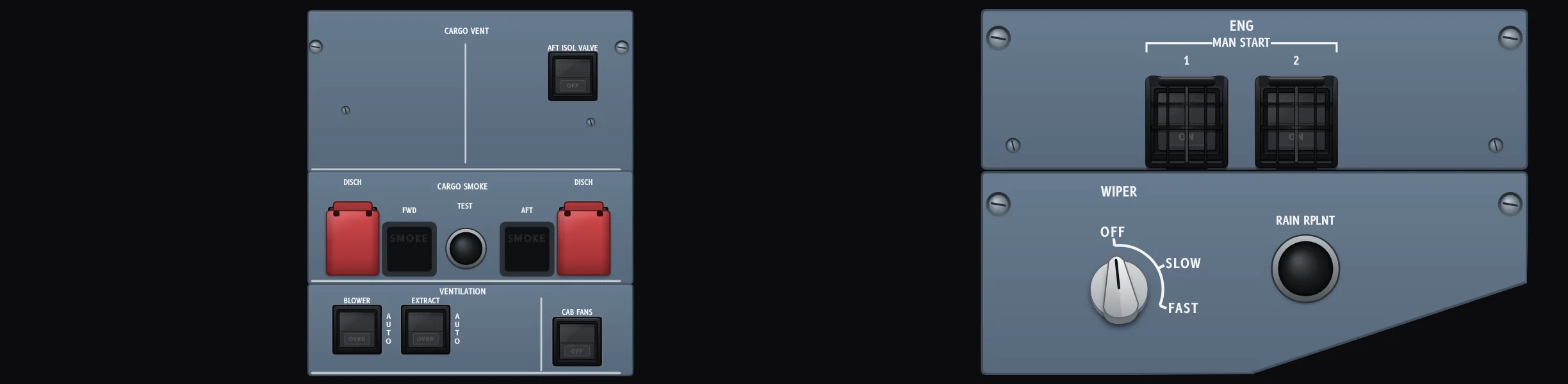
It is a level 3 red warning: the continuous repetitive chime, MASTER WARN flashing red and the red message on the E/WD. On the overhead CARGO SMOKE panel, the SMOKE light under FWD comes on red.
The FCOM's list of the SD's twelve system pages has no cargo smoke page, and the live aircraft's SD stays on the CRUISE page.
Sources FCOM DSC-31-10 WARNING/CAUTION CLASSIFICATION / FCOM DSC-31-30 ATTENTION GETTERS / FCOM DSC-26-50-10 FIRE EXTINGUISHING / FCOM DSC-26-50-20 / FCOM DSC-31-20 SYSTEM PAGES
The moment the warning comes on
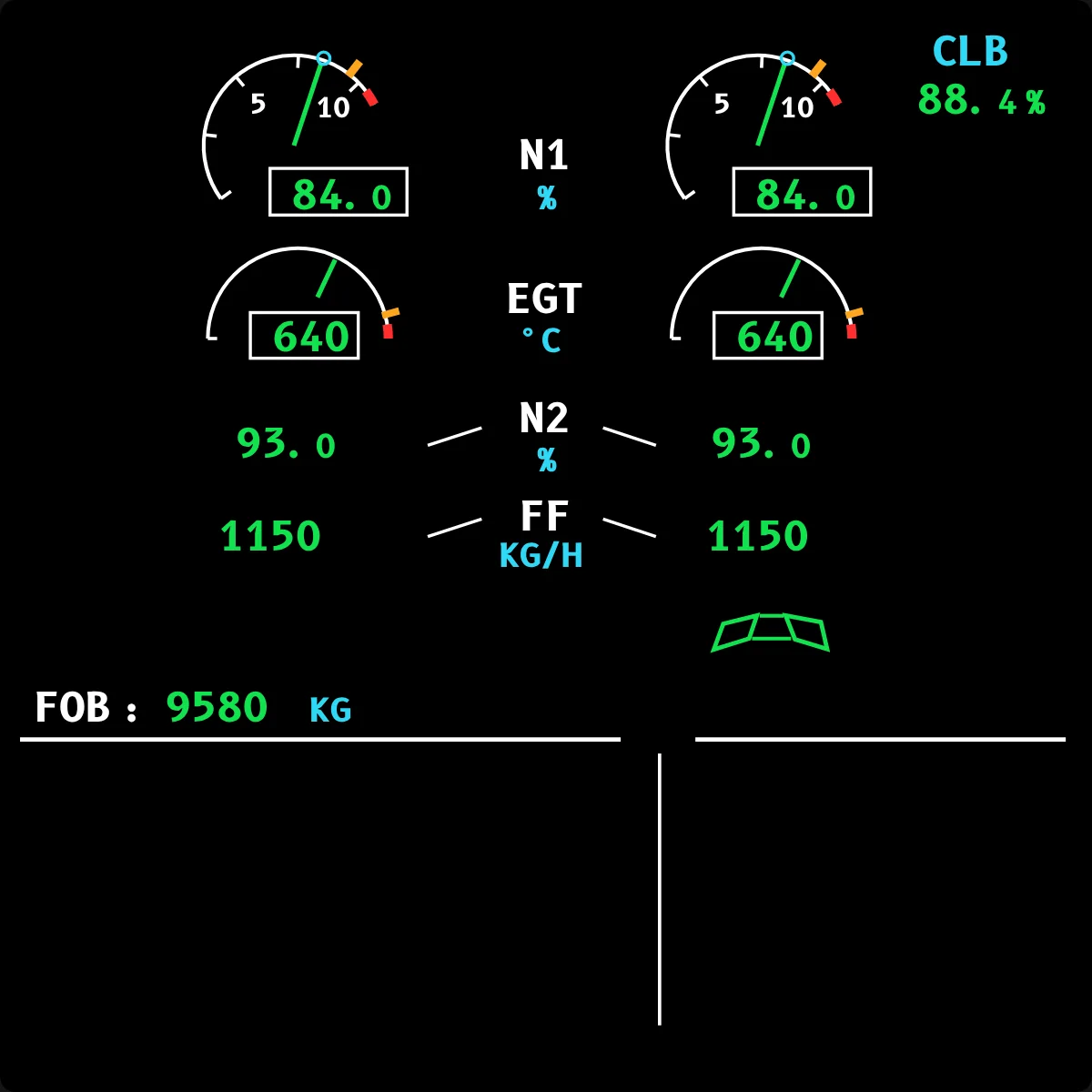
A healthy aircraft in the cruise. Press the button to put smoke in the forward hold, then look at the E/WD and the CARGO SMOKE panel.
The alert Smoke in the forward hold
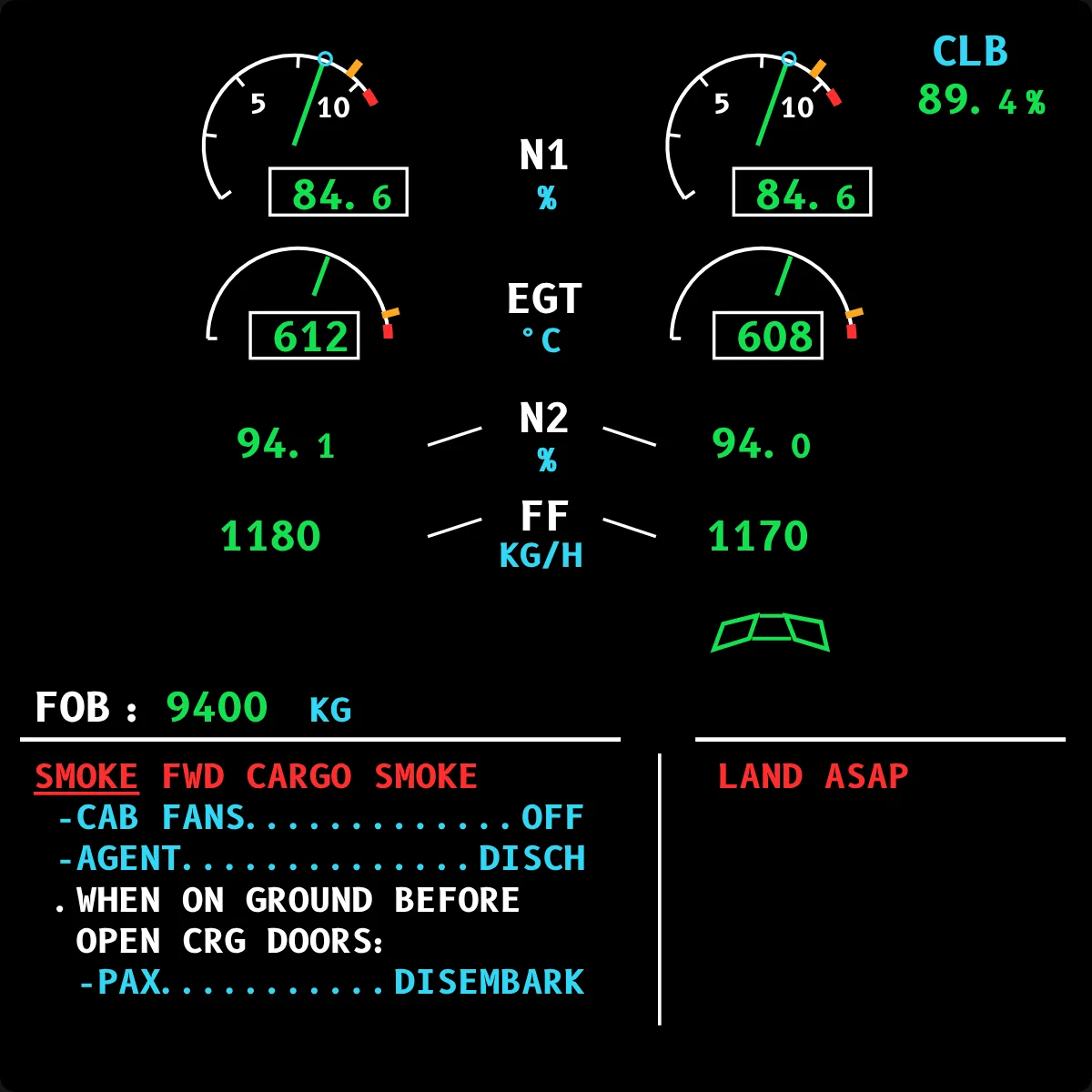
The E/WD shows SMOKE FWD CARGO SMOKE in red with LAND ASAP, then CAB FANS OFF and AGENT DISCH, with WHEN ON GROUND BEFORE OPEN CRG DOORS, PAX DISEMBARK below. The FWD SMOKE light is red on the CARGO SMOKE panel.
There is no FWD ISOL VALVE line here: the FCOM gives it only for aircraft with forward cargo ventilation, an option the live aircraft does not have. Working the lines is what the ECAM Trainer does with you.
Sources FCOM PRO-ABN-SMOKE SMOKE / FCOM DSC-26-50-20
Why is the isolation valve line only on some aircraft?
Forward cargo ventilation is optional equipment, and the FCOM marks the FWD ISOL VALVE line with it. Where fitted, air from the cabin enters the forward hold through an inlet isolation valve, moved either by an extraction fan or, in flight, by differential pressure, and a skin-mounted venturi discharges it overboard through an outlet isolation valve.
Its controller works in two modes: on the ground, or in flight with a differential pressure of 1 PSI or less, it opens the isolation valves and runs the fan; in flight above 1 PSI it stops the fan and the pressure difference keeps the air moving.
When the forward cargo smoke detection detects smoke, the controller closes the isolation valves and stops the extraction fan by itself, and also when the crew sets the FWD ISOL VALVE pushbutton to OFF. The ECAM line reads FWD ISOL VALVE (IF NOT AUTOMATICALLY CLOSED), OFF. On an aircraft without the option, as on the live aircraft, the procedure starts at the cabin fans: at OFF, the two cabin fans are off.
Sources FCOM PRO-ABN-SMOKE SMOKE / FCOM DSC-21-40-20 / FCOM DSC-21-10-50 CONTROLS ON OVERHEAD PANEL
Where does the agent go, and what does DISCH show?
The FCOM describes one fire bottle for both holds, with two discharge heads, one for each compartment, supplying three nozzles. The forward hold has one of them; the aft hold has two. Pressing FWD DISCH ignites the forward head's squib, and the bottle discharges its agent into the forward hold.
DISCH is about the bottle, not the smoke: within 60 s of the press, the amber DISCH light comes on once the bottle is fully discharged.
The smoke warning itself may not go. The procedure tells the crew to expect it to remain even if the source is out, as the gases are not evacuated and the detectors also sense the agent.
Sources FCOM DSC-26-50-10 FIRE EXTINGUISHING / FCOM DSC-26-50-20 / FCOM PRO-ABN-SMOKE SMOKE / FCTM PR-AEP-SMOKE CARGO SMOKE
One bottle, two holds
What does the procedure keep for the ground?
In flight the last line waits for the landing: WHEN ON GROUND BEFORE OPEN CRG DOORS, PAX DISEMBARK. On the ground it shows IF FWD CRG CLOSED: the ground crew is told not to open the affected compartment's door unless the passengers have disembarked and fire services are present, and the crew makes sure the forward cargo door is closed before discharging the agent.
The FCTM gives the same instruction for the ground crew, and one case the other way round: if the warning appears on the ground with the cargo door open, there is no agent discharge, and the ground crew investigates and removes the source. It also notes that, on the ground, high humidity can set the warning off.
Sources FCOM PRO-ABN-SMOKE SMOKE / FCTM PR-AEP-SMOKE CARGO SMOKE
What is lost afterwards?
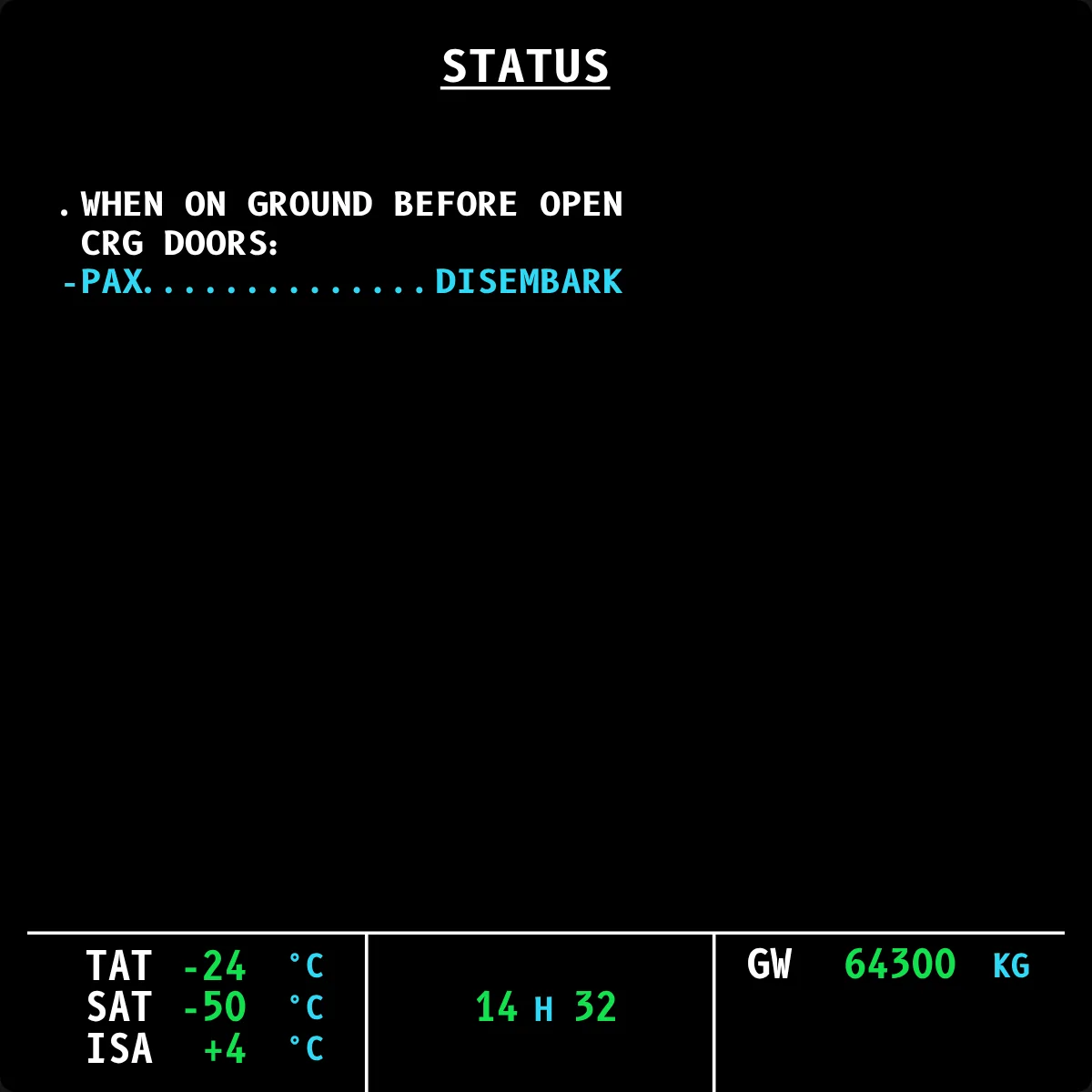
STATUS is the SD's operational summary. In flight it shows WHEN ON GROUND BEFORE OPEN CRG DOORS, PAX DISEMBARK; on the ground the condition reads BEFORE OPEN CRG DOORS.
The FCOM's INOP SYS lists FWD CRG VENT and FWD CRG HEAT, both optional equipment. The live aircraft has neither, so its INOP SYS is empty. Unlike one of the aft hold's two versions, it does not list the cabin fans.
Sources FCOM PRO-ABN-SMOKE SMOKE / FCOM DSC-31-20 STATUS PAGE
A319ceo, A320ceo, A320neo, A321neo: what differs?
| A319ceo, A320ceo | A320neo, A321neo | |
|---|---|---|
| The warning, its procedure and STATUS | The same in every version | The same in every version |
| Smoke detectors in the forward hold | Two | Two on the A320neo, four on the A321neo |
The FCOM prints a single forward hold STATUS for every aircraft, and the STATUS above shows it. The FCOM marks forward cargo ventilation and cargo heating as options, without tying either to a type.
Sources FCOM PRO-ABN-SMOKE / FCOM PRO-ABN-SMOKE SMOKE / FCOM DSC-26-50-10 SMOKE DETECTION

Work SMOKE FWD CARGO SMOKE as a crew
Read and do each line against the FCOM, with the E/WD, the SD page and the overhead following your hands, the PF and PM calls, and a debrief that says what you missed.
Work this failure in the ECAM TrainerGo further
Written in our own words from the FCOM and the FCTM; each part names the units it rests on. The E/WD, the STATUS and the live aircraft are the platform's own ECAM and systems model, the same the ECAM Trainer and the flight deck run. This page explains the procedure; it is not the procedure. Aircraft differ by type, engine and options: your aircraft's FCOM, your QRH and your operator's procedures always come first. How we write and check these pages.
Every ECAM procedure, line by line, against the FCOM.
The ECAM Trainer works 108 scenarios with the E/WD, the SD page and the overhead following your hands. Start free today, or open everything with A320 Knowledge+.
For study and revision only. Always follow your operator's approved documentation and procedures. A320 Knowledge is independent and not affiliated with Airbus.