
ENG ALL ENGINES FAILURE
A red warning for an aircraft whose engines have all failed in flight. Here is what the aircraft does by itself, with the RAT and the emergency generator, what it loses, which laws it flies in, and why the crew's priorities are what they are, with the live aircraft at the moment the warning comes on.
Written and checked by current A320 pilotschecked against the FCOM on Our editorial policy
What ENG ALL ENGINES FAILURE means
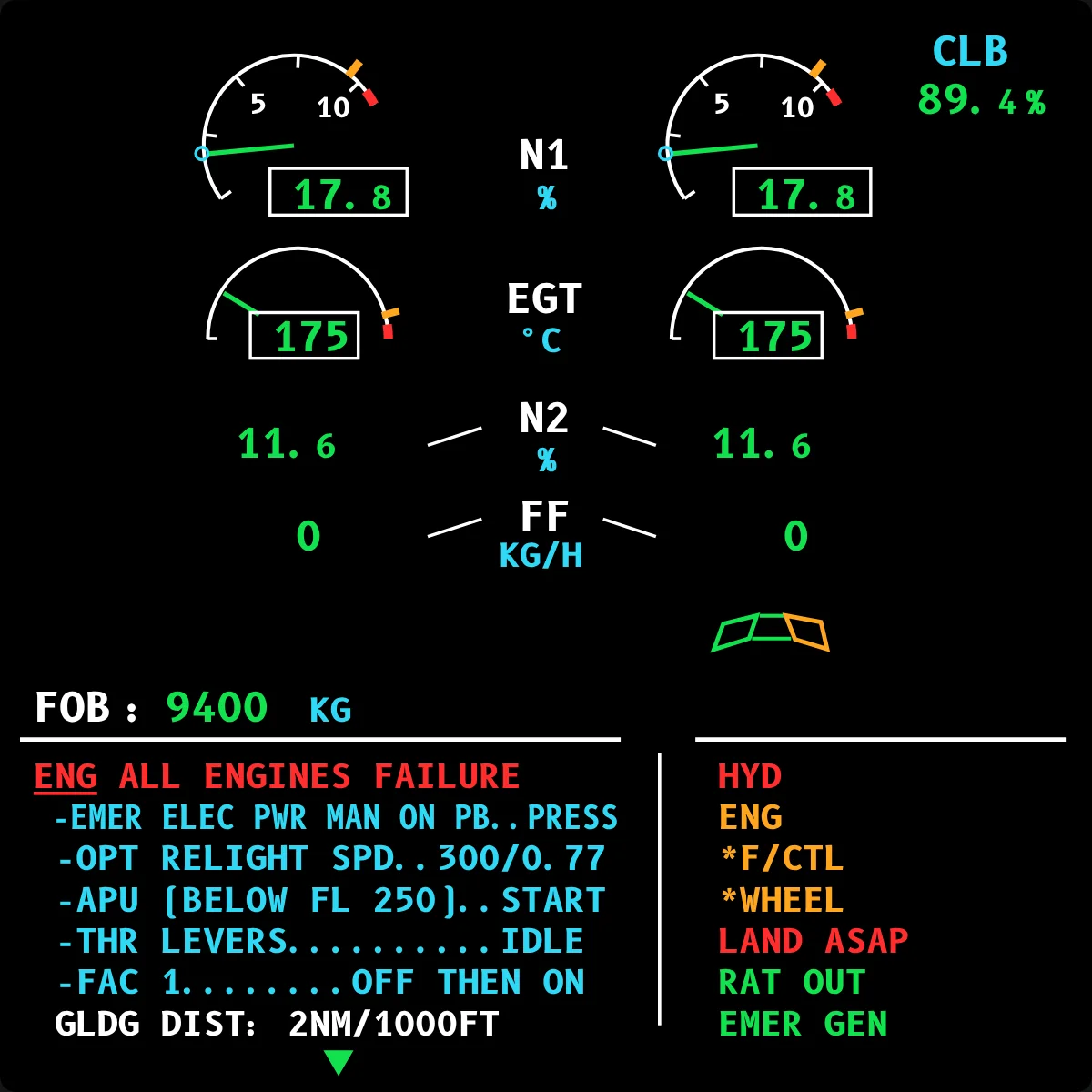
ENG ALL ENGINES FAILURE is a red warning: all engines have failed in flight. The FCTM describes an aircraft that loses engine thrust, entirely or partially, and can no longer maintain level flight. It results mainly in the emergency electrical configuration and the loss of the green and yellow hydraulic systems.
The ECAM procedure gives the first key steps, the FCTM says. Its purpose, the FCOM says, is to secure the RAT's automatic extension and the emergency generator's automatic connection. It then shows the optimum relight speed and the gliding distance, and sends the crew to the ALL ENG FAIL QRH procedure.
Sources FCOM PRO-ABN-ENG ENG ALL ENGINES FAILURE / FCTM PR-AEP-ENG ALL ENGINES FAILURE / FCTM PR-AEP-ENG / FCOM PRO-ABN-ENG ENG / FCOM PRO-ABN-ENG / FCOM PRO-ABN-ENG ABNORMAL AND EMERGENCY PROCEDURES
At a glance
- Level
- Red warning, level 3: continuous repetitive chime, MASTER WARN flashing red, and red LAND ASAP
- Sets it off
- All engines failed in flight; the warning inhibits ELEC EMER CONFIG
- By itself
- Above 100 kt with AC BUS 1 and 2 lost, the RAT extends; blue drives the emergency generator, which supplies the AC ESS BUS, and the DC ESS BUS through the ESS TR
- Flight deck
- The first officer's PFD and ND are lost, so the left-hand seat pilot is PF; AP, FD and A/THR are lost, and the aircraft is in alternate law
- Hydraulics
- Green and yellow lost; the RAT pressurises blue
- Then
- The ECAM's last line sends the crew to the ALL ENG FAIL QRH procedure
Sources FCOM DSC-31-10 WARNING/CAUTION CLASSIFICATION / FCOM DSC-31-30 ATTENTION GETTERS / FCOM PRO-ABN-ENG ENG / FCOM PRO-ABN-ENG / FCTM AOP-30-10 LAND ASAP DEFINITION / FCOM PRO-ABN-ENG ENG ALL ENGINES FAILURE / FCOM DSC-24-10-30-30 EMERGENCY GENERATION AFTER LOSS OF ALL MAIN GENERATORS / FCOM DSC-24-20 OVERHEAD PANEL (CONT'D) / FCTM PR-AEP-ENG / FCOM PRO-ABN-ENG ABNORMAL AND EMERGENCY PROCEDURES
What sets the warning off?
The FCOM's triggering condition is one line: all engines failed in flight. The warning then inhibits ELEC EMER CONFIG, the warning for AC 1 and AC 2 both unsupplied, and gives the crew its own procedure to apply immediately.
The FCTM adds that in most cases the FWC detects the condition and shows the warning, but not always. With a partial loss of thrust and no flameout, the residual N2 may stay slightly above the ENG 1(2) FAIL threshold, and the crew must still decide rapidly what to apply.
Different causes may lead to a thrust loss that leaves the aircraft unable to hold its altitude; the FCTM names fuel starvation as one of the most probable.
Sources FCOM PRO-ABN-ENG ENG ALL ENGINES FAILURE / FCOM PRO-ABN-ENG ENG / FCOM PRO-ABN-ENG / FCOM PRO-ABN-ELEC ELEC EMER CONFIG / FCTM PR-AEP-ENG ALL ENGINES FAILURE / FCTM PR-AEP-ENG
From two failed engines to the warning
What does the crew see and hear?
A red warning is the ECAM's highest level: the continuous repetitive chime, MASTER WARN flashing red and the warning message in red on the E/WD. The procedure opens with LAND ASAP in red: land as soon as possible at the nearest airport at which a safe landing can be made, a time-critical situation.
The cockpit changes a great deal, as the generators disconnect from the AC and DC busbars. The first officer's PFD and ND are lost; the E/WD remains, and the PM can show an SD page on it by pressing and holding that page's key on the ECAM control panel.
Sources FCOM DSC-31-10 WARNING/CAUTION CLASSIFICATION / FCOM DSC-31-10 AUDIO INDICATORS / FCOM DSC-31-30 ATTENTION GETTERS / FCOM PRO-ABN-ENG ENG / FCOM PRO-ABN-ENG / FCTM AOP-30-10 LAND ASAP DEFINITION / FCTM PR-AEP-ENG
The moment the warning comes on
A healthy aircraft in the cruise at FL350, both engines running, the APU not running. Press the button to flame both engines out, then look at the E/WD, the hydraulic schematic and the EMER ELEC PWR panel.
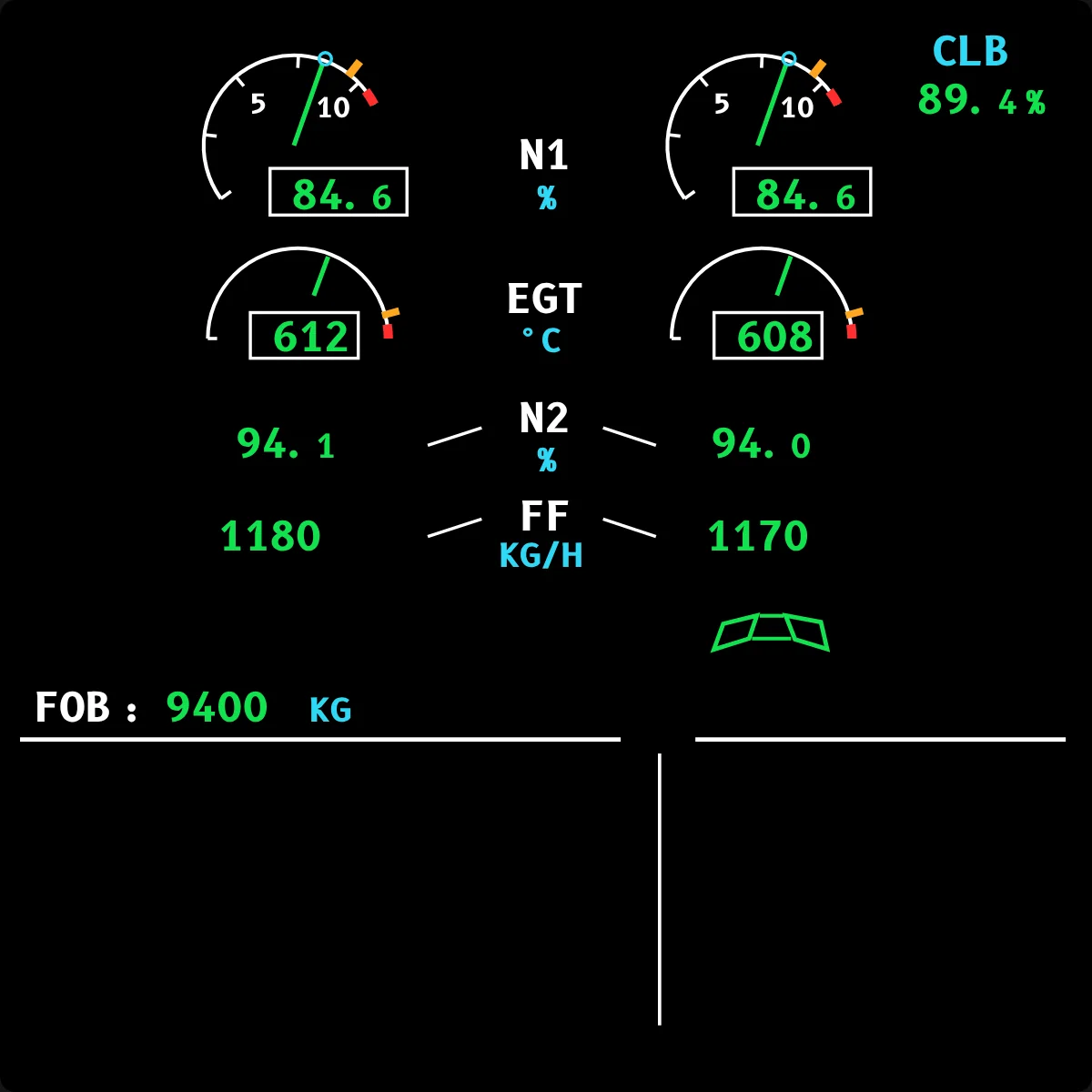
The alert Flame out both engines
The E/WD shows ENG ALL ENGINES FAILURE in red with one version of the procedure's lines, from EMER ELEC PWR MAN ON PB PRESS to ALL ENG FAIL PROC APPLY, and red LAND ASAP. Nothing has been done yet.
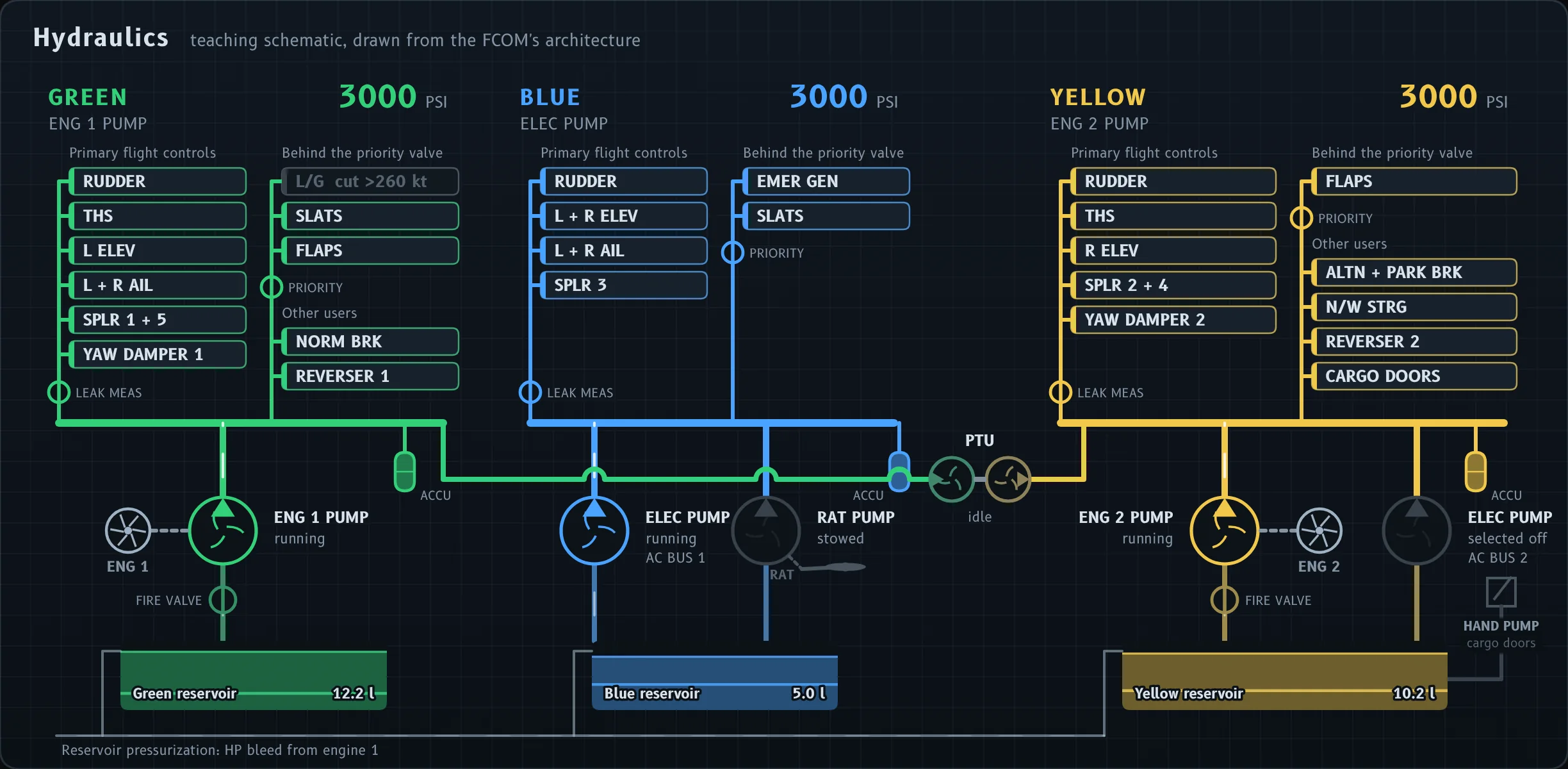
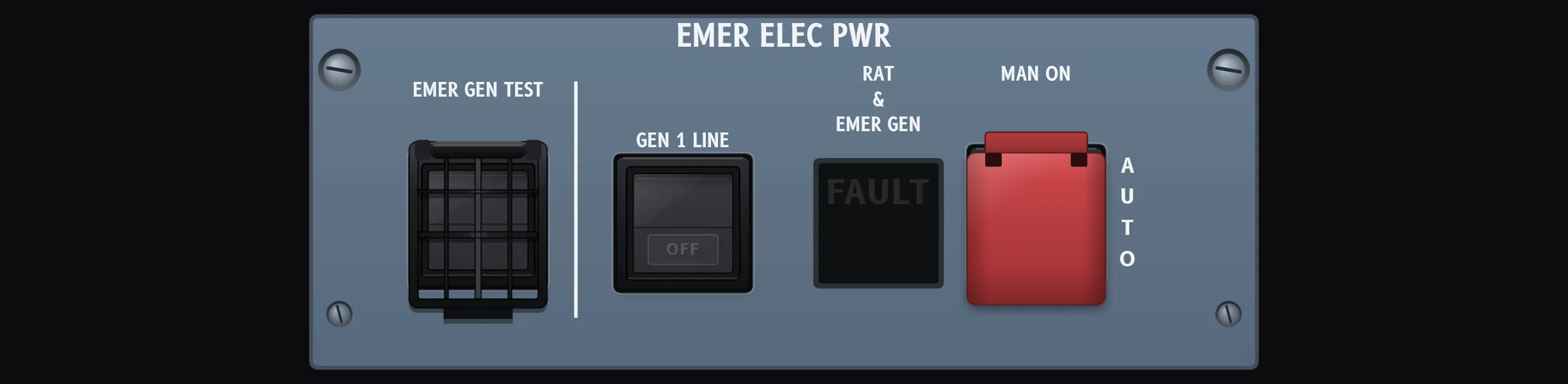
On the schematic green and yellow have lost their engine pumps, and the RAT, out by itself, pressurises blue. On the EMER ELEC PWR panel MAN ON is still in AUTO. Working the lines in order is what the ECAM Trainer does with you.
Sources FCOM PRO-ABN-ENG ENG / FCOM PRO-ABN-ENG ABNORMAL AND EMERGENCY PROCEDURES / FCOM DSC-24-10-30-30 EMERGENCY GENERATION AFTER LOSS OF ALL MAIN GENERATORS / FCOM DSC-24-20 OVERHEAD PANEL (CONT'D) / FCTM PR-AEP-ENG
What does the aircraft do by itself?
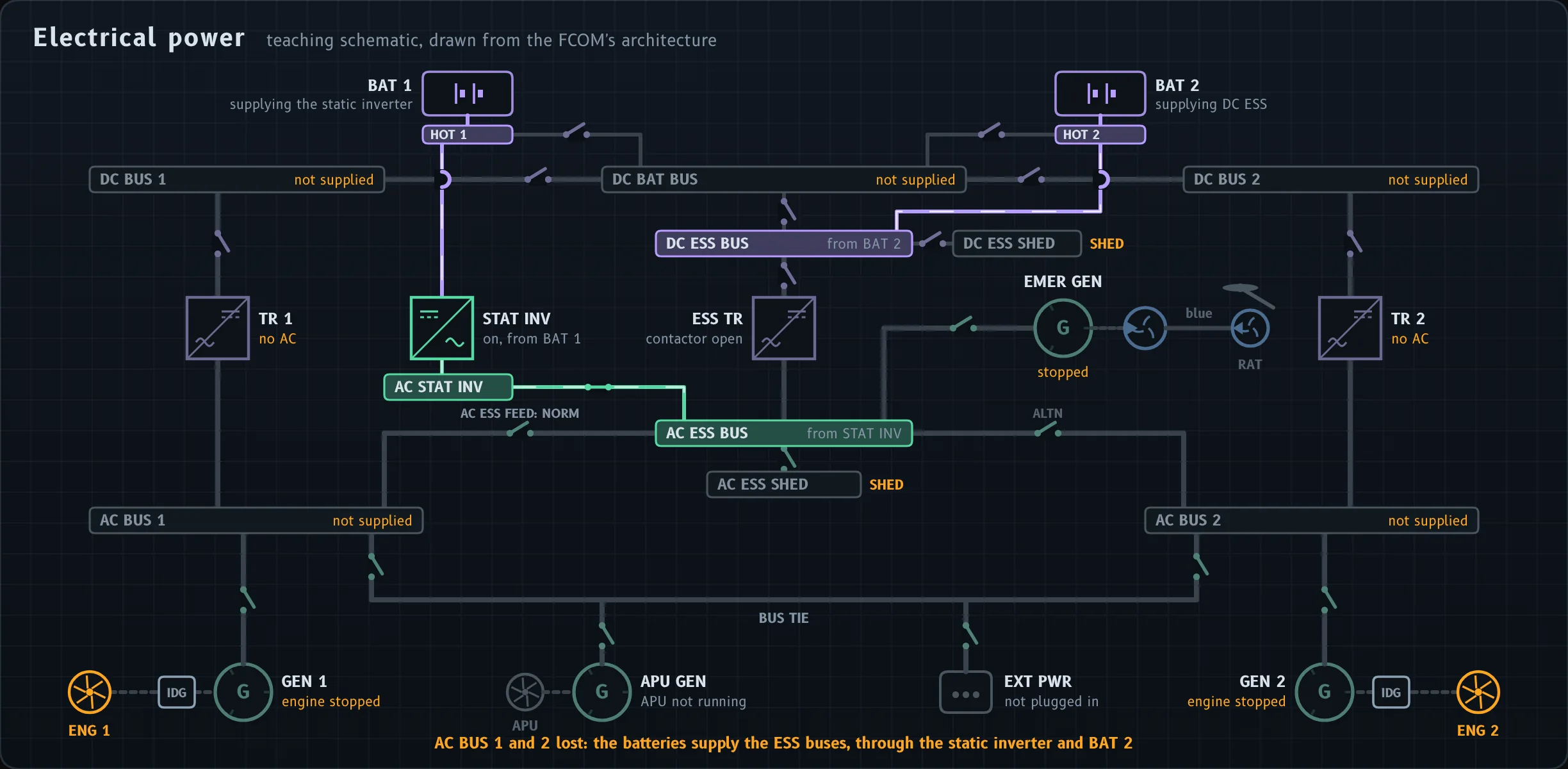
With AC BUS 1 and AC BUS 2 both lost and the aircraft above 100 kt, the RAT extends automatically. It powers the blue hydraulic system, which drives the emergency generator through a hydraulic motor. The generator supplies the AC ESS BUS, and the DC ESS BUS through the ESS TR.
During the RAT's extension and the coupling, about 8 s, the batteries power the emergency network. The FCTM adds that the emergency generator can supply every load needed for the rest of the flight, and that once connected it stays connected, even if the main generators come back after a relight or the APU generator is connected.
Green and yellow are lost with the engines, and the RAT pressurises blue. If the engines windmill enough, some more hydraulic power may come back.
Sources FCOM DSC-24-10-30-30 EMERGENCY GENERATION AFTER LOSS OF ALL MAIN GENERATORS / FCOM DSC-24-20 OVERHEAD PANEL (CONT'D) / FCTM PR-AEP-ENG
Press MAN ON
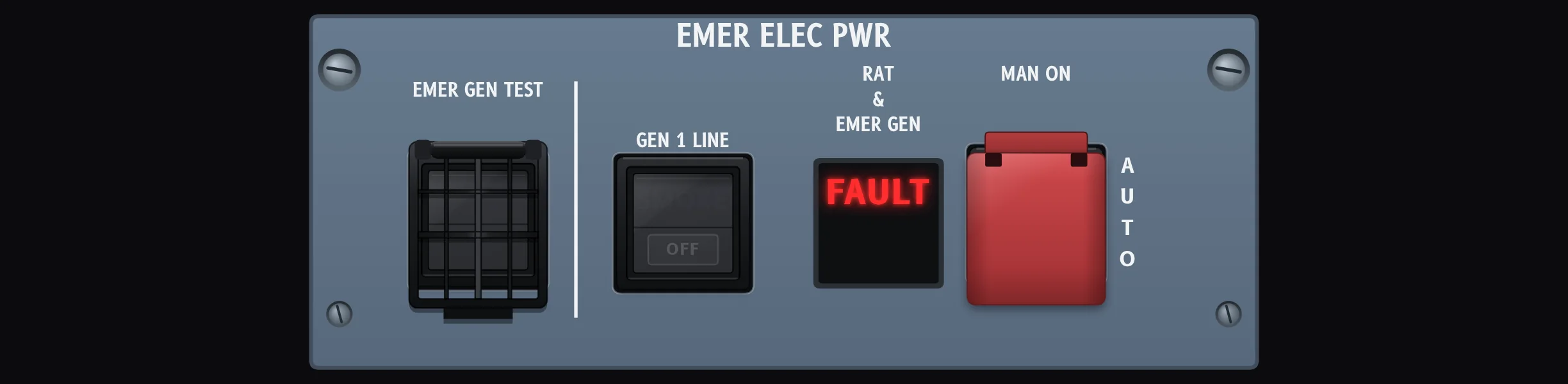
A constructed case: both engines have flamed out and, to give MAN ON something to show, the live aircraft has also failed the RAT's automatic extension, so the essential buses are on the batteries. Predict first, then lift the guard and press MAN ON on the EMER ELEC PWR panel.
-
Predict The automatic extension has failed. What does pressing MAN ON do?
Try it Lift the guard and press MAN ON.
Pressed, MAN ON selects the RAT's manual extension. In the drawing the RAT drives blue, blue drives the emergency generator, and the generator takes the AC ESS BUS from the static inverter, and the DC ESS BUS through the ESS TR; the shed buses, shed on the batteries, are supplied again.
The live aircraft couples at once; on the aircraft the coupling comes 3 s after the RAT supplies the generator. The FCOM gives the procedure this purpose: to secure the RAT's automatic extension and the emergency generator's automatic connection, and its first line, MAN ON, enables both.
Sources FCOM DSC-24-10-30-30 EMERGENCY GENERATION AFTER LOSS OF ALL MAIN GENERATORS / FCOM DSC-24-20 OVERHEAD PANEL (CONT'D) / FCOM PRO-ABN-ENG ENG / FCOM PRO-ABN-ENG
Why does the crew fly first, and why does the E/WD give a relight speed?
The FCTM starts with its golden rule: fly, navigate, communicate, in that order. Only PFD 1 is available, so the left-hand seat pilot is PF, takes over at once and establishes a safe flight path. Then the PM does the ECAM actions.
The FCTM explains why the E/WD gives the optimum windmill relight speed as soon as the warning triggers. Compared with a starter-assisted relight on APU bleed, a windmill relight is available over a large altitude range, tries all engines at once and does not depend on the condition of the aircraft's systems. The speed is the one that allows an immediate windmill relight without an excessive descent rate.
The crew may gain speed in the descent to reach it, but in alternate law the overspeed protection is lost and the speed and Mach limits are reduced. The thrust levers go to idle so that no thrust surge comes when an engine relights.
The gliding distance on the E/WD is a rough range at the relight speed with no wind, an envelope value, so the crew can rapidly assess the landing strategy if the engines do not relight. The PF then initiates the diversion: an accessible runway, or the most appropriate area for a forced landing or a ditching.
If fuel remains, the crew should attempt an APU start below FL 250, for cabin pressurisation, more electrical power and bleed air for a starter-assisted relight. Each start attempt draws on the batteries. One version of the procedure adds FAC 1 OFF THEN ON, which recovers the characteristic speeds on the PFD and the rudder trim, though no indication shows it.
The last line hands over to the ALL ENG FAIL QRH procedure, which, as the FCTM puts it, addresses all situations, through the ditching or the forced landing if the engines do not relight. When time permits, the crew sends an emergency message to ATC on VHF 1.
Sources FCTM PR-AEP-ENG / FCOM PRO-ABN-ENG ENG / FCOM PRO-ABN-ENG ABNORMAL AND EMERGENCY PROCEDURES / FCOM PRO-ABN-ENG
What does the aircraft lose with its engines?
The FCTM sums it up: all the AC busbars are lost and the RAT supplies the emergency generator; green and yellow are lost and the RAT pressurises blue. AP, FD and A/THR go with the generators, and the aircraft operates in alternate law.
That is alternate law with reduced protection: the normal laws and their protections are lost, and only the load factor limitation and the high and low speed stability remain, with MAX SPEED 320/0.77 for the lost high speed protection. STATUS adds that at gear extension control reverts to direct law, in pitch as well as in roll.
Without green and yellow the right aileron is lost and floats to its zero hinge moment position. There is enough authority to balance it; rather than hold the sidestick over, the PF may use the rudder trim, and should avoid large and rapid rudder inputs, as only the RAT gives hydraulic power. When the APU generator is connected, ELAC 2 and the right aileron come back.
Sources FCTM PR-AEP-ENG / FCOM PRO-ABN-HYD HYD / FCOM PRO-ABN-ENG ENG / FCOM DSC-27-20-20 FLIGHT CONTROLS LAW RECONFIGURATION
What goes with both engines
What comes back if an engine relights?
When at least one engine relights, ENG ALL ENGINES FAILURE disappears and ENG 1(2) FAIL triggers on the E/WD for the engines still failed. Its procedure asks the crew to consider the QRH's ENG RELIGHT (in flight) procedure, with which the FCTM says the crew can attempt a windmilling start or a starter-assisted relight with the other engine's bleed.
With one engine back, AC 1, DC 1, AC 2 and DC 2 return and the normal electrical configuration is restored, except that the AC ESS and DC ESS buses stay on the emergency generator. Green, yellow and blue come back too: the recovered engine's pump and the PTU for green and yellow, the blue electric pump for blue.
Sources FCTM PR-AEP-ENG
What is lost afterwards?
STATUS is the aircraft's operational summary. No STATUS is drawn here. The FCOM prints one for this warning, in two versions for different aircraft, and both open with MIN RAT SPEED 140 KT, MAX SPEED 320/0.77 and MAX BRK PR 1000 PSI, then MANEUVER WITH CARE, FUEL GRVTY FEED and AVOID NEGATIVE G FACTOR.
For the approach both give the flap lever at 2 for landing and, in CONF 2 and at VAPP, the gear by gravity: being stabilised at VAPP before the gear goes down lets the aircraft be trimmed for the approach. Then ALTN LAW: PROT LOST, direct law with the gear down, the brakes on the yellow accumulator with 7 full applications, and SLATS SLOW.
INOP SYS lists, among others, G+Y HYD, F/CTL PROT, the stabiliser, the right aileron, both reversers, ADR 2+3 and IR 2+3, RA 1+2, AP 1+2, A/THR, the fuel pumps, anti-skid, nosewheel steering, the flaps and both packs.
Sources FCOM DSC-31-20 STATUS PAGE / FCOM PRO-ABN-ENG ENG
A319ceo, A320ceo, A320neo, A321neo: what differs?
| A319ceo, A320ceo | A320neo, A321neo | |
|---|---|---|
| The warning and its trigger | The same in every version | The same in every version |
| OPT RELIGHT SPD | Not given by type: 300/0.77 in one version of the procedure; 270/0.77 in another | Not given by type: 300/0.77 in one version of the procedure; 270/0.77 in another |
| FAC 1 OFF THEN ON | Not given by type: in the version with 300/0.77, after the thrust levers, to recover the characteristic speeds and the rudder trim; not in the other | Not given by type: in the version with 300/0.77, after the thrust levers, to recover the characteristic speeds and the rudder trim; not in the other |
| Engines | CFM56-5B | LEAP-1A |
| STATUS | Not given by type: two versions for lists of aircraft, one reading FOR LDG USE FLAP 2, the other FOR LDG FLAP LVR 2 | Not given by type: two versions for lists of aircraft, one reading FOR LDG USE FLAP 2, the other FOR LDG FLAP LVR 2 |
The FCOM prints the procedure in two versions, each for some aircraft.
Sources FCOM PRO-ABN-ENG ENG ALL ENGINES FAILURE / FCOM PRO-ABN-ENG ENG / FCOM PRO-ABN-ENG / FCOM PRO-ABN-ENG ABNORMAL AND EMERGENCY PROCEDURES / FCOM DSC-70-05 OVERVIEW / FCOM DSC-70-05

Work ENG ALL ENGINES FAILURE as a crew
Read and do each line against the FCOM, with the E/WD, the SD page and the overhead following your hands, the PF and PM calls, and a debrief that says what you missed.
Work this failure in the ECAM TrainerGo further
Written in our own words from the FCOM and the FCTM; each part names the units it rests on. The E/WD, the STATUS and the live aircraft are the platform's own ECAM and systems model, the same the ECAM Trainer and the flight deck run. This page explains the procedure; it is not the procedure. Aircraft differ by type, engine and options: your aircraft's FCOM, your QRH and your operator's procedures always come first. How we write and check these pages.
Every ECAM procedure, line by line, against the FCOM.
The ECAM Trainer works 108 scenarios with the E/WD, the SD page and the overhead following your hands. Start free today, or open everything with A320 Knowledge+.
For study and revision only. Always follow your operator's approved documentation and procedures. A320 Knowledge is independent and not affiliated with Airbus.
Related
- ENG 1 FAILAn amber caution for an engine whose core speed has fallen below idle with its master lever still on.
- ENG 1 FUEL LEAKAn amber caution for an abnormal difference between the engines in fuel flow or fuel used.
- ENG 1 OIL HI TEMPAn amber caution for engine oil that is too hot, or has been warm for too long.
- ENG 1 OIL LO PRA red warning for an engine whose oil pressure has fallen below its alert threshold.
- A320 engines and APUThe system guide, with the live aircraft
- Every ECAM procedureThe alerts the ECAM Trainer works, grouped by system