
F/CTL SPD BRK STILL OUT
An amber caution, titled for speed brakes still out, with no line to act on. Here is what the FCOM prints for it and what it leaves out, what the speed brake lever and the SPEED BRK memo do, when the system retracts the speed brakes by itself and why the crew brings them in, with the live aircraft at the moment the caution comes on.
Written and checked by current A320 pilotschecked against the FCOM on Our editorial policy
What F/CTL SPD BRK STILL OUT means
F/CTL SPD BRK STILL OUT is an amber caution whose title says the speed brakes, spoilers 2, 3 and 4, are still out. The FCOM prints no trigger for it: its page gives the flight phases in which it is inhibited, then crew awareness, with no line to act on and no STATUS.
The FCOM shows the SPEED BRK memo in amber when the speed brakes should be retracted, and does not say whether this caution shares that condition. The FCTM gives a reason to bring them in when the aircraft regains its descent profile: so that the autothrust does not apply thrust against them.
Sources FCOM PRO-ABN-F_CTL F/CTL SPD BRK STILL OUT / FCOM DSC-27-10-20 / FCOM DSC-27-20-30 / FCTM PR-NP-SOP-170 GUIDANCE AND MONITORING
At a glance
- Level
- Amber caution, level 2: single chime and MASTER CAUT steady amber
- Sets it off
- Not printed: the FCOM gives this caution only its flight phase inhibition and crew awareness
- Procedure
- Crew awareness: no line under the title
- The memo
- SPEED BRK, green with the speed brakes extended, amber when they should be retracted; the FCOM does not say whether it comes with this caution
- Speed brakes
- Spoilers 2, 3 and 4: spoiler 2 on SEC 3, spoilers 3 and 4 on SEC 1
- STATUS
- None printed for this caution
Sources FCOM DSC-31-10 WARNING/CAUTION CLASSIFICATION / FCOM DSC-31-30 ATTENTION GETTERS / FCOM PRO-ABN-F_CTL F/CTL SPD BRK STILL OUT / FCOM DSC-27-20-30 / FCOM DSC-27-10-20
What sets it off?
The FCOM does not say. This caution's page, printed once for all aircraft, has no triggering conditions: only its flight phase inhibition and one line, crew awareness.
The nearest the FCOM comes is the memo on the E/WD: SPEED BRK appears in green when the speed brakes are extended, and "This memo appears in amber when the speedbrakes should be retracted." The FCOM does not say whether the memo and this caution share a condition.
The FCTM gives one case where the memo turns amber: in the descent, when the aircraft regains the descent profile, the speed brakes should be retracted to prevent the autothrust applying thrust against them; if they are not, the memo becomes amber. The FCOM does not say whether this caution comes with it.
Two neighbours have printed triggers. F/CTL SPD BRK FAULT is the lever's transducers to SEC 1 and SEC 3 failed. CONFIG SPD BRK NOT RETRACTED comes with the speed brakes not retracted when the thrust levers are set at TO or FLEX TO, or when the T.O CONFIG pushbutton is pressed.
Sources FCOM PRO-ABN-F_CTL F/CTL SPD BRK STILL OUT / FCOM DSC-27-20-30 / FCTM PR-NP-SOP-170 GUIDANCE AND MONITORING / FCOM PRO-ABN-F_CTL F/CTL SPD BRK FAULT / FCOM PRO-ABN-CONFIG CONFIG SPD BRK NOT RETRACTED
What does the crew see and hear?
A level 2 caution: a single chime, the MASTER CAUT light steady amber and the caution in amber on the E/WD.
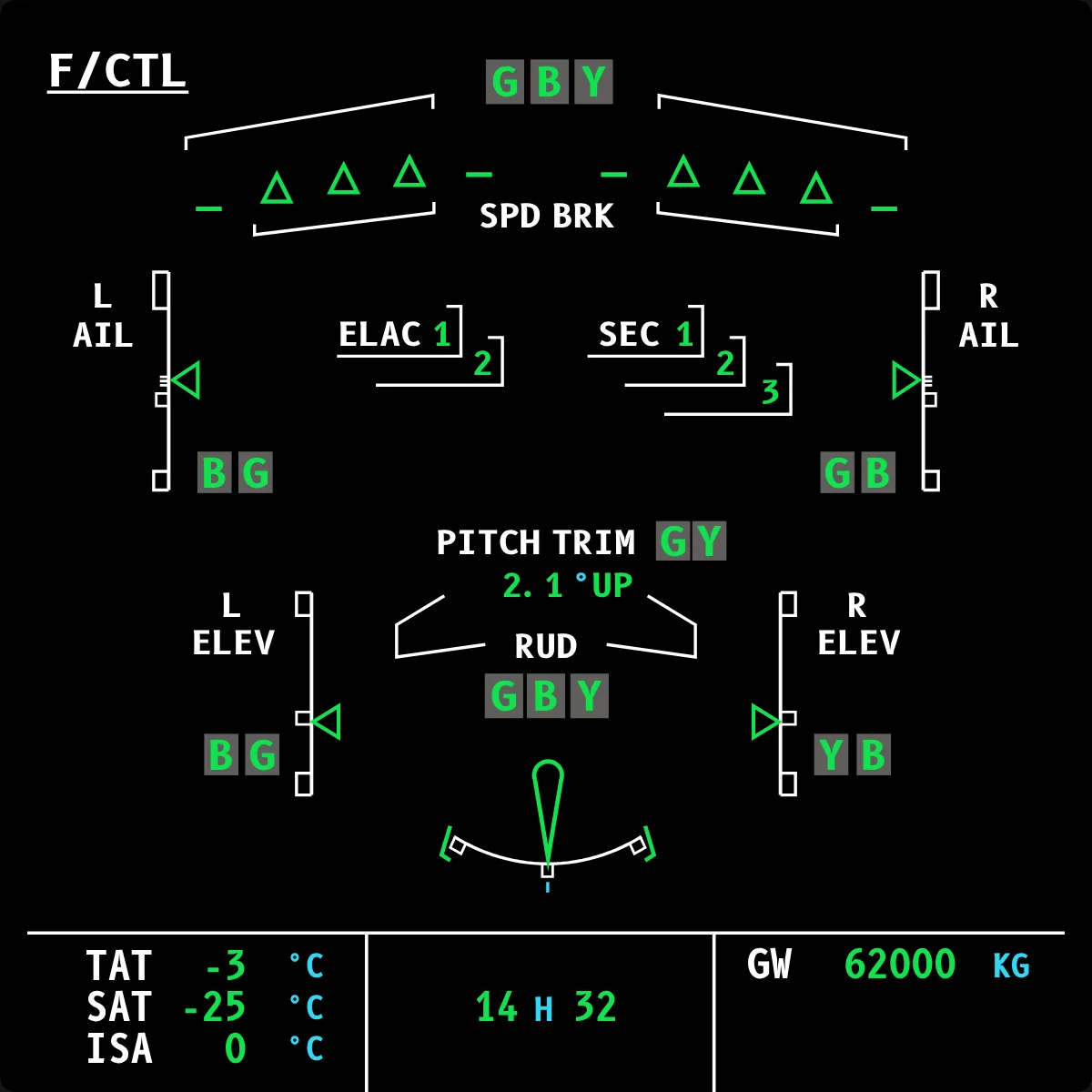
The procedure has no action line: it is crew awareness. On the F/CTL page a spoiler is a green dash when retracted and a green triangle when deflected by more than 2.5°.
Sources FCOM DSC-31-10 WARNING/CAUTION CLASSIFICATION / FCOM DSC-31-30 ATTENTION GETTERS / FCOM PRO-ABN-F_CTL F/CTL SPD BRK STILL OUT / FCOM DSC-27-20-30 ECAM F/CTL PAGE
The moment the caution comes on
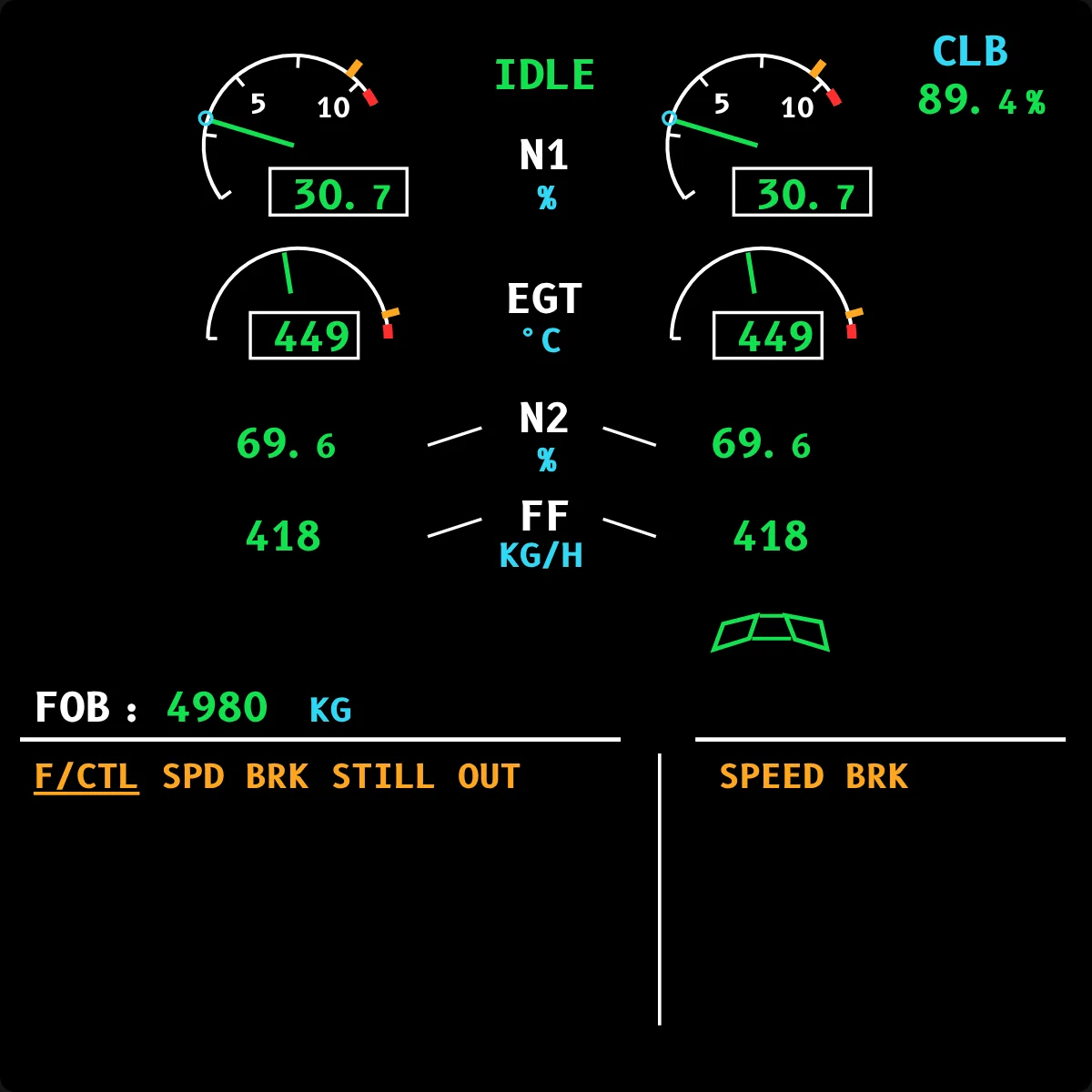
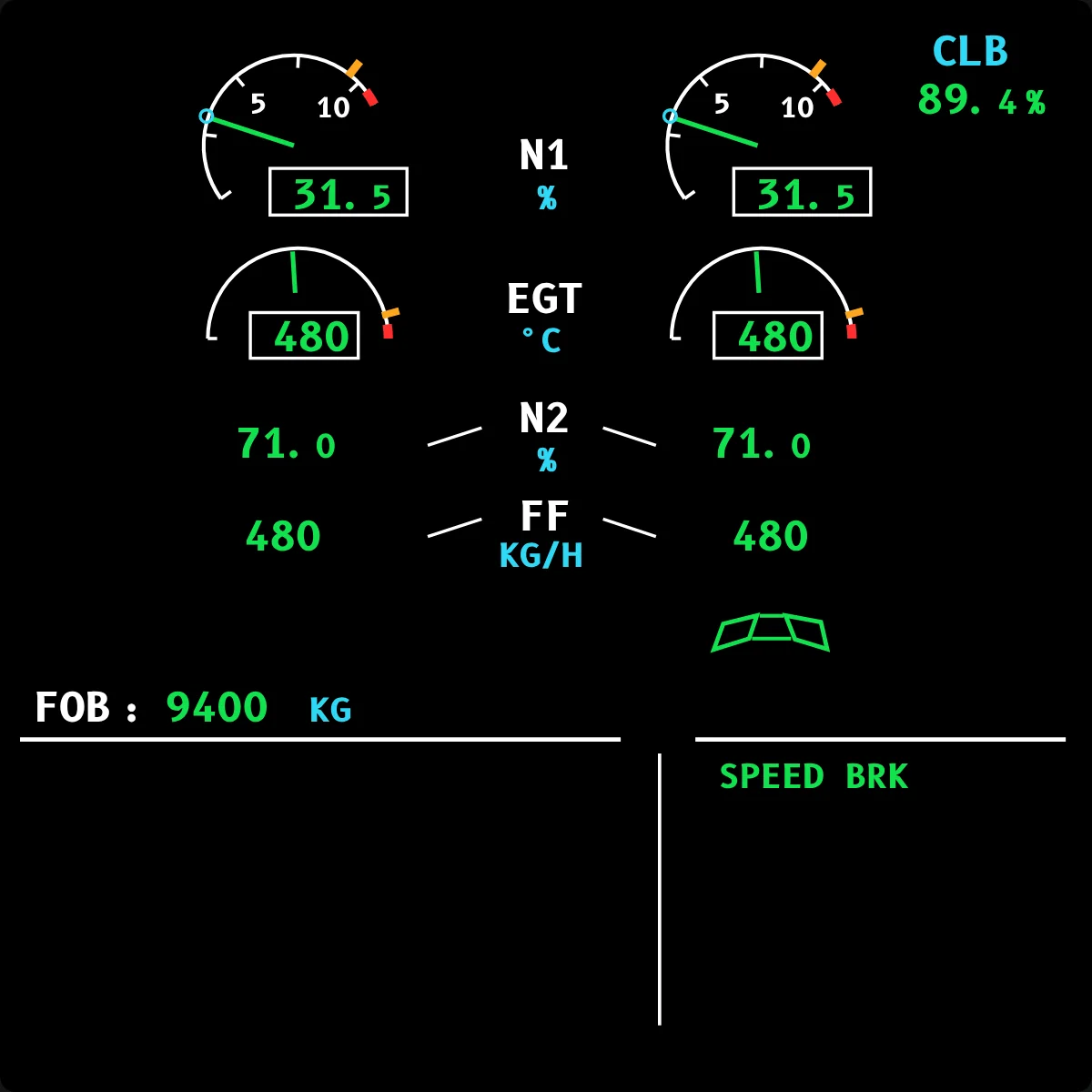
A descent with the speed brake lever at half and everything working: SPEED BRK green on the memo. Press the button for the caution, then look at the E/WD, the F/CTL page and the lever on the pedestal.

The alert Bring the caution on
The E/WD shows F/CTL SPD BRK STILL OUT in amber and nothing under it: the procedure is crew awareness. The drawing also turns the SPEED BRK memo amber; the FCOM does not say whether the memo and this caution come together.
This drawing keeps the state the block started with: spoilers 2, 3 and 4 as green triangles on the F/CTL page and the lever at half. The ECAM Trainer's own scenario draws them retracted. With no trigger printed, the FCOM gives neither picture as the aircraft's.
Sources FCOM PRO-ABN-F_CTL F/CTL SPD BRK STILL OUT / FCOM DSC-27-20-30 / FCOM DSC-27-20-30 ECAM F/CTL PAGE / FCOM DSC-27-20-30 PEDESTAL
What does the speed brake lever do?
The speed brake lever, on the centre pedestal, sets the position of the speed brake surfaces: the pilot pushes it down and moves it, with a hardpoint at the half position. Pulled up from RET, it arms the ground spoilers.
The speed brakes are spoilers 2, 3 and 4. SEC 3 controls spoiler 2, SEC 1 spoilers 3 and 4, and if a SEC fails, the spoilers it controls are retracted automatically.
These surfaces also do roll work, and the roll function has priority: when a roll order and a speed brake order together ask more of one surface than it can give in flight, the symmetric surface on the other wing is retracted until the difference equals the roll order. When a speed brake surface on one wing fails, the symmetric one on the other wing is inhibited.
Retraction is not always quick: faster than 315 kt or M 0.75 with the autopilot engaged, the retraction rate is reduced, and FULL to clean takes about 25 s.
Sources FCOM DSC-27-20-30 PEDESTAL / FCOM DSC-27-10-20 / FCOM DSC-27-10-20 SPEED BRAKES AND GROUND SPOILERS
From the lever to the memo
When do the speed brakes come in by themselves?
Speed brake extension is inhibited if SEC 1 and SEC 3 are both faulty, an elevator is faulty, angle of attack protection is active, the flaps are in configuration FULL, the thrust levers are above MCT, or alpha floor is activated.
On the A321neo the flaps condition is configuration 3 or FULL; the other conditions are the same.
If an inhibition occurs with the speed brakes extended, they retract automatically and stay retracted until the inhibition disappears and the crew resets the lever. They can be extended again 10 s or more after the reset. The FCOM does not say whether such a case raises this caution.
Sources FCOM DSC-27-10-20 SPEED BRAKES AND GROUND SPOILERS / FCOM DSC-27-10-20
The speed brakes retracted by the system
Why bring the speed brakes in?
The procedure gives no line and no reason: it is crew awareness. The reasons in the manuals belong to the speed brakes themselves.
In the descent, the FCTM asks for them to be retracted on regaining the profile, to prevent the autothrust applying thrust against them. It also says the speed brakes are very effective in increasing the rate of descent, but should be used with caution at high altitude, because of the associated increase in VLS.
In V/S with the autothrust in SPEED mode, the FCTM does not recommend the speed brakes to reduce speed: the thrust would increase and the speed would be maintained.
In direct law, the FCTM asks the pilot flying to avoid sudden speed brake movements and, with the speed brakes out and the aircraft re-trimmed, to retract them gently, to give time to re-trim and avoid a large nose-down trim change.
For takeoff, speed brakes not retracted give an alert of their own, CONFIG SPD BRK NOT RETRACTED, with the thrust levers at TO or FLEX TO or the T.O CONFIG pushbutton pressed.
Sources FCOM PRO-ABN-F_CTL F/CTL SPD BRK STILL OUT / FCTM PR-NP-SOP-170 GUIDANCE AND MONITORING / FCTM AOP-10-30-20 FLYING IN RECONFIGURATION LAWS / FCOM PRO-ABN-CONFIG CONFIG SPD BRK NOT RETRACTED
What is lost afterwards?
STATUS is the aircraft's operational summary. The FCOM prints none for this caution: its page ends with crew awareness. The ECAM Trainer's replay reaches no STATUS page either, so no picture is drawn.
Sources FCOM DSC-31-20 STATUS PAGE / FCOM PRO-ABN-F_CTL F/CTL SPD BRK STILL OUT
A319ceo, A320ceo, A320neo, A321neo: what differs?
| A319ceo, A320ceo | A320neo, A321neo | |
|---|---|---|
| The caution and its procedure | The same in every version | The same in every version |
| Speed brake extension inhibited by the flaps | In configuration FULL | In configuration FULL on the A320neo; in configuration 3 or FULL on the A321neo |
| Maximum speed brake deflection, in the system description | A320ceo, in manual flight: 40° for spoilers 3 and 4, 20° for spoiler 2, reduced on some aircraft in CONF 0 above MLW + 2 t. A319ceo: 25° for spoilers 3 and 4; 12.5° for spoiler 2 in configuration 3, 17.5° in the others | A320neo, in manual flight: 40° for spoilers 3 and 4, 20° for spoiler 2. A321neo: 25° for spoilers 2, 3 and 4 |
Sources FCOM PRO-ABN-F_CTL F/CTL SPD BRK STILL OUT / FCOM DSC-27-10-20 SPEED BRAKES AND GROUND SPOILERS / FCOM DSC-27-10-20

Work F/CTL SPD BRK STILL OUT as a crew
Read and do each line against the FCOM, with the E/WD, the SD page and the overhead following your hands, the PF and PM calls, and a debrief that says what you missed.
Work this failure in the ECAM TrainerGo further
Written in our own words from the FCOM and the FCTM; each part names the units it rests on. The E/WD, the STATUS and the live aircraft are the platform's own ECAM and systems model, the same the ECAM Trainer and the flight deck run. This page explains the procedure; it is not the procedure. Aircraft differ by type, engine and options: your aircraft's FCOM, your QRH and your operator's procedures always come first. How we write and check these pages.
Every ECAM procedure, line by line, against the FCOM.
The ECAM Trainer works 108 scenarios with the E/WD, the SD page and the overhead following your hands. Start free today, or open everything with A320 Knowledge+.
For study and revision only. Always follow your operator's approved documentation and procedures. A320 Knowledge is independent and not affiliated with Airbus.
Related
- F/CTL ELAC 1 FAULTAn amber caution for one of the two elevator aileron computers.
- F/CTL ELAC 2 FAULTAn amber caution for one of the two elevator aileron computers.
- F/CTL FLAPS FAULTAn amber caution for flaps that have lost both of their control channels.
- F/CTL FLAPS LOCKEDAn amber caution for flaps that the wingtip brakes have stopped.
- A320 flight controlsThe system guide, with the live aircraft
- Every ECAM procedureThe alerts the ECAM Trainer works, grouped by system