
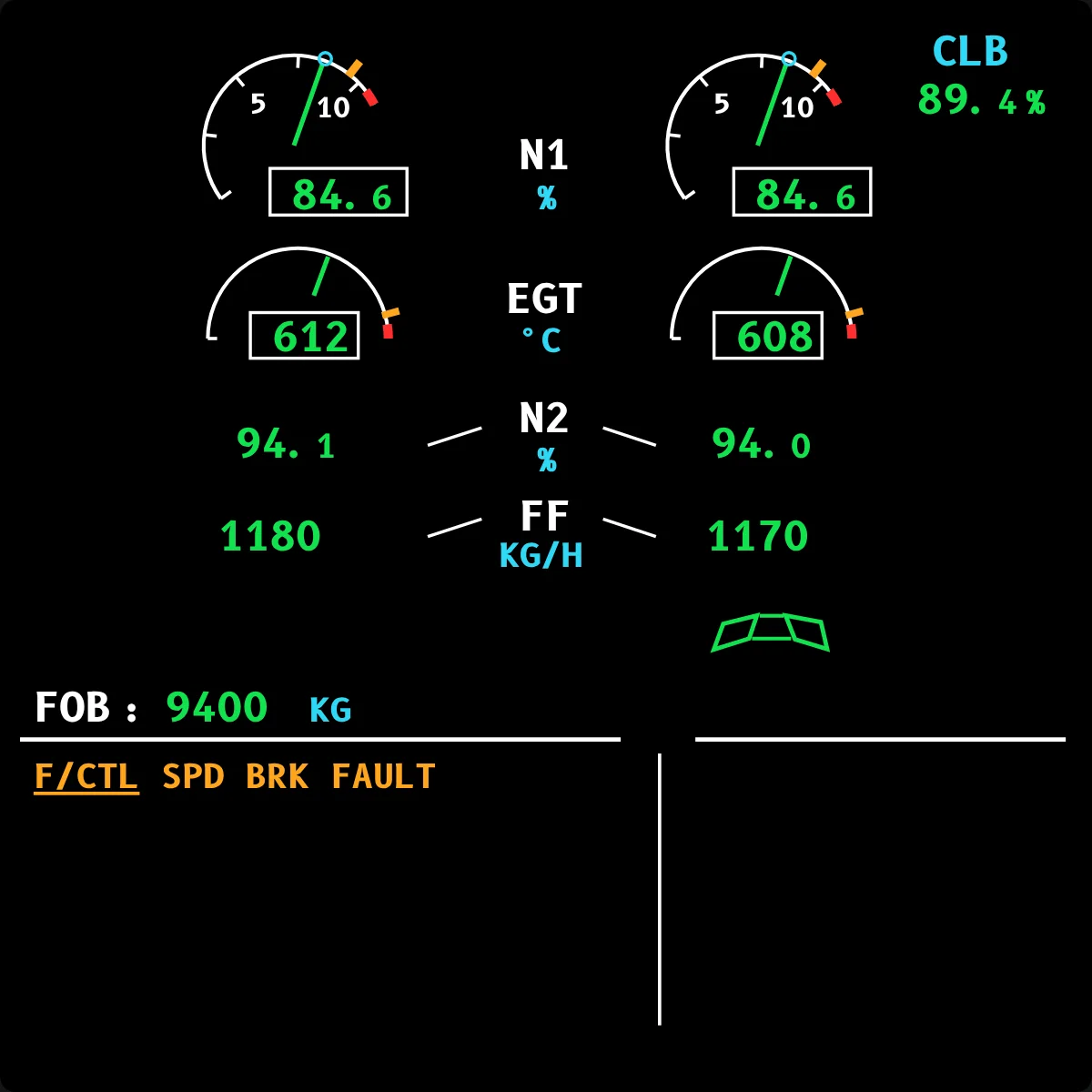
F/CTL SPD BRK FAULT
An amber caution with no line to act on: the speed brake lever's transducers to SEC 1 and SEC 3 have failed. Here is what the lever does, which spoilers it moves through which computer, what happens to the ground spoilers and what STATUS asks, with the live aircraft at the moment the caution comes on.
Written and checked by current A320 pilotschecked against the FCOM on Our editorial policy
What F/CTL SPD BRK FAULT means
F/CTL SPD BRK FAULT is an amber caution: the transducers that tell SEC 1 and SEC 3 where the speed brake lever is have failed. The speed brakes are spoilers 2, 3 and 4, and SEC 3 controls spoiler 2, SEC 1 spoilers 3 and 4.
The procedure is crew awareness, with one comment: the associated ground spoilers are available only through reverse selection. STATUS reads SPD BRK DO NOT USE in one version, and in another lists the speed brakes as inoperative with the landing distance procedure.
Sources FCOM PRO-ABN-F_CTL F/CTL SPD BRK FAULT / FCOM DSC-27-10-20 / FCOM PRO-ABN-F_CTL F/CTL
At a glance
- Level
- Amber caution, level 2: single chime, MASTER CAUT steady amber and, normally, the F/CTL page on the SD
- Sets it off
- The speed brake lever's transducers to SEC 1 and SEC 3 failed
- Procedure
- Crew awareness; the associated ground spoilers are available only through reverse selection
- Speed brakes
- Spoilers 2, 3 and 4: spoiler 2 on SEC 3, spoilers 3 and 4 on SEC 1
- STATUS
- SPD BRK DO NOT USE in one version; LDG DIST PROC APPLY with the speed brakes inoperative in another
Sources FCOM DSC-31-10 WARNING/CAUTION CLASSIFICATION / FCOM DSC-31-30 ATTENTION GETTERS / FCOM DSC-31-20 SYSTEM PAGES / FCOM PRO-ABN-F_CTL F/CTL SPD BRK FAULT / FCOM PRO-ABN-F_CTL F/CTL / FCOM DSC-27-10-20
What does the speed brake lever do, and what has failed?
The speed brake lever, on the centre pedestal, sets the position of the speed brake surfaces: the pilot pushes it down and moves it, with a hardpoint at the half position. Pulled up from RET, it arms the ground spoilers.
The speed brakes are spoilers 2, 3 and 4, controlled electrically. SEC 3 controls spoiler 2, SEC 1 spoilers 3 and 4, and SEC 2 spoiler 5, which is not a speed brake.
These surfaces also do roll work, and the roll function has priority: when a roll order and a speed brake order together ask more of one surface than it can give in flight, the symmetric surface on the other wing is retracted until the difference equals the roll order.
This caution triggers when the speed brake lever transducers to SEC 1 and SEC 3 have failed. With the transducers to SEC 3, or to SEC 1, alone failed, the caution is another, F/CTL SPD BRK 2 (3+4) FAULT. The FCOM names no single cause.
Sources FCOM DSC-27-10-10 COCKPIT CONTROLS / FCOM DSC-27-20-30 PEDESTAL / FCOM DSC-27-10-10 CONTROL SURFACES / FCOM DSC-27-10-20 / FCOM PRO-ABN-F_CTL F/CTL SPD BRK FAULT / FCOM PRO-ABN-F_CTL F/CTL SPD BRK 2 (3+4) FAULT
From the lever to the speed brakes
What does the crew see and hear?
A level 2 caution: a single chime, the MASTER CAUT light steady amber and the caution in amber on the E/WD, and the SD normally calls up the relevant system page by itself, here the F/CTL page.
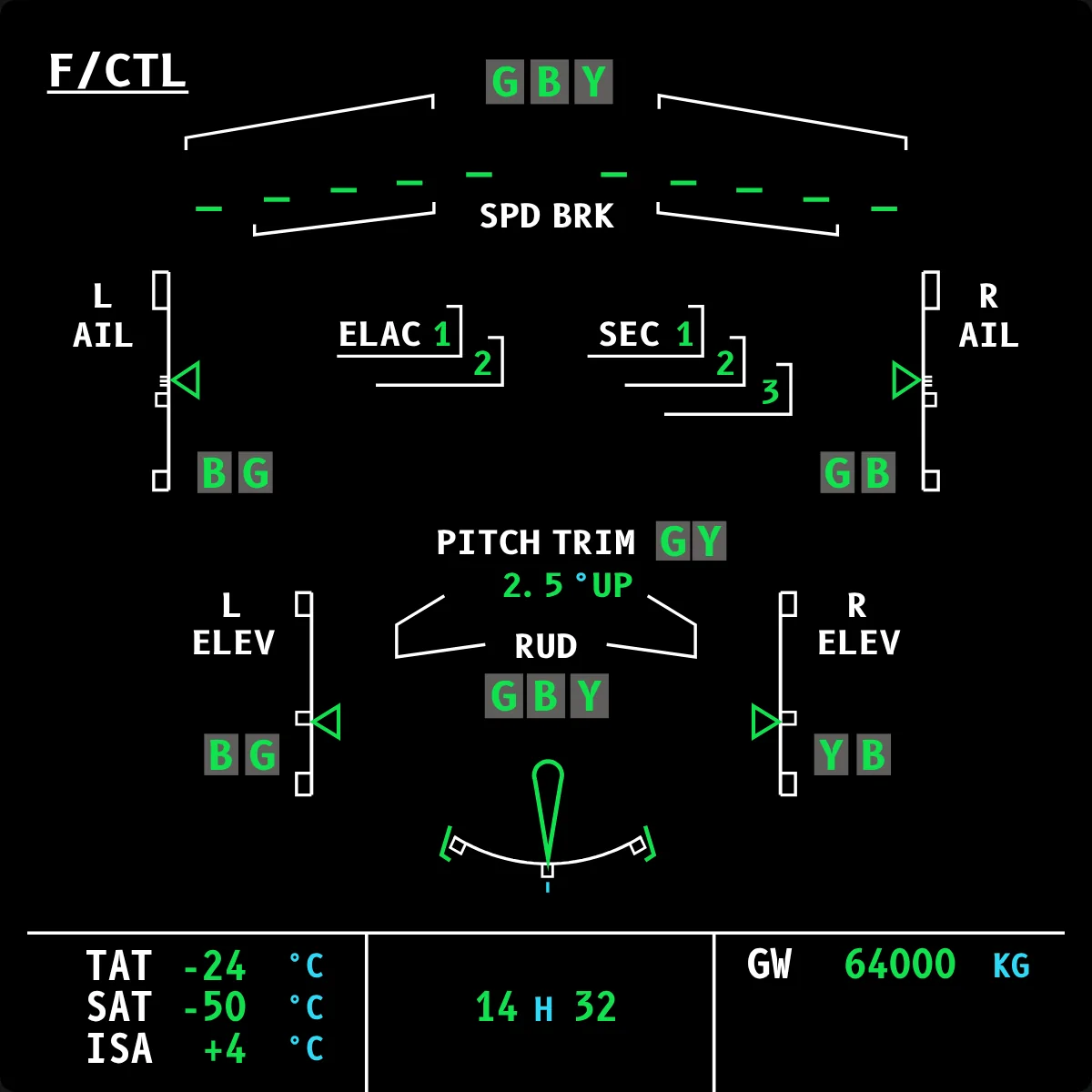
The procedure has no action line: it is crew awareness. On the F/CTL page a spoiler is a green dash when retracted, a green triangle when deflected by more than 2.5°, and amber when it has failed or its position is not valid.
Sources FCOM DSC-31-10 WARNING/CAUTION CLASSIFICATION / FCOM DSC-31-30 ATTENTION GETTERS / FCOM DSC-31-20 SYSTEM PAGES / FCOM PRO-ABN-F_CTL F/CTL / FCOM DSC-27-20-30 ECAM F/CTL PAGE
The moment the caution comes on
A healthy aircraft in the cruise, the speed brakes retracted. Press the button to lose the lever's transducers, then look at the E/WD, the F/CTL page and the pedestal, where the speed brake lever is.
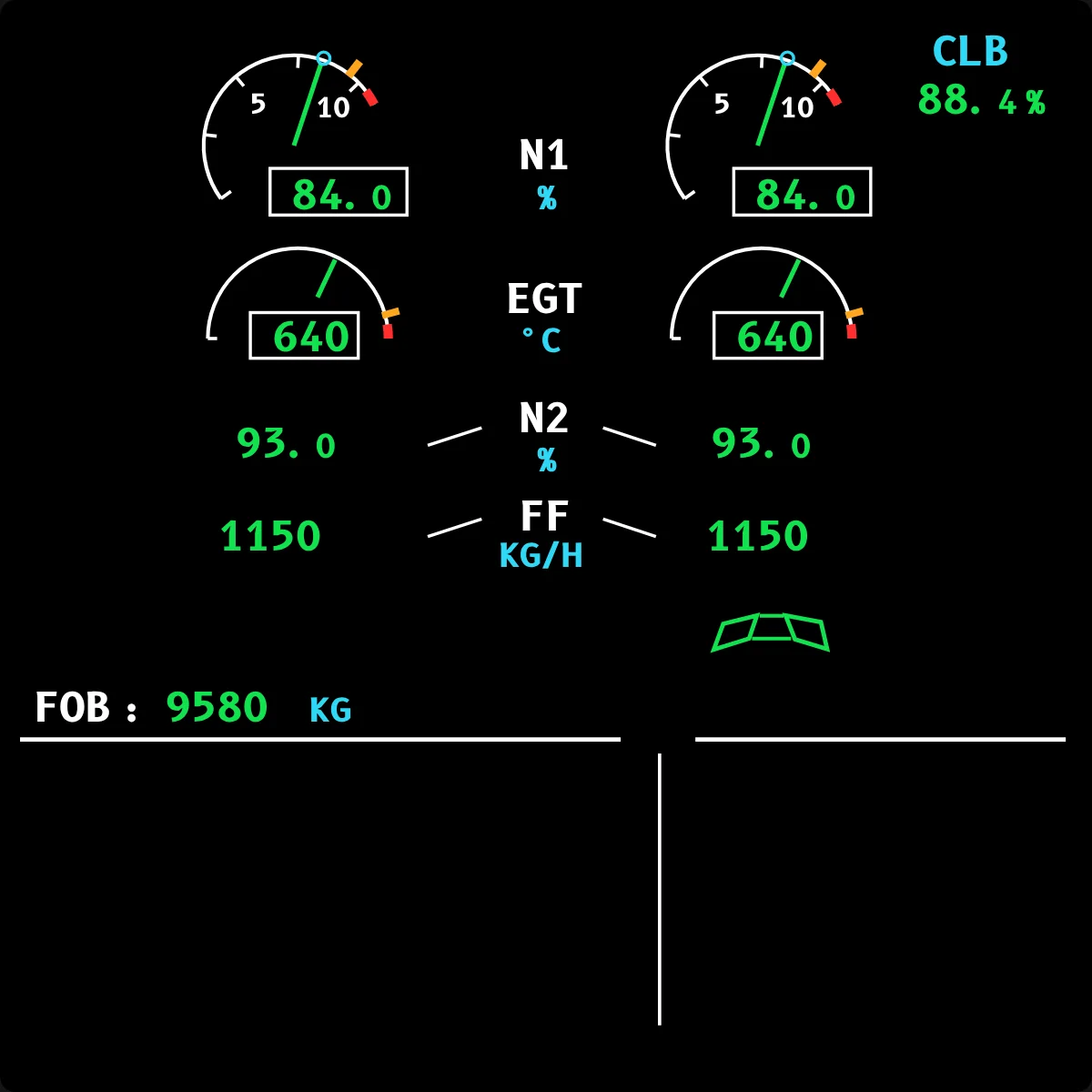

The alert Lose the lever's transducers
The E/WD shows F/CTL SPD BRK FAULT in amber and nothing under it: the procedure is crew awareness. On the F/CTL page every spoiler is still a green dash.
The pedestal shows the speed brake lever at RET. Working the caution is what the ECAM Trainer does with you.
Sources FCOM PRO-ABN-F_CTL F/CTL / FCOM DSC-27-20-30 ECAM F/CTL PAGE / FCOM DSC-27-20-30 PEDESTAL
Why are the speed brakes not used?
The FCOM gives no reason under SPD BRK DO NOT USE for this caution. What it does give: the speed brakes are spoilers 2, 3 and 4, and the two computers that control them, SEC 3 and SEC 1, are the two whose lever transducers have failed.
The system also inhibits speed brake extension by itself in some cases: SEC 1 and SEC 3 both faulty, an elevator faulty, angle of attack protection active, flaps in configuration FULL (3 or FULL on the A321neo), thrust levers above MCT, or alpha floor. If an inhibition comes with the speed brakes out, they retract and stay in until it disappears and the crew resets the lever.
In the block below, the lever's transducers are already lost. Add a computer failure and compare the F/CTL page.
Sources FCOM PRO-ABN-F_CTL F/CTL / FCOM DSC-27-10-20 / FCOM PRO-ABN-F_CTL F/CTL SPD BRK FAULT / FCOM DSC-27-10-20 SPEED BRAKES AND GROUND SPOILERS
The transducers lost, then SEC 1
The lever's transducers to SEC 1 and SEC 3 are lost, and every spoiler is still green on the F/CTL page. Now fail a computer.
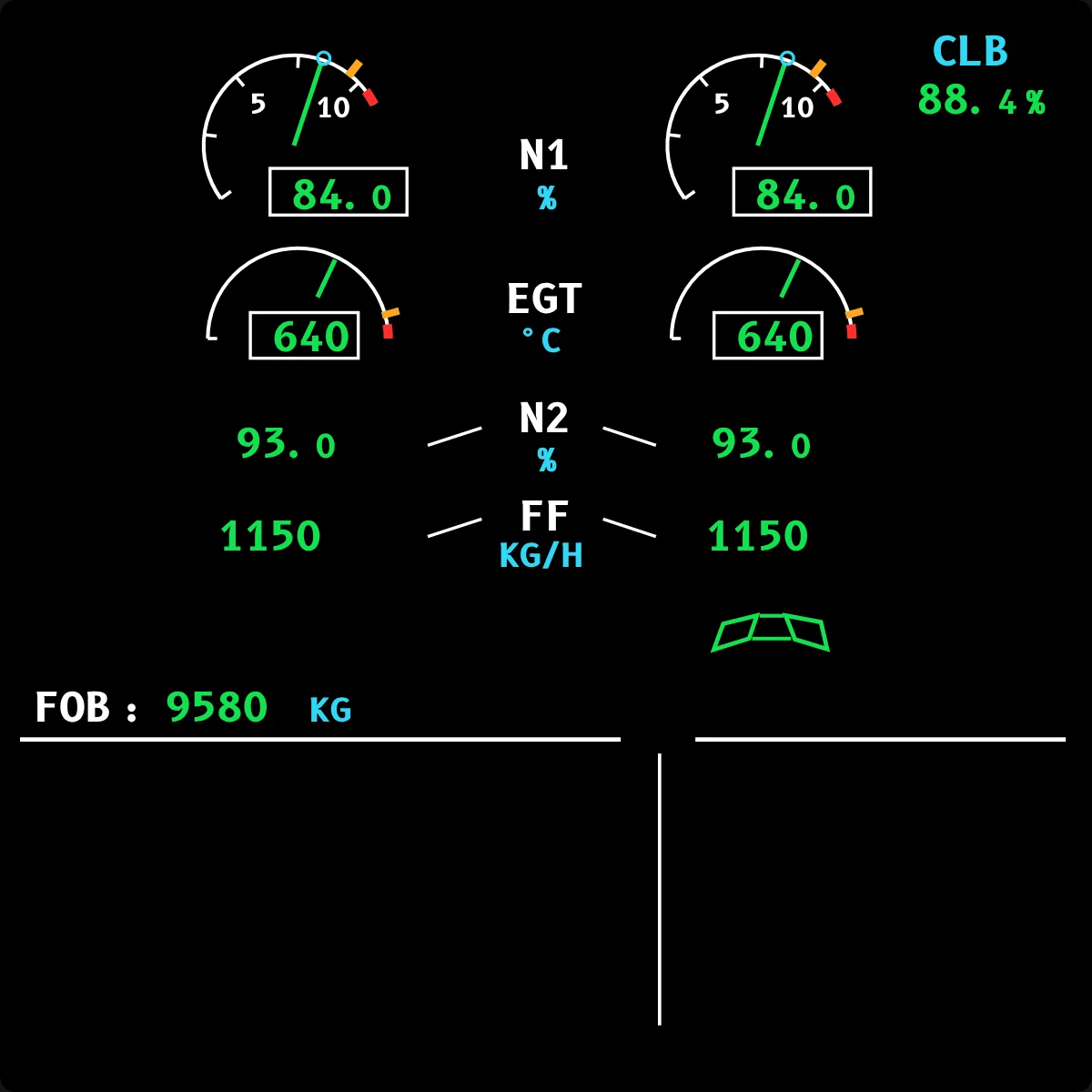
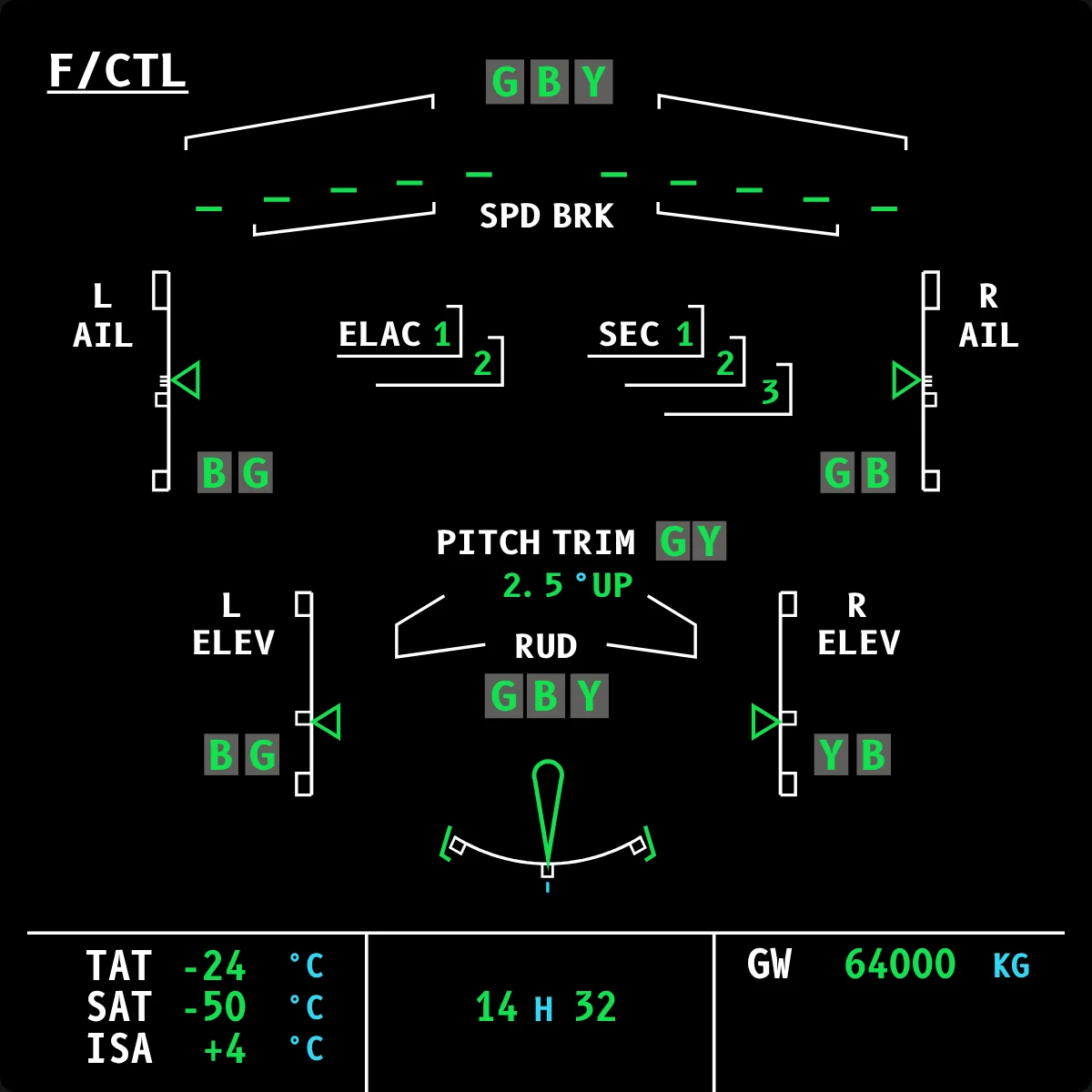
The alert Then SEC 1 fails
The E/WD shows F/CTL SEC 1 FAULT. On the F/CTL page SEC 1 turns amber, and so do spoilers 3 and 4 on both wings: if a SEC fails, the spoilers it controls are retracted automatically.
With the transducers alone lost, the page drew every spoiler green: the FCOM turns a spoiler amber when it has failed, and this caution's trigger is the lever's transducers.
Sources FCOM PRO-ABN-F_CTL F/CTL SEC 1(2)(3) FAULT / FCOM DSC-27-10-20 / FCOM DSC-27-20-30 ECAM F/CTL PAGE / FCOM PRO-ABN-F_CTL F/CTL SPD BRK FAULT
What happens to the ground spoilers?
The procedure's one comment: the associated ground spoilers are available only through reverse selection.
The ground spoiler function uses all the spoilers at full extension. The crew normally arms it by pulling the speed brake lever up. Armed, the ground spoilers extend in a rejected takeoff above 72 kt once both thrust levers are back at idle, and at landing with both main gears on the ground and both thrust levers at or below idle.
The system has a second way that needs no arming. With the lever retracted and the ground spoilers not armed, they extend in a rejected takeoff above 72 kt as soon as reverse is selected on one engine, and at landing with both main gears on the ground and reverse selected on at least one engine, the other thrust lever below MCT.
Sources FCOM PRO-ABN-F_CTL F/CTL / FCOM DSC-27-10-20 / FCOM DSC-27-20-30 PEDESTAL
Two ways to the ground spoilers
What does STATUS leave for the landing?
The FCOM prints two versions of this STATUS. In one, SPD BRK DO NOT USE in blue, with STEEP APPR inoperative. In another, LDG DIST PROC APPLY, with the speed brakes and STEEP APPR inoperative.
Both versions give STEEP APPR a footnote: inoperative if speed brakes 3 or 4 are affected. STEEP APPR carries the option marker: where fitted.
Speed brakes 3 and 4 are spoilers 3 and 4, the ones SEC 1 controls. The FCOM gives no reason for the landing distance line in the second version.
Sources FCOM PRO-ABN-F_CTL F/CTL / FCOM DSC-27-10-20
What is lost afterwards?
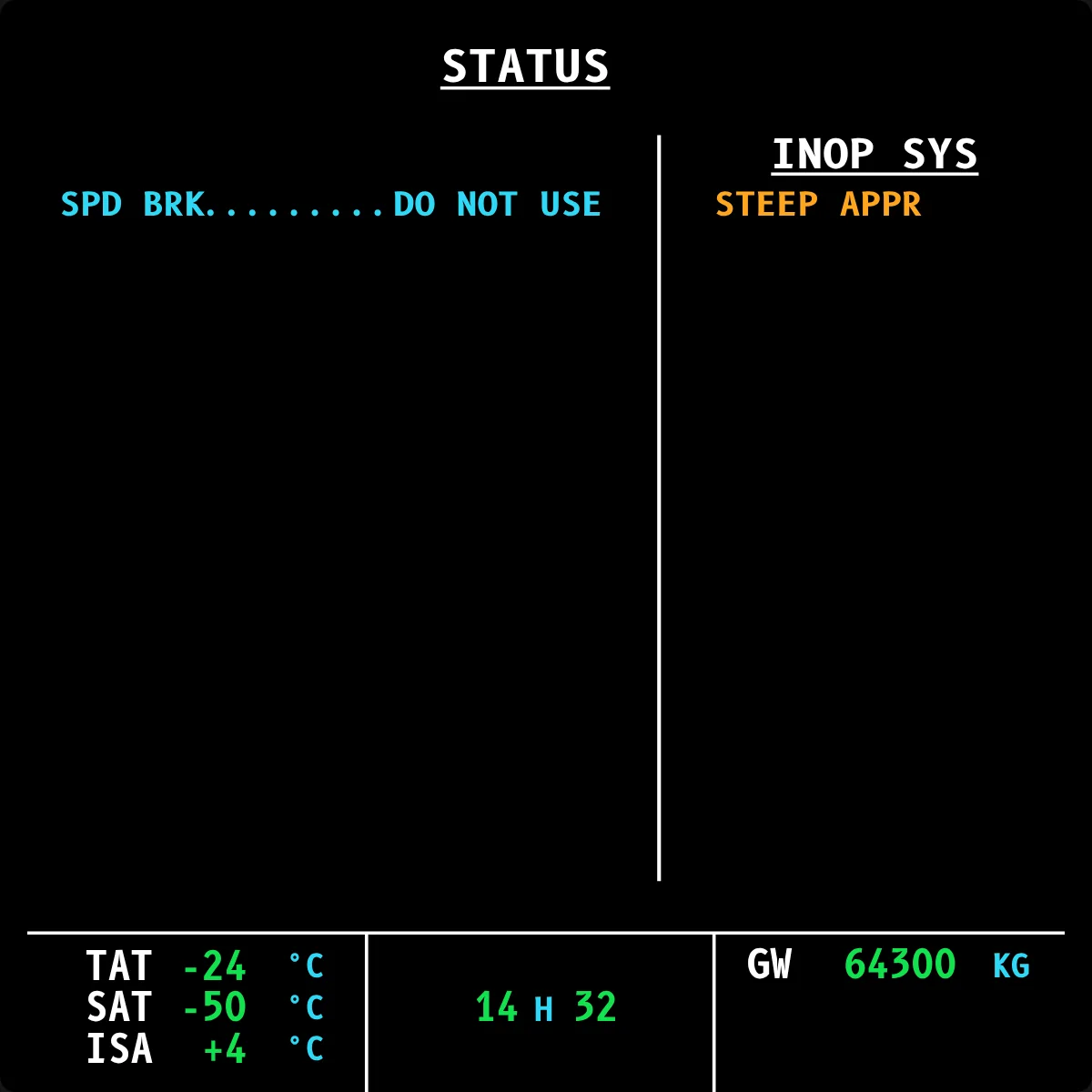
STATUS is the aircraft's operational summary. In this version it reads SPD BRK DO NOT USE in blue, with STEEP APPR under INOP SYS in amber.
The FCOM prints STEEP APPR with its footnote, if speed brakes 3 or 4 are affected, and the option marker; our picture draws it without either.
Another version, for other aircraft, reads LDG DIST PROC APPLY, with SPD BRK and STEEP APPR under INOP SYS.
Which version applies depends on your aircraft: check your own FCOM.
Sources FCOM DSC-31-20 STATUS PAGE / FCOM PRO-ABN-F_CTL F/CTL
A319ceo, A320ceo, A320neo, A321neo: what differs?
| A319ceo, A320ceo | A320neo, A321neo | |
|---|---|---|
| The caution and its procedure | The same in every version | The same in every version |
| STATUS | Not given by type: SPD BRK DO NOT USE in one version; LDG DIST PROC APPLY with SPD BRK inoperative in another | Not given by type: SPD BRK DO NOT USE in one version; LDG DIST PROC APPLY with SPD BRK inoperative in another |
| Maximum speed brake deflection, in the system description | A320ceo, in manual flight: 40° for spoilers 3 and 4, 20° for spoiler 2, reduced on some aircraft in CONF 0 above MLW + 2 t. A319ceo: 25° for spoilers 3 and 4; 12.5° for spoiler 2 in configuration 3, 17.5° in the others | A320neo, in manual flight: 40° for spoilers 3 and 4, 20° for spoiler 2. A321neo: 25° for spoilers 2, 3 and 4 |
| Speed brake extension inhibited by the flaps | In configuration FULL | In configuration FULL on the A320neo; in configuration 3 or FULL on the A321neo |
Sources FCOM PRO-ABN-F_CTL F/CTL SPD BRK FAULT / FCOM PRO-ABN-F_CTL F/CTL / FCOM DSC-27-10-20 SPEED BRAKES AND GROUND SPOILERS / FCOM DSC-27-10-20

Work F/CTL SPD BRK FAULT as a crew
Read and do each line against the FCOM, with the E/WD, the SD page and the overhead following your hands, the PF and PM calls, and a debrief that says what you missed.
Work this failure in the ECAM TrainerGo further
Written in our own words from the FCOM and the FCTM; each part names the units it rests on. The E/WD, the STATUS and the live aircraft are the platform's own ECAM and systems model, the same the ECAM Trainer and the flight deck run. This page explains the procedure; it is not the procedure. Aircraft differ by type, engine and options: your aircraft's FCOM, your QRH and your operator's procedures always come first. How we write and check these pages.
Every ECAM procedure, line by line, against the FCOM.
The ECAM Trainer works 108 scenarios with the E/WD, the SD page and the overhead following your hands. Start free today, or open everything with A320 Knowledge+.
For study and revision only. Always follow your operator's approved documentation and procedures. A320 Knowledge is independent and not affiliated with Airbus.
Related
- F/CTL ELAC 1 FAULTAn amber caution for one of the two elevator aileron computers.
- F/CTL ELAC 2 FAULTAn amber caution for one of the two elevator aileron computers.
- F/CTL FLAPS FAULTAn amber caution for flaps that have lost both of their control channels.
- F/CTL FLAPS LOCKEDAn amber caution for flaps that the wingtip brakes have stopped.
- A320 flight controlsThe system guide, with the live aircraft
- Every ECAM procedureThe alerts the ECAM Trainer works, grouped by system