
ENG 1 STALL
An amber caution the FADEC raises when it detects a stall in its engine. Here is what a stall is and what causes one, what the crew sees and hears, why the thrust comes to idle first, how a stall differs from a flameout, and what it means that the procedure is not a memory item, with the live aircraft at the moment the caution comes on.
Written and checked by current A320 pilotschecked against the FCOM on Our editorial policy
What ENG 1 STALL means
ENG 1 STALL is an amber caution: engine 1's FADEC has detected a stall, a disruption of the airflow in which the compressor blades can no longer compress the air from the front of the engine to the rear. It can bring bangs, a loss of thrust, fluctuating parameters, a rising EGT and vibration.
In flight the ECAM has the thrust lever brought to idle, which reduces the pressure difference across the compressor, and the engine parameters checked at idle. Its last line hands over to the QRH's engine stall procedure. It is not a memory item: in the cruise, most of the time the FADEC recovers from the stall before the crew acts.
Sources FCOM PRO-ABN-ENG ENG 1(2) STALL / FCOM PRO-ABN-ENG ENG / FCTM PR-AEP-ENG ENGINE STALL
At a glance
- Level
- Amber caution, level 2: single chime, MASTER CAUT steady amber and, normally, the ENGINE page on the SD
- Sets it off
- The FADEC detects an engine stall and requests the caution; it does not detect every stall
- In flight
- Thrust lever 1 to idle, the engine parameters checked, then ENG 1(2) STALL PROC APPLY
- No hurry
- Not a memory item: in the cruise the crew takes time to assess, as the FADEC most often recovers by itself
- STATUS
- One line, CONSIDER ENG 1 RELIGHT, the same in every version
- Afterwards
- Every engine stall is reported for maintenance action
Sources FCOM DSC-31-10 WARNING/CAUTION CLASSIFICATION / FCOM DSC-31-30 ATTENTION GETTERS / FCOM DSC-31-20 SYSTEM PAGES / FCOM PRO-ABN-ENG ENG 1(2) STALL / FCOM PRO-ABN-ENG ENG / FCTM PR-AEP-ENG ENGINE STALL
What is an engine stall, and what sets the caution off?
A stall is a disruption of the airflow in a turbine engine: the compressor blades stall and can no longer compress the air from front to rear. In some cases the high pressure air at the end of the compressor reverses and leaves through the front of the engine, which may cause an immediate and significant loss of thrust.
The FCTM lists the causes: engine degradation, such as a broken or worn compressor blade; birds, other foreign objects or ice ingested; a malfunction of the bleed system or of the engine controls; and a significant disturbance of the airflow, from wake turbulence, a lightning strike or reverse thrust used wrongly after landing.
Most FADECs regulate the airflow through the compressor to prevent stalls, can detect them, and try to recover without crew action by modifying the airflow; the A320neo and A321neo FADEC lists protection against engine stall and flameout among its functions.
When the FADEC detects a stall, it requests the caution. It does not detect every stall: a crew that sees the symptoms should suspect a stall even without the caution, and apply the QRH's engine stall procedure.
Sources FCTM PR-AEP-ENG ENGINE STALL / FCOM DSC-70-20 FUNCTIONS / FCOM PRO-ABN-ENG ENG 1(2) STALL
Who sees the stall
What does the crew see and hear?
A level 2 caution: a single chime, the MASTER CAUT light steady amber and the caution in amber on the E/WD, and the SD normally calls up the relevant system page by itself, here the ENGINE page.
The engine shows it too. At takeoff and high power: one or more very loud bangs, an instant loss of thrust or even reverse thrust that yaws the aircraft, fluctuating N1 and N2, a rising EGT, vibration, perhaps flames from the inlet or the tail pipe, and an acrid smell. In the cruise and at low power: muffled bangs, slow or no thrust lever response, fluctuating parameters, a rising EGT, vibration and an acrid smell.
Sources FCOM DSC-31-10 WARNING/CAUTION CLASSIFICATION / FCOM DSC-31-30 ATTENTION GETTERS / FCOM DSC-31-20 SYSTEM PAGES / FCOM PRO-ABN-ENG ENG / FCTM PR-AEP-ENG ENGINE STALL
The moment the caution comes on
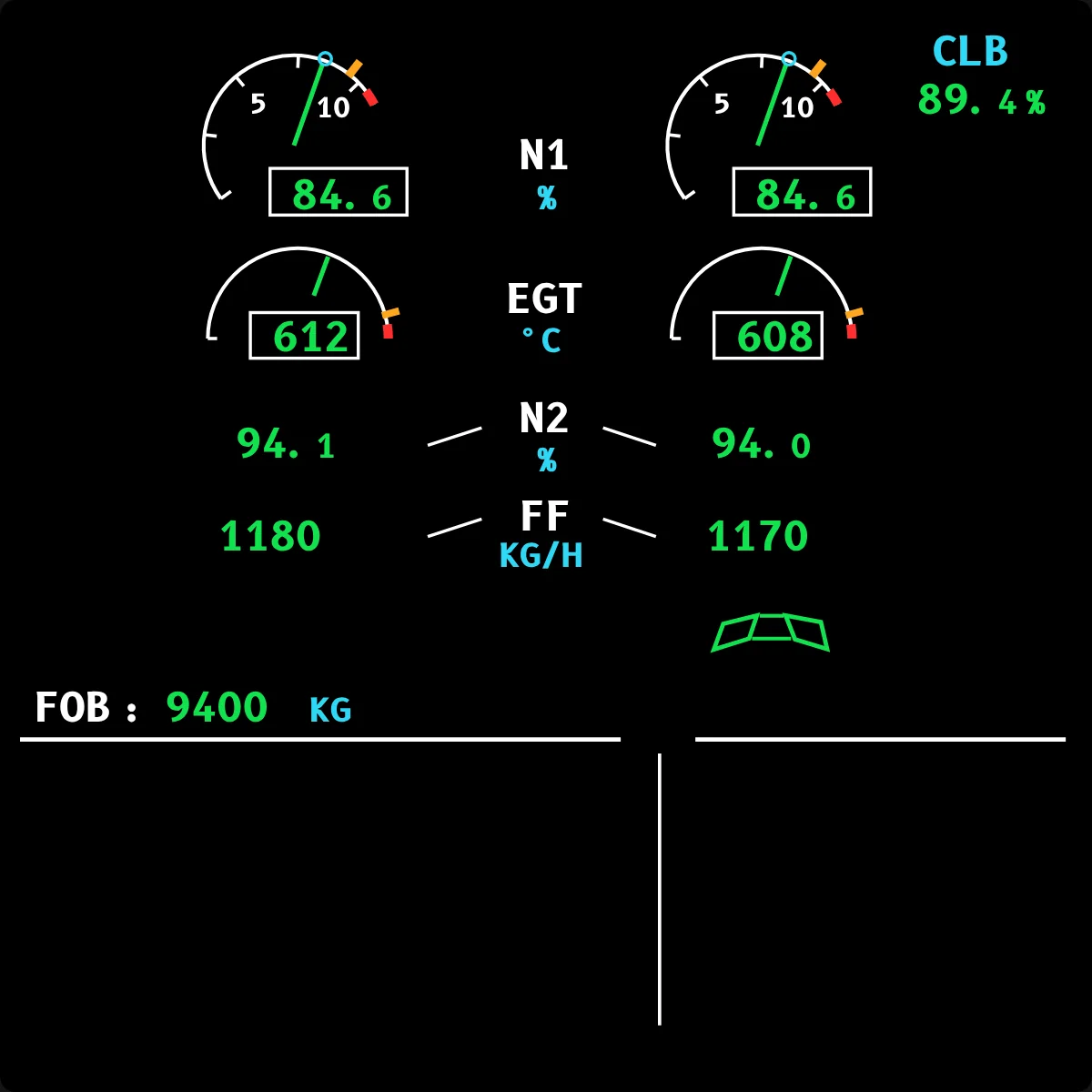
A healthy aircraft in the cruise, both thrust levers in the climb detent. Press the button to stall engine 1, then look at the E/WD, the ENGINE page and the thrust levers.

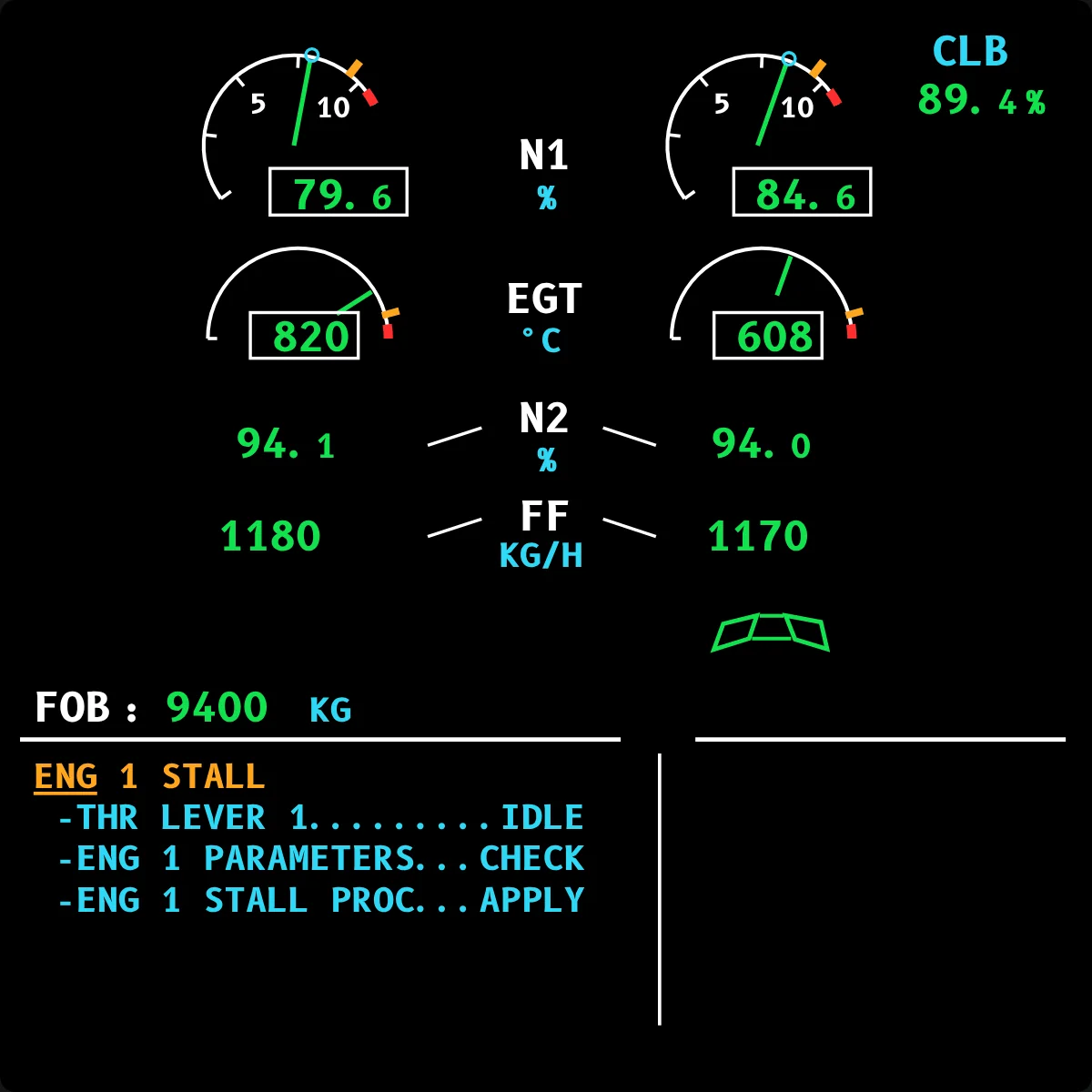
The alert Stall engine 1
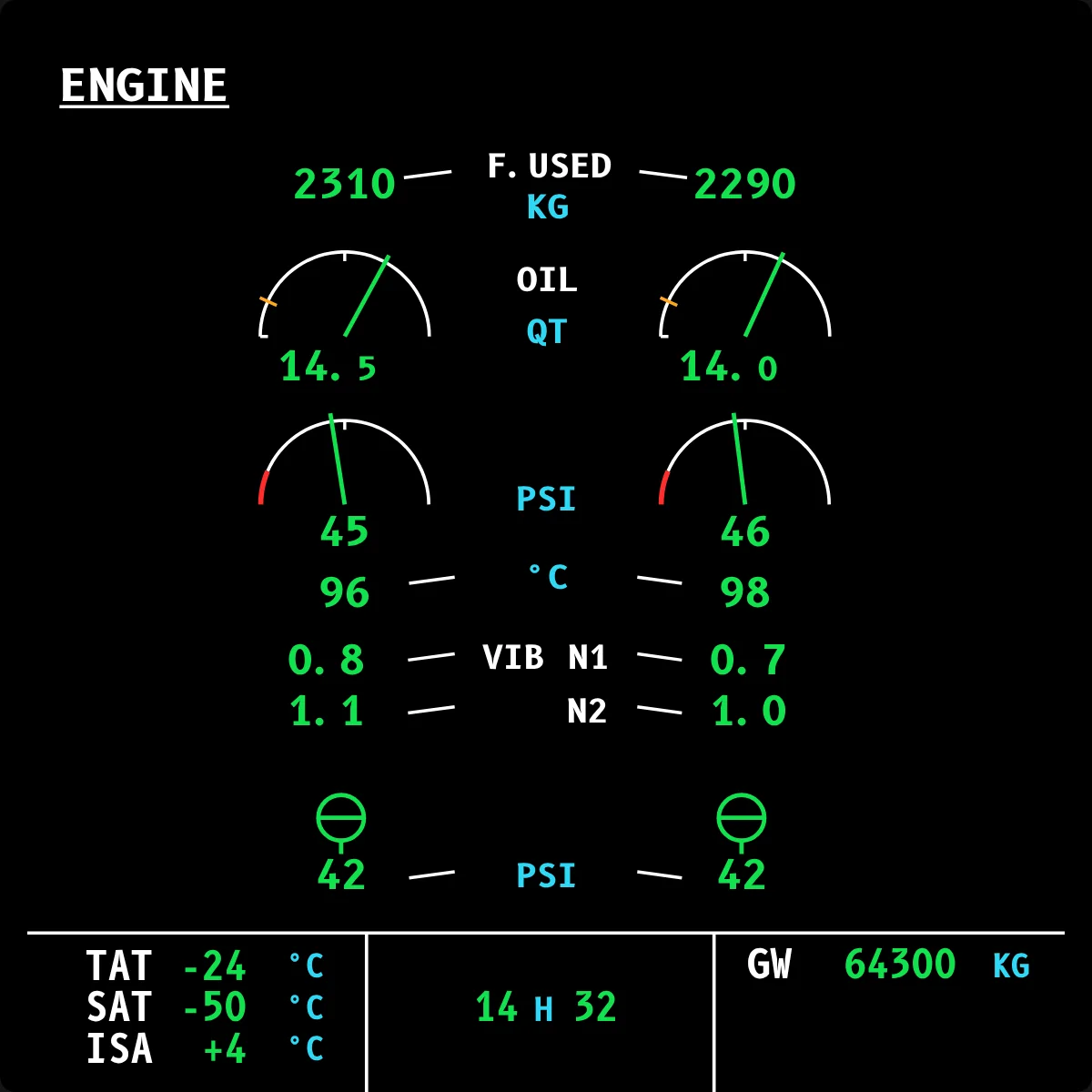
The E/WD shows ENG 1 STALL in amber with its three in-flight lines, the FCOM's THR LEVER (AFFECTED ENGINE) IDLE, ENG PARAMETERS (AFFECTED ENGINE) CHECK and ENG 1(2) STALL PROC APPLY, each drawn for engine 1. On it engine 1 runs at a lower N1 and a higher EGT than engine 2.
Engine 1 is still running and its thrust lever is still in the climb detent. The ENGINE page in this drawing keeps engine 1's normal vibration figures: the failure key does not move them. On the aircraft the crew checks them at idle. Working the lines is what the ECAM Trainer does with you.
Sources FCOM PRO-ABN-ENG ENG / FCTM PR-AEP-ENG ENGINE STALL
Why does the thrust come to idle first?
The FCTM gives the reason for the first line. Once the trajectory is stabilised, the crew reduces the affected engine to idle: this reduces the differential pressure across the compressor, which helps the airflow through the engine become more stable.
At idle the crew checks that the engine parameters on the E/WD are stable, in particular N1, EGT and N2, and checks the engine vibrations on the ENGINE page.
ENG 1(2) STALL PROC APPLY then hands over to the QRH's engine stall procedure; the FCTM's guidance behind it is that the crew should not shut down an engine whose stall can be avoided.
Sources FCTM PR-AEP-ENG ENGINE STALL / FCOM PRO-ABN-ENG ENG
A stall or a flameout?
The FCOM gives each its own indications. A stall's include fluctuating performance parameters and a high or rapidly rising EGT; a flameout may be recognised by a rapid decrease in EGT, N2 and fuel flow, followed by N1. With the core speed below idle, the master lever at ON and the fire pushbutton not pushed, the caution is ENG 1 FAIL.
The two are linked: an engine stall is among the FCTM's examples of what can flame an engine out, and repeated or uncontrollable stalls are one of the symptoms of engine damage.
Sources FCOM PRO-ABN-ENG ENG / FCOM PRO-ABN-ENG ENG 1(2) FAIL / FCTM PR-AEP-ENG ENGINE FAILURE - GENERAL
Stall or flameout: compare the two
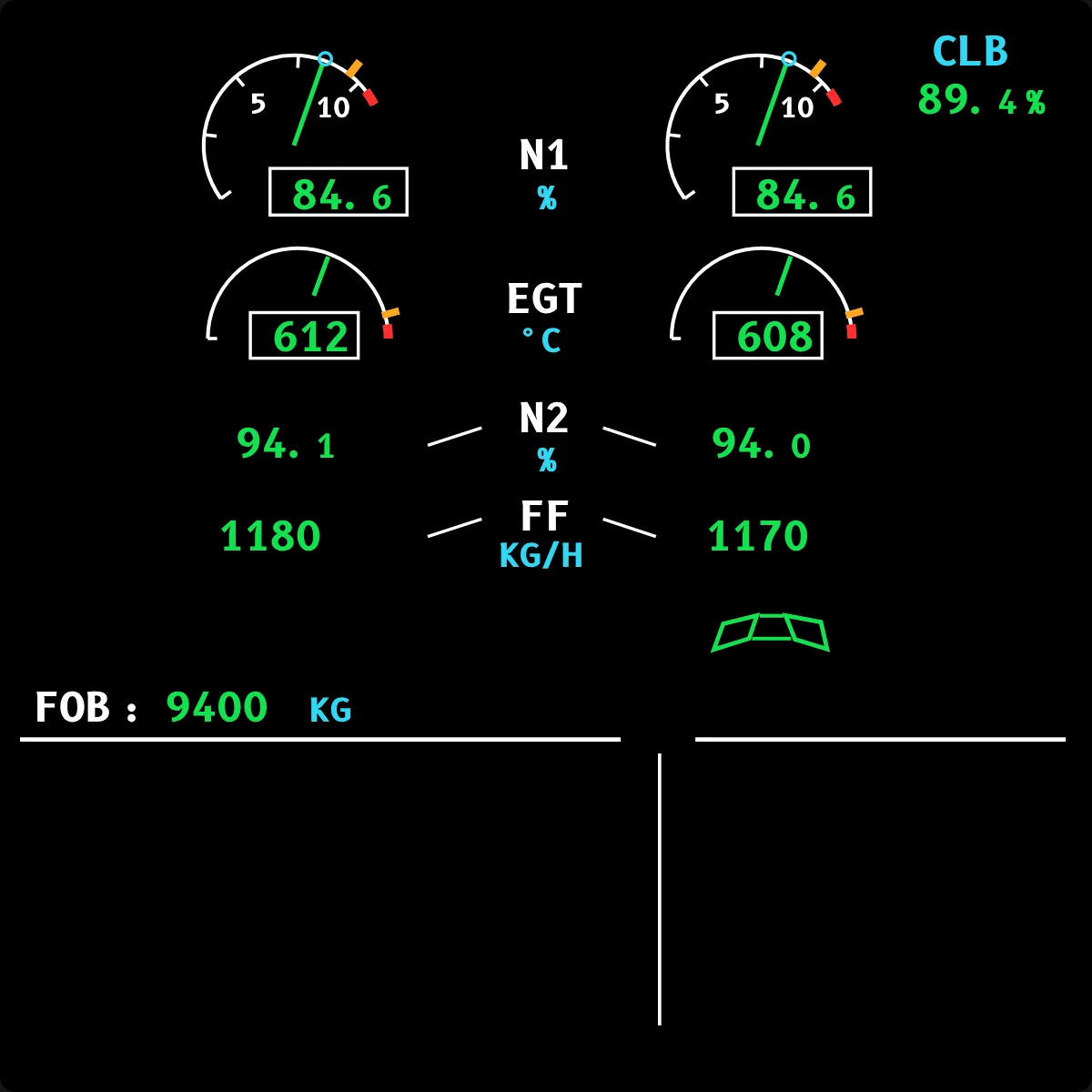
The same healthy aircraft. Press one failure, look at the electrical schematic and the HYD page, then press the other and compare.
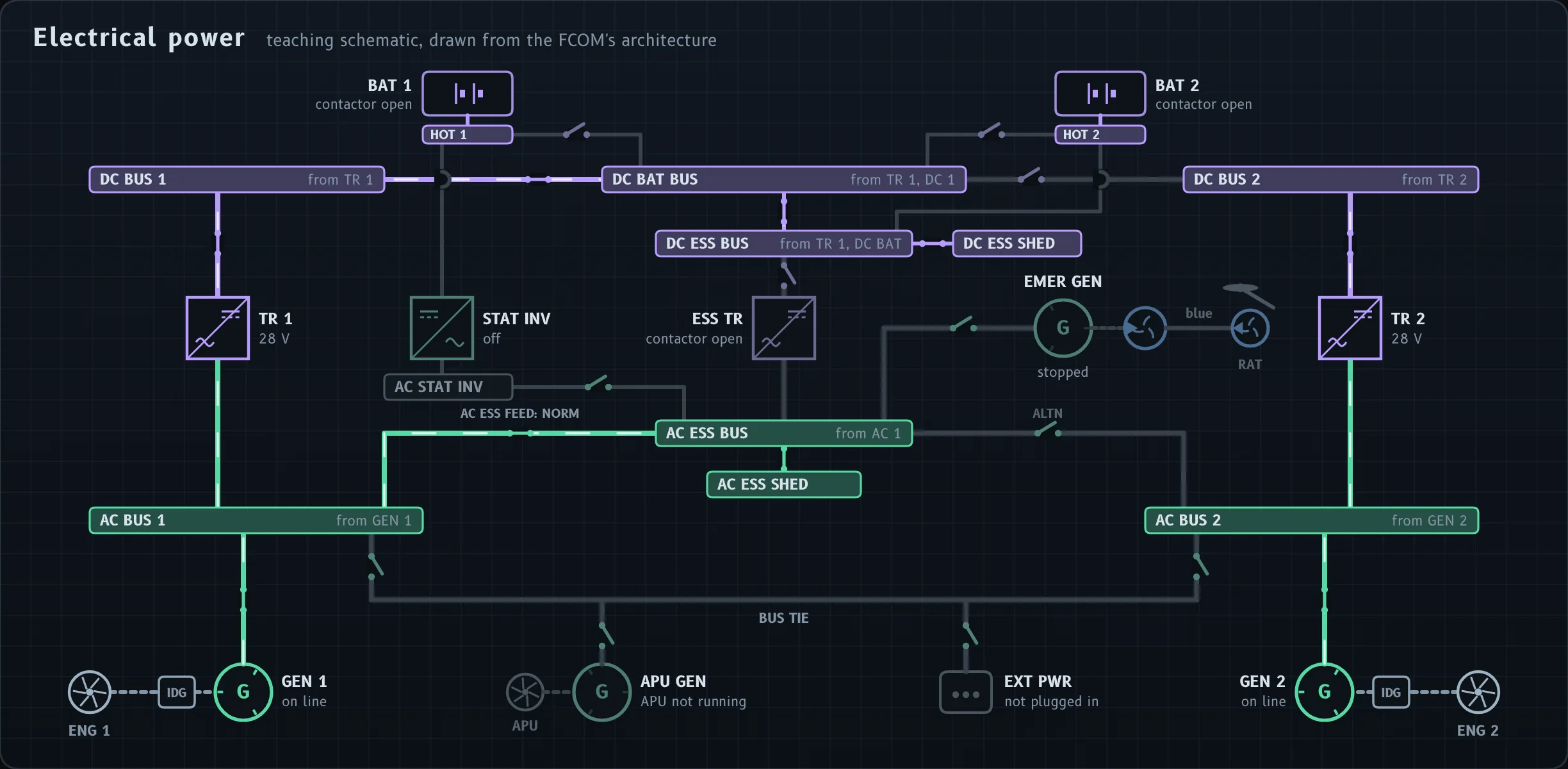
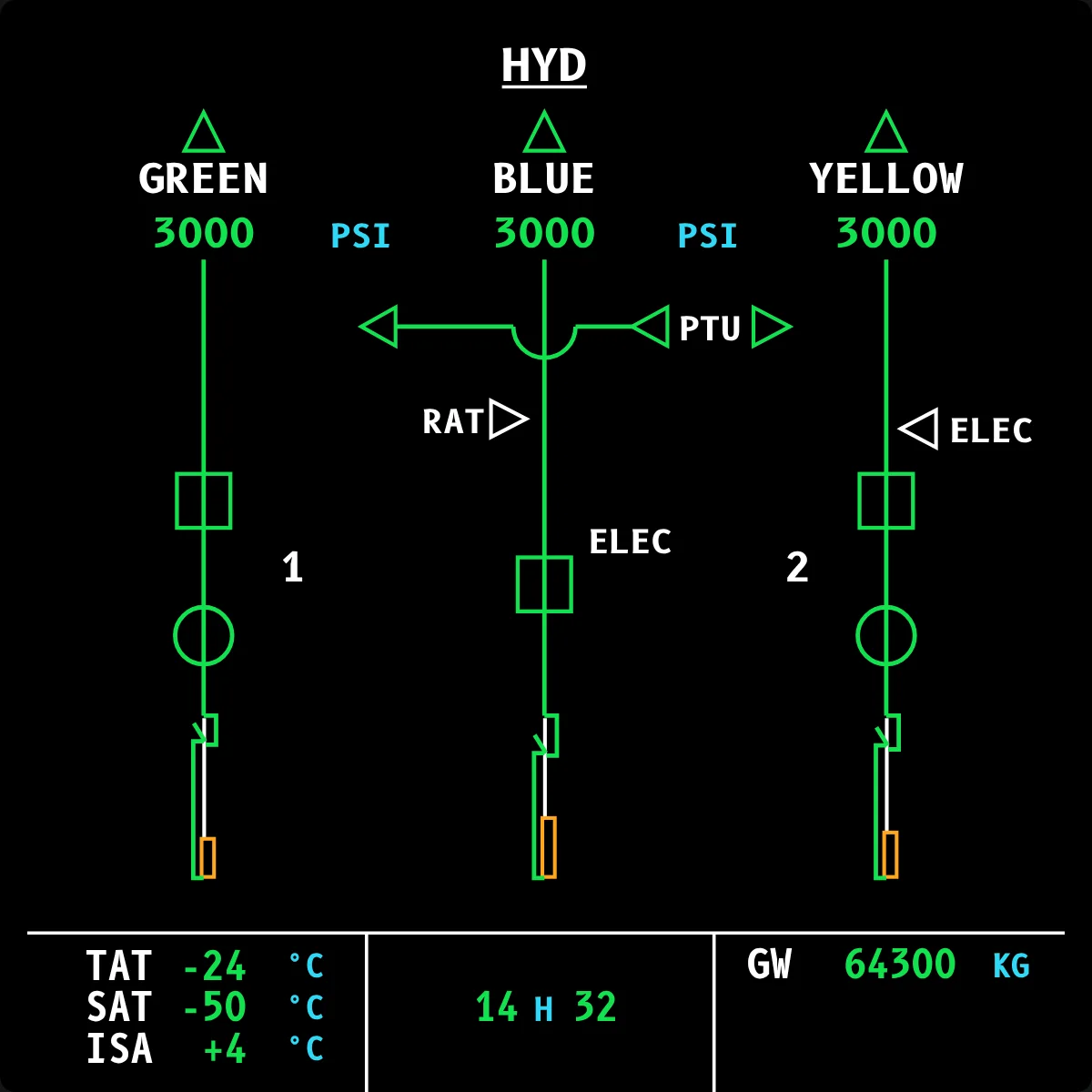
The alert Stall engine 1
Here the stalled engine keeps running: generator 1 keeps AC BUS 1 and green keeps its engine pump, both driven through the engine's accessory gearbox. Nothing on these two pages has changed.
Sources FCOM PRO-ABN-ENG ENG / FCOM DSC-70-10 ACCESSORY GEARBOX
The alert Flame out engine 1
Now the E/WD shows ENG 1 FAIL. Generator 1 drops off line and generator 2 takes AC BUS 1 as well; green loses its engine pump and the PTU pressurises it from yellow.
Sources FCOM PRO-ABN-ENG ENG 1(2) FAIL / FCOM DSC-24-10-30-30 FAILURE OF ONE ENGINE GENERATOR / FCOM DSC-29-10-20 POWER TRANSFER UNIT (PTU)
What does it mean that the stall procedure is not a memory item?
The FCTM says it plainly: the engine stall procedure is not a memory item. If a stall happens in the cruise, the crew takes the time to assess the situation before applying it, as most of the time the FADEC recovers from the stall before any crew action.
The first task stays the flight path. An engine stall is one of the most startling events at takeoff or in flight, and the FCTM says it should not take the crew away from flying the aircraft. Every engine stall must be reported for maintenance action.
On the ground the procedure is different: the thrust lever to idle and the master lever off.
Sources FCTM PR-AEP-ENG ENGINE STALL / FCOM PRO-ABN-ENG ENG
What is lost afterwards?
STATUS is the aircraft's operational summary. For this caution the FCOM gives it one line, CONSIDER ENG 1(2) RELIGHT, the same for every aircraft, and gives no condition with it.
The FCOM prints the line in green.
Sources FCOM DSC-31-20 STATUS PAGE / FCOM PRO-ABN-ENG ENG
A319ceo, A320ceo, A320neo, A321neo: what differs?
| A319ceo, A320ceo | A320neo, A321neo | |
|---|---|---|
| The caution, its procedure and STATUS | The same in every version | The same in every version |
| Engines | CFM56-5B | LEAP-1A |
| FADEC functions | Fuel flow, acceleration and deceleration schedules, variable bleed valves and stator vanes, among others | The same, and protection against engine stall and engine flameout listed as a function |
Sources FCOM PRO-ABN-ENG ENG 1(2) STALL / FCOM PRO-ABN-ENG ENG / FCOM DSC-70-05 OVERVIEW / FCOM DSC-70-05 / FCOM DSC-70-20 FUNCTIONS

Work ENG 1 STALL as a crew
Read and do each line against the FCOM, with the E/WD, the SD page and the overhead following your hands, the PF and PM calls, and a debrief that says what you missed.
Work this failure in the ECAM TrainerGo further
Written in our own words from the FCOM and the FCTM; each part names the units it rests on. The E/WD, the STATUS and the live aircraft are the platform's own ECAM and systems model, the same the ECAM Trainer and the flight deck run. This page explains the procedure; it is not the procedure. Aircraft differ by type, engine and options: your aircraft's FCOM, your QRH and your operator's procedures always come first. How we write and check these pages.
Every ECAM procedure, line by line, against the FCOM.
The ECAM Trainer works 108 scenarios with the E/WD, the SD page and the overhead following your hands. Start free today, or open everything with A320 Knowledge+.
For study and revision only. Always follow your operator's approved documentation and procedures. A320 Knowledge is independent and not affiliated with Airbus.
Related
- ENG 1 FAILAn amber caution for an engine whose core speed has fallen below idle with its master lever still on.
- ENG 1 FUEL LEAKAn amber caution for an abnormal difference between the engines in fuel flow or fuel used.
- ENG 1 OIL HI TEMPAn amber caution for engine oil that is too hot, or has been warm for too long.
- ENG 1 OIL LO PRA red warning for an engine whose oil pressure has fallen below its alert threshold.
- A320 engines and APUThe system guide, with the live aircraft
- Every ECAM procedureThe alerts the ECAM Trainer works, grouped by system