
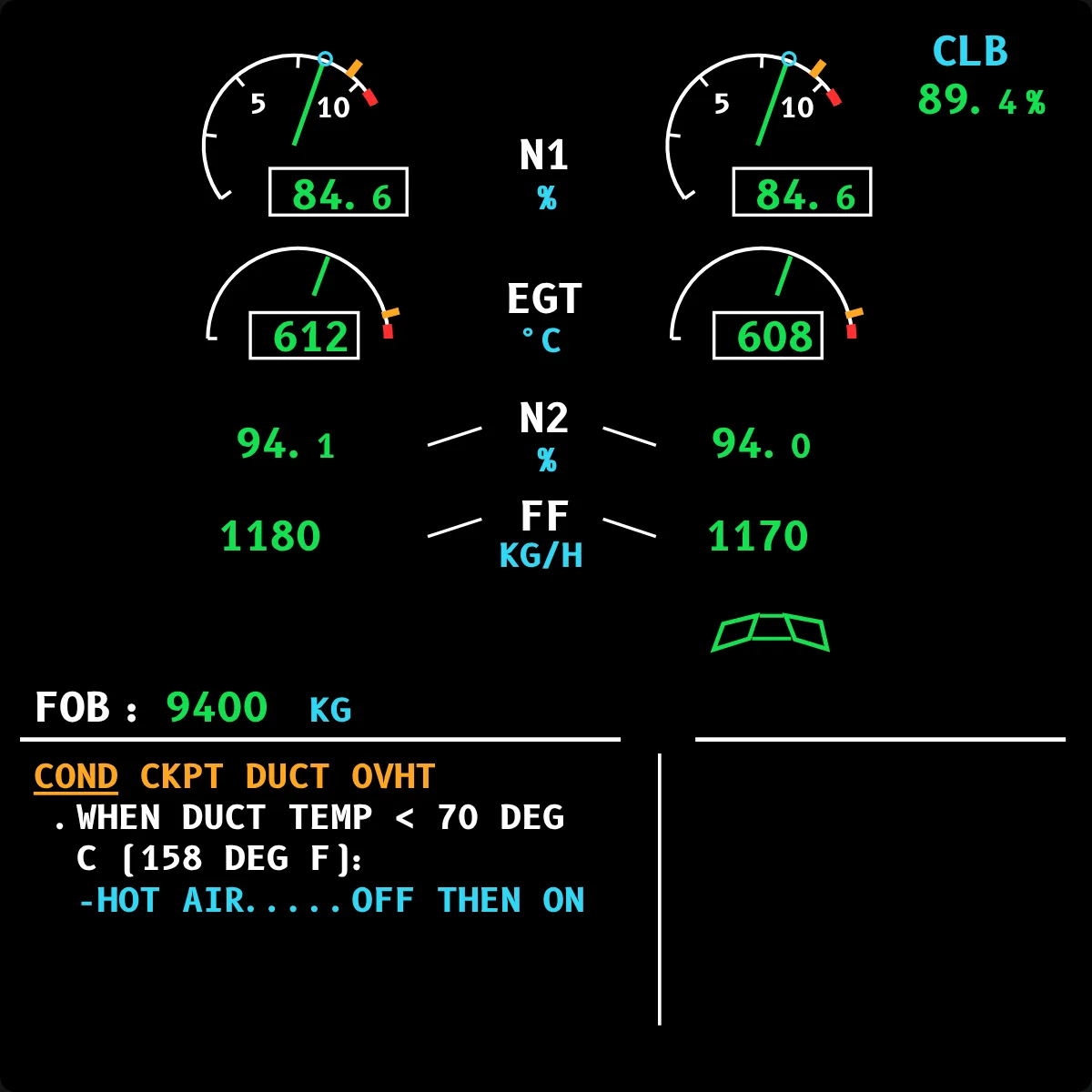
COND CKPT DUCT OVHT
An amber caution with nothing to do yet. Here is what the duct overheat logic watches, what the aircraft closes by itself, when the hot air may be reset and what the packs keep doing if it is not, with the live aircraft at the moment the caution comes on.
Written and checked by current A320 pilotschecked against the FCOM on Our editorial policy
What COND CKPT DUCT OVHT means
COND CKPT DUCT OVHT is an amber caution: the cockpit zone's duct temperature has risen above 88 °C, or above 80 °C four times during the same flight. The HOT AIR pushbutton's description gives FAULT in the pushbutton at 88 °C, and the hot air pressure regulating valve and the trim air valves closing by themselves.
There is nothing to do at once. The procedure waits for the duct to cool below 70 °C, then has the crew select HOT AIR off then on, and the valve reopens. If the system is not recovered, the packs alone regulate the temperatures, still automatically: STATUS gives CAB TEMP BY PACK ONLY and lists HOT AIR inoperative.
Sources FCOM PRO-ABN-COND COND FWD CAB/AFT CAB/CKPT DUCT OVHT / FCOM DSC-21-10-50 CONTROLS ON OVERHEAD PANEL / FCOM PRO-ABN-COND COND / FCOM PRO-ABN-COND
At a glance
- Level
- Amber caution, level 2: single chime, MASTER CAUT and, except in some cases, the relevant system page on the SD
- Sets it off
- The duct temperature above 88 °C, or above 80 °C four times during the same flight
- Lights
- FAULT in the HOT AIR pushbutton; on the COND page the duct temperature is amber from 80 °C
- By itself
- The hot air pressure regulating valve and the trim air valves close automatically
- Procedure
- Nothing at once; when the duct is below 70 °C, HOT AIR off then on
- STATUS
- If the system is not recovered: CAB TEMP BY PACK ONLY, and HOT AIR inoperative
Sources FCOM DSC-31-10 WARNING/CAUTION CLASSIFICATION / FCOM DSC-31-20 SYSTEM PAGES / FCOM PRO-ABN-COND COND FWD CAB/AFT CAB/CKPT DUCT OVHT / FCOM DSC-21-10-50 CONTROLS ON OVERHEAD PANEL / FCOM DSC-21-10-50 ECAM COND PAGE / FCOM DSC-21-10-20 HOT-AIR PRESSURE-REGULATING VALVE / FCOM PRO-ABN-COND COND / FCOM PRO-ABN-COND
What sets the caution off?
Hot air is tapped upstream of the packs and passes the hot air pressure regulating valve, which ACSC 1 regulates. A trim air valve for each zone, cockpit, forward cabin and aft cabin, then adjusts that zone's temperature by adding hot air to it.
The caution watches the duct temperature of each zone. The FCOM prints one alert for the three zones, COND FWD CAB/AFT CAB/CKPT DUCT OVHT, with one procedure; this page is about the cockpit's. It triggers when the duct temperature rises above 88 °C, or above 80 °C four times during the same flight.
The HOT AIR pushbutton's description gives one figure: the fault circuit detects an overheat when the duct temperature reaches 88 °C, once, in all but one version of that description, which gives no "once". It does not mention the fourth time above 80 °C; the alert's triggering conditions do. The FCOM does not say whether the FAULT light and the closure of the valves also follow that fourth time.
On the COND page each zone's duct temperature is shown in green, and turns amber at 80 °C.
Sources FCOM DSC-21-10-20 HOT-AIR PRESSURE-REGULATING VALVE / FCOM DSC-21-10-20 TRIM AIR VALVES / FCOM PRO-ABN-COND COND FWD CAB/AFT CAB/CKPT DUCT OVHT / FCOM PRO-ABN-COND COND / FCOM DSC-21-10-50 CONTROLS ON OVERHEAD PANEL / FCOM DSC-21-10-50 ECAM COND PAGE
From hot air to the caution
What does the crew see and hear?
A level 2 caution: a single chime, the MASTER CAUT light steady amber, the caution in amber on the E/WD, and the SD normally calls up the relevant system page, here the COND page.
Under the title the E/WD gives a precondition, WHEN DUCT TEMP < 70 DEG C (158 DEG F), and under it HOT AIR OFF THEN ON. The FCOM marks a precondition with a black dot and prints it in large letters when it appears on the ECAM, as this one does.
Sources FCOM DSC-31-10 WARNING/CAUTION CLASSIFICATION / FCOM DSC-31-20 SYSTEM PAGES / FCOM DSC-21-10-50 ECAM COND PAGE / FCOM PRO-ABN-COND COND / FCOM PRO-ABN-ABN-00 INTRODUCTION
The moment the caution comes on
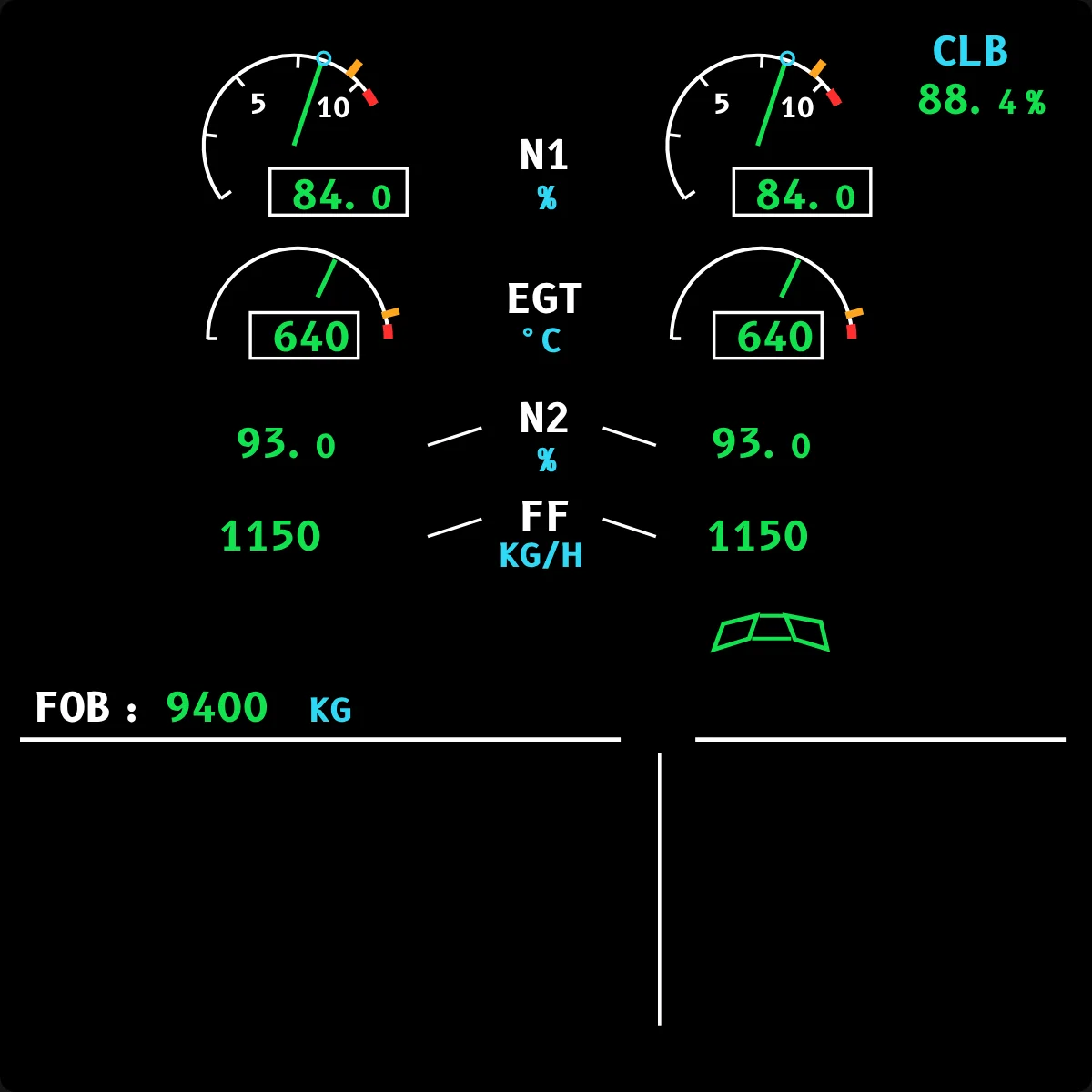
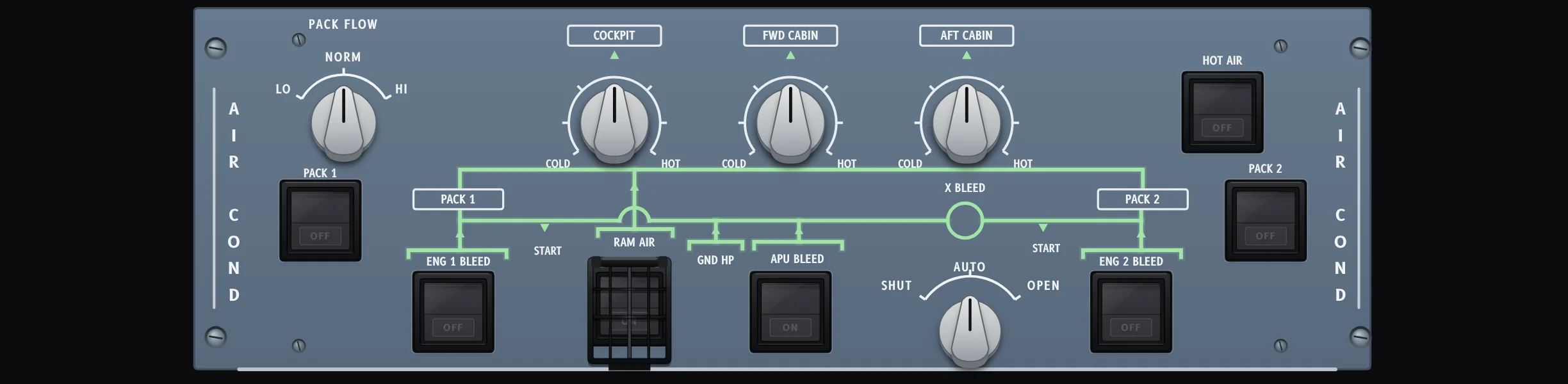
In the cruise, both packs running and HOT AIR on. Press the button to overheat the cockpit duct, then look at the E/WD, the COND page and the AIR COND panel.
The alert Overheat the cockpit duct
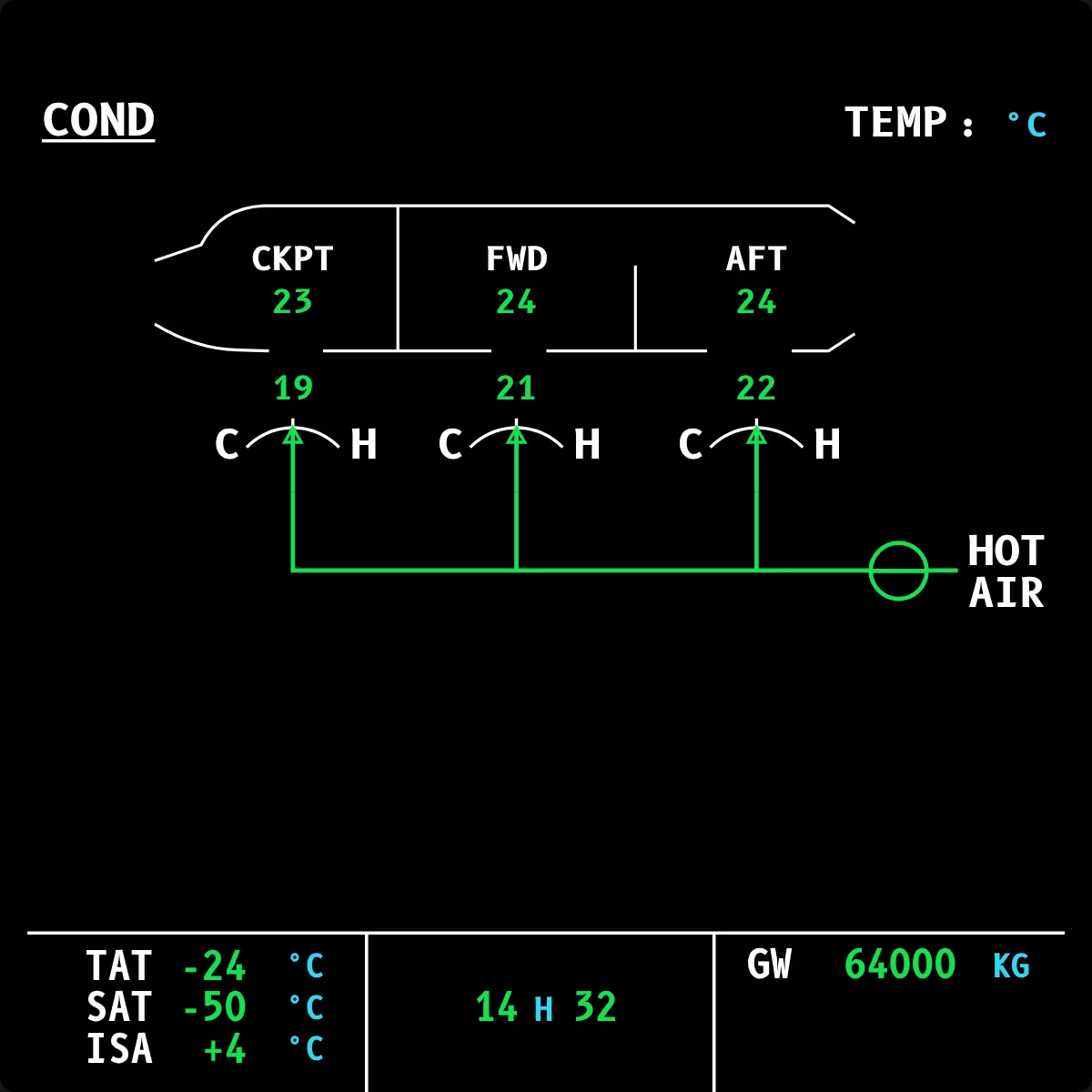
The E/WD shows the caution with its two lines: the condition, then HOT AIR OFF THEN ON indented under it. FAULT lights in HOT AIR. On the COND page the hot air valve is drawn crossline, closed, and each trim air valve's arrow sits at C, fully closed.
Two things in the drawing need a word. The drawing has no duct temperature of its own: the cockpit duct keeps the 19 °C it showed before the failure, in green. On the aircraft the caution comes with that duct above 88 °C, or above 80 °C for the fourth time, and the page shows a duct temperature amber from 80 °C. And the closed valve's crossline is drawn green. The FCOM's legend gives green for a valve normally fully closed and amber for one closed with its pushbutton OFF or against its control position; it does not say which applies to a valve closed by an overheat.
Sources FCOM PRO-ABN-COND COND / FCOM DSC-21-10-50 CONTROLS ON OVERHEAD PANEL / FCOM DSC-21-10-50 ECAM COND PAGE / FCOM PRO-ABN-COND COND FWD CAB/AFT CAB/CKPT DUCT OVHT
What does the aircraft do by itself?
It closes the hot air. With a duct overheat the hot air pressure regulating valve and the trim air valves close automatically: the FCOM gives both on the HOT AIR pushbutton, and lists the duct overheat among the cases in which the valve closes by itself.
Temperature regulation has two layers. In the basic one, the controller works out each zone's demand from its selected and actual temperatures, and the lowest demand sets the outlet temperature of both packs. The optimised one acts on the trim air valves, one for each zone.
The FCOM describes a hot air valve failed closed this way: optimised regulation is lost, the trim air valves are driven fully closed, pack 1 controls the cockpit temperature to the selected value, and pack 2 the forward and aft cabin to the mean of their selected temperatures.
Sources FCOM DSC-21-10-50 CONTROLS ON OVERHEAD PANEL / FCOM DSC-21-10-20 HOT-AIR PRESSURE-REGULATING VALVE / FCOM DSC-21-10-30 TEMPERATURE REGULATION / FCOM DSC-21-10-20 TRIM AIR VALVES / FCOM DSC-21-10-40 HOT AIR PRESSURE REGULATING VALVE FAILURE
The packs alone
What else closes the hot air valve?
The duct overheat is one of four automatic closures. The valve also closes if both lanes of ACSC 1 fail, if the cockpit trim air valve fails, or if both cabin trim air valves fail; and it closes when HOT AIR is set OFF. It stays operative with one cabin trim air valve failed.
The HOT AIR pushbutton's FAULT light is described for one case: it comes on, with its ECAM caution, when a duct overheat is detected.
Sources FCOM DSC-21-10-20 HOT-AIR PRESSURE-REGULATING VALVE / FCOM DSC-21-10-50 CONTROLS ON OVERHEAD PANEL
Compare: both controllers lost
The same aircraft, with both air conditioning controllers failing this time. Press it and compare the COND page and the HOT AIR pushbutton with what the duct overheat showed.
The alert Fail both air conditioning controllers
The E/WD shows AIR PACK 1+2 FAULT. In the drawing the COND page shows the hot air valve crossline and the trim air valves at C, as after the duct overheat, but HOT AIR shows no FAULT: the FCOM describes that light for a duct overheat only. For both lanes of a controller failed, the FCOM gives the related pack lost and the hot air valve and associated trim air valves closed.
Sources FCOM PRO-ABN-AIR AIR PACK 1+2 FAULT / FCOM DSC-21-10-40 / FCOM DSC-21-10-50 ECAM COND PAGE / FCOM DSC-21-10-50 CONTROLS ON OVERHEAD PANEL
Why wait for 70 °C before HOT AIR off then on?
The procedure has no action for now. Its one action, HOT AIR OFF THEN ON, sits under the precondition WHEN DUCT TEMP < 70 DEG C (158 DEG F).
The FCOM says what each half of that line does. OFF closes the valve and the trim air valves and resets the FAULT circuit; the FAULT light goes off when the temperature drops below 70 °C and the crew selects OFF. ON lets the valve regulate hot air pressure again, and the procedure's remark adds that the valve reopens.
70 °C is below both figures that set the caution off, 80 °C and 88 °C. The FCOM gives no reason for the figure, and no time for the duct to cool.
The FCOM classes a level 2 caution as one the crew should be aware of without any immediate action, yet to be considered without delay, time and situation permitting, so that the affected system does not degrade further.
Sources FCOM PRO-ABN-COND COND / FCOM PRO-ABN-ABN-00 INTRODUCTION / FCOM DSC-21-10-50 CONTROLS ON OVERHEAD PANEL / FCOM PRO-ABN-COND COND FWD CAB/AFT CAB/CKPT DUCT OVHT / FCOM DSC-31-10 WARNING/CAUTION CLASSIFICATION
What is lost if the hot air does not come back?
Optimised regulation, as the FCOM describes it for a valve failed closed. STATUS gives, under the precondition If system not recovered, CAB TEMP BY PACK ONLY in green, with the FCOM's explanation: basic temperature regulation is by the packs only and remains automatic. INOP SYS lists HOT AIR and, where fitted, FWD CRG HEAT.
That precondition is printed in small letters, the FCOM's mark for one that does not appear on the ECAM.
The crew's temperature selectors stay in use: in the FCOM's description of a valve failed closed, pack 1 controls the cockpit to its selected value and pack 2 the cabin to the mean of the forward and aft selections.
Sources FCOM DSC-21-10-40 HOT AIR PRESSURE REGULATING VALVE FAILURE / FCOM PRO-ABN-COND / FCOM DSC-31-20 STATUS PAGE / FCOM PRO-ABN-ABN-00 INTRODUCTION
What is lost afterwards?
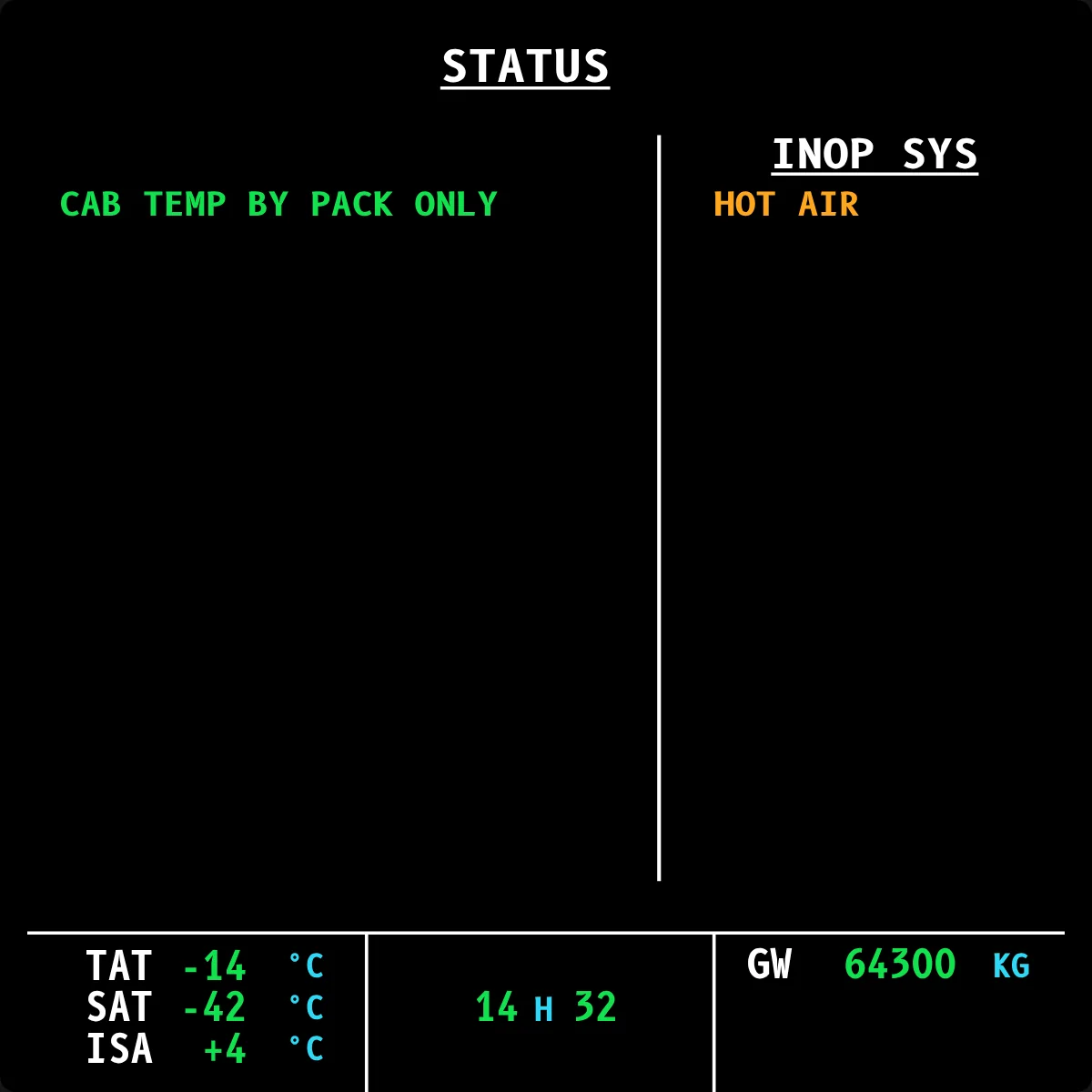
STATUS is the aircraft's operational summary. The FCOM prints one STATUS for this caution for all aircraft: CAB TEMP BY PACK ONLY under If system not recovered, and under INOP SYS HOT AIR and FWD CRG HEAT, the latter marked as an option. The picture shows CAB TEMP BY PACK ONLY and HOT AIR; its aircraft is drawn without cargo heat, so FWD CRG HEAT is not listed.
Sources FCOM DSC-31-20 STATUS PAGE / FCOM PRO-ABN-COND
A319ceo, A320ceo, A320neo, A321neo: what differs?
| A319ceo, A320ceo | A320neo, A321neo | |
|---|---|---|
| The caution, its procedure and STATUS | The same in every version | The same in every version |
| HOT AIR pushbutton: FAULT at 88 °C, the valves closed, FAULT off below 70 °C with OFF selected | The same in every version of the panel description, each given to a list of aircraft | The same: the versions agree |
Sources FCOM PRO-ABN-COND COND FWD CAB/AFT CAB/CKPT DUCT OVHT / FCOM PRO-ABN-COND COND / FCOM PRO-ABN-COND / FCOM DSC-21-10-50 CONTROLS ON OVERHEAD PANEL

Work COND CKPT DUCT OVHT as a crew
Read and do each line against the FCOM, with the E/WD, the SD page and the overhead following your hands, the PF and PM calls, and a debrief that says what you missed.
Work this failure in the ECAM TrainerGo further
Written in our own words from the FCOM and the FCTM; each part names the units it rests on. The E/WD, the STATUS and the live aircraft are the platform's own ECAM and systems model, the same the ECAM Trainer and the flight deck run. This page explains the procedure; it is not the procedure. Aircraft differ by type, engine and options: your aircraft's FCOM, your QRH and your operator's procedures always come first. How we write and check these pages.
Every ECAM procedure, line by line, against the FCOM.
The ECAM Trainer works 108 scenarios with the E/WD, the SD page and the overhead following your hands. Start free today, or open everything with A320 Knowledge+.
For study and revision only. Always follow your operator's approved documentation and procedures. A320 Knowledge is independent and not affiliated with Airbus.