
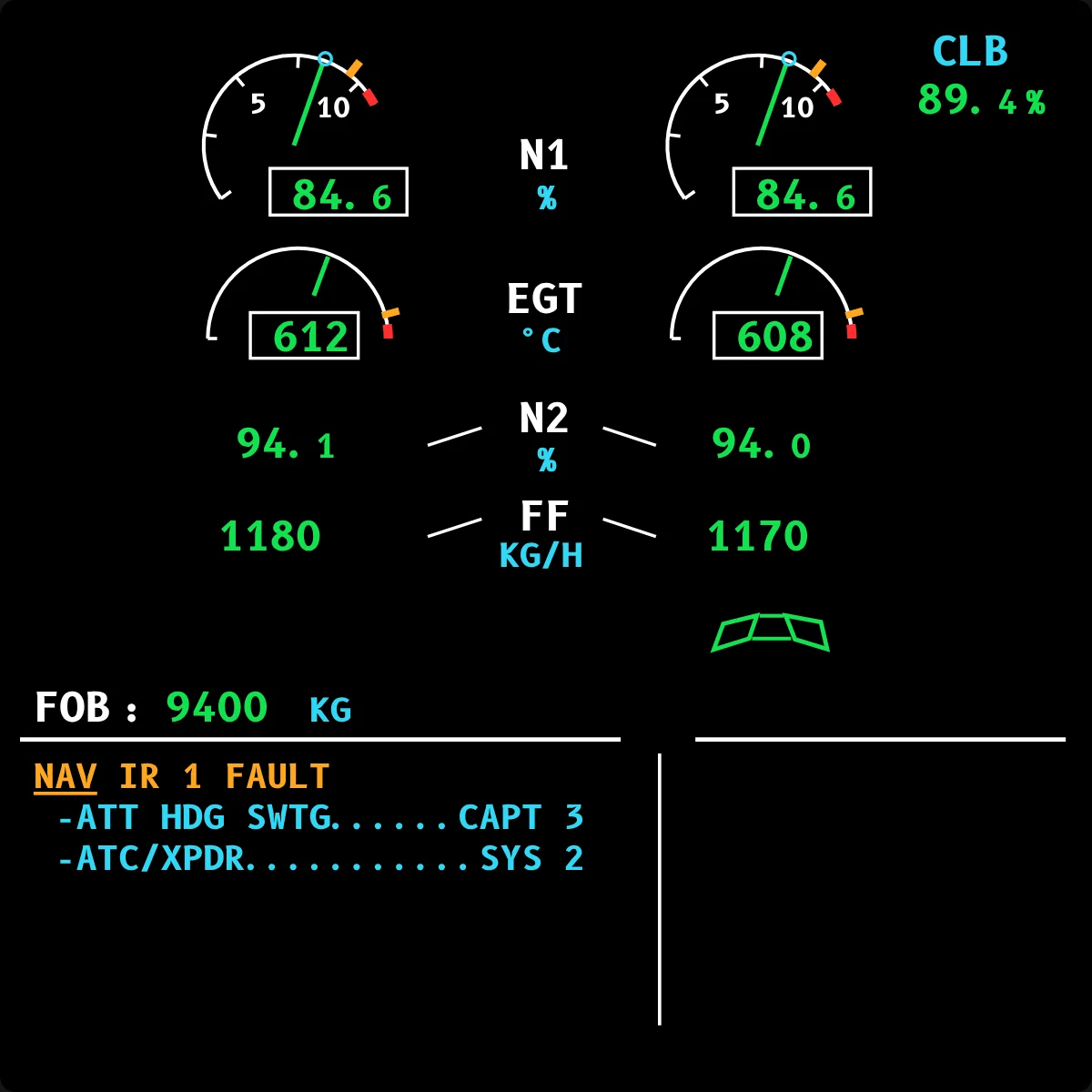
NAV IR 1 FAULT
An amber caution for the inertial half of the captain's ADIRU. Here is what IR 1 supplies, how IR 3 takes its place, what the flashing FAULT light and ATT mode mean, and what STATUS loses, with the live aircraft at the moment the caution comes on.
Written and checked by current A320 pilotschecked against the FCOM on Our editorial policy
What NAV IR 1 FAULT means
NAV IR 1 FAULT is an amber caution: the inertial reference of ADIRU 1 has failed. IR 1 supplies attitude, heading, track, ground speed and position, and in NORM its ADIRU feeds the captain's PFD and ND. The air data part of the same unit can keep working on its own.
The ECAM has the crew turn the ATT HDG selector to CAPT 3, so that IR 3 replaces IR 1 on the captain's side, and select transponder 2. STATUS says the IR may be available in ATT mode and reads CAT 3 SINGLE ONLY; among the inoperative systems are IR 1, CAT 3 DUAL, the TCAS and transponder 1.
Sources FCOM PRO-ABN-NAV NAV IR 1(2)(3) FAULT / FCOM DSC-34-NAV-10-10 GENERAL / FCOM DSC-34-NAV-10-20 PEDESTAL / FCOM PRO-ABN-NAV NAV / FCOM PRO-ABN-NAV
At a glance
- Level
- Amber caution, level 2: single chime and MASTER CAUT steady amber
- Sets it off
- IR 1 failed: the inertial part of ADIRU 1, whose air data part can keep working on its own
- Lights
- FAULT in amber in the IR 1 pushbutton (an IR 1 light on aircraft with the ADIRS CDU): flashing if attitude and heading may be recovered in ATT mode, steady if IR 1 is lost
- Procedure
- ATT HDG SWTG to CAPT 3, then ATC/XPDR to SYS 2
- STATUS
- IR MAY BE AVAIL IN ATT and CAT 3 SINGLE ONLY; IR 1, CAT 3 DUAL, TCAS, ATC/XPDR 1, and GPWS TERR and ROW/ROP where fitted, inoperative
Sources FCOM DSC-31-10 WARNING/CAUTION CLASSIFICATION / FCOM DSC-31-30 ATTENTION GETTERS / FCOM PRO-ABN-NAV NAV IR 1(2)(3) FAULT / FCOM DSC-34-NAV-10-10 GENERAL / FCOM DSC-34-NAV-10-20 OVERHEAD PANEL / FCOM PRO-ABN-NAV NAV / FCOM PRO-ABN-NAV
What does IR 1 supply, and what stands behind it?
The ADIRS has three identical ADIRUs. Each is divided in two parts, either of which can work on its own if the other fails: the ADR (air data reference) supplies barometric altitude, airspeed, Mach, angle of attack, temperature and overspeed warnings; the IR (inertial reference) supplies attitude, flight path vector, track, heading, accelerations, angular rates, ground speed and position.
The ADIRS feeds the PFDs and NDs and many other systems: the FMGCs, the FADECs, the ELACs, SECs and FACs, the FWCs, the SFCCs, the transponders, the GPWS, the CFDIU and the cabin pressure controllers.
On the pedestal's SWITCHING panel, the ATT HDG and AIR DATA selectors at NORM have ADIRU 1 supply PFD 1, ND 1, the DDRMI where fitted and VOR/DME, and ADIRU 2 supply PFD 2 and ND 2. At CAPT 3, ADR 3 or IR 3 replaces ADR 1 or IR 1; at F/O 3, it replaces ADR 2 or IR 2. The switching is there so that ADR 3 or IR 3 can stand in for ADIRU 1 or 2 on the displays.
Each FMGC receives a position from each of the three IRs and computes a weighted average, the MIX IRS position. If one IR fails, each FMGC uses only one IR, its onside one or IR 3.
Sources FCOM DSC-34-NAV-10-10 GENERAL / FCOM DSC-34-NAV-10-20 PEDESTAL / FCOM DSC-22_20-20-10 GENERAL / FCOM DSC-22_20-20-10 MIX IRS POSITION
Three ADIRUs, and who feeds whom
What does the crew see and hear?
A level 2 caution: a single chime, the MASTER CAUT light steady amber and the caution in amber on the E/WD.
On the overhead ADIRS panel, FAULT comes on amber in the IR 1 pushbutton, or, on aircraft with the ADIRS CDU, in an IR 1 light on the same panel. The light carries a message: flashing, the attitude and heading information may be recovered in ATT mode; steady, IR 1 is lost.
The procedure prints no comment on the PFDs for one IR, and no unit ties a PFD flag to this caution. The FCOM's PFD flags are general: a PFD that loses all attitude data has its sphere cleared to display the ATT flag, and a HDG flag replaces a failed heading scale.
Sources FCOM DSC-31-10 WARNING/CAUTION CLASSIFICATION / FCOM DSC-31-30 ATTENTION GETTERS / FCOM DSC-34-NAV-10-20 OVERHEAD PANEL / FCOM PRO-ABN-NAV NAV / FCOM DSC-31-40 FLAGS AND MESSAGES DISPLAYED ON PFD
The moment the caution comes on
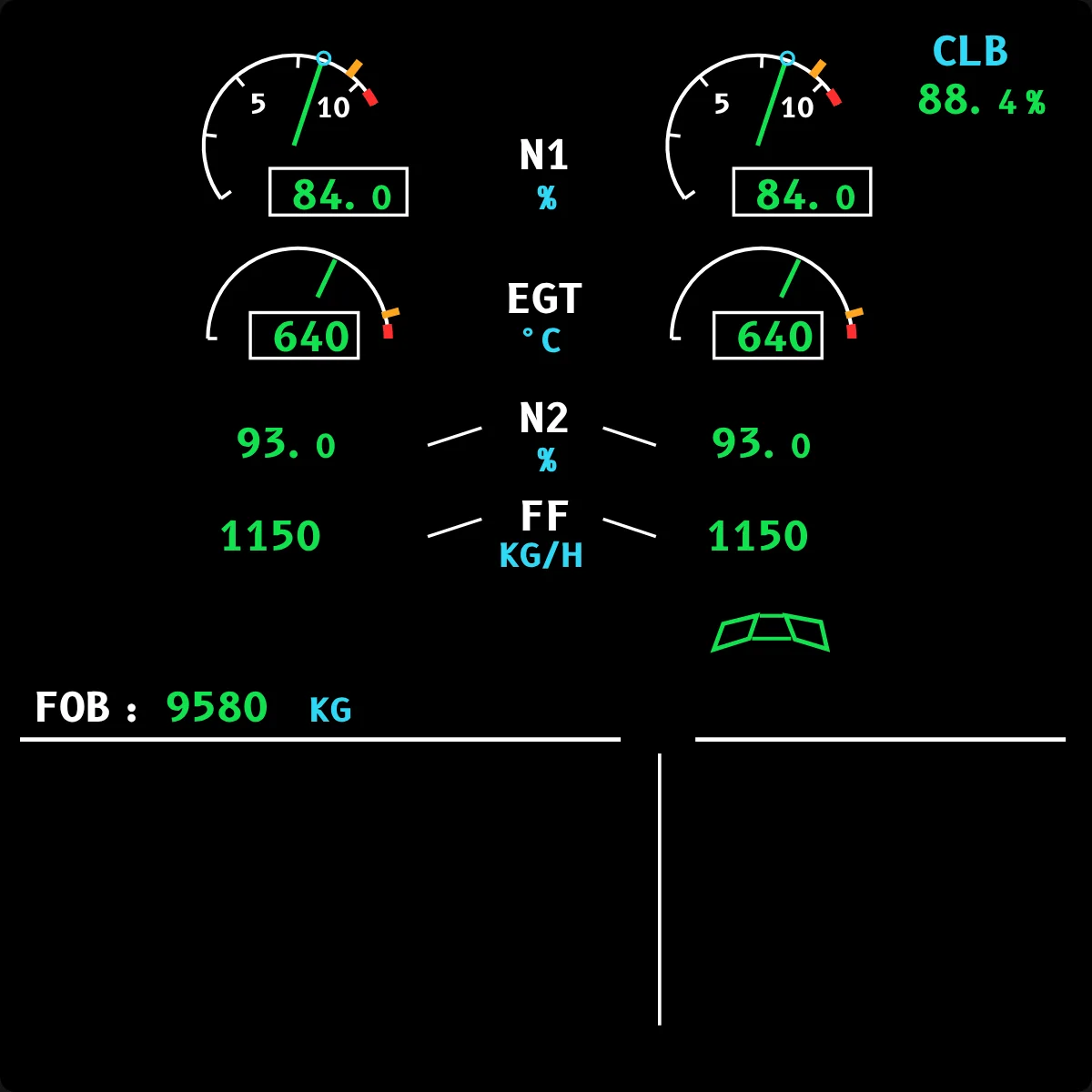
A healthy aircraft in the cruise, all three ADIRUs in NAV, nothing lit on the ADIRS panel. Press the button to fail IR 1, then look at the E/WD and the panel.

The alert Fail IR 1
The E/WD shows NAV IR 1 FAULT in amber with two blue lines, ATT HDG SWTG to CAPT 3 and ATC/XPDR to SYS 2. FAULT flashes in IR 1 on the ADIRS panel: in the drawing, IR 1's attitude and heading may be recovered in ATT mode. ADR 1 shows nothing.
Both lines are on the pedestal, not on this panel: ATT HDG on the SWITCHING panel and the transponder on the ATC/TCAS panel. No PFD is drawn here. Working the lines is what the ECAM Trainer does with you.
Sources FCOM PRO-ABN-NAV NAV / FCOM DSC-34-NAV-10-20 OVERHEAD PANEL / FCOM DSC-34-NAV-10-20 PEDESTAL / FCOM DSC-34-SURV-10-10 PRINCIPLE
What do the two lines do?
ATT HDG SWTG to CAPT 3 selects IR 3 to the captain's side: IR 3 replaces IR 1 for the captain's displays. Nothing is switched off on the overhead.
ATC/XPDR to SYS 2 changes transponders. The procedure prints no reason. DSC-34 says only the selected transponder operates, and that among the data it sends to ATC, the magnetic heading, roll angle, ground speed, track angle, track angle rate and inertial vertical speed are supplied by the IRs.
The FCTM calls a single NAV ADR FAULT or NAV IRS FAULT a simple procedure, needing only action on the switching panel as the ECAM indicates.
The procedure's note covers an ADR and an IR of the same ADIRU failing together: the ADR procedure comes before the IR procedure.
Sources FCOM PRO-ABN-NAV NAV / FCOM DSC-34-NAV-10-20 PEDESTAL / FCOM DSC-34-SURV-10-10 PRINCIPLE / FCTM PR-AEP-NAV ADR/IRS FAULT
One IR, two IRs, or an ADR
A healthy aircraft again. Press one failure at a time and compare its E/WD and its lights with IR 1 alone.
The alert Lose IR 1 and IR 2
Two FAULT lights, steady in the drawing, and a different E/WD: ATT HDG SWTG to CAPT 3, no transponder line, then the associated procedure F/CTL ALTN LAW (PROT LOST) in amber with MAX SPEED 320 KT.
The law reconfiguration table's inertial rows start with two IRs failed: one IR alone has no row.
Sources FCOM PRO-ABN-NAV NAV / FCOM DSC-34-NAV-10-20 OVERHEAD PANEL / FCOM DSC-27-20-20 FLIGHT CONTROLS LAW RECONFIGURATION
The alert Lose ADR 1 instead
The other half of ADIRU 1: FAULT in ADR 1, IR 1 dark, and two different lines, AIR DATA SWTG to CAPT 3 and ADR 1 P/B OFF. An ADR is switched off with its pushbutton; this IR procedure switches nothing off.
Sources FCOM PRO-ABN-NAV NAV / FCOM DSC-34-NAV-10-20 OVERHEAD PANEL
What does IR MAY BE AVAIL IN ATT mean?
Each IR has a mode selector on the ADIRS panel: OFF, NAV or ATT. In NAV the IR provides full inertial data. In ATT it provides only attitude, and heading if the crew enters it; the navigation data are not available, and the heading has to be reset about every 10 min.
The heading is entered through the MCDU; on aircraft with the ADIRS CDU, through the CDU keyboard, or the MCDU if the entry field is available. In one version of the memo list, for some aircraft, the memo IR IN ATT ALIGN appears in green during the alignment in ATT mode.
The step is one way: in flight, a mode selector moved from NAV to ATT or to OFF loses the NAV mode for the remainder of the flight. At OFF the whole ADIRU is not energised, its ADR included.
STATUS names the QRH procedure for it, IR alignment in ATT mode, whose aim is to recover attitude and heading from the failed IR. Its note adds that after an IR 1 fault the TCAS may be inoperative, depending on its manufacturer, and that with IR 1 available in ATT mode, entering the magnetic heading into the CDU can recover it.
Sources FCOM DSC-34-NAV-10-20 OVERHEAD PANEL / FCOM DSC-34-NAV-10-20 MEMO DISPLAY / FCOM PRO-ABN-NAV
What does the aircraft lose with IR 1?
STATUS gives CAT 3 SINGLE ONLY, and lists IR 1 and CAT 3 DUAL as inoperative. After an IR 1 fault it adds the GPWS TERR, ROW/ROP where fitted, the TCAS and ATC/XPDR 1; after an IR 2 fault, ATC/XPDR 2. The FCOM gives no reason for the IR 1 lines.
Each FMGC computes the landing category from the aircraft systems and functions available. CAT 3 DUAL is fail-operational: after a failure below alert height, the remaining automatic system completes the approach, flare and landing. CAT 3 SINGLE is fail-passive: the landing is not completed automatically after a failure, and the pilot takes control.
The law reconfiguration table has no row for one IR: its inertial rows start with two IRs failed. In the FCTM, dual IR failures bring the loss of the AP and A/THR and alternate law; with IR 2 as the second, the alert is NAV IR 1+2 FAULT.
Sources FCOM PRO-ABN-NAV / FCOM PRO-NOR-SRP-01-70 LANDING CATEGORIES / FCOM DSC-27-20-20 FLIGHT CONTROLS LAW RECONFIGURATION / FCTM PR-AEP-NAV ADR/IRS FAULT
IR 1 lost: what goes, what stays
What is lost afterwards?
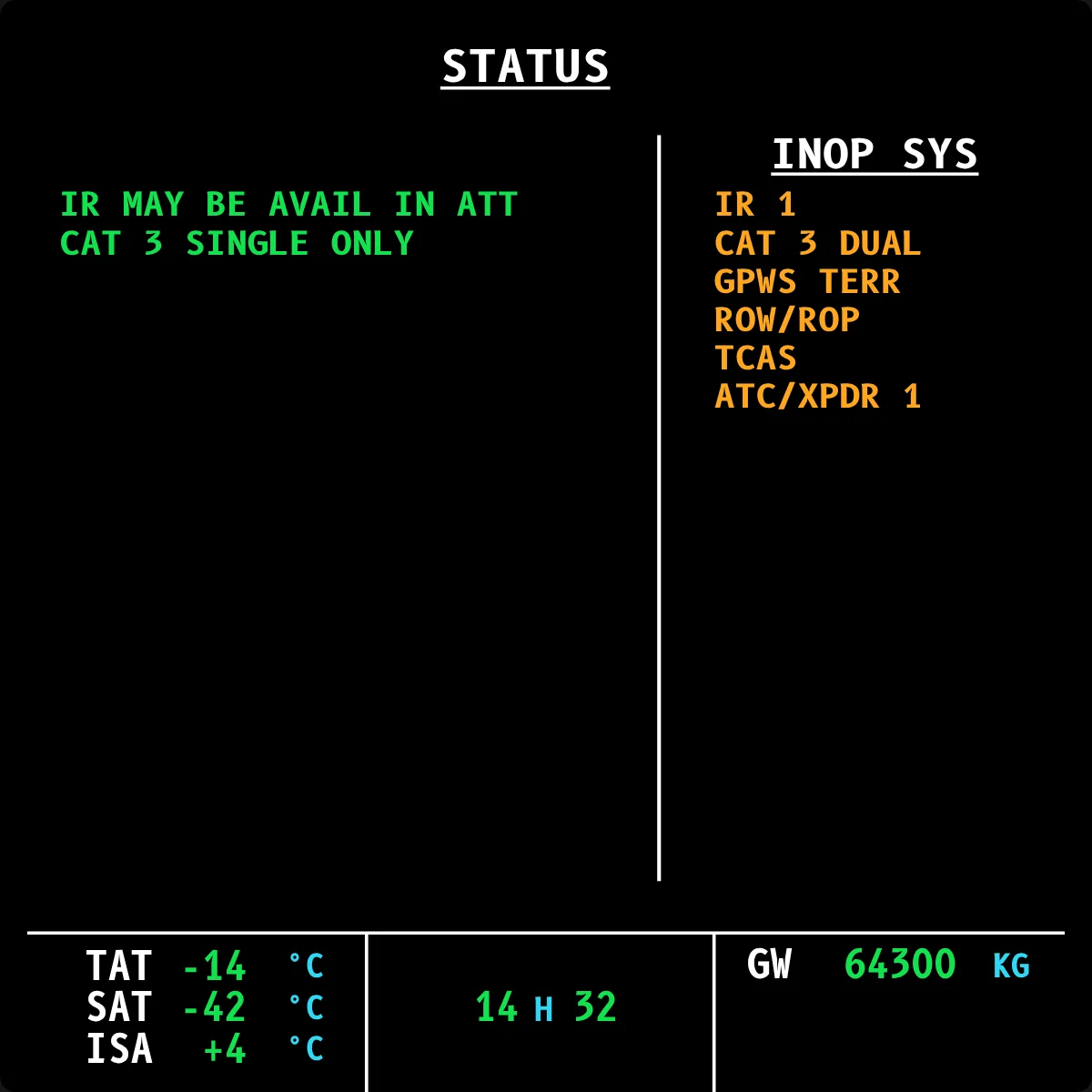
STATUS is the aircraft's operational summary. After this caution it reads IR MAY BE AVAIL IN ATT and CAT 3 SINGLE ONLY in green, as information, with IR 1, CAT 3 DUAL, GPWS TERR, ROW/ROP, TCAS and ATC/XPDR 1 under INOP SYS in amber; the last four are for an IR 1 fault, and the GPWS TERR and ROW/ROP where fitted.
The FCOM prints one STATUS for this caution, for all aircraft, and one procedure.
Sources FCOM DSC-31-20 STATUS PAGE / FCOM PRO-ABN-NAV / FCOM PRO-ABN-NAV NAV
A319ceo, A320ceo, A320neo, A321neo: what differs?
| A319ceo, A320ceo | A320neo, A321neo | |
|---|---|---|
| The caution, its procedure and STATUS | The same in every version | The same in every version |
| Where the IR FAULT light is | In the IR pushbutton on the ADIRS panel, or, on aircraft with the ADIRS CDU, in an IR light on the same panel, which has no IR pushbutton | In the IR pushbutton on the ADIRS panel |
Sources FCOM PRO-ABN-NAV NAV IR 1(2)(3) FAULT / FCOM PRO-ABN-NAV NAV / FCOM PRO-ABN-NAV / FCOM DSC-34-NAV-10-20 OVERHEAD PANEL

Work NAV IR 1 FAULT as a crew
Read and do each line against the FCOM, with the E/WD, the SD page and the overhead following your hands, the PF and PM calls, and a debrief that says what you missed.
Work this failure in the ECAM TrainerGo further
Written in our own words from the FCOM and the FCTM; each part names the units it rests on. The E/WD, the STATUS and the live aircraft are the platform's own ECAM and systems model, the same the ECAM Trainer and the flight deck run. This page explains the procedure; it is not the procedure. Aircraft differ by type, engine and options: your aircraft's FCOM, your QRH and your operator's procedures always come first. How we write and check these pages.
Every ECAM procedure, line by line, against the FCOM.
The ECAM Trainer works 108 scenarios with the E/WD, the SD page and the overhead following your hands. Start free today, or open everything with A320 Knowledge+.
For study and revision only. Always follow your operator's approved documentation and procedures. A320 Knowledge is independent and not affiliated with Airbus.
Related
- NAV ADR 1+2+3 FAULTA red warning for the loss of all three air data references: the speed, the barometric altitude and the angle of attack the ADRs supply are gone.
- NAV ADR 1+2 FAULTAn amber caution for the loss of two of the three air data references.
- NAV ADR 1 FAULTAn amber caution for the air data half of the captain's ADIRU.
- NAV ALTI DISCREPANCYAn amber caution for two PFDs that no longer agree on the altitude.
- A320 navigation and surveillanceThe system guide, with the live aircraft
- Every ECAM procedureThe alerts the ECAM Trainer works, grouped by system