
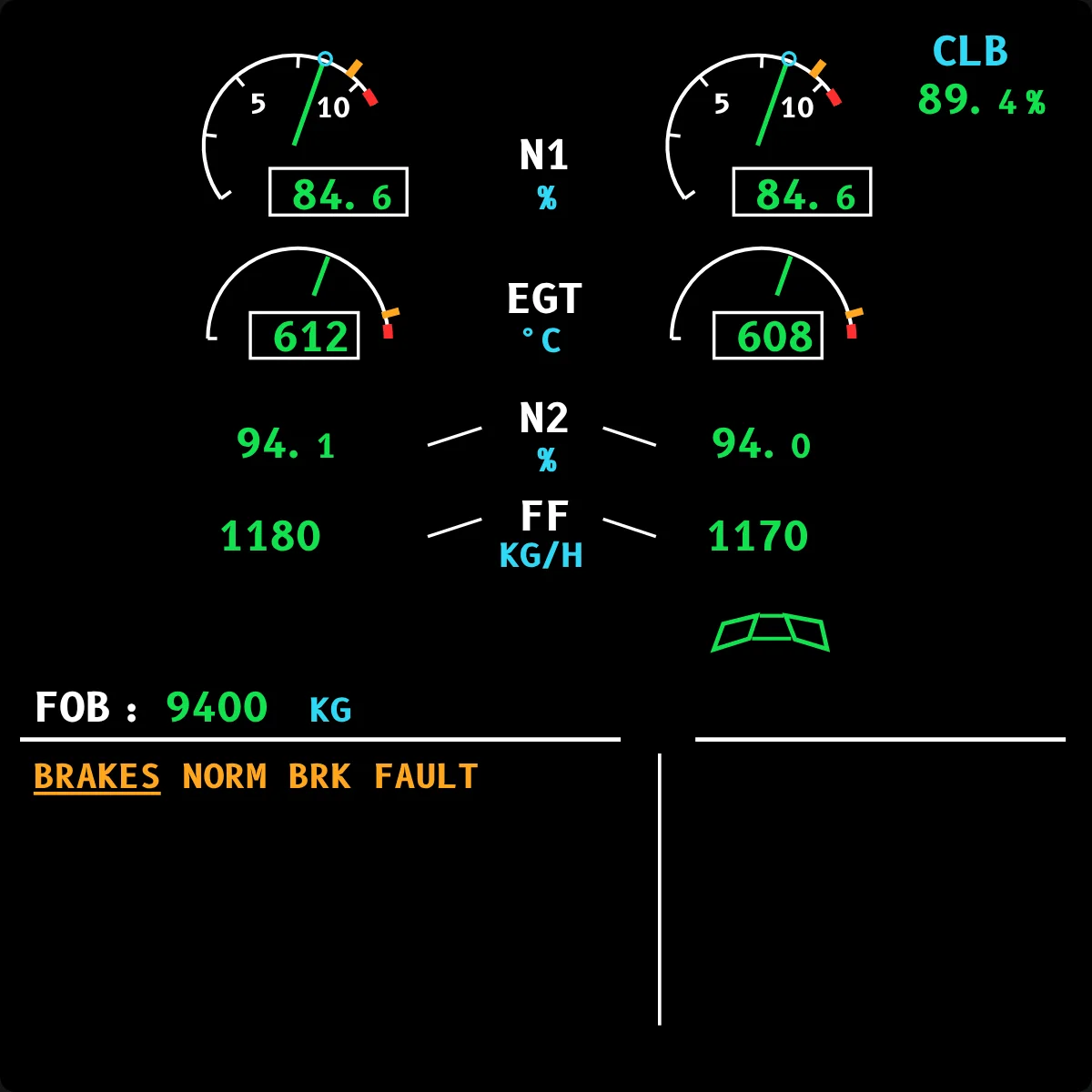
BRAKES NORM BRK FAULT
An amber caution for the loss of normal braking. Here is how the brakes are built, what takes over, what the WHEEL page and the triple indicator show and what STATUS keeps for the landing, with the live aircraft at the moment the caution comes on.
Written and checked by current A320 pilotschecked against the FCOM on Our editorial policy
What BRAKES NORM BRK FAULT means
BRAKES NORM BRK FAULT is an amber caution: the normal braking function is lost. Normal braking uses green hydraulic pressure, controlled electrically through the BSCU, with the anti-skid and the autobrake. The alternate system uses the yellow hydraulic system, backed up by the hydraulic accumulator.
The E/WD shows the title and no line under it: the FCOM's procedure is crew awareness. STATUS gives LDG DIST PROC APPLY, then ALTN Y BRK WITH A/SKID and CAT 3 SINGLE ONLY, and lists CAT 3 DUAL, NORM BRK and AUTO BRK as inoperative.
Sources FCOM PRO-ABN-BRAKES BRAKES NORM BRK FAULT / FCOM DSC-32-30-10 GENERAL / FCOM DSC-32-30-10 / FCOM PRO-ABN-BRAKES BRAKES
At a glance
- Level
- Amber caution, level 2: single chime, MASTER CAUT steady amber, the WHEEL page on the SD
- Sets it off
- The normal braking function is lost
- What is left
- Alternate braking on the yellow system, backed up by the accumulator; STATUS reads ALTN Y BRK WITH A/SKID
- Procedure
- No action line: the title alone on the E/WD, for crew awareness
- STATUS
- LDG DIST PROC APPLY and CAT 3 SINGLE ONLY; CAT 3 DUAL, NORM BRK and AUTO BRK inoperative
Sources FCOM DSC-31-10 WARNING/CAUTION CLASSIFICATION / FCOM DSC-31-30 ATTENTION GETTERS / FCOM DSC-31-20 SYSTEM PAGES / FCOM PRO-ABN-BRAKES BRAKES NORM BRK FAULT / FCOM DSC-32-30-10 GENERAL / FCOM PRO-ABN-BRAKES BRAKES
How are the brakes built?
The main wheels have carbon multidisc brakes, which either of two independent brake systems can apply. The normal system uses green hydraulic pressure; the alternate system uses the yellow hydraulic system, backed up by the hydraulic accumulator. Braking commands come from the brake pedals, or from the autobrake at a deceleration rate the crew selects.
In normal operation a dual channel Brake and Steering Control Unit, the BSCU, controls normal braking and the anti-skid. The two channels change over at each DOWN selection of the gear lever, or when one channel fails. The BSCU also checks the residual pressure in the brakes, monitors the brake temperatures and gives wheel speed to other systems.
The FCOM lists four braking modes: normal braking, alternate braking with anti-skid, alternate braking without anti-skid, and the parking brake. The Alternate Braking Control Unit, the ABCU, controls alternate braking; with anti-skid, the BSCU still controls the anti-skid. Every normal and alternate braking component is monitored, and a detected failure is signalled to the crew on the ECAM.
Normal braking works when green pressure is available and the A/SKID & N/W STRG switch is ON. It is electrically controlled through the BSCU from the pedals, by the autobrake on the ground, or automatically in flight when the gear lever is selected up. In normal braking the BSCU controls the anti-skid through the normal servo valves, and there is no brake pressure indication in the cockpit.
Sources FCOM DSC-32-30-10 GENERAL / FCOM DSC-32-30-10 BRAKING MODES / FCOM DSC-32-30-10
Two brake systems, two computers
What does the crew see and hear?
A level 2 caution: a single chime, the MASTER CAUT light steady amber, BRAKES NORM BRK FAULT in amber on the E/WD and the WHEEL page on the SD. No line follows the title: the FCOM's procedure is crew awareness.
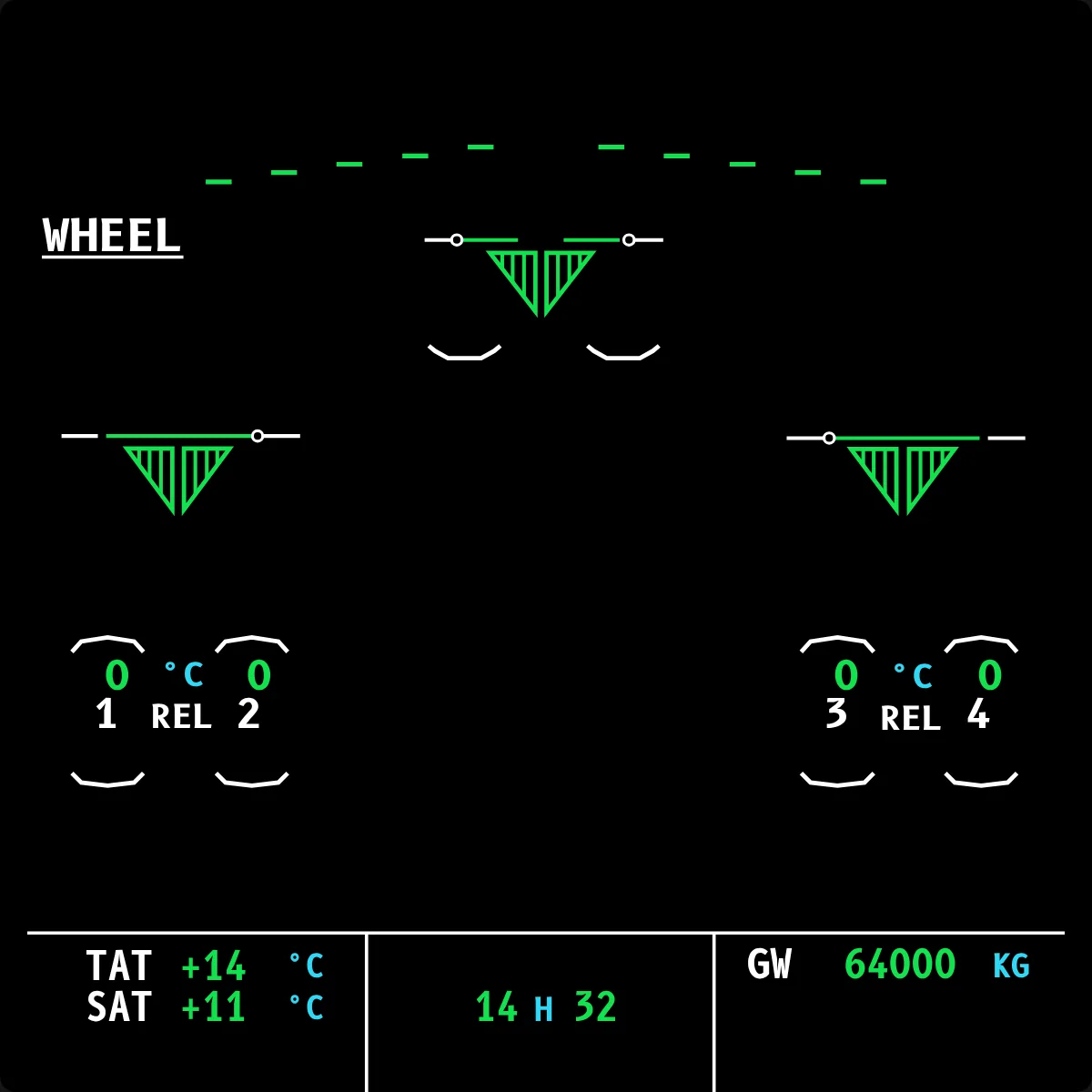
On the WHEEL page, NORM BRK appears in amber when normal braking has failed; the FCOM names a total BSCU failure, the loss of green pressure and the loss of the anti-skid. ALTN BRK appears in green when normal braking has failed and alternate braking is still available, with its Y green while yellow pressure is there and ACCU PRESS in green. ANTI SKID appears in green while the anti-skid is still available.
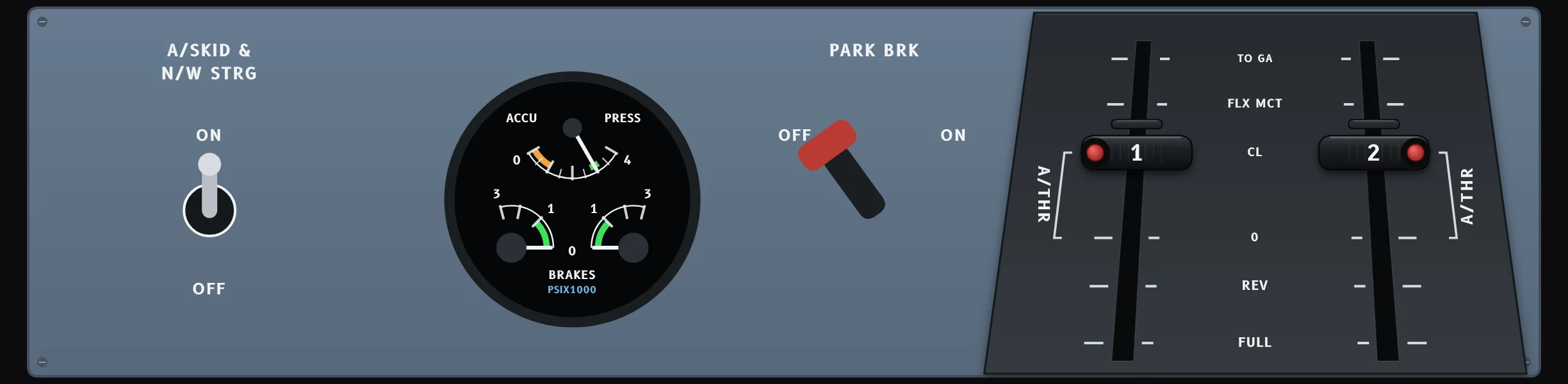
The triple indicator on the centre instrument panel shows brake pressure only when the yellow system controls the brakes, in alternate braking or with the parking brake applied. It also shows the pressure in the yellow brake accumulator.
The FCOM's graphic inhibits the caution from the first engine at takeoff power to 1 500 ft. Most warnings and cautions are inhibited in the critical phases because most system failures will not affect the aircraft's ability to continue a takeoff or landing.
Sources FCOM DSC-31-10 WARNING/CAUTION CLASSIFICATION / FCOM DSC-31-30 ATTENTION GETTERS / FCOM DSC-31-20 SYSTEM PAGES / FCOM PRO-ABN-BRAKES BRAKES NORM BRK FAULT / FCOM DSC-32-30-20 WHEEL SD PAGE / FCOM DSC-32-30-20 CENTER INSTRUMENT PANEL / FCOM DSC-31-10 PRIORITY RULES
The moment the caution comes on
In flight with the gear down, the green and yellow systems pressurised, the autobrake not armed. The WHEEL page shows no braking legend; the BRAKES panel below has the A/SKID & N/W STRG switch, the triple indicator and the parking brake handle. Press the button to lose normal braking.
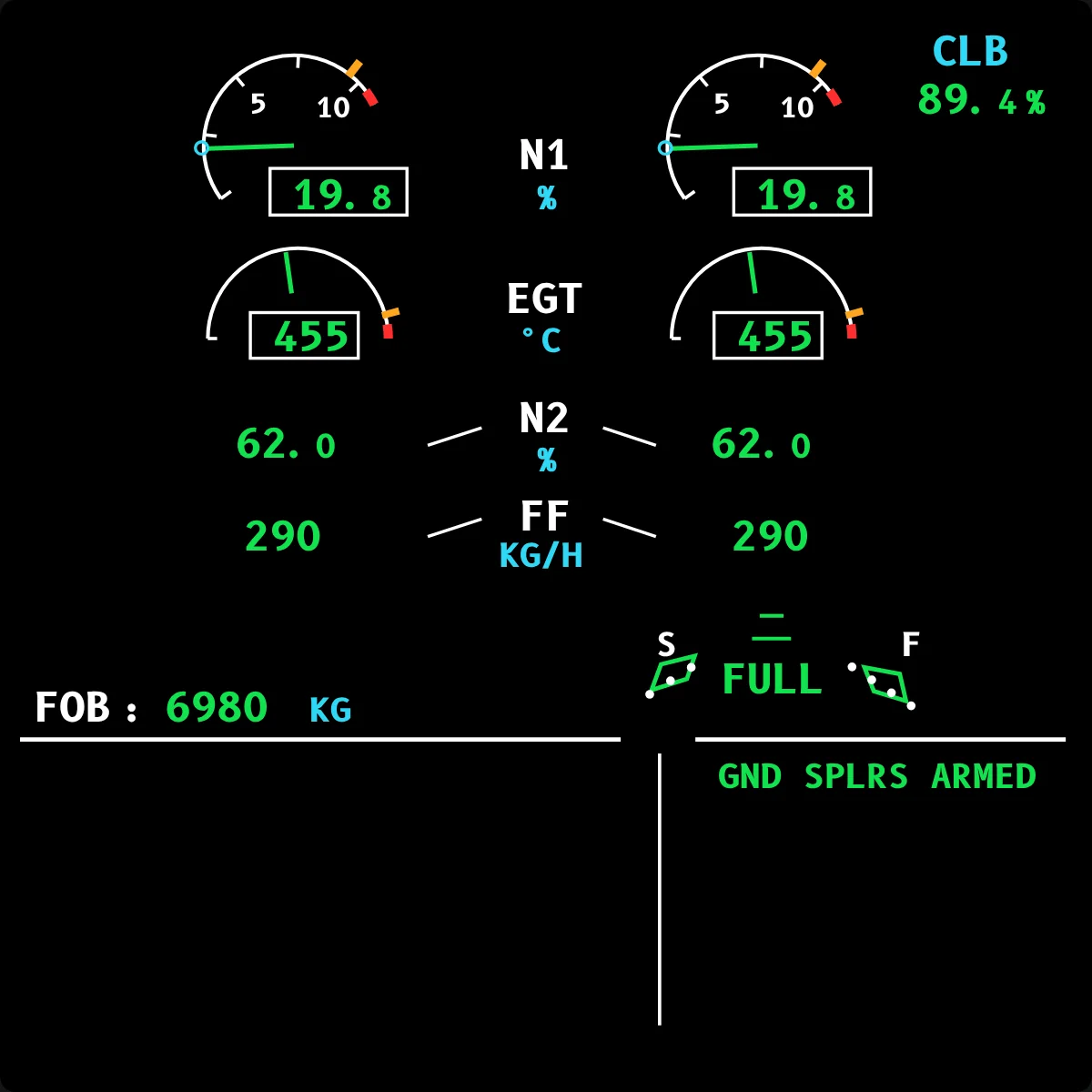
The alert Lose normal braking
BRAKES NORM BRK FAULT comes up in amber with no line under it. On the WHEEL page, NORM BRK is amber with its G still green: green pressure is there, but normal braking is not. ALTN BRK, its Y and ACCU PRESS are green, and ANTI SKID is green.
The triple indicator's brake needles stay at zero with no pedal pressed; on the aircraft they show the yellow pressure delivered to the left and right brakes when alternate braking is used. Working the procedure is what the ECAM Trainer does with you.
Sources FCOM PRO-ABN-BRAKES BRAKES NORM BRK FAULT / FCOM DSC-32-30-20 WHEEL SD PAGE / FCOM DSC-32-30-20 CENTER INSTRUMENT PANEL
What braking is left, and how does it differ?
Alternate braking with anti-skid is used when green pressure is insufficient, yellow pressure is available, the A/SKID & N/W STRG switch is ON and the parking brake is not ON. The pedals send their demand to the ABCU, which opens the alternate brake selector valve to the yellow circuit and controls the alternate servo valves; the BSCU controls the anti-skid. The autobrake is inoperative.
The FCOM adds a note for the pedals: initial pedal force or displacement produces more braking action in alternate mode than in normal mode.
The anti-skid keeps each wheel at the limit of an impending skid. Each main wheel's speed is compared with a reference speed, which the BSCU normally works out from an ADIRU's horizontal acceleration, and brake release orders are given when the wheel falls below about 0.87 times it, depending on conditions. It is deactivated below 20 kt ground speed, and without the autobrake, full braking performance comes only with the pedals at full deflection.
If the anti-skid goes as well, through the switch OFF, a power supply or BSCU failure, or green and yellow both at low pressure, braking is alternate without anti-skid. The brake pressure is then limited automatically to 1 000 psi, to avoid wheel locking and limit the risk of tyre burst, and the accumulator can supply at least 7 full brake applications.
Sources FCOM DSC-32-30-10 / FCOM DSC-32-30-10 ANTI-SKID SYSTEM
Lose a hydraulic system instead
The same healthy aircraft. Press one failure at a time and compare its WHEEL page with the caution's: here normal braking goes because its hydraulic supply goes.
The alert Lose the green system
A hydraulic caution this time. NORM BRK is amber with its G amber too; ALTN BRK, its Y and ACCU PRESS are green, and ANTI SKID stays green: alternate braking with anti-skid, as with BRAKES NORM BRK FAULT. This caution's STATUS gives the same ALTN Y BRK WITH A/SKID.
Sources FCOM DSC-32-30-20 WHEEL SD PAGE / FCOM DSC-32-30-10 / FCOM PRO-ABN-HYD HYD / FCOM PRO-ABN-HYD ABNORMAL AND EMERGENCY PROCEDURES
The alert Lose green and yellow
For the brakes, only the accumulator is left. ANTI SKID turns amber, the Y beside ALTN BRK is amber and ACCU ONLY appears in green: alternate braking without anti-skid, on the accumulator, limited to 1 000 psi. N/W STEERING turns amber as well.
Sources FCOM DSC-32-30-20 WHEEL SD PAGE / FCOM DSC-32-30-10 / FCOM DSC-32-20-20 WHEEL SD PAGE
What does the A/SKID & N/W STRG switch do?
The switch on the centre instrument panel turns the anti-skid and the nosewheel steering on or off. At ON with green available, the anti-skid is available. At ON with green lost, yellow automatically takes over the brakes, the anti-skid and the steering remain, and the triple indicator shows the yellow brake pressure.
At OFF, the yellow system supplies the brakes, the anti-skid is deactivated with the pressure limited to 1 000 psi, the nosewheel steering is lost, and differential braking remains through the pedals.
This caution asks nothing of the switch: its procedure is crew awareness. LOSS OF BRAKING is a separate procedure, which the FCTM says the crew applies from memory when no deceleration is felt when required.
Sources FCOM DSC-32-30-10 ANTI-SKID SYSTEM / FCOM DSC-32-30-20 CENTER INSTRUMENT PANEL / FCOM PRO-ABN-BRAKES BRAKES NORM BRK FAULT / FCTM PR-AEP-BRK LOSS OF BRAKING
What does STATUS ask for the landing?
STATUS opens with LDG DIST PROC APPLY in blue, the colour of procedures and corrections to apply for landing. The FCTM gives its aim: to assess the landing performance when a failure affects it, with the QRH's tables for a landing with failure, which this page does not reproduce.
ALTN Y BRK WITH A/SKID follows in green, as information: the mode left for the landing. AUTO BRK is under INOP SYS. The FCOM's description of alternate braking with anti-skid gives the autobrake as inoperative, and lists green pressure and no failure in the braking system among the autobrake's arming conditions.
CAT 3 SINGLE ONLY, with CAT 3 DUAL inoperative, is the landing capability left; the procedure gives no reason. Each FMGC computes the landing category from the systems and functions available. CAT 3 DUAL is fail-operational: after a failure below alert height, the remaining automatic system completes the approach, flare and landing. CAT 3 SINGLE is fail-passive: the landing is not completed automatically after a failure, and the pilot takes control.
Sources FCOM DSC-31-20 STATUS PAGE / FCOM PRO-ABN-BRAKES BRAKES / FCTM PR-NP-SOP-160 LANDING PERFORMANCE - ABNORMAL OPERATIONS / FCOM DSC-32-30-10 / FCOM PRO-NOR-SRP-01-70 LANDING CATEGORIES
What is lost afterwards?
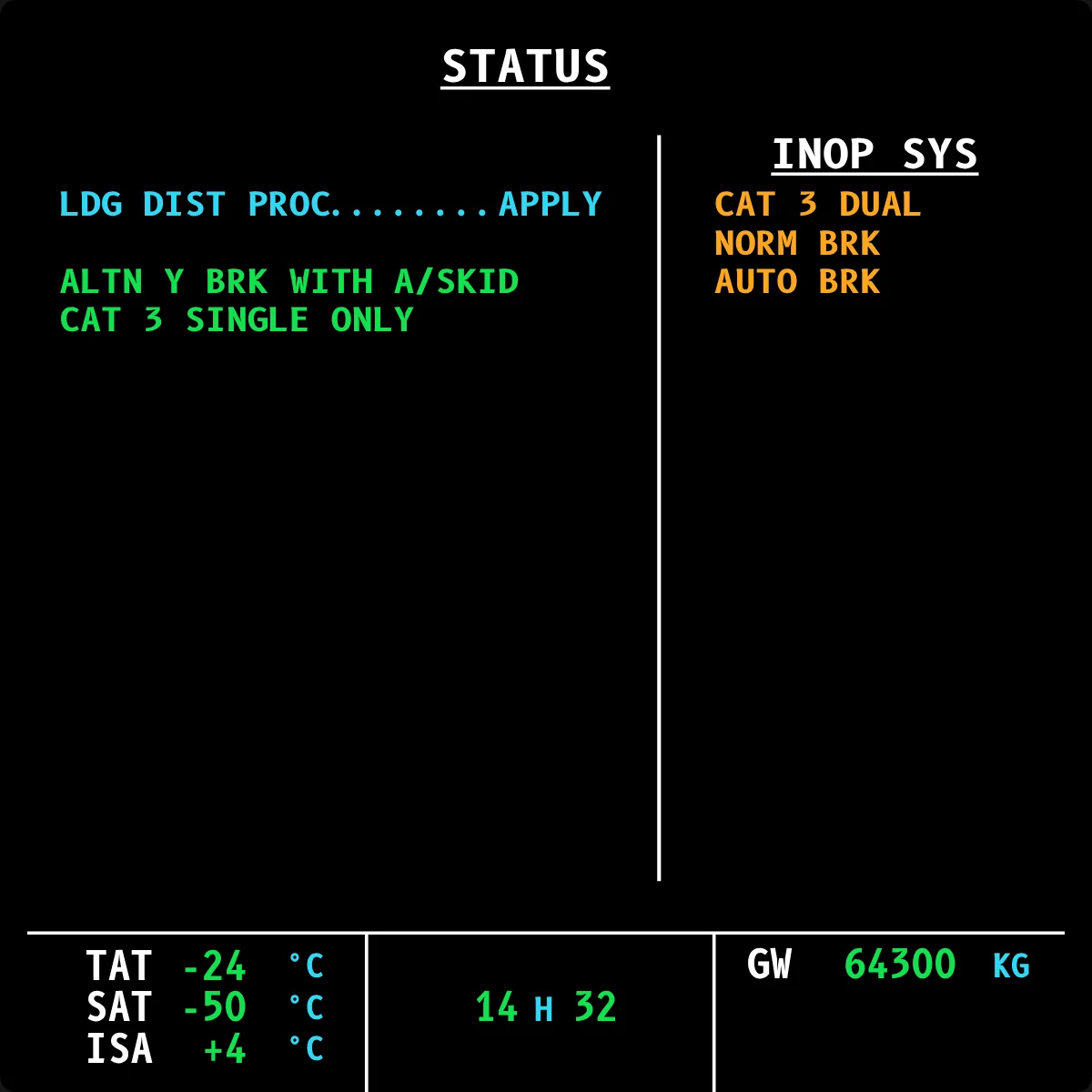
STATUS is the aircraft's operational summary: procedures in blue, information in green, inoperative systems in amber. After this caution it reads LDG DIST PROC APPLY, ALTN Y BRK WITH A/SKID and CAT 3 SINGLE ONLY, with CAT 3 DUAL, NORM BRK and AUTO BRK under INOP SYS.
The FCOM prints one procedure and one STATUS for this caution, for all aircraft; the ECAM Trainer draws that one STATUS.
Sources FCOM DSC-31-20 STATUS PAGE / FCOM PRO-ABN-BRAKES BRAKES / FCOM PRO-ABN-BRAKES BRAKES NORM BRK FAULT
A319ceo, A320ceo, A320neo, A321neo: what differs?
| A319ceo, A320ceo | A320neo, A321neo | |
|---|---|---|
| The caution, its procedure and STATUS | The same in every version | The same in every version |
| Normal and alternate braking, the anti-skid and the WHEEL page | The same on all four types | The same on all four types |
Sources FCOM PRO-ABN-BRAKES BRAKES NORM BRK FAULT / FCOM PRO-ABN-BRAKES BRAKES / FCOM DSC-32-30-10 GENERAL / FCOM DSC-32-30-10 BRAKING MODES / FCOM DSC-32-30-10 / FCOM DSC-32-30-20 CENTER INSTRUMENT PANEL / FCOM DSC-32-30-20 WHEEL SD PAGE

Work BRAKES NORM BRK FAULT as a crew
Read and do each line against the FCOM, with the E/WD, the SD page and the overhead following your hands, the PF and PM calls, and a debrief that says what you missed.
Work this failure in the ECAM TrainerGo further
Written in our own words from the FCOM and the FCTM; each part names the units it rests on. The E/WD, the STATUS and the live aircraft are the platform's own ECAM and systems model, the same the ECAM Trainer and the flight deck run. This page explains the procedure; it is not the procedure. Aircraft differ by type, engine and options: your aircraft's FCOM, your QRH and your operator's procedures always come first. How we write and check these pages.
Every ECAM procedure, line by line, against the FCOM.
The ECAM Trainer works 108 scenarios with the E/WD, the SD page and the overhead following your hands. Start free today, or open everything with A320 Knowledge+.
For study and revision only. Always follow your operator's approved documentation and procedures. A320 Knowledge is independent and not affiliated with Airbus.