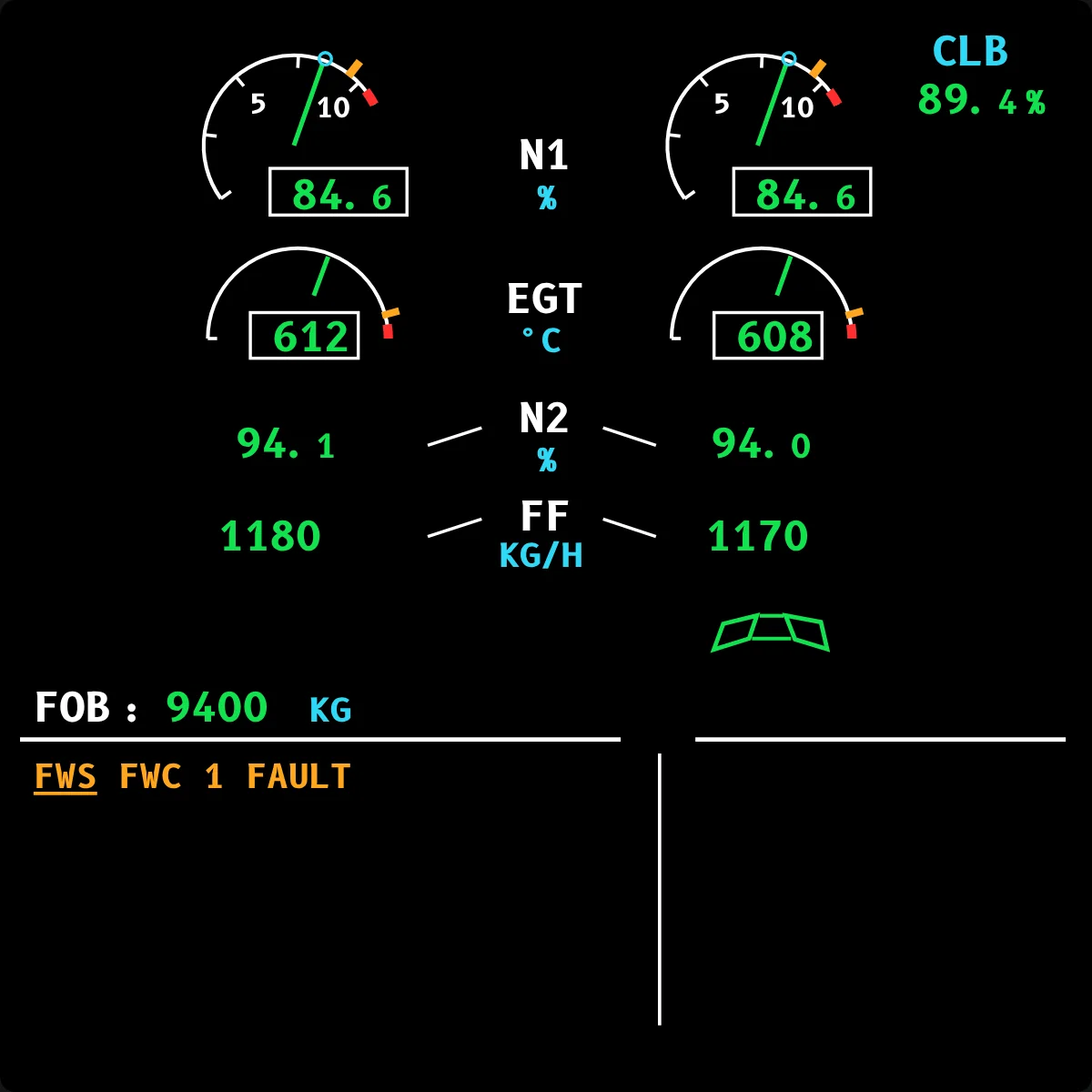
FWS FWC 1 FAULT
An amber caution for one of the two computers that generate the ECAM's alert messages. Here is what the FWCs do, what the crew sees when FWC 1 fails, what STATUS loses and what a second failure would take, with the live aircraft at the moment the caution comes on.
Written and checked by current A320 pilotschecked against the FCOM on Our editorial policy
What FWS FWC 1 FAULT means
FWS FWC 1 FAULT is an amber caution: flight warning computer 1 has failed. The two identical FWCs generate the alert messages, memos, aural alerts and synthetic voice messages, the ECAM displaying their alert messages, and drive the MASTER WARN and MASTER CAUT lights.
The caution brings no action line. STATUS reads CAT 3 SINGLE ONLY, with CAT 3 DUAL and FWC 1 under INOP SYS. The FCOM's list of what is not available, the ECAM warnings, the altitude alert, STATUS and the automatic callouts among it, belongs to the loss of both FWCs.
Sources FCOM PRO-ABN-FWS FWS FWC 1(2) FAULT / FCOM DSC-31-05-30 FLIGHT WARNING COMPUTER (FWC) / FCOM DSC-31-05-30 ATTENTION - GETTERS / FCOM PRO-ABN-FWS FWS / FCOM PRO-ABN-FWS FWS FWC 1 + 2 FAULT
At a glance
- Level
- Amber caution, level 2: single chime and MASTER CAUT steady amber
- Sets it off
- FWC 1 failed (the same alert covers FWC 2)
- E/WD
- The title alone: no line for the crew to action
- STATUS
- CAT 3 SINGLE ONLY; CAT 3 DUAL and FWC 1 under INOP SYS
- Both FWCs
- FWS FWC 1 + 2 FAULT: ECAM warnings, altitude alert, STATUS and automatic callouts among what is not available
Sources FCOM DSC-31-10 WARNING/CAUTION CLASSIFICATION / FCOM DSC-31-30 ATTENTION GETTERS / FCOM PRO-ABN-FWS FWS FWC 1(2) FAULT / FCOM PRO-ABN-FWS FWS / FCOM PRO-ABN-FWS FWS FWC 1 + 2 FAULT
What do the two FWCs do?
The two identical FWCs generate the alert messages, memos, aural alerts and synthetic voice messages, and the ECAM display units display the alert messages they generate. They also generate the radio height callouts, the decision height callouts and the landing distance and landing speed increments.
They take their data in two ways: directly from the aircraft's sensors or systems to generate the red warnings, and through the two SDACs to generate the amber cautions.
The FWCs also drive the attention getters under the glareshield, one set for each pilot: MASTER WARN flashing red for a level 3 warning, MASTER CAUT steady amber for a level 2 caution; a level 1 caution lights neither. The communications loudspeakers announce the aural alerts and voice messages even when they are turned off.
The FWC observes the priorities, a level 3 warning before a level 2 caution before a level 1, and divides its functions into ten flight phases, inhibiting some warnings and cautions during takeoff and landing.
Sources FCOM DSC-31-05-30 FLIGHT WARNING COMPUTER (FWC) / FCOM DSC-31-05-30 SYSTEM DATA ACQUISITION CONCENTRATOR (SDAC) / FCOM DSC-31-05-30 ATTENTION - GETTERS / FCOM DSC-31-30 ATTENTION GETTERS / FCOM DSC-31-10 WARNING/CAUTION CLASSIFICATION / FCOM DSC-31-05-30 LOUDSPEAKER / FCOM DSC-31-10 PRIORITY RULES / FCOM DSC-31-15 FLIGHT PHASES
Where the alerts come from
What does the crew see and hear?
A level 2 caution: a single chime, the MASTER CAUT light steady amber and FWS FWC 1 FAULT in amber on the E/WD. The FCOM's procedure for it has no line for the crew to action.
The ECAM Trainer calls no system page with it; the SD stays where it was. The FCOM's flight phase chart inhibits the caution from takeoff power to 1 500 ft, and from 800 ft down to 80 kt after touchdown.
Sources FCOM DSC-31-10 WARNING/CAUTION CLASSIFICATION / FCOM DSC-31-30 ATTENTION GETTERS / FCOM PRO-ABN-FWS FWS FWC 1(2) FAULT / FCOM PRO-ABN-FWS FWS / FCOM DSC-31-15 FLIGHT PHASES
The moment the caution comes on
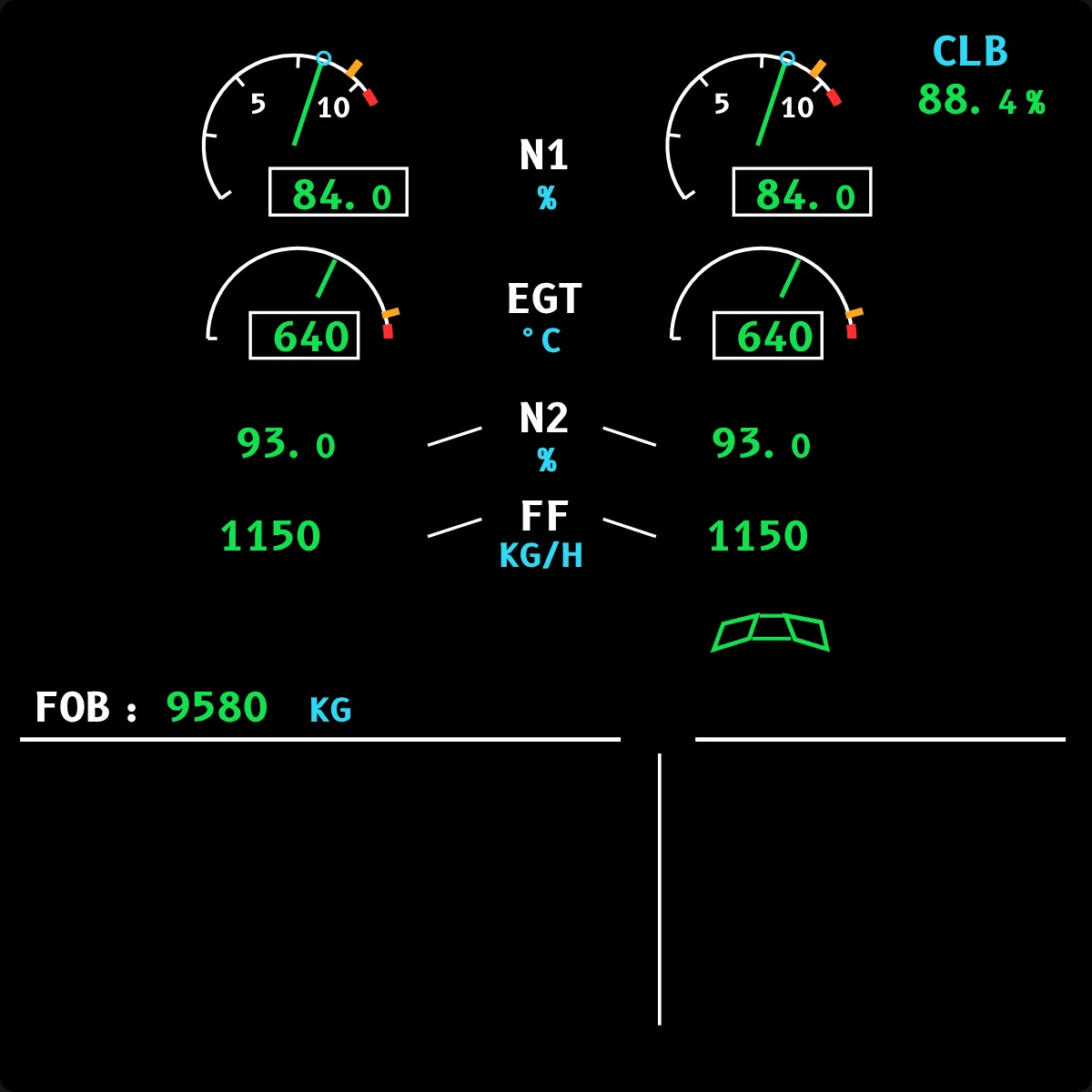
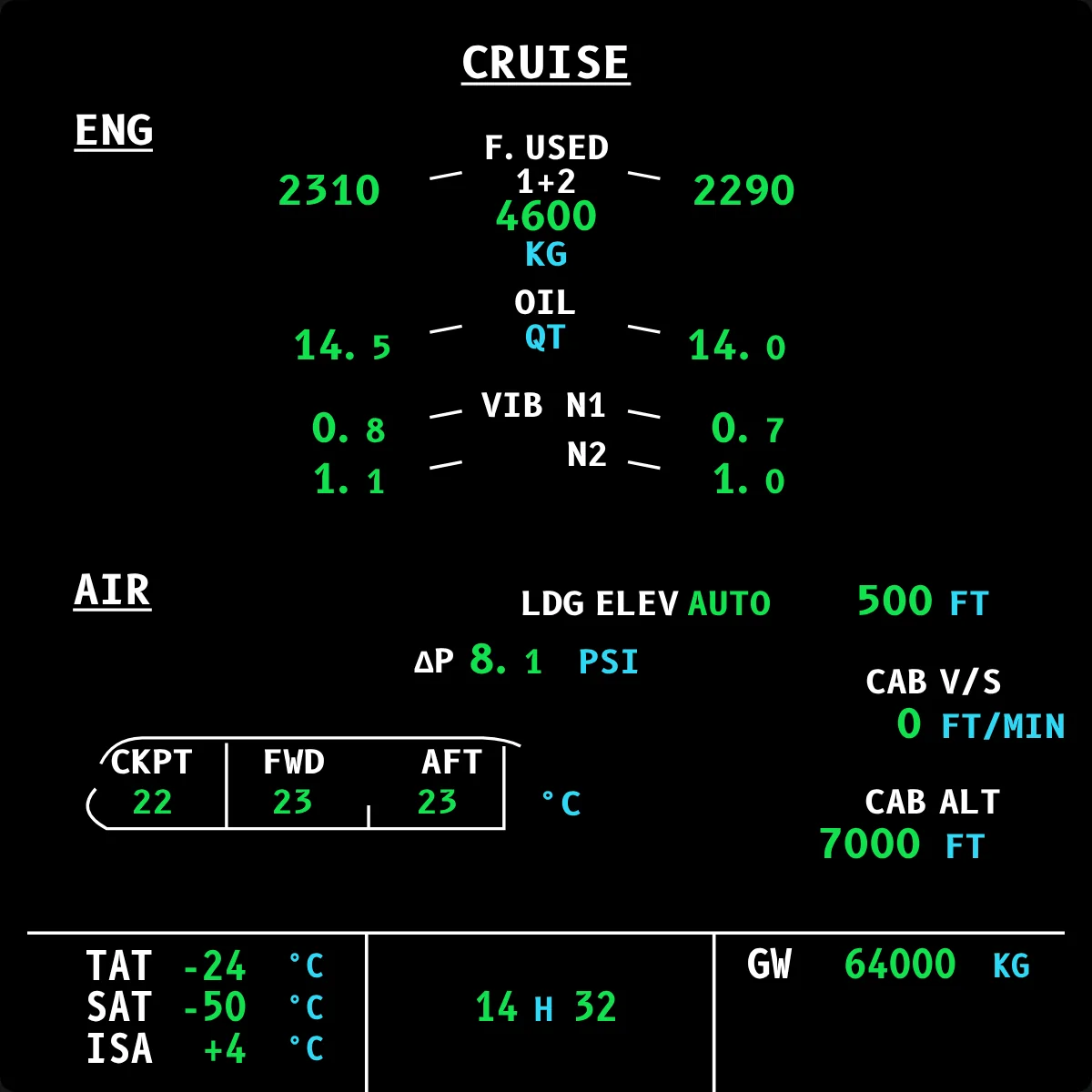
In the cruise at FL350, nothing failed: the E/WD above, the SD on its CRUISE page below. Press the button to fail FWC 1, then read both screens.
The alert Fail FWC 1
FWS FWC 1 FAULT comes up in amber with nothing under it: no blue line. The SD stays on the CRUISE page.
STATUS, when the crew calls it, reads CAT 3 SINGLE ONLY in green, with CAT 3 DUAL and FWC 1 in amber under INOP SYS.
Sources FCOM PRO-ABN-FWS FWS FWC 1(2) FAULT / FCOM PRO-ABN-FWS FWS / FCOM DSC-31-20 STATUS PAGE
What does one FWC's loss take away, and what stays?
For one FWC, the FCOM gives the crew nothing to do and STATUS one consequence for the flight: CAT 3 DUAL is lost, leaving CAT 3 SINGLE ONLY. FWC 1 itself is listed as inoperative.
The list of what is not available belongs to a different caution. FWS FWC 1 + 2 FAULT, both FWCs failed or the communication between the FWC and the EIS lost, has the crew monitor the systems and the overhead panel, with the ECAM warnings, the altitude alert, STATUS and the automatic callouts among what is not available.
With one FWC lost, the FCOM prints none of those losses. It gives no reason in its procedure why one FWC takes CAT 3 DUAL; it states the result.
Sources FCOM PRO-ABN-FWS FWS FWC 1(2) FAULT / FCOM PRO-ABN-FWS FWS / FCOM PRO-ABN-FWS FWS FWC 1 + 2 FAULT
One FWC, or one SDAC
A healthy aircraft again. This time fail another part of the warning system, an SDAC, and compare its E/WD with FWC 1 alone.
The alert Lose SDAC 1 instead
The same look: FWS SDAC 1 FAULT in amber, the title alone. The difference is in STATUS: SDAC 1 under INOP SYS, with no landing category line, and a note that, although the ECAM may display some symbols or parameters in amber, this does not always mean that further systems have failed.
The SDACs pass data to the FWCs for the ECAM messages and to the DMCs for the system pages and engine parameters.
Sources FCOM PRO-ABN-FWS FWS SDAC 1(2) FAULT / FCOM PRO-ABN-FWS FWS / FCOM DSC-31-05-30 SYSTEM DATA ACQUISITION CONCENTRATOR (SDAC)
What does CAT 3 SINGLE ONLY mean for the approach?
Each FMGC computes its own landing category, CAT 1, CAT 2, CAT 3 SINGLE or CAT 3 DUAL, from the systems and functions available, and displays it on the FMA once the APPR pushbutton is pressed to arm the ILS approach modes. A downgrade sounds a triple click.
CAT 3 DUAL is fail-operational: after a failure below alert height, the remaining automatic system completes the approach, flare and landing. CAT 3 SINGLE is fail-passive: after a failure the landing is not completed automatically, and the pilot takes control.
STATUS shows CAT 3 SINGLE ONLY in green, as information; information lines on STATUS are green, inoperative systems amber.
Sources FCOM PRO-NOR-SRP-01-70 LANDING CATEGORIES / FCOM DSC-22_30-80-30-10 LANDING CAPABILITIES / FCOM PRO-ABN-FWS FWS / FCOM DSC-31-20 STATUS PAGE
What if the second FWC fails too?
FWS FWC 1 + 2 FAULT is the caution for both. Its two blue lines are MONITOR SYS and MONITOR OVERHEAD PANEL, and its STATUS lists CAT2 under Other INOP SYS.
A note on its STATUS says what goes: the ECAM cautions and warnings, the aural warnings and the master caution and warning lights are lost, while the ECAM system pages are still available, so the crew checks the cockpit panels for local warnings and the system pages more often than usual.
A caution about their contents also exists: FWS OEB/FWC DISCREPANCY triggers when FWC 1 and FWC 2 do not have the same OEBs in their OEB reminder database.
Sources FCOM PRO-ABN-FWS FWS FWC 1 + 2 FAULT / FCOM PRO-ABN-FWS FWS / FCOM PRO-ABN-FWS MEMO / FCOM PRO-ABN-FWS FWS OEB/FWC DISCREPANCY
One FWC lost, then two
What is lost afterwards?
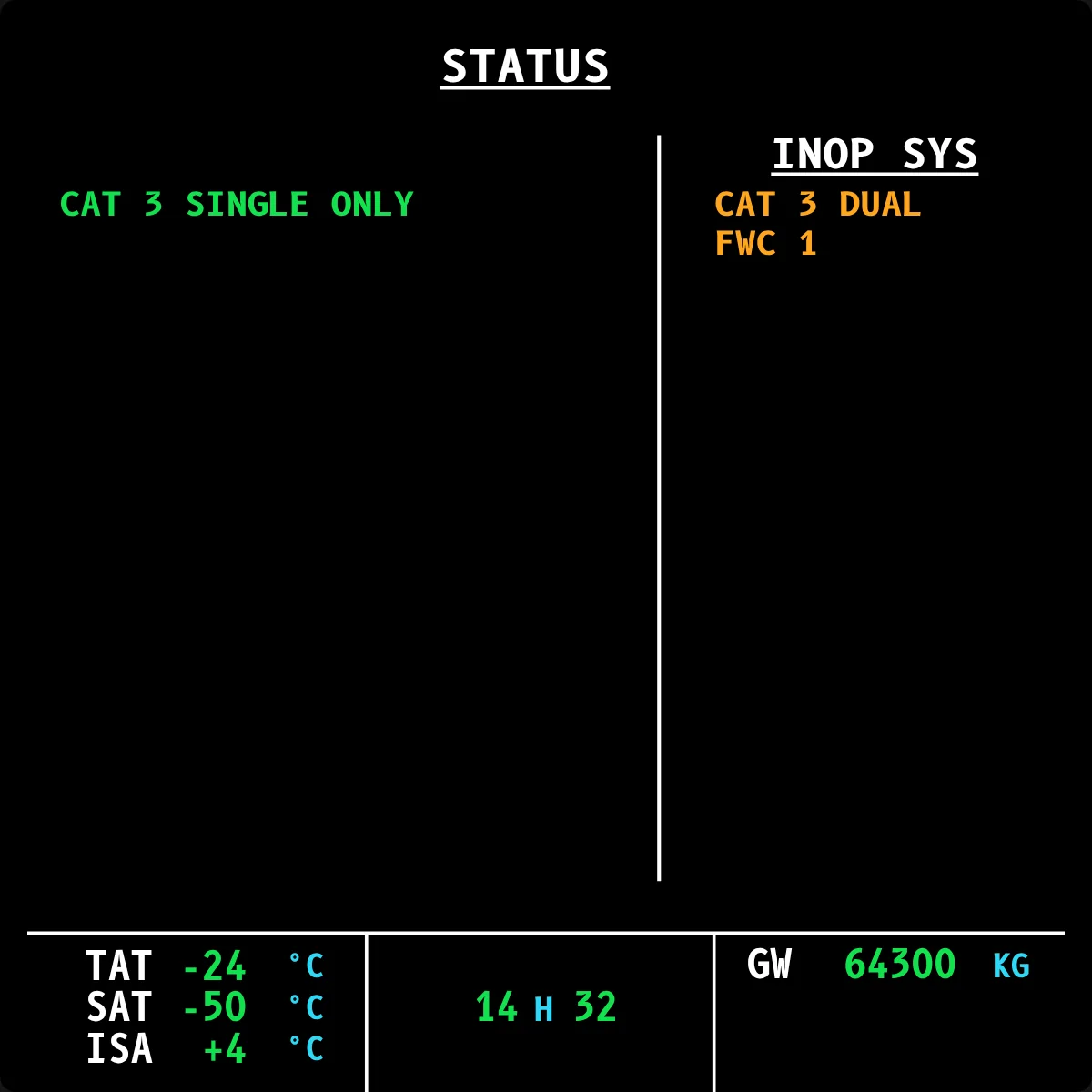
STATUS is the aircraft's operational summary. After this caution it reads CAT 3 SINGLE ONLY in green, as information, with CAT 3 DUAL and FWC 1 in amber under INOP SYS.
The FCOM prints one STATUS for this caution, for all aircraft; the ECAM Trainer draws that one STATUS.
Sources FCOM DSC-31-20 STATUS PAGE / FCOM PRO-ABN-FWS FWS / FCOM PRO-ABN-FWS FWS FWC 1(2) FAULT
A319ceo, A320ceo, A320neo, A321neo: what differs?
| A319ceo, A320ceo | A320neo, A321neo | |
|---|---|---|
| The caution and STATUS | The same in every version | The same in every version |
| The two FWCs and the attention getters | The same on all four types | The same on all four types |
Sources FCOM PRO-ABN-FWS FWS FWC 1(2) FAULT / FCOM PRO-ABN-FWS FWS / FCOM DSC-31-05-30 FLIGHT WARNING COMPUTER (FWC) / FCOM DSC-31-05-30 ATTENTION - GETTERS

Work FWS FWC 1 FAULT as a crew
Read and do each line against the FCOM, with the E/WD, the SD page and the overhead following your hands, the PF and PM calls, and a debrief that says what you missed.
Work this failure in the ECAM TrainerGo further
Written in our own words from the FCOM and the FCTM; each part names the units it rests on. The E/WD, the STATUS and the live aircraft are the platform's own ECAM and systems model, the same the ECAM Trainer and the flight deck run. This page explains the procedure; it is not the procedure. Aircraft differ by type, engine and options: your aircraft's FCOM, your QRH and your operator's procedures always come first. How we write and check these pages.
Every ECAM procedure, line by line, against the FCOM.
The ECAM Trainer works 108 scenarios with the E/WD, the SD page and the overhead following your hands. Start free today, or open everything with A320 Knowledge+.
For study and revision only. Always follow your operator's approved documentation and procedures. A320 Knowledge is independent and not affiliated with Airbus.