
COM RMP 1 FAULT
An amber caution for the captain's radio management panel. Here is what the RMPs do, what the three lines on the E/WD ask for, what the captain loses with RMP 1 and what a second failure would take, with the live aircraft at the moment the caution comes on.
Written and checked by current A320 pilotschecked against the FCOM on Our editorial policy
What COM RMP 1 FAULT means
COM RMP 1 FAULT is an amber caution: radio management panel 1, the captain's, has failed. On the aircraft the FCOM prints it for, the RMPs control the radios, the audio, the transponders and TCAS, and back up the FMGCs for radio navigation.
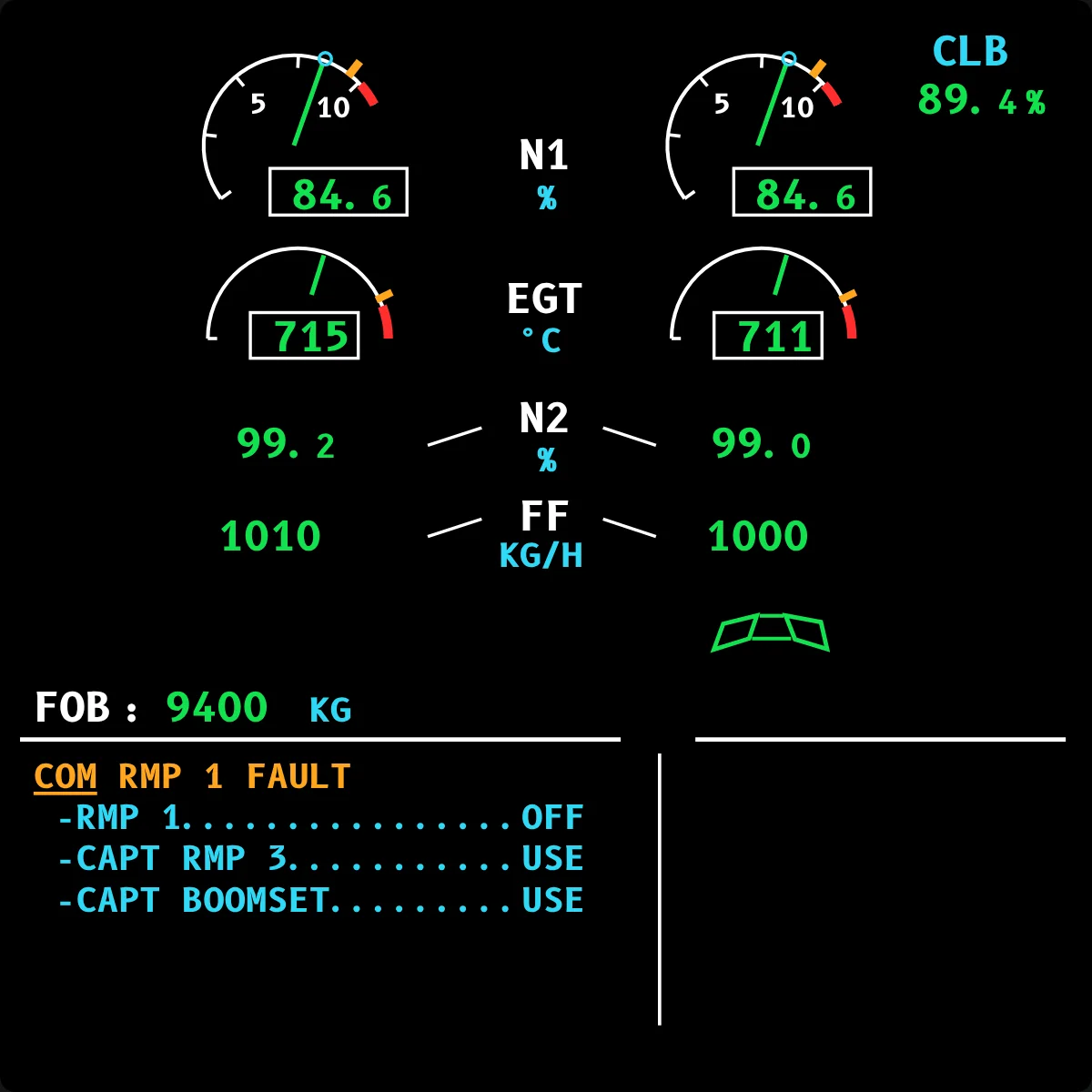
The E/WD asks for the affected RMP OFF, then for the captain to use RMP 3 and the boomset. STATUS reads CAPT BOOMSET ONLY, with the left loudspeaker and the captain's hand microphone not available, and RMP 1 under INOP SYS.
Sources FCOM PRO-ABN-COM COM RMP 1(2)(3) FAULT / FCOM DSC-23-10-20 RMP ARCHITECTURE / FCOM DSC-23-10-20 / FCOM PRO-ABN-COM COM
At a glance
- Level
- Amber caution, level 2: single chime and MASTER CAUT steady amber
- Sets it off
- RMP 1 failed (the same alert covers RMP 2 and RMP 3)
- Procedure
- The affected RMP OFF, then CAPT RMP 3 USE and CAPT BOOMSET USE
- STATUS
- CAPT BOOMSET ONLY; L SPEAKER and CAPT HANDMIC NOT AVAIL; RMP 1 under INOP SYS
- Applies to
- Some aircraft only: the list the FCOM also gives the RMP with its own screen
Sources FCOM DSC-31-10 WARNING/CAUTION CLASSIFICATION / FCOM DSC-31-30 ATTENTION GETTERS / FCOM PRO-ABN-COM COM RMP 1(2)(3) FAULT / FCOM PRO-ABN-COM COM / FCOM DSC-23-10-20 RMP ARCHITECTURE / FCOM DSC-23-10-20 / FCOM DSC-23-45-10 RMP OVERVIEW
What do the RMPs do, and where are they?
Identical RMPs give the crew control of all the VHF radios, and the HF where fitted, and back up the FMGCs for controlling the radio navigation systems. Two RMPs are on the centre pedestal; a third, where fitted, is on the overhead panel.
On the aircraft this caution is printed for, each RMP has its own screen and carries the audio as well: the crew selects transmission and reception, controls the volume, tunes VHF frequencies, and HF where fitted, manages the interphone, the passenger address and the cabin interphone, and sets the transponder and TCAS.
In normal operation the captain controls communication through RMP 1, the first officer through RMP 2, and the third occupant through ACP 3 or RMP 3, where fitted. The INT/RAD switch on RMP 1 controls the captain's microphones.
The RMPs share their selections, the active and standby frequencies among them, so that the crew can control all radio communication from any RMP; each can still show a different page.
The radio navigation backup: if both FMGCs fail, the crew can use RMP 1 and RMP 2 on the pedestal for back up tuning, the captain's RMP tuning VOR 1 and ADF 1, where fitted. RMP 3 is not used for navaid tuning.
Sources FCOM DSC-23-10-20 RMP ARCHITECTURE / FCOM DSC-23-10-20 / FCOM DSC-23-45-10 RMP OVERVIEW / FCOM DSC-23-45-10 VHF PAGE / FCOM DSC-34-NAV-30-10 GENERAL
Three RMPs and what stands behind them
What does the crew see and hear?
A level 2 caution: a single chime, the MASTER CAUT light steady amber and COM RMP 1 FAULT in amber on the E/WD, with three blue lines: the affected RMP OFF, CAPT RMP 3 USE and CAPT BOOMSET USE.
The FCOM's flight phase chart inhibits the caution from takeoff power to 1 500 ft, and from 800 ft down to 80 kt after touchdown.
Sources FCOM DSC-31-10 WARNING/CAUTION CLASSIFICATION / FCOM DSC-31-30 ATTENTION GETTERS / FCOM PRO-ABN-COM COM RMP 1(2)(3) FAULT / FCOM PRO-ABN-COM COM / FCOM DSC-31-15 FLIGHT PHASES
The moment the caution comes on
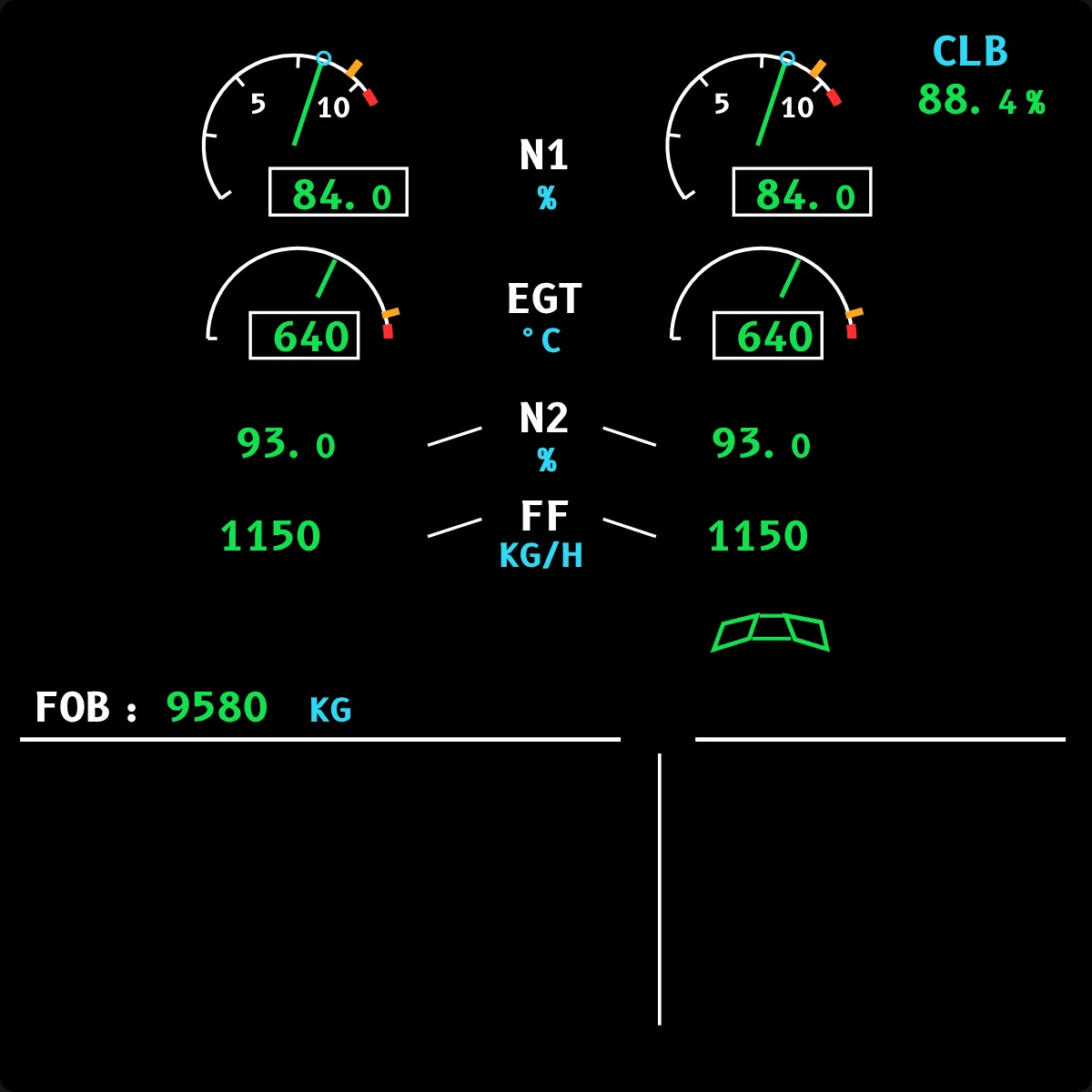
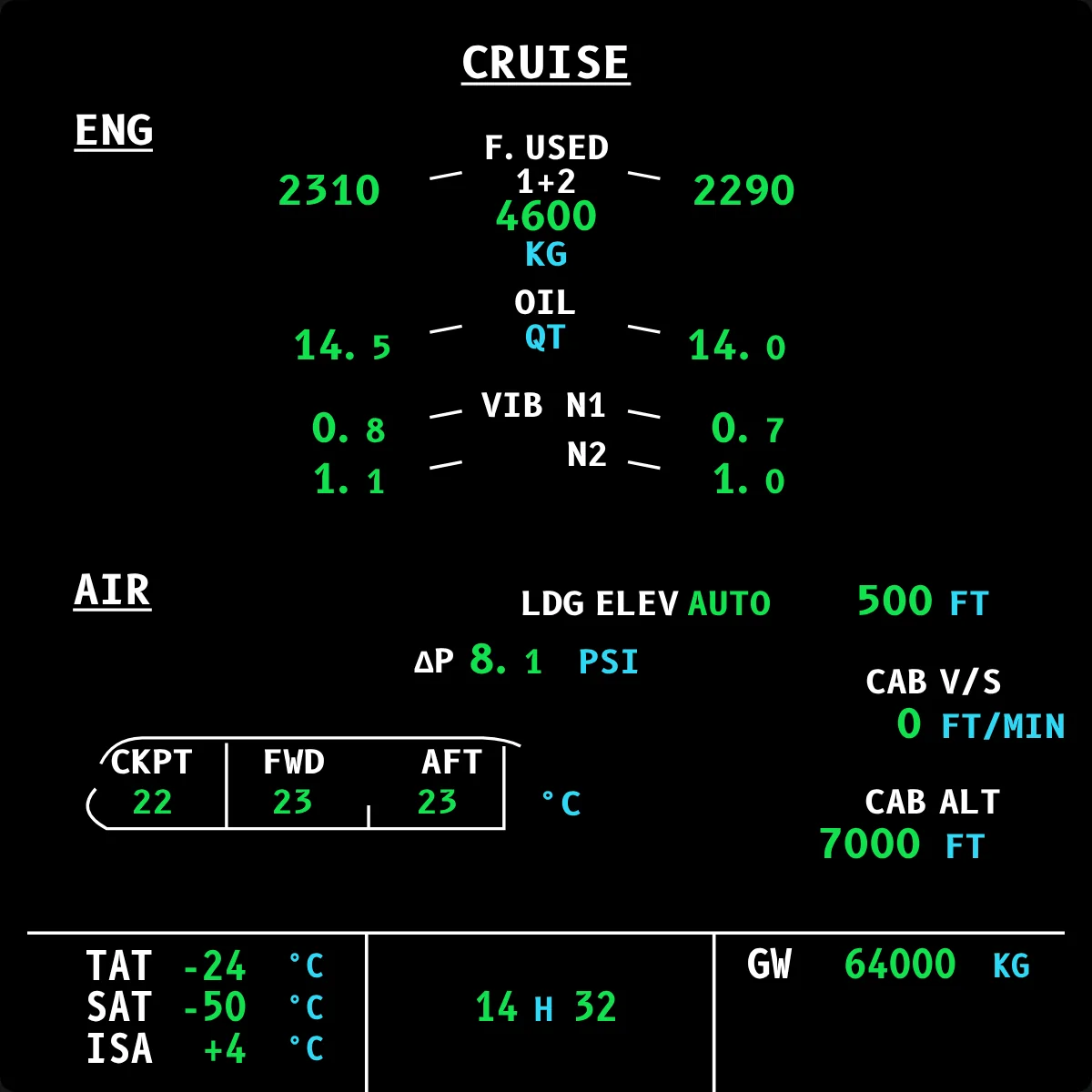
In the cruise at FL350, nothing failed: the E/WD above, the SD on its CRUISE page below. Press the button to fail RMP 1, then read the E/WD.
The alert Fail RMP 1
COM RMP 1 FAULT comes up in amber with three blue lines: RMP 1 OFF, CAPT RMP 3 USE and CAPT BOOMSET USE. The FCOM prints the first as RMP (AFFECTED) OFF, and the other two under the condition If COM RMP 1 FAULT. The SD stays on the CRUISE page.
No RMP is drawn here. On the aircraft, RMP 1 is switched off with its BRT/OFF knob, and RMP 3, where fitted, can be used as a backup instead of the failed RMP. Working the lines is what the ECAM Trainer does with you.
Sources FCOM PRO-ABN-COM COM RMP 1(2)(3) FAULT / FCOM PRO-ABN-COM COM / FCOM DSC-23-45-10 RMP OVERVIEW / FCOM DSC-23-10-20
What do the three lines do?
The affected RMP OFF: the BRT/OFF knob, set to OFF, switches the RMP off.
CAPT RMP 3 USE: if a connection or an RMP fails, the communication system can reconfigure itself automatically, standby connections taking the place of the failed ones, and RMP 3, where fitted, can be used as a backup instead of the failed RMP, except for standby radio navigation control.
CAPT BOOMSET USE: the captain uses the boomset, and STATUS gives CAPT BOOMSET ONLY. The FCOM gives no reason in the procedure for the boomset, the loudspeaker or the hand microphone; it states the result.
For RMP 2 the same procedure has the first officer use RMP 3 and the boomset; for RMP 3 only the off line applies.
Sources FCOM PRO-ABN-COM COM / FCOM DSC-23-45-10 RMP OVERVIEW / FCOM DSC-23-10-20
The captain's side after the lines
What does the captain lose with RMP 1?
STATUS has three lines, each group under the condition If COM RMP 1(2) FAULT: CAPT BOOMSET ONLY in blue, then L SPEAKER NOT AVAIL and CAPT HANDMIC NOT AVAIL in green. RMP 1 is under INOP SYS, in amber.
Standby radio navigation tuning is given to RMP 1 and RMP 2 only: the crew selects it on both if both FMGCs or both MCDUs fail, and RMP 3, where fitted, can be used instead of a failed RMP except for that control. The procedure itself says nothing about navaid tuning.
The RMPs share their selections so that the crew can control all radio communication from any RMP, and the first officer keeps RMP 2.
Sources FCOM PRO-ABN-COM COM / FCOM DSC-31-20 STATUS PAGE / FCOM DSC-23-10-20 / FCOM DSC-34-NAV-30-30 NAV PAGE
What if a second RMP fails?
COM RMP 1+2(1+3)(2+3) FAULT covers two RMPs failed. With RMP 1 and RMP 2 gone, both pilots use RMP 3 and their boomsets, and STATUS gives both loudspeakers and both hand microphones as not available; with RMP 1 and RMP 3 gone, the captain uses RMP 2 and the boomset.
COM RMP 1+2+3 FAULT is all three: every RMP off and AUDIOS NOT AVAIL. Its STATUS lists the altitude alert, the automatic callouts and the aural attention getters under AUDIOS NOT AVAIL, and XPDR 7600 ACTIVE.
An RMP switched off has its own caution, COM RMP 1(2)(3) OFF, with the same RMP 3 and boomset lines for RMP 1 or 2.
Sources FCOM PRO-ABN-COM COM RMP 1+2(1+3)(2+3) FAULT / FCOM PRO-ABN-COM COM / FCOM PRO-ABN-COM ABNORMAL AND EMERGENCY PROCEDURES / FCOM PRO-ABN-COM COM RMP 1+2+3 FAULT / FCOM PRO-ABN-COM COM RMP 1(2)(3) OFF
What is lost afterwards?
STATUS is the aircraft's operational summary: procedures and limitations in blue, information in green, inoperative systems in amber.
For this caution the FCOM prints CAPT BOOMSET ONLY in blue, L SPEAKER NOT AVAIL and CAPT HANDMIC NOT AVAIL in green, each under its condition, and RMP 1 in amber under INOP SYS. The ECAM Trainer draws the boomset line in green, so no STATUS picture is drawn here.
Sources FCOM DSC-31-20 STATUS PAGE / FCOM PRO-ABN-COM COM
A319ceo, A320ceo, A320neo, A321neo: what differs?
| A319ceo, A320ceo | A320neo, A321neo | |
|---|---|---|
| The caution, its lines and STATUS | Not given by type: the FCOM prints it for a list of aircraft | Not given by type: the FCOM prints it for a list of aircraft |
| The RMP | Not given by type: two designs, each for its own list of aircraft; one has RMPs with ACTIVE and STBY/CRS windows beside separate audio control panels, the other RMPs with their own screen that carry the audio controls | Not given by type: the same two designs, each for its own list of aircraft |
| Emergency electrical configuration | Not given by type: in the design with frequency windows, only RMP 1 works; in the design with a screen, RMP 1 and RMP 2 receive power | Not given by type: in the design with frequency windows, only RMP 1 works; in the design with a screen, RMP 1 and RMP 2 receive power |
| Back up tuning if both FMGCs fail | The same on all four types: RMP 1 and RMP 2, RMP 3 not used for navaids | The same on all four types: RMP 1 and RMP 2, RMP 3 not used for navaids |
The FCOM copy the site writes from prints this caution, and the RMP design it belongs to, for the same list of aircraft. The page ties neither design to a type.
Sources FCOM PRO-ABN-COM COM RMP 1(2)(3) FAULT / FCOM PRO-ABN-COM COM / FCOM DSC-23-10-20 RADIO MANAGEMENT PANEL / FCOM DSC-23-10-30 AUDIO MANAGEMENT SYSTEM / FCOM DSC-23-10-20 / FCOM DSC-23-45-10 RMP OVERVIEW / FCOM DSC-23-10-20 DESCRIPTION / FCOM DSC-34-NAV-30-30 NAV PAGE / FCOM DSC-34-NAV-30-10 GENERAL / FCOM DSC-23-10-20 RMP ARCHITECTURE

Work COM RMP 1 FAULT as a crew
Read and do each line against the FCOM, with the E/WD, the SD page and the overhead following your hands, the PF and PM calls, and a debrief that says what you missed.
Work this failure in the ECAM TrainerGo further
Written in our own words from the FCOM and the FCTM; each part names the units it rests on. The E/WD, the STATUS and the live aircraft are the platform's own ECAM and systems model, the same the ECAM Trainer and the flight deck run. This page explains the procedure; it is not the procedure. Aircraft differ by type, engine and options: your aircraft's FCOM, your QRH and your operator's procedures always come first. How we write and check these pages.
Every ECAM procedure, line by line, against the FCOM.
The ECAM Trainer works 108 scenarios with the E/WD, the SD page and the overhead following your hands. Start free today, or open everything with A320 Knowledge+.
For study and revision only. Always follow your operator's approved documentation and procedures. A320 Knowledge is independent and not affiliated with Airbus.